Spatiotemporal Characterization of Active Brownian Dynamics in Channels
Accumulation at boundaries represents a widely observed phenomenon in active systems with implications for microbial ecology and engineering applications. To rationalize the underlying physics, we provide analytical predictions for the first-passage properties and spatial distributions of a confined active Brownian particle (ABP). We show that ABPs with absorbing and hard-wall boundary conditions are Siegmund duals, yielding a direct mapping between the propagators of the two problems. We analyze the system across low and high activity regimes – quantifying persistent motion relative to diffusion – and show that active motion, together with a favorable initial orientation, typically lowers the mean first-passage time relative to passive diffusion. Notably, the full time-dependent propagator between hard walls approaches a wall-accumulated stationary state given by the derivative of the splitting probability as a consequence of Siegmund duality.
💡 Research Summary
The paper investigates the spatiotemporal dynamics of an active Brownian particle (ABP) confined between two parallel walls, focusing on first‑passage properties and stationary spatial distributions. The authors begin by motivating the study through examples from microbial ecology (surface foraging, biofilm formation) and emerging microrobotic applications where boundary interactions are crucial. They pose two central questions: (i) how long does it take an active agent to reach a boundary, and (ii) how do boundaries reshape the particle’s spatial distribution.
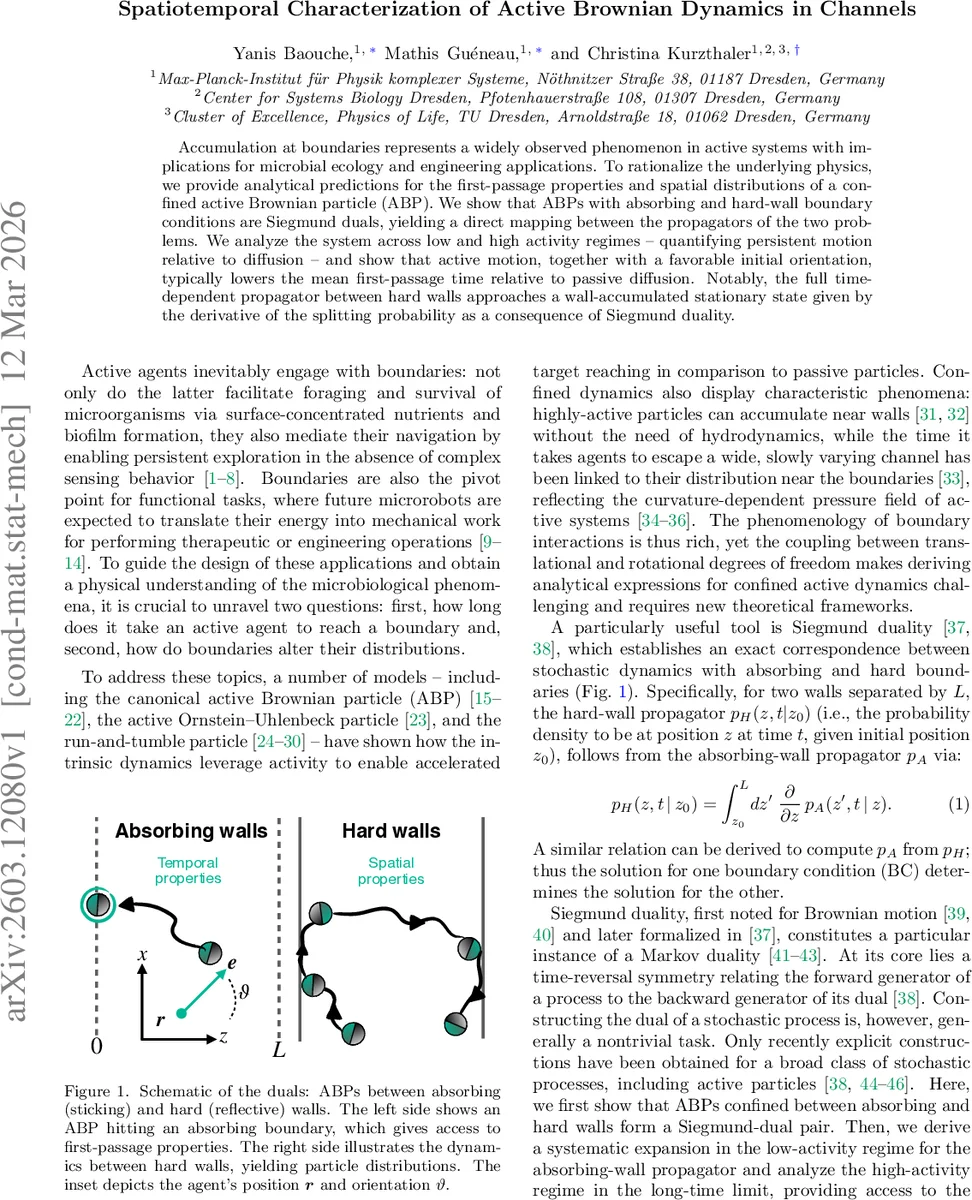
The model is a two‑dimensional ABP moving at constant speed v along an orientation θ(t) that undergoes rotational diffusion with diffusivity D_rot, while the particle’s position experiences translational diffusion D. The Langevin equations (2) describe the coupled translational‑rotational dynamics. The particle is confined between walls at z=0 and z=L, and the authors consider two boundary conditions: (A) absorbing (sticking) walls and (H) hard (reflective) walls. Two dimensionless groups are introduced: the Péclet number Pe = τ/τ_a (ratio of diffusive to ballistic time scales) and γ = τ/τ_rot (ratio of translational to rotational diffusion times). The analysis concentrates on the z‑coordinate, averaging over the equilibrium distribution of the initial orientation.
A central theoretical tool is Siegmund duality, originally known for ordinary Brownian motion and recently extended to active processes. The authors demonstrate that the backward generator for the absorbing‑wall problem, L†, is the transpose of the forward generator for the hard‑wall problem, L, after a simple angle shift (θ → θ+π). This yields the exact relation (1):
p_H(z,t|z₀) = ∫₀^{z₀} ∂_z p_A(z′,t|z) dz′,
which maps the propagator of the absorbing system to that of the reflective system and vice‑versa. Consequently, solving either boundary‑value problem provides the full solution for the other.
The paper proceeds with two complementary asymptotic analyses. In the low‑activity regime (Pe ≪ 1) translational diffusion dominates. The authors expand the absorbing‑wall propagator in powers of Pe: P_A = P_A^{(0)} + Pe P_A^{(1)} + Pe² P_A^{(2)} + … . The zeroth‑order term is the classic diffusion solution with absorbing walls, obtained via the method of images. Higher‑order corrections are generated recursively through Eq. (15), which involves convolving the zeroth‑order propagator with a drift term proportional to cos θ. By integrating the resulting propagator over space and orientation they obtain the survival probability S(s|z₀,θ₀) and, via the Laplace‑zero limit, the mean first‑passage time (MFPT) ⟨T⟩. The low‑Pe expressions capture the dependence of ⟨T⟩ on the initial position z₀ and orientation θ₀, showing symmetric MFPT profiles with a maximum at the channel centre for randomly oriented particles.
In the high‑activity regime (Pe ≫ 1) ballistic motion dominates over rotational diffusion (γ ≪ Pe). The authors introduce a small boundary‑layer parameter ε = γ/Pe and rescale the coordinate near the walls. Neglecting rotational diffusion inside the layer leads to a simple ordinary differential equation for the MFPT, which can be solved analytically. The resulting expression (16) shows that for particles initially pointing toward a wall the MFPT scales as (L−z₀)/v, while particles pointing away experience a much longer time that diverges as Pe → ∞. The high‑Pe formula smoothly interpolates to the Brownian limit as Pe → 0, providing a unified description across regimes.
The splitting probability π_L(z₀,θ₀) – the probability of hitting the right wall before the left – is derived analogously. In the low‑Pe limit it grows almost linearly with z₀, reflecting diffusive symmetry. In the high‑Pe limit the probability becomes a step function of the initial orientation: π_L ≈ 1 for θ₀ pointing right, ≈ 0 for θ₀ pointing left, and ≈ 0.5 for random orientations, as expressed in Eq. (17). The authors also discuss the non‑monotonic dependence of MFPT on Pe for particles starting near a wall and moving toward the opposite wall, highlighting the competition between persistent ballistic motion and rotational diffusion.
Using Siegmund duality, the stationary distribution for hard‑wall confinement, p_H(z), is obtained from the long‑time limit of the absorbing‑wall splitting probability. The authors show that p_H(z) = ∂_{z₀}π_L(z₀) evaluated at z₀ = z, i.e., the stationary density is the derivative of the splitting probability. This yields an explicit high‑Pe stationary profile (Eq. 18) that matches extensive Brownian dynamics simulations (Fig. 3). The profile exhibits strong wall accumulation, a hallmark of active matter even in the absence of hydrodynamic interactions.
Overall, the paper makes four major contributions: (1) a rigorous proof that ABPs with absorbing and hard walls are Siegmund duals, providing a powerful mapping between first‑passage and steady‑state problems; (2) systematic low‑Pe expansions and high‑Pe asymptotics for propagators, MFPTs, and splitting probabilities; (3) explicit quantification of how initial position and orientation modulate first‑passage efficiency, revealing regimes where activity either speeds up or slows down escape; and (4) a clear connection between first‑passage statistics and wall‑accumulated stationary states. These results deepen the theoretical understanding of active particles in confined geometries and have practical implications for designing micro‑robots that exploit boundary interactions, interpreting microbial foraging strategies, and developing coarse‑grained models of active suspensions.
Comments & Academic Discussion
Loading comments...
Leave a Comment