A note on geometric α-stable processes and the existence of ground states for associated Schrödinger operators
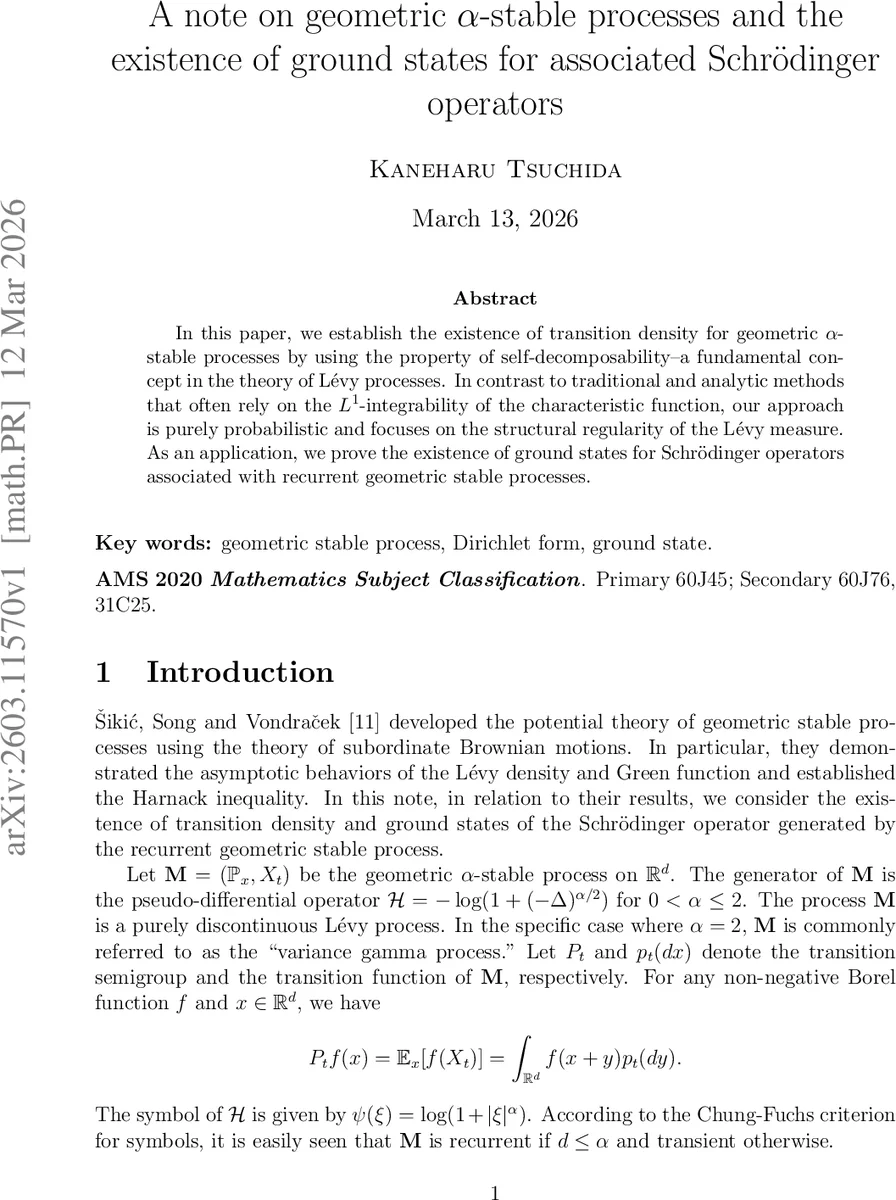
In this paper, we establish the existence of transition density for geometric $α$-stable processes by using the property of self-decomposability–a fundamental concept in the theory of Lévy processes. In contrast to traditional and analytic methods that often rely on the $L^{1}$-integrability of the characteristic function, our approach is purely probabilistic and focuses on the structural regularity of the Lévy measure. As an application, we prove the existence of ground states for Schrödinger operators associated with recurrent geometric stable processes.
💡 Research Summary
The paper addresses two fundamental problems concerning geometric α‑stable processes: (i) the existence and regularity of their transition densities for all positive times, and (ii) the existence of ground states for Schrödinger operators generated by the recurrent case of these processes.
Background. A geometric α‑stable process M on ℝⁿ is a pure‑jump Lévy process whose characteristic exponent is ψ(ξ)=log(1+|ξ|^{α}) (0<α≤2). Its generator is the pseudo‑differential operator H=−log(1+(−Δ)^{α/2}). For α=2 the process coincides with the variance‑gamma process. Classical approaches to the existence of a transition density p_t(x) rely on Fourier inversion, which requires the characteristic function Φ(t,ξ)=e^{−tψ(ξ)} to be L¹‑integrable. Because ψ grows only logarithmically, Φ fails to be integrable for small times (t≤d/α), and the Hartman‑Wintner condition is also violated. Consequently, standard analytic techniques do not apply.
Self‑decomposability as a structural tool. The authors exploit the fact that the law of M_t is self‑decomposable: for any scaling factor b>1 there exists an independent remainder such that the characteristic function factorises as μ̂_t(ξ)=μ̂_t(b^{−1}ξ)·ρ̂_b(ξ). A fundamental result (Lemma 3.2, see Sato) states that any non‑degenerate self‑decomposable distribution on ℝⁿ is absolutely continuous with respect to Lebesgue measure. To verify self‑decomposability, the Lévy measure J of M is examined. Theorem 2.1 (from previous work) provides an explicit density j(x) for J, with precise small‑ and large‑scale asymptotics. By passing to spherical coordinates, the Lévy measure can be written in the form required by Lemma 3.3:
J(B)=∫_{S^{n−1}}∫_0^{∞} 1_B(rθ) k_θ(r) r dr λ(dθ),
where λ is the surface measure on the unit sphere and
k_θ(r)=∫_0^{∞} u^{n−1} q_1(uθ) e^{-(ru)^{α}} du.
Here q_1 denotes the transition density of the standard symmetric α‑stable process. The authors show that k_θ(r) is decreasing in r, which fulfills the monotonicity condition of Lemma 3.3. Hence the distribution of M_t is self‑decomposable for every t>0, and by Lemma 3.2 it possesses a Lebesgue density p_t(x). This yields Theorem 3.4: the transition density exists for all t>0.
Strong Feller property. For Lévy processes, absolute continuity of transition probabilities is equivalent to the strong Feller property. Therefore M enjoys the strong Feller property, a crucial ingredient for the functional‑analytic treatment that follows.
Application to Schrödinger operators. The paper then focuses on the recurrent regime, i.e., when the spatial dimension d satisfies d≤α. In this case the Green function of the underlying process is not globally defined, making spectral analysis delicate. The authors introduce a signed measure μ=μ⁺−μ⁻, where μ⁺ belongs to the Kato class K and μ⁻ belongs to the Green‑tight Kato class K_{μ⁺}^{∞}. The process killed by μ⁺, denoted M_{μ⁺}, has an associated Dirichlet form (𝔈_{μ⁺},𝔽_{μ⁺}) obtained by adding the potential term ∫ u² dμ⁺ to the original form.
A variational problem is posed:
λ = inf { 𝔈_{μ⁺}(u,u) : u∈𝔽_{μ⁺}^{e}, ∫ u² dμ⁻ = 1 }.
If a minimiser h exists, it satisfies (−H+μ)h = λh in the weak sense and is called a λ‑ground state. To guarantee existence, the authors employ Takeda’s Class (T) method. This method requires (a) compactness of the semigroup {P_t}, (b) the strong Feller property, and (c) a suitable Kato‑type control of the killing measure. The strong Feller property has already been established via self‑decomposability. Compactness follows from the fact that the transition density is bounded and integrable, which implies that the embedding of the Dirichlet space into L²(ℝⁿ) is compact. Consequently the semigroup is compact, and the variational problem admits a minimiser. Hence a λ‑ground state exists for the Schrödinger operator −H+μ in the recurrent case.
Significance. By replacing Fourier‑analytic arguments with a probabilistic structural argument based on self‑decomposability, the authors provide a unified and conceptually transparent proof of the existence of transition densities for geometric α‑stable processes, even when traditional criteria fail. The strong Feller property derived from this proof serves as a bridge to Dirichlet‑form techniques, allowing the authors to treat spectral problems for non‑local operators with logarithmic symbols. The work thus enriches the toolbox for studying Lévy processes whose symbols grow slower than any power, and opens avenues for further investigations of ground states and spectral properties of a broad class of non‑local Schrödinger operators.
Comments & Academic Discussion
Loading comments...
Leave a Comment