On the minimum degree of minimal $k$-$\{1,2\}$-factor critical $k$-planar graphs
A graph of order $n$ is said to be $k$-\emph{factor-critical} $(0\le k<n)$ if the removal of any $k$ vertices results in a graph with a perfect matching. A $k$-factor-critical graph $G$ is \emph{minimal} if $G-e$ is not $k$-factor-critical for any ed…
Authors: Kevin Pereyra
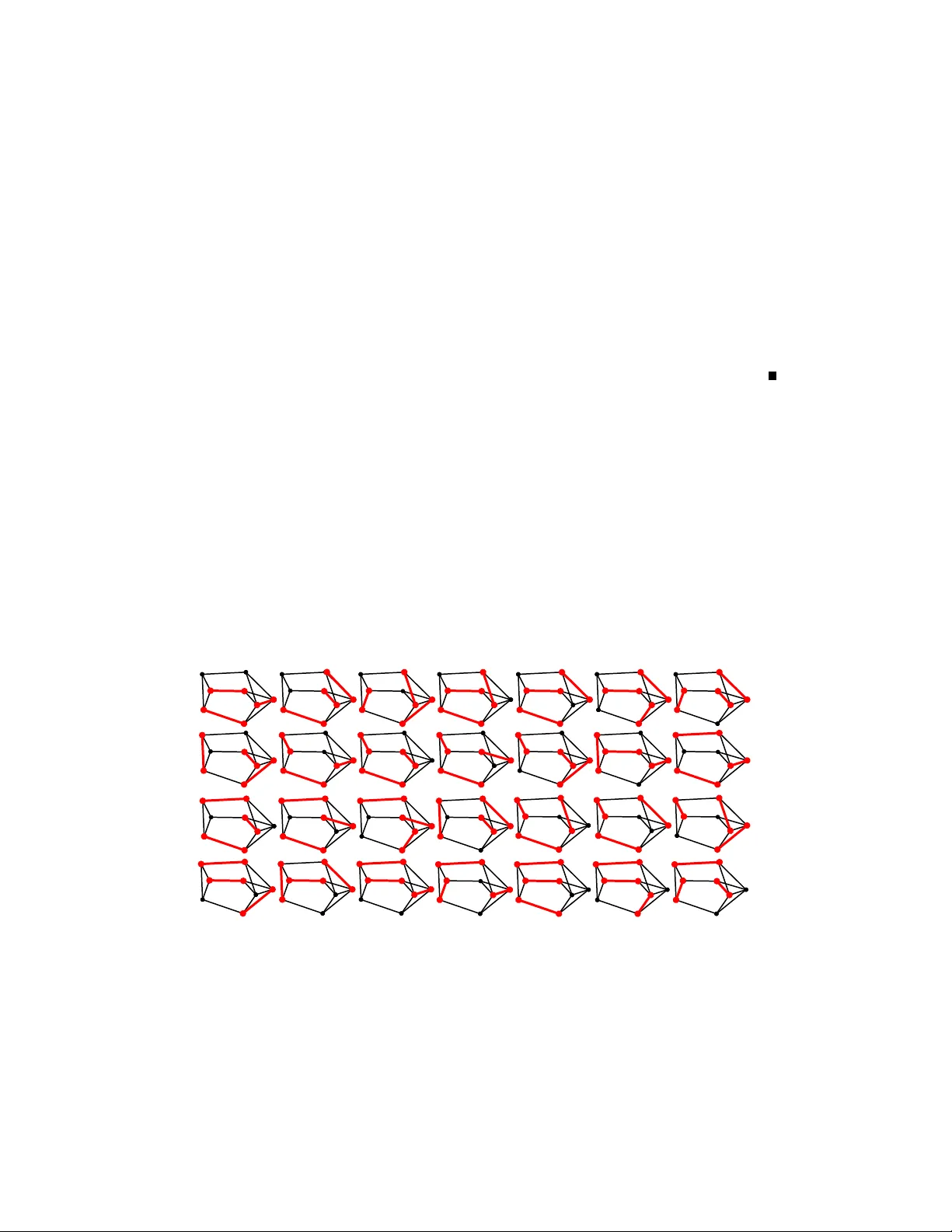
On the minim um degree of minimal k - { 1 , 2 } -factor critical k -planar graphs Kevin P ereyra a,b a Instituto de Matemátic a Aplic ada San Luis, Universidad Nacional de San Luis and CONICET, San Luis, A r gentina. b Dep artamento de Matemátic a, Universidad Nacional de San Luis, San Luis, A r gentina. Abstract A graph of order n is said to be k - factor-critic al (0 ≤ k < n ) if the remo v al of any k v ertices results in a graph with a p erfect matc hing. A k - factor-critical graph G is minimal if G − e is not k -factor-critical for any edge e in G . In 1998, F a v aron and Shi p osed the conjecture that ev ery minimal k -factor-critical graph is of minimum degree k + 1 . A natural extension of this notion arises from { 1 , 2 } -factors. A spanning subgraph of G is called a { 1 , 2 } -factor if eac h of its comp onen ts is a regular graph of degree one or t wo. A graph is k - { 1 , 2 } -factor critic al if the remo v al of an y k v ertices results in a graph with a { 1 , 2 } -factor. A recen t conjecture in the area states that every minimal k - { 1 , 2 } -factor critical graph G satisfies k + 1 ≤ δ ( G ) ≤ k + 2 . In this pap er, we prov e that the conjecture holds for k -planar graphs, that is, graphs in which the deletion of any set of k v ertices yields a planar graph. In particular, this resolv es the conjecture for planar graphs. Keywor ds: P erfect matching; k -F actor-critical graph; Sac hs subgraphs; Planar; Minimal k-factor-critical graph; Minim um degree. 2000 MSC: 05C70, 05C50, 05C10 1. In tro duction A spanning subgraph of G is called a { 1 , 2 } -factor if eac h of its com- p onen ts is a regular graph of degree one or tw o. { 1 , 2 } -factors of a graph Email addr ess: kdpereyra@unsl.edu.ar (Kevin Pereyra) pla y a fundamen tal role in the study of determinan ts and p ermanents of the adjacency matrix of the graph [ 10 , 23 ]. These spanning subgraphs are also kno wn in the literature as Sachs sub gr aphs . Graphs admitting a { 1 , 2 } -factor can b e characterized as follows. Theorem 1.1 ([ 24 ]) . A gr aph G has a { 1 , 2 } -factor if and only if i ( G − S ) ≤ | S | for al l S ⊂ V ( G ) . The Theorem 1.1 was originally pro v ed b y T utte in [ 24 ]; later, a short pro of w as given in [ 1 ]. A graph of order n is said to b e k - factor-critic al (0 ≤ k < n ) if the remo v al of an y k v ertices results in a graph with a p erfect matching. These graphs were introduced independently by F av aron [ 4 ] and Y u [ 22 ]. A graph G is k - { 1 , 2 } - factor critical if the remo v al of any k v ertices results in a graph with a { 1 , 2 } - factor (0 ≤ k < n ) . In [ 25 ], T utte prov ed his well-kno wn theorem characterizing graphs with a p erfect matc hing: Theorem 1.2 ([ 25 ]) . A gr aph G has a p erfe ct matching if and only if o dd ( G ) ≤ | S | for al l S ⊂ V ( G ) . In [ 4 ], the T utte condition w as mo dified to c haracterize k -factor-critical graphs. Theorem 1.3 ([ 4 ]) . A gr aph G is a k -factor-critic al gr aph if and only if o dd ( G ) ≤ | S | − k for al l S ⊂ V ( G ) with | S | ≥ k . Similar ideas allow one to refine Theorem 1.1 in order to easily obtain the follo wing characterization of k - { 1 , 2 } -factor-critical graphs. Theorem 1.4 ([ 11 ]) . A gr aph G is k - { 1 , 2 } - factor critic al if and only if i ( G − S ) ≤ | S | − k for al l S ⊂ V ( G ) such that | S | ≥ k . 2 A k -factor-critical graph G is said to b e minimal if G − e is not k -factor- critical for any edge e in G [ 5 ]. It is easy to see that if G is a k -factor-critical graph, then δ ( G ) ≥ k + 1 . F a v aron and Shi [ 5 ] conjectured that if G is moreo ver a minimal k -factor-critical graph, then it satisfies δ ( G ) = k + 1 . Conjecture 1.5 ([ 5 , 28 ]) . L et G b e a minimal k -factor-critic al gr aph. Then δ ( G ) = k + 1 . F a v aron and Shi [ 5 ] confirmed this conjecture for k ∈ { n − 6 , n − 4 , n − 2 } . Guo et al. [ 7 , 8 , 9 ] confirmed this conjecture for k ∈ { 2 , n − 8 , n − 10 } , and for claw-free graphs [ 6 ]. Qiuli–F uliang–Heping confirmed this conjecture for planar graphs [ 15 ]. Since k < n , if δ ( G ) ≤ k we can delete k vertices, among whic h are all the neigh b ors of a vertex of minimum degree, and obtain a graph with isolated v ertices, which has no { 1 , 2 } -factor. This prov es the following observ ation. Observ ation 1.6. If G is a k - { 1 , 2 } -factor-critic al gr aph, then δ ( G ) ≥ k + 1 . A k - { 1 , 2 } -factor-critical graph is said to b e minimal if G − e is not k - { 1 , 2 } -factor-critical for any edge e in G . In con trast to Theorem 1.5 for minimal k -factor-critical graphs, minimal k - { 1 , 2 } -factor-critical graphs may hav e minim um degree k + 2 , regardless of the order of the graph. F or instance, for n ≥ 4 the complete graph K n is a minimal ( n − 3) - { 1 , 2 } -factor-critical graph, while δ ( K n ) = k + 2 = n − 1 . Moreo ver, K n is a minimal ( n − 2) - { 1 , 2 } -factor-critical graph. Conjecture 1.7 ([ 19 ]) . L et G b e a minimal k - { 1 , 2 } -factor-critic al gr aph. Then k + 1 ≤ δ ( G ) ≤ k + 2 . In [ 19 ] it is sho wn that Theorem 1.7 holds for some infinite families. Theorem 1.8 ([ 19 ]) . L et k ∈ { 0 , 1 , n − 5 , n − 4 , n − 3 , n − 2 } and let G b e a minimal k - { 1 , 2 } -factor-critic al gr aph. Then k + 1 ≤ δ ( G ) ≤ k + 2 . Theorem 1.9 ([ 19 ]) . L et G b e a minimal k - { 1 , 2 } -factor-critic al claw-fr e e gr aph of or der n such that n − k is even and κ ( G ) > k . Then δ ( G ) = k + 1 . In this pap er, w e show that Theorem 1.7 holds for k -planar graphs, that is, graphs in whic h the deletion of an y set of k vertices yields a planar graph. The pap er is organized as follows. In Section 1 w e present the general con text of the problem and in tro duce the fundamen tal concepts. In Section 2 w e fix the notation that will b e used throughout the article. Finally , in Section 3 w e state and prov e the main results. 3 2. Preliminaries All graphs considered in this pap er are finite, undirected, and simple. F or any undefined terminology or notation, we refer the reader to Lov ász and Plummer [ 20 ] or Diestel [ 3 ]. Let G = ( V , E ) b e a simple graph, where V = V ( G ) is the finite set of v ertices and E = E ( G ) is the set of edges, with E ⊆ {{ u, v } : u, v ∈ V , u = v } . W e denote the edge e = { u, v } as uv . A subgraph of G is a graph H suc h that V ( H ) ⊆ V ( G ) and E ( H ) ⊆ E ( G ) . A subgraph H of G is called a sp anning subgraph if V ( H ) = V ( G ) . Let e ∈ E ( G ) and v ∈ V ( G ) . W e define G − e := ( V , E \ { e } ) and G − v := ( V \ { v } , { uw ∈ E : u, w = v } ) . If X ⊆ V ( G ) , the induc e d subgraph of G by X is the subgraph G [ X ] = ( X , F ) , where F := { uv ∈ E ( G ) : u, v ∈ X } . The num b er of vertices in a graph G is called the or der of the graph and denoted b y | G | . A cycle in G is called o dd (resp. even ) if it has an o dd (resp. ev en) num b er of edges. F or a v ertex v ∈ V ( G ) , the neighb orho o d of v is N G ( v ) = { u ∈ V ( G ) : uv ∈ E ( G ) } . When no confusion arises, we write N ( v ) instead of N G ( v ) . F or a set S ⊆ V ( G ) , the neighb orho o d of S is N G ( S ) = [ v ∈ S N G ( v ) . The de gr e e of a vertex v ∈ V ( G ) is deg G ( v ) = | N G ( v ) | . The minimum de gr e e of G is δ ( G ) = min { deg G ( v ) : v ∈ V ( G ) } . A graph G is called r -r e gular if deg G ( v ) = r for every v ∈ V ( G ) . A vertex v ∈ V ( G ) is called an isolate d vertex if deg G ( v ) = 0 . The n umber of isolated vertices of a graph G is denoted b y i ( G ) . A matching M in a graph G is a set of pairwise non-adjacen t edges. The matching numb er of G , denoted b y µ ( G ) , is the maximum cardinality of any matc hing in G . Matc hings induce an in volution on the vertex set of the graph: M : V ( G ) → V ( G ) , where M ( v ) = u if uv ∈ M , and M ( v ) = v otherwise. If S, U ⊆ V ( G ) with S ∩ U = ∅ , w e say that M is a matching from S to U if M ( S ) ⊆ U . A matc hing M is p erfe ct if M ( v ) = v for every v ertex of the graph. A vertex set S ⊆ V is indep endent if, for every pair of v ertices u, v ∈ S , w e ha ve uv / ∈ E . The n um b er of vertices in a maxim um indep endent set 4 is denoted b y α ( G ) . A bip artite graph is a graph whose vertex set can b e partitioned in to tw o disjoint indep enden t sets. 3. Main Results W e briefly recall the notion of graph minors. A graph H is said to be a minor of a graph G if H can b e obtained from G b y a sequence of v ertex deletions, edge deletions, and edge contractions. A graph is called planar if it admits a drawing in the plane in which no t w o edges intersect except p ossibly at their common endp oints. The complete graph on n v ertices and the complete bipartite graph with parts of size n and m are denoted and K n , K 3 , 3 , resp ectiv ely . The following classic theorem, named Kuratowski’s theorem, giv es a characterization of planar graphs. Theorem 3.1 ([ 13 , 26 ]) . A gr aph G is planar if and only if it c ontains neither K 5 nor K 3 , 3 as a minor. A graph is said to b e k -planar if G − S is planar for every S ⊂ V ( G ) with | S | = k . In particular, every planar graph of order n is k -planar for each k = 0 , . . . , n . In Fig. 1 a non-planar graph is shown, which can b e v erified b y applying Theorem 3.1 . Ho wev er, as observed in Fig. 2 , the deletion of an y v ertex yields a planar subgraph. Consequen tly , this non-planar graph turns out to b e 1 -planar. G K 3 , 3 e Figure 1: Example of a non-planar graph 5 Figure 2: Example of a non-planar and 1 -planar graph Lemma 3.2 ([ 12 ]) . G is a 1 - { 1 , 2 } -factor-critic al gr aph if and only if | S | < | N ( S ) | for every nonempty indep endent set S ⊂ V ( G ) . Graphs satisfying the condition of Theorem 3.2 are kno wn as 2 -bicritical graphs, originally in tro duced in [ 21 ]. The class of 2 -bicritical graphs can b e regarded as the structural counterpart of König–Egerv áry graphs [ 14 ]. In recen t works, sev eral new prop erties of 2 -bicritical graphs hav e b een estab- lished; see, for instance, [ 18 , 16 , 17 ]. Lemma 3.3 ([ 12 ]) . G has a { 1 , 2 } -factor if and only if | S | ≤ | N ( S ) | for every set S ⊂ V ( G ) . The num b er d G ( X ) = | X | − | N ( X ) | is the differ enc e of the set X ⊂ V ( G ) , and d ( G ) = max { d G ( X ) : X ⊂ V ( G ) } is called the critic al differ enc e of G . A set U ⊂ V ( G ) is critic al if d G ( U ) = d ( G ) [ 27 ]. The num b er id ( G ) = max { d G ( I ) : I is an indep enden t set of G } is called the critic al indep endenc e differ enc e of G . If I ⊂ V ( G ) is indep endent and d G ( I ) = id ( G ) , then I is called critic al indep endent [ 27 ]. It is known that the equalit y d ( G ) = id ( G ) holds for ev ery graph G [ 27 ]. Lemma 3.4 ([ 27 ]) . F or every gr aph G , we have d ( G ) = id ( G ) . A bipartite graph with bipartition A, B is said to b e balanced if | A | = | B | . 6 Lemma 3.5. L et G b e a planar gr aph with bip artition A, B and b alanc e d. Then ther e exists a vertex v ∈ A such that deg( v ) ≤ 3 . Pr o of. Let f be the num b er of faces of G , n = | G | , and m = ∥ G ∥ . In a planar bipartite graph, each face has length at least 4 , therefore 2 m ≥ 4 f . Moreov er, it is w ell known that planar graphs satisfy Euler’s formula: n − m + f = 2 . Hence 2 m ≥ 4(2 − n + m ) = 8 − 4 n + 4 m . F rom this it follows that m ≤ 2 n − 4 . By contradiction, supp ose that deg( v ) ≥ 4 for every vertex v ∈ A . Then the sum of degrees satisfies X v ∈ A deg( v ) = m ≥ 4 | A | = 2 n. This con tradicts the fact that m ≤ 2 n − 4 . Lemma 3.6. L et G b e a gr aph such that G − e is a planar bip artite gr aph with bip artition A, B satisfying | B | + 1 ≤ | A | ≤ | B | + 2 , wher e e ⊂ A . Then ther e exists a vertex v ∈ A such that deg G ( v ) ≤ 3 . Pr o of. Let n = | G | = | G − e | , m ( G ) = ∥ G ∥ , and m ( G − e ) = m ( G ) − 1 . Then, as in the pro of of Theorem 3.5 , we ha v e m ( G − e ) ≤ 2 n − 4 . By con tradiction, supp ose that deg G ( v ) ≥ 4 for every v ertex v ∈ A . Then the sum of degrees satisfies 2 n + 2 = 2 | A | + 2 ( | B | + 1) ≤ 4 | A | ≤ X v ∈ A deg G ( v ) = X v ∈ A deg G − e ( v ) + 2 ≤ m ( G − e ) + 2 . That is, 2 n ≤ m ( G − e ) . This contradicts the fact that m ( G − e ) ≤ 2 n − 4 . Lemma 3.7. L et G b e a planar gr aph with bip artition A, B such that | A | = | B | − 1 . Then ther e exists a vertex v ∈ A such that deg( v ) ≤ 3 . Pr o of. Let n = | G | and m = ∥ G ∥ . Then, as in the pro of of Theorem 3.5 , w e hav e m ≤ 2 n − 4 . By contradiction, supp ose that deg( v ) ≥ 4 for ev ery v ertex v ∈ A . Then the sum of degrees satisfies X v ∈ A deg( v ) = m ≥ 4 | A | = 2 n − 2 . 7 This con tradicts the fact that m ≤ 2 n − 4 . Lemma 3.8. L et G b e a gr aph such that G − e is a planar bip artite gr aph with bip artition A, B satisfying | B | ≤ | A | ≤ | B | + 1 , wher e e ⊂ A . Then ther e exists a vertex v ∈ A such that deg G ( v ) ≤ 3 . Pr o of. Let n = | G | = | G − e | , m ( G ) = ∥ G ∥ , and m ( G − e ) = m ( G ) − 1 . Then, as in the pro of of Theorem 3.5 , we ha v e m ( G − e ) ≤ 2 n − 4 . By con tradiction, supp ose that deg G ( v ) ≥ 4 for every v ertex v ∈ A . Then the sum of degrees satisfies 2 n ≤ 2 | A | + 2 | B | ≤ 4 | A | ≤ X v ∈ A deg G ( v ) = X v ∈ A deg G − e ( v ) + 2 ≤ m ( G − e ) + 2 . That is, 2 n − 2 ≤ m ( G − e ) . This contradicts the fact that m ( G − e ) ≤ 2 n − 4 . Theorem 3.9. L et G b e a k - { 1 , 2 } -factor-critic al gr aph and supp ose that ther e exists an e dge e ∈ E ( G ) such that G − e is not a k - { 1 , 2 } -factor-critic al gr aph. Then • If k = 0 and G is planar, then k + 1 ≤ δ ( G ) ≤ k + 3 . • If k > 0 and G is k -planar, then k + 1 ≤ δ ( G ) ≤ k + 2 . Pr o of. The low er b ounds in b oth items follo w directly from Theorem 1.6 . Therefore, in what follo ws we fo cus only on proving the upp er b ounds. Let k = 0 and supp ose that G has a { 1 , 2 } -factor but G − e do es not. By Theorem 3.3 there exists a set S ′ ⊂ V ( G ) such that | S ′ | > | N G − e ( S ′ ) | , whic h implies that d ( G − e ) ≥ d G − e ( S ′ ) = | S ′ | − | N G − e ( S ′ ) | > 0 . Then, by Theorem 3.4 , there exists an independent set S ⊂ V ( G ) of G − e suc h that | S | > | N G − e ( S ) | . By Theorem 3.3 we hav e | S | ≤ | N G ( S ) | . Thus w e conclude that | N G ( S ) | − 2 ≤ | N G − e ( S ) | < | S | ≤ | N G ( S ) | , 8 that is, | N G ( S ) | − 1 ≤ | S | ≤ | N G ( S ) | . No w let e = xy . Since | N G − e ( S ) | < | N G ( S ) | , it follo ws that at least one of the v ertices x or y b elongs to S . Without loss of generalit y , we consider the following tw o cases. Case 1. Supp ose that x ∈ S and y / ∈ S . In this case, S is also an inde- p enden t set in G and y / ∈ N G − e ( S ) , since otherwise | N G − e ( S ) | = | N G ( S ) | , a con tradiction. Hence, | S | ≤ | N G ( S ) | = | N G − e ( S ) | + 1 ≤ | S | , that is, N G ( S ) = N G − e ( S ) ∪ { y } and | N G ( S ) | = | S | . Therefore, the graph H obtained from G [ S ∪ N G ( S )] by remo ving edges joining v ertices of N G ( S ) is a balanced planar bipartite graph with bipartition S , N G ( S ) . By Theorem 3.5 , there exists a v ertex v ∈ S suc h that deg H ( v ) ≤ 3 . Note that δ ( G ) ≤ deg G ( v ) = deg H ( v ) ≤ 3 = k + 3 . As desired. Case 2. Supp ose that x ∈ S and y ∈ S . In this case, N G − e ( S ) ∪ { x, y } = N G ( S ) and | N G ( S ) | = | N G − e ( S ) | + 2 . Let H be the graph obtained from G [ S ∪ N G ( S )] by removing edges joining v ertices of N G ( S ) − { x, y } . Then H − e is a planar bipartite graph with bipartition S, N H − e ( S ) , where | N H − e ( S ) | + 1 ≤ | S | ≤ | N H − e ( S ) | + 2 . Therefore, b y Theorem 3.6 , there exists a vertex v ∈ S such that deg H ( v ) ≤ 3 . As b efore, this implies that δ ( G ) ≤ deg G ( v ) = deg H ( v ) ≤ 3 = k + 3 . No w supp ose that k > 0 . Since G − e is not a k - { 1 , 2 } -factor-critical graph, there exists a set S ′ ⊂ V ( G ) with | S ′ | = k suc h that ( G − e ) − S ′ has no { 1 , 2 } -factor. On the other hand , let v ∈ S ′ , let S = S ′ − { v } , and define G ′ = G − S . Claim 3.10. G ′ is a planar gr aph. Claim 3.11. G ′ is a 1 - { 1 , 2 } -factor-critic al gr aph. 9 Pr o of. Note that for every x ∈ V ( G − S ) , the graph ( G − S ) − x = G − ( S ∪ { x } ) has a { 1 , 2 } -factor, since | S ∪ { x }| = k and G is a k - { 1 , 2 } -factor- critical graph. Claim 3.12. G ′ − e is not a 1 - { 1 , 2 } -factor-critic al gr aph. Pr o of. Note that ( G ′ − e ) − v = (( G − S ) − e ) − v = ( G − e ) − S ′ has no { 1 , 2 } -factor. Then, by Theorem 3.12 and Theorem 3.2 , there exists a nonempt y in- dep enden t set S ⊂ V ( G ) suc h that | S | ≥ | N G ′ − e ( S ) | . On the other hand, b y Theorem 3.11 and Theorem 3.2 , w e hav e | S | < | N G ′ ( S ) | (note that this holds regardless of whether S is indep endent in G ′ ). Now, denoting e = xy , it follo ws that at least one of the vertices x or y b elongs to S . Without loss of generalit y , we consider the following tw o cases. Case 1. Supp ose that x ∈ S and y / ∈ S . In this case, S is also an indep enden t set in G and | N G ′ − e ( S ) | = | S | = | N G ′ ( S ) | − 1 . Therefore, the graph H obtained from G [ S ∪ N G ′ ( S )] b y remo ving edges joining vertices of N G ′ ( S ) is bipartite and planar with bipartition S , N G ′ ( S ) and | S | = | N G ′ ( S ) | − 1 . By Theorem 3.7 , there exists a v ertex v ∈ S such that deg H ( v ) ≤ 3 . Since deg H ( v ) = deg G ′ ( v ) , we obtain δ ( G ) ≤ deg G ′ ( v ) + | S | = deg H ( v ) + k − 1 ≤ k + 2 . As desired. Case 2. Supp ose that x ∈ S and y ∈ S . In this case, N G ( S ) ∪ { x, y } = N G − e ( S ) and | N G ( S ) | = | N G − e ( S ) | + 2 . Let H be the graph obtained from G [ S ∪ N G ( S )] by removing edges joining v ertices of N G ( S ) − { x, y } . Then H − e is a bipartite graph with bipartition S, N H − e ( S ) satisfying | N H − e ( S ) | ≤ | S | ≤ | N H − e ( S ) | + 1 . Therefore, b y Theorem 3.8 , there exists a vertex v ∈ S such that deg H ( v ) ≤ 3 . As b efore, this implies that δ ( G ) ≤ deg H ( v ) ≤ k + 3 . 10 The b ounds for δ ( G ) in Theorem 3.9 are attainable. F or k > 0 , see Fig. 3 . The graph on the left in Fig. 3 is a 1 - { 1 , 2 } -factor-critical graph whereas G − e is not; moreo v er, δ ( G ) = k + 2 = 3 . The graph on the righ t is a 1 - { 1 , 2 } - factor-critical graph whereas G − e is not; moreov er, δ ( G ) = k + 1 = 2 . Both graphs are planar, and therefore also 1 -planar. F or k = 0 , consider K 2 , K 3 , or the graph in Fig. 4 ; all three graphs are planar 0 - { 1 , 2 } -factor-critical graphs with an edge whose deletion breaks the existence of { 1 , 2 } -factors and δ ( G ) = k + 1 , k + 2 , k + 3 , resp ectively . e e Figure 3: Planar k - { 1 , 2 } -factor-critical graphs with k = 1 . In eac h example, G − e is not a k - { 1 , 2 } -factor-critical graph and δ ( G ) = k + 2 = 3 for the graph on the left, while δ ( G ) = k + 1 = 2 for the graph on the righ t. The highlighted vertices are sets S ⊂ V ( G ) satisfying i ( G − e − S ) > | S | − k , w hic h verifies that G − e is not a k - { 1 , 2 } -factor-critical graph by Theorem 1.4 . e Figure 4: Planar 0 - { 1 , 2 } -factor-critical graph with minim um degree δ ( G ) = 0 + 3 = 3 . Moreo ver, G − e is not a 0 - { 1 , 2 } -factor-critical graph, which can b e verified using the highligh ted set via Theorem 1.4 . 11 F rom Theorem 3.9 , the follo wing tw o results are obtained directly . Theorem 3.13. L et G b e a minimal k - { 1 , 2 } -factor-critic al gr aph such that for every S ⊂ V ( G ) with | S | = k − 1 the gr aph G − S is planar. Then k + 1 ≤ δ ( G ) ≤ k + 2 . Pr o of. By Theorem 3.9 , it suffices to prov e that every minimal 0 - { 1 , 2 } - factor-critical graph G satisfies 1 ≤ δ ( G ) ≤ 2 . But this is trivially true, since G itself is a { 1 , 2 } -factor in this case. The b ounds in Theorem 3.13 are tight. Note that K 5 is a minimal 2 - { 1 , 2 } -factor-critical graph for whic h K 5 − v is planar for ev ery v ∈ V ( K 5 ) , while δ ( K 5 ) = 4 = k + 2 with k = 2 . On the other hand, the graph in Fig. 1 is a 1 -planar graph, and Fig. 5 sho ws that it is a 2 - { 1 , 2 } -factor-critical graph. Moreo ver, the minimalit y of this graph as a 2 - { 1 , 2 } -factor-critical graph follo ws immediately: remo ving an edge differen t from e pro duces v ertices of degree 2 , yielding a graph that is not a 2 - { 1 , 2 } -factor-critical graph, as ensured b y Theorem 1.6 . On the other hand, G − e is also not a 2 - { 1 , 2 } - factor-critical graph, since if S denotes the set of red vertices in Fig. 1 , then i ( G − e − S ) = 2 > | S | − 2 = 1 , and hence G − e is not 2 - { 1 , 2 } -factor-critical b y Theorem 1.4 . Fin ally , note that δ ( G ) = k + 1 = 3 . Figure 5: The graph in Fig. 1 , Fig. 2 is a 2 - { 1 , 2 } -factor-critical ( 2 -factor-critical) graph. Theorem 3.14. L et G b e a minimal k - { 1 , 2 } -factor-critic al planar gr aph. Then k + 1 ≤ δ ( G ) ≤ k + 2 . 12 If k = 1 and G = K 4 , w e hav e δ ( G ) = k + 2 , since G is a minimal k - { 1 , 2 } -factor-critical planar graph. If k ′ = 2 , then G is a minimal k ′ - { 1 , 2 } - factor-critical planar graph, while δ ( G ) = k ′ + 1 . That is, b oth b ounds in Theorem 3.14 can b e attained. The examples obtained motiv ate the following conjecture. Conjecture 3.15. If G is a minimal t - { 1 , 2 } -factor-critic al gr aph for t = k , k + 1 , then G is a c omplete gr aph. In [ 19 ], using the ear-p endant decomp osition of 2 -bicritical graphs due to Bourjolly and Pulleyblank [ 2 ], the follo wing result is obtained. Theorem 3.16 ([ 19 ]) . L et G b e a minimal 1 - { 1 , 2 } -factor-critic al gr aph dif- fer ent fr om K 4 . Then δ ( G ) = 2 . If G is a minimal 2 - { 1 , 2 } -factor-critical graph, then δ ( G ) ≥ 3 . Hence, if G is also a minimal 1 - { 1 , 2 } -factor-critical graph, w e obtain that G = K 4 . This confirms Theorem 3.15 for k = 1 . A c knowledgmen ts This work w as partially supp orted b y Univ ersidad Nacional de San Luis, gran ts PROICO 03-0723 and PROIPR O 03-2923, MA TH AmSud, grant 22- MA TH-02, Consejo Nacional de Inv estigaciones Cien tíficas y Técnicas gran t PIP 11220220100068CO and Agencia I+D+I grants PICT 2020-00549 and PICT 2020-04064. Declaration of generative AI and AI-assisted tec hnologies in the writing pro cess During the preparation of this w ork the authors used ChatGPT-3.5 in order to improv e the grammar of several paragraphs of the text. After using this service, the authors reviewed and edited the con tent as needed and tak e full resp onsibility for the conten t of the publication. Data a v ailability Data sharing not applicable to this article as no datasets w ere generated or analyzed during the curren t study . 13 Declarations Conflict of in terest The authors declare that they ha ve no conflict of in terest. References [1] Akbari, S. and Mahmo o di, A. (2008). Note: A short pro of of a theorem of tutte. AUSTRALASIAN JOURNAL OF COMBINA TORICS , 42:299–300. 2 [2] Bourjolly , J.-M. and Pulleyblank, W. R. (1989). König-egerváry graphs, 2-bicritical graphs and fractional matchings. Discr ete Applie d Mathemat- ics , 24(1-3):63–82. 13 [3] Diestel, R. (2012). Gr aph The ory, 4th Edition , volume 173 of Gr aduate texts in mathematics . Springer. 4 [4] F a v aron, O. (1996). On k-factor-critical graphs. Discussiones mathemat- ic ae gr aph the ory , 16(1):41–51. 2 [5] F a v aron, O. and Shi, M. (1996). Minimal ly k-factor-critic al gr aphs . Uni- v ersité P aris-Sud, Centre d’Orsa y , Lab oratoire de recherc he en Informa- tique. 3 [6] Guo, J., Li, Q., Lu, F., and Zhang, H. (2023). The minim um degree of minimal k -factor-critical cla w-free graphs. arXiv pr eprint arXiv:2311.15821 . 3 [7] Guo, J., W u, H., and Zhang, H. (2024). Cubic v ertices of minimal bicrit- ical graphs. Discr ete Applie d Mathematics , 352:44–48. 3 [8] Guo, J. and Zhang, H. (2022). Minimally k-factor-critical graphs for some large k. Gr aphs and Combinatorics , 39. 3 [9] Guo, J. and Zhang, H. (2024). Minim um degree of minimal (n-10)-factor- critical graphs. Discr ete Mathematics , 347(4):113839. 3 [10] Harary , F. (1962). The determinant of the adjacency matrix of a graph. Siam R eview , 4(3):202–210. 2 14 [11] Jaume, D. A., Martinez, D. G., P anelo, C., and Pereyra, K. (2025a). k-sac hs-critical graphs. Pr o c e dia Computer Scienc e . 2 [12] Jaume, D. A., Panelo, C., and Pereyra, K. (2025b). On sachs structure of a graphs. Submitte d . 6 [13] Kurato wski, C. (1930). Sur le probleme des courb es gauches en top olo- gie. F undamenta mathematic ae , 15(1):271–283. 5 [14] Larson, C. E. (2011). The critical indep endence n umber and an indep en- dence decomp osition. Eur op e an Journal of Combinatorics , 32(2):294–300. 6 [15] Li, Q., Lu, F., and Zhang, H. (2025). On minimal k-factor-critical planar graphs. arXiv pr eprint arXiv:2511.08137 . 3 [16] P ereyra, K. (2025a). The SD-KE and gallai-edmonds decomp ositions: A structural connection. Submitte d . 6 [17] P ereyra, K. (2025b). Sterb oul-deming graphs and p osy-factors. Submit- te d . 6 [18] P ereyra, K. (2025c). Sterb oul-deming graphs: Characterizations. Sub- mitte d . 6 [19] P ereyra, K. and Jaume, D. A. (2025). On the minimum degree of mini- mal k-{1,2}-factor critical graphs. Submitte d . 3 , 13 [20] Plummer, M. D. and Lo vász, L. (1986). Matching the ory , volume 29. Elsevier. 4 [21] Pulleyblank, W. R. (1979). Minim um no de cov ers and 2-bicritical graphs. Mathematic al pr o gr amming , 17(1):91–103. 6 [22] Qinglin, Y. (1993). Characterizations of v arious matching extensions in graphs. Austr alasian Journal of Combinatorics , 2:55–64. 2 [23] Sac hs, H. (2022). Beziehungen zwischen den in einem graphen enthalte- nen kreisen und seinem charakteristisc hen p olynom. Public ationes Mathe- matic ae Debr e c en , 11(1-4):119–134. 2 15 [24] T utte, W. (1953). The 1-factors of oriented graphs. Pr o c e e dings of the A meric an Mathematic al So ciety , 4(6):922–931. 2 [25] T utte, W. T. (1947). The factorization of linear graphs. Journal of the L ondon Mathematic al So ciety , 1(2):107–111. 2 [26] W agner, K. (1937). Üb er eine eigensc haft der eb enen komplexe. Math- ematische A nnalen , 114(1):570–590. 5 [27] Zhang, C.-Q. (1990). Finding critical indep endent sets and critical vertex subsets are p olynomial problems. SIAM Journal on Discr ete Mathematics , 3(3):431–438. 6 [28] Zhang, Z.-B., W ang, T., and Lou, D. (2010). Equiv alence b etw een ex- tendibilit y and factor-criticality . arXiv pr eprint arXiv:1011.3381 . 3 16
Original Paper
Loading high-quality paper...
Comments & Academic Discussion
Loading comments...
Leave a Comment