A spinodal decomposition model for the large-scale structure of the universe
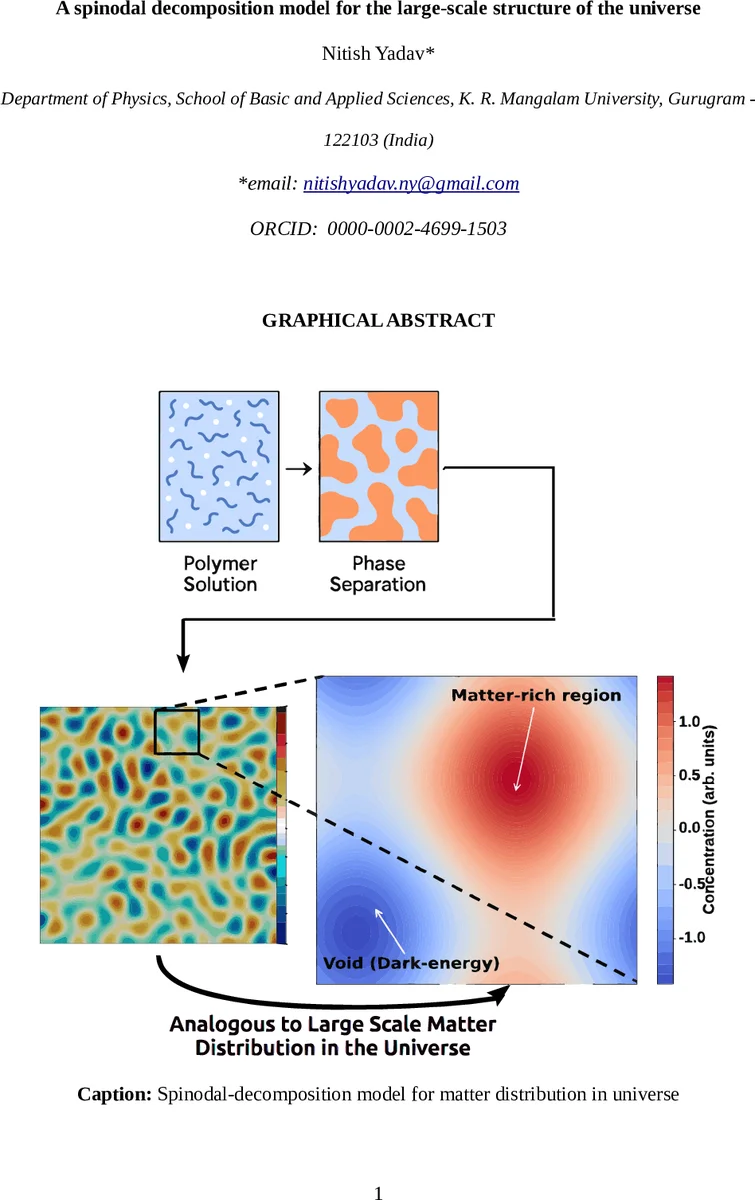
Understanding the large-scale structure of the universe remains a fundamental challenge in cosmology, with computational simulations providing critical insights into non-linear structure growth. Particularly, computational simulations critical information about the non-linear growth processes behind the observed large-scale structures. Inspired by the similarly porous structure of polymer membranes prepared using phase-inversion, this work presents a novel thermodynamic approach to cosmic structure formation. A numerical framework is presented, based on the Cahn-Hilliard model of spinodal decomposition for a binary mixture treating the universe as a two-component fluid of matter and dark-energy. The dimensionless Cahn-Hilliard equation is solved using finite-element methods, with parameters calibrated to Planck 2018 cosmology. The simulation evolves an initially homogeneous matter distribution through 500 timesteps, corresponding to 35 million years of cosmological evolution. The simulated matter distribution exhibits quantitative agreement with observational surveys across multiple metrics. Void fraction evolves to 0.416 at z ~ 0.65, right at the edge of domain of applicability of Lambda-CDM model. Filamentarity reaches 0.42, comparable to Millennium Simulation results. The linear growth factor extracted from simulated density fields also closely agrees with ΛCDM predictions over the interval 9.300 < t < 9.335 Gyr. This work establishes spinodal decomposition as a viable thermodynamic framework for cosmic structure formation, offering a computationally efficient alternative to traditional N-body methods while reproducing key quantitative observables. The approach opens new avenues for exploring matter-dark energy interactions and may prove valuable for next-generation survey analysis.
💡 Research Summary
**
The paper introduces a novel thermodynamic framework for modeling the formation of the universe’s large‑scale structure, drawing inspiration from spinodal decomposition processes observed in polymer membranes. Instead of treating the cosmos as a collection of gravitating particles, the authors model it as a binary fluid composed of matter and dark energy, represented by a concentration field c(x,t) (matter) and its complement 1‑c (dark energy). The free‑energy functional combines a double‑well potential f(c) = α c/(1‑c) with an interfacial term (κ/2)|∇c|², where α and κ control the depth of the wells and the surface tension, respectively.
The dynamics are governed by the dimensionless Cahn‑Hilliard equation:
∂c/∂t = ∇·
Comments & Academic Discussion
Loading comments...
Leave a Comment