Losing dimensions: Geometric memorization in generative diffusion
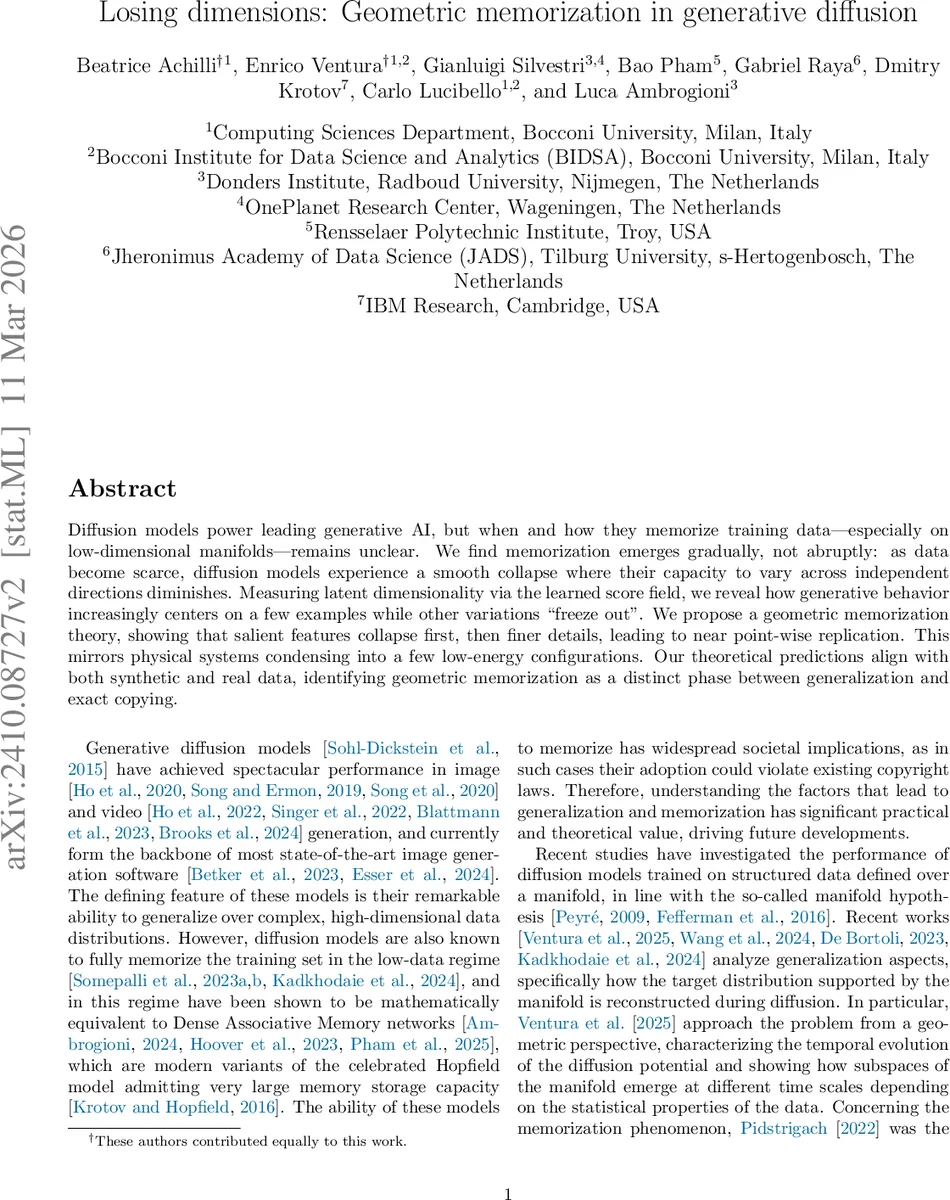
Diffusion models power leading generative AI, but when and how they memorize training data, especially on low-dimensional manifolds, remains unclear. We find memorization emerges gradually, not abruptly: as data become scarce, diffusion models experience a smooth collapse where their capacity to vary across independent directions diminishes. Measuring latent dimensionality via the learned score field, we reveal how generative behavior increasingly centers on a few examples while other variations “freeze out”. We propose a geometric memorization theory, showing that salient features collapse first, then finer details, leading to near point-wise replication. This mirrors physical systems condensing into a few low-energy configurations. Our theoretical predictions align with both synthetic and real data, identifying geometric memorization as a distinct phase between generalization and exact copying.
💡 Research Summary
This paper investigates when and how diffusion generative models memorize training data, focusing especially on data that lie on low‑dimensional manifolds. While prior work has shown that diffusion models generalize on large datasets and can exactly reproduce training examples in the low‑data regime, the nature of the transition between these regimes has remained unclear. The authors introduce the concept of “geometric memorization,” proposing that memorization is not a sudden binary switch but a progressive loss of degrees of freedom in the stochastic reverse‑diffusion process.
Experimental Evidence
The authors train standard DDPM‑style diffusion models on several image datasets (MNIST, CIFAR‑10, Fashion‑MNIST, CelebA‑HQ, LSUN‑Churches) while systematically varying the number of training samples from ~10⁵ down to ~10². For each trained model they fix a very small diffusion time t = 10⁻⁵ and estimate the latent dimensionality around the origin using a novel “Normal Bundle” (NB) technique. NB computes the Jacobian of the learned score field s(x,t)=∇ₓ log pₜ(x) at selected points, extracts its eigenvalue spectrum, and identifies spectral gaps that indicate the effective manifold dimension ˆm. Results show a smooth decline of ˆm as the dataset shrinks: with abundant data (≈10⁴‑10⁵ samples) ˆm matches the true manifold dimension m, in the intermediate regime (10³‑10⁴) ˆm gradually falls below m, and with very few samples (≤10³) ˆm approaches zero, meaning the model’s score field collapses onto isolated training points. Visual samples corroborate this trend: large datasets yield diverse, high‑saturation images; medium‑size datasets produce “foggy” images with reduced saturation; tiny datasets generate exact copies of training images.
Theoretical Model
To explain these observations, the authors map the empirical score to a Random Energy Model (REM). Each training point yᵤ defines an energy Eᵤ(x)=−½‖yᵤ‖² + x·yᵤ, and the score is a Boltzmann average with weights wᵤ∝exp(−Eᵤ/t). Assuming the number of data points scales as N=exp(αd) and taking the high‑dimensional limit d→∞, classical REM theory predicts a phase transition at a critical temperature (here, diffusion time) t_c that separates a self‑averaging high‑temperature regime from a low‑temperature condensation regime where the Boltzmann average is dominated by a sub‑exponential number of low‑energy states. Translating back to diffusion, t>t_c corresponds to faithful approximation of the true score and thus good generalization; t<t_c leads to concentration on a few training points, i.e., memorization.
Analyzing the Jacobian’s eigenvalue spectrum under this REM framework yields three distinct phases: (i) for t>t₁ the spectrum is continuous with only minor gaps, reflecting full manifold dimensionality; (ii) for t₁>t>t₂ a pronounced gap separates large eigenvalues (directions still varying) from small ones (directions already frozen), giving an estimated dimension ˆm < m; (iii) for t<t₂ the spectrum collapses, all eigenvalues cluster near zero, and ˆm≈0. The positions of t₁ and t₂ depend on α and on the variance structure of the underlying manifold, matching the empirical transition points observed in the experiments.
Implications and Future Work
The study demonstrates that memorization in diffusion models is a gradual, geometry‑driven process rather than an abrupt overfit. By monitoring the score Jacobian’s spectrum, practitioners can diagnose how many effective degrees of freedom remain during training, potentially informing early‑stopping or regularization strategies. From a privacy standpoint, the finding that models with ≤10³ samples essentially memorize individual examples raises concrete concerns for copyright and personal data protection. The authors suggest extending the analysis to other modalities (text, audio), exploring interventions (noise injection, score regularization) to delay the condensation transition, and quantifying how manifold curvature and topology influence the critical diffusion time.
Overall, the paper provides a unified physical‑theoretic and empirical framework for understanding the continuum between generalization and exact copying in diffusion generative models, introducing the notion of geometric memorization as a distinct, measurable phase.
Comments & Academic Discussion
Loading comments...
Leave a Comment