Nontrivial Riemann Zeros as Spectrum
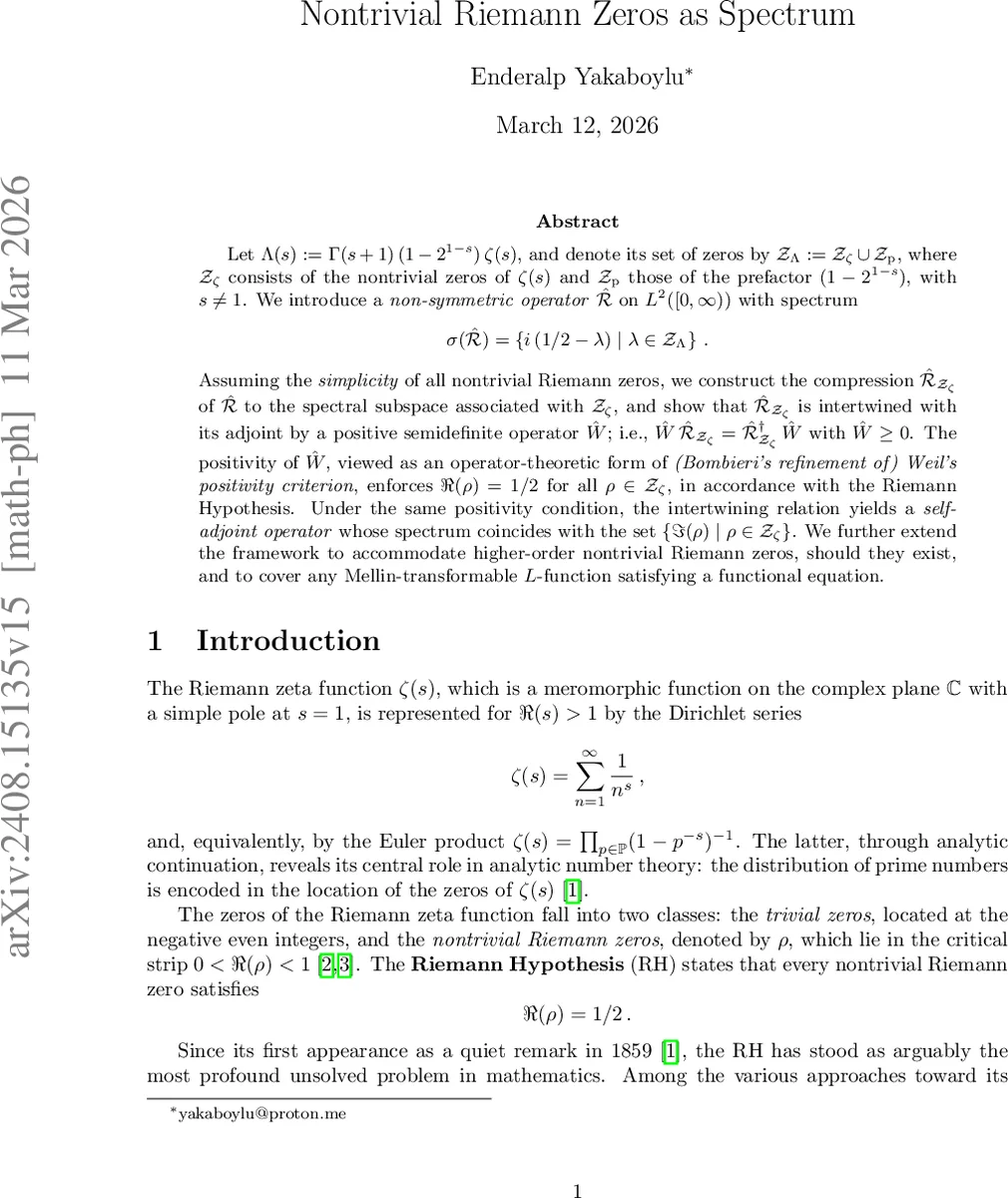
Let $ Λ(s) := Γ(s+1), (1-2^{1-s}) , ζ(s) $, and denote its set of zeros by $ Z_Λ:= Z_ζ\cup Z_\mathrm{p} $, where $ Z_ζ$ consists of the nontrivial zeros of $ ζ(s) $ and $ Z_\mathrm{p} $ those of the prefactor $ ( 1-2^{1-s} ) $, with $ s \neq 1 $. We introduce a non-symmetric operator $ R $ on $ L^2([0,\infty)) $ with spectrum [ σ(R) = \left{ i\left(1/2- λ\right) \mid λ\in Z_Λ\right} , . ] Assuming the simplicity of all nontrivial Riemann zeros, we construct the compression $ R_{Z_ζ} $ of $ R $ to the spectral subspace associated with $ Z_ζ$, and show that $ R_{Z_ζ} $ is intertwined with its adjoint by a positive semidefinite operator $ W $; i.e., $ W , R_{Z_ζ} = R_{Z_ζ}^\dagger , W $ with $ W \ge 0 $. The positivity of $ W $, viewed as an operator-theoretic form of (Bombieri’s refinement of) Weil’s positivity criterion, enforces $ \Re(ρ)=1/2 $ for all $ ρ\in Z_ζ$, in accordance with the Riemann Hypothesis. Under the same positivity condition, the intertwining relation yields a self-adjoint operator whose spectrum coincides with the set $ { \Im(ρ) \mid ρ\in Z_ζ} $. We further extend the framework to accommodate higher-order nontrivial Riemann zeros, should they exist, and to cover any Mellin-transformable $ L $-function satisfying a functional equation.
💡 Research Summary
The paper introduces a novel operator‑theoretic framework that directly links the non‑trivial zeros of the Riemann zeta function to the spectrum of a concrete, non‑self‑adjoint operator on a Hilbert space. The starting point is the “completed eta function’’ \
Comments & Academic Discussion
Loading comments...
Leave a Comment