Hysteretic squashed entanglement in many-body quantum systems
Entanglement in many-body quantum systems is distributed across spatial regions, where its structure often dictates the information-processing capabilities of the state. Yet, characterizing the entanglement structure, especially for mixed states, rem…
Authors: Siddhartha Das, Alex, er Yosifov
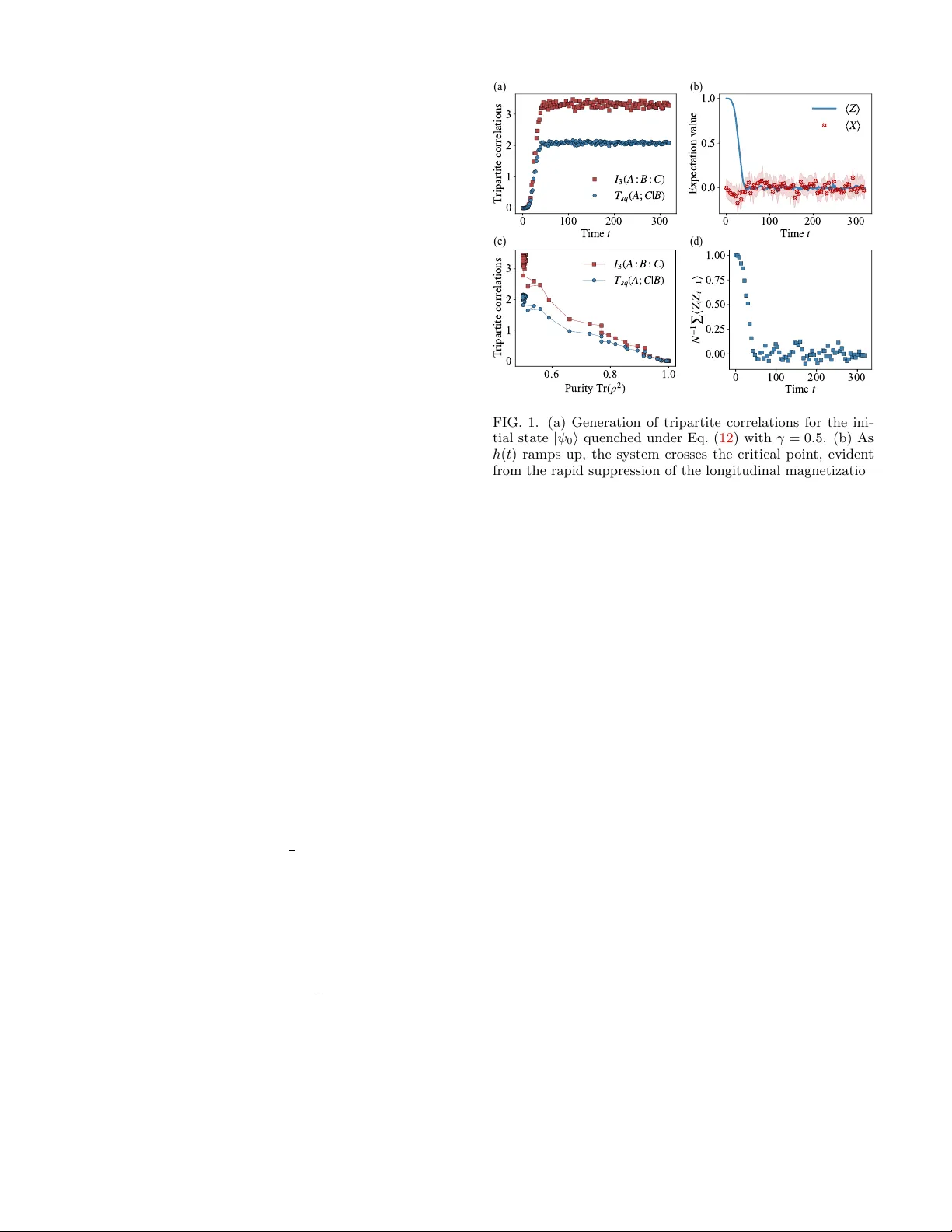
Hysteretic squashed en tanglemen t in man y-b o dy quan tum systems Siddhartha Das, 1 , ∗ Alexander Y osifo v, 2, 3 , † and Jinzhao Sun 3 , ‡ 1 q4i, Centr e for Quantum Scienc e and T e chnolo gy (CQST), Center for Se curity, The ory and Algorithmic R ese ar ch (CST AR), International Institute of Information T e chnolo gy Hyder ab ad, Gachib ow li 500032, T elangana, India 2 Clar endon L ab or atory, University of Oxfor d, Parks R o ad, Oxfor d, O X1 3PU, Unite d Kingdom 3 Scho ol of Physic al and Chemic al Scienc es, Que en Mary University of London, L ondon E1 4NS, Unite d Kingdom (Dated: Marc h 11, 2026) En tanglement in many-bo dy quantum systems is distributed across spatial regions, where its structure often dictates the information-pro cessing capabilities of the state. Y et, c haracterizing the en tanglement structure, especially for mixed states, remains a challenge. In this work, we prop ose h ysteretic squashed entanglemen t T sq , a conditional en tanglement monotone that measures the gen- uine quantum correlations b etw een t wo subregions, conditioned on a third region, in a many-bo dy quan tum state. T sq is upp er b ounded by the conv ex-roof extension of quantum conditional mutual information and exhibits several desirable prop erties like monogamy , conv exity , asymptotic con ti- n uity , faithfulness, and additivit y for tensor-pro duct states. W e study the conditional entanglemen t generation in a one-dimensional transverse-field Ising mo del under quench, where we show that T sq effectiv ely squashes classical contributions and can detect genuine quan tum correlations across b oth adjacen t and long-range subsystems. W e elucidate the utility of this measure as a robust quan tifier of topological entanglemen t en trop y for mixed states. This opens new op erational resource-theoretic a ven ues for probing top ological order and criticality . Characterizing ho w quantum correlations are dis- tributed across spatial regions is a ma jor problem in quan tum man y-b o dy ph ysics [ 1 – 3 ], with applications to computation, communication, error correction, and metrology [ 4 – 10 ]. Ho wev er, in extended op en systems correlations b et ween tw o regions are typically mediated b y surrounding parties and mixed with classical contri- butions. Scale also plays a role here as short-range quan- tum correlations among adjacent regions coexist with long-range ones betw een distant regions that are relay ed through intermediate subsystems. This raises a funda- men tal question: ho w to quan tify the genuine quan- tum correlations b et w een tw o spatial regions, conditioned on an in termediate region that can mediate informa- tion? Addressing this is essential for understanding non- equilibrium quantum dynamics and emergent order in man y-b o dy systems [ 3 ]. A natural starting p oin t is the quan tum conditional m utual information (QCMI) [ 11 ] which has found man y applications in informational asp ects of man y-b ody quan tum systems [ 3 , 12 – 14 ]. The QCMI I ( A ; C | B ) ρ of a quantum state ρ AB C quan tifies the total correlations b et w een regions A and C , conditioned on B . Later, that b ecame the basis for squashing out correlations in a state of a comp osite system that can b e rela yed by some compatible state extension to determine intrinsic or genuine quantum correlations presen t in the system. This idea underlies squashed entanglemen t E sq [ 15 ] that measures bipartite entanglemen t and its generalization squashed quan tum non-Marko vianity N sq [ 16 ], used for ∗ das.seed@iiit.ac.in † alexanderyyosifo v@gmail.com ‡ jinzhao.sun.phys@gmail.com studying genuine non-Mark ovianit y in tripartite quan- tum states and information backflo w in op en quantum systems [ 17 ]. Despite recent success in defining faith- ful and op erationally meaningful measures of quantum correlations, curren t measures cannot distinguish quan- tum correlations that are genuinely shared betw een dis- tan t regions from those that are conditionally rela yed through in termediate region in a man y-b o dy quantum state. In other words, there is no information-theoretic measure that quantifies the irreducible conditional quan- tum correlations b etw een spatial subregions of a many- b ody state [ 18 ]. This gap is esp ecially pronounced in mixed state regimes, where mediation and mixing are basic features of the correlation structure. Here, we in tro duce hyster etic squashe d entanglement T sq , which for a (quadripartite) man y-b o dy state quan- tifies the en tanglement b et ween tw o subregions, condi- tioned on the third and any compatible extension system, while the fourth subregion remains a silent sp ectator. More formally , T sq ( A ; C | B ) ρ of a state ρ AB C D quan ti- fies the conditional entanglemen t b etw een A - C , when D is silent (excluded), that cannot b e relay ed through an in- termediate conditioning region B whic h may include any compatible extension system [see Eq. ( 1 )]. And imp or- tan tly , it is distinct from both bipartite and gen uine m ul- tipartite entanglemen t (GME). Even though T sq (similar to E sq and N sq ) is numerically difficult to compute in general, we sho w that its utilit y lies in its prop erties that can shed light on the structure of the states and p ossible ph ysical ramifications for many-bo dy systems. W e show that T sq satisfies several desirable prop er- ties of a conditional entanglemen t monotone [ 17 , 19 ]: con vexit y , faithfulness, asymptotic con tinuit y , additivity , and monogamy . These prop erties clarify the intrinsic structure of a many-bo dy quantum state when its T sq 2 is approximately v anishing. F urthermore, T sq can pro- vide a robust diagnostic of topological entanglemen t en- trop y (TEE) in mixed states [ 20 – 22 ], and lays the ground- w ork for a resource-theoretic treatment of top ological or- der b ey ond pure states [ 23 , 24 ]. As another application, w e p erform numerical study of the conditional entangle- men t generation in a quenched 1D Ising mo del, where T sq detects quan tum correlations in regimes where GME- sp ecific diagnostics v anish. Before w e present our main results, w e remark that T sq admits an operational interpretation within a secure com- m unication protocol adapted from the one-time quan tum conditional pad [ 16 , 25 ]. Consider a scenario where mul- tiple copies of a state ρ AB C D are distributed such that Alice holds A , Charlie holds C , and an eav esdropp er Ev e p ossesses B and all compatible extensions E , but lacks access to D . Alice and Charlie are connected by an ideal quan tum channel whose output is also accessible to Ev e. In this setting, T sq ( A ; C | B ) ρ is exactly twice the optimal rate at which Alice can send priv ate messages to Charlie. The pro of follows the same construction as [ 25 ] (see also Theorem 4 in [ 16 ]). Pr eliminaries.— W e briefly introduce some measures of interest. F or a tripartite state ρ AB C , QCMI is de- fined as I ( A ; C | B ) ρ := I ( A ; B C ) ρ − I ( A ; B ) ρ , where I ( A ; B ) ρ := S ( A ) ρ + S ( B ) ρ − S ( AB ) ρ is the quan tum mu- tual information (QMI) and S ( · ) := − tr[ · log · ] is the von Neumann entrop y . The nonnegativity of QCMI is equiv- alen t to the strong subaddivit y of the en trop y [ 11 ], where its strengthening sho ws that for an arbitrary state ρ AB C , there exists a universal recov ery map R B → B C [ 26 ], suc h that I ( A ; C | B ) ρ ≥ − log F ( ρ AB C , R B → B C ( ρ AB )) ≥ 0, where F ( ρ, σ ) := √ ρ √ σ 2 1 is the fidelity b etw een states ρ, σ . F or a bipartite state ρ AB , squashed entanglemen t is defined as E sq ( A ; C ) := 1 2 inf { I ( A ; C | E ) ρ : tr E [ ρ AC E ] = ρ AC } . F or a tripartite state ρ AB C , squashed quan- tum non-Marko vianit y is defined as N sq ( A ; C | B ) ρ := 1 2 inf { I ( A ; C | B E ) ρ : tr E [ ρ AB C E ] = ρ AB C } . Pr op erties.— W e now formally define our measure. Definition 1. F or a r elevant quadrip artite density op er- ator ρ AB C D , its (squashe d) hyster etic squashe d entangle- ment T sq ( A ; C | B ) ρ r e ads T sq ( A ; C | B ) ρ = 1 2 inf σ ABC D E : tr E ( σ ABC D E )= ρ ABC D I ( A ; C | B E ) σ , (1) wher e the optimization is with r esp e ct to al l p ossible state extensions σ AB C D E of ρ AB C D . It follo ws from Definition 1 that T sq ( A ; C | B ) ρ ≤ log min {| A | , | C |} for a state ρ AB C D and the inequalit y is saturated iff its marginal state ρ AC is a maximally en tan- gled pure state of Sc hmidt rank d = min {| A | , | C |} . W e note that to ev aluate T sq with finite-dimensional AB C D , the infim um can be restricted (without loss of generality) to finite-dimensional E ; whereas for infinite-dimensional AB C D , E is also infinite-dimensional [ 15 , 27 ]. In this w ork, w e fo cus on man y-bo dy systems comp osed of finite- dimensional regions. Physically , T sq quan tifies the irre- ducible A - C correlations that p ersist under conditioning on B and any compatible E , and disregarding D ; mean- ing that T sq = 0 iff the A - C correlations can b e mediated through B and some compatible E that is hidden. T sq exhibits the following desirable prop erties. Prop osition 1. F or a many-b o dy quantum system AB C D c omp osite of four r e gions, T sq satisfies the fol lowing pr op erties: 1) Convexity: F or a state ρ AB C D expr esse d as a c onvex mixtur e P x p X ( x ) ρ x AB C D of quantum states T sq ( A ; C | B ) ρ ≤ X x p X ( x ) T sq ( A ; C | B ) ρ x . (2) 2) F aithfulness: F or a state ρ AB C D , T sq ( A ; C | B ) ρ = 0 iff ther e exists a state extension ρ AB C D E and a universal r e c overy map R B E → B C E , such that R B E → B C E ( ρ AB E ) = tr D [ ρ AB C D E ] . (3) 3) Asymptotic c ontinuity: F or two finite-dimensional states ρ AB C D and σ AB C D close in tr ac e distanc e, 1 2 ∥ ρ − σ ∥ ≤ ε ∈ [0 , 1] , we have | T sq ( A ; C | B ) ρ − T sq ( A ; C | B ) σ | ≤ f ( d, ε ) , (4) wher e f ( d, ε ) = 2 √ ε log d + (1 + 2 √ ε ) h 2 2 √ ε 1+2 √ ε for d = min {| A | , | C |} and Shannon ’s binary entr opy h 2 ( p ) := − p log p − (1 − p ) log(1 − p ) , and lim ε → 0 + f ( d, ε ) = 0 . 4) Mono gamy: F or a quantum state ρ A 1 A 2 B C D T sq ( A 1 A 2 ; C | B ) ρ ≥ T sq ( A 1 ; C | B ) ρ + T sq ( A 2 ; C | B ) ρ . (5) 5) A dditive under tensor-pr o duct states: F or a quantum state ρ A 1 A 2 B 1 B 2 C 1 C 2 D 1 D 2 T sq ( A 1 ; C 1 | B 1 ) ρ + T sq ( A 2 ; C 2 | B 2 ) ρ ≥ T sq ( A ; C | B ) ρ , (6) and the ine quality satur ates if ρ A 1 A 2 B 1 B 2 C 1 C 2 D 1 D 2 = σ A 1 B 1 C 1 D 1 ⊗ τ A 2 B 2 C 2 D 2 , i.e., T sq ( A ; C | B ) ρ = T sq ( A 1 ; C 1 | B 1 ) σ + T sq ( A 2 ; C 2 | B 2 ) τ , (7) assuming A = A 1 A 2 , B = B 1 B 2 , C = C 1 C 2 . Prop osition 1 comes from Lemma 2 of [ 16 ]. Here: 1) ensures probabilistic mixing cannot create hysteretic squashed en tanglement from states with T sq = 0; 2) means T sq = 0 exactly for states without irreducible con- ditional en tanglemen t, and T sq > 0 otherwise; 3) guar- an tees robustness b ecause the less distinguishable t wo states are, the closer their T sq v alues must b e; 4) shows that conditional entanglemen t cannot b e freely shared across m ultiple parties; while 5) implies T sq do es not in- crease by simply adjoining tw o states but equals the sum of their individual v alues. The consequence of 4) is also observ ed n umerically in Fig. 1 . 3 Ov erall, Prop osition 1 sho ws that T sq captures a physi- cally consisten t notion of conditional entanglemen t in ex- tended systems: it is stable under noise, cannot b e freely shared among subsystems, and characterizes when global correlations can b e reconstructed from lo cal data. F or instance, if ρ AB C D is a genuinely entangled pure state, then there exist A - C correlations that are mediated, as w ell as “shielded” by B and D ; entanglemen t is hence shared among all the subsystems AB C D without an y leak age to the en vironment. GHZ state (Φ n ) W state (Ψ n ) n = 3 1 0.918 n = 4 0 0.377 n = 5 0 0.249 n ≥ 4 0 2 h 2 ( 2 n ) − h 2 ( 1 n ) − h 2 ( 3 n ) T ABLE I. Comparison of I ( A ; C | B ) for n -party GHZ and W states. h 2 ( p ) denotes the binary entrop y . T o further elab orate, let Φ n and Ψ n denote, resp ec- tiv ely , n -qubit GHZ and W states [ 5 , 28 , 29 ], and let this system b e partitioned as A - B - C - D for n ≥ 4, where A, B , C are each single qubit and the remaining qubits are in D . When n = 3 for b oth GHZ and W states, D is in a pro duct state with AB C . Since Φ n and Ψ n are pure, w e get T sq ( A ; C | B ) Φ n = 1 2 I ( A ; C | B ) Φ n and T sq ( A ; C | B ) Ψ n = 1 2 I ( A ; C | B ) Ψ n . The v alues of I ( A ; C | B ), whic h are double that of the resp ective T sq for n -partite GHZ and W states, are shown in T able I . This is consistent with the fact that eac h tw o-qubit marginal of the W state remains en tangled but tracing out even a single qubit from the GHZ state makes it separable. In con trast to the GHZ state, the QCMI for the W state re- mains strictly positive for an y finite n , irresp ectiv e of ho w n -qubit W and GHZ states are partitioned in to A - B - C - D . This non-v anishing I ( A ; C | B ) Ψ n reflects the intrinsic nature of W-type entanglemen t, which is spread across all pairs and triplets in a w a y that precludes reconstruc- tion from lo cal marginals. Ev en up on tracing out the ob- serv er qubit D , the resulting mixed state ρ AB C retains bipartite entanglemen t across all remaining partitions. Consequen tly , the in termediary region B fails to act as a p erfect shield (or a quan tum Marko v buffer) betw een regions A and C . Finally , we pro ve T sq generalizes to E sq and N sq for relaxed spatial constraints (see Supplemental Materials ). Lemma 1. Supp ose ρ AC and ρ AB C ar e r e duc e d states of ρ AB C D . The squashe d quantum c orr elations E sq of ρ AC , N sq of ρ AB C , and T sq of ρ AB C D c an then b e or der e d as E sq ( A ; C ) ρ ≤ N sq ( A ; C | B ) ρ ≤ T sq ( A ; C | B ) ρ ≤ 1 2 I ( A ; C | D ) ρ . (8) This formalizes a hierarch y relation in the context of constrained optimization; as more spatial regions are in- cluded AC → AB C → AB C D , the set of v alid exten- sions σ AB C D ⊆ σ AB C ⊆ σ AC shrinks, where σ X denotes the set of state extensions ρ X E , such that tr E [ ρ X E ] = ρ X . F rom the definitions of E sq and N sq [ 15 – 17 ], it is easy to see that an extension compatible with the global state ρ AB C D is automatically compatible with the marginals ρ AB C and ρ AC . Note that T sq is related to N sq but formally distinct as the latter is defined for tripartite state while the former for a quadripartite state. There is no silen t sp ectator D presen t in the con text of N sq whic h is crucial in quan tify- ing h ysteretic entanglemen t b et w een tw o subregions A - C relativ e to B in a quan tum state ρ AB C D , see T able I . T op olo gic al or der of mixe d states.— It is well known [ 3 , 13 ] that for a gapp ed quantum many-bo dy system in top ologically ordered pure ground state ψ AB C D , where the configuration A - B - C follows the Levin-W en (L W) sc heme, the TEE is γ = 1 2 I ( A ; C | B ) ψ [ 20 – 22 ]. Here, γ = 0 corresp onds to a quantum Marko v chain. Equiv a- len tly , γ = 0 for ψ AB C D if there exists a universal recov- ery map R B → B C that can p erfectly recov er the reduced state ψ AB C from ψ AB . F or a mixed state ρ AB C D , ho w- ev er, correlations may b e mediated through an intermedi- ate part y , and an extension system E must be introduced. Here, γ = 0 is related to the existence of a state exten- sion ρ AB C D E and a univ ersal recov ery map R B E → B C E , suc h that R ( ρ AB E ) = ρ AB C E ; the regions here are con- figured as A - B E - C . The conv ex-ro of extension of QCMI (dubb ed co(QCMI)), see Eq. ( 14 ), was recently used [ 23 ] to study top ological order for mixed states. T sq ( A ; C | B ) ρ is a well-founded diagnostic of top o- logical order in terms of TEE of a mixed state due to desirable prop erties of the conditional entanglemen t it satisfies. F or pure state ψ AB C D , T sq ( A ; C | B ) ψ = co(QCMI)[ ψ ABCD ] = 1 2 I ( A ; C | B ) ψ = γ . F or rele- v ant man y-b o dy system in a mixed state ρ AB C D , where regions A, B , C are as p er L W scheme, we refer to T sq ( A ; C | B ) ρ as the hysteretic TEE. The follo wing theo- rem states that T sq is upper b ounded by co(QCMI). W e pro vide detailed pro of in Appendix C . Theorem 1. F or an arbitr ary r elevant state ρ AB C D , the hyster etic TEE T sq ( A ; C | B ) ρ is upp er b ounde d by the c o(QCMI) 0 ≤ T sq ( A ; C | B ) ρ ≤ co(QCMI)[ ρ AB C D ] . (9) Imp ortan tly , from here w e can form a resource- theoretic approach [ 16 , 30 ] to study topological order in man y-b o dy mixed states. T sq = 0 for states with no topo- logical order, and those can b e deemed “free”, whereas states with non-zero top ological order ha ve T sq > 0 and can b e deemed “resourceful”. The set of free op era- tions includes lo cal op erations and classical comm uni- cation [ 31 ] b et ween non-conditioning regions, lo cal op er- ations and one-wa y quantum comm unication from non- conditioning to conditioning regions, and lo cal operations on conditioning regions (pro of follo ws from Lemma 3 of [ 16 ]). Since T sq is non-increasing under these op erations, it serv es as a v alid monotone for quantifying top ological order in man y-b ody mixed states. In contrast, the tri- partite measure N sq cannot directly characterize TEE, 4 as it lacks the spatial conditioning structure required to isolate correlations across separated regions. Theorem 2. If T sq ( A ; B | C ) ρ of a quantum state ρ AB C D changes ne gligibly under the action of a quantum channel E A → A ′ on A then ther e exists a state extension ρ AB C D E and a universal r e c overy map R ρ ABE ⊗ ρ C , E that almost r e c overs the state ρ AB C E fr om E ( ρ AB C E ) . In p articular, T sq ( A ; C | B ) ρ − T sq ( A ′ ; C | B ) E ( ρ ) ≤ ε (10) implies the existenc e of a quantum channel R ρ ABE ⊗ ρ C , E such that sup ρ ABC E : tr E ( ρ ABC D E )= ρ ABC D F ( ρ AB C E , R ◦ E ( ρ AB C E )) ≥ 2 − ε , (11) and R ρ ABE ⊗ ρ C , E ◦ E ( ρ AB C E ) ≈ ρ AB C E iff ε ≈ 0 . Theorem 2 (detailed pro of in App endix C ) shows that the correlations quantified by T sq are stable under lo cal pro cessing: if a lo cal op eration changes T sq only sligh tly , then there exists a state extension and a recov er map that allow to approximately undo the action of the lo cal pro cessing. Mo del.— T o illustrate the op erational utility of T sq , w e study the entanglemen t generation in an N = 8 qubit 1D transverse-field Ising mo del with p eriodic b oundary conditions, describ ed by the Hamiltonian H = − J X ⟨ ij ⟩ Z i Z j + h ( t ) X i X i , (12) where J = 1 is the nearest-neighbor (NN) in teraction, Z i and X i are the Pauli op erators on i , and h ( t ) is the time-dep enden t transv erse magnetic field on all i . The system is initialized in | ψ 0 ⟩ = N i |↓⟩ i , corresp onding to one of the tw o degenerate ferromagnetic ground states at h = 0. W e partition the chain in to three o verlapping re- gions A, B , C via the L W scheme, thereb y forming a ring. The remaining degrees of freedom constitute a fourth re- gion D that remains uncorrelated with AB C throughout the ev olution; hence, ρ AB C D ( t ) = ρ AB C ( t ) ⊗ ρ D ∀ t , in whic h case N sq = T sq . Note that for AB C in a pure state ψ AB C , T sq ( A ; C | B ) ρ = 1 2 I ( A ; C ) ψ . W e then con- sider a quench under Eq. ( 12 ), where the system, cou- pled to a dephasing environmen t, is driv en across the phase transition. h ( t ) follows a standard linear ramp proto col: it increases from 0 to h max = 2 J o v er time t up = 150, then it is held constant for t hold = 20, and ramp ed bac k to zero. The ev olution is go verned by the Lindblad master equation for the densit y matrix ρ ( t ): ˙ ρ = − i [ H ( t ) , ρ ] + γ P i Z i ρZ i − 1 2 { Z 2 i , ρ } , where γ is the lo cal dephasing rate. The equation is solved via the Mon te Carlo wa vefunction metho d. Numeric al r esults.— In Fig. 1 we compare T sq against the TMI I 3 ( A : B : C ) = S ( A ) + S ( B ) + S ( C ) − S ( AB ) − S ( B C ) − S ( AC ) + S ( AB C ); I 3 = 0 when the three sub- systems are separable across any bipartition and I 3 > 0 in the presence of correlations (classical and quantum) 0 100 200 300 T i m e t 0 1 2 3 T ripartite correlations I 3 ( A : B : C ) T s q ( A ; C | B ) 0 100 200 300 T i m e t 0.0 0.5 1.0 Expectation value Z X 0 100 200 300 T i m e t 0.00 0.25 0.50 0.75 1.00 N 1 Z i Z i + 1 0.6 0.8 1.0 P u r i t y T r ( 2 ) 0 1 2 3 T ripartite correlations I 3 ( A : B : C ) T s q ( A ; C | B ) (a) (b) (c) (d) FIG. 1. (a) Generation of tripartite correlations for the ini- tial state | ψ 0 ⟩ quenched under Eq. ( 12 ) with γ = 0 . 5. (b) As h ( t ) ramps up, the system crosses the critical p oint, eviden t from the rapid suppression of the longitudinal magnetization order ⟨ Z ⟩ = N − 1 P i ⟨ Z ⟩ , hence marking the transition to a paramagnetic regime. (c) As purity decreases under γ , the gap widens, showing T sq effectiv ely squashes classical correla- tions. (d) The av erage NN correlation function ov er time. shared among all three parties. A t the onset of the quenc h t ≪ t up , b oth T sq and I 3 are near-zero, sug- gesting correlations are strictly lo cal and confined to the NN Z Z couplings in the ground state | ψ 0 ⟩ , Fig. 1 (a). As h ( t ) ramps up, quantum fluctuations from the non- comm uting X i terms induce a rapid buildup of multipar- tite correlations, conv erting local Z Z order into delo cal- ized quasiparticle pairs. Overall, we observ e T sq remains systematically lo w er than I 3 due to the squashing of clas- sical redundancies from the en vironment. This is consis- ten t with the visible gap in Fig. 1 (c) that only widens as the state b ecomes less pure under γ . Meanwhile, the macroscopic response to the quench is captured b y the order parameters in Fig. 1 (b): w e observe the longitudi- nal magnetization ⟨ Z ⟩ decays sharply during the ramp- up as quantum fluctuations suppress long-range Z Z or- der, while the transverse magnetization ⟨ X ⟩ p eaks near criticalit y , signaling the transition to the paramagnetic regime. This is corrob orated b y the av erage NN corre- lations in Fig. 1 (d), whose rapid decrease coincides with the decay of ⟨ Z ⟩ and the growth of b oth T sq and I 3 . Ph ysically , as h ( t ) disrupts the initial spin alignment, the suppression of lo cal ferromagnetic order giv es rise to delo calized quantum fluctuations that drive tripartite en tanglement. The close agreement b etw een T sq and I 3 early on indicates the presence of predominan tly quan- tum correlations, with classical contributions becoming significan t only after prolonged dephasing. W e no w compare T sq with τ 3 , Fig. 2 . Calculat- ing its exact Coffman-Kundu-W o otters form [ 32 ] for 5 0 50 T i m e t 0.0000 0.0001 0.0002 0.0003 Local correlations T s q 3 ( a ) ( b ) FIG. 2. (a) F or adjacent qubits, the quench induces lo- cal GHZ-t yp e GME that quic kly collapses due to γ and monogam y as correlations spread. In contrast, T sq remains p ositiv e, witnessing bipartite and GME. (b) F or distan t qubits, τ 3 = 0 as the correlations, mediated by quasiparti- cles, are bipartite. Under the quench, T sq oscillates due to coheren t recurrences in the non-lo cal regime. In b oth sce- narios, T sq captures gen uinely quantum correlations that τ 3 misses. mixed states, ho wev er, requires conv ex ro of optimiza- tion ov er pure-state decomp ositions which is intractable for general dissipative dynamics [ 33 ]. F or this rea- son, we employ the negativity-based witness τ 3 = 3 p N A | B C · N B | AC · N C | AB , where N i | j k = ∥ ρ T i ABC ∥ 1 − 1 2 is the negativit y across the i | j k bipartition and ρ T i AB C is the partial transp ose with resp ect to subsystem i [ 34 , 35 ]. τ 3 pro vides a strict low er b ound for GME, v anishes if the state is biseparable across any bipartition, and is efficien tly computable for mixed states via direct diag- onalization of the reduced densit y matrix. W e see from Fig. 2 (a) that adjacent qubits support b oth bipartite and GME. A t early times t ≪ t up , the sharp increase in τ 3 in- dicates the presence of irreducible GHZ-t ype correlations induced b y NN Z Z couplings. Its subsequent collapse to 0 is exp ected and underscores the kno wn fragility of GME under local γ [ 36 ]. In contrast, T sq remains p ositive and oscillates, capturing p ersisten t conditional entangle- men t. While for distant qubits, we see τ 3 = 0, confirm- ing that long-range correlations, generated b y low-energy quasiparticle excitations during the quench, are bipartite, Fig. 2 (b). T sq is again p ositiv e here. Its oscillations in- dicate coherent quasiparticle recurrences within the lat- tice. Overall, while τ 3 is only sensitive to residual GME, T sq captures genuine conditional quantum correlations shared across a given bipartition, capturing all quan tum resources on lo cal and non-lo cal scales. Discussion.— W e in tro duced the h ysteretic squashed en tanglement T sq as a measure of irreducible conditional quan tum correlations in many-bo dy systems. By mini- mizing the QCMI ov er compatible state extensions, T sq remo ves correlations mediated through the conditioning region and hidden environmen ts, isolating those that can- not b e repro duced by extension-based reco very , Fig. 1 . Its prop erties (Prop osition 1 ) establish it as a consisten t conditional entanglemen t monotone; its ordering with E sq and N sq (Lemma 1 ) places it within a hierarch y of squashed correlations, and it is prov en to b e upp er b ounded b y co(QCMI) in Theorem 1 . T sq = 0 char- acterizes conditional reco v erability: all conditioned A - C correlations are compatible with reconstruction from lo- cal data and a suitable state extension, whereas T sq > 0 quan tifies the irreducible obstruction to such reconstruc- tion. W e further observed this in Fig. 2 , where compared with τ 3 , T sq detects conditional correlations in mixed, non-equilibrium regimes where residual GME measures fail. This viewpoint provides a quan titative route to mixed-state top ological structure (Theorem 2 ). Here, T sq > 0 signals conditionally protected long-range quan- tum correlations that cannot b e locally mediated, while T sq = 0 indicates that apparen t long-range correlations are reconstructible and do not enco de intrinsic global or- der. These results open immediate a ven ues for studying resource theory of conditional entanglemen t based on T sq and using T sq to classify mixed-state phases; particularly to c haracterize the emergence, stabilit y , and dynamical transitions of top ological order b ey ond equilibrium and pure states. A cknow le dgments.— S.D. and A.Y. con tributed equally and are listed alphab etically . S.D. ackno wledges supp ort from the ANRF, DST, Go vt. of India, under Gran t No. SR G/2023/000217, MeitY, Govt. of India, un- der Grant No. 4(3)/2024-ITEA, and the II IT F aculty Seed Grant. APPENDIX App endix A: Quantum c onditional mutual information.— Here w e provide some further de- tails ab out QCMI. I ( A ; C | B ) ρ = 0 iff there ex- ists a universal recov ery map R B → B C , suc h that R B → B C ( ρ AB ) = ρ AB C [ 37 ]. In fact, for I ( A ; C | B ) ρ = 0, the reco v ery map R B → B C coincides with the Petz reco very map R P B → B C [ 26 , 37 , 38 ] R P B → B C ( · ) = ρ 1 / 2 B C ρ − 1 / 2 B ( · ) ρ − 1 / 2 B ⊗ 1 C ρ 1 / 2 B C . (13) F or a state ρ AB , ρ A = tr B ( ρ AB ) is a reduced or marginal state, and any state ω AB C suc h that tr C ( ω AB C ) = ρ AB is called its state extension. F or finite-dimensional systems, a state ρ AC is separable (not entangled) if there exists a state extension ρ AC E suc h that I ( A ; C | E ) ρ = 0 [ 39 ]. In other words, a quantum state ρ AC is not entangled if there exists a state extension ρ AC E and a univer- sal recov ery map R E → E C suc h that R E → E C ( ρ AE ) = ρ AC E . As highlighted in the main text, this notion w as recently extended to quantify the squashed quan- tum non-Mark o vianity N sq [ 16 ] that captures en tangle- men t b et w een A and C , conditioned on B , for a tripar- tite state ρ AB C if there exists a state extension ρ AB C E , suc h that I ( A ; C | B E ) ρ = 0. This makes sense b e- cause gen uine quantum correlations b et w een t w o systems are not shareable with infinitely man y systems [ 40 , 41 ]. 6 If I ( A ; C | B ) ρ = 0 then one can sequentially apply R B → B C ( ρ AB ) many times to obtain R ◦ · · · ◦ R ( ρ AB ) = ρ AB C 1 ...C k , where C i ≃ C for i ∈ { 1 , 2 , . . . , k } suc h that tr C 1 ...C k \ C i = ρ AC ∀ k ∈ N [ 39 ], which is p ossible iff ρ AC is separable [ 42 ]. App endix B: c o(QCMI) and T sq .— F or a mixed state ρ AB C D , the co(QCMI) [ 23 ] is formally defined as co(QCMI)[ ρ ABCD ] := 1 2 inf { p i ,ψ i } i : ρ = P i p i ψ i X i p i I ( A : C | B ) ψ i , (14) where the infim um is tak en o ver all ensem bles { p i , ψ i AB C D } i of pure states. F or a pure state ψ AB C D , the upp er b ound in Theorem 1 is saturated T sq ( A ; C | B ) ψ = co(QCMI)[ ψ ABCD ] = 1 2 I ( A ; C | B ) ψ = γ , (15) whic h can b e exp ected since every extension of a pure state is trivial, so the optimization in T sq is attained b y the purification itself. App endix C: Pr o ofs of main r esults.— W e now pro ve Theorem 1 and Theorem 2 . Theorem 1. F or an arbitr ary r elevant state ρ AB C D , the hyster etic TEE T sq ( A ; C | B ) ρ is upp er b ounde d by the c o(QCMI) 0 ≤ T sq ( A ; C | B ) ρ ≤ co(QCMI)[ ρ AB C D ] . Pr o of. The hysteretic TEE T sq is nonnegativ e b ecause of the nonnegativit y of the conditional mutual informa- tion of a quantum state. F or a relev an t state ρ AB C D , let { p i , ψ i AB C D } i denote an ensemble of pure states that giv es optimal v alue for co(QCMI)[ ρ AB C D ]. Using this op- timal ensem ble, w e can form a state extension σ AB C D E of ρ AB C D suc h that σ AB C D E = X i p i ψ i AB C D ⊗ | i ⟩ ⟨ i | E , (16) where {| i ⟩} i is an orthonormal set of vectors. It follo ws that T sq ( A ; C | B ) ρ ≤ 1 2 I ( A ; C | B E ) σ = 1 2 X i p i I ( A ; C | B ) ψ i = co(QCMI)[ ρ AB C D ] , (17) where, to arriv e at the first equality , we used the fact that S ( X A ) ρ = H ( X ) + X x p X ( x ) S ( ρ x A ) (18) for a classical-quantum state ρ X A = X x p X ( x ) | x ⟩ ⟨ x | X ⊗ ρ x A . (19) This pro ves the upp er bound on T sq ( A ; C | B ) ρ , which is saturated if ρ AB C D is pure b ecause the extending sys- tem E can only b e in product state with AB C D , and I ( A ; C | B ) ψ = I ( A ; C | B E ) ψ for all p ossible state exten- sions ψ AB C D E of an arbitrary pure state ψ AB C D . Theorem 2. If T sq ( A ; B | C ) ρ of a quantum state ρ AB C D changes ne gligibly under the action of a quantum channel E A → A ′ on A then ther e exists a state extension ρ AB C D E and a universal r e c overy map R ρ ABE ⊗ ρ C , E that almost r e c overs the state ρ AB C E fr om E ( ρ AB C E ) . In p ar- ticular, T sq ( A ; C | B ) ρ − T sq ( A ′ ; C | B ) E ( ρ ) ≤ ε implies the existenc e of a quantum channel R ρ ABE ⊗ ρ C , E such that sup ρ ABC E : tr E ( ρ ABC D E )= ρ ABC D F ( ρ AB C E , R ◦ E ( ρ AB C E )) ≥ 2 − ε , and R ρ ABE ⊗ ρ C , E ◦ E ( ρ AB C E ) ≈ ρ AB C E iff ε ≈ 0 . Pr o of. F or any state extension ρ AB C D E of ρ AB C D and an y quantum channel E A → A ′ , there exists a universal re- co very map R such that I ( A ; C | B E ) ρ − I ( A ; C | B E ) E ( ρ ) = I ( AB E ; C ) ρ − I ( B E ; C ) ρ − I ( AB E ; C ) E ( ρ ) + I ( B E ; C ) E ( ρ ) = I ( AB E ; C ) ρ − I ( AB E ; C ) E ( ρ ) ≥ − log F ( ρ AB C E , R ρ ABE ⊗ ρ C , E ◦ E ( ρ AB C E )) , (20) where the last inequality follows from the strengthened data-pro cessing inequality [ 26 ] after recognizing that the QMI of a quantum state is equal to the quantum relative en tropy b etw een the states and the tensor-pro duct of its reduced state I ( A ; B ) σ = D ( σ AB ∥ σ A ⊗ σ B ) . (21) In particular, for arbitrary quantum states ρ A , σ A and ar- bitrary quantum channel N A → B , there exists a universal reco very map R σ, N suc h that [ 26 ] D ( ρ ∥ σ ) − D ( N ( ρ ) ∥N ( σ )) ≥ − log F ( ρ, R σ, N ◦ N ( ρ )) . (22) F urthermore, D ( ρ ∥ σ ) = D ( N ( ρ ) ∥N ( σ )) iff [ 37 ] R σ, N ( · ) = σ 1 2 N † [ N ( σ ) − 1 2 ( · ) N ( σ ) − 1 2 ] σ 1 2 . (23) T aking infimum o v er all state extensions ρ AB C D E of ρ AB C D , we get T sq ( A ; C | B ) ρ − T sq ( A ′ ; C | B ) E ( ρ ) ≥ inf ρ ABC D E I ( A ; C | B E ) ρ − I ( A ; C | B E ) E ( ρ ) ≥ − log sup ρ ABC D E F ( ρ AB C E , R ρ ABE ⊗ ρ C , E ◦ E ( ρ AB C E )) . (24) 7 W e kno w that 0 ≤ F ( τ , σ ) ≤ 1 for any tw o states τ A and σ A ; F ( τ , σ ) = 1 iff τ = σ , and F ( τ , σ ) = 0 iff τ ⊥ σ . W e ha ve 1 − p F ( τ , σ ) ≤ 1 2 ∥ ρ − σ ∥ 1 ≤ p 1 − F ( ρ, σ ) . (25) This observ ation concludes the pro of as F ( τ , σ ) ≈ 1 iff τ ≈ σ . Theorem 2 formalizes that small change of T sq under lo cal pro cessing implies approximate recov erabilit y of the global correlations conditioned on the mediating region. This connects irreducible conditional entanglemen t to robustness of information flow under lo cal noise. App endix D: Extension to dynamic al settings.— Our formalism of h ysteretic en tanglement can b e extended to study dynamical memory effects in op en many-bo dy quan tum systems. This p ersp ectiv e is motiv ated by the application of N sq in the context of reviv als of informa- tion in op en quan tum systems [ 17 ]. Let ρ AB C D ( t ) denote the evolv ed state at time t = t with t = 0 denoting the initial time. Consider that the evolution is happ ening under quantum dynamics with Liouvillian L ( k ) for k ∈ { 1 , 2 , . . . } and we do not kno w under which dynamics the state evolv es. Be- sides, the dynamics L ( k ) are such that if ρ AB C D (0) has I ( A ; C | B ) ρ (0) = 0, then I ( A ; C | B ) e L ( k ) t ( ρ ) = 0. That is, the dynamics L ( k ) preserv es the quan tum Marko v c hain prop ert y A - B - C of the initial state. In this case, there ex- ists state ρ AB C D (0) and dynamics L ( k ) for k ∈ { 1 , 2 , . . . } suc h that when we do not know whic h L ( k ) o ccurred, we could hav e I ( A ; C | B ) ρ ( t ) > 0 and still we will alwa ys hav e T sq ( A ; C | B ) ρ ( t ) = 0. This holds b ecause of the conv exit y of T sq , see Prop osition 1 . Let us now consider a tripartite state ρ AB C ( t 0 ) = Φ AC ⊗ γ B at t = t 0 , where Φ AC := P i,j | ii ⟩ ⟨ j j | AC is a maximally entangled state and γ B is some state. Supp ose the state ρ AB C undergo es a tw o-step unitary transforma- tion: U AB → A 1 B 1 from t = t 0 to t = t 1 and V A 1 B 1 → A 2 B 2 from t = t 1 to t = t 2 , i.e., ρ AB C ( t 0 ) → ρ A 1 B 1 C ( t 1 ) → ρ A 2 B 2 C ( t 2 ). Such an op en quantum system dynamics is said to exhibit a non-causal reviv al of information [ 17 ], whenev er a reviv al occurs I ( A 2 ; C ) ρ ( t 2 ) > I ( A 1 ; C ) ρ ( t 1 ) , but there exists a compatible mo del for the dynamical ev olution and an inert extension system E such that I ( A 2 E ; C ) ρ ( t 2 ) ≤ I ( A 1 E ; C ) ρ ( t 1 ) . If E sq ( A 2 ; C ) ρ ( t 2 ) > S ( A 1 ) ρ ( t 1 ) , then the reviv al requires a non-zero amoun t of genuine backflo w to b e explained [ 17 ]. [1] R. Horo decki, P . Horo dec ki, M. Horo decki, and K. Horo decki, Quan tum entanglemen t, Rev. Mo d. Phys. 81 , 865 (2009) . [2] L. Amico, R. F azio, A. Osterloh, and V. V edral, En tan- glemen t in many-bo dy systems, Rev. Mod. Ph ys. 80 , 517 (2008) . [3] B. Zeng, X. Chen, D.-L. Zhou, and X.-G. W en, Quan tum information meets quan tum matter–from quantum en- tanglemen t to top ological phase in many-bo dy systems, arXiv:1508.02595 (2015) . [4] G. M. D’Ariano, P . L. Presti, and M. G. Paris, Using en tanglement improv es the precision of quantum mea- suremen ts, Phys. Rev. Lett. 87 , 270404 (2001) . [5] S. Das, S. B¨ auml, M. Winczewski, and K. Horo dec ki, Univ ersal limitations on quantum k ey distribution ov er a net work, Phys. Rev. X 11 , 041016 (2021) . [6] C. H. Bennett, G. Brassard, C. Cr´ ep eau, R. Jozsa, A. Peres, and W. K. W o otters, T elep orting an unkno wn quan tum state via dual classical and einstein-p o dolsky- rosen channels, Phys. Rev. Lett. 70 , 1895 (1993) . [7] S. Das and M. M. Wilde, Quantum reb ound capacit y , Ph ys. Rev. A 100 , 030302 (2019) . [8] T. Brun, I. Devetak, and M.-H. Hsieh, Correcting quan- tum errors with entanglemen t, Science 314 , 436 (2006) . [9] P . W. Shor, Scheme for reducing decoherence in quan tum computer memory , Phys. Rev. A 52 , R2493 (1995) . [10] L. Pezz ` e, En tanglement-enhanced sensor net works, Nat. Photonics 15 , 74 (2021) . [11] E. H. Lieb and M. B. Rusk ai, A fundamental property of quan tum-mechanical entrop y , Phys. Rev. Lett. 30 , 434 (1973) . [12] P . Svetlic hn yy and T. Kennedy , Decay of quan tum con- ditional mutual information for purely generated finitely correlated states, J. Math. Phys. 63 , 072201 (2022) . [13] M. Levin, Physical proof of the top ological entanglemen t en tropy inequality , Phys. Rev. B 110 , 165154 (2024) . [14] S. Das, K. Goswami, and V. P andey , Conditional entrop y and information of quantum processes, (2024) . [15] M. Christandl and A. Win ter, “Squashed en tanglemen t”: An additiv e entanglemen t measure, J. Math. Ph ys. 45 , 829–840 (2004) . [16] R. Gangwar, T. Pandit, K. Goswami, S. Das, and M. N. Bera, Squashed quan tum non-Marko vianit y: a measure of genuine quan tum non-Marko vianit y in states, Quan- tum 9 , 1646 (2025) . [17] F. Buscemi, R. Gangwar, K. Goswami, H. Badhani, T. Pandit, B. Mohan, S. Das, and M. N. Bera, Causal and noncausal reviv als of information: A new regime of non-Mark ovianit y in quantum stochastic processes, PRX Quan tum 6 , 020316 (2025) . [18] A. Maiellaro, F. Romeo, R. Citro, and F. Illumi- nati, Squashed entanglemen t in one-dimensional quan- tum matter, Phys. Rev. B 107 , 115160 (2023) . [19] D. Y ang, M. Horo dec ki, and Z. D. W ang, An additive and operational entanglemen t measure: Conditional en- tanglemen t of mutual information, Ph ys. Rev. Lett. 101 , 140501 (2008) , see also arXiv:quant-ph/0701149. [20] A. Kitaev and J. Preskill, T op ological entanglemen t en- trop y , Phys. Rev. Lett. 96 , 110404 (2006) . [21] M. A. Levin and X.-G. W en, String-net condensation: A ph ysical mechanism for topological phases, Phys. Rev. B 8 71 , 045110 (2005) . [22] M. Levin and X.-G. W en, Detecting top ological order in a ground state wa v e function, Physical Review Letters 96 , 10.1103/physrevlett.96.110405 (2006). [23] T.-T. W ang, M. Song, Z. Y. Meng, and T. Grov er, Ana- log of top ological entanglemen t entrop y for mixed states, PRX Quantum 6 , 010358 (2025) . [24] T. D. Ellison and M. Cheng, T ow ard a classification of mixed-state top ological orders in t wo dimensions, PRX Quan tum 6 , 010315 (2025) . [25] K. Sharma, E. W ak aku wa, and M. M. Wilde, Conditional quan tum one-time pad, Ph ys. Rev. Lett. 124 , 050503 (2020) . [26] M. Junge, R. Renner, D. Sutter, M. M. Wilde, and A. Winter, Universal reco very maps and appro ximate suf- ficiency of quantum relative entrop y , Ann. Henri Poincare 19 , 2955 (2018) . [27] F. G. S. L. Brand˜ ao, M. Christandl, and J. Y ard, F aith- ful squashed entanglemen t, Commun. Math. Phys. 306 , 805–830 (2011) . [28] W. D¨ ur, G. Vidal, and J. I. Cirac, Three qubits can b e en tangled in t wo inequiv alen t wa ys, Phys. Rev. A 62 , 062314 (2000) . [29] D. Home, D. Saha, and S. Das, Multipartite b ell-t yp e inequalit y by generalizing wigner’s argument, Ph ys. Rev. A 91 , 012102 (2015) . [30] E. Chitam bar and G. Gour, Quan tum resource theories, Rev. Mo d. Phys. 91 , 025001 (2019) . [31] E. Chitam bar, D. Leung, L. Manˇ cinsk a, M. Ozols, and A. Win ter, Everything y ou alw a ys wan ted to kno w about lo cc (but w ere afraid to ask), Commun. Math. Phys. 328 , 303–326 (2014) . [32] V. Coffman, J. Kundu, and W. K. W o otters, Distributed en tanglement, Phys. Rev. A 61 , 052306 (2000) . [33] R. Lohma yer, A. Osterloh, J. Siewert, and A. Uhlmann, En tangled three-qubit states without concurrence and three-tangle, Phys. Rev. Lett. 97 , 260502 (2006) . [34] B. Jungnitsc h, T. Moro der, and O. G ¨ uhne, T aming mul- tiparticle entanglemen t, Phys. Rev. Lett. 106 , 190502 (2011) . [35] G. Adesso, A. Serafini, and F. Illuminati, Multipartite en- tanglemen t in three-mo de gaussian states of contin uous- v ariable systems: Quantification, sharing structure, and decoherence, Phys. Rev. A 73 , 032345 (2006) . [36] C. Simon and J. Kemp e, Robustness of m ultiparty en- tanglemen t, Phys. Rev. A 65 , 052327 (2002) . [37] D. Petz, Sufficiency Of Channels Over von Neumann al- gebras, Quart. J. Math. Oxford Ser. 39 , 97 (1988) . [38] O. F awzi and R. Renner, Quantum conditional mutual information and approximate mark ov chains, Commun. Math. Phys. 340 , 575–611 (2015) . [39] K. Li and A. Win ter, Squashed entanglemen t, k - extendibilit y , quan tum Mark ov chains, and recov ery maps, F ound. Phys. 48 , 910–924 (2018) . [40] M. Koashi and A. Winter, Monogamy of quan tum entan- glemen t and other correlations, Phys. Rev. A 69 , 022309 (2004) . [41] E. Kaur, S. Das, M. M. Wilde, and A. Winter, Extendibil- it y limits the performance of quan tum pro cessors, Phys. Rev. Lett. 123 , 070502 (2019) . [42] A. C. Dohert y , P . A. Parrilo, and F. M. Sp edalieri, Com- plete family of separability criteria, Ph ys. Rev. A 69 , 022308 (2004) . [43] Sohail, V. Pandey , U. Singh, and S. Das, F undamental limitations on the reco v erability of quantum processes, in Ann. Henri Poinc ar´ e (Springer, 2025) pp. 1–62. 9 SUPPLEMENT AL MA TERIALS W e ough t to start with Ref. [ 16 ] which formulated the notion of squashed quantum non-Marko vianit y N sq . The prop erties of T sq , as defined in Prop osition 1 in the main text, were prov en in Lemma 2 of [ 16 ]. The squashed-based measures E sq , N sq , and T sq form a hierarch y distinguished b y the amount of conditioning allow ed when removing mediated correlations. Where E sq remo ves correlations repro ducible via an external extension, N sq additionally allo ws conditioning on a mediating subsystem, whereas T sq allo ws mediation in the case of embedding within a larger en vironment. With that, we now prov e Lemma 1 . Lemma 1. Supp ose ρ AC and ρ AB C ar e r e duc e d states of ρ AB C D . The squashe d quantum c orr elations E sq of ρ AC , N sq of ρ AB C , and T sq of ρ AB C D c an then b e or der e d as E sq ( A ; C ) ρ ≤ N sq ( A ; C | B ) ρ ≤ T sq ( A ; C | B ) ρ ≤ 1 2 I ( A ; C | D ) ρ . Pr o of. The inequalit y E sq ( A ; C ) ρ ≤ N sq ( A ; C | B ) ρ w as prov en in Lemma 1 of [ 16 ]. F urthermore, N sq ( A ; C | B ) ρ ≤ T sq ( A ; C | B ) ρ follo ws directly from Definition 1 of [ 16 ] and Definition 1 in this w ork. W e notice that ρ AB C is a marginal state of ρ AB C D , then the set of all p ossible state extensions σ 2 AB C D E of ρ AB C D is con tained in the set of all p ossible state extensions σ 1 AB C E of ρ AB C , and N sq ( A ; C | B ) ρ = 1 2 inf σ 1 ABC E I ( A ; C | B E ) σ 1 ≤ 1 2 inf σ 2 ABC D E I ( A ; C | B E ) σ 2 = T sq ( A ; C | B ) ρ . (26) W e get T sq ( A ; C | B ) ρ ≤ 1 2 I ( A ; C | D ) ρ b y considering purification ψ ρ AB C D E of a state ρ AB C D , i.e., ψ ρ AB C D E is a pure state such that tr E ( ψ ρ AB C D E ) = ρ AB C D T sq ( A ; C | B ) ρ ≤ 1 2 I ( A ; C | B E ) ψ ρ = 1 2 I ( A ; C | D ) ψ ρ = 1 2 I ( A ; C | D ) ρ , where the first equality follo ws from the duality of the QCMI for pure states: for any pure state ϕ AB C D , we hav e I ( A ; C | B ) ϕ = I ( A ; C | D ) ϕ . (27) The b ound T sq ( A ; C | B ) ρ ≤ 1 2 I ( A ; C | D ) ρ sho ws that irreducible conditional entanglemen t cannot exceed the total conditional correlations across any complementary partition. Th us, T sq isolates the portion of QCMI after squashing out all extension-assisted mediation. Exact in v ariance of T sq under a lo cal c hannel characterizes a quan tum Mark ov structure conditioned on the mediat- ing subsystem and compatible extensions. Th us, v anishing change of T sq iden tifies states whose conditional correlations are en tirely reconstructible. The following observ ation directly follows from Theorem 2 and the saturation condition of the data-pro cessing inequalit y [ 26 , 37 , 38 , 43 ]. Corollary 1. The hyster etic TEE T sq ( A ; C | B ) ρ of a quantum state ρ AB C D r emains invariant under the action of a quantum channel E A → A ′ on A iff ther e exists a state extension ρ AB C D E and a universal r e c overy map R ρ ABE ⊗ ρ C , E that p erfe ctly r e c overs the state ρ AB C E fr om E ( ρ AB C E ) . That is T sq ( A ; C | B ) ρ = T sq ( A ′ ; C | B ) E ( ρ ) (28) iff ther e exists of a state extension ρ AB C D E and a universal r e c overy map R ρ ABE ⊗ ρ C , E such that sup ρ ABC E : tr E ( ρ ABC D E )= ρ ABC D F ( ρ AB C E , R ◦ E ( ρ AB C E )) = 1 . (29) F urthermor e, R ρ ABE ⊗ ρ C r e duc es to the Petz r e c overy map R P ρ ABE ⊗ ρ C [ 37 ] R P σ, N ( · ) := σ 1 / 2 N † [ N ( σ ) − 1 / 2 ( · ) N ( σ ) − 1 / 2 ] σ 1 / 2 . (30) It follows that the P etz reco very map R P σ, N , for σ = ρ AB E ⊗ ρ C and N = E A → A ′ , is of the form R ρ ABE ⊗ ρ C , E A → A ′ = Π ρ C ρ 1 / 2 AB E E † [ E ( ρ AB E ) − 1 / 2 ( · ) E ( ρ AB E ) − 1 / 2 ] ρ 1 / 2 AB E Π ρ C , where Π ρ C is pro jector on the supp ort of the reduced state ρ C .
Original Paper
Loading high-quality paper...
Comments & Academic Discussion
Loading comments...
Leave a Comment