Convolved Numbers of $k$-sections of the Fibonacci Sequence: Properties, Consequences
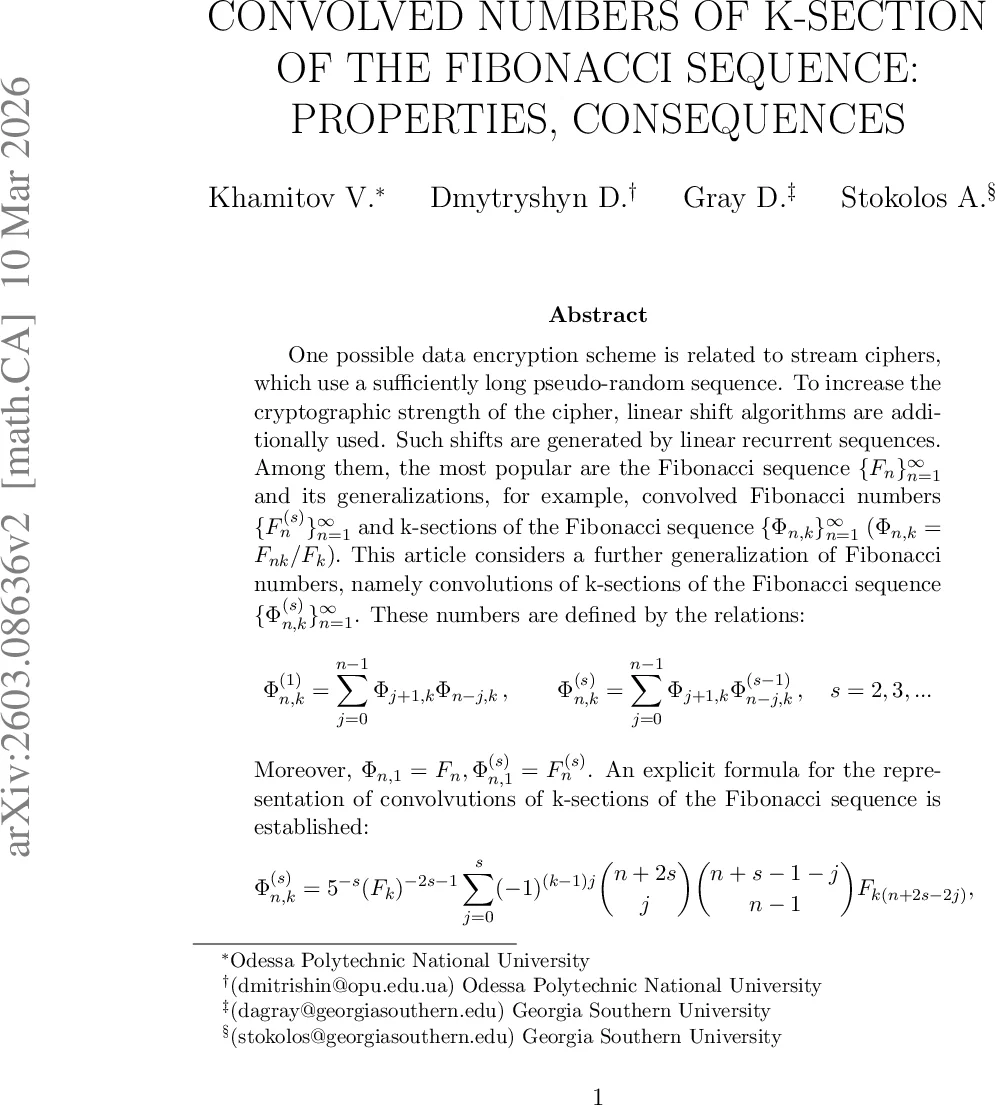
One possible data encryption scheme is related to stream ciphers, which use a sufficiently long pseudo-random sequence. To increase the cryptographic strength of the cipher, linear shift algorithms (generated by linear recurrent sequences such as the Fibonacci sequence and its generalizations) are additionally used. Two such generalizations are convolved Fibonacci numbers ${F_n^{(s)}}{n=1}^\infty$ and k-sections of the Fibonacci sequence ${Φ{n,k}}{n=1}^\infty$ $( Φ{n,k}=F_{nk}/F_k).$ This article considers a further generalization of Fibonacci numbers, namely convolutions of k-sections of the Fibonacci sequence ${Φ_{n,k}^{(s)}}{n=1}^\infty$. These numbers are defined by the relations: $$ Φ{n,k}^{(1)}=\sum_{j=0}^{n-1}Φ_{j+1,k}Φ_{n-j,k,},\qquad Φ_{n,k}^{(s)}=\sum_{j=0}^{n-1}Φ_{j+1,k}Φ_{n-j,k}^{(s-1)},,\quad s=2,3,…$$Moreover, $Φ_{n,1}=F_n, Φ_{n,1}^{(s)}=F_n^{(s)}$. An explicit formula for the representation of convolutions of k-sections of the Fibonacci sequence and a Binet type formula is established:$$Φ_{n,k}^{(s)}=5^{-s}(F_k)^{-2s-1}\sum_{j=0}^{s}(-1)^{(k-1)j}{n+2s\choose j}{n+s-1-j\choose n-1} F_{k(n+2s-2j)}.$$ Several consequences were also obtained for $F_n$ and $F_n^{(s)}$, based on the connection between the derivatives of Chebyshev polynomials of the second kind $U_n(z)$ and their derivatives, as well as the connection for convolutions of k-sections of the Fibonacci sequence with derivatives of Chebyshev polynomials of the second kind via Lucas numbers $L_k$. Note that the sequences ${Φ_{n,k}^{(s)}}_{n=1}^\infty$ for $k=3,4,…$ and $s=1,2,..$ are not included in the OEIS encyclopedia.
💡 Research Summary
The paper investigates a novel generalization of Fibonacci numbers obtained by convolving k‑sections of the Fibonacci sequence. A k‑section is defined as Φₙ,ₖ = F_{nk}/F_k, where F_n denotes the ordinary Fibonacci numbers; this yields an integer sequence for every positive integer k. The authors introduce a family of “convolved k‑section numbers” Φₙ,ₖ^{(s)} by the recursive formulas
Φₙ,ₖ^{(1)} = Σ_{j=0}^{n‑1} Φ_{j+1, k} Φ_{n‑j, k},
Φₙ,ₖ^{(s)} = Σ_{j=0}^{n‑1} Φ_{j+1, k} Φ_{n‑j, k}^{(s‑1)} for s ≥ 2.
When k = 1 the construction collapses to the previously studied convolved Fibonacci numbers Fₙ^{(s)}.
The authors first develop generating‑function representations. The ordinary Fibonacci generating function f(z) = z/(1‑z‑z²) and the k‑section generating function \hat f_k(z) = z/(1‑L_k z + (‑1)^k z²) (where L_k is the k‑th Lucas number) are shown to be specializations of the Chebyshev‑second‑kind generating function g(z,t) = 1/(1‑2tz+z²). Specifically, f(z) = z g(z/i,i/2) and \hat f_k(z) = z g(z/i,(i/2)L_k) for odd k (or z g(z,½L_k) for even k). This yields closed forms for the basic k‑section numbers:
Φₙ,ₖ = (‑i)^{n‑1} U_{n‑1}(i² L_k) (odd k) or U_{n‑1}(½ L_k) (even k), where U_n denotes the Chebyshev polynomial of the second kind.
By differentiating the Chebyshev polynomials, the authors obtain a representation for the convolved k‑sections:
Φₙ,ₖ^{(s)} = (2s)!⁻¹ U_{n+s‑1}^{(s)}(i² L_k) (odd k) or (½ L_k) (even k), where U_n^{(s)} denotes the s‑th derivative. This connection allows the use of known identities for Chebyshev derivatives, notably formulas (13)–(16) in the paper, to derive explicit binomial‑coefficient expansions.
The central explicit formula is:
Φₙ,ₖ^{(s)} = 5^{‑s} (F_k)^{‑2s‑1} ∑{j=0}^{s} (‑1)^{(k‑1)j} C{n+2s}^{ j} C_{n+s‑1‑j}^{ n‑1} F_{k(n+2s‑2j)}.
Here C denotes binomial coefficients and F_m the ordinary Fibonacci numbers. This expression generalizes the known Binet formula for Fibonacci numbers and for convolved Fibonacci numbers, reducing to those cases when k = 1.
A Binet‑type expression is also derived by substituting φ = (1+√5)/2 and its conjugate φ⁻¹, yielding a sum of terms of the form φ^{k(n+2s‑j)} and (‑1)^{kn} φ^{‑k j}. The authors verify that the two representations are equivalent and provide several corollaries, such as identities linking Φₙ,ₖ^{(s)} to Φₙ,ₖ and to the ordinary Fibonacci numbers.
The paper supplies concrete examples for small k and s. For k = 3, the sequences Φ_{n,3}^{(1)} = {1, 8, 50, 280, 1476,…}, Φ_{n,3}^{(2)} = {1, 12, 99, 688, 4326,…}, and Φ_{n,3}^{(3)} = {1, 16, 164, 1360, 9930,…} are computed. While Φ_{n,3}^{(1)} coincides with OEIS A005570 (number of walks on a cubic lattice), the higher‑order convolutions for k ≥ 3 are not listed in OEIS, indicating that the paper introduces genuinely new integer sequences.
From a cryptographic perspective, the authors argue that the convolved k‑section numbers can serve as the basis for pseudo‑random sequence generators in stream ciphers. The underlying linear recurrence (order two) provides efficient hardware implementation, while the convolution (order s) introduces non‑linearity, increasing resistance to linear cryptanalysis. The explicit Binet‑type formulas enable fast computation of terms, and the parameter choices (k, s) allow designers to tune period length and statistical properties.
In conclusion, the work unifies several strands of number‑theoretic combinatorics: Fibonacci and Lucas numbers, k‑section sequences, convolution operations, binomial identities, and Chebyshev polynomial theory. It delivers explicit closed forms, generating‑function analyses, and concrete examples, while highlighting potential applications in cryptography. Future directions suggested include period analysis of Φₙ,ₖ^{(s)} modulo primes, statistical testing of the generated sequences, and integration into practical stream‑cipher constructions.
Comments & Academic Discussion
Loading comments...
Leave a Comment