Observables in $\mathrm{U}(1)^n$ Chern-Simons theory
In this article, we will compute the expectation value of observables (which appear as Wilson loops) in $\mathrm{U}(1)^n$ Chern-Simons theory for closed oriented $3$-manifolds. We will show how the various topological sectors of the observable affect…
Authors: Michail Tagaris, Frank Thuillier
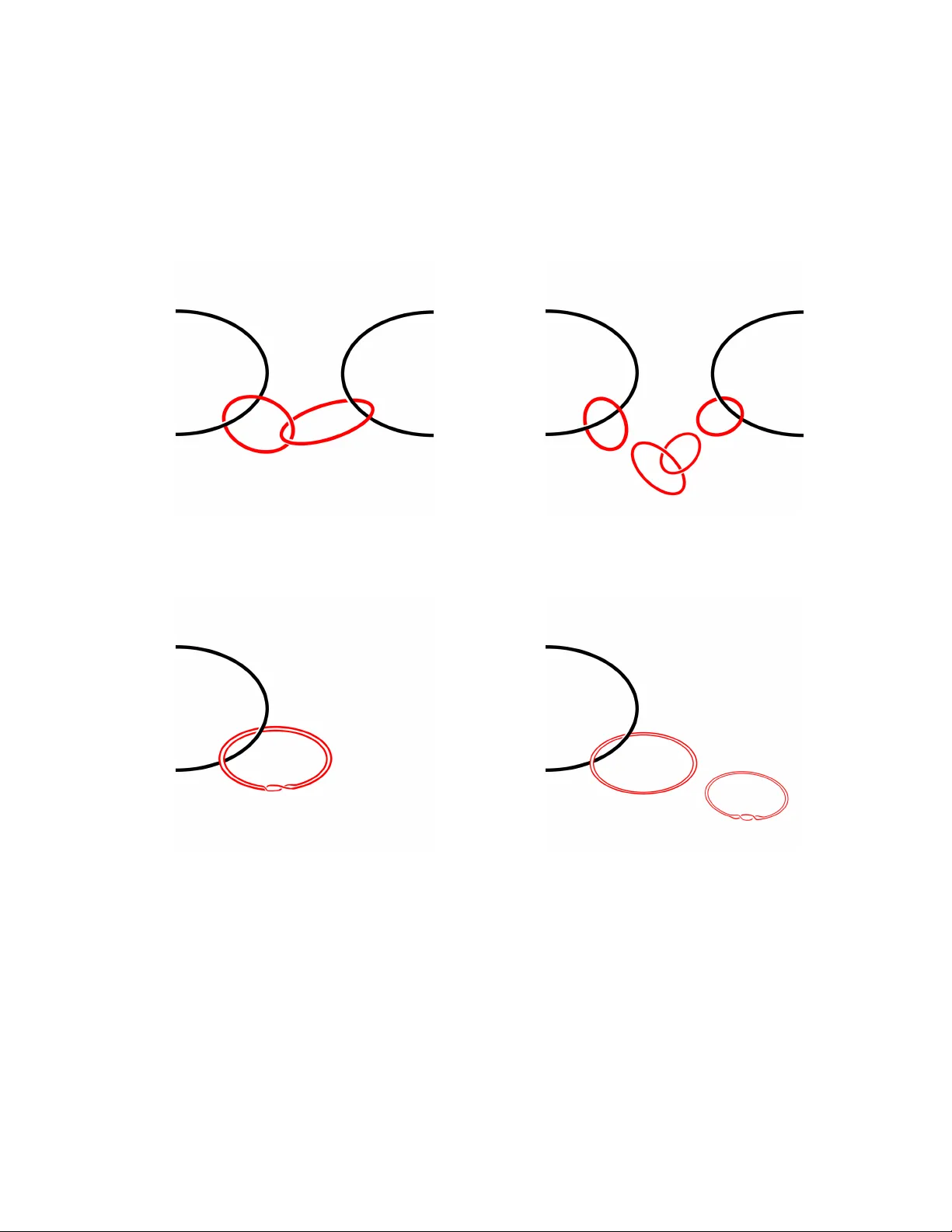
Observ ables in U(1) n Chern-Simons theory Mic hail T agaris and F rank Th uillier LAPTh, Univ. Savoie Mont Blanc, CNRS, F-74000 A nne cy, F r anc e, michail.tagaris@lapth.cnrs.fr and fr ank.thuil lier@lapth.cnrs.fr Abstract In this article, we will compute the expectation v alue of observ ables (which appear as Wilson lo ops) in U(1) n Chern-Simons theory for closed oriented 3 -manifolds. W e will show how the v arious top ological sectors of the observ able affect the expectation v alue and confirm that it is a top ological in v ariant. W e will also exhibit in this case as w ell a form of the CS duality introduced in previous w orks. Finally , to complete the treatment of this theory , w e will compute its zero mo des and the equations of motion. 1 In tro duction In recen t articles, we explored the generalization of the U(1) Chern-Simons (CS) partition function, to the U(1) n case[1] whic h in tro duces some new concepts suc h as the inclusion of U(1) n BF theory into a U(1) 2 n CS and the CS dualit y , whic h shows a connection b et ween t wo Chern-Simons partition functions with different parameters. W e also explored the U(1) n Reshetikhin-T uraev construction [2] and show ed, in this case as well, its connection with Chern- Simons. In this article, we wish to explore the b ehavior of the observ ables on suc h a CS theory and analyze the ab ov e concepts with regard to observ ables as w ell. In the next section, we will p erform the full computation of the exp ectation v alue while taking care of sp ecial cases that arise. At the end of the section we will also discuss how CS dualit y manifests in the observ ables as w ell. Then w e will presen t a couple of examples that show case how the computation and the CS dualit y w ork in actualit y . Finally , in app endix A w e also compute some other quantities related to the CS action, namely the zero modes and the equations of motion. Before we begin, there is an important note ab out the computation of the exp ectation v alue. W e will b e making use of Dehn surgery to represen t the manifold and the observ ables in S 3 to mak e our computations easier. That b eing said, Dehn surgery is not necessary for any of these calculations. 2 Exp ectation v alue of U(1) n observ ables W e will b egin with a short reminder ab out the U(1) CS partition function. W e start with a closed orien ted 3 -manifold M . Since U(1) is topologically not simply connected, the fibre bundle corresp onding to such a gauge group is not generally trivializable. This means that, in general, our fields are not globally defined o v er the whole manifold. T o fix this issue, w e hav e to consider only lo cal fields and make use of the Deligne-Beilinson cohomology [3–6]. W e define the U(1) CS action b y S [ A ] = ˛ M A ⋆ A. This is a functional that takes v alues in R / Z and A are elements of the first Deligne-Beilinson (DB) cohomology of M . In this case, ⋆ denotes the DB product. As a reminder, representativ es of DB classes consist of a 3 -tuple: A = [( X , Λ , ν )] , where X , Λ and ν are families of lo cal fields. The DB product b et ween tw o such classes is comm utative and for B = [( Y , Θ , µ )] it is defined as: A ⋆ B = [( X ∧ d Y , Λ d Y , ν Y , ν Θ , ν µ )] A comprehensiv e analysis of DB cohomology in U(1) Chern-Simons can also be found in [7]. T o generalize the theory to U(1) n w e will consider an n -tuple of suc h fields A = ( A 1 . . . A n ) and the 1 action in this case will b e: S CS C [ A ] = ˛ M A ⊤ ⋆ C A := X i,j C ij ˛ M A i ⋆ A j . C ij are in teger num b ers b elonging to an integer matrix C . T o make sense of this integral, since it is only well defined modulo integers, w e will hav e to ev aluate it in a complex exp onen tial. So the CS partition function looks lik e this: Z CS C = 1 N ˆ D A e 2 iπ S C [ A ] , with N a normalization defined such that it gets rid of an infinite sector that appears later in the computation. A small commen t on the notation. W e will use b old symbols lik e A when our quan tities are defined in U(1) n and thus are n -tuples of regular, non-b olded v ariables. 2.1 Computing the exp ectation v alue If w e ha ve a Wilson lo op represen ted by a closed path γ inside the manifold, the observ able asso ciated with it in the U(1) case is the follo wing: W ( A, γ ) = e 2 iπ ´ γ A , The U(1) case through DB cohomology , has b een studied extensiv ely by [8, 9]. In the U(1) n case this generalizes to W ( A , γ ) = e 2 iπ ´ γ A , where now γ is an n -tuple of Wilson lo ops inside the manifold. By using the DB pro duct, we can define the distributional DB class η with supp ort on γ suc h that ´ γ A = ´ M A ⋆ η . The exp ectation v alue will then be “ ⟨⟨ W M ( A , η ) ⟩⟩ CS C = 1 N CS C ( M ) ˆ ( H 1 DB ( M ) ) n D A e 2 π i ( S CS C ( A )+ ´ M A ⋆ η ) ” . (1) It is w orth noting that here again, the observ ables in a U(1) n BF theory w ould b e a sub-case of a U(1) 2 n CS theory since ⟨⟨ W M ( A , B , η 1 , η 2 ) ⟩⟩ BF C = 1 N BF C ( M ) ˆ ( H 1 DB × ( M ) ) n × ( H 1 DB × ( M ) ) n D A D B e 2 π i ( S BF C ( A , B )+ ´ M A ⋆ η 1 + ´ M B ⋆ η 2 ) = 1 N CS C ′ ( M ) ˆ ( H 1 DB ( M ) ) 2 n D A e 2 π i ( S CS C ′ ( A ′ ) + ´ M A ′ ⋆ η ′ ) , 2 with A ′ = A ⊕ B , η ′ = η 1 ⊕ η 2 and C ′ = Å 0 C 0 0 ã . In principle, we can compute the exp ectation v alue of an y DB class B simply by replacing η with a general B , but for no w we will restrict to exp ectation v alues of classes/distributions, asso ciated with loops. In general, our observ ables could also b e links, i.e., a collection of lo ops. This means that now we hav e t wo types of links, the surgery link (on which Dehn surgery will b e p erformed) and the observ able link that will not undergo surgery itself but will be affected b y the surgery depending on whic h comp onents it was link ed to. This description with tw o links (one observ able and one for surgery) can also be seen in [10]. In U n (1) , as we explained earlier, the observ able link will in-fact b e n -fold, one for eac h copy of the gauge group. Eac h of these n folds can still link and in teract with eac h other. By cutting and gluing, suc h a link γ inside the manifold can alw a ys b e decomp osed homologically in to three parts: γ = γ 0 + γ t + γ f . These parts corresp ond to the free, the torsion and the top ologically trivial components of the link. F urthermore, we can alwa ys cut our link in such a wa y that the comp onents are simple unknots, eac h b elonging to one of these three parts. This decomp osition of γ in turn, causes a decomp osition of η . γ = γ 0 + γ t + γ f η = ω + j Σ + η t + η f | {z } | {z } P erturbative Non-perturb part part Let us examine the part of η that corresp onds to torsion (i.e. j Σ + η t ). The DB-tuple of a generator of order p of that part w ould lo ok lik e this: ( ∂ Σ /p, m/p, n ) . j Σ η t Where j Σ = ∂ Σ /p are currents, such that pj Σ is dual to the boundary of a surface. η t are in fact, the pseudo-canonical origins of DB [1, 8]. W e can no w p erform computations with η . The field A also admits a decomp osition [11] A = A m A ∈ F H 2 ( M ) + A κ A ∈ T H 2 ( M ) + α ⊥ ∈ Ω 1 ( M ) / Ω 1 cl ( M ) + α 0 ∈ Ω 1 cl ( M ) / Ω 1 Z ( M ) , 3 whic h, in turn, induces a decomposition on A . With that in mind, equation (1) decomp oses as: “ ⟨⟨ W M ( A , η ) ⟩⟩ CS C = 1 N CS C ( M ) X κ A ∈ ( T H 2 ( M )) n e 2 π i ´ M ( A ⊤ κ A ⋆ CA κ A + A ⊤ κ A ⋆ η ) X m A ∈ ( F H 2 ( M )) n e 2 π i ( ´ M A ⊤ κ A ⋆ CA m A + ´ M A ⊤ m A ⋆ CA κ A + ´ M A ⊤ m A ⋆ η ) ˆ ( Ω 1 cl ( M ) / Ω 1 Z ( M ) ) n D α 0 e 2 π i ( ´ M A ⊤ m A ⋆ C α 0 + ´ M α ⊤ 0 ⋆ CA m A + ´ M α ⊤ 0 ⋆ η ) ˆ ( Ω 1 ( M ) / Ω 1 cl ( M ) ) n D α ⊥ e 2 π i ( ´ M A ⊤ m A ⋆ C α ⊥ + ´ M ( α ⊥ ) ⊤ ⋆ CA m A + ´ M ( α ⊥ ) ⊤ ⋆ C α ⊥ + ´ M ( α ⊥ ) ⊤ ⋆ η ) ” Because distributional DB classes ha ve integer linking [8]: ˆ M A ⊤ m A ⋆ η = Z 0 . No w using the fact that ˆ M A ⊤ m A ⋆ C α 0 = Z m ⊤ A C θ A , ˆ M α ⊤ 0 ⋆ CA m A = Z θ ⊤ A Cm A and ˆ M α ⊤ 0 ⋆ η = ˆ M α ⊤ 0 ⋆ η f = Z θ ⊤ A f ˆ ( R / Z ) n d θ A e 2 π i ( θ ⊤ A ( Km A + f ) ) = δ ( Km A + f ) . Where f ∈ ( F H 2 ( M )) n ≃ ( Z b 1 ) n is the class of the free homology comp onent corresp o ding to η f . As long as the equation ( Km A + f ) = 0 has a solution for integer v ectors f and m A , the terms ´ M A ⊤ κ A ⋆ CA m A + ´ M A ⊤ m A ⋆ CA κ A will cancel out with the free part, ´ M A ⊤ κ A ⋆ η f , of the term ´ M A ⊤ κ A ⋆ η . The same is true for ´ M A ⊤ m A ⋆ C α ⊥ + ´ M ( α ⊥ ) ⊤ ⋆ CA m A , and the free part of ´ M ( α ⊥ ) ⊤ ⋆ η . Since w e used the pseudo-canonical origins for A κ A , then ˆ M A ⊤ κ A ⋆ C ( ω + j Σ ) = 0 , 4 (trivial by p erforming the computation). F or the same reason, ˆ M ( α ⊥ ) ⊤ ⋆ η t = 0 , as well. Hence, the only parts of η coupling to α ⊥ are the perturbative parts ω and j Σ . So w e remain with: “ ⟨⟨ W M ( A , η ) ⟩⟩ CS C = 1 N CS C ( M ) X κ A ∈ ( T H 2 ( M )) n e 2 π i ´ M ( A ⊤ κ A ⋆ CA κ A + A ⊤ κ A ⋆ η t ) ˆ ( Ω 1 ( M ) / Ω 1 cl ( M ) ) n D α ⊥ e 2 π i ( ´ M ( α ⊥ ) ⊤ ⋆ C α ⊥ + ´ M ( α ⊥ ) ⊤ ⋆ ( ω + j Σ ) ) ” F or the sake of notation, we will refer to ω + j Σ as η p for the next calculation ( p stands for p erturbativ e). The normalization N CS C ( M ) will b e defined in the same wa y as the partition function and will b e: N CS C ( M ) = ˆ ( Ω 1 ( M ) / Ω 1 cl ( M ) ) n D α ⊥ e 2 π i ( ´ M ( α ⊥ ) ⊤ ⋆ C α ⊥ ) . Substituting the normalization we will hav e: ⟨⟨ W M ( A , η ) ⟩⟩ CS C = X κ A ∈ ( T H 2 ( M )) n e − π i κ ⊤ A ( K ⊗ Q ) κ A − 2 κ ⊤ A ( Id ⊗ Q ) τ ´ ( Ω 1 ( M ) / Ω 1 cl ( M ) ) n D α ⊥ e 2 π i ( ´ M ( α ⊥ ) ⊤ ⋆ C α ⊥ + ´ M ( α ⊥ ) ⊤ ⋆ η p ) ´ ( Ω 1 ( M ) / Ω 1 cl ( M ) ) n D α ⊥ e 2 π i ( ´ M ( α ⊥ ) ⊤ ⋆ C α ⊥ ) , with τ ∈ T H 2 ( M ) the torsion class corresp onding to η t . The term ´ ( Ω 1 ( M ) / Ω 1 cl ( M ) ) n D α ⊥ e 2 π i ( ´ M ( α ⊥ ) ⊤ ⋆ C α ⊥ + ´ M ( α ⊥ ) ⊤ ⋆ η p ) ´ ( Ω 1 ( M ) / Ω 1 cl ( M ) ) n D α ⊥ e 2 π i ( ´ M ( α ⊥ ) ⊤ ⋆ C α ⊥ ) is called the p erturbative term of the exp ectation v alue. T o calculate that, we will fo cus on the exp onen t of the n umerator. F or the next calculation, w e wil l use the notation K − 1 η p . Rigorously , this is an abuse of notation since we cannot m ultiply DB classes b y a rational n umber. It only mak es sense here since the class η p is of the form [( a , 0 , 0)] so by K − 1 η p w e mean the class [( K − 1 a , 0 , 0)] . Before we work on the exponent, w e wan t to perform the follo wing calculation: 2 π i ˆ M ( α ⊥ ) ⊤ + K − 1 η ⊤ p ⋆ C α ⊥ + K − 1 η p = 5 2 π i ˆ M ( α ⊥ ) ⊤ ⋆ C α ⊥ + ( α ⊥ ) ⊤ ⋆ CK − 1 η p + K − 1 η ⊤ p ⋆ C α ⊥ + K − 1 η ⊤ p ⋆ CK − 1 η p = 2 π i ˆ M ( α ⊥ ) ⊤ ⋆ C α ⊥ + ( α ⊥ ) ⊤ ⋆ ( C + C ⊤ ) K − 1 η p + K − 1 η ⊤ p ⋆ CK − 1 η p = 2 π i ˆ M ( α ⊥ ) ⊤ ⋆ C α ⊥ + ( α ⊥ ) ⊤ ⋆ η p + K − 1 η ⊤ p ⋆ CK − 1 η p So now we can rewrite the exp onent in the n umerator as 2 π i ˆ M ( α ⊥ ) ⊤ + K − 1 η ⊤ p ⋆ C α ⊥ + K − 1 η p − 2 π i ˆ M K − 1 η ⊤ p ⋆ CK − 1 η p The first term is a shift on the infinite dimensional part which gets eliminated b y the normal- ization. F or the second term w e can do the following: − 2 π i ˆ M K − 1 η ⊤ p ⋆ CK − 1 η p = − 2 π i ˆ M K − 1 η ⊤ p ∧ CK − 1 d η p = − π i ˆ M K − 1 η ⊤ p ∧ CK − 1 d η p + K − 1 η ⊤ p ∧ C ⊤ K − 1 d η p = − π i ˆ M K − 1 η ⊤ p ∧ KK − 1 d η p = There would b e three contributions to this term: K − 1 ω ⊤ ∧ KK − 1 d ω , K − 1 j ⊤ Σ ∧ KK − 1 d j Σ and 2 K − 1 ω ⊤ ∧ KK − 1 d j Σ . The first term is nothing but the linking and self-linking b etw een the trivial comp onents of the lo op: − π i ( K − 1 ⊗ ℓk )( γ 0 , γ 0 ) . T o compute this, we w ould need a framing on the trivial parts of the loop. The last term is the linking b etw een the torsion and trivial parts of the lo op: − π i ( K − 1 ⊗ ℓk )( γ 0 , γ t ) . Note that we can alwa ys take this term to b e 0 , again b y cutting and gluing all torsion generators to b e unlink ed with the rest of the link. An example can b e seen later in figure 1. Now, the middle term requires a small computation. Because of zero regularization we hav e: ˆ M ( η t + j Σ ) ⊤ ⋆ C ( η t + j Σ ) mod Z = 0 . But also, ˆ M ( η t + j Σ ) ⊤ ⋆ C ( η t + j Σ ) = ˆ M η ⊤ t ⋆ C η t + ˆ M j ⊤ Σ ⋆ C j Σ , 6 and ˆ M η ⊤ t ⋆ C η t mod Z = − ( C ⊗ Q )( τ , τ ) . This means that: ˆ M j ⊤ Σ ⋆ C j Σ mod Z = ( C ⊗ Q )( τ , τ ) . (2) Here though w e hav e something different, we had − 2 π i ˆ M K − 1 j ⊤ Σ ∧ CK − 1 d j Σ , or equiv alently by the commutativit y of w edge pro duct: − π i ˆ M K − 1 j ⊤ Σ ∧ KK − 1 d j Σ . Assigning a v alue to this quan tit y is a bit tric ky . The problem is that now, w e cannot w ork mo d Z as b efore since our currents are m ultiplied by a rational matrix. T o b e able to assign a meaningful v alue to this quantit y , w e need to use a geometric point of view. W e will use the fact that our manifold can b e constructed by Dehn surgery , on a link L describ ed by the linking matrix L . Afterw ards we will consider how the lo op γ t in tersects L b efore the surgery , while living in S 3 . Note that up until no w we did not require our manifold to b e coming from Dehn surgery . As men tioned in the in tro duction, this is still true but this picture allows us a consisten t wa y to choose represen tatives for the previous quantities. F or simplicity w e will tak e L to be non-degenerate, but w e will examine the degenerate case later to o. Giv en a surgery link L and our observ able loop γ | S 3 , now in S 3 b efore the surgery , we can use the followin g ideas. First of all, w e do not care about the part of the observ able correspond- ing (after surgery) to the free sector as this will v anish. Secondly , without loss of generality , w e can consider the framing (self-linking) of the torsion part of the observ able lo op to b e 0 in S 3 . That is b ecause we can alwa ys transfer this framing to a new trivial comp onent that w e can split from the torsion part [8]. Lastly , w e can consider the torsion parts to b e unlink ed to eac h other, that is b ecause, similar to the previous idea, we can alw ays extract this linking to a trivial component. All of these ideas can b e seen below in figure 1. This means that w e can alw ays take the torsion parts to be unknots that link simply to eac h component of the surgery link. This is a consequence of the theory b eing ab elian, all the exp ectation v alues are based on linking n umbers and thus we can cut and glue as long as we k eep the linking in tact [8, 11]. In the cases where they are link ed t wice or more, we will sa y that the observ able has a charge equal to that linking num b er. Note that just b ecause the torsion parts are not linked to each other in S 3 (pre-surgery), do es not mean that they do not interact. In fact, the reason we w ant them to b e unlinked is to av oid extra interaction terms. These comp onents still in teract naturally through the linking form (for observ able comp onen ts coupled to different surgery components) 7 and through the K matrix (for observ able comp onents b elonging in differen t copies of the gauge group). Now we can start the computation. W e could represen t γ t b y the v ector ℓ whose components can b e defined as ℓ i = ℓk ( γ t , L i ) | S 3 . This ℓ is closely related to τ , in fact, ℓ is a sp ecific representativ e of the class of τ expressed in the basis of ( Z m / L Z m ) n whic h is isomorphic to T H 2 ( M ) . In other w ords, the class of ℓ is equiv- alen t to τ under the ab ov e isomorphism. Now w e w ant to define ℓk ( γ t , γ t ) | M but in Q instead of Q / Z . By the prop erties of the linking matrix, the lo op ( L ⊗ I d ) γ t w ould b e a trivial lo op after surgery (i.e., the boundary of a surface). Thus, the linking num b er ℓk ( γ t , ( L ⊗ I d ) γ t ) | M w ould b e an integer and equal to ℓ T · ℓ . So no w we can set ℓk ( γ t , γ t ) | M = ℓ T ( L − 1 ⊗ Id ) ℓ This now gives us a meaningful wa y to assign a v alue to the expression as − π i ˆ M K − 1 j Σ ∧ KK − 1 d j Σ = − πiℓk ⊤ ( γ t , ( Id ⊗ K − 1 ) γ t ) = − π i ( K − 1 ⊗ L − 1 )( ℓ , ℓ ) . And since Q ( τ , τ ) mod Z = L − 1 ( ℓ , ℓ ) , we can write the whole thing as: ⟨⟨ W M ( L , γ | S 3 ) ⟩⟩ CS K = X κ A ∈ ( Z m / L Z m ) n e − π i κ ⊤ A ( K ⊗ L − 1 ) κ A − 2 κ ⊤ A ( Id ⊗ L − 1 ) ℓ (3) e − π i ( K − 1 ⊗ ℓk )( γ 0 , γ 0 + γ t ) e − π i ( K − 1 ⊗ L − 1 )( ℓ , ℓ ) , where no w w e replaced the manifold with its surgery link L and the observ able has b een replaced with an observ able link pre-surgery . Moreo ver, we lab el the expectation with the subscript CS K instead of CS C b ecause now it is based on the matrix K . In the next section we will analyze the remaining term and also see the cases where K and L are degenerate. Note that the degeneracy of L is related to the free homology of the manifold. This means that everything inv olving η f , including the condition ( Km A + f ) = 0 , are relev ant only when L is degenerate. 2.2 Recipro cit y and degenerate case In previous articles, we dealt with terms of the form: X κ A ∈ ( T H 2 ( M )) n e − π i κ ⊤ A ( K ⊗ Q ) κ A through the use of a reciprocity formula. Now we are dealing with a term of similar form, albeit with a linear comp onent as well. Thankfully , for this case there is also a recipro city form ula but w e ha ve to adapt the parameters. F or a non-degenerate symmetric n × n matrix K and a 8 (a) T w o surgery components (in black) that hav e torsion observ able components (in red) linked to them and in terlinked to eac h other. (b) The same links as figure 1a but now w e ha ve split the torsion comp onents so that the interlinking has passed to trivial comp onen ts. (c) A surgery comp onent that is linked to a torsion observ able that has some fram- ing (self-linking). The observ able is rep- resen ted as a ribb on so the framing can b e sho wn as a twist of that ribb on. (d) The same links as in figure 1c but now w e ha v e extracted the twist (i.e. the fram- ing) into a trivial comp onent, so the tor- sion observ able component has zero fram- ing. Figure 1: Extracting the framing and the interlinking from the torsion parts of the observ able. 9 non-degenerate symmetric m × m matrix L , from [12], w e know that the following reciprocity form ula is true: 1 | det ( K ) | m 2 X x L ∈ ( Z n / K Z n ) m e π i x ⊤ L ( L ⊗ K − 1 ) x L − π i x ⊤ L ( L ⊗ Id n ) u = 1 | det ( L ) | n 2 e iπ 4 ( σ ( K ) σ ( L ) − u ⊤ eu ) X κ A ∈ ( Z m / L Z m ) n e − π i κ ⊤ A ( K ⊗ L − 1 ) κ A + π i κ ⊤ A ( K ⊗ Id m ) u ′ . (4) Where u is a rational W u class for e = L ⊗ K , i.e., it ob eys the equation x ⊤ ex + x ⊤ eu ∈ 2 Z for all x ∈ Z mn . The primed v ariables (e.g., u ′ ) signify the images of their non-primed coun terparts under tensor permutation, meaning that x ⊤ ( L ⊗ K ) y = x ′⊤ ( K ⊗ L ) y ′ . F or this notation, it is easy to see that x ′′ = x . Now, if one of the matrices L or K is even, we kno w that 2( L ⊗ K ) − 1 w with w an integer vector, will alwa ys b e suc h a rational W u class ( x ⊤ ex ∈ 2 Z by the evenness and x ⊤ eu = 2 x ⊤ w ∈ 2 Z ). By c ho osing w = − ℓ ′ and substituting u ′ = 2( K ⊗ L ) − 1 ℓ and u = 2( L ⊗ K ) − 1 ℓ ′ w e get: 1 | det ( K ) | m 2 X x L ∈ ( Z n / K Z n ) m e π i x ⊤ L ( L ⊗ K − 1 ) x L +2 π i x ⊤ L ( Id m ⊗ K − 1 ) ℓ ′ (5) = 1 | det ( L ) | n 2 e iπ 4 ( σ ( K ) σ ( L ) − 4 ℓ ′⊤ ( L ⊗ K ) − 1 ℓ ′ ) X κ A ∈ ( Z m / L Z m ) n e − π i κ ⊤ A ( K ⊗ L − 1 ) κ A − 2 π i κ ⊤ A ( Id n ⊗ L − 1 ) ℓ . So far, L and K hav e b een non-degenerate. In general, our matrices might be degenerate so we ha ve to accoun t for that case. When calculating the partition function, we could compute the con tribution of a 0 -sector quite easily . No w we ha v e to address a few issues. First of all, b y c hanging the dimension of L w e need to c hange the dimension of u . If L is a degenerate m × m matrix of rank r , it can alwa ys b e transformed b y Kirb y mo ves to L → L 0 ⊕ 0 m − r [13, 14] where no w L 0 is an r × r non-degenerate matrix. Now assuming that we ha ve a u whose pro jection on the non-degenerate subspace of L is u right (the notation will b ecome clearer later) then the sum on the left-hand-side of 4 will b ecome: X x L ∈ ( Z n / K Z n ) m e π i x ⊤ L ( L ⊗ K − 1 ) x L − π i x ⊤ L ( L ⊗ Id n ) u = = X x L ∈ ( Z n / K Z n ) r e π i x ⊤ L ( L 0 ⊗ K − 1 ) x L − π i x ⊤ L ( L 0 ⊗ Id n ) u right · X x L ∈ ( Z n / K Z n ) m − r 1 = | det ( K ) | m − r X x L ∈ ( Z n / K Z n ) r e π i x ⊤ L ( L 0 ⊗ K − 1 ) x L − π i x ⊤ L ( L 0 ⊗ Id n ) u right . So, w e get a factor of | det ( K ) | for ev ery degenerate direction we add. W e see that the calculation is the same as for the partition function but we only use a pro jection of u at the end. The sum 10 on the right-hand-side, will be the same as long as we use L 0 (and its appropriate dimensions) instead of L and u right . The phase will remain the same. A similar computation o ccurs for the righ t hand side but it will hav e a different pro jection u ′ left , namely a pro jection on the space where K is degenerate this time. And finally , there will b e one more projection, the pro jection of u on to both of these subspaces u middle . F or b oth K and L degenerate, w e w ould ha ve the follo wing formula: 1 | det ( K 0 ) | m − r 2 X x L ∈ ( Z s / K 0 Z s ) m e π i x ⊤ L ( L ⊗ K − 1 0 ) x L − π i x ⊤ L ( L ⊗ Id s ) u left = 1 | det ( L 0 ) | n − s 2 e iπ 4 ( σ ( K ) σ ( L ) − u ⊤ eu ) X κ A ∈ ( Z r / L 0 Z r ) n e − π i κ ⊤ A ( K ⊗ L − 1 0 ) κ A + π i κ ⊤ A ( K ⊗ Id r ) u ′ right (6) Note that we can replace u ⊤ eu in the phase b y u ⊤ middle ( L 0 ⊗ K 0 ) u middle . It is easy to see now that the follo wing will b e a W u class for e , u = 2(( L − 1 0 ⊕ 0 ) ⊗ ( K − 1 0 ⊕ 0 )) w ′ , for some integer v ector w . W e will c ho ose w = ℓ with ℓ the vector we defined earlier from the linking of the observ able lo op. Similarly w e w ould hav e u ′ right = 2(( K − 1 0 ⊕ 0 ) ⊗ L − 1 0 ) ℓ right , u left = 2(( L − 1 0 ⊕ 0 ) ⊗ K − 1 0 ) ℓ ′ left and u middle = 2( L 0 ⊗ K 0 ) − 1 ℓ ′ middle . With those substitutions in mind the equation becomes: 1 | det ( K 0 ) | m − r 2 X x L ∈ ( Z s / K 0 Z s ) m e π i x ⊤ L ( L ⊗ K − 1 0 ) x L − 2 π i x ⊤ L ( ( Id r ⊕ 0 ) ⊗ K − 1 0 ) ℓ ′ left = 1 | det ( L 0 ) | n − s 2 e iπ 4 ( σ ( K ) σ ( L ) − 4 ℓ ′ middle ⊤ ( L 0 ⊗ K 0 ) − 1 ℓ ′ middle ) X κ A ∈ ( Z r / L 0 Z r ) n e − π i κ ⊤ A ( K ⊗ L − 1 0 ) κ A +2 π i κ ⊤ A ( ( Id s ⊕ 0 ) ⊗ L − 1 0 ) ℓ right . (7) As w e mentioned earlier ℓ right (or ℓ when L is in vertible) is related to what w e were calling τ . While ℓ right is a sp ecific representativ e of a class b elonging in ( Z r / L 0 Z r ) n , τ is an abstract elemen t of T H 2 ( M ) . This distinction is very important as it shows the difference betw een using Q and L − 1 0 . While Q is acting on elements of the torsion group, L − 1 0 is acting on vectors in the L 0 mo dule ( Z r / L 0 Z r ) n . When computing the partition function, this difference did not come in to play . That is b ecause w e were summing ov er all elemen ts of the torsion group T H 2 ( M ) and ev aluating the bilinear forms on these elements only , so it did not matter which basis we w ere using. Moreov er, the sp ecific representativ e of the torsion class now also matters and it is part of the choices w e ha v e to make for this computation. On the exp ectation v alue side, this c hoice is only important for calculating the phase. In principle, we only need the class of ℓ right for the sum. This might cause some confusion as to where each v ariable lies. F or equation (7), on the righ t-hand-side sum, ℓ right needs to only be defined mo d ( L 0 ) ⊗ n . Ho wev er, on the phase factor, ℓ ′ middle needs to b e defined mod ( L 0 ⊗ K 0 ) . Lastly , ℓ ′ left is defined mod ( K 0 ) ⊗ m . But 11 of course, all these are just pro jections of a single ℓ so it migh t seem parado xical how it can be w ell defined in all these different mo dules. W e will see the answer to that at the end of this section. Let’s take a momen t to understand the structure of ℓ as a whole. In general, ℓ contains some top ologically trivial comp onents but for this part of the computation we will not need them. A more accurate definition of ℓ in the degenerate case would be ℓ i = ℓk ( γ , L i ) | S 3 . In U(1) , ℓ has a part that comes from the torsion homology of the manifold and a part that comes from the free homology . In U(1) n , ℓ has again the same comp onents but n -fold (coming from K b eing n × n ), i.e. it is an n -dimensional vector where each component is a v ector ℓ with a torsion and free part. During the computation, we see that the free part needs to b e trivial mod K and it do es not contribute to the partition function so we only considered ℓ right ≃ τ , the torsion part. W e see that this is a natural consequence of the partition function computation and it also appears naturally in the recipro city formula. How ever, ℓ right is also n -fold v ector and some of its comp onents might correspond to directions where K is degenerate. The structure of ℓ similarly τ can b e shown in this diagram. ℓ L tors L free K tors ℓ tors tors ℓ tors free = ℓ middle K free ℓ free tors ℓ free free = ℓ right ≃ τ = ℓ left A priori there is no reason for the directions of ℓ right ≃ τ corresp onding to the degeneracy of K to b e 0 . In the case where K is degenerate, w e can alwa ys bring it to a form K 0 ⊕ 0 via a sequence of field redefinitions (the equiv alen t of the second Kirb y mov es for K ), where now 0 is some 0 -matrix equal to the dimension of the degenerate part of K (i.e its corank). F urthermore, let τ 1 = τ | K tors ≃ ℓ middle and τ 2 = τ | K free ≃ ℓ free tors to sa ve space. If K was an n × n matrix of rank s . The non-perturbative part of the expectation v alue will now b ecome: X κ A ∈ ( T H 2 ( M )) n e − π i κ ⊤ A ( ( K 0 ⊕ 0 ( n − s ) ) ⊗ Q ) κ A − 2 κ ⊤ A ( Id n ⊗ Q ) τ = X κ A ∈ ( T H 2 ( M )) n exp − π i κ ⊤ A ( K 0 ⊕ 0 ( n − s ) ) ⊗ Q κ A − 2 κ ⊤ A (( Id s ⊕ Id ( n − s ) ) ⊗ Q ) τ = X κ A ∈ ( T H 2 ( M )) s exp − π i κ ⊤ A ( K 0 ⊗ Q ) κ A − 2 κ ⊤ A ( Id s ⊗ Q ) τ 1 X κ A ∈ ( T H 2 ( M )) n − s exp − π i κ ⊤ A 0 ( n − s ) ⊗ Q κ A − 2 κ ⊤ A ( Id ( n − s ) ⊗ Q ) τ 2 . F rom the last result, the first sum is just the exp ectation v alue for the non-degenerate case. F or 12 the second sum, it is easy to see now that: X κ A ∈ ( T H 2 ( M )) n − s exp − 2 κ ⊤ A ( Id ( n − s ) ⊗ Q ) τ 2 = ® | T H 2 ( M ) | n − s if τ 2 = 0 (as a class) 0 otherwise With that in mind, we can now write the follo wing about the non-p erturbative part of our exp ectation v alue: X κ A ∈ ( T H 2 ( M )) n e − π i κ ⊤ A ( ( K 0 ⊕ 0 ( n − s ) ) ⊗ Q ) κ A − 2 κ ⊤ A ( Id n ⊗ Q ) τ = | T H 2 ( M ) | n − s δ τ 2 X κ A ∈ ( T H 2 ( M )) s exp − π i κ ⊤ A ( K 0 ⊗ Q ) κ A − 2 κ ⊤ A ( Id s ⊗ Q ) τ 1 = δ τ 2 X κ A ∈ ( T H 2 ( M )) n exp − π i κ ⊤ A (( K 0 ⊕ 0 n − s ) ⊗ Q ) κ A − 2 κ ⊤ A (( Id s ⊕ 0 n − s ) ⊗ Q ) τ . In this form, this sum, matc hes the sum on the righ t hand side of 7 , thus w e can use the recipro cit y formula. F urthermore, there is something extra we can sa y about ℓ free free . Earlier, w e calculated that ( Km A + f = 0) m ust ha ve a solution for in teger m A . Now f is the equiv alent of τ for the free section, suc h that ℓ ≃ τ ⊕ f . F or the degenerate directions of K this equation b ecomes f | K free = 0 . And since ℓ free free = f | K free , then ℓ free free = 0 exactly . Lastly , when K is degenerate, we will also hav e to deal with the cases where there are trivial observ able lo ops on the directions that K is degenerate. F or these directions, the in tegral: ˆ ( Ω 1 ( M ) / Ω 1 cl ( M ) ) s D α ⊥ e 2 π i ( ´ M ( α ⊥ ) ⊤ ⋆ C α ⊥ + ´ M ( α ⊥ ) ⊤ ⋆ η p ) , ends up being ˆ ( Ω 1 ( M ) / Ω 1 cl ( M ) ) s D α ⊥ e 2 π i ( ´ M ( α ⊥ ) ⊤ ⋆ ω ) = Ç ˆ Ω 1 ( M ) / Ω 1 cl ( M ) D α ⊥ e 2 π i ( ´ M α ⊥ ∧ dω ) å s . This expression is, of course, not mathematically w ell-defined, but w e can p erform a heuristic computation, just lik e in the partition function, to obtain a meaningful result. The expression 2 π i ´ M α ⊥ ∧ dω defines a linear functional on ω ; therefore, the whole expression can b e con- sidered an infinite-dimensional F ourier transform of the unit. T o be consistent with the finite- dimensional cases, using the ideas of [15–17], w e could extend the finite-dimensional F ourier transforms such that the whole expression can b e: “ Ç ˆ Ω 1 ( M ) / Ω 1 cl ( M ) D α ⊥ e 2 π i ( ´ M α ⊥ ∧ dω ) å s = ® | v ol( Ω 1 ( M ) Ω 1 cl ( M ) ) | s if ω = 0 (as a class) 0 otherwise ” 13 In other w ords, when ω | K free = 0 , we will get an infinite factor that will get absorbed by the normalization and when ω | K free = 0 , our partition function will be 0 . So o verall, our partition function will get an extra δ ω | K free term. With everything in mind, we can now write 3 as ⟨⟨ W M ( L , γ | S 3 ) ⟩⟩ CS K = | det( L 0 ) | n − s δ ω | K free δ ℓ free free δ mod L 0 ℓ free tors δ mod K 0 ℓ tors free e − π i ( K − 1 0 ⊗ ℓk )( γ 0 , γ 0 ) e − π i ℓ ⊤ middle ( K − 1 0 ⊗ L − 1 0 ) ℓ middle . X κ A ∈ ( Z r / L 0 Z r ) s e − π i κ ⊤ A ( K 0 ⊗ L − 1 0 ) κ A − 2 κ ⊤ A ( Id s ⊗ L − 1 0 ) ℓ middle (8) By writing it like this, w e can also notice, that in the last line, we can complete the square and get: X κ A ∈ ( Z r / L 0 Z r ) s e − π i ( κ A + K − 1 0 ℓ middle ) ⊤ ( K 0 ⊗ L − 1 0 ) ( κ A + K − 1 0 ℓ middle ) , with a small abuse of notation for K − 1 0 ℓ middle to mean ( K − 1 0 ⊗ Id r ) ℓ middle . No w, with this form, we see that for the exp ectation v alue, ℓ middle need only b e defined mo d ( K 0 ) ⊗ r . This no w shows how we can pass from a v ariable that is defined mo d ( L 0 ) ⊗ s to one that is defined mo d ( K 0 ) ⊗ r . Finally , w e can notice that before completing the square, the modulus of the sum on the last line, w as dep endent on ℓ middle mo d ( L 0 ) ⊗ s . After completing the square, the modulus dep ends on ℓ middle mo d ( K 0 ) ⊗ r , y et the only difference b etw een them is a phase (whic h do es not affect the mo dulus). This sho ws that the mo dulus in fact dep ends on b oth ℓ middle mo d ( L 0 ) ⊗ s and ℓ middle mo d ( K 0 ) ⊗ r . When s = r = 1 , L 0 = p and K 0 = q , this just means that the modulus dep ends only on ℓ middle mo d gcd( p, q ) . On arbitrary dimensions, this w ould cause the mo dulus to dep end on ℓ middle mo d G ( K ⊗ r 0 , L ⊗ s 0 ) with G : M d × d ( Z ) × M d × d ( Z ) → M d × d ( Z ) , whic h would constitute a generalization of the gcd function from in tegers to integer matrices. Finally , w e claim that this exp ectation v alue constitutes a manifold in v ariant. T o show that, w e just hav e to show inv ariance under Kirby mov es on L . As a reminder, t wo surgery links giv e the same manifold, if and only if they are related b y a series of Kirb y mo ves, ambien t isotop y and reordering of link comp onents. Since ℓ is defined from the link, the Kirb y mo v es will ha ve an effect on it as w ell. The first Kirb y mo v e, adds an unlink ed, unknot with framing ± 1 to the surgery link, effectively turning L into L ⊕ ± 1 . This comp onent will be unlink ed with the observ able so it will add “ 0 -charged” components to the appropriate p ositions on ℓ (these p ositions are to be determined by the structure of each ℓ but for an n -dimensional K matrix they will be added betw een the components k n − 1 and kn for in teger k if matrix elemen t n umbering starts from “ 1 ”). On the exp onent of the exp ectation v alue, the new term will factorize suc h 14 that: K 0 ⊗ L − 1 0 K − 1 0 ℓ middle → K 0 ⊗ L − 1 0 ( K − 1 0 ⊗ Id r ) ℓ middle ⊕ K 0 K − 1 0 (0 , . . . , 0) ⊤ . Therefore, the expectation v alue will factorize itself as: ⟨⟨ W M ( L , γ | S 3 ) ⟩⟩ CS K → ⟨⟨ W M ( L , γ | S 3 ) ⟩⟩ CS K · X κ A ∈ ( Z / Z ) s e − π i · 0 = ⟨⟨ W M ( L , γ | S 3 ) ⟩ CS K . So the expectation v alue is in v ariant under the first Kirby mov e. There is one more thing to note regarding this Kirby mo ve. When p erforming the in v erse mov e, i.e., removing an unlinked (with the surgery link), unknotted comp onent with framing ± 1 . If there are an y observ able loops link ed to that, they do not disappear. Instead they b ecome trivial lo ops of framing ± 1 (since we had taken those to hav e framing 0 pre-surgery). One might w onder where this framing comes from. The answer is that it arises from the surgery itself. The surgery on the ± 1 component causes the space to twist around itself, without in tro ducing any top ology to the manifold but only causing a twist on the observ able lo op, c hanging its framing by one. F or the second Kirb y mo ve, w e will first explain the idea in the U(1) case and then show the general transformation. The second Kirb y mov e from i to j , “adds” the i -th surgery component to the j -th one. Essen tially ha ving L j → L j + L i . This will cause the comp onent of the observ able link that previously coupled to L i ( ℓ i ), to add its con tribution to the comp onent that couples to L j ( ℓ j ). Essentially ℓ j = ℓ j + ℓ i . On the linking matrix, it can b e represented b y the transformation L → P ⊤ L P , for a unimo dular matrix P [13, 14]. On ℓ the transformation will b e ℓ → P ℓ . In the U n (1) case no w, since ℓ has n n umber of observ able links, the transformation will b e ℓ → ( Id n ⊗ P ) ℓ . T o calculate the effect on the expectation v alue, we will first note that as in the partition function, the transformation Z r / L 0 Z r → ( P Z r ) / L 0 Z r , constitutes an automorphism of the group. And so, the sum m ust alw ays b e inv ariant under the transformation κ A → ( Id n ⊗ P ) κ A . So o verall, w e hav e that X κ A ∈ ( Z r / L 0 Z r ) s e − π i ( κ A +( Id n ⊗ P ) K − 1 0 ℓ middle ) ⊤ K 0 ⊗ ( P − 1 ) ⊤ L − 1 0 P − 1 ( κ A +( Id n ⊗ P ) K − 1 0 ℓ middle ) = X κ A ∈ ( Z r / L 0 Z r ) s e − π i ( ( Id n ⊗ P ) ( κ A + K − 1 0 ℓ middle )) ⊤ K 0 ⊗ ( P − 1 ) ⊤ L − 1 0 P − 1 ( ( Id n ⊗ P ) ( κ A + K − 1 0 ℓ middle )) = X κ A ∈ ( Z r / L 0 Z r ) s e − π i ( κ A + K − 1 0 ℓ middle ) ⊤ ( Id n ⊗ P ) ⊤ K 0 ⊗ ( P − 1 ) ⊤ L − 1 0 P − 1 ( Id n ⊗ P ) ( κ A + K − 1 0 ℓ middle ) = X κ A ∈ ( Z r / L 0 Z r ) s e − π i ( κ A + K − 1 0 ℓ middle ) ⊤ K 0 ⊗ P ⊤ ( P − 1 ) ⊤ L − 1 0 P − 1 P ( κ A + K − 1 0 ℓ middle ) = X κ A ∈ ( Z r / L 0 Z r ) s e − π i ( κ A + K − 1 0 ℓ middle ) ⊤ ( K 0 ⊗ L − 1 0 ) ( κ A + K − 1 0 ℓ middle ) . 15 And so we see that the expectation v alue is in v ariant under the second Kirb y mo ve as well. Th us we hav e a manifold in v ariant. 2.3 CS dualit y CS duality is the idea describ ed in [1], that for sp ecific descriptions of Chern-Simons (namely , the linking matrix being ev en whic h is alwa ys ac hiev able), the partition function Z C S ( L , K ) of a manifold describ ed b y linking matrix L and with coupling constant matrix K is related to the partition function Z C S ( K , L ) by recipro city form ulas. W e will no w discuss if there is an indication of CS duality in the case of observ ables. First w e hav e to understand what is our observ able here as well. At the end of our computation, our observ able was a link γ | S 3 living in S 3 that was interlink ed with a surgery link L (describ ed by the linking matrix L ), where w e defined ℓ i = ℓk ( γ , L i ) | S 3 . W e should not forget that in fact, ℓ i is itself a vector of dimension n , the dimension of the matrix K . Note that the dual case is only defined if L is an even matrix, ho wev er, we can alwa ys transform L into an even matrix by a sequence of Kirb y mov es [1, 18]. W e can write the abov e definition as ℓ j i = ℓk ( γ j , L i ) | S 3 where the index j ∈ { 0 , . . . , n − 1 } refers to the part of γ b elonging to the j -th cop y of U(1) . In the dual case, we would ha v e a link K describ ed by the linking matrix K . The dual observ able γ ′ will b e subject to the follo wing conditions ℓk (( γ ′ ) i , K j ) | S 3 = ( ℓ ′ ) i j = ℓ j i = ℓk ( γ j , L i ) | S 3 . So where b efore γ | S 3 w as interlink ed with the comp onents of L , now γ ′ | S 3 is interlink ed with the components of K . W e tak e the case where neither link con tains trivial parts. With that in mind, the dual exp ectation v alue, w ould b e: ⟨⟨ W M ′ ( K , γ ′ | S 3 ) ⟩⟩ CS L = | det( K 0 ) | m − r δ ℓ free free δ mod L 0 ℓ free tors δ mod K 0 ℓ tors free e − π i ℓ ′ ⊤ middle ( L − 1 0 ⊗ K − 1 0 ) ℓ ′ middle . X κ A ∈ ( Z s / K 0 Z s ) r e − π i κ ⊤ A ( L 0 ⊗ K − 1 0 ) κ A − 2 κ ⊤ A ( Id r ⊗ K − 1 0 ) ℓ ′ middle (9) Then by using the recipro city form ulas we would ha ve e π i ℓ ⊤ middle ( K − 1 0 ⊗ L − 1 0 ) ℓ middle | det( K 0 ) | m − r 2 ⟨⟨ W M ( L , γ | S 3 ) ⟩⟩ CS K = e − iπ 4 ( σ ( K ) σ ( L )) | det( L 0 ) | n − s 2 ⟨⟨ W M ′ ( K , γ ′ | S 3 ) ⟩⟩ CS L . (10) W e see that again, just like in the partition function, the tw o expectation v alues are related. 16 3 Examples In this section we will presen t a couple of examples that will hop efully help sho wcase the metho d- ology . Example 1. Let’s see a comprehensiv e example on the exp ectation v alues of observ ables. W e tak e our parameters to be the following matrices: L = Ñ 2 2 − 1 2 2 − 1 − 1 − 1 − 2 é , K = Ñ 4 2 8 2 4 4 8 4 16 é . W e purp osefully chose them to b e non-in vertible to show case the v arious cases. It is not difficult to see that w e can isolate an inv ertible part from a non-inv ertible in b oth cases. On L by a series of (second) Kirb y mov es, on K b y a series of field redefinitions corresp onding to sheer mappings lik e A 1 → A 1 + A 2 (note that algebraically , on the matrices the abov e mov es and mappings are equiv alent so the matrices can be treated in the exact same wa y). On K for example w e could p erform the mapping A 2 → A 2 − 2 A 0 (an algorithmic pro cedure on how to do this in the general case can be found in [14]). W e can then turn b oth of these matrices in to: L → Ñ − 2 1 0 1 2 0 0 0 0 é , K → Ñ 4 2 0 2 4 0 0 0 0 é . W e can refer to the inv ertible (top-left) part of these matrices b y L 0 and K 0 . Note that this linking matrix could represent the manifold created b y taking the connected sum of the lens space L (5 , 2) with S 2 × S 1 . It is time to pic k our observ able in S 3 . Because of our earlier argumen ts we ha v e the following: the trivial part of the observ able can alw ays be taken to b e decoupled from the rest of the observ able. The part of the observ able coupling to the free sector can also tak en to b e decoupled from the rest of the observ able (as it is alwa ys in the class of 0 ). Finally , the torsion parts can b e tak en to b e decoupled to each other, only coupling to one surgery link each and having framing 0 . The non-trivial part of the observ able can th us b e exhibited b y 3 (from the dimension of K ) indep endent 3 -comp onent (from the dimension of L ) links coupled to the surgery link and so, can b e fully described by a 9 -comp onent vector (since K ⊗ L is 9 × 9 dimensional). W e will use the observ able found in figure 2. Note that the comp onen ts of the observ able that hav e c harge 0 mo d K can be ignored. Our v ector will then 17 b e: ℓ = 1 2 0 − 1 4 0 0 0 0 . T o show case a bit b etter the pro jections of ℓ , we will presen t it in this 3 × 3 table. ℓ L tors L free K tors Å 1 2 − 1 4 ã Å 0 0 ã K free 0 0 0 = ℓ right ≃ τ = ℓ left F urthermore, we will also add a trivial part to our observ able, let’s say a simple Hopf link whose comp onen ts hav e charges 3 and 1 , framings 0 and − 4 , and live in the first and second cop y of U(1) respectively . W e can then start calculating (9) for this case. T o make the computation a little easier, w e will go term b y term. | det( L 0 ) | n − s = | − 5 | 3 − 2 = 5 , δ ℓ free free = δ mod L 0 ℓ free tors = δ mod K 0 ℓ tors free = 1 , e ( − π i ( K − 1 0 ⊗ ℓk ) ( γ 0 , γ 0 ) ) = e ( − π i ( 1 3 · 0 · 3 2 +2 − 1 6 · 1 · 3 · 1+ 1 3 · ( − 4) · 1 2 )) = e π 3 i . Finally , we’ll hav e the sum X κ A ∈ ( Z r / L 0 Z r ) s e − π i ⊤ ( κ A + K − 1 0 ℓ middle ) ( K 0 ⊗ L − 1 0 ) ( κ A + K − 1 0 ℓ middle ) = − 5 . So all in all, ⟨⟨ W M ( L , γ | S 3 ) ⟩⟩ CS K = − 25 e π 3 i . 18 framing = − 2 framing = +2 c harge = 1 c harge = 2 (a) The surgery link along with the non- p erturbativ e observ able in the first copy of U(1) . framing = − 2 framing = +2 c harge = − 1 c harge = 4 (b) The surgery link along with the non- p erturbativ e observ able in the second cop y of U(1) . framing = 0 framing = − 4 c harge = 3 c harge = 1 (c) The trivial part of the observ able link, note that the t wo lo ops b elong in different copies of U(1) . Figure 2: Observ able of example 1, we ha ve split the figure into three parts. The first t wo eac h sho wcase the torsion comp onent of the observ able (in red) corresp onding to a different copy of the gauge group, along with the surgery link (in black). The third part show cases the trivial comp onen t. 19 Example 2. In this example, we will show case the CS duality . W e could pick a simple lens space like L (13 , 2) as our manifold, and a symmetrized coupling constant matrix suc h that: L = Ñ − 2 1 0 1 2 1 0 1 − 2 é , K = Å 8 3 3 4 ã W e also pick no free and trivial sectors for our observ ables and finally , ℓ = (1 , 6 , 0 , 5 , 3 , 2) ⊤ . So then we will ha ve: ⟨⟨ W M ( L , γ | S 3 ) ⟩⟩ CS K = X κ A ∈ ( Z 3 / L Z 3 ) 2 e − π i ( κ A + K − 1 ℓ ) ⊤ ( K ⊗ L − 1 ) ( κ A + K − 1 ℓ ) = 12 e − 16 23 π i . On the dual side, w e w ould hav e ℓ ′ = (1 , 5 , 6 , 3 , 0 , 2) ⊤ , so, ⟨⟨ W M ′ ( K , γ ′ | S 3 ) ⟩⟩ CS L = X κ A ∈ ( Z 2 / K Z 2 ) 3 e − π i ( κ A + K − 1 ℓ ′ ) ⊤ ( L ⊗ K − 1 ) ( κ A + K − 1 ℓ ′ ) = (23) 3 / 2 . And indeed w e can confirm that: e π i ℓ ⊤ middle ( K − 1 0 ⊗ L − 1 0 ) ℓ middle | det( K 0 ) | m − r 2 ⟨⟨ W M ( L , γ | S 3 ) ⟩⟩ CS K = e − 37 46 π i | 23 | 3 / 2 · 12 e − 16 23 π i = e 1 2 π i 12 · (23) 3 / 2 = e − iπ 4 (2 · ( − 1)) | 12 | 2 / 2 · (23) 3 / 2 = e − iπ 4 ( σ ( K ) σ ( L )) | det( L 0 ) | n − s 2 ⟨⟨ W M ′ ( K , γ ′ | S 3 ) ⟩⟩ CS L . 4 Conclusion The calculation of the exp ectation v alue of observ ables in U(1) Chern-Simons theories, naturally extends to the U(1) n case, introducing new problems that needed to b e addressed. Moreo ver, CS- dualit y exists for observ ables to o and we show the relation b et ween the dual expectation v alues. This article concludes our main study of U(1) n CS on 3 dimensional closed orien ted manifolds. In the future w e wish to explore the case of manifolds with b oundary and generalizing to higher dimensions. Specifically , the theory should work on (4 k + 3) -dimensional manifolds. How ever, the surgery approac h implemen ted in this article do es not extend to dimensions higher than 3 . Nev ertheless, that will not b e a problem since (as previously men tioned), the computation is ultimately done inside the manifold and can b e p erformed irrespective of an y Dehn surgery . 20 References [1] Han-Miru Kim, Philipp e Mathieu, Michail T agaris, and F rank Th uillier. “U(1)^n Chern–Simons theory: P artition function, recipro cit y form ula and Chern–Simons dualit y”. In: Journal of Mathematic al Physics 66.4 (Apr. 2025), p. 042301. issn : 0022-2488. doi : 10 . 1063 / 5 . 0239253 . [2] Mic hail T agaris and F rank Thuillier. R eshetikhin-T ur aev c onstruction and U(1)^n Chern- Simons p artition function . arXiv:2507.08587 [math-ph]. July 2025. doi : 10.48550/arXiv. 2507.08587 . [3] Pierre Deligne. “Théorie de Hodge : I I”. fr. In: Public ations Mathématiques de l’IHÉS 40 (1971), pp. 5–57. issn : 1618-1913. [4] Alexander A. Beilinson. “Higher regulators and v alues of L-functions”. en. In: Journal of Soviet Mathematics 30.2 (July 1985), pp. 2036–2070. issn : 1573-8795. doi : 10 . 1007 / BF02105861 . [5] Jean-Luc Brylinski. L o op Sp ac es, Char acteristic Classes and Ge ometric Quantization . en. Boston, MA: Birkhäuser, 1993. isbn : 9780817647308 9780817647315. doi : 10.1007/978- 0- 8176- 4731- 5 . [6] Hélène Esnault and Eckart Viehw eg. “DELIGNE-BEILINSON COHOMOLOGY”. In: Beilinson ’s Conje ctur es on Sp e cial V alues of L-F unctions . V ol. 4. Perspectives in Mathe- matics. Boston: A cademic Press, Jan. 1988, pp. 43–91. [7] F rank Th uillier. “Deligne-Beilinson Cohomology in U(1) Chern-Simons Theories”. In: Mathematic al A sp e cts of Quantum Field The ories . Ed. b y Damien Calaque and Thomas Strobl. Cham: Springer In ternational Publishing, 2015, pp. 233–271. isbn : 9783319099484 9783319099491. doi : 10.1007/978- 3- 319- 09949- 1_8 . [8] Enore Guadagnini and F rank Th uillier. “Path-in tegral inv arian ts in abelian Chern–Simons theory”. In: Nucle ar Physics B 882 (Ma y 2014), pp. 450–484. issn : 0550-3213. doi : 10 . 1016/j.nuclphysb.2014.03.009 . [9] Philipp e Mathieu. “Abelian BF theory”. Theses. Université Grenoble Alp es, July 2018. [10] Josef Mattes, Michael P olyak, and Nik olai Reshetikhin. “On in v arian ts of 3-manifolds de- riv ed from ab elian groups”. In: Quantum T op olo gy . V ol. V olume 3. Series on Knots and Ev- erything V olume 3. WORLD SCIENTIFIC, Sept. 1993, pp. 324–338. isbn : 9789810215446. [11] Enore Guadagnini and F rank Thuillier. “Three-manifold in v ariant from functional in tegra- tion”. In: Journal of Mathematic al Physics 54.8 (Aug. 2013), p. 082302. issn : 0022-2488. doi : 10.1063/1.4818738 . [12] Florian Deloup and Vladimir T uraev. “On recipro city”. In: Journal of Pur e and A pplie d A lgebr a 208.1 (Jan. 2007), pp. 153–158. issn : 0022-4049. doi : 10.1016/j.jpaa.2005.12. 008 . 21 [13] Delphine Moussard. “Realizing isomorphisms b etw een first homology groups of closed 3- manifolds b y borromean surgeries”. In: Journal of K not The ory and Its R amific ations 24.04 (Apr. 2015), p. 1550024. issn : 0218-2165. doi : 10.1142/S0218216515500248 . [14] Mic hail T agaris. “U(1) × ... × U(1) Chern-Simons theory”. MA thesis. ETH Zurich, Apr. 2023. doi : 10.3929/ethz- b- 000623374 . [15] Sergio Alb everio and Sonia Mazzucc hi. “Infinite dimensional oscillatory in tegrals as pro- jectiv e systems of functionals”. In: Journal of the Mathematic al So ciety of Jap an 67.4 (Oct. 2015), pp. 1295–1316. issn : 0025-5645, 1881-1167. doi : 10.2969/jmsj/06741295 . [16] Sergio Alb everio and Sonia Mazzucchi. “Theory and Applications of Infinite Dimensional Oscillatory Integrals”. In: Sto chastic A nalysis and A pplic ations, Pr o c e e dings of the A b el Symp osium 2005 in honor of Pr of. K iyosi Ito, Ab el Symp osia. Springer, Berlin, Heidelb erg, 2006, pp. 75–92. isbn : 978-3-540-70846-9. doi : 10.1007/978- 3- 540- 70847- 6_4 . [17] F rank Thuillier. The U(1) BF functional me asur e and the Dir ac distribution on the sp ac e of quantum fields . arXiv:2306.04259 [math-ph]. June 2023. doi : 10 . 48550 / arXiv . 2306 . 04259 . [18] Nik olai Sa veliev. L e ctur es on the T op olo gy of 3-manifolds: A n Intr o duction to the Cas- son Invariant . en. Go ogle-Bo oks-ID: ErraOM8HY cIC. W alter de Gruyter, 1999. isbn : 9783110162721. [19] Emil Høssjer, Philipp e Mathieu, and F rank Thuillier. A n extension of the U(1) BF the ory, T ur aev-Vir o invariant and Drinfeld c enter c onstruction. Part I: Quantum fields, quantum curr ents and Pontryagin duality . arXiv:2212.12872 [math-ph]. Dec. 2022. doi : 10.48550/ arXiv.2212.12872 . [20] Emil Høssjer, Philipp e Mathieu, and F rank Th uillier. Gener alize d A b elian T ur aev-Vir o and U(1) BF The ories . arXiv:2302.09191 [math-ph]. F eb. 2023. doi : 10. 48550 / arXiv . 2302 . 09191 . App endix A Equations of motion and zero mo des F or the equations of motion, we will hav e to do a v ariation of the CS action as follows: δ S CS C [ A ] = ˛ M ( δ A ⊤ ⋆ CA + A ⋆ C δ A ) = ˛ M ( δ A ⊤ ⋆ ( C + C ⊤ ) A ) = ˛ M δ A ⊤ ⋆ KA Immediately we get that an equation of motion would be along the directions corresp onding to the kernel of K . No w we wan t to examine what δ A lo oks lik e. Reminder that the comp onents A are classes A 22 • • • • • • • • • × × Ω 1 ( M ) / Ω 1 Z ( M ) H 1 DB ( M ) H 2 ( M ) Figure 3: Representation of H 1 DB ( M ) as a fibration with base space H 2 ( M ) and fib ers Ω 1 ( M ) / Ω 1 Z ( M ) b elonging in H 1 DB . W e can represen t H 1 DB as a fibration as seen in figure 3 [19]. Since the structure of H 2 ( M ) is discrete, it is easy to see that the v ariation of an H 1 DB class along that direction w ould be 0 . So for A ∈ H 1 DB , δ A = ( δ α, 0 , 0) , where α is a global 1 -form. Then if A = ( A, Λ , n ) , δ A ⋆ A = δ a ∧ dA . Thus, in this case, the v ariation of the action is 0 when dA = 0 , that is, on the flat connections. So in total, the v ariation of S CS C [ A ] is 0 when a direction is in the kernel of K or it is a flat connection. No w for the zero modes. Y is a zero mo de if the following is true for any field A . S CS C [ A + Y ] = S CS C [ A ] . In other w ords: ˛ M ( A + Y ) ⊤ ⋆ C ( A + Y ) = ˛ M A ⊤ ⋆ CA ˛ M A ⊤ ⋆ CA + A ⊤ ⋆ CY + Y ⊤ ⋆ CA + Y ⊤ ⋆ CY = ˛ M A ⊤ ⋆ CA ˛ M A ⊤ ⋆ KY + Y ⊤ ⋆ CY = 0 . 23 W e start first with A ⊤ ⋆ KY . The first part in every component of that term will be something of the form A ∧ d Y . F or general A , this can only be 0 if d Y = 0 . So Y , by the 2nd decomp osition, can be expressed as Y = y 0 + k Y with y 0 ∈ Ω 1 cl / Ω 1 Z and k Y ∈ T H 2 . W e need for them, indep en- den tly A ⊤ ⋆ K y 0 = 0 and A ⊤ ⋆ K k Y = 0 where now y 0 and k Y are the tuples containing the y 0 and k Y comp onen ts resp ectively . This means that K y 0 ∼ 0 and K k Y ∼ 0 in terms of classes. F or the Y ⊤ ⋆ CY term we use the same decomposition again. W e note that using go o d origins for our fib ers [20], y 0 ⋆ y 0 = 0 and y 0 ⋆ k Y = 0 . Therefore, the only term remaining w ould b e k Y ⋆ k Y . This is the usual linking form and can b e rewritten as ( Q ⊗ C )( k Y ) . So we get another condition: ( Q ⊗ C )( k Y ) = 0 . It is imp ortant to note that this condition is not implied by the earlier condi- tion K k Y ∼ 0 since from that w e w ould get that 0 = Y ⊤ ⋆ KY = Y ⊤ ⋆ ( C + C ⊤ ) Y = 2 Y ⊤ ⋆ CY . F or y 0 this means that y 0 = K − 1 R where R is a v ector whose comp onents are ( ρ, 0 , 0) where ρ ∈ Ω 1 Z . F or k Y the idea is similar but it is more restrictive. W e ha ve to find specific torsion classes k Y suc h that K k Y = 0 . Unlike for the y 0 , here we cannot take any torsion class equiv alent to 0 and multiply that b y K − 1 as it will not in general pro duce a torsion class. Then out of those classes, pick the ones that fulfill ( Q ⊗ C )( k Y ) = 0 . F or this reason, this zero mo de is more of a coincidence and it is important to distinguish it from the y 0 zero mode. An example would b e in the simple U (1) case with C = 1 , T H 2 = Z 4 and Q = 1 / 4 where we hav e g 4 a Z 4 generator and k Y = 2 g 4 . In this case, K k Y = 4 g 4 ∼ 0 and ( Q ⊗ C )( k Y ) = 2 1 4 2 = 1 ∼ 0 . 24
Original Paper
Loading high-quality paper...
Comments & Academic Discussion
Loading comments...
Leave a Comment