A thermodynamic metric quantitatively predicts disordered protein partitioning and multicomponent phase behavior
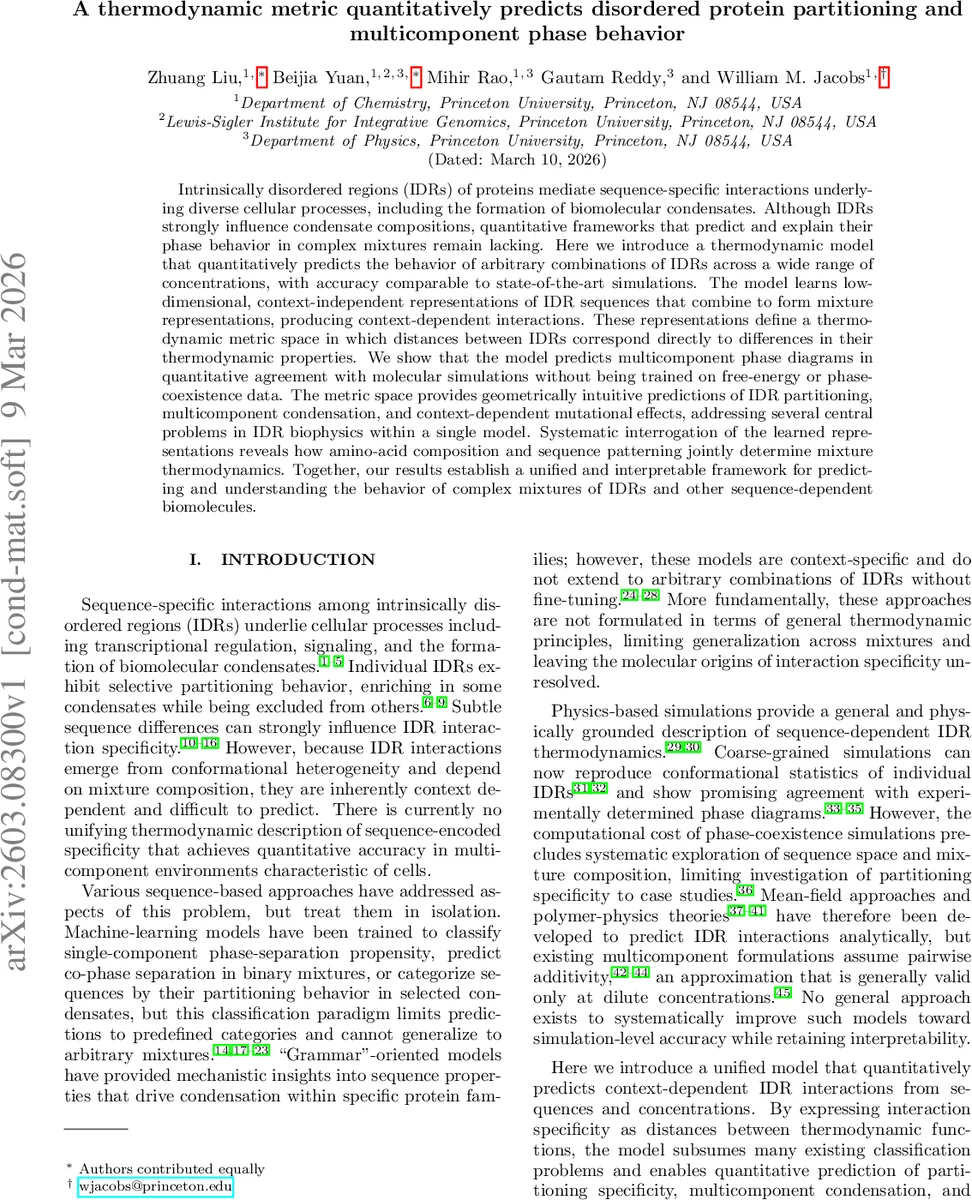
Intrinsically disordered regions (IDRs) of proteins mediate sequence-specific interactions underlying diverse cellular processes, including the formation of biomolecular condensates. Although IDRs strongly influence condensate compositions, quantitative frameworks that predict and explain their phase behavior in complex mixtures remain lacking. Here we introduce a thermodynamic model that quantitatively predicts the behavior of arbitrary combinations of IDRs across a wide range of concentrations, with accuracy comparable to state-of-the-art simulations. The model learns low-dimensional, context-independent representations of IDR sequences that combine to form mixture representations, producing context-dependent interactions. These representations define a thermodynamic metric space in which distances between IDRs correspond directly to differences in their thermodynamic properties. We show that the model predicts multicomponent phase diagrams in quantitative agreement with molecular simulations without being trained on free-energy or phase-coexistence data. The metric space provides geometrically intuitive predictions of IDR partitioning, multicomponent condensation, and context-dependent mutational effects, addressing several central problems in IDR biophysics within a single model. Systematic interrogation of the learned representations reveals how amino-acid composition and sequence patterning jointly determine mixture thermodynamics. Together, our results establish a unified and interpretable framework for predicting and understanding the behavior of complex mixtures of IDRs and other sequence-dependent biomolecules.
💡 Research Summary
This paper introduces a unified thermodynamic framework that quantitatively predicts the phase behavior of intrinsically disordered regions (IDRs) in arbitrary multicomponent mixtures. The authors address a major gap in the field: while previous work has either classified single‑component phase‑separation propensity or predicted co‑phase separation for binary mixtures, no model has been able to accurately forecast free‑energy differences and full phase diagrams for complex mixtures without explicit simulation.
The core idea is to map each IDR sequence to a low‑dimensional, context‑independent feature vector z. These vectors capture all sequence information needed to determine thermodynamic behavior. In a mixture, the vectors are combined by a concentration‑weighted average (\bar z), which defines a mixture representation. A neural network learns a scalar free‑energy density function (\Psi(\bar z)); the excess chemical potential of component i is then given by the inner product ( \mu^{ex}_i = z_i \cdot \nabla \Psi(\bar z) ). By defining a metric in which the Euclidean distance between two feature vectors equals the L2 norm of the difference between their excess chemical‑potential functions, the authors construct a thermodynamic metric space. In this space, distance directly reflects how similarly two IDRs behave across the ensemble of mixtures defined by a prior distribution.
To build the prior, the human proteome’s intrinsically disordered regions (the “IDRome”) were fragmented into non‑overlapping 20‑residue segments, yielding 335,439 representative fragments. These fragments were randomly combined into mixtures whose composition was biased toward a few dominant species, mimicking the enrichment patterns observed in cellular condensates. This prior defines the thermodynamic contexts over which distances are evaluated.
The model was trained on equation‑of‑state (EOS) data generated with the state‑of‑the‑art coarse‑grained force field Mpipi, which faithfully reproduces experimental trends across diverse IDR chemistries. Importantly, the training used only EOS data (pressure versus concentration) rather than explicit free‑energy or coexistence calculations. A multilayer perceptron (MLP) architecture was employed, and the dimensionality d of the metric space was systematically varied. The authors found that d ≈ 10 is sufficient to reproduce excess chemical potentials with an error below 0.1 kT across the mixture prior; the first few dimensions capture the majority of variance, indicating that IDR interactions are governed by a small set of underlying sequence features (e.g., charge density, hydropathy patterning).
Performance was benchmarked against two alternatives: a learned pairwise (PW) model that restricts interactions to a quadratic concentration dependence (analogous to Flory‑Huggins theory) and the hand‑crafted FINCHES model, a recent pairwise approach based on Flory‑Huggins interaction parameters. All models were re‑parameterized on the same EOS data for a fair comparison. The MLP model achieved root‑mean‑square errors (RMSE) of 0.12 kT for binary mixtures, substantially outperforming the PW model (≈0.6 kT) and FINCHES (≈2.8 kT). Accuracy improved further as the number of components increased from one to four, reflecting self‑averaging in multicomponent systems and the linear mixing rule inherent in the metric space.
To test whether the learned representation also captures the underlying free‑energy landscape, the authors constructed a test set of 231 free‑energy density differences (Δf) obtained via explicit thermodynamic integration of simulation data for random binary mixtures. The MLP model reproduced Δf with errors comparable to those observed for EOS predictions, while the pairwise models showed large deviations, especially for mixtures where hand‑crafted interaction rules are insufficient. Δf prediction remained robust as the number of components grew, confirming that the representation scales naturally to arbitrary mixtures.
Interpretability was demonstrated by visualizing the 10‑dimensional feature vectors using principal‑component projections. Vectors clustered according to physicochemical properties: highly charged fragments occupied distinct regions from those enriched in patterned hydrophobic/hydrophilic motifs. Because Euclidean distance in the metric space equals the L2 norm of excess chemical‑potential differences, one can directly infer how a novel sequence will partition relative to known condensates simply by measuring its distance to existing vectors. This provides a “thermodynamic map” of sequence space that links composition and patterning to phase behavior.
In summary, the study delivers three major contributions: (1) a mathematically rigorous, low‑dimensional embedding that translates IDR sequences into thermodynamic descriptors; (2) a predictive engine that, without additional simulations, yields accurate EOS, free‑energy differences, and full multicomponent phase diagrams; and (3) an interpretable framework that elucidates how specific sequence features govern mixture thermodynamics. The approach bridges the gap between coarse‑grained simulation accuracy and the need for rapid, scalable predictions in biologically relevant, highly heterogeneous environments. Future integration with experimental datasets could enable precise design of synthetic IDRs, rational modulation of cellular condensates, and deeper mechanistic insight into disease‑related phase‑separation dysregulation.
Comments & Academic Discussion
Loading comments...
Leave a Comment