Conditional Complexity Hardness: Monotone Circuit Size, Matrix Rigidity, and Tensor Rank
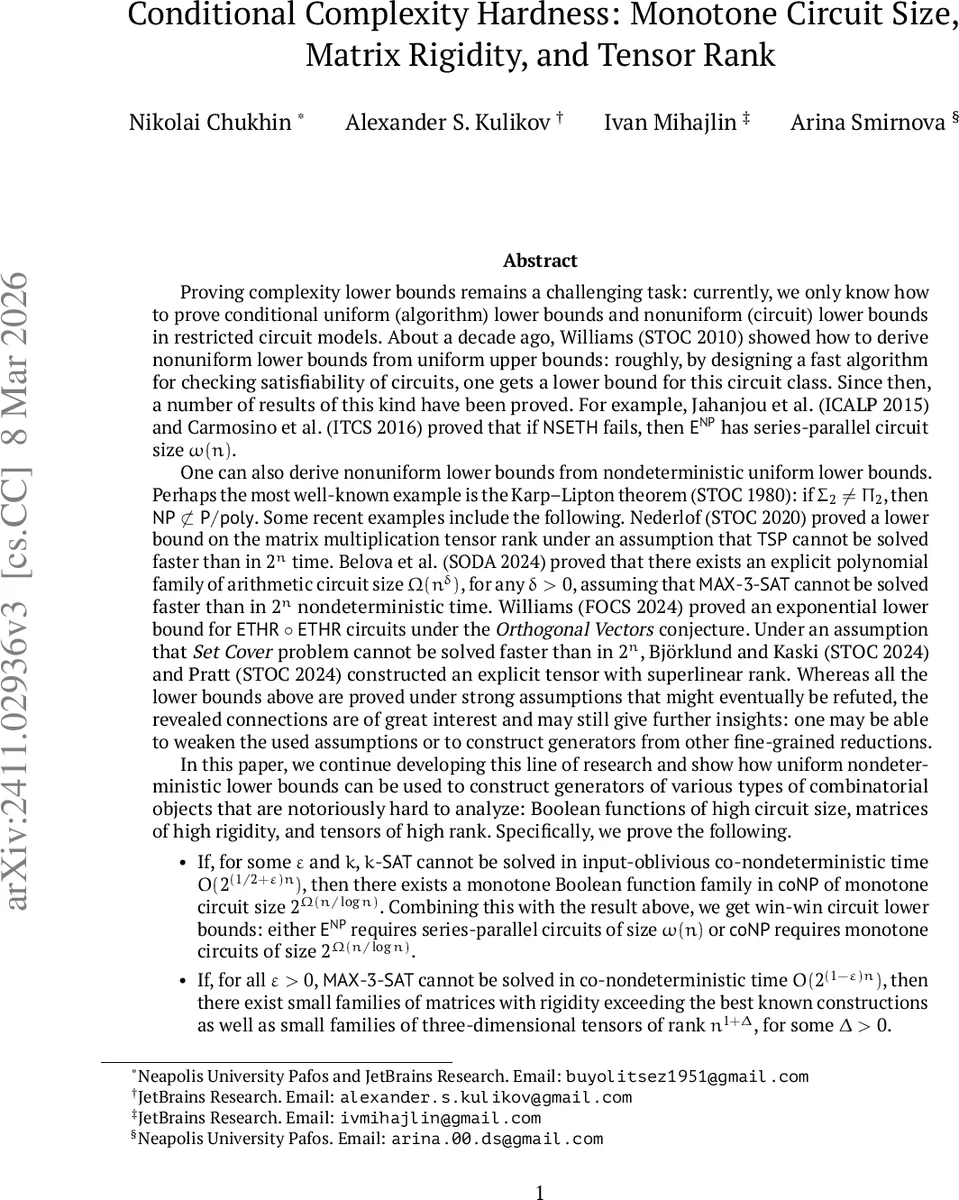
Proving complexity lower bounds remains a challenging task: we only know how to prove conditional uniform lower bounds and nonuniform lower bounds in restricted circuit models. Williams (STOC 2010) showed how to derive nonuniform lower bounds from uniform upper bounds: by designing a fast algorithm for checking satisfiability of circuits, one gets a lower bound for this circuit class. Since then, a number of results of this kind have been proved. For example, Jahanjou et al. (ICALP 2015) and Carmosino et al. (ITCS 2016) proved that if NSETH fails, then $\text{E}^{\text{NP}}$ has series-parallel circuit size $ω(n)$. One can also derive nonuniform lower bounds from nondeterministic uniform lower bounds. Recent examples include lower bounds on tensor rank, arithmetic circuit size, $\text{ETHR} \circ \text{ETHR}$ circuit size under assumptions that various problems (like TSP, MAX-3-SAT, SAT, Set Cover) cannot be solved faster than in $2^n$ time. In this paper, we continue developing this line of research and show how uniform nondeterministic lower bounds can be used to construct generators of various types of combinatorial objects: Boolean functions of high circuit size, matrices of high rigidity, and tensors of high rank. Specifically, we prove the following. If $k$-SAT cannot be solved in input-oblivious co-nondeterministic time $O(2^{(1/2+\varepsilon)n})$, then there exists a monotone Boolean function family in coNP of monotone circuit size $2^{Ω(n / \log n)}$. This implies win-win circuit lower bounds: either $\text{E}^{\text{NP}}$ requires series-parallel circuits of size $ω(n)$ or coNP requires monotone circuits of size $2^{Ω(n / \log n)}$. If MAX-3-SAT cannot be solved in co-nondeterministic time $O(2^{(1 - \varepsilon)n})$, then there exist small families of matrices with high rigidity as well as small families of three-dimensional tensors of high rank.
💡 Research Summary
This paper advances the line of research that derives non‑uniform circuit lower bounds from uniform fine‑grained hardness assumptions, focusing on three combinatorial objects: monotone Boolean functions, rigid matrices, and high‑rank tensors. The authors introduce a novel type of assumption—input‑oblivious co‑nondeterministic time lower bounds for SAT‑type problems—and show how such assumptions can be leveraged to construct explicit generators for objects that are provably hard for certain restricted computational models.
The first main result assumes that for some ε>0 and integer k≥3, k‑SAT cannot be solved in input‑oblivious co‑nondeterministic time O(2^{(1/2+ε)n}). Under this hypothesis the authors construct a family of monotone Boolean functions that lie in coNP and require monotone circuits of size at least 2^{Ω(n/ log n)}. This improves the previous best monotone lower bound of 2^{Ω(√n)} and yields a “win‑win” statement: either NSETH fails, giving the known series‑parallel lower bound ω(n) for E^{NP}, or else the new monotone lower bound holds. The proof uses a fine‑grained reduction that maps SAT instances to monotone functions, together with a lifting argument that translates the hardness of the SAT verifier into a monotone circuit size lower bound.
The second contribution concerns the class Q_{n}^{t}, defined as the set of Boolean functions where any t zero‑outputs share a common zero coordinate. Assuming the Non‑deterministic Exponential Time Hypothesis (NETH), the authors exhibit, for infinitely many n, a function f∈Q_{n}^{t}∩coNP/poly such that any circuit composed solely of threshold gates THR_{ℓ+1} (for arbitrary ℓ) that computes a function dominating f must have size 2^{Ω(n)}. This shows that even very simple threshold‑only circuits cannot efficiently represent certain functions that are easy for general circuits, providing another win‑win: either NETH fails and E^{NP} lacks linear‑size circuits, or the threshold lower bound holds.
The third and fourth results turn to algebraic objects. Assuming that for every ε>0, MAX‑3‑SAT cannot be solved in co‑nondeterministic time O(2^{(1−ε)n}), the authors construct two families of generators:
-
A matrix generator g: {0,1}^{O(log 1)} → F^{k×k} computable in polynomial time, such that for infinitely many k there exists a seed s with g(s) having rigidity k^{1−δ} and size k^{2−δ} (for any constant δ>0). This exceeds the best known explicit rigidity constructions.
-
A tensor generator h: {0,1}^{O(log 1)} → F^{k×k×k} also computable in polynomial time, such that for infinitely many k either the matrix from (1) has the above rigidity or the tensor h(s) has rank at least k^{1+Δ} for some constant Δ>0.
These generators provide conditional explicit examples of matrices and tensors that are far harder than any previously known constructions. By plugging the rigidity bound into the framework of canonical circuits (Goldreich–Wigderson), the authors obtain conditional lower bounds for depth‑three circuits: an explicit bilinear function requiring canonical circuits of size 2^{Ω(n^{2/3−δ})} or a trilinear function requiring arithmetic circuits of size Ω(n^{1.25}). This improves recent results of Goldreich and addresses an open problem from prior work.
Technically, the paper combines fine‑grained reductions, hardness amplification, monotone lifting, and threshold‑gate analysis. The reductions are crafted so that the nondeterministic verifier’s proof length depends only on the input size, enabling the construction of small‑seed generators. The monotone lifting translates SAT hardness into monotone circuit size, while the threshold analysis leverages known characterizations of Q_{n}^{t} as THR‑gate circuits.
In summary, the work introduces a new paradigm for obtaining conditional non‑uniform lower bounds from input‑oblivious co‑nondeterministic time assumptions. It yields stronger monotone circuit lower bounds, novel hardness results for threshold‑only circuits, and conditional explicit constructions of highly rigid matrices and high‑rank tensors, thereby deepening our understanding of the interplay between fine‑grained algorithmic hardness and structural complexity.
Comments & Academic Discussion
Loading comments...
Leave a Comment