Enhancing User Fairness in Two-Layer RSMA: A Movable Antenna Approach
Enhancing user fairness in advanced multi-user systems like two-layer rate-splitting multiple access (RSMA) is a critical yet challenging task. This letter proposes a novel movable antenna (MA) approach to address this challenge. We formulate a max-min fairness problem, maximizing the minimum user rate, a key metric for fairness, through the joint optimization of the beamforming matrices, user clustering, common rate allocation, and the antenna position vector (APV). To solve this non-convex problem, we develop an efficient two-loop iterative algorithm. The outer-loop leverages the dynamic neighborhood pruning particle swarm optimization method to find a high-quality APV, while the inner-loop optimizes the remaining variables for a given APV. Simulation results validate our approach, demonstrating that the proposed scheme yields significant fairness gains over various benchmark schemes.
💡 Research Summary
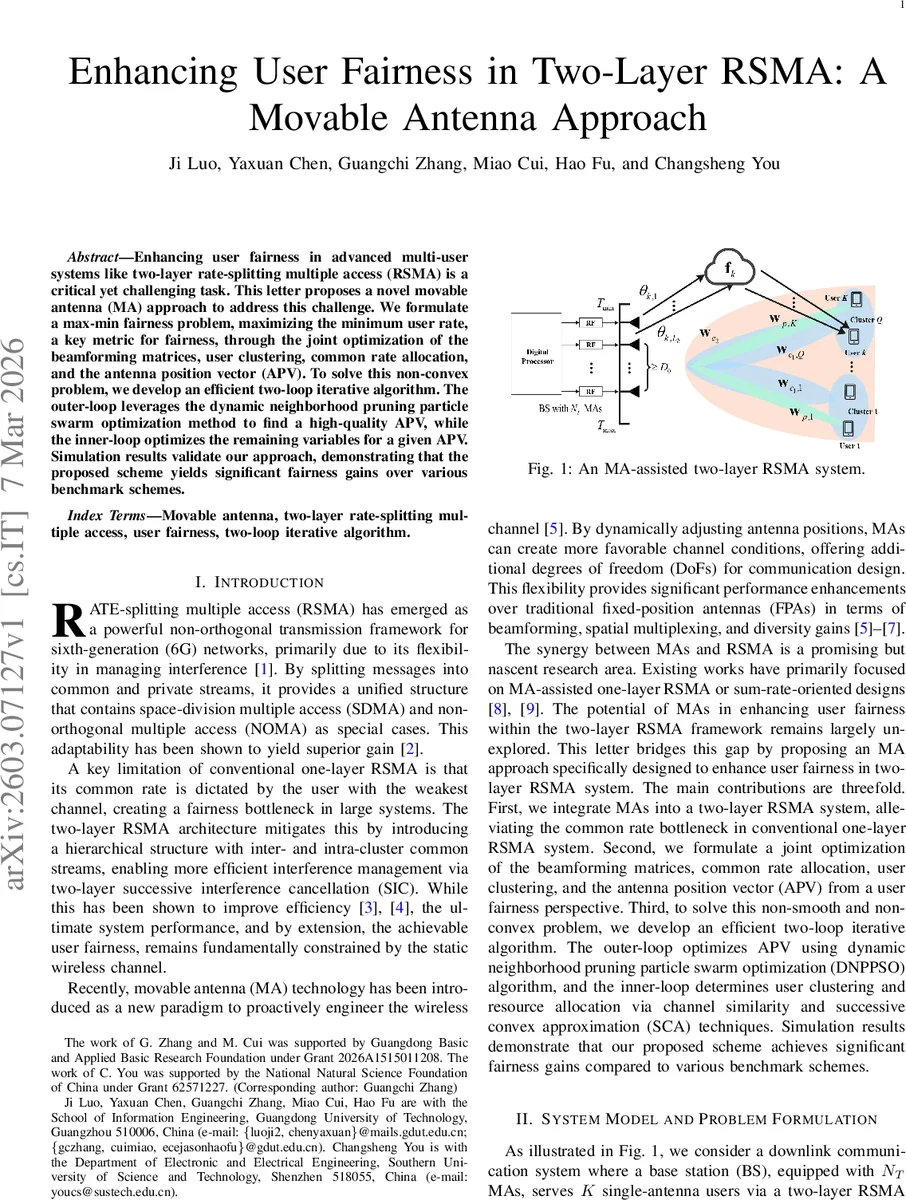
This paper addresses the long‑standing fairness bottleneck in multi‑user downlink communications by integrating movable antennas (MAs) with a two‑layer Rate‑Splitting Multiple Access (RSMA) framework. In conventional one‑layer RSMA, the common stream rate is limited by the user with the weakest channel, which severely restricts fairness, especially in large networks. The two‑layer RSMA architecture mitigates this issue by introducing an inter‑cluster common stream and intra‑cluster common streams, allowing successive interference cancellation (SIC) to handle inter‑ and intra‑cluster interference separately. However, when the antenna array is fixed, the channel matrix cannot be dynamically shaped, limiting the potential gains of the two‑layer design.
The authors propose to equip the base station with N_T movable antennas that can slide along a one‑dimensional line segment
Comments & Academic Discussion
Loading comments...
Leave a Comment