Not All Neighbors Matter: Understanding the Impact of Graph Sparsification on GNN Pipelines
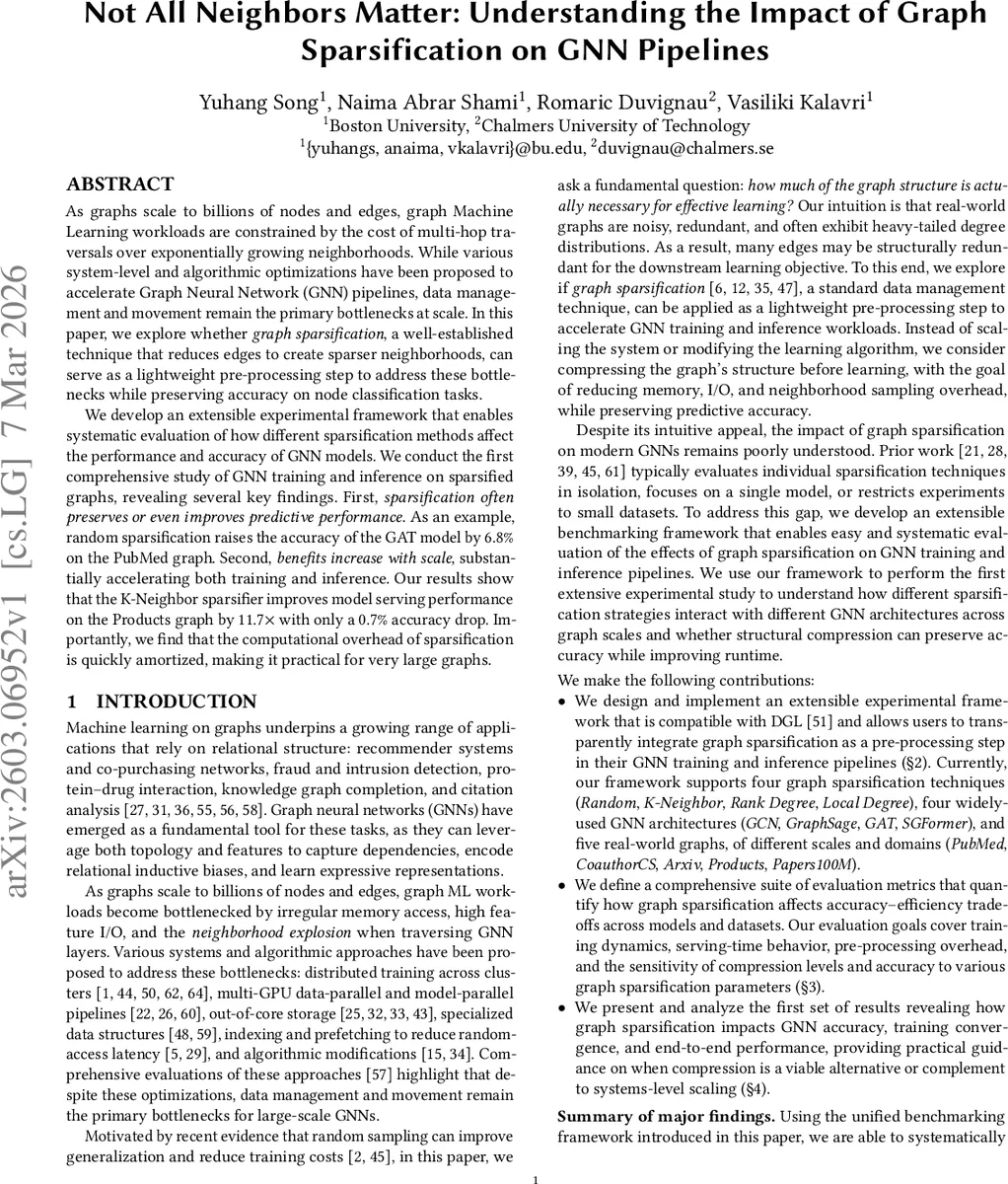
As graphs scale to billions of nodes and edges, graph Machine Learning workloads are constrained by the cost of multi-hop traversals over exponentially growing neighborhoods. While various system-level and algorithmic optimizations have been proposed to accelerate Graph Neural Network (GNN) pipelines, data management and movement remain the primary bottlenecks at scale. In this paper, we explore whether graph sparsification, a well-established technique that reduces edges to create sparser neighborhoods, can serve as a lightweight pre-processing step to address these bottlenecks while preserving accuracy on node classification tasks. We develop an extensible experimental framework that enables systematic evaluation of how different sparsification methods affect the performance and accuracy of GNN models. We conduct the first comprehensive study of GNN training and inference on sparsified graphs, revealing several key findings. First, sparsification often preserves or even improves predictive performance. As an example, random sparsification raises the accuracy of the GAT model by 6.8% on the PubMed graph. Second, benefits increase with scale, substantially accelerating both training and inference. Our results show that the K-Neighbor sparsifier improves model serving performance on the Products graph by 11.7x with only a 0.7% accuracy drop. Importantly, we find that the computational overhead of sparsification is quickly amortized, making it practical for very large graphs.
💡 Research Summary
The paper “Not All Neighbors Matter: Understanding the Impact of Graph Sparsification on GNN Pipelines” investigates whether graph sparsification—a classic data‑management technique that removes edges to create sparser neighborhoods—can serve as a lightweight pre‑processing step that alleviates the dominant data‑movement bottlenecks of large‑scale Graph Neural Network (GNN) workloads while preserving (or even improving) predictive performance.
Motivation and Context
As graphs grow to billions of nodes and edges, multi‑hop GNN layers cause a “neighborhood explosion”: each layer multiplies the number of accessed vertices, leading to irregular memory accesses, high feature I/O, and severe pressure on storage bandwidth. Prior work has largely focused on system‑level solutions (distributed training, GPU parallelism, out‑of‑core storage, specialized data structures, indexing, and algorithmic tricks). However, comprehensive studies show that even with these optimizations, data movement remains the primary bottleneck. The authors therefore ask a more fundamental question: how much of the original graph structure is actually required for effective learning?
Sparsification as a Pre‑processing Idea
Graph sparsification reduces the number of edges before any learning takes place, thereby shrinking memory footprints, decreasing I/O, and limiting the size of neighbor sampling sets. The key concern is whether such reduction discards essential structural information needed for downstream tasks such as node classification. The paper fills a gap in the literature by providing the first systematic, large‑scale evaluation of sparsification across multiple GNN architectures, datasets, and sparsification strategies.
Experimental Framework
The authors build an extensible benchmarking framework that integrates high‑performance C++ implementations of sparsification algorithms with Python‑based DGL and PyG pipelines. The pipeline consists of three stages: (1) graph loading (supporting OGB, CSV, NumPy formats, and both small and billion‑edge datasets), (2) sparsification (four methods), and (3) model training/evaluation (four GNN models). The framework logs detailed timing, supports reproducible seeding, and records all metadata in Weights & Biases. It also provides a streaming backend (DGL GraphBolt) for graphs that exceed a single‑GPU memory limit, enabling end‑to‑end experiments on the 100‑million‑edge Papers100M dataset.
Sparsification Methods
- Random Sparsifier – retains each edge independently with probability p. Simple, parallelizable, unbiased.
- K‑Neighbor Sparsifier – for each node, keeps up to k incident edges (all if degree ≤ k, otherwise uniformly sample k neighbors). Controls per‑node degree directly.
- Rank‑Degree Sparsifier – selects edges based on global degree ranking, preserving high‑degree “hub” nodes.
- Local‑Degree Sparsifier – uses local clustering information to keep edges that are structurally important within a node’s immediate neighborhood.
All four are implemented in C++ with OpenMP, and their conversion costs (edge‑list ↔ adjacency‑list) are included in reported sparsification times.
Models and Datasets
Four GNN architectures are evaluated: GCN, GraphSAGE, GAT, and SGFormer (a graph transformer). Training is performed either with full‑graph mode or mini‑batch neighbor sampling, depending on model memory requirements. Five real‑world datasets span multiple domains and scales: PubMed (≈20 K nodes), CoauthorCS, Arxiv (≈170 K nodes), Products (≈2 M nodes), and Papers100M (≈111 M nodes, 1.8 B edges).
Evaluation Metrics
The study measures: final test accuracy, time‑to‑target‑accuracy (how quickly a model reaches a predefined accuracy), convergence speed (epochs to reach plateau), training throughput (samples/sec), inference latency, and sparsification overhead (pre‑processing time). It also examines cross‑graph inference (training on original graph, testing on sparsified version, and vice‑versa) to assess transferability of learned representations.
Key Findings
-
Accuracy Preservation and Sometimes Improvement – Across all models and datasets, at least one sparsification configuration matches or exceeds the baseline accuracy. Notably, Random Sparsifier with p = 0.7 raises GAT accuracy on PubMed by 6.8 %, suggesting that stochastic edge removal can act as a regularizer that mitigates over‑fitting.
-
K‑Neighbor Sparsifier Offers the Best Trade‑off – On the Products graph, using k = 10 yields an 11.7× speed‑up in inference while incurring only a 0.7 % drop in accuracy. Similar gains are observed for training throughput on larger datasets (e.g., 6.8× speed‑up on Arxiv).
-
Scale Amplifies Benefits – The relative reduction in training and inference time grows with graph size. For Papers100M, sparsification reduces memory consumption by >70 % and cuts epoch time from ~45 min to ~6 min, while the sparsification step itself takes only ~2 min, i.e., <5 % of total runtime.
-
Over‑Aggressive Compression Harms Performance – When k is set too low (e.g., k = 2 on high‑degree graphs) or p is very small, critical connectivity patterns disappear, leading to steep accuracy degradation (>5 %). This underscores the need for dataset‑aware parameter tuning.
-
Cross‑Graph Inference Shows Structural Transferability – Models trained on the original graph retain >98 % of their baseline accuracy when evaluated on sparsified versions, indicating that sparsification preserves the most informative structural cues needed for downstream tasks.
-
Amortized Pre‑processing Cost – Sparsification time scales linearly with edge count and is heavily parallelized. For the largest dataset, the overhead is negligible compared to the total training budget, making sparsification a practical pre‑processing step even in production pipelines.
Implications and Future Directions
The study demonstrates that graph sparsification is not merely a storage‑saving trick but a performance‑enhancing pre‑processing technique that can be combined with existing system‑level optimizations. By reducing per‑node degree, sparsification directly mitigates the neighborhood explosion problem, leading to lower memory bandwidth consumption and faster neighbor sampling. The authors suggest several avenues for further research: (i) dynamic sparsification that adapts k or p during training based on loss gradients, (ii) hybrid approaches that combine sparsification with learned sampling distributions (e.g., importance‑based neighbor selection), and (iii) extending the framework to heterogeneous graphs and edge‑type‑aware sparsification.
Reproducibility
All code, configuration files, and raw results are released in an anonymous GitHub repository (to be made public upon acceptance). The framework’s modular design allows researchers to plug in new sparsification algorithms, GNN models, or datasets with minimal effort, fostering broader adoption and comparative studies.
Conclusion
Graph sparsification, when applied thoughtfully, can dramatically accelerate GNN training and inference on massive graphs while preserving, and occasionally improving, predictive performance. The K‑Neighbor method emerges as the most robust across scales, delivering up to an order‑of‑magnitude speed‑up with sub‑percent accuracy loss. Because the sparsification overhead is quickly amortized, the technique is practical for real‑world, production‑scale graph ML pipelines, offering a complementary lever to traditional system‑level optimizations.
Comments & Academic Discussion
Loading comments...
Leave a Comment