Altermagnets Enable Gate-Switchable Helical and Chiral Topological Transport with Spin-Valley-Momentum-Locked Dual Protection
We establish a unified, symmetry-driven framework that combines the alternating spin splitting of altermagnets with valley topology to realize and electrically interconvert helical and chiral topological phases within a single material platform. We first demonstrate a magnetic analogue of the quantum spin Hall effect in altermagnets, hosting helical spin-valley-momentum-locked (SVML) edge states characterized by a composite spin-valley Chern number Csv = 2. Large-scale quantum transport simulations show these SVML edge states exhibit fully quantized spin conductance robust against nonmagnetic and long-range magnetic disorder, reflecting their dual topological protection, while remaining vulnerable to short-range magnetic disorder. Exploiting that the counterpropagating SVML modes are linked by crystal rotation symmetry, we introduce a gate-tunable sublattice-staggered potential that selectively gaps one valley and converts the helical state into a chiral quantum anomalous Hall phase with Csv = 1, robust against all disorder types. Reversing the potential switches the transmitted spin-valley polarization. Our first-principles calculations identify monolayer V2STeO and VO families as realistic platforms supporting both helical and chiral topological phases and their electrical switching. These results establish altermagnets as electrically programmable platforms for robust topological devices across charge, spin, and valley.
💡 Research Summary
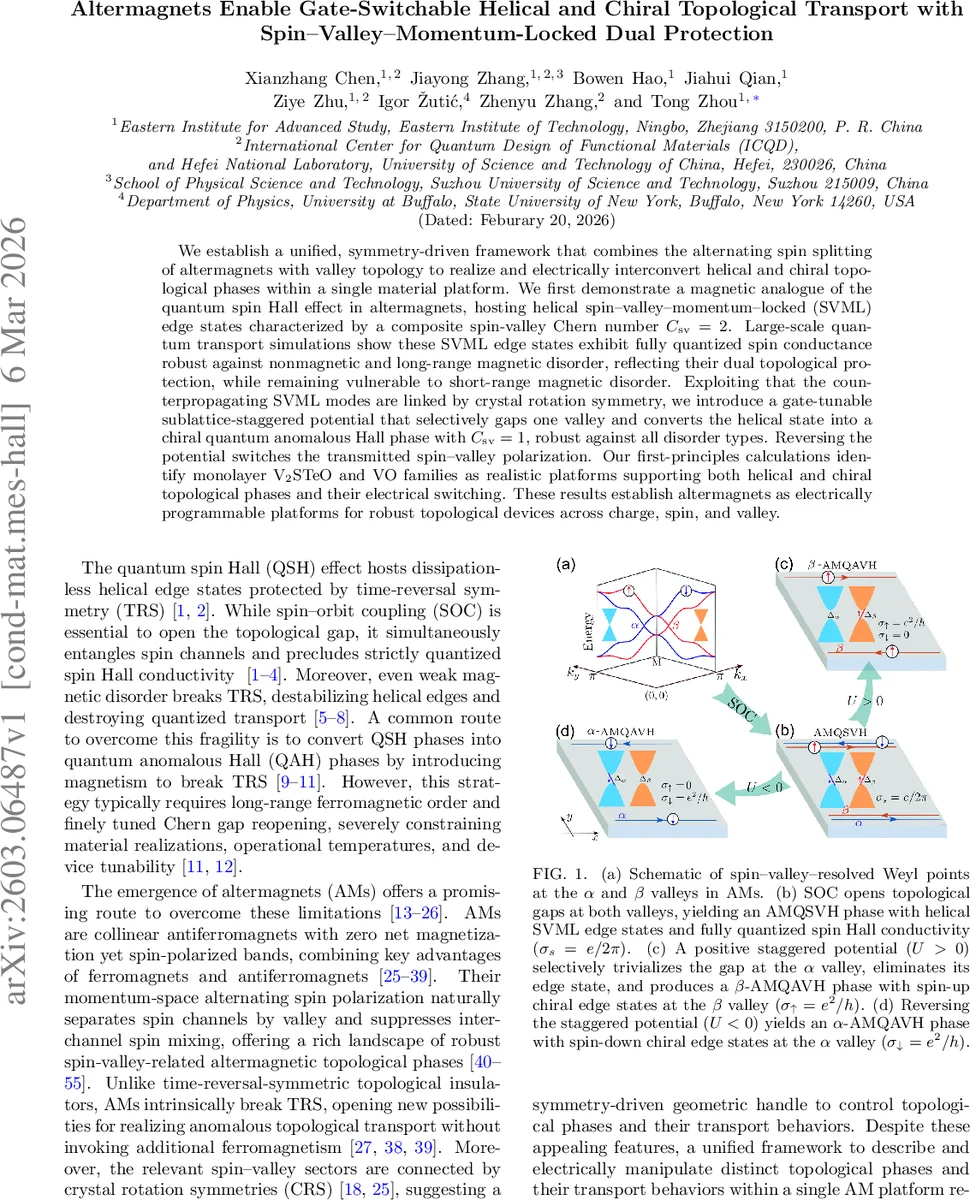
The manuscript presents a comprehensive, symmetry‑driven framework that unifies the alternating spin‑splitting characteristic of altermagnets (AMs) with valley topology to achieve electrically switchable helical and chiral topological transport within a single two‑dimensional material. Starting from a square‑lattice antiferromagnetic tight‑binding model, the authors incorporate nearest‑ and next‑nearest‑neighbor hoppings, a staggered antiferromagnetic exchange field, spin‑orbit coupling (SOC), and a sublattice‑staggered potential U. The alternating spin‑polarized band structure produces two symmetry‑related valleys (α and β) that are spin‑valley‑momentum locked (SVML): spin‑up states reside in the α valley, spin‑down states in the β valley. When SOC opens gaps at both valleys, each valley carries a Berry curvature of ±1, yielding a composite spin‑valley Chern number C_sv = 2. This predicts a pair of helical edge modes—one bound to each valley—realizing an altermagnetic quantum spin Hall (AMQSVH) phase.
Large‑scale transport simulations using the Landauer‑Büttiker formalism demonstrate that the AMQSVH state exhibits fully quantized spin conductance (σ_s = e/2π) under non‑magnetic disorder and long‑range magnetic fluctuations, reflecting dual protection from both spin‑momentum locking and valley‑momentum locking. Only short‑range (Anderson‑type) magnetic disorder, which can flip spins and scatter between valleys simultaneously, degrades the quantization. This robustness surpasses that of conventional QSH systems, which are fragile to any magnetic perturbation because they rely solely on time‑reversal symmetry.
The key innovation is the use of crystal rotation symmetry (CRS) that links the two helical branches. By applying a gate‑tunable staggered potential U—readily achievable in two‑sublattice 2D crystals—the CRS can be broken selectively. For U > 0 the β‑valley gap becomes trivial while the α‑valley remains topological, collapsing the helical pair into a single chiral edge channel with spin‑down polarization (α‑AMQA VH). Conversely, U < 0 yields a β‑valley chiral channel with spin‑up polarization. In both cases the composite Chern number reduces to C_sv = 1, and the resulting altermagnetic quantum anomalous Hall (AMQA VH) phase is immune to all disorder types, including short‑range magnetic impurities, because only one SVML channel remains.
First‑principles calculations identify monolayer V₂STeO and VO families as realistic platforms. Without SOC, these materials display the required spin‑valley‑locked Weyl points; SOC opens ~20 meV gaps, establishing the AMQSVH phase. The staggered potential is engineered by substituting Ti for V on a single sublattice, which induces an effective U of controllable sign. Ti on the A sublattice trivializes the β‑valley, producing the α‑AMQA VH (spin‑down chiral) state; Ti on the B sublattice reverses the sign, yielding the β‑AMQA VH (spin‑up chiral) state. This chemical‑doping strategy is experimentally feasible and can be generalized to related compounds such as Nb₂SeTeO.
Overall, the work delivers (i) a novel SVML topological protection mechanism unique to altermagnets, (ii) an all‑electrical route to toggle between helical QSH and chiral QAH phases via a gate‑controlled sublattice potential, (iii) quantitative disorder‑robustness analysis confirming enhanced resilience, and (iv) concrete material candidates with realistic pathways for experimental realization. These results position altermagnets as a versatile, programmable platform for spin‑valley electronics, topological transistors, and robust quantum information devices.
Comments & Academic Discussion
Loading comments...
Leave a Comment