Countable models of weakly quasi-o-minimal theories II
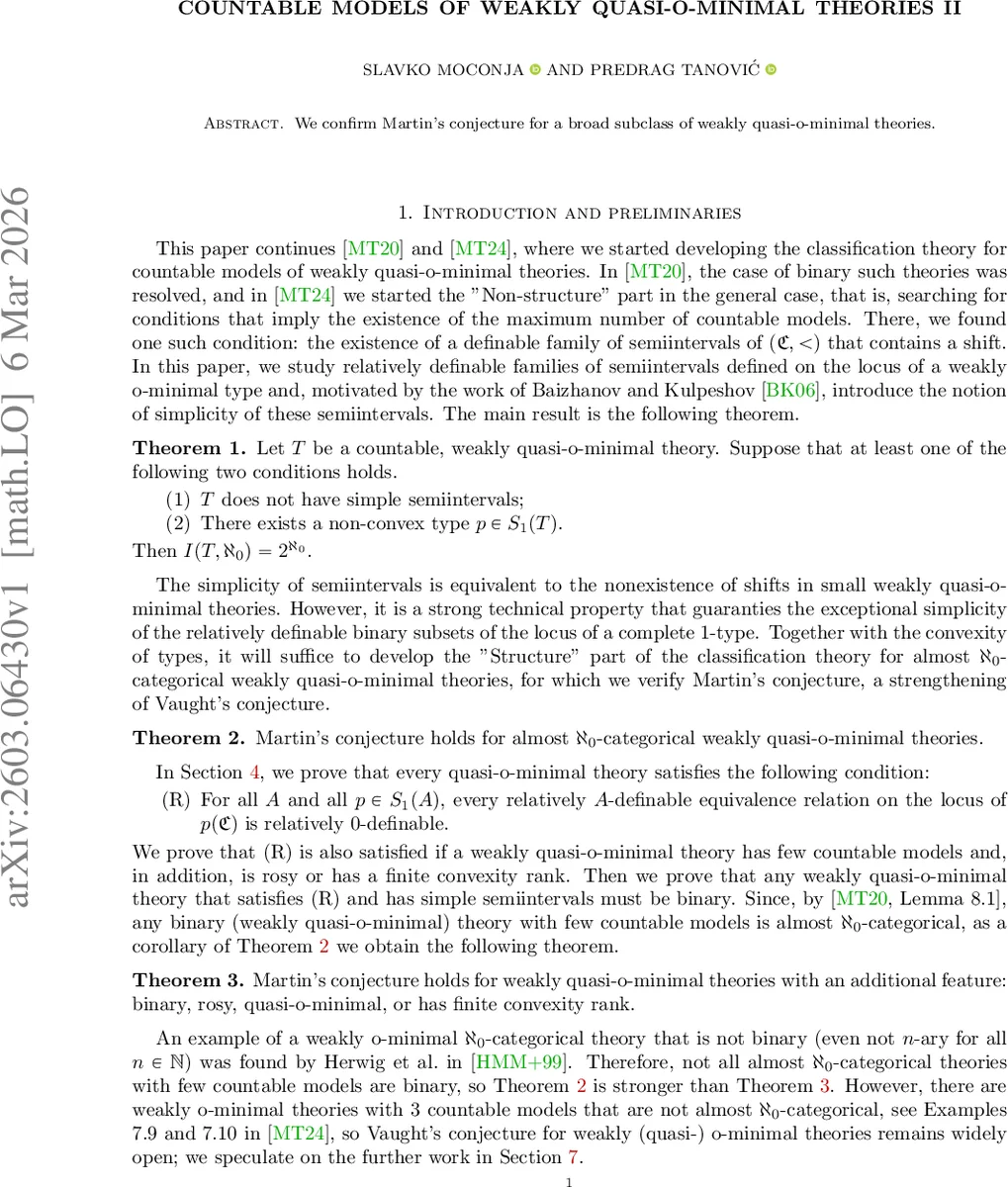
We confirm Martin’s conjecture for a broad subclass of weakly quasi-o-minimal theories.
💡 Research Summary
This paper continues the line of research initiated in the authors’ earlier works (MT20 and MT24) on the classification of countable models of weakly quasi‑o‑minimal theories. The central goal is to determine when a countable weakly quasi‑o‑minimal theory T has continuum many non‑isomorphic countable models and to verify Martin’s conjecture—a strengthening of Vaught’s conjecture—within broad subclasses of such theories.
The authors introduce the notion of a p‑semi‑interval, a relatively definable convex subset of the locus of a weakly o‑minimal type p, equipped with a distinguished minimal element. A family of p‑semi‑intervals is called simple if it does not contain a “shift”: a sequence of iterated unions Sⁿ(a) that strictly increases without stabilising. Simplicity is shown to be equivalent to the non‑existence of a definable family of semi‑intervals that contains a shift, and also to the property that every p‑semi‑interval is determined by an equivalence relation from the set Eₚ of relatively definable equivalence relations on the locus of p.
A key technical condition, denoted (R), requires that for every set A and every type p over A, every relatively A‑definable equivalence relation on the locus of p is already 0‑definable. The authors prove that, in the presence of simple semi‑intervals, (R) is equivalent to the theory being binary (all definable sets are Boolean combinations of binary relations). This equivalence allows them to transfer results from the binary case—where Vaught’s conjecture is known—to the more general setting.
The main results are:
-
Theorem 1. Let T be a countable weakly quasi‑o‑minimal theory. If either (i) T does not have simple semi‑intervals, or (ii) T admits a non‑convex 1‑type, then the number of countable models I(T,ℵ₀) equals 2^{ℵ₀}. The proof combines the characterization of simplicity with the existence of a definable family of semi‑intervals containing a shift (case (i)), and a construction of many non‑isomorphic models using a non‑convex type (case (ii)).
-
Theorem 2. Martin’s conjecture holds for almost ℵ₀‑categorical weakly quasi‑o‑minimal theories. By showing that such theories satisfy condition (R) and are therefore binary, the authors apply known results for binary theories to obtain the conjecture.
-
Theorem 3. Martin’s conjecture also holds for weakly quasi‑o‑minimal theories that are either binary, rosy, quasi‑o‑minimal, or have finite convex rank. Each of these additional hypotheses guarantees either the absence of simple semi‑intervals or the validity of (R), thus reducing the situation to the binary case.
The paper also discusses examples that illustrate the limits of these results. Herwig et al. (1999) constructed a weakly o‑minimal ℵ₀‑categorical theory that is not binary, showing that Theorem 2 is strictly stronger than Theorem 3. Moreover, MT24 provides examples of weakly o‑minimal theories with exactly three countable models that are not almost ℵ₀‑categorical, indicating that Vaught’s conjecture remains open for the full class of weakly (quasi‑)o‑minimal theories.
In the final section, the authors outline future directions: developing criteria for the existence of shift families in more general contexts, extending the analysis to non‑rosy theories or those without finite convex rank, and refining the classification of weakly quasi‑o‑minimal theories beyond the binary setting.
Overall, the paper advances the understanding of the model‑theoretic landscape of weakly quasi‑o‑minimal theories by linking the combinatorial property of semi‑interval simplicity with deep classification conjectures, and by establishing Martin’s conjecture for several substantial subclasses.
Comments & Academic Discussion
Loading comments...
Leave a Comment