Asymptotically linear fractional problems with mixed boundary conditions
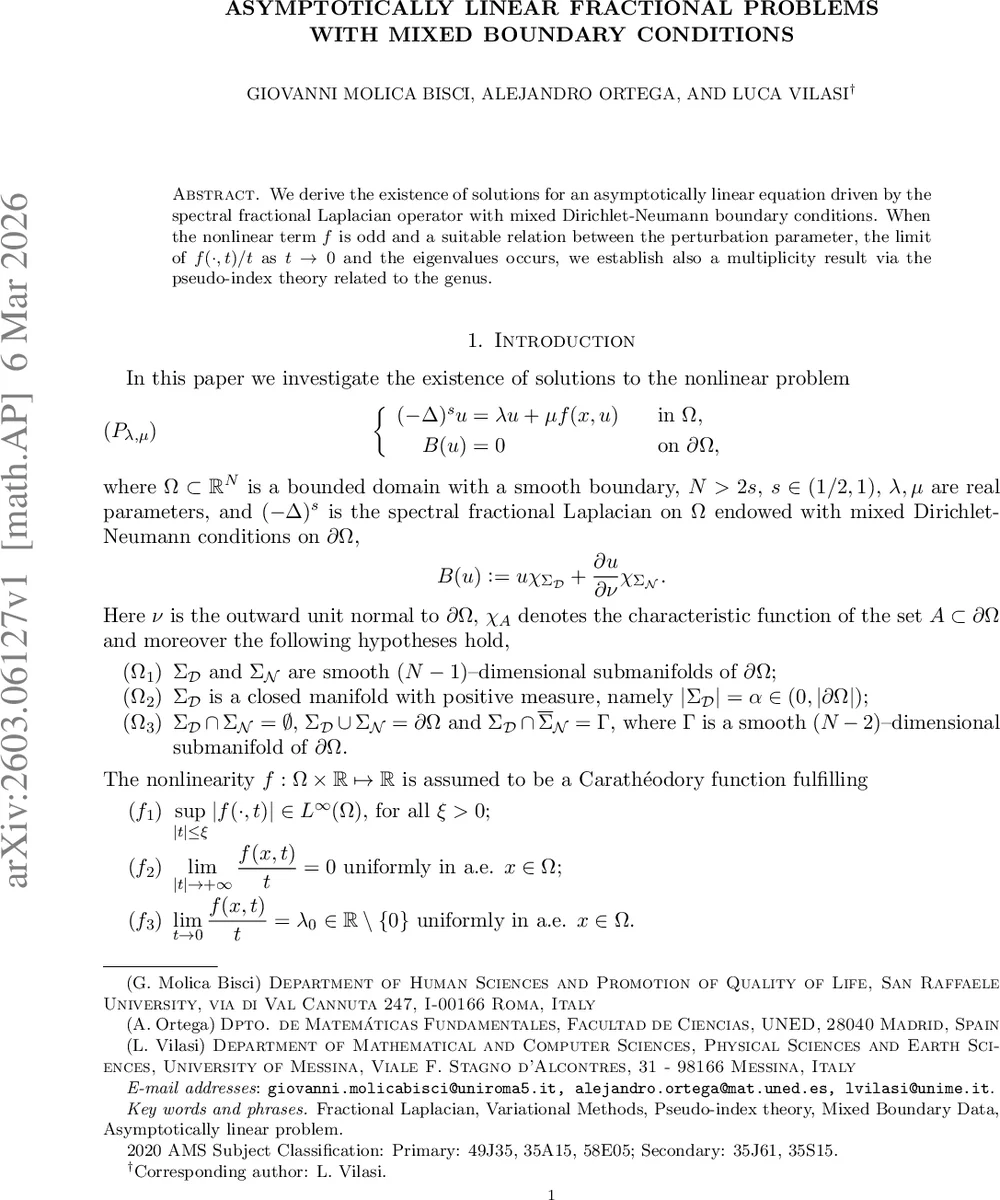
We derive the existence of solutions for an asymptotically linear equation driven by the spectral fractional Laplacian operator with mixed Dirichlet-Neumann boundary conditions. When the nonlinear term $f$ is odd and a suitable relation between the perturbation parameter, the limit of $f(\cdot,t)/t$ as $t\to 0$ and the eigenvalues occurs, we establish also a multiplicity result via the pseudo-index theory related to the genus.
💡 Research Summary
This paper investigates the existence and multiplicity of solutions for a class of nonlinear equations driven by the spectral fractional Laplacian operator, subject to mixed Dirichlet-Neumann boundary conditions. The problem studied is (P_λ,μ): (-Δ)^s u = λu + μf(x, u) in Ω, with B(u)=0 on ∂Ω, where s ∈ (1/2, 1), λ and μ are real parameters, and the boundary operator B(u) imposes Dirichlet conditions on a closed part Σ_D of the boundary and Neumann conditions on the remaining part Σ_N.
The authors’ primary objective is to understand how the asymptotic behavior of the nonlinear term f(x,t) at infinity and near zero, combined with the position of the parameter λ relative to the spectrum of the fractional operator, influences the solution set. The functional framework is based on the fractional Sobolev space H^s_Σ_D(Ω), tailored for the mixed boundary data.
The main results are bifurcated into two theorems, depending on the assumptions on f.
- Theorem 1 assumes f satisfies (f1) local boundedness, (f2) asymptotically linearity at infinity (f(x,t)/t → 0 as |t|→∞), and (f3) linear behavior at zero (f(x,t)/t → λ_0 as t→0). Part (i) states that for any λ not in the spectrum σ((-Δ)^s) and λ > Λ_1 (the first eigenvalue), problem (P_λ,1) admits at least one nontrivial weak solution, proven via the Saddle Point Theorem. Furthermore, if f is odd and a spectral gap condition (Λ): λ_0 + λ < Λ_h ≤ Λ_l < λ holds, then the problem possesses at least l-h+1 distinct pairs of nontrivial solutions. This multiplicity result is achieved using pseudo-index theory related to the Krasnoselskii genus (Theorem 3), which exploits the symmetric structure and the geometry of the energy functional I_λ,μ.
- Theorem 2 considers a broader class of nonlinearities. It replaces (f3) with a weaker, more technical condition (f’_3) that allows a kind of “lower asymptotically linear” growth at zero (e.g., limsup essinf f(x,t)/t = +∞ on a subset), and (f2) with a subcritical growth condition (f’_2). Under these hypotheses, it is proven that for every λ < Λ_1 and for every μ below an explicitly computed threshold μ_λ (given in (1.2)), problem (P_λ,μ) has at least one nontrivial weak solution. This solution is of a different nature, obtained as a local minimum of the energy functional restricted to a sublevel set, by applying an abstract critical point theorem from
Comments & Academic Discussion
Loading comments...
Leave a Comment