When Specifications Meet Reality: Uncovering API Inconsistencies in Ethereum Infrastructure
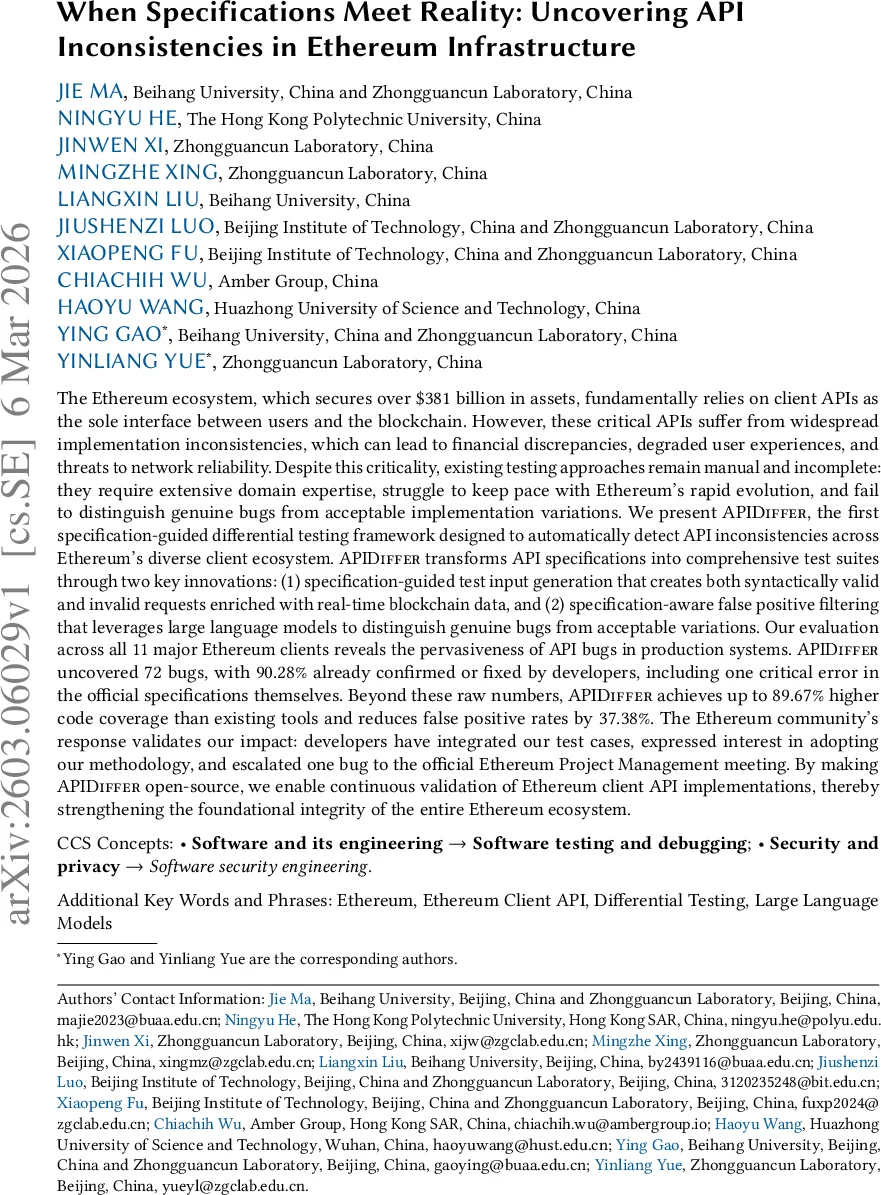
The Ethereum ecosystem, which secures over $381 billion in assets, fundamentally relies on client APIs as the sole interface between users and the blockchain. However, these critical APIs suffer from widespread implementation inconsistencies, which can lead to financial discrepancies, degraded user experiences, and threats to network reliability. Despite this criticality, existing testing approaches remain manual and incomplete: they require extensive domain expertise, struggle to keep pace with Ethereum’s rapid evolution, and fail to distinguish genuine bugs from acceptable implementation variations. We present APIDiffer, the first specification-guided differential testing framework designed to automatically detect API inconsistencies across Ethereum’s diverse client ecosystem. APIDiffer transforms API specifications into comprehensive test suites through two key innovations: (1) specification-guided test input generation that creates both syntactically valid and invalid requests enriched with real-time blockchain data, and (2) specification-aware false positive filtering that leverages large language models to distinguish genuine bugs from acceptable variations. Our evaluation across all 11 major Ethereum clients reveals the pervasiveness of API bugs in production systems. APIDiffer uncovered 72 bugs, with 90.28% already confirmed or fixed by developers. Beyond these raw numbers, APIDiffer achieves up to 89.67% higher code coverage than existing tools and reduces false positive rates by 37.38%. The Ethereum community’s response validates our impact: developers have integrated our test cases, expressed interest in adopting our methodology, and escalated one bug to the official Ethereum Project Management meeting.
💡 Research Summary
The paper addresses a critical yet under‑explored problem in the Ethereum ecosystem: inconsistencies among client API implementations. Because the Ethereum client API (JSON‑RPC for execution‑layer clients and Beacon API for consensus‑layer clients) is the sole gateway for users, wallets, and dApps to interact with the blockchain, any divergence can cause financial loss, poor user experience, and undermine network reliability. The authors illustrate this with a real‑world bug on Etherscan, where the same transaction’s transfer value was shown as 0.1 ETH in one view and 0.01 ETH in another due to differing behavior of Erigon’s trace_transaction and debug_traceTransaction methods.
Existing testing tools for Ethereum APIs—EtherDiff (a DSL‑based generator) and rpctestgen (hand‑crafted test cases)—are limited. They require deep domain expertise, cannot keep up with rapid protocol evolution, and struggle to separate true bugs from permissible implementation variations, leading to high manual effort and many false positives.
To overcome these limitations, the authors introduce APIDiffer, the first specification‑guided differential testing framework for both execution‑layer (EL) and consensus‑layer (CL) Ethereum client APIs. APIDiffer operates in three stages:
-
Specification‑Driven Test Generation – It parses the official JSON‑RPC and Beacon API specifications, extracts method signatures, parameter types, and constraints, and automatically synthesizes test inputs. Inputs include both syntactically valid requests and deliberately malformed ones. Crucially, the framework enriches requests with live on‑chain data (real addresses, block numbers, transaction hashes) so that tests exercise realistic state rather than synthetic placeholders.
-
Differential Execution – The same set of generated requests is sent concurrently to all supported clients (the paper evaluates eleven major clients: Geth, Nethermind, Besu, Erigon, Reth for EL; Lighthouse, Prysm, Teku, Nimbus, Lodestar, Grandine for CL). Responses are collected for each method call.
-
Specification‑Aware False‑Positive Filtering – Raw response differences are first filtered using lightweight heuristics derived from the specifications (e.g., required fields, value ranges). The remaining ambiguous cases are fed to a large language model (LLM), such as GPT‑4, with prompts that ask the model to decide whether the observed discrepancy is an acceptable variation or a genuine bug. The LLM leverages its understanding of the protocol semantics and prior bug patterns to dramatically reduce manual triage effort.
Evaluation: Across the eleven clients, APIDiffer discovered 72 distinct API bugs. Of these, 90.28 % (65 bugs) have been confirmed or fixed by the respective client developers, including one critical error in the official specification itself. Compared to the baseline tools, APIDiffer achieved up to 89.67 % higher code coverage, demonstrating that specification‑driven generation reaches many API paths that manual or DSL‑based approaches miss. Moreover, the LLM‑augmented filtering cut the false‑positive rate by 37.38 %, meaning developers spent far less time investigating spurious differences.
Contributions:
- A unified testing framework for both EL and CL APIs, eliminating the need for separate tools.
- Automatic, specification‑derived test case synthesis that eliminates manual effort and stays up‑to‑date with protocol changes.
- An innovative combination of rule‑based heuristics and LLM reasoning to separate true bugs from permissible divergences.
- Open‑source release and integration guidance for continuous integration pipelines, enabling the Ethereum community to maintain API correctness over time.
The authors argue that APIDiffer’s methodology is broadly applicable beyond Ethereum: any distributed system with formally published APIs can benefit from specification‑guided differential testing coupled with LLM‑based semantic analysis. By providing a scalable, low‑maintenance solution, the work promises to improve the robustness of blockchain infrastructure and set a precedent for systematic API validation in other high‑stakes domains.
Comments & Academic Discussion
Loading comments...
Leave a Comment