$L^p$-Sobolev inequalities on minimal submanifolds
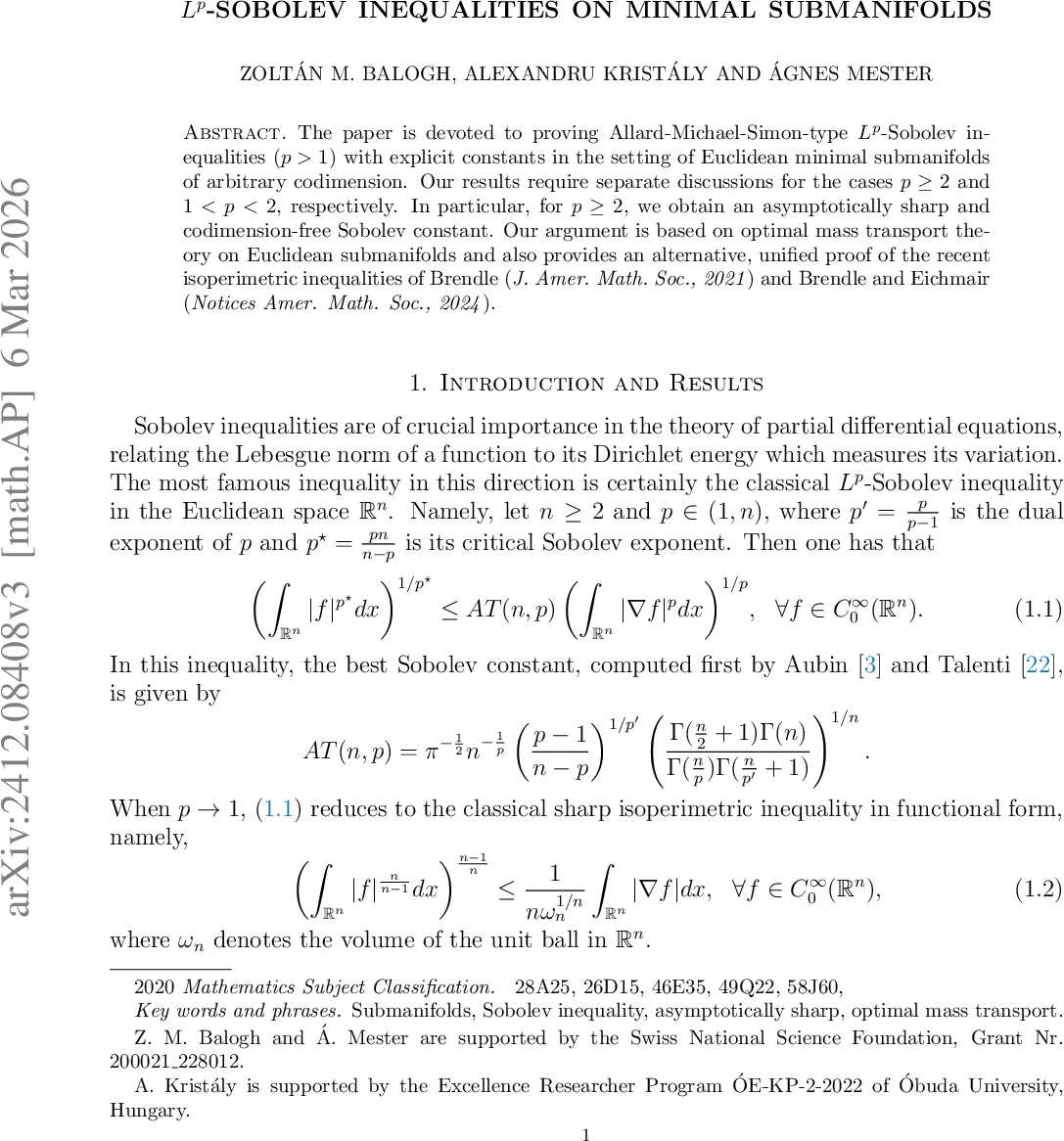
The paper is devoted to proving Allard-Michael-Simon-type $L^p$-Sobolev inequalities $(p>1)$ with explicit constants in the setting of Euclidean minimal submanifolds of arbitrary codimension. Our results require separate discussions for the cases $p\geq 2$ and $1<p<2$, respectively. In particular, for $p\geq 2$, we obtain an asymptotically sharp and codimension-free Sobolev constant. Our argument is based on optimal mass transport theory on Euclidean submanifolds and also provides an alternative, unified proof of the recent isoperimetric inequalities of Brendle (J. Amer. Math. Soc., 2021) and Brendle and Eichmair (Notices Amer. Math. Soc., 2024).
💡 Research Summary
The paper addresses the long‑standing problem of obtaining sharp L p‑Sobolev inequalities on Euclidean submanifolds with explicit constants, focusing on the case of minimal submanifolds (zero mean curvature) of arbitrary codimension. Classical Sobolev inequalities in ℝⁿ (Aubin–Talenti) involve the critical exponent p* = np/(n−p) and a best constant AT(n,p). When a submanifold Σ⊂ℝ^{n+m} is considered, the Michael–Simon inequality adds a mean‑curvature term but its constant 4^{n+1}ω_{1/n}ⁿ is far from optimal. Recent breakthroughs by Brendle and Brendle‑Eichmair produced codimension‑dependent constants C(n,m) that are optimal for codimension 1 and 2, yet still blow up as m→∞.
The authors propose a unified approach based on optimal mass transport (OMT) on submanifolds, extending the Brenier–McCann theory to measures supported on Σ via a generalized theorem of Balogh and Kristály. By constructing a transport map Φ from a probability measure μ on Σ (density f^{p*}) to a reference measure ν on ℝ^{n+m} (a Talenti‑type bubble), they obtain an integral version of the Monge–Ampère equation. Minimality (H≡0) eliminates curvature terms, and a determinant‑trace inequality yields det DΦ ≤ |Δ_Σ ac u|ⁿ.
Two regimes are treated separately:
- p ≥ 2 (Theorem 1.1).
The authors introduce a parameter t∈(0,1) and use the concavity of the p′‑norm together with the Pythagorean identity |Φ|² = |∇_Σ u|² + |v|² to bound |Φ|^{p′} from below. After integrating over the normal fibers and applying the beta–gamma integral formula, they derive an explicit bound \
Comments & Academic Discussion
Loading comments...
Leave a Comment