Robust Permutation Flowshops Under Budgeted Uncertainty
We consider the robust permutation flowshop problem under the budgeted uncertainty model, where at most a given number of job processing times may deviate on each machine. We show that solutions for this problem can be determined by solving polynomia…
Authors: Noam Goldberg, Danny Hermelin, Dvir Shabtay
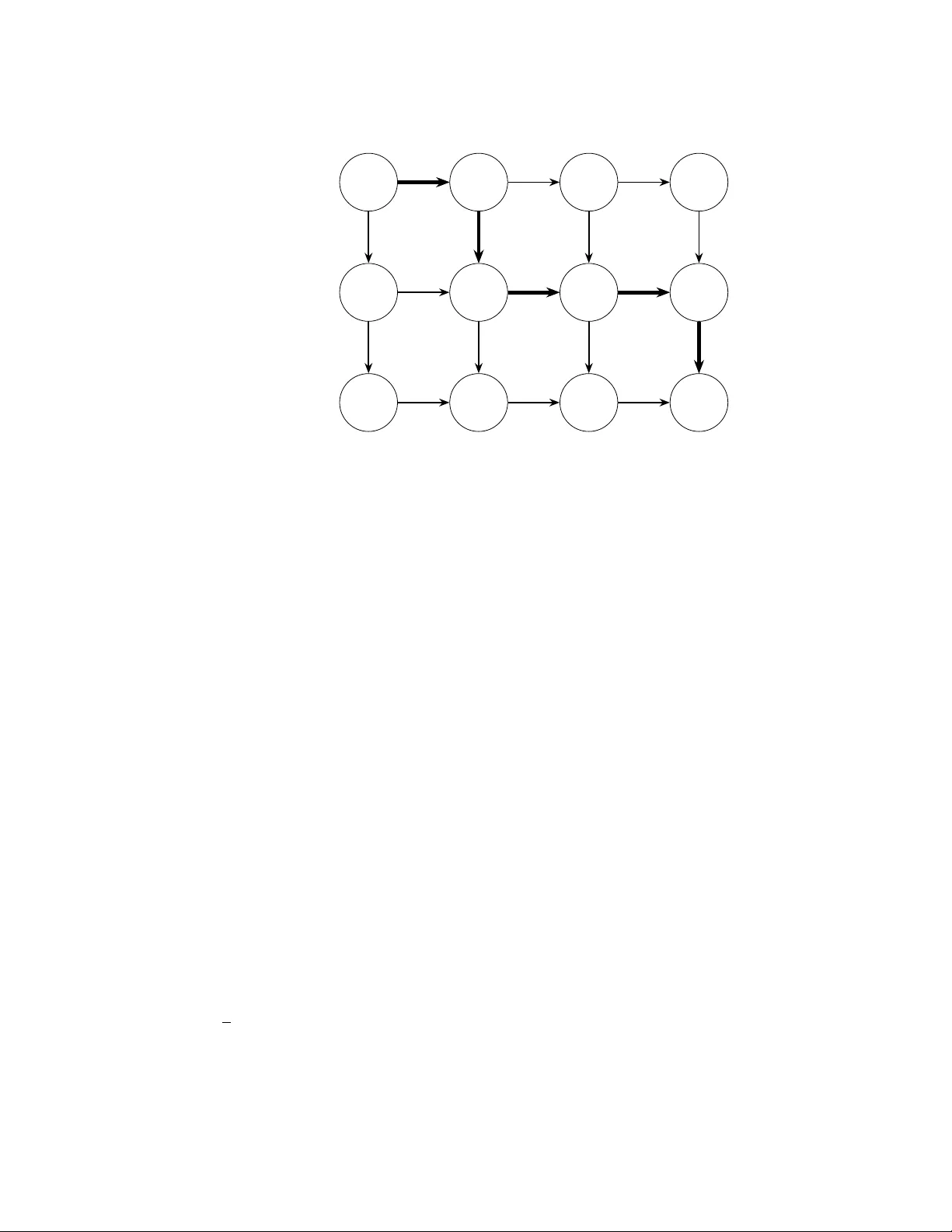
Robust P erm utation Flo wshops Under Budgeted Uncertain t y Noam Goldb erg 1 , Dann y Hermelin 1 , and Dvir Shabta y 1 1 Departmen t of Industrial Engineerin g & Managemen t, Ben-Gurion Univ ersit y of the Negev Abstract W e consider the robust p erm utation flowshop problem under the budgeted uncertain ty mo del, where at most a given num b er of job processing times ma y deviate on each machine. W e show that solutions for this problem can b e determined by solving polynomially many in- stances of the corresp onding nominal problem. As a direct consequence, our result implies that this robust flowshop problem can b e solv ed in p olynomial time for tw o machines, and can b e appro ximated in p olynomial time for an y fixed num b er of machines. The reduction that is our main result follows from an analysis similar to Bertsimas and Sim (2003) except that dualiza- tion is applied to the terms of a min-max ob jectiv e rather than to a linear ob jective function. Our result ma y b e surprising considering that heuristic and exact integer programming based metho ds hav e b een developed in the literature for solving the tw o-mac hine flowshop problem. W e conclude by showing a logarithmic factor improv ement in the o v erall running time implied b y a naive reduction to nominal problems in the case of t wo machines and three mac hines. 1 In tro duction A p erm utation flowshop is a common pro duction en vironment where multiple jobs are pro cessed on a set of machines in the exact same sequence. The machines are arranged in series, meaning that the output of one mac hine b ecomes the input for the next. Eac h job has to b e pro cessed on eac h one of the machines, and all jobs hav e to follow the same path. That is, each job has to b e pro cessed by the same sequence of mac hines (by conv en tion machine 1, mac hine 2, ..., machine m ). After completion on one mac hine, a job queues for pro cessing on the next machine. So, the pro cessing order of the jobs remains fixed throughout on each of the mac hines. This setup is widely used in manufacturing assem bly lines, where the ph ysical lay out of conv ey ors and workstations mak es it impossible or impractical for jobs to o vertak e one another. Differen t flo wshop v arian ts are also common in healthcare services, in particular when they are provided in stages, including, for example, preparation of patien ts prior to the service, which may then b e follo wed b y a final stage of reco very and production of images or rep orts [41]. In this pap er, we are concerned about computing schedules with minim um mak espan in suc h an en vironment, sp ecifically when the pro cessing times of the jobs are sub ject to uncertaint y . Giv en that real-world durations often fluctuate due to machine v ariability , defects and malfunctions, or h uman factors, we in vestigate a robust approach to this classical problem. Before presen ting our results, w e briefly review some necessary bac kground. 1 1.1 P erm utation Flowshops W e consider a p ermutation flo w shop problem, that includes a set of n jobs [ n ] := { 1 , . . . , n } to b e pro cessed in a flowshop consisting of m = O (1) machines with the ob jectiv e of determining a sc hedule that minimizes the makesp an (the completion time of the last job on the last mac hine). Let p ij denote the pro cessing time of job j ∈ [ n ] on machine i ∈ [ m ]. A sche dule is defined by a p erm utation of the jobs σ = ( σ (1) , . . . , σ ( n )), where σ ( j ) = k indicates that job k ∈ [ n ] is in the j -th p osition of the order, whic h is maintained on all of the machines. Let C i,σ ( j ) denote the completion time of the job in the j -th p osition of the p ermutation σ on machine i ∈ [ m ]. The completion times are defined by the follo wing recurrence: C i,σ ( j ) = max n C i,σ ( j − 1) , C i − 1 ,σ ( j ) o + p iσ ( j ) , for i ∈ [ m ] and j ∈ [ n ], where C i,σ (0) = 0 and C 0 ,σ ( j ) = 0. The ob jective is to determine a p erm utation σ that minimizes C max ( σ ) := C m,σ ( n ) . Using the classical three-field notation [18], this problem is denoted by F m | prmu | C max . Due to its imp ortance, the F m | prmu | C max problem has b een extensively studied in the literature. A foundational result is Johnson ’s algorithm [21] which solves the tw o-mac hine case optimally in O ( n log n ) time. In fact, Johnson sho wed that when m ≤ 3, the problem is equiv alent to F m || C max , the flo wshop v ariant in which the sequence of jobs is allow ed to change on differ- en t machines, in the sense that F m || C max m ust hav e an optimal p ermutation solution (which is also feasible and hence optimal to F m | pr mu | C max ). Ho wev er, for any flowshop with three or more machines ( m ≥ 3), the F m | pr mu | C max problem b ecomes strongly NP-hard [11]. Sev- eral exact solution metho ds hav e b een studied in the literature to solve the F m | pr mu | C max problem, including several that apply integer programming form ulations (see, e.g., [10, 39]) and ones that dev elop sp ecialized branch-and-bound metho ds (see, e.g., [26, 13]). In terms of approx- imation algorithms, the current state-of-the-art results are due to Chen et al. [9] and Nagara jan and Sviridenko [29]. In [9] a 5/3 approximation algorithm was provided for the F 3 | pr mu | C max problem, while a 3 √ m -appro ximation algorithm for the more general F m | prmu | C max is pro vided in [29]. Several authors also considered heuristic approaches to b etter tackle the problem in certain practical settings [8, 19, 30, 31, 38]. 1.2 Robust P erm utation Flowshops In classical scheduling, it is common to assume that the job parameters are certain and can b e determined in adv ance. This, how ev er, is not a realistic assumption in man y applications. The area of r obust optimization [2, 25, 17, 3, 14] attempts to deal with this discrepancy b y analyzing optimization problems where parameters may v ary in some giv en uncertaint y set U . In the con text of the F m | prmu | C max problem, the uncertaint y applies to the pro cessing times on the differen t mac hines, and so eac h element of U is a realization of the job pro cessing times p ∈ R m × n , to b e referred to as a sc enario . Let C max ( p, σ ) denote the ob jective v alue of schedule σ in scenario p . The standard most common approach to robust optimization is the min-max r obustness , where the goal is to compute a sc hedule σ that minimizes max p ∈U { C max ( p, σ ) } . Another approach, which is not the fo cus of the curren t pap er, but has b een explored in particular in the scheduling literature, is to minimize the maximum r e gr et , whic h is the worst-case difference betw een the realized makespan and the ideal outcome of having an ticipated the same realization. Regarding the p ossible scenario 2 realizations, the literature on robust com binatorial optimization has mostly focused on the following uncertain ty set models: • Discr ete sc enarios , where each scenario p ∈ U is given explicitly as part of the input. • Box unc ertainty , where each uncertain parameter can assume any v alue in a giv en in terv al. That is, in any scenario p ∈ U , w e hav e p ij − b p ij ≤ p ij ≤ p ij + b p ij for all i ∈ [ m ] and j ∈ [ n ], where the v ectors p i , b p i , for i ∈ [ m ], are giv en as a part of the input. • Budgete d unc ertainty , where each uncertain parameter has tw o p ossible v alues: its nominal v alue, p ij , or its deviate d v alue, b p ij , and at most Γ parameters may deviate in an y scenario. The discrete scenario approac h t ypically leads to in tractable min-max robustness problems. In fact, Kouv elis et al. [24] prov ed that the min-max robust F 2 || C max problem, whic h is equiv alent to the min-max robust F 2 | pr mu | C max problem [21], is ordinary NP-hard even when there are only t wo scenarios. Kasp erski et al. [23] later strengthened this result and sho wed that the problem is in fact strongly NP-hard for all |U | ≥ 2. They prov ed that the problem admits a p olynomial time appro ximation scheme (PT AS) when |U | = O (1), and a 2-approximation algorithm for the general problem with |U | arbitrary . Gilenson et al. [12] studied a different v arian t of the F 2 || C max problem under the discrete scenario approach, and sho w ed that their v arian t is also NP-hard. In contrast to the discrete scenarios approach, in the b o x uncertaint y setting, most scheduling problems reduce to their nominal counterpart. Indeed, the min-max robust problem reduces to its nominal ( i.e. non-robust) version b y setting the processing times of eac h job to the upper b ound of its uncertain t y interv al, i.e. p ij = p ij + b p ij for all i ∈ [ m ] and j ∈ [ n ]. Consequently , one can apply an y algorithm for the nominal problem in order to obtain an optimal solution for the min-max robust problem in this setting. This simple observ ation applies to almost all sc heduling problems, pro vided that the scheduling criterion is a non-decreasing function of job completion times ( i.e. , the criterion is r e gular ). While not the fo cus of this pap er, we note that the maxim um regret robust F 2 || C max problem is NP-hard under b oth discrete scenarios [24] and b o x uncertain t y [36]. It is well-kno wn that when Γ = n , budgeted uncertaint y reduces to b ox uncertaint y [2, 5]. Consequen tly , the maxim um regret v ersion of our problem is NP-hard already for m = 2. 1.3 Robust P erm utation Flowshops under Budgeted Uncertain ty The current pap er addresses the min-max robust F m | prmu | C max problem under the budgeted uncertain ty approac h [5, 4]. W e denote this problem by F m | pr mu | C Γ max . Sp ecifically , we assume that the uncertain ty set for the pro cessing times, giv en p, b p ∈ N m × n and Γ ∈ N m , is defined as U Γ ,p, b p = n p ∈ R m × n : δ ∈ { 0 , 1 } m × n , || δ i || 1 ≤ Γ i , and p ij = p ij + δ ij b p ij for all j ∈ [ n ] , i ∈ [ m ] o . This problem has b een previously studied for the case of m = 2 by Ying [40], and by Levorato et al. [27]. Ying [40] primarily fo cused on the dev elopment of heuristic algorithms for F 2 || C Γ max , whereas Levorato et al. [27] in vestigate exact decomp osition metho ds (whose worst-case running time is not guaranteed to b e p olynomial). More recently , decomp osition approaches for the exact solution of more general v ariants of the problem under budgeted uncertaint y hav e been studied b y Juvin et al. [22]. 3 1.4 Our Con tribution The main technical contribution of this pap er is an algorithm that reduces an y giv en instance of the F m | pr mu | C Γ max problem to a p olynomial num ber of nominal F m | pr mu | C max instances. Theorem 1. An optimal solution to the F m | pr mu | C Γ max pr oblem c an b e obtaine d by solving O ( n m ) instanc es of the nominal F m | prmu | C max pr oblem. This also extends to appr oximate solu- tions: F or any ρ ≥ 1 , an ρ -appr oximate solution to the nominal pr oblem yields an ρ -appr oximation for the r obust c ounterp art. This reduction is in the spirit of Bertsimas and Sim [4], who in tro duced the concept of budgeted uncertain ty , and presen ted a similar reduction for generic com binatorial optimization problems with uncertain linear ob jectiv es (see Section 1.5 for more details). Ho w ever, since our nominal problem is of a min-max form (1), it does not directly fit in to their framew ork, hence calling for an extension of the standard reduction. Our reduction has several algorithmic consequences. F or the tw o machine case, a direct appli- cation of Johnson’s algorithm [21] to eac h of the O ( n 2 ) instances implied b y Theorem 1 leads to a O ( n 3 log n ) algorithm for F 2 || C Γ max . Ho wev er, by use of a sorting prepro cessing sc heme, we are able to reduce the running time by a factor of log n leading to the follo wing theorem. Theorem 2. The F 2 || C Γ max pr oblem c an b e solve d in O ( n 3 ) time. Hall [20] presen ts an algorithm that constructs a (1 + ϵ )-appro ximate solution for an y given F m || C max instance in O ( n 3 . 5 ( m/ϵ ) O ( m 4 /ϵ 2 ) ) time. Note that for m = O (1) this translates in to an efficient p olynomial-time approximation sc heme (EPT AS) running in O ( n 3 . 5 (1 /ϵ ) O (1 /ϵ 2 ) ) time. F or m = 3, this algorithm yields a permutation schedule (see [33]) and based on Theorem 1, the follo wing corollary is immediately established. Corollary 1. Ther e exists an EPT AS for the F 3 || C Γ max pr oblem which pr ovides a (1 + ϵ ) - appr oximate solution for any instanc e of the pr oblem in O ( n 6 . 5 ϵ − O ( ϵ − 2 ) ) time. W e can also apply the 5/3-appro ximation algorithm by Chen et al. [9] along with our nov el prepro cessing sc heme to obtain the following result for the F 3 || C Γ max problem. Theorem 3. A 5 / 3 -appr oximate solution to any F 3 || C Γ max instanc e c an b e obtaine d in O ( n 4 ) time. Finally , for larger m = O (1) v alues, Nagara jan and Sviridenko [29, Theorem 3.1] provides a p olynomial time approximation algorithm that provides a 3 √ m -appro ximation (assuming m ≤ n ) for the F m | prmu | C max problem. Although p olynomial, the exact running time complexity b ound of this algorithm is not giv en in [20], but [33] show ed that it is low er bounded b y Ω( n 4 ) (for m = O (1)). Their result leads to the follo wing corollary of Theorem 1. Corollary 2. A 3 √ m -appr oximate solution to any F m | pr mu | C Γ max instanc e c an b e obtaine d in p olynomial time. In practice, one could use the result in Theorem 1 along with several heuristic approaches for F m | pr mu | C max [8, 19, 30, 31, 38] to obtain a fast heuristic for F m | prmu | C Γ max . A similar use can b e done by applying exact algorithms [10, 13, 26], with the disadv an tage of ha ving a running time that is not guaranteed to be p olynomial. Note that Theorem 2 renders the heuristic and exact algorithms in [40, 27] for F 2 || C Γ max practically obsolete, as these algorithms either do not pro duce the optimal solution, or do so but are lacking polynomial runtime guaran tees. 4 1.5 Related W ork F ollowing the general robust optimization framework of Ben-T al et al. [2], Bertsimas and Sim [4] in tro duced the budgeted uncertaint y set to address robust com binatorial optimization problems. The main app eal of this approach is that uncertain t y is mo deled as a simple p olyhedral uncertaint y set that is specifically designed to mitigate the inherent conserv atism of box uncertaint y . This is ac hieved by restricting the num ber of parameters that can simultaneously deviate from their nominal v alues via the budget parameter Γ. In the con text of binary combinatorial optimization, where the ob jective is to minimize a linear function c · x ov er a set of feasible solutions x ∈ X ⊆ { 0 , 1 } n , and the uncertaint y is associated with the ob jective co efficien ts. Sp ecifically , for a nominal v ector c , a deviation vector b c , and a giv en budget Γ, the problems inv estigated in [4] are of the form min x ∈ X max c ∈U { c · x } , where U = U Γ ,c, b c with m = 1. It is sho wn that solving an y problem of this form can b e reduced to solving n + 1 non-robust instances of the problem, implying that the robust counterpart of a p olynomially solv able binary optimization problem remains p olynomially solv able. There are also a few extensions and impro vemen ts to this result [1, 15, 34]. While the result of Bertsimas and Sim [4] and its extensions can b e used to establish the tractabilit y of many robust com binatorial optimization problems, there are many cases in whic h the intr o duction of robustness under the budgeted uncertain t y makes a tractable com binatorial optimization problem NP-hard. In particular, this applies to several scheduling problems that cannot b e cast as problems studied in [4]. Minimizing the w eighted sum of completion times or the n umber of tardy jobs on a single machine are t wo examples of such problems [7, 16]. A different example is the NP-hard bin packing problem, whic h has asymptotic fully-p olynomial approximation sc hemes, but ma y not admit suc h an approximation scheme when item sizes are uncertain under the budgeted uncertaint y mo del [6]. Indeed, it app ears that there is no direct wa y of formulating our problem as a min x ∈ X max c ∈U { c · x } problem, whic h migh t ha v e lead [40, 27] to c onjecture that the problem is NP-hard. On the other hand, we remark that the single mac hine problem of minimizing the (unw eigh ted) sum of completion times under budgeted uncertaint y is solved in p olynomial time b y extending the algorithm of Bertsimas and Sim [37, 7]. 2 Min-Max F orm ulation Let Σ denote the set of all p ermutations σ : [ n ] → [ n ]. It is well known (see e.g. [32]) that the computation of the makespan for a giv en p ermutation σ ∈ Σ can b e mo deled as a directed acyclic graph (digraph) on an m × n grid of no des (see Figure 1). Eac h no de ( i, j ) ∈ [ m ] × [ n ] in the grid corresp onds to the op eration of the job at p osition σ ( j ) on mac hine i , with an asso ciated weigh t equal to the pro cessing time p iσ ( j ) . The edges in the graph represent the precedence constrain ts that are implicit in the flo wshop problem: v ertical edges from ( i − 1 , j ) to ( i, j ) represent the job av ailabilit y constraint, while horizontal edges from ( i, j − 1) to ( i, j ) represent the mac hine a v ailabilit y constrain t. The makespan C max ( σ ) equals the length of longest path from the source no de (1 , 1) to the sink the sink no de ( m, n ) (also kno wn as the critic al p ath ). F rom Figure 1, it is easy to see that in an y critical path, there are exactly m − 1 jobs k 1 ≤ · · · ≤ k m − 1 where the path crosses from some ro w i to row i + 1. Th us, given an y σ , to compute C max ( σ ) it suffices to determine these k − 1 critic al jobs . More sp ecifically , let k 0 = 1, and let K denote the set of all tuples k ∈ [ n ] m with k 1 ≤ · · · ≤ k m = n . Then, the makespan v alue of the 5 p 1 ,σ (1) p 1 ,σ (2) p 1 ,σ (3) p 1 ,σ (4) p 2 ,σ (1) p 2 ,σ (2) p 2 ,σ (3) p 2 ,σ (4) p 3 ,σ (1) p 3 ,σ (2) p 3 ,σ (3) p 3 ,σ (4) Job 1 Job 2 Job 3 Job 4 Mac hine 1 Mac hine 2 Mac hine 3 Figure 1: An depiction of the flowshop digraph for a flo wshop with three machines and four jobs, where the no de lab els indicate their w eights (pro cessing times). An example of a critical path is highligh ted in b old, with k 1 = 2 and k 2 = 4. giv en F m || C max instance can b e computed by C max := min σ ∈ Σ C max ( σ ) = min σ ∈ Σ max k ∈ K ( m X i =1 k i X j = k i − 1 p iσ ( j ) ) . (1) Equation (1) directly leads to the following min-max form ulation of F m | pr mu | C Γ max : C Γ max = min σ ∈ Σ max p ∈U C max ( p, σ ) = min σ ∈ Σ max p ∈U max k ∈ K ( m X i =1 k i X j = k i − 1 p iσ ( j ) ) . (2) 3 Reduction to Nominal Instances In the following section, w e show ho w to reduce an instance of F m | pr mu | C Γ max in to p olynomial man y instances of the non-robust F m | prmu | C max problem. Our proof follo ws similar lines as in Bertsimas and Sim [4], ho w ever it also differs as w e are directly dealing with the ob jective function C max ( σ ) in (1), whic h is a maxim um of linear functions for a giv en fixed permutation (rather than a linear function as in [4], and the subsequen t literature that follo w ed its main results). The curren t section is en tirely devoted to pro ving Theorem 1. Lemma 1. Solving an F m | pr mu | C Γ max instanc e r e duc es to solving O ( n m ) instanc es of the nominal F m | pr mu | C max pr oblem. Pr o of. Let (Γ , p, b p ) b e a giv en F m | pr mu | C Γ max instance. Next, observe that follo wing the form ulation of our problem as (2) and the fact that we can interc hange tw o consecutive max 6 op erators, the ob jectiv e C Γ max can b e written as C Γ max = min σ ∈ Σ max p ∈U C max ( p, σ ) = min σ ∈ Σ max p ∈U max k ∈ K ( m X i =1 k i X j = k i − 1 p iσ ( j ) ) = min σ ∈ Σ max k ∈ K max p ∈U ( m X i =1 k i X j = k i − 1 p iσ ( j ) ) . F o cusing on the inner maximization problem for a fixed σ ∈ Σ and k ∈ [ n ] m , b y definition of U we ha ve f ( σ, k ) := max p ∈U ( m X i =1 k i X j = k i − 1 p iσ ( j ) ) = max δ iσ ( j ) ∈{ 0 , 1 } ∀ i ∈ [ m ]: || δ i || 1 ≤ Γ i ( m X i =1 k i X j = k i − 1 p iσ ( j ) + δ ij b p iσ ( j ) ) . F ollowing [5, Proposition 1] the v alue of f ( σ, k ) equals the v alue of the following linear program: max m X i =1 k i X j = k i − 1 p iσ ( j ) + m X i =1 k i X j = k i − 1 b p iσ ( j ) δ iσ ( j ) sub ject to k i X j = k i − 1 δ iσ ( j ) ≤ Γ i ∀ i ∈ [ m ] 0 ≤ δ iσ ( j ) ≤ 1 ∀ i ∈ [ m ] , j ∈ [ k i ] \ [ k i − 1 − 1] Applying strong dualit y , the v alue of f ( σ, k ) also equals min m X i =1 k i X j = k i − 1 p iσ ( j ) + m X i =1 Γ i µ i + m X i =1 k i X j = k i − 1 λ iσ ( j ) sub ject to µ i + λ iσ ( j ) ≥ b p iσ ( j ) ∀ i ∈ [ m ] , ∀ j ∈ [ k i ] \ [ k i − 1 − 1] λ iσ ( j ) , µ i ≥ 0 ∀ i ∈ [ m ] , ∀ j ∈ [ k i ] \ [ k i − 1 − 1] It is not difficult to see that the optimal solution ( λ ∗ , µ ∗ ) to the ab o ve dual program satisfies λ ∗ iσ ( j ) = max { b p iσ ( j ) − µ ∗ i , 0 } ∀ i ∈ [ m ] , ∀ j ∈ [ k i ] \ [ k i − 1 − 1] . Therefore, w e can rewrite f ( σ, k ) as f ( σ, k ) = min µ ≥ 0 f ( σ, k , µ ), where f ( σ, k , µ ) := m X i =1 k i X j = k i − 1 p iσ ( j ) + m X i =1 Γ i µ i + m X i =1 k i X j = k i − 1 max n b p iσ ( j ) − µ i , 0 o . The problem min µ ≥ 0 f ( σ, k , µ ) is a minimization of a piecewise linear function in v ariable v ector µ . Therefore, the minimum of this problem m ust b e attained either at one of its breakpoints or at one of its endp oin ts. Accordingly , for eac h i ∈ [ m ], an optimal µ i m ust b e an element of the set Q i ( σ, k i − 1 , k i ) := { 0 , b p iσ ( k i − 1 ) , . . . , b p iσ ( k i ) } . 7 Altogether, setting Q ( σ, k ) := Q 1 ( σ, k 0 , k 1 ) × · · · × Q m ( σ, k m − 1 , k m ), and letting e f ( σ, k , µ ) = f ( σ, k , µ ) − P i Γ i µ i , w e hav e sho wn that C Γ max = min σ ∈ Σ max k ∈ K min µ ∈ Q ( σ,k ) ( e f ( σ, k , µ ) + m X i =1 Γ i µ i ) . No w, let Q ′ := { 0 , b p 11 , . . . , b p 1 n } × . . . × { 0 , b p m 1 , . . . , b p mn } , and note that Q ( σ , k ) ⊆ Q ′ for any σ ∈ Σ and an y k ∈ K . Moreov er, note that for an y µ ≥ 0 (and, in particular, for µ / ∈ Q ( σ, k )), w e hav e f ( σ, k , µ ) ≥ f ( σ, k ) for all σ ∈ Σ and k ∈ K , b y the weak duality of linear programs. Hence, the problem can b e written as C Γ max = min µ ∈ Q ′ ( min σ ∈ Σ max k ∈ K { e f ( σ, k , µ ) } + m X i =1 Γ i µ i ) . (3) Eviden tly , the inner problem min σ ∈ Σ max k ∈ K e f ( σ, k , µ ) is precisely an instance of the nominal F m | pr mu | C max problem formulated as (1), with its pro cessing times defined by p ij = p ij + max { b p ij − µ i , 0 } , for eac h i ∈ [ m ] and j ∈ [ n ]. Since | Q ′ | = O ( n m ), this completes the pro of of Lemma 1. The follo wing corollary and its pro of are similar to [4, Theorem 4]. Corollary 3. Given a ρ -appr oximation algorithm for the nominal pr oblem, a ρ -appr oximate so- lution for the F m | pr mu | C Γ max c an b e determine d b ase d on ρ -appr oximate solutions of O ( n m ) instanc es of the nominal F m | prmu | C max pr oblem. Pr o of. Given a ρ -approximation algorithm for the nominal problem, for ev ery µ , in the inner prob- lem of (3) we are able to compute some σ µ ∈ Σ satisfying max k ∈ K e f ( σ µ , k , µ ) ≤ ρ min σ ∈ Σ max k ∈ K e f ( σ, k , µ ). Substituting in (3), min µ ∈ Q ′ ( max k ∈ K { e f ( σ µ , k , µ ) } + m X i =1 Γ i µ i ) ≤ min µ ∈ Q ′ ( ρ min σ ∈ Σ max k ∈ K { e f ( σ, k , µ ) } + m X i =1 Γ i µ i ) ≤ ρC Γ max 4 Algorithmic Consequences W e now consider the corollaries of Theorem 1 and develop algorithmic schemes for sp eeding up sorting-based algorithms for solving the nominal subproblems that apply for m = 2 and m = 3, leading to Theorems 2 and 3, resp ectively . W e also elab orate on some details of the immediate corollaries of Theorem 1 including the sp ecialization of the complexit y b ounds that apply for general m = O (1), in volv ed in Corollaries 1 and 2. Recall that the F m | pr mu | C max and F m || C max problems are equiv alen t for m ≤ 3, as the latter problem must hav e an optimal schedule which is a p ermutation schedule [21]. As this prop erty applies also to the robust coun terparts of these problems, in the following w e refer to these as F 2 || C Γ max and F 3 || C Γ max , for m = 2 and m = 3, resp ectiv ely . 8 4.1 Exact Solution for Tw o Mac hines Lemma 1 establishes that the F 2 || C Γ max problem can be solv ed exactly using O ( n 2 ) inv o cations of Johnson’s algorithm. Since Johnson’s algorithm runs in O ( n log n ) time, this immediately implies that the F 2 || C Γ max problem can b e solv ed in O ( n 3 log n ) time. In the following we show how to “sha ve off ” an O (log n ) factor from this time complexit y , yielding an improv ed O ( n 3 ) time algorithm, as stated by Theorem 2. The sp eed-up in run time is ac hieved b y using an initial auxiliary sorting of the job pro cessing times, whic h allo ws us to reduce the subsequent runtime of eac h inv o cation of Johnson’s algorithm from O ( n log n ) to O ( n ). Johnson’s algorithm constructs an optimal job pro cessing permutation σ ∗ for a given F 2 || C max instance as giv en b y Algorithm 1. F or con v enience, w e use π to denote an auxiliary ordering of the jobs, to b e distinguished from σ that corresp onds to an actual job pro cessing p ermutation. Giv en π 1 and π 2 , the running time of the algorithm is O ( n ), and it is O ( n log n ) including the initial sorting that is needed for computing these orderings. Algorithm 1 Johnson’s Algorithm [21] Input: Processing time vectors p i ∈ N n for i ∈ [2], and orderings π i ∈ Σ suc h that p iπ i ( j 1 ) ≤ p iπ i ( j 2 ) whenev er j 1 ≤ j 2 . 1: P artition the jobs into t w o subsets: J 1 = { j ∈ [ n ] : p 1 j ≤ p 2 j } and J 2 = [ n ] \ J 1 . 2: Construct σ ∗ so that the jobs in J 1 app ears first in non-decreasing order of p 1 j ( i.e. , according to π 1 ), follo wed b y the jobs in J 2 in non-increasing order of p 2 j ( i.e. , in rev erse order of π 2 ). Output: σ ∗ The improv ed running time is ac hieved by a voiding the need to re-sort the pro cessing times in each of the O ( n 2 ) inv ocations of Johnson’s algorithm (Algorithm 1). This is done using a prepro cessing step that in v olves a computation of “extreme orderings” of the pro cessing times for the smallest and largest candidate v alues of µ 1 and µ 2 , given by the set Q ′ defined in the pro of of Lemma 1. Then, for each intermediate v alue of µ , we show how to sort the asso ciated pro cessing times in O ( n ) using the prepro cessed “extreme orderings”. The details of our metho d are summarized b y Algorithm 2. Algorithm 2 Robust Johnson’s Algorithm Input: Γ and p i , b p i ∈ N n , for i ∈ [2]. 1: F or i ∈ [2], sort the comp onen ts of vectors p i and p i + b p i in nondecreasing order, denoting these sc hedules π i max and π 0 i , resp ectiv ely . 2: for µ = ( µ 1 , µ 2 ) ∈ Q ′ do 2.1: F or i ∈ [2], compute the non-decreasing order of job pro cessing times π i according to p ij = p ij + max { b p ij − µ i , 0 } . 2.2: F or i ∈ [2], partition [ n ] in to J i, 0 ∪ J i, max , where J i, 0 := { j ∈ [ n ] : b p ij − µ i > 0 } and J i, max := { j ∈ [ n ] : b p ij − µ i ≤ 0 } . Let π 0 i b e the ordering of J i, 0 according to π 0 , and let π max i b e the ordering of J i, max according to π max i . 2.3: F or i ∈ [2], merge the t wo sc hedules π 0 i and π max i in to a single schedule e π i . 2.4: σ µ ← Johnson( p 1 , p 2 , e π 1 , e π 2 ). Output: Output the sc hedule σ µ with smallest C max ( σ µ ) o ver all µ = ( µ 1 , µ 2 ) ∈ Q ′ . The follo wing lemma, prov ed using a similar argumen t to the one used in [16], establishes the 9 correctness of the robust version of Johnson’s algorithm. Lemma 2. Supp ose µ = ( µ 1 , µ 2 ) ∈ Q ′ , and let i ∈ [2] . Then, the or dering e π i c ompute d in line 2.3 of A lgorithm 2 is a nonde cr e asing or dering of the job pr o c essing times p ij = p ij + max { b p ij − µ i , 0 } and it c an b e c ompute d in O ( n ) time. Pr o of. F or jobs j ∈ J i, max w e hav e b p ij ≤ µ i , and so p ij = p ij + max { b p ij − µ i , 0 } = p ij . Th us, the nondecreasing order of their pro cessing times is determined by π max i . F or jobs j ∈ J i, 0 w e hav e b p ij > µ i , and so p ij = p ij + max { b p ij − µ i , 0 } = p ij + b p ij − µ i . Th us, the nondecreasing order of their pro cessing time is determined by π 0 i , as subtracting the same v alue µ i from each pro cessing time do es not alter the ordering of these jobs from that of p ij + b p ij . Finally , the claim of the lemma follows from the fact that e π i is obtained by merging the tw o subsets J i, 0 and J i, max (ordered according to π 0 i and π max i , resp ectiv ely) in O ( n ) time. F ollowing Lemma 2, for each µ ∈ Q ′ , Algorithm 2 orders the pro cessing times for eac h of the t wo machines in O ( n ) time. Using these computed orderings, eac h inv o cation of Johnson’s algorithm requires O ( n ) time. As there are O ( n 2 ) inv o cations in total, the total running time of line 2 in the algorithm is O ( n 3 ). Thus, the o verall running time of the en tire algorithm is O ( n log n + n 3 ) = O ( n 3 ), whic h completes the pro of of Theorem 2. 4.2 Three Mac hines The classical algorithm of Hall [20] for the F m || C max problem constructs a (1 + ϵ )-approximate solution for any given F m || C max instance in O ( n 3 . 5 ( m/ϵ ) O ( m 4 /ϵ 2 ) ) time. Using Theorem 1, and the equiv alence b et ween F 3 || C max and F 3 || C Γ max , this directly gives us a (1 + ε )-appro ximation algorithm for the latter problem running in O ( n 6 . 5 ϵ − O ( ϵ − 2 ) ) time (as stated in Corollary 1). This running time also conceals a large constant in this case, hence it might b e deemed impractical. Alternativ ely , the current state-of-the-art constant-factor appro ximation algorithm for F 3 || C max is the 5/3-factor appro ximation by Chen et al. [9], which runs in O ( n log n ) time. A direct imple- men tation of Theorem 1 leads to a similar approximation for the F 3 || C Γ max problem with a run time complexit y b ound of O ( n 4 log n ). How ev er, as demonstrated in the tw o-mac hine case, this com- plexit y can also b e reduced to O ( n 4 ), as claimed by Theorem 3, by utilizing a sorting prepro cessing sc heme. W e begin b y reviewing the algorithm of Chen et al. [9], presen ted in the following as Algorithm 3. W e then demonstrate how a prepro cessing step can reduce the total execution time for solving the robust problem. 10 Algorithm 3 Three-mac hine 5/3-approximation [9] Input: p 1 , p 2 , p 3 ∈ N n . 1: Initialize σ ′ to some p erm utation with C max ( σ ′ ) = ∞ . 2: Solv e the 2-machine problem with pro cessing time vectors q 1 = p 1 + p 2 and q 2 = p 2 + p 3 , denoting its optimal schedule σ with critical jobs k 1 , k 2 ∈ [ n ]. 3: if k 1 = k 2 and P k 2 − 1 j = k 1 +1 p 2 σ ( j ) + min { p 2 σ ( k 1 ) , p 2 σ ( k 2 ) } > 2 3 P n j =1 p 2 j then 4: if P k 1 − 1 j =1 p 1 σ ( j ) + p 1 σ ( k 1 ) ≥ p 3 σ ( k 2 ) + P n j = k 2 +1 p 3 σ ( j ) then 5: Determine ∃ ℓ ∈ [ k 2 − 1] \ [ k 1 ] suc h that P k 2 − 1 j = k 1 +1 p 2 σ ( j ) + P ℓ j = k 1 p 2 σ ( j ) ≥ 2 3 P n j =1 p 2 j 6: else 7: Determine ∃ ℓ ∈ [ k 2 − 1] \ [ k 1 ] suc h that P n j = k 2 +1 p 2 σ ( j ) + P k 2 j = ℓ p 2 σ ( j ) ≥ 2 3 P n j =1 p 2 j 8: Let p ermutation σ ′ = ( σ ( k 1 +1) , . . . , σ ( ℓ − 1) , σ (1) , . . . , σ ( k 1 ) , ℓ, σ ( k 2 ) , σ ( k 2 +1) , . . . , σ ( n ) , σ ( ℓ +1) , . . . , σ ( k 2 − 1)) Output: arg min σ ∗ = σ,σ ′ { C max ( σ ∗ ) } Eviden tly , the b ottleneck of Algorithm 3 is the solution of a tw o machine problem with pro cess- ing times q 1 = p 1 + p 2 and q 2 = p 2 + p 3 , in step 2, whic h is also kno wn as the mac hine aggregation heuristic of [35]. The running time of this step is O ( n log n ) as it in volv es Johnson’s algorithm (Al- gorithm 1). All subsequent steps 3-8 of Algorithm 3 are O ( n ). The algorithm for solving the robust problem follo wing the initial prepro cessing step is essentially the same as Algorithm 2, except that no w we ha ve a three dimensional vector µ = ( µ 1 , µ 2 , µ 3 ) ∈ Q ′ and in each iteration Algorithm 3 is in vok ed to solve the nominal F 3 || C max problem in place of directly calling Johnson’s algorithm (Algorithm 1). Our initial prepro cessing step m ust no w enable O ( n ) sorting of the comp onen ts of vectors q i , for i ∈ [2], whic h now depend on a triple ( µ 1 , µ 2 , µ 3 ) ∈ Q ′ . Accordingly , since for i ∈ [2] and j ∈ [ n ], q ij = p ij + max { b p ij − µ i , 0 } + p i +1 ,j + max { b p i +1 ,j − µ i +1 , 0 } , additional precomputation is required. In particular, the prepro cessing no w inv olves precomputing four “extreme orderings” in addition to the ones computed in Algorithm 2. Overall, we precompute eight (nondecreasing) orderings of the comp onen ts of the following v ectors: • P i +1 l = i ( p l + b p l ), to b e denoted π 0 , 0 i , for eac h i ∈ [2]. • P i +1 l = i p l + b p i , to b e denoted π 0 , max i for eac h i ∈ [2]. • P i +1 l = i p i + b p i +1 , to b e denoted π max , 0 i , for eac h i ∈ [2]. • P i +1 l = i p i , to b e denoted π max , max i , for eac h i ∈ [2]. In eac h iteration, for given ( µ 1 , µ 2 , µ 3 ) ∈ Q ′ the ordering of q ij = p ij + max { b p ij − µ i , 0 } + p i +1 ,j + max { b p i +1 ,j − µ i +1 , 0 } for i ∈ [2] and j ∈ [ n ] can b e obtained b y merging the subsets: • J i, 0 , 0 := { j ∈ [ n ] : b p ij − µ i > 0 and b p i +1 ,j − µ i +1 > 0 } ordered according to π 0 , 0 i , • J i, 0 , max := { j ∈ [ n ] : b p ij − µ i > 0 and b p i +1 ,j − µ i +1 ≤ 0 } ordered according to π 0 , max i , • J i, max , 0 := { j ∈ [ n ] : b p ij − µ i ≤ 0 and b p i +1 ,j − µ i +1 > 0 } ordered according to π max , 0 i , • J i, max , max := { j ∈ [ n ] : b p 1 j − µ 1 ≤ 0 and b p i +1 ,j − µ i +1 ≤ 0 } ordered according to π max , max i . 11 Of course the precomputation of the required (constant num b er of ) orderings remains O ( n log n ). The merging of four subsets for each i ∈ [2] remains O ( n ) so eac h in v o cation of Algorithm 3 in the prop osed extension of Algorithm 2 remains O ( n ). Hence, the ov erall running time of the algorithm is O ( n 4 ), thereb y establishing the claim of Theorem 3. 4.3 More Than Three Mac hines F or the more general F m | prmu | C Γ max problem, Nagara jan and Sviridenko [29] provide a simple 2 √ m -appro ximation randomized algorithm based on uniform random selection. They further de- v elop a p olynomial-time pro cedure to derandomize the algorithm, yielding a deterministic version with an approximation ratio of 3 √ m . Therefore, based on the result in Theorem 1, Corollary 2 follo ws. It should b e noted that their study do es not include a running time complexity analysis of the deterministic approximation algorithm [29], although it app ears to run in polynomial time. P oggi and Sotelo [33] establish a low er b ound of Ω( n 4 ) for the algorithm app earing in [29] (when m = O (1)). How ev er, the exact gap b etw een the actual running time and this low er b ound app ears to ha ve remained unresolv ed to date. 5 Summary and Discussion In this pap er, w e studied the min-max robust v arian t of the p ermutation flow shop problem with uncertain pro cessing times follo wing the budgeted uncertain t y model. W e established that the problem could b e reduced into a p olynomial num b er of nominal (deterministic) problems, given that m = O (1). This main result w as k ey to establishing sev eral complexit y and approximation results for our robust sc heduling problem. One imp ortant result w as sho wing that the t wo mac hine- case could b e solv ed in O ( n 3 ) time. This is while the same problem had b een studied in the literature from the point of view of heuristic algorithms and algorithms lacking (worst-case) p olynomial time guaran tees. W e also show ed that the three-machine problem (kno wn to b e strongly NP-hard even in the absence of uncertain ty) admitted an EPT AS and could also b e approximated within a factor of 5/3 in O ( n 4 ) time. W e further pro ved the existence of a 3 √ m -appro ximation algorithm for the general case of a constant n um b er of m machines. Our fo cus in this pap er on m mac hine-dep endent uncertaint y budgets with given parameters, Γ i , for i ∈ [ m ], is motiv ated b y previous studies of this problem (see [40, 28, 22]). How ev er, if deviations in pro cessing times are driv en b y external factors so that they are practically mac hine-indep enden t, adopting a single uncertaint y budget parameter Γ for all m mac hines ma y be more realistic. Using a similar analysis as done in Section 3, it is straigh tforward to sho w that, following this approac h, w e can reduce any instance of F m | pr mu | C Γ max to O ( n ) instances of the nominal (non-robust) F m | pr mu | C max problem. Accordingly , the results in Theorems 2 and 3 and Corollaries 1 and 2 apply to this uncertaint y model as w ell, where the running time complexit y b ounds w ould all be reduced b y a factor of O ( n m − 1 ). Finally , although robust optimization is a well-established research area, only a few studies ha ve incorporated this metho dology , and in particular under the budgeted uncertain t y approach, in sc heduling mo dels. This stands in contrast to the reality that man y practical scheduling applications in volv e significant uncertain ty in job parameters. Consequently , there remains a v ast v ariet y of sc heduling problems to b e explored in this setting, suggesting fertile grounds for future research. 12 References [1] E. ´ Alv arez-Miranda, I. Ljubi´ c, and P . T oth. A note on the Bertsimas & Sim algorithm for robust com binatorial optimization problems. 4OR , 11(4):349–360, 2013. [2] A. Ben-T al, A. Nemiro vski, and L. El Ghaoui. R obust optimization . Princeton univ ersity press, 2009. [3] D. Bertsimas and D. d. Hertog. R obust and adaptive optimization . Dynamic Ideas LLC, 2022. [4] D. Bertsimas and M. Sim. Robust discrete optimization and netw ork flo ws. Mathematic al Pr o gr amming , 98:49–71, 2003. [5] D. Bertsimas and M. Sim. The price of robustness. Op er ations R ese ar ch , 52(1):35–53, 2004. [6] M. Bougeret, G. D´ osa, N. Goldberg, and M. P oss. Constant-ratio appro ximation for robust bin pac king with budgeted uncertaint y . SIAM Journal on Discr ete Mathematics , 36(4):2534–2552, 2022. [7] M. Bougeret, A. A. P essoa, and M. Poss. Robust scheduling with budgeted uncertain ty . Discr ete Applie d Mathematics , 261:93–107, 2019. [8] H. G. Campbell, R. A. Dudek, and M. L. Smith. A heuristic algorithm for the n job, m mac hine sequencing problem. Management Scienc e , 16(10):B–630, 1970. [9] B. Chen, C. A. Glass, C. N. P otts, and V. A. Strusevich. A new heuristic for three-machine flo w shop scheduling. Op er ations R ese ar ch , 44:891–898, 1996. [10] A. F rieze and J. Y adegar. A new integer programming form ulation of the p ermutation flow shop problem. Eur op e an Journal of Op er ational R ese ar ch , 40:90–98, 1989. [11] M. R. Garey , D. S. Johnson, and R. Sethi. The complexity of flow-shop and job-shop scheduling. Mathematics of Op er ations R ese ar ch , 1(2):117–129, 1976. [12] M. Gilenson, D. Shabtay , L. Y edidsion, and R. Malshe. Sc heduling in multi-scenario en viron- men t with an agreeable condition on job pro cessing times. Annals of Op er ations R ese ar ch , 307(1):153–173, 2021. [13] J. Gm ys, M. Mezmaz, N. Melab, and D. T uyttens. A computationally efficient branch-and- b ound algorithm for the p ermutation flo w-shop scheduling problem. Eur op e an Journal of Op er ational R ese ar ch , 284(3):814–833, 2020. [14] M. Goerigk and M. Hartisch. An in tro duction to robust combinatorial optimization. Interna- tional Series in Op er ations R ese ar ch and Management Scienc e , 2024. [15] K.-S. Goetzmann, S. Stiller, and C. T elha. Optimization o ver integers with robustness in cost and few constraints. In International Workshop on Appr oximation and Online Algorithms , pages 89–101. Springer, 2011. [16] N. Goldb erg and D. Shabta y . A parametrized complexity view on robust sc heduling with budgeted uncertain ty . arXiv pr eprint arXiv:2602.02748 , 2026. 13 [17] B. L. Gorissen, ˙ I. Y anıko˘ glu, and D. Den Hertog. A practical guide to robust optimization. Ome ga , 53:124–137, 2015. [18] R. L. Graham, E. L. La wler, J. K. Lenstra, and A. R. Kan. Optimization and appro ximation in deterministic sequencing and scheduling: a survey . In Annals of Discr ete Mathematics , v olume 5, pages 287–326. Elsevier, 1979. [19] J. N. D. Gupta. A functional heuristic algorithm for the n -job, m -mac hine flo wshop sc heduling problem. Op er ational R ese ar ch Quarterly , 23(4):561–564, 1972. [20] L. A. Hall. Approximabilit y of flow shop sc heduling. Mathematic al Pr o gr amming , 82(1):175– 190, 1998. [21] S. M. Johnson. Optimal t wo-and three-stage production schedules with setup times included. Naval R ese ar ch L o gistics Quarterly , 1(1):61–68, 1954. [22] C. Juvin, L. Houssin, and P . Lop ez. Flow-shop and job-shop robust scheduling problems with budgeted uncertain ty . Eur op e an Journal of Op er ational R ese ar ch , 326:54–68, 2025. [23] A. Kasperski, A. Kurpisz, and P . Zieli ´ nski. Approximating a t wo-mac hine flo w shop sc heduling under discrete scenario uncertain ty . Eur op e an Journal of Op er ational R ese ar ch , 217(1):36–43, 2012. [24] P . Kouv elis, R. Daniels, and G. V airaktarakis. Robust sc heduling of a tw o–machine flow-shop with uncertain pro cessing times. IIE T r ansactions , 32(1):421–432, 2000. [25] P . Kouv elis and G. Y u. R obust discr ete optimization and its applic ations , v olume 14. Springer Science & Business Media, 2013. [26] T. Ladhari and M. Haouari. A computational study of the p ermutation flo w shop problem based on a tight lo w er b ound. Computers & Op er ations R ese ar ch , 32(7):1831–1847, 2005. [27] M. Lev orato, R. Figueiredo, and Y. F rota. Exact solutions for the tw o-mac hine robust flow shop with budgeted uncertain t y . Eur op e an Journal of Op er ational R ese ar ch , 300(1):46–57, 2022. [28] M. Lev orato, R. Figueiredo, and Y. F rota. Exact solutions for the tw o-mac hine robust flow shop with budgeted uncertain t y . Eur op e an Journal of Op er ational R ese ar ch , 300(1):46–57, 2022. [29] V. Nagara jan and M. Sviridenk o. Tigh t b ounds for p ermutation flo w shop scheduling. Math- ematics of Op er ations R ese ar ch , 34:417–427, 2009. [30] M. Naw az, E. E. Enscore Jr, and I. Ham. A heuristic algorithm for the m-machine, n-job flo w-shop sequencing problem. Ome ga , 11(1):91–95, 1983. [31] D. S. P almer. Sequencing jobs through a multi-stage pro cess in the minimum total time— a quick metho d of obtaining a near optimum. Journal of the Op er ational R ese ar ch So ciety , 16(1):101–107, 1965. [32] M. Pinedo. Sche duling: The ory, Algorithms and Systems . Springer, 2022. 14 [33] M. Poggi and D. Sotelo. A linear time appro ximation algorithm for p ermutation flo w shop sc heduling. The or etic al Computer Scienc e , 416:87–94, 2012. [34] M. Poss. Robust com binatorial optimization with knapsac k uncertaint y . Discr ete Optimization , 27:88–102, 2018. [35] H. R¨ oc k and G. Schmidt. Machine aggr e gation heuristics in shop sche duling . Univ er- sit¨ atsbibliothek d. TU, Abt. Publik ation, 1982. [36] Y. Shafransky and V. Shink arevic h. On the complexity of constructing a minmax regret solution for the t wo-mac hine flow shop problem under the interv al uncertaint y . Journal of Sche duling , 23(6):745–749, 2020. [37] B. T aday on and J. C. Smith. Algorithms and complexity analysis for robust single-machine sc heduling problems. Journal of Sche duling , 18(6):575–592, 2015. [38] ´ E. T aillard. Some efficient heuristic metho ds for the flow shop sequencing problem. Eur op e an Journal of Op er ational R ese ar ch , 47(1):65–74, 1990. [39] F. Tseng, E. Stafford, and J. Gupta. An empirical analysis of in teger programming form ulations for the p erm utation flowshop. Ome ga , 32(4):285–293, 2004. [40] K.-C. Ying. Scheduling the t wo-mac hine flowshop to hedge against pro cessing time uncertain ty . Journal of the Op er ational R ese ar ch So ciety , 66(9):1413–1425, 2015. [41] S. Y oun, H. N. Geismar, and M. Pinedo. Planning and scheduling in healthcare for b etter care co ordination: Current understanding, trending topics, and future opp ortunities. Pr o duction and Op er ations Management , 31(12):4407–4423, 2022. 15
Original Paper
Loading high-quality paper...
Comments & Academic Discussion
Loading comments...
Leave a Comment