Sharp Bounds for Multiple Models in Matrix Completion
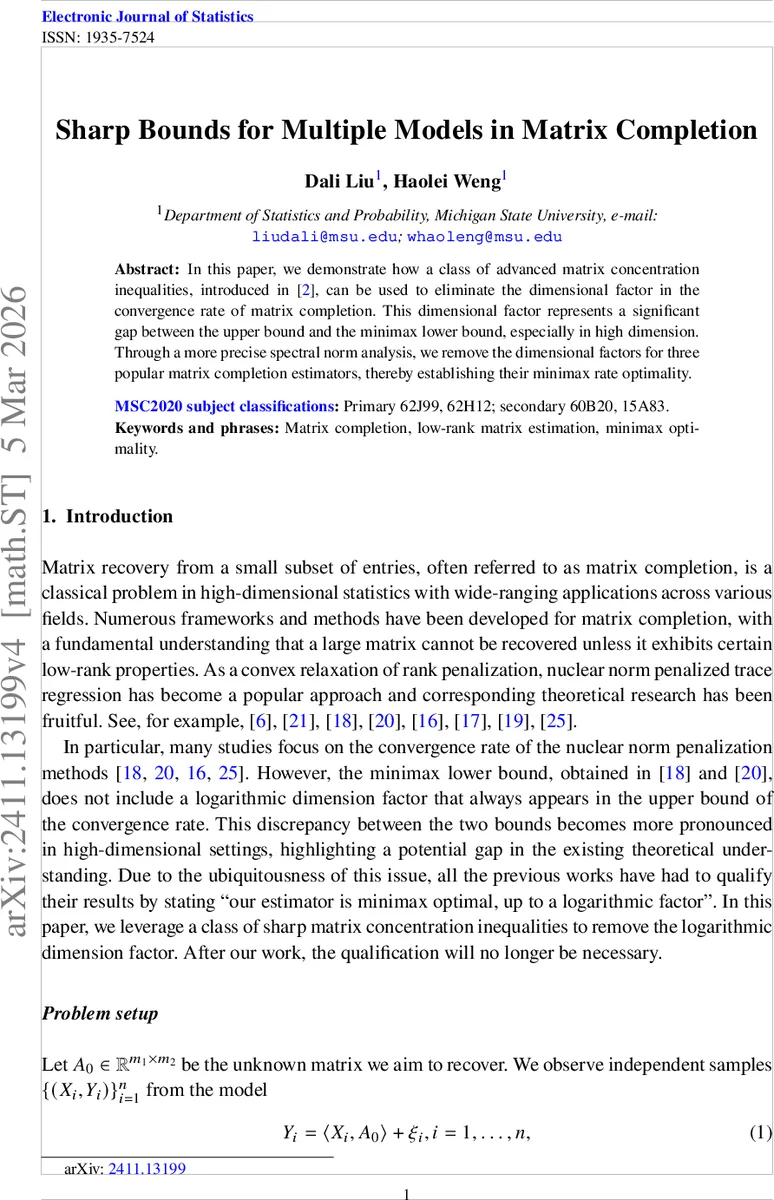
In this paper, we demonstrate how a class of advanced matrix concentration inequalities, introduced in \cite{brailovskaya2024universality}, can be used to eliminate the dimensional factor in the convergence rate of matrix completion. This dimensional factor represents a significant gap between the upper bound and the minimax lower bound, especially in high dimension. Through a more precise spectral norm analysis, we remove the dimensional factors for three popular matrix completion estimators, thereby establishing their minimax rate optimality.
💡 Research Summary
The paper addresses a long‑standing gap in the theory of low‑rank matrix completion: the presence of a logarithmic dimension factor (typically (\log(m_{1}+m_{2}))) in the upper bounds for popular estimators, which makes the rates sub‑optimal compared to the known minimax lower bound. By leveraging the sharp matrix concentration inequalities recently introduced by Brailovskaya et al. (2024), the authors eliminate this logarithmic factor for three widely studied estimators, thereby establishing exact minimax optimality.
Problem setting. The observation model is (Y_i=\langle X_i,A_0\rangle+\xi_i), where each sampling matrix (X_i) is a standard basis outer product (so it has a single non‑zero entry) and (\xi_i) denotes noise. The unknown matrix (A_0\in\mathbb{R}^{m_1\times m_2}) is assumed to have rank at most (r) and bounded entrywise magnitude. Classical analyses use nuclear‑norm penalized convex relaxations, but their error bounds contain a factor (\log d) with (d=m_1+m_2). The minimax lower bound, however, scales as (\Omega!\bigl(r\max(m_1,m_2)/n\bigr)) without any logarithmic term.
Technical contribution. The core of the paper is the application of the “sharp” matrix concentration results from Brailovskaya 2024. These inequalities control the spectral norm of sums of the form (\sum_{i=1}^{n}\zeta_i X_i) without incurring a dimension‑dependent logarithmic penalty. In addition, the authors employ a peeling (pee‑ling) argument for empirical processes to handle truncation of heavy‑tailed noise and to bound bias terms that would otherwise introduce extra (\log d) components.
Three estimator families.
- Heavy‑tailed noise with Huber loss. Assuming only finite second moments for the noise, the estimator solves a Huber‑loss minimization plus a nuclear‑norm penalty. Under a fairly general sampling distribution (Assumption 1) and a mild sample‑size condition (n\ge 160,m\log^{4}d), the authors prove with probability at least (1-2d) that
\
Comments & Academic Discussion
Loading comments...
Leave a Comment