Plane geometry of $q$-rationals and Springborn Operations
We study the geometry of $q$-rational numbers, introduced by Morier-Genoud and Ovsienko, for positive real $q$. In particular, we construct and analyse the deformed Farey triangulation and the deformed modular surface. We interpret every $q$-rational…
Authors: Perrine Jouteur, Olga Paris-Romaskevich, Alex
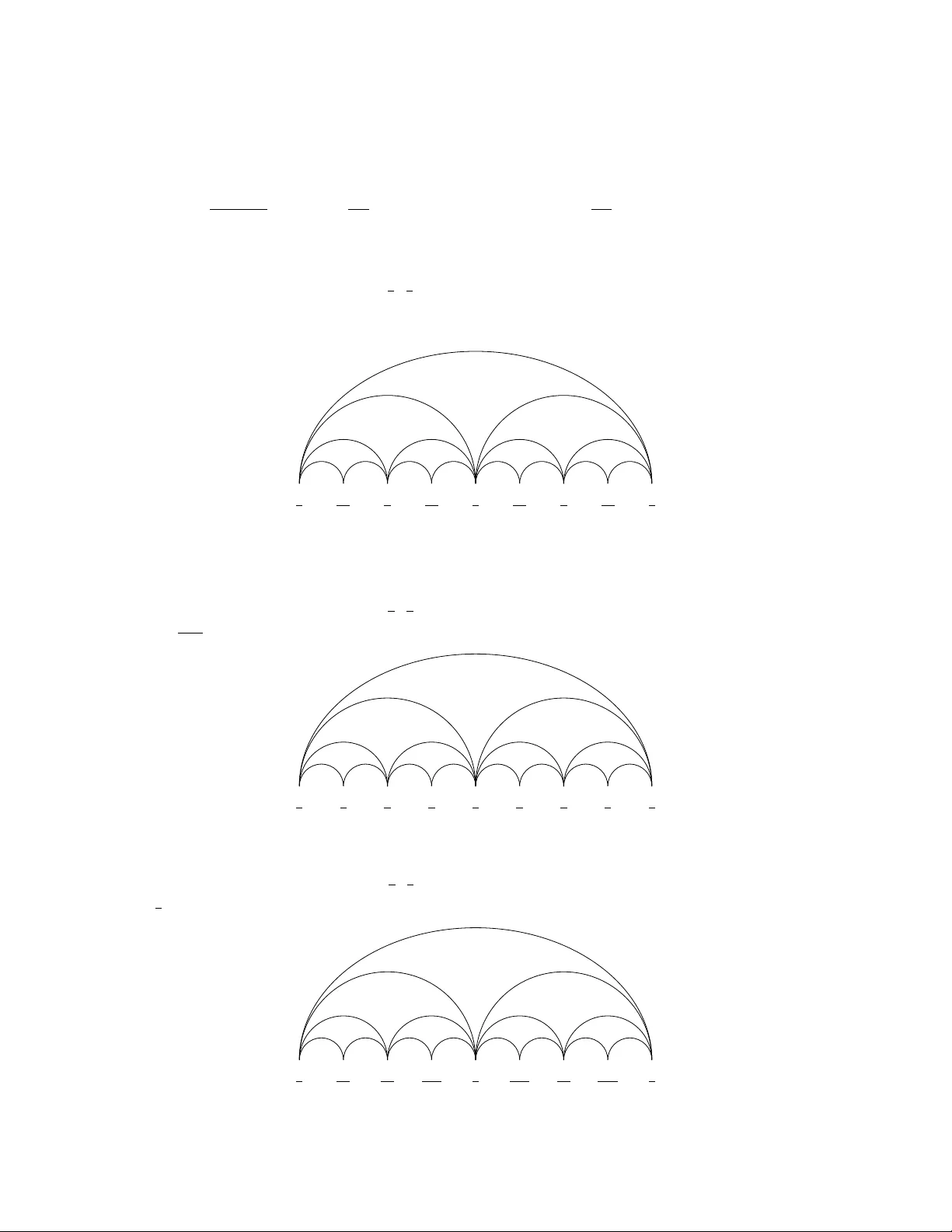
PLANE GEOMETR Y OF q -RA TIONALS AND SPRINGBORN OPERA TIONS PERRINE JOUTEUR, OLGA P ARIS-R OMASKEVICH AND ALEXANDER THOMAS Abstract. W e study the geometry of q -rational num bers, in tro duced b y Morier- Genoud and Ovsienk o, for positive real q . In particular, w e construct and analyse the deformed F arey triangulation and the deformed mo dular surface. W e interpret every q -rational geometrically as a circle, similar to the famous F ord circles. F urther, we define and study new op erations on q -rationals, the Springb orn op erations, which can b e seen as a quadratic version of the F arey addition. Geometrically , the Springborn op erations corresp ond to taking the homothety centers of a pair of tw o circles. Contents 1. In tro duction 1 2. F rom q -in tegers to q -rationals to q -reals 5 3. Hyp erbolic geometry and deformed F arey tesselation 9 4. Deformed F arey determinan ts and op erations 18 5. Classical Springborn op erations 24 6. Springb orn op erations for q -rationals 32 7. An example : Marko v fractions 41 References 50 1. Intr oduction Con text and motiv ations. In their seminal paper [ 22 ], Morier-Genoud and Ovsienk o in tro duced the notion of a q -deformed rational n umber, using a deformed v ersion of the con tin ued fraction dev elopment. These q -rationals hav e astonishing p ositivity and con vergence prop erties. Equiv alently , one can define q -rationals via a deformation of the F arey addition a b ⊕ F c d = a + c b + d , where a b , c d are tw o rationals with F arey determinant | ad − bc | = 1. Still another equiv a- len t description of q -rationals can b e obtained by deforming the action of the mo dular 1 2 PERRINE JOUTEUR, OLGA P ARIS-ROMASKEVICH AND ALEXANDER THOMAS group PSL 2 ( Z ) on the h yp erb olic plane H 2 b y M¨ obius transformations (fractional linear transformations). The usual generators S and T of PSL 2 ( Z ) get deformed as follo ws: T = 1 1 0 1 q ⇝ T q := q 1 0 1 , S = 0 − 1 1 0 q ⇝ S q := 0 − 1 q 0 . So on after, another version of q -rationals was disco v ered, first noticed in [ 23 , Remark 3.2] and in tro duced formally b y Bapat-Beck er-Licata [ 3 ]. It is called the left version (while the first version is then called the right v ersion), and has similar p ositivit y and conv ergence prop erties. In their work, Bapat-Bec ker-Licata stipulate the idea of thinking ab out a q -rational n um b er as a hyperb olic geo desic, with endp oin ts giv en by the left and right q -deformation. F or this geometric picture to hold, it is necessary to sp ecialize the formal parameter q to b e a p ositive real n umber. The starting p oin t of this pap er is a deep ened inv estigation of the geometry of q - rational n umbers, using the geometry of the hyperb olic plane and the symmetries of the F arey triangulation. By doubling the hyperb olic geo desics, using complex conjugation, w e adv o cate for the picture of a q -rational as a disk in C . The set of disks, indexed b y QP 1 , resp ects the order of the rationals. The figure b elow the abstract, drawn using Shaderto y [ 19 ], sho ws some of these disks. A natural ob ject asso ciated to rationals and the mo dular group action on them is the F arey triangulation and the mo dular surface. Recen tly , Simon [ 27 , Section 3.2] has describ ed a deformation of the modular surface, whic h b ecomes a hyperb olic orbifold with a unique funnel. W e indep endently arriv e at the same description, and go further, making the link to q -rationals. The preimage of the unique geo desic around the funnel in H 2 , seen as universal cov er, is the set of h yp erb olic geo desics asso ciated to q -rationals. The visualization of the q -rationals via disks allo wed us to notice an unexp ected prop ert y: for man y pairs of circles, the intersection p oin t of the inner or outer common tangen ts (the inner or outer homothet y cen ter of the t wo circles) lies at the b oundary of another disk. If the t wo initial circles are indexed by rational num b ers a b and c d , the inner homothet y p oin t lies on the circle asso ciated to (1.1) a b ⊕ S c d = ab + cd b 2 + d 2 , where the fraction on the right hand side might not b e reduced. This op eration is a quadratic v ersion of the F arey addition. In a different con text (Diophantine appro xi- mations of rationals num b ers), it has been recen tly studied by Springb orn [ 28 ]. This is wh y w e call it the Springb orn addition . A similar op eration, the Springb orn difference, corresp onds to the outer homothet y cen ter. The pro of of this property led to the study of in volutiv e symmetries of the classical F arey triangulation and their deformations. Finding the reduced expression of the q - deformed Springb orn op eration uses recen t results on q -rationals, notably when the denominator is palindromic [ 13 , 26 ]. PLANE GEOMETR Y OF q -RA TIONALS AND SPRINGBORN OPERA TIONS 3 Summary and results. In Section 2 w e recall the construction and main prop erties of q -rationals, notably through their symmetry group PSL 2 ( Z ) or the extended modular group PGL 2 ( Z ). In Section 3 , w e study the F arey triangulation and its symmetries. The F ar ey deter- minant of tw o rational num b ers a b and c d , denoted b y d F ( a b , c d ), is giv en by | ad − bd | . The F arey triangulation is simply the union of all hyperb olic geo desics b et ween pairs of rationals of F arey determinant 1. Using the q -deformed action of the mo dular group on H 2 , we describe the q -deformed F arey tesselation and the deformed mo dular surface. Concretely , w e compute the fundamental domain of the deformed PGL 2 ( Z )-action [ 10 ]: Prop osition A (Prop osition 3.10 ) . The fundamental domain of the q -deforme d action of PGL 2 ( Z ) on H 2 is a hyp erb olic “triangle” op en towar ds infinity, with two vertic es given by i √ q and σ = 1+ i √ 3 2 . It is a deformation of the triangle with vertic es i, σ and ∞ . As a consequence, together with P oincar´ e’s theorem on fundamen tal polygons, this allo ws to c heck that the group whic h acts is indeed PGL 2 ( Z ) (Corollary 3.11 ). The deformed mo dular surface is an orbifold with a unique funnel. The preimage of the geo desic around the funnel is the set of q -rationals, seen as h yp erb olic geo desics. W e denote b y [ a b ] the geo desic asso ciated to a b ∈ Q (working in the upp er half-plane mo del), or the full disk in C . As applications, we get the well-orderedness of the disks asso ciated to q -rationals, and w e rederive the Etingof gap formula [ 6 , Prop. 4.6] in Corollary 3.19 , using the ergo dicity of the geo desic flow on a closed hyperb olic surface. In Section 4 we define a deformed v ersion of the F arey determinant. Since there are righ t and left versions for q -rationals, we get four possible notions of q -F arey determi- nan ts, denoted b y d △ □ F with △ , □ ∈ { ♯, ♭ } , see Definition 4.1 . Theorem B (Theorem 4.5 and Prop osition 4.6 ) . The four q -F ar ey determinants have p ositive inte gers c o efficients: d △ □ F ∈ N [ q ] . F urther, up to multiplic ation by some mono- mial in q (denote d by ≡ q ), they ar e r elate d by d ♭♯ F ( q ) ≡ q d ♯♭ F ( q − 1 ) and d ♭♭ F ( q ) ≡ q d ♯♯ F ( q − 1 ) . The pro of of this theorem needs the computation of sp ecial v alues of numerators and denominators of q -rationals at the v alue q = σ = 1+ i √ 3 2 , see Lemma 4.2 . This con tributes to other special v alues computed for instance in [ 22 , Section 1.4] for q = − 1, [ 13 , Section 7] for q = σ 2 and [ 16 ] for ro ots of unity of order at most 5. W e also generalize the q -F arey addition, in tro duced in the original paper on q - rationals [ 22 , Section 2.5] for pairs of rationals of F arey determinant 1, to pairs whic h are at graph distance 2 in the F arey triangulation, see Theorem 4.13 . In Section 5 , we in tro duce the Springb orn op erations ( 1.1 ), give geometric in terpre- tations and analyse ho w to iterate them. An imp ortan t notion is that of inner and outer regular pairs, for whic h a reduced expression of the Springb orn op eration can b e giv en. W e concen trate on inner regular pairs in this in tro duction. A pair of rationals ( a b , c d ) is called inner r e gular , if gcd( ab + cd, b 2 + d 2 , a 2 + c 2 ) = d F ( a b , c d ). The core of the pap er is Section 6 , in which w e introduce the q -version of the Spring- b orn op erations, giv en b y the homothetic cen ters of tw o circles asso ciated to q -rationals. W e denote b y i ([ a b ] , [ c d ]) the inner homothety center of the tw o circles [ a b ] and [ c d ]. 4 PERRINE JOUTEUR, OLGA P ARIS-ROMASKEVICH AND ALEXANDER THOMAS In case of a regular pair, we get an explicit reduced expression: Theorem C (Prop osition 6.3 and Theorem 6.5 ) . L et a b , c d ∈ Q 2 b e an inner r e gular p air. Then ther e ar e explicit inte gers ε 1 , ε 2 such that i h a b i , h c d i = q ε 2 A ♯ B ♭ + q ε 1 C ♭ D ♯ q ε 2 B ♯ B ♭ + q ε 1 D ♯ D ♭ , and the gr e atest c ommon divisor of numer ator and denominator is (up to a monomial in q ) given by d ♯♭ F . The symmetries of the classical F arey triangulation allows to c haracterize the regular pairs: Theorem D (Theorem 6.7 ) . A p air a b , c d ∈ Q 2 is inner r e gular if and only if ther e is an orientation-r eversing involution in PGL 2 ( Z ) exchanging a b and c d . Finally , this leads to our main result: Theorem E (Theorem 6.8 ) . L et ( a b , c d ) ∈ Q 2 . If the p air is inner r e gular, then h a b ⊕ S c d i ♯ q = i h a b i , h c d i . As a consequence, we sho w the existence of an explicit formula for the q -midp oin t [ 1 2 ( a b + c d )] ♯ q whenev er | ad − bc | = 1, see Corollary 6.10 . In the final Section 7 , we study com binatorial in terpretations for the q -Springb orn op erations in the case of Mark ov fractions, introduced by Springb orn in [ 28 ]. They are rational num b ers with a Mark ov n umber in the denominator, obtained b y iteration of the Springborn sum on inner regular pairs. The q -Springb orn sum giv es a new notion of q -Mark ov n umbers, and we deduce from our main result a deformed Mark ov equation they satisfy , see Theorem 7.2 . Notation. • F or a rational num b er r s ∈ Q , we denote by R ♯ , S ♯ ∈ Z [ q ] the numerator and denominator of the right q -rational asso ciated to r s . Similarly , we denote by R ♭ , S ♭ ∈ Z [ q ] its left q -version. • W e put σ = 1+ i √ 3 2 , the 6th ro ot of unit y and fixed p oin t of the order 3 element of the mo dular group. • F or t w o p olynomials A, B ∈ Z [ q , q − 1 ], we write A ≡ q B if there is an in teger n ∈ Z suc h that A ( q ) = q n B ( q ). Ac knowledgemen ts. W e had man y fruitful discussions and exchanges of ideas, for whic h we wan t to thank Vladimir F o c k, Summer Haag, Cyril Lecuire, Julien Marc h ´ e, Th ´ eo Marty , Sophie Morier-Genoud, V alentin Ovsienko, Serge P armentier, Iv an Rasskin, Charles Reid, Barbara Schapira, Bruno Sev ennec, Christopher-Lloyd Simon, Boris Springb orn, Katherine Stange and Andrei Zab olotskii. F or the mathematical illustra- tions, A. T. is v ery grateful to Stev e T rettel for his course on Shadertoy , to Sebastian Manec ke for his improv ement of the illustration and to the semester program ab out mathematical illustration at IHP in 2026. PLANE GEOMETR Y OF q -RA TIONALS AND SPRINGBORN OPERA TIONS 5 W e are grateful to our institutions, Universit ´ e de Reims Champagne-Ardenne and Univ ersit´ e Claude Bernard Ly on 1, as w ell as to the Institut Henri Poincar ´ e, where we regularly met for discussions. O. P .-R. has b een supp orted by the ANR grant GALS ANR-23-CE40-0001. A. T. has been supp orted b y a BQR gran t of Univ ersit´ e Claude Bernard Lyon 1. 2. Fr om q -integers to q -ra tionals to q -reals 2.1. Definition(s) of q -rationals. Let q b e a formal parameter. Recall the classical q -in tegers that deform an y p ositiv e integer n ∈ Z ≥ 0 as follo ws [ n ] q := 1 − q n 1 − q = 1 + q + . . . + q n − 1 ∈ Z [ q ] . One of v arious illustrations of the interest of q -integers is the fact that they generalize classical com binatorial ob jects in the setting of v ector spaces. Example 2.1. Define [ n ]! q := [ n ] q · [ n − 1] q · . . . [1] q and n k q := [ n ]! q [ k ]! q · [ n − k ]! q . Then, for the finite field F q , the q -binomial c o efficient c ounts the numb er of k -dimensional subsp ac es of F n q : | Gr( k , n )( F q ) | = n k q . Morier-Genoud and Ovsienk o in [ 22 ] extended this q -deformation to all rational n um- b ers. Their construction relies on a deformation of the standard action of the mo dular group PSL 2 ( Z ) on the pro jective line QP 1 b y fractional linear transformations. It is defined via the following deformation of the tw o generators of the mo dular group PSL 2 ( Z ) = ⟨ T , S | S 2 = ( T S ) 3 = 1 ⟩ : (2.1) T = 1 1 0 1 q ⇝ T q := q 1 0 1 , S = 0 − 1 1 0 q ⇝ S q := 0 − 1 q 0 . A t this formal lev el, the matrices T q and S q are elemen ts of PGL 2 ( Z [ q , q − 1 ]). One c hecks that as M¨ obius transformations, we still ha ve S 2 q = ( T q S q ) 3 = 1. Hence the group generated by T q and S q is still PSL 2 ( Z ). Giv en a matrix M ∈ PSL 2 ( Z ), its q -analogue M q is obtained b y replacing T by T q and S b y S q in the expansion of M as a finite pro duct of generators T and S . This do es not dep end on the choice of represen ting M as pro duct of T and S . Notation 2.2. By c onvention, the r e duc e d form of a r ational numb er x ∈ Q is a fr action x = a b with a and b two c oprime inte gers, and such that b ∈ Z ≥ 0 . Any r ational numb er admits a unique such r e duc e d form. We extend to QP 1 by putting ∞ = 1 0 . Thr oughout the do cument, we assume that r ational numb ers ar e always given in r e duc e d form, if not state d explicitly otherwise. 6 PERRINE JOUTEUR, OLGA P ARIS-ROMASKEVICH AND ALEXANDER THOMAS Definition 2.3 ( [ 3 , 22 ]) . The right q -v ersion of a numb er a b ∈ QP 1 is a r ational function in q with inte ger c o efficients define d as (2.2) h a b i ♯ q := M q · 1 0 = A ♯ a/b ( q ) B ♯ a/b ( q ) ∈ Z ( q ) , wher e M ∈ PSL 2 ( Z ) is any map such that M · 1 0 = x and wher e PSL 2 ( Z ) acts by M¨ obius tr ansformations. Its left q -version is define d as (2.3) h a b i ♭ q := M q · 1 1 − q = A ♭ a/b ( q ) B ♭ a/b ( q ) ∈ Z ( q ) . We often omit the subscript a/b while de aling with these p olynomials when the c orr e- sp onding r ational is fixe d along the ar gument. By c onvention, A □ and B □ ar e c oprime p olynomials in q , and B □ has p ositive dominant c o efficient, for □ ∈ { ♯, ♭ } . The left version of q -rationals w as first mentionned in [ 23 , Remark 3.2], and then studied b y Bapat-Bec k er-Licata in [ 3 ]. The reason for such naming is that for any q ∈ (0 , 1), the left q -version of any rational num b er is strictly smaller than its right q -v ersion (see Proof of Proposition 2.14 in [ 3 ]). The choice of 1 0 and 1 1 − q in Definition 2.3 comes from the fact that these are exactly the tw o fixed points of T q . Example 2.4. In addition to the usual q -inte gers [ n ] q = [ n ] ♯ q , we give some mor e examples: • F or n ∈ N > 0 , we have [ n ] ♭ q = 1 + q + q 2 + ... + q n − 2 + q n . • 1 2 ♯ q = q 1+ q and 1 2 ♭ q = q 2 1+ q 2 . • 7 5 ♯ q = q 4 +2 q 3 +2 q 2 + q +1 q 3 +2 q 2 + q +1 and 7 5 ♭ q = q 5 + q 4 +2 q 3 + q 2 + q +1 q 4 + q 3 + q 2 + q +1 . V arious equiv ariance prop erties of q -rationals are summarized in the follo wing: Prop osition 2.5 ( [ 10 , 17 ]) . F or any x ∈ QP 1 and □ ∈ { ♯, ♭ } , we have (i) [ x + 1] □ q = q [ x ] □ q + 1 and − 1 x □ q = − 1 q [ x ] □ q , (ii) 1 x □ q = 1 [ x ] □ q − 1 and [ − x ] □ q = − 1 q [ x ] □ q − 1 . Pr o of. Item (i) expresses the equiv ariance with resp ect to T and S , so follo ws directly from Definition 2.3 . F or item (ii), w e also need the negation map N q (Equation ( 2.5 ) b elo w) and the duality g q (Theorem 2.10 b elow). W e get 1 x ♯ q = [ N S x ] ♯ q = N q S q [ x ] ♭ q = N q S q g q − 1 [ x ] ♯ q − 1 = 1 [ x ] ♯ q − 1 . The same holds for [ 1 x ] ♭ q . Finally , [ − x ] □ q = [ N x ] □ q = N q g q − 1 [ x ] □ q − 1 = − 1 q [ x ] □ q − 1 . □ PLANE GEOMETR Y OF q -RA TIONALS AND SPRINGBORN OPERA TIONS 7 Ev en though any q -rational can b e explicitly computed in a finite time, the arithmetic patterns of its co efficien ts represen t a c hallenge to understand. W e state several results in this direction, starting with Prop osition 2.6 ( Positivity pr op erty , [ 3 , 22 ]) . F or any numb er a b ∈ Q \{ 0 } , the four c orr esp onding p olynomials A ♯ , A ♭ , B ♯ , B ♭ have inte ger c o efficients of c onstant sign. Mor e over, this sign is p ositive if a b > 0 . Pr o of. If a b ≥ 1, there is a combinatorial in terpretation of all co efficien ts of the four p olynomials, as pro ven in [ 22 , Theorem 4] and [ 3 , Corollary A.2], see also [ 17 , Propo- sition 2.4]. Indeed, these co efficien ts coun t some sp ecial subsets of the graph dual to a part of the F arey triangulation enco ding the contin ued fraction con vergen ts of a b . So they are all p ositiv e. If 0 ≤ a b < 1, from Prop osition 2.5 the iden tity 1 x □ q = 1 [ x ] □ q − 1 , reduces the argumen t to the previous case. F or a b < 0, again from Prop osition 2.5 the identit y [ − x ] □ q = − 1 q [ x ] □ q − 1 reduces the argumen t to the t wo previous cases. □ Remark 2.7. The only two p olynomials with c o efficients of differ ent signs ar e the numer ator of [0] ♭ q = q − 1 q and the denominator of [ ∞ ] ♭ q = 1 1 − q . In our inv estigations, w e will need t w o results giving conditions under which the n umerators of t wo q -rationals are iden titcal or palindromic. Recall that a p olynomial B ( q ) is called palindromic if B ( q ) = B ( q − 1 ) · q deg B . Theorem 2.8 (Theorem 1.2 in [ 26 ]) . The p olynomial B ♯ a/b is p alindr omic if and only if a 2 ≡ 1 mo d b , and the p olynomial B ♭ a/b is p alindr omic if and only if a 2 ≡ − 1 mo d b . Theorem 2.9 (Theorem 3.5 in [ 13 ]) . L et p b e a p ositive inte ger. F or irr e ducible fr ac- tions a p and b p with ab ≡ − 1 mo d p , the denominators ar e e qual: B ♯ a/p ( q ) = B ♯ b/p ( q ) . The authors also conjecture that the inv erse holds if p is prime and a = b mo d p . An imp ortan t feature of q -rationals is the existence of a transition map that exc hanges the left version with the righ t one while replacing q by q − 1 : Theorem 2.10 ( [ 10 , 30 ]) . F or any r ational a b ∈ QP 1 , we have g q h a b i ♯ q = h a b i ♭ q − 1 and g q h a b i ♭ q = h a b i ♯ q − 1 , wher e g q ( x ) = 1+( x − 1) q 1+( q − 1) x is c al le d the transition map . In other wor ds, ther e is a glob al map that exchanges left and right q -versions of r ational numb ers : a c omp osition of the tr ansition map (acting on r ational fr actions in q ) and that of the duality map on the set of p ar ameters : q 7→ 1 q . Pr o of. The first statemen t is pro ven in [ 30 , Theorem 2.7], the second follo ws from the first together with a remark that g q ◦ g q − 1 = id. This statemen t also follows from [ 10 , Theorem 1.7], by applying the argumen t of the theorem to the iden tity matrix. □ 8 PERRINE JOUTEUR, OLGA P ARIS-ROMASKEVICH AND ALEXANDER THOMAS 2.2. Extension of the deformation from PSL 2 ( Z ) to PGL 2 ( Z ) . The q -action of PSL 2 ( Z ) w as extended to that of PGL 2 ( Z ) in [ 10 ], sho wing that under this larger q - action the left and righ t versions of q -rationals form a single orbit. Since PGL 2 ( Z ) = ⟨ T , S, N | S 2 = ( T S ) 3 = 1 , N 2 = ( N T ) 2 = ( N S ) 2 = 1 ⟩ , where N : x 7→ − x is the negation map, the extension is defined b y q -deforming N into (2.4) N q = − 1 1 − q − 1 q − 1 1 . Moreo ver, for any matrix M ∈ PGL 2 ( Z ) with det M = − 1 and x ∈ QP 1 , the follo wing relations hold (see Theorem 1.5 in [ 10 ]): (2.5) M q · [ x ] ♯ q = [ M · x ] ♭ q and M q · [ x ] ♭ q = [ M · x ] ♯ q . F or any q ∈ R > 0 , the map N q sends the upp er half-plane to the low er half-plane. In order to define (and deform) PGL 2 ( Z ) inside the group Isom( H 2 ), one should comp ose N (and N q ) with the complex conjugation c : z 7→ ¯ z , and define PGL 2 ( Z ) as generated b y this comp osition and its pro ducts with T and S . Putting s 1 = S N c , s 2 = N c , s 3 = T N c, w e get another w ell-known presentation of PGL 2 ( Z ), seen as Coxeter group: (2.6) PGL 2 ( Z ) = ⟨ s 1 , s 2 , s 3 | s 2 i = ( s 1 s 2 ) 2 = ( s 1 s 3 ) 3 = 1 ⟩ . 2.3. F rom q -rationals to q -reals and b ey ond. The q -rational n umbers satisfy con- v ergence prop erties leading to the definition of q -irrational num b ers, see [ 23 , Thm 1]. In the formal setting, the conv ergence takes place as Laurent series (expanded around q = 0) in the q -adic top ology . W e only state the version with q sp ecialized to a p ositive real v alue (smaller than 1), see [ 3 , Thm 2.11]. Theorem 2.11 ( Conver genc e pr op erty , [ 3 , 23 ]) . L et q ∈ (0 , 1) and ( x n ) n ∈ N b e a c onver gent se quenc e of r ational numb ers with limit ℓ . • If ℓ is irr ational, then b oth ([ x n ] ♯ q ) n ∈ N and ([ x n ] ♭ q ) n ∈ N c onver ge to the same r e al numb er, denote d by [ ℓ ] q . • If ( x n ) n ∈ N c onver ges to ℓ ∈ Q fr om the right (r esp. fr om the left), b oth ([ x n ] ♯ q ) n ∈ N and ([ x n ] ♭ q ) n ∈ N c onver ge to [ ℓ ] ♯ q (r esp. to [ ℓ ] ♭ q ). Note that, unlik e the case of rational n umbers, the left and right v ersions of q - irrationals coincide. These prop erties b ecome visualized in our geometric approac h whic h represent q -rationals as circles, see for instance Figure 3.4 . The geometric argumen ts in [ 3 ], as well those that w e develop in this w ork, show that for an y x ∈ R \ Q , its quantification [ x ] q ∈ R is well-defined for any q ∈ R + . Question 2.12. F or any fixe d x ∈ R \ Q , c onsider the function on the half-line [ x ] : R + → R , define d by [ x ] : q 7→ [ x ] q . This function is c ontinuous in q ∈ R + , and analytic ne ar q = 0 . What c an one say ab out its b ehavior outside its c onver genc e r adius? What ab out its smo othness class, do es it dep end in any way on the Diophantine pr op erties of x ? PLANE GEOMETR Y OF q -RA TIONALS AND SPRINGBORN OPERA TIONS 9 F or an irrational num b er x ∈ R \ Q , the expression for [ x ] q is given b y a formal Lauren t series. The question of conv ergence of this series w as raised by Leclere in [ 18 ], where this conv ergence was prov en for an y rational x ∈ Q > 1 in the disk cen tered at 0 of radius R ∗ := 3 − 2 √ 2. It w as also conjectured in [ 18 ] that for an y x ∈ R > 1 the corresp onding Laurent series defining its q -analogue [ x ] q con verges in the disk of radius R ⋆ := 3 − √ 5 2 cen tered at 0. This w as prov en for all x ∈ Q in [ 5 ] using the theory of Kleinian groups. Then, in [ 6 ] the ab o ve conjecture is pro v en for all real x , in a weak er form (in the disk of radius R ∗ = 3 − 2 √ 2 < R ⋆ ). Finally , one could ask : what about q -complex n umbers? Tw o differen t approac hes w ere prop osed by Ovsienko in [ 24 ] (quantization of Gaussian in tegers) and Etingof [ 6 ] (quan tization of all complex num b ers), and w e are curren tly working on another (geometric) approac h that w e will presen t in up coming work. In the following, we deal exclusiv ely with q -rationals for q ∈ R + . 3. Hyperbolic geometr y and def ormed F arey tessela tion F or a fixed p ositiv e real q , w e prop ose a geometric picture of q -rationals, using the F arey triangulation of the hyperb olic plane. 3.1. Classical F arey triangulation. W e present tw o constructions of the classical F arey triangulation. The first uses geodesics connecting certain pairs of rationals, the second uses the representation of PGL 2 ( Z ) as a reflection group. Definition 3.1. The F arey determinant d F : Q × Q → N is the function which to a given p air of r ational numb ers in r e duc e d form a b , c d asso ciates the quantity d F a b , c d = | ad − bc | . We c an extend this definition to a p air in QP 1 by writing ∞ = 1 0 . The F arey sum and the F arey difference of the p air ar e a b ⊕ F c d := a + c b + d and a b ⊖ F c d := a − c b − d . Note that the resulting fractions of the F arey op erations are not necessarily reduced. These expressions are reduced if the pair is of F arey determinan t 1. Prop osition 3.2. The F ar ey determinant is invariant under the SL 2 ( Z ) -action, and the F ar ey op er ations ar e e quivariant under the same action. A l l p airs of F ar ey determinant n b elong to the same SL 2 ( Z ) -orbit, that of 1 0 , k n with some k ∈ [0 , n ) . Pr o of. The in v ariance of the F arey determinan t is clear from the matrix p ersp ectiv e: the F arey determinan t is the (absolute v alue) of the determinant of the matrix M = ( a c b d ). The F arey op erations corresp ond to M 1 1 and M 1 − 1 . Since the SL 2 ( Z )-action pre- serv es the space of reduced fractions, its action on pairs is simply by matrix multiplica- tion. Hence the F arey determinant is unc hanged, while the F arey op erations commute with the PSL 2 ( Z )-action. 10 PERRINE JOUTEUR, OLGA P ARIS-ROMASKEVICH AND ALEXANDER THOMAS Since SL 2 ( Z ) acts transitively on QP 1 , w e can send one element of a pair to ∞ = 1 0 . The other elemen t is then of the form k n , where n is the F arey determinan t of the original pair. Using the action of T ∈ Stab( ∞ ), w e can imp ose k ∈ { 0 , 1 , ..., n − 1 } . □ Definition 3.3. The F arey triangulation F is a tesselation of the hyp erb olic plane by ide al triangles, delimite d by al l hyp erb olic ge o desics b etwe en two r ationals in QP 1 of F ar ey determinant 1 . 1 0 0 1 1 1 − 1 1 2 1 1 2 − 1 2 − 2 1 3 1 − 3 1 1 3 − 1 3 3 2 − 3 2 2 3 − 2 3 Figure 3.1. The ideal triangles of the classical F arey triangulation F attac hed to rationals with denominator at most 3. Note that the rational p oin ts are not equidistant on the b oundary . The second construction of the F arey triangulation starts from the presentation of PGL 2 ( Z ) as a subgroup of Isom( H 2 ) giv en b y (see ( 2.6 )): PGL 2 ( Z ) = ⟨ s 1 , s 2 , s 3 | s 2 i = ( s 1 s 2 ) 2 = ( s 1 s 3 ) 3 = 1 ⟩ . Prop osition 3.4. Consider the ide al hyp erb olic triangle ∆ 0 with vertic es i, σ = 1+ i √ 3 2 and ∞ . The r efle ction gr oup gener ate d by its thr e e sides is PGL 2 ( Z ) . Pr o of. W e w ork in the upp er half plane mo del of H 2 . A direct computation sho ws that the fixed p oint set of s 1 is the unit circle, whic h is the geo desic b et ween i and σ . The fixed p oin t set of s 2 is the imaginary axis, the geo desic b etw een i and ∞ , and the fixed p oin t set of s 3 is Re( z ) = 1 2 , the geo desic b et ween σ and ∞ . □ The tesselation generated b y the reflection group and the base triangle ∆ 0 is a re- finemen t of the F arey tesselation, where eac h F arey triangle gets sub divided in to six smaller triangles. PLANE GEOMETR Y OF q -RA TIONALS AND SPRINGBORN OPERA TIONS 11 1 0 0 1 1 1 − 1 1 2 1 1 2 − 1 2 − 2 1 3 1 − 3 1 1 3 − 1 3 3 2 − 3 2 2 3 − 2 3 Figure 3.2. The subdivided F arey triangulation, consisting in all geo desics b et ween rationals of F arey determinant 1 (blac k) or 2 (red), up to the denominator at most 3. This Figure is an refinemen t of the Figure 3.1 . The p oin ts app earing as in tersections of three red lines b e- long to the orbit of σ under the action of the mo dular group, while the in tersections b et ween red and blac k lines to the orbit of i . 3.2. Symmetries of classical F arey triangulation. W e are no w studying the sym- metries of the F arey triangulation F . In particular, we describ e the set of inv olutiv e symmetries. Prop osition 3.5. The gr oup of symmetries of the F ar ey triangulation F is PGL 2 ( Z ) . Pr o of. The group PGL 2 ( Z ) is generated by three reflections, and these reflections are symmetries of F . Hence PGL 2 ( Z ) is included in the symmetry group of F . On the other hand, an y symmetry of F is an isometry of H 2 whic h preserves QP 1 , the set of v ertices of F . Suc h an isometry is in PGL 2 ( Q ). Finally , a matrix in GL 2 ( Q ) which preserv es the F arey determinan t (which is necessary to preserv e the set of edges in F ) is necessarily of determinan t ± 1, hence in GL 2 ( Z ). Since the action is pro jective, w e get PGL 2 ( Z ). □ In order to describ e inv olutive symmetries of F , it will appear natural to in tro duce F arey determinants for pairs of p oin ts in the quadratic imaginary field Q [ i ]. This ring is Euclidean, so reduced fractions are well-defined. Definition 3.6. F or two r e duc e d fr actions r s and r ′ s ′ in Q [ i ] , we define their F arey determinan t by d F r s , r ′ s ′ = | r s ′ − r ′ s | . In the sequel, we will only use the case for a pair of complex conjugates. Prop osition 3.7. F or any matrix M ∈ GL 2 ( Z ) , we have d F ( M z , M ¯ z ) = | det( M ) | d F ( z , ¯ z ) . In particular, we see that the F arey determinan t is preserv ed under conjugacy . 12 PERRINE JOUTEUR, OLGA P ARIS-ROMASKEVICH AND ALEXANDER THOMAS Pr o of. It is sufficient to pro v e the prop osition for z = i . Indeed, if z = α + iβ γ + iδ is a reduced fraction in Q [ i ], then w e can replace M b y M α β γ δ to reduce to z = i . F or M = ( a b c d ), a direct computation giv es d F ( M i, − M i ) = | ( a + bi )( c − di ) − ( c + di )( a − bi ) | = 2 | ad − bc | . Since d F ( i, − i ) = | 2 i | = 2, the latter equals | det( M ) | d F ( i, − i ). □ W e can no w describ e the set of in volutiv e symmetries of the F arey triangulation. Prop osition 3.8. The set of orientation-r eversing involutions in PGL 2 ( Z ) is the set of inversions in cir cles with endp oints in QP 1 of F ar ey determinant 1 or 2. The set of orientation-pr eserving involutions in PGL 2 ( Z ) is the set of r otations of π ar ound a p oint z ∈ Q [ i ] ∩ H 2 such that d F ( z , ¯ z ) = 2 . Pr o of. Consider a pair of distinct points in QP 1 with F arey determinant 1 or 2. Then the asso ciate geo desic is an edge in the refined F arey triangulation. Hence the inv ersion with respect to this geo desic is a symmetry of F . Con versely , consider an orien tation-reversing inv olution I which is a symmetry of F . F rom general structure theory of isometries of the h yp erb olic plane, we know that I is an in version with resp ect to some geo desic γ . If γ do es never in tersect the interior of a triangle of F , then γ has to be one edge of F , so b y definition its endpoints are of F arey determinan t 1. Consider then the case when γ intersects the in terior of some triangle. W e can assume that this triangle is the base triangle ∆ 0 , by conjugating I if necessary by an element of PGL 2 ( Z ) (by definition this action is transitive on triangles of F ). Since I is a symmetry of F , it has to fix ∆ 0 . Hence γ is one of the three p erp endicular bisectors of ∆ 0 , whic h are geo desics with endp oin ts of F arey determinan t 2 (see Figure 3.1 ). Finally , consider an orien tation-preserving in v olution I ′ in PGL 2 ( Z ), different from iden tity . Any such inv olution is the rotation around a p oin t z with angle π . W e can conjugate I ′ inside PGL 2 ( Z ) so that the fixed p oin t z lies inside the fundamen tal triangle ∆ 0 . If z lies strictly inside ∆ 0 , then I ′ (0) ∈ (1 , ∞ ) and I ′ ( ∞ ) ∈ (0 , 1). But there is no edge in F b et ween an y pair of p oin ts in these tw o in terv als. Hence z lies on the b oundary of ∆ 0 . Using the rotation T S , we can supp ose that z lies on the geo desic b et w een 0 and ∞ , so I ′ exc hanges 0 and ∞ . Hence I ′ sends ∆ 0 to the triangle ( − 1 , 0 , ∞ ). Therefore z is the in tersection of the geodesic b et ween 0 and ∞ with the one b et ween 1 and − 1. Thus z = i , for which w e hav e d F ( i, ¯ i ) = | 2 i | = 2. Since the action of PGL 2 ( Z ) do es not change the F arey determinan t, w e see that d F ( z , ¯ z ) = 2. Con versely , any point z ∈ Q [ i ] ∩ H 2 with d F ( z , ¯ z ) = 2 can b e conjugated to i , so the rotation around z with angle π is a symmetry of F . □ Prop osition 3.9. If two distinct r ational numb ers a b and c d ar e exchange d under an orientation-r eversing involution in PSL 2 ( Z ) , then the fixe d p oints (in R ) of this involu- tion ar e a + c b + d and a − c b − d . If two distinct r ational numb ers a b and c d ar e exchange d under an orientation-pr eserving involution in PSL 2 ( Z ) , then the fixe d p oints (in C ) of this involution ar e a + ci b + di and a − ci b − di . Note that the expressions of the fixed p oin ts need not to be reduced fractions. PLANE GEOMETR Y OF q -RA TIONALS AND SPRINGBORN OPERA TIONS 13 Pr o of. The statemen t is inv arian t under PSL 2 ( Z )-action. Consider first the case of an orien tation-rev ersing in volution. By the previous Prop osition 3.8 , we kno w that d F ( a + c b + d , a − c b − d ) ∈ { 1 , 2 } . Hence we can conjugate this pair to b e either (0 , ∞ ) or ( − 1 , 1). In the first case, the inv olution b ecomes x 7→ − x , so c d = − a b . Then ( a + c b + d , a − c b − d ) = (0 , ∞ ). In the second case, the inv olution becomes x 7→ 1 x , so c d = b a . Thus, w e ha ve ( a + c b + d , a − c b − d ) = (1 , − 1). Consider now the case of an orien tation-preserving inv olution. Again from Prop osi- tion 3.8 , we know that d F ( a + ci b + di , a − ci b − di ) = 2. Hence we can conjugate this pair to ( i, − i ). The in volution then b ecomes x 7→ − 1 x , so c d = − b a . Then ( a + ci b + di , a − ci b − di ) = ( − i, i ). □ 3.3. q -F arey tesselation and q -mo dular surface. Using the second viewp oin t on the F arey tesselation ab o ve, w e no w q -deform the construction, using the deformed generators ( S q , T q , N q ) and complex conjugation c . W e consider q ∈ (0 , 1), since w e can get q > 1 from the transition map 2.10 . Prop osition 3.10. The fundamental domain of the q -deforme d action of PGL 2 ( Z ) on H 2 in the upp er half-plane mo del, is a quadrilater al with vertic es i √ q , σ, P 1 := 1+ √ q 2 − q +1 1 − q and P 2 := 1+ √ q − 1+ q − 1 1 − q . Note that one side of the quadrilateral lies at the b oundary at infinit y of H 2 , see Figure 3.3 . Pr o of. In analogy to the classical case ( q = 1) we consider the combinations s 1 = S q N q c , s 2 = N q c and s 3 = T q N q c , whic h satisfy the same relations than in Equation ( 2.6 ). W e determine the fixed p oin t sets of eac h of the transformations. Consider first z = S q N q c ( z ) = ( q − 1) ¯ z + 1 q ¯ z + 1 − q . W riting z = x + iy the previous equation is equiv alent to q ( x 2 + y 2 ) + 2(1 − q ) x − 1 = 0, whic h in turn can b e written as (3.1) x − q − 1 q 2 + y 2 = q 2 − q + 1 q 2 , whic h is the equation of a circle. This is the q -deformed unit circle C 1 ,q . Similarly , z = N q c ( z ) = − ¯ z +1 − 1 /q ( q − 1) ¯ z +1 giv es ( q − 1)( x 2 + y 2 ) + 2 x + 1 − q q = 0, which is equiv alent to (3.2) x − 1 1 − q 2 + y 2 = q 2 − q + 1 q (1 − q ) 2 , a circle describing the q -deformed imaginary axis, which we denote b y Im q . Finally , z = T q N q c ( z ) = − ¯ z + q ( q − 1) ¯ z +1 giv es ( q − 1)( x 2 + y 2 ) + 2 x − q = 0 which is equiv alen t to (3.3) x − 1 1 − q 2 + y 2 = q 2 − q + 1 (1 − q ) 2 , 14 PERRINE JOUTEUR, OLGA P ARIS-ROMASKEVICH AND ALEXANDER THOMAS a circle describing the q -deformed line Re( z ) = 1 2 , denoted by C 2 ,q . Finally , w e notice that the three fixed geo desics form a quadrilateral. The computa- tion of the vertices is direct. □ x y P 1 P 2 i √ q σ Figure 3.3. F undamental quadrilateral for the action of PGL 2 ( Z ) on H 2 . Corollary 3.11. F or q ∈ R + , the gr oup gener ate d by T q , S q and N q c is isomorphic to PGL 2 ( Z ) . Pr o of. It is clear that the map T q 7→ T , S q 7→ S, N q c 7→ N c is a surjective group ho- momorphism. W e only ha ve to show that its kernel is trivial, i.e. that there are not more relations among the generators than exp ected. This follo ws from P oincar ´ e’s theo- rem on fundamen tal p olygons (see for instance [ 20 ]). It asserts that giv en a hyperb olic p olygon P in whic h all angles are rational m ultiples of π , then the group G generated b y reflections in all sides of P is a Co xeter group with explicit presen tation, and its action on H 2 has P as fundamen tal domain. W e apply this theorem to our fundamen tal domain we found in the previous prop o- sition. W e only ha ve to c heck the angles. A t the v ertex i √ q , the angle is π 2 since this v ertex is the fixed point of S q , which is of order 2. Similarly , at the vertex σ , the angle is π 3 , since this vertex is the fixed p oint of T q S q , whic h is of order 3. □ Remark 3.12. Note that the pr evious Cor ol lary is not true for al l r e al q . In the c ase of q = − 1 for example, the gr oup gener ate d by T − 1 , S − 1 and N − 1 c is finite. Mor e pr e cisely, the c orr esp onding sp e cial line ar gr oup has pr esentation T − 1 , S − 1 | T 2 − 1 = S 2 − 1 = ( T − 1 S − 1 ) 3 = 1 , so it is the classic al dihe dr al gr oup of or der 6 , that is, the symmetric gr oup S 3 . F urther- mor e, the c orr esp onding gener al line ar gr oup is a semidir e ct pr o duct S 3 ⋊ Z / 2 Z . Inde e d, S 3 is its normal sub gr oup of index 2 and it is e asily che cke d that the element N − 1 c is an antiholomorphic involution such that N − 1 cT N − 1 c = S, N − 1 cS N − 1 c = T . Since one side of the fundamental quadrilateral is along the b oundary ∂ ∞ H 2 , geo- metrically w e hav e a funnel. There is a unique geodesic which cuts this funnel. In our case, it is giv en by the vertical line x = 1 1 − q , whic h is orthogonal b oth to Im q and C 2 ,q . This geodesic links precisely [ ∞ ] ♭ q and [ ∞ ] ♯ q . PLANE GEOMETR Y OF q -RA TIONALS AND SPRINGBORN OPERA TIONS 15 Definition 3.13. Consider q ∈ (0 , 1) . T o e ach x ∈ QP 1 , we asso ciate the unique hyp erb olic ge o desic b etwe en [ x ] ♭ q and [ x ] ♯ q . We denote this ge o desic by [ x ] . The union of al l these ge o desics is denote d by Q . We denote by H 2 q the hyp erb olic plane in the upp er half-plane mo del fr om which we r e- move d al l (Euclide an) half-disks b ounde d by the ge o desics [ x ] , wher e x ∈ QP 1 . Doubling the c onstruction using c omplex c onjugation is shown in Figur e 3.4 . ∞ − 1 − 1 / 2 0 H q H q 1 2 1 / 2 x y Figure 3.4. Representation of the q -disks corresponding to the n umbers − 1 , 1 / 2 , 0 , 1 / 2 , 1 , 2 and ∞ are represen ted for the parameter q sp ecified to q = 0 . 45. The “ q -disk” corresp onding to ∞ is a half-plane b ordered by a v ertical line x = 1 1 − q in this representation. The con vergence prop erties of q -rationals and q -irrationals from Theorem 2.11 can b e w ell-understo od in this visualization. Prop osition 3.14. F or x, y ∈ QP 1 with x = y , the ge o desics [ x ] and [ y ] ar e disjoint. Pr o of. This follows from the geometric viewp oin t: denote by γ the unique geo desic cutting the funnel of the q -deformed mo dular surface, and b y π : H 2 → H 2 / PGL 2 ( Z ) the univ ersal co v ering map. Then Q = π − 1 ( γ ), hence all geo desics in Q are pairwise disjoin t. □ Remark 3.15. The pr evious pr op osition also fol lows fr om the p ositivity of q -r ationals, se e Cor ol lary 4.7 . Remark 3.16. The wel l-or der dness of q -r ationals might c ome as a surprise on the first sight, sinc e r ational numb ers ar e alr e ady dense in R . F or x ∈ Q , the interval [[ x ] ♭ q , [ x ] ♯ q ] do es not c ontain x in gener al. Henc e the c onstruction of q -r ationals, step by step via F ar ey addition, is similar to the c onstruction of a Cantor set. Recall from hyperb olic geometry that for tw o disjoin t geo desics γ 1 , γ 2 , there is a unique third geo desic orthogonal to b oth of them. This third geo desic realizes the minimal distance b etw een γ 1 and γ 2 . F or x, y ∈ QP 1 , we denote by γ ([ x ] , [ y ]) the geo desic b etw een [ x ] and [ y ] (whic h are disjoin t b y Prop osition 3.14 ). F rom Prop osition 3.8 and the PGL 2 ( Z )-symmetry of Q , we get: 16 PERRINE JOUTEUR, OLGA P ARIS-ROMASKEVICH AND ALEXANDER THOMAS ∞ x y y A 1 1 − q B C D Figure 3.5. F undamental quadrilateral for the action of PSL 2 ( Z ) on H 2 q . The angles at C and D are equal to π 2 . The p oin t B is obtained as the in tersection of the circle cen tered at 1 1 − q passing by C and of the (Euclidean) line connecting 1 1 − q and A . Corollary 3.17. If d F ( x, y ) ∈ { 1 , 2 } , the inversion with r esp e ct to γ ([ x ] , [ y ]) is a sym- metry of Q . W e analyze more in detail the quotient H 2 q / PSL 2 ( Z ), the conv ex core of the deformed mo dular surface. It is an orbifold with boundary . The orbifold p oin t i/ √ q is of order 2, while σ is of order 3. The deformed mo dular surface has recently b een describ ed indep enden tly b y Simon [ 27 , Section 3.2]. Prop osition 3.18. The b oundary curve of the c onvex c or e of the q -deforme d mo d- ular surfac e H 2 q / PSL 2 ( Z ) is a ge o desic of length | ln( q ) | . Its ar e a is arctan 2 q − 1 √ 3 + arctan 2 q − 1 − 1 √ 3 . Note that for q = 1, the recov er the mo dular surface with a cusp and of area 2arctan( 1 √ 3 ) = π 3 . W e also see the symmetry b et w een q and q − 1 . If we use PGL 2 ( Z ) instead of PSL 2 ( Z ), then the length of the boundary geo desic and the area ha v e to b e divided b y 2, since the fundamental domain for PGL 2 ( Z ) is half the one for PSL 2 ( Z ). Pr o of. The proof is a direct computation. The v ertices of the fundamen tal quadrilateral of PSL 2 ( Z ) acting on H 2 q are given b y A = σ, B = S q ( σ ) , C = q + i √ q 2 − q +1 q (1 − q ) , D = T q ( C ), see Figure 3.5 . Since C and D lie on the same vertical line, their hyperb olic distance is giv en by | ln( y ( C ) /y ( D )) | , where y ( C ) denotes the y -co ordinate of C . Since D = T q ( C ), w e get y ( D ) = q y ( C ). Therefore the length of the b oundary geo desic is | ln( q ) | . F or the area, we parametrize the b oundary circles of the fundamental domain, which are p ortions of the deformed unit circle C 1 ,q (see Equation ( 3.1 )), C 2 ,q (see Equation PLANE GEOMETR Y OF q -RA TIONALS AND SPRINGBORN OPERA TIONS 17 ( 3.3 )) and C 3 ,q = S q ( C 2 ,q ), giv en b y x − 1 1 − q 2 + y 2 = q 2 − q + 1 q 2 (1 − q ) 2 . W e v ertical line is x = 1 1 − q . W e can then directly compute the area A : A = Z 1 2 x = − 1 2 q Z C 3 ,q y ∈C 1 ,q dx dy y 2 + Z 1 1 − q x = 1 2 Z C 3 ,q y ∈C 2 ,q dx dy y 2 = Z 1 2 x = − 1 2 q dx q q 2 − q +1 q 2 − ( x − q − 1 q ) 2 − Z 1 1 − q x = − 1 2 q dx q q 2 − q +1 q 2 (1 − q ) 2 − ( x − 1 1 − q ) 2 + Z 1 1 − q x = 1 2 dx q q 2 − q +1 (1 − q ) 2 − ( x − 1 1 − q ) 2 = arctan( 2 − q √ 3 q ) − arctan( 1 − 2 q √ 3 ) + 0 − arctan( 1+ q √ 3( q − 1) ) − 0 + arctan( 1+ q √ 3( q − 1) ) = arctan 2 q − 1 √ 3 + arctan 2 q − 1 − 1 √ 3 , where w e used that R dx √ a − ( x − b ) 2 = arctan x − b √ a − ( x − b ) 2 . □ Etingof [ 6 , Prop. 4.6] defines the jump of a rational x ∈ Q as the length ℓ q ( x ) := | [ x ] ♯ q − [ x ] ♭ q | . Using analytic considerations, Etingof computes the sum of jumps of all rationals for q in some op en subset of C (Section 6 of his pap er). F rom our geometric p ersp ectiv e, the jump corresp onds to the diameter of the q -disk [ x ]. W e get a similar result for q ∈ R > 0 , whic h is b oth more restrictiv e (we do not include complex q ) and more general (since Etingof considers only Re( q ) < 1): Corollary 3.19. L et q ∈ R > 0 . If q ∈ (0 , 1) , then for any x, y ∈ QP 1 with x < y , we have X x 1 , then X x c d , we have d □ △ F ∈ N [ q ] for □ , △ ∈ { ♯, ♭ } . Pr o of. W e sho w that for an y pair of distinct rationals, the q -F arey determinan ts ha ve constan t sign co efficients (this prop erty is inv ariant under T and S ). The proposition then follo ws, since the sign can b e determined by ev aluating at q = 1. W e ha ve already seen that the F arey determinants do not c hange under T and S (mod- ulo a p o wer of q ). If △ = ♯ , we can send c d to 0 1 , then d □ ♯ F = A □ , which has constant sign co efficien ts by Prop osition 2.6 . This pro ves the prop osition for d ♯♯ F and d ♭♯ F . The remaining tw o cases follow from the relations betw een the q -F arey determinants giv en in Theorem 4.5 . □ Note that even in the case ( ♯♯ ), this provides a new pro of of the p ositivit y of the p olynomial A ♯ D ♯ − B ♯ C ♯ . The original pro of in [ 22 , Section 4.7] uses the F arey trian- gulation. As a consequence, we recov er the well-orderedness of q -rationals: Corollary 4.7. F or a b > c d and q ∈ (0 , 1) , we have h c d i ♭ q < h c d i ♯ q < h a b i ♭ q < h a b i ♯ q . Another consequence arises b y combining Theorem 4.5 with results about palindromic denominators in q -rationals from [ 13 , 26 ]. Corollary 4.8. Consider a r ational numb er k n ∈ Q . ( i ) If n divides k 2 + 1 , then N ♯ + ( q − 1) K ♯ ≡ q N b . ( ii ) If n divides k 2 − 1 , then N ♭ + ( q − 1) K ♭ ≡ q ( q 2 − q + 1) N ♯ . Pr o of. F rom [ 26 , Theorem 1.2] (see Theorem 2.8 ), we know that n | k 2 + 1 implies that N ♭ is palindromic. Hence b y the denominator of Equation ( 4.1 ), w e see that N ♭ ( q ) = q deg( N ♭ ) N ♭ ( q − 1 ) ≡ q ( N ♯ + ( q − 1) K ♯ ) . 22 PERRINE JOUTEUR, OLGA P ARIS-ROMASKEVICH AND ALEXANDER THOMAS Similarly , from [ 13 , Corollary 3.8] (see Theorem 2.9 ), we kno w that n | k 2 − 1 implies that N ♯ is palindromic. Hence the denominator of Equation ( 4.2 ) concludes. □ 4.2. q -F arey op erations. The q -deformed F arey op erations are an equiv alent wa y to define q -rationals. They were in tro duced in [ 22 , Section 2.5]. Let us quickly recall them here. Prop osition 4.9 ( [ 22 , 25 ]) . L et ( a b , c d ) b e a p air of r ationals with F ar ey determinant 1. Put r s = a b ⊕ F c d = a + c b + d . Then R ♯ = A ♯ + q α C ♯ and S ♯ = B ♯ + q α D ♯ , wher e α = ε ( a b ) − ε ( c d ) + 1 if ε ( a b ) ≥ ε ( c d ) 1 else , wher e ε is define d in Definition ( 3.20 ) . A similar formula holds for left q -r ationals. P airs of F arey determinan t 1 corresp ond to points in the F arey graph F which are at graph distance 1 (they ha ve an edge b etw een them). W e will generalize the ab o ve prop osition to pairs of rationals of F arey graph distance 2. Remark 4.10. Note that the F ar ey gr aph distanc e is not linke d in gener al to the F ar ey determinant. Only the c ase when b oth ar e 1 c oincide. P airs of rationals of F arey graph distance 2 arise naturally in any F arey sequence, i.e. a sequence of all reduced fractions in a giv en interv al, with denominator smaller or equal to a fixed num b er m , and ordered increasingly , see Chapter I I I of [ 9 ]. F or a F arey sequence ( f n ), w e ha ve d F ( f n , f n +1 ) = 1 for all n , and also (4.3) f n = f n − 1 ⊕ F f n +1 . Hence, the F arey graph distance b et w een f n and f n +2 is at most 2. Example 4.11. The F ar ey se quenc e in the intver al [0 , 1 2 ] for m = 6 is given by 0 1 , 1 6 , 1 5 , 1 4 , 1 3 , 2 5 , 1 2 . F or a mor e c omplic ate d example, c onsider the interval [ 151 227 , 153 229 ] with m = 234 , which gives { 151 227 , 153 230 , 155 233 , 2 3 , 155 232 , 153 229 } . In b oth examples, you c an verify ( 4.3 ) . There is a nice c haracterization of pairs of F arey graph distance at most 2: Prop osition 4.12. Consider a p air of r ationals ( a b , c d ) and denote by d F their F ar ey determinant. The p air is of F ar ey gr aph distanc e at most 2 inside F if and only if gcd( a + c, b + d ) = d F or gcd( a − c, b − d ) = d F . In particular, the reduced expression of the F arey sum or the F arey difference of a pair of F arey graph distance 2 is explicit. PLANE GEOMETR Y OF q -RA TIONALS AND SPRINGBORN OPERA TIONS 23 Pr o of. Assume that gcd( a + c, b + d ) = d F . W e then compute the F arey distance b et w een a b and a + c b + d : d F ( a b , a + c b + d ) = a ( b + d ) − b ( a + c ) d F = 1 . The same computation shows that d F ( c d , a + c b + d ) = 1. Hence their graph distance is at most 2. A similar argumen t w orks for the assumption that gcd( a − c, b − d ) = d F . Con versely , assume that the graph distance is at most 2. If the distance is 1, there is nothing to pro v e since the F arey determinan t is 1 and the F arey op erations giv e reduced fractions. If the distance is 2, w e kno w that there is a rational num b er x y suc h that d F ( x y , a b ) = 1 = d F ( x y , c d ). This leads to a system in ( x, y ) with solution x = ± a ± c d F and y = ± b ± d d F . Since x y is a reduced fraction, we get that either gcd( a + c, b + d ) = d F or gcd( a − c, b − d ) = d F . □ Theorem 4.13. L et ( a b , c d ) b e a p air of r ationals, and denote by d F their F ar ey de- terminant. Assume that gcd( a + c, b + d ) = d F . Then ther e ar e inte gers α , β such that h a b ⊕ F c d i ♯ q = ( q α A ♯ + q β C ♯ ) /d ♯♯ F ( q α B ♯ + q β D ♯ ) /d ♯♯ F , wher e the fr action on the right hand side is r e duc e d. The idea of the pro of is to sho w that the property is inv arian t under the PSL 2 ( Z )- action, whic h allo ws to reduce to the pair ( 1 0 , − 1 n ).Finding an explicit form ula for α and β seems c hallenging. Pr o of. Put r s = a b ⊕ F c d , i.e. r = ( a + c ) /d F and s = ( b + d ) /d F . W e hav e to sho w that there are integers α and β such that d ♯♯ F R ♯ = q α A ♯ + q β C ♯ ; (4.4) d ♯♯ F S ♯ = q α B ♯ + q β D ♯ . This implies in particular that gcd( q α A ♯ + q β C ♯ , q α B ♯ + q β D ♯ ) = d ♯♯ F . Let us sho w that the equations ( 4.4 ) are inv arian t under the deformed PSL 2 ( Z )- action. The crucial fact is that the classical F arey op eration is equiv ariant with resp ect to an y M¨ obius transformation M ∈ PSL 2 ( Z ), see Prop osition 3.2 . Hence the action of S or T has the same effect on a b , c d and r s . By Prop osition 4.4 , w e kno w that the q -F arey determinan t is in v ariant, up to some p o wer of q whic h can be absorb ed in the integers α and β . The transformation S q sends an y q -rational ( X ♯ , Y ♯ ) to ( − Y ♯ , q X ♯ ) or ( − Y ♯ /q , X ♯ ) (dep ending on whether q divides the denominator Y ♯ ). Applying this to ( A ♯ , B ♯ ), ( C ♯ , D ♯ ) and ( R ♯ , S ♯ ), we see that Equations ( 4.4 ) can b e satisfied after the action of S q , c hanging α or β b y 1 if necessary . Similarly , the transformation T q sends an y q -rational ( X ♯ , Y ♯ ) to ( q X ♯ + Y ♯ , Y ♯ ) or ( X + Y ♯ /q , Y ♯ /q ). Applying this to ( A ♯ , B ♯ ), ( C ♯ , D ♯ ) and ( R ♯ , S ♯ ), w e see that Equations ( 4.4 ) can b e satisfied after the action of T q , c hanging α or β b y 1 if necessary . 24 PERRINE JOUTEUR, OLGA P ARIS-ROMASKEVICH AND ALEXANDER THOMAS Using the PSL 2 ( Z )-in v ariance, we can reduce to the case where a b = ∞ = 1 0 . Then c d = k n with n = d F . By the assumption on the greatest common divisor, w e see that k ≡ − 1 mo d n . Using T , we can assume k = − 1. Then α = β = 0 satisfy Equations ( 4.4 ). Indeed, [ ∞ ] ♯ q = 1 0 and [ − 1 n ] ♯ q = − 1 q [ n ] ♯ q . Hence d ♯♯ F = q [ n ] ♯ q . Finally , 1 0 ⊕ F − 1 n = 0 1 , with deformation [0] ♯ q = 0 1 . □ Remark 4.14. Ther e is a whole zo o ful l of identities like in The or em 4.13 , pr oven similarly. Under the same assumptions, we have h a b ⊕ F c d i ♯ q = ( q α A △ + q β C □ ) /d △ □ F ( q α B △ + q β D □ ) /d △ □ F , wher e ( △ , □ ) ∈ { ( ♯, ♯ ) , ( ♯, ♭ ) , ( ♭, ♯ ) } . Note that the inte gers α and β dep end on the differ ent c ases. Similarly, h a b ⊕ F c d i ♭ q = ( q α A △ + q β C □ ) /d △ □ F ( q α B △ + q β D □ ) /d △ □ F , wher e ( △ , □ ) ∈ { ( ♯, ♯ ) , ( ♭, ♭ ) } . Final ly, under the assumption gcd( a − c, b − d ) = d F , you get again the same c on clusions. 5. Classical Springborn opera tions In this section, w e in tro duce a quadratic v ersion of the F arey operations, whic h w e call the Springb orn op erations. The Springb orn sum has b een used b y Springb orn in [ 28 ]. Our motiv ation comes from the geometric picture, seeing q -rationals as circles. 5.1. Motiv ation: Homothetic centers. Consider t wo circles C 1 and C 2 . Denote b y M 1 and M 2 their cen ters and b y r 1 and r 2 their radii. Definition 5.1. The inner homothety center of C 1 and C 2 , denote d by i ( C 1 , C 2 ) , is the fixe d p oint of the unique homothety with ne gative factor exchanging C 1 and C 2 . Similarly, the outer homothety center , denote d by e ( C 1 , C 2 ) , is the fixe d p oint of the unique homothety with p ositive factor exchanging C 1 and C 2 . In the case when C 1 and C 2 ha ve disjoint interiors, i ( C 1 , C 2 ) (resp. e ( C 1 , C 2 )) is the in tersection of the inner (resp. outer) common tangen ts of C 1 and C 2 , see Figure 5.1 . PLANE GEOMETR Y OF q -RA TIONALS AND SPRINGBORN OPERA TIONS 25 C 1 C 2 • • Figure 5.1. Inner (in purple) and outer (in orange) homothety centers. Observ ation 5.2. F or many p airs a b , c d ∈ Q 2 , we find i h a b i , h c d i = ab + cd b 2 + d 2 ♯ q and e h a b i , h c d i = ab − cd b 2 − d 2 ♭ q . One of the main result of our work is to pro ve this observ ation for some pairs satisfying arithmetic conditions, that w e call regular pairs. Theorem 6.2 co v ers the particular case of pairs with F arey determinan t 1 or 2, and then Theorem 6.8 gives the more general setting. Remark 5.3. The formula ab + cd b 2 + d 2 first app e ars in the study of F or d cir cles [ 8 ]. It se ems that the first time it was use d as an iter ative op er ation was r e c ently by Springb orn [ 28 ] in the c ontext of Diophantine appr oximation of r ationals. Springb orn defines the notion of Markov fr actions, which c an b e obtaine d as iter ations of this formula on the p air ( 0 1 , 1 1 ) . Then, this formula was explor e d in the subse quent work of V eselov [ 31 , Equation (1)]. We study q -deforme d Markov fr actions in Se ction 7 . 5.2. Regular pairs and Springborn op erations. Motiv ated b y Observ ation 5.2 , we define the Springb orn sum and difference as follo ws: Definition 5.4. L et a b and c d b e two r ationals in r e duc e d form (or e qual to ∞ = 1 0 ). We define the Springb orn sum and Springb orn difference r esp e ctively by a b ⊕ S c d = ab + cd b 2 + d 2 and a b ⊖ S c d = ab − cd b 2 − d 2 . Note that these expressions are in general not reduced. Remark 5.5. The Springb orn op er ations ar e not e quivariant with r esp e ct to M¨ obius tr ansformations. W e define no w a family of pairs for whic h the reduced forms of Springborn op erations is easy to compute. Definition 5.6. A p air ( a b , c d ) ∈ Q 2 with F ar ey determinant d F = | ad − bc | is said to b e inner regular if gcd( ab + cd, b 2 + d 2 , a 2 + c 2 ) = d F . Similarly, the p air is outer regular if gcd( ab − cd, b 2 − d 2 , a 2 − c 2 ) = d F . 26 PERRINE JOUTEUR, OLGA P ARIS-ROMASKEVICH AND ALEXANDER THOMAS The follo wing lemma will b e useful to chec k regularit y . Lemma 5.7. F or two r ational numb ers a b , c d , the quantities gcd( a 2 + c 2 , ab + cd ) and gcd( b 2 + d 2 , ab + cd ) divide d F . If mor e over gcd( b, d ) = 1 , then ( a b , c d ) is inner r e gular if and only if d F | b 2 + d 2 . A similar statement holds for the outer r e gular c ase. Pr o of. W e ha ve the follo wing identities: (5.1) b ( ab + cd ) = a ( b 2 + d 2 ) − d d F a ( ab + cd ) = b ( a 2 + c 2 ) + c d F , ( a 2 + c 2 )( b 2 + d 2 ) = ( ab + cd ) 2 + d 2 F . The third one implies the first statement of the lemma. No w supp ose gcd( b, d ) = 1. W e only ha ve to prov e that d F | b 2 + d 2 implies inner regularit y . By the first relation in ( 5.1 ), w e see that d F divides b ( ab + cd ), but gcd( b, d ) = 1 so d F and b are coprime, th us d F divides gcd( b 2 + d 2 , ab + cd ). By the first part of the lemma, we get gcd( b 2 + d 2 , ab + cd ) = d F . Finally , the second relation in ( 5.1 ) implies that d F divides a 2 + c 2 , hence the inner regularit y condition is satisfied. □ Let us now see some sp ecial cases : Example 5.8. When d F = 1 , the p air is b oth inner and outer r e gular by the last p art of L emma 5.7 ( d F = 1 implies gcd( b, d ) = 1 ). Example 5.9. In the sp e cial c ase d F = 2 , the p air is also inner and outer r e gular. Inde e d, if gcd( b, d ) = 1 , then again by L emma 5.7 it is sufficient to show that 2 | b 2 + d 2 . If b is even and d is o dd, then a is also o dd, which c ontr adicts d F = ad − bc = 2 . Henc e b oth b and d ar e o dd, so 2 | b 2 + d 2 . Now if gcd( b, d ) > 1 , then gcd( b, d ) = 2 and a, c ar e b oth o dd. Put b = 2 b ′ and d = 2 d ′ . It is then e asy to se e that ab ′ + cd ′ is o dd, henc e gcd( ab + cd, b 2 + d 2 ) / 2 = gcd( ab ′ + cd ′ , b ′ 2 + d ′ 2 ) = 1 , wher e the last e quality c omes fr om L emma 5.7 . Ther efor e the p air is inner r e gular. Similar ar guments show the same for the outer c ase. Prop osition 5.10. The set of inner r e gular p airs is invariant under the mo dular gr oup action. A set of r epr esentatives is given by ( 1 0 , k n ) wher e n | k 2 + 1 , and 0 ≤ k < n . Similarly, the set of outer r e gular p airs is invariant under PSL 2 ( Z ) and a set of r epr esentatives is given by ( 1 0 , k n ) wher e n | k 2 − 1 , and 0 ≤ k < n . Pr o of. Applying S to a pair ( a b , c d ) exc hanges a with b and c with d . Hence it do es not c hange the regularit y condition. Applying T changes a into a + b and c into c + d , but k eeps b and d the same. By elemen tary operations in the greatest common divisor, we see that regularity is preserved under T . By Proposition 3.2 , the F arey determinan t d F is in v arian t under PSL 2 ( Z )-action with represen tative ( 1 0 , k n ), with 0 ≤ k < n , for a pair of F arey determinan t n . Inner regularity implies that gcd( k n, n 2 , 1 + k 2 ) = n . This is equiv alent to n | k 2 + 1. Similarly , outer regulartiy implies that gcd( k n, n 2 , − 1 + k 2 ) = n , whic h is equiv alent to n | k 2 − 1. □ PLANE GEOMETR Y OF q -RA TIONALS AND SPRINGBORN OPERA TIONS 27 5.3. Geometric in terpretations. W e giv e a list of geometric constructions giving the Springb orn addition and difference. The first one is not geometric, but algebraic, and can b e obtained b y a direct com- putation: Prop osition 5.11. We have a b ⊕ S c d = 1 2 a + ic b + id + a − ic b − id = Re a + ic b + id a b ⊖ S c d = 1 2 a + c b + d + a − c b − d . A simple computation gives the follo wing: Prop osition 5.12. The F ar ey sum a b ⊕ F c d divides the se gment [ a b , c d ] into two p arts of r atio d : b , while the Springb orn sum a b ⊕ S c d divides it into p arts of r atio d 2 : b 2 . In p articular, the four p oints a b , c d , a b ⊕ S c d , a b ⊖ S c d ar e harmonic, i.e. their cr oss r atio is − 1 . Other geometric interpretations relies on the following explicit form ula for the inner and outer homothety p oint s of tw o circles: Prop osition 5.13. F or two cir cles C 1 and C 2 , with c enters M 1 and M 2 and r adii r 1 and r 2 r esp e ctively, we have: i ( C 1 , C 2 ) = r 1 M 2 + r 2 M 1 r 1 + r 2 and e ( C 1 , C 2 ) = r 1 M 2 − r 2 M 1 r 1 − r 2 . W e can reco v er the Springb orn op erations using F ord circles. The F or d cir cle F a/b asso ciated to a rational n umber a b is the circle with cen ter a b , 1 2 b 2 and radius 1 2 b 2 . Prop osition 5.14. F or two r ational numb ers a b , c d , we have a b ⊖ S c d = e ( F a/b , F c/d ) and a b ⊕ S c d = Re( i ( F a/b , F c/d )) . In particular, if d F ( a b , c d ) = 1, the t wo F ord circles are tangen t and the x -coordinate of the con tact p oin t is giv en b y ac + bd b 2 + d 2 , as already stated in the original pap er by F ord [ 8 ]. Pr o of. W e simply use the explicit form ulas for inner and outer homothety cen ter. W e get i ( F a/b , F c/d ) = 1 2 b 2 ( c d + i 2 d 2 ) + 1 2 d 2 ( a b + i 2 b 2 ) 1 2 b 2 + 1 2 d 2 = ab + cd b 2 + d 2 + i b 2 + d 2 . Similarly , w e get e ( F a/b , F c/d ) = ab − cd b 2 − d 2 . □ It turns out that in the pro of of Prop osition 5.14 , we ha ve only used the x -co ordinate of the center of the F ord circles (and the radius). So we can mov e them vertically without c hanging the result. Prop osition 5.15. Denote by C a/b the cir cle with c enter a b and r adius 1 2 b 2 . Then a b ⊕ S c d = i ( C a/b , C c/d ) and a b ⊖ S c d = e ( C a/b , C c/d ) . 28 PERRINE JOUTEUR, OLGA P ARIS-ROMASKEVICH AND ALEXANDER THOMAS Figure 5.2. Springb orn operations from F ord circles Figure 5.3. Springb orn op erations from F ord-lik e circles orthogonal to the real line W e are grateful to Boris Springb orn, who mentionned an equiv alen t form ulation using h yp erb olic in volutions: Prop osition 5.16. L et C 1 , C 2 b e two cir cles c enter e d on the r e al line, with disjoint interiors. The outer homothety c enter e ( C 1 , C 2 ) is the image of ∞ under the unique orientation-r eversing isometry of H 2 exchanging C 1 and C 2 . Similarly, the inner homothety c enter i ( C 1 , C 2 ) is the image of ∞ under the unique orientation-pr eserving isometry of H 2 exchanging C 1 and C 2 . Pr o of. The space of orien tation-reversing isometries of H 2 consists of inv ersions in geo desics (circle inv ersions or axial reflections from Euclidean viewp oint). Supp ose that there is an in version I e with respect to a circle C e exc hanging C 1 and C 2 . Denote b y M e the midp oin t of C e . Since the image P ′ of any p oint P under the in version I e is on P M e , w e see that the tw o tangent lines from M e to C 2 are also tangen t to C 1 . Hence M e = e ( C 1 , C 2 ). The radius is then uniquely determined. Conv ersely , this data determines C e uniquely . Since an inv ersion exchanges the center of the circle with infinit y , w e get e ( C 1 , C 2 ) = M e = I e ( ∞ ). F or the inner homothety center, consider the geo desic γ 3 b et ween C 1 and C 2 (whic h exists since C 1 and C 2 ha ve disjoint interiors). This geo desic is part of a circle C 3 PLANE GEOMETR Y OF q -RA TIONALS AND SPRINGBORN OPERA TIONS 29 whic h is orthogonal to C 1 and C 2 . Denote by I 3 the in version in C 3 . This inv ersion fixes C 1 and C 2 , so also C e . Hence C 3 is orthogonal to C e . Consider the comp osition I i = I e ◦ I 3 . Since C e is orthogonal to C 3 , w e also ha v e I i = I 3 ◦ I e . Clearly I i is an orien tation-preserving isometry of H 2 . It also exc hanges C 1 with C 2 . Finally , I i ( ∞ ) = I 3 ( I e ( ∞ )) = I 3 ( e ( C 1 , C 2 )) = i ( C 1 , C 2 ) , where w e used that i ( C 1 , C 2 ) , e ( C 1 , C 2 ) together with C 3 ∩ R form four harmonic points, whic h can b e prov en b y explicit computation. □ 5.4. Rev ersion and iteration of Springb orn operations. W e can ask whether an y rational n umber x y can be represented as the Springborn sum of t wo others. Prop osition 5.17. The e quation a b ⊕ S c d = x y , wher e a, b, x, y ar e given and c, d ar e unknowns, has as solution c = ax − b (1 + x 2 ) y and d = ay − bx . Henc e the e quation admits a solution if and only if y | b (1 + x 2 ) and gcd( c, d ) = 1 . Similarly, a b ⊖ S c d = x y has solution c = − ax + b ( x 2 − 1) y and d = bx − ay , which is wel l-define d if and only if y | b ( x 2 − 1) and gcd( c, d ) = 1 and b = d . Pr o of. Put d F = ad − bc . W e w ant to solve ab + cd = xd F b 2 + d 2 = y d F . Fix d ∈ Z such that y | b 2 + d 2 . Then c = 1 d x b 2 + d 2 y − ab = x ( b 2 + d 2 ) − aby y d . It follo ws that d F = ad − bc = ( b 2 + d 2 )( ay − bx ) y d . Hence d F = b 2 + d 2 y if and only if d = ay − bx . W e then get c = ax − b (1+ x 2 ) y b y a direct computation. Therefore, we see that y | b (1 + x 2 ) is a necessary condition to solve the system. Note that this also implies y | b 2 + d 2 for d = ay − bx . If y | b (1 + x 2 ), the system has a solution if and only if c d is a reduced fraction, i.e. if and only if gcd( c, d ) = 1. The same argument holds for the Springborn difference. □ Example 5.18. Consider x = 5 , y = 2 and a, b arbitr ary (c oprime). Then d = 2 a − 5 b and c = 5 a − 13 b and a dir e ct c omputation gives that gcd( c, d ) = gcd( a, b ) = 1 . Henc e 5 2 c an b e written as Springb orn sum in infinitely many ways. The next example shows that all rational n umbers are attained by the Springb orn sum and also by the Springb orn difference. Example 5.19. Consider the c ase wher e b = y . Then c = x ( a − x ) − 1 and d = y ( a − x ) . In p articular gcd( c, d ) = gcd( x 2 − ax + 1 , y ) b e c ause of gcd( c, a − x ) = 1 . Sinc e x and y ar e c oprime, by B´ ezout’s identity, ther e ar e inte gers α, β such that αx + β y = 1 . 30 PERRINE JOUTEUR, OLGA P ARIS-ROMASKEVICH AND ALEXANDER THOMAS Cho ose a = α . Then gcd( a, b ) = gcd( α, y ) = 1 by B´ ezout’s identy, and gcd( c, d ) = gcd( x 2 + β y , y ) = gcd( x 2 , y ) = 1 . Ther efor e we have two r e duc e d fr actions and α y ⊕ S x 2 + β y y ( x + α ) = x y . Similary for the Springb orn differ enc e, b = y and a = − α gives − α y ⊖ S x 2 − β y y ( x + α ) = x y . The follo wing prop osition giv es the conditions under whic h w e can iterate the Spring- b orn sum or difference. Prop osition 5.20. L et a b , c d b e an inner r e gular p air with gcd( b, d ) = 1 . If in addition b | a 2 + 1 and d | c 2 + 1 , then the p airs a b , a b ⊕ S c d and a b ⊕ S c d , c d ar e inner r e gular. Similarly, if a b , c d is outer r e gular, gcd( b, d ) = 1 , b | a 2 − 1 and d | c 2 − 1 , then one c an iter ate the Springb orn differ enc e. Pr o of. F or the Springb orn addition, w e ha ve to show the follo wing: (1) gcd( b, ( b 2 + d 2 ) /d F ) = 1 (2) gcd ab + ( ab + cd )( b 2 + d 2 ) d 2 F , b 2 + ( b 2 + d 2 ) 2 d 2 F = d F a b , ( ab + cd ) /d F ( b 2 + d 2 ) /d F (3) ( b 2 + d 2 ) /d F divides ab + cd d F 2 + 1 and the same items with a b exc hanged by c d . Since all h yp othesis are symmetric in this exc hange, w e will get automatically these items from the list ab o ve. In addition, we ha ve to prov e similar items for the Springborn difference. Since gcd( b, d ) = 1, we see that b 2 + d 2 and b 2 − d 2 are relatively prime to b oth b and d . Hence, ( b 2 + d 2 ) /d F and ( b 2 − d 2 ) /d F to o, which gives (1). Let us compute the new F arey determinan ts. d F a b , ( ab + cd ) /d F ( b 2 + d 2 ) /d F = a ( b 2 + d 2 ) − b ( ab + cd ) d F = d ( ad − bc ) d F = d. Similarly w e get d F a b , ( ab − cd ) /d F ( b 2 − d 2 ) /d F = a ( b 2 − d 2 ) − b ( ab − cd ) d F = − d ( ad − bc ) d F = − d. W e use Lemma 5.7 to chec k the second p oint. Since gcd( d, d F ) = gcd( d, bc ) = 1, w e are left with abd 2 F + ( ab + cd )( b 2 + d 2 ) and b 2 d 2 F + ( b 2 + d 2 ) 2 . Modulo d , the first one reduces to ab 3 ( c 2 + 1) and the second to b 4 ( c 2 + 1). Since gcd( c, d ) = 1, we see that d divides b oth expressions if and only if d divides c 2 + 1, which giv es (2). In the case of the Springborn difference, v ery similar arguments hold and giv e d divides c 2 − 1. Finally for (3), we compute ab + cd d F 2 + 1 = 1 d 2 F (( ab + cd ) 2 + ( ad − bc ) 2 ) = 1 d 2 F ( a 2 + c 2 )( b 2 + d 2 ) , PLANE GEOMETR Y OF q -RA TIONALS AND SPRINGBORN OPERA TIONS 31 whic h is divisible by ( b 2 + d 2 ) /d F . A similar computation holds for the Springb orn difference: ab − cd d F 2 − 1 = 1 d 2 F (( ab − cd ) 2 − ( ad − bc ) 2 ) = 1 d 2 F ( a 2 − c 2 )( b 2 − d 2 ) . □ Example 5.21. Starting fr om ( 0 1 , 1 1 ) with Springb orn addition, we get the Markov fr ac- tions describ e d in the initial p ap er by Springb orn [ 28 ]. Up to 3 iter ations this gives the fol lowing 9 numb ers that we r epr esent via a gr aph : 0 1 5 13 2 5 12 29 1 2 17 29 3 5 8 13 1 1 W e draw the edges of the graph as curves in order to b etter represent its com binatorial structure. The same is done in the follo wing tw o examples. Example 5.22. Starting fr om ( 0 1 , 1 2 ) with Springb orn differ enc e, we get fr actions of the form n n +1 . Up to 3 iter ations this gives: 0 1 4 5 3 4 6 7 2 3 7 8 4 5 6 7 1 2 Note that the or der is not r esp e cte d, and that the se quenc e is not inje ctive. Example 5.23. Starting fr om ( 0 1 , 1 3 ) with Springb orn differ enc e, we get al l c omp anions of 0 1 as describ e d in Springb orn ’s original p ap er. Up to 3 iter ations this gives: 0 1 21 55 8 21 144 377 3 8 377 987 21 55 144 377 1 3 32 PERRINE JOUTEUR, OLGA P ARIS-ROMASKEVICH AND ALEXANDER THOMAS 6. Springborn opera tions for q -ra tionals W e use our geometric picture of q -rationals, seen as circles, and apply the Springborn op erations to them. F or regular pairs, we get an explicit reduced formula. W e start with the sp ecial case of pairs of F arey determinant 1 or 2. 6.1. P airs with F arey determinan t 1 or 2 . Recall that to each rational x , w e asso ciate the h yp erb olic geodesic [ x ], from [ x ] ♯ q to [ x ] ♭ q . Let us work in the upp er-half plane model. So [ x ] is a half circle, whic h w e can complete to a full circle (using complex conjugation). W e still denote b y [ x ] the full circle. The union of all [ x ] for x ∈ QP 1 is denoted b y Q . Using Definition 5.1 w e can then sp eak ab out the inner and outer homothet y centers i ([ x ] , [ y ]) and e ([ x ] , [ y ]) of tw o q -rationals, where x, y ∈ Q , x = y . W e extend to the case of y = ∞ b y i ([ x ] , [ ∞ ]) = [ x ] ♯ q and e ([ x ] , [ ∞ ]) = [ x ] ♭ q . Recall also that b y Corollary 3.17 , if t wo rational num b ers x and y hav e F arey determinan t 1 or 2, then the in v ersion with resp ect to the geo desic betw een [ x ] and [ y ] is a symmetry of Q . This fact, combined with Proposition 5.16 ab ov e, will imply that inner and outer homothet y cen ters of [ x ] and [ y ] b elongs to Q . T o b e more precise, w e need the following lemma. Lemma 6.1. L et a b and c d b e two r ational numb ers in r e duc e d form with F ar ey deter- minant 1 (r esp. 2 ). Then the F ar ey determinant b etwe en the F ar ey sum and the F ar ey differ enc e of a b and c d is 2 (r esp. 1 ). Pr o of. Let us denote b y d F the F arey determinan t b etw een a b and c d , and supp ose without loss of generalit y that c d < a b . Note the following relations : a ( b + d ) − b ( a + c ) = d F , and b ( a − c ) − a ( b − d ) = d F . Let us supp ose first that d F = 1. Then the fractions a + c b + d and a − c b − d are reduced, and the F arey determinan t betw een those is given by d F a + c b + d , a − c b − d = | ( a + c )( b − d ) − ( a − c )( b + d ) | = 2 | ad − bc | = 2 . No w, supp ose that d F = 2. Then gcd( a + c, b + d ) = gcd( a − c, b − d ) = 2, and the F arey determinan t w e are in terested in is giv en b y d F a + c b + d , a − c b − d = a + c 2 b − d 2 − a − c 2 b + d 2 = 2 d F 4 = 1 . □ W e can now relate precisely the homothet y centers construction and its algebraic coun terpart. Theorem 6.2. L et a b and c d b e two r ational numb ers with F ar ey determinant 1 or 2 . Then the inner and outer homothety c enters of a b and c d b elong to Q . Mor e pr e cisely, i h a b i , h c d i = h a b ⊕ S c d i ♯ q and e h a b i , h c d i = h a b ⊖ S c d i ♭ q . PLANE GEOMETR Y OF q -RA TIONALS AND SPRINGBORN OPERA TIONS 33 + + + [ x ] [ x ⊖ F y ] [ y ] [ x ⊕ F y ] x + y 2 ♭ [ x ⊕ S y ] ♯ [ x ⊖ S y ] ♭ Figure 6.1. A pair ([ x ] , [ y ]) with d F ( x, y ) = 1, and its F arey and Spring- b orn sum and difference. In blue, the geo desic γ b etw een [ x ] and [ y ]. In green, the geo desic b et ween [ x ⊕ F y ] and [ x ⊖ F y ]. Pr o of. Let us consider the pair a + c b + d , a − c b − d , which also has F arey determinant 1 or 2. The inv ersion with resp ect to the geo desic γ b et ween a + c b + d and a − c b − d exc hanges the circles a b and c d (according to Lemma 5.12 ). Th us b y Corollary 3.17 and Proposition 5.16 , the cen ter of this in version, which is e ([ a b ] , [ c d ]), b elongs to Q , and is the left-most p oin t of some q -circle [ z e ], as the image of [ ∞ ] ♯ b y a symmetry-preserving op eration. T o compute z e , one can lo ok at the limit q → 1 of the picture. In this case, the geo desic γ b ecomes the circle orthogonal to the real line with intersection points a + c b + d and a − c b − d , so the center z e of this circle is z e = 1 2 a + c b + d + a − c b − d = ab − cd b 2 − d 2 . F or the inner homothety center, Prop osition 5.16 tells that i a b , c d is the image of e a b , c d under the in v ersion with respect to the geo desic b etw een a b and c d , so it also b elongs to Q and it is the righ t-most point of some q -circle [ z i ]. A t q = 1, the four points a b , c d , z e and z i are harmonic. T ogether with Prop osition 5.12 , this giv es z i = ab + cd b 2 + d 2 . □ 6.2. General non-reduced expression. W e determine an explicit expression for the inner and outer homothetic cen ters of t w o q -rationals, seen as circles. 34 PERRINE JOUTEUR, OLGA P ARIS-ROMASKEVICH AND ALEXANDER THOMAS Prop osition 6.3. L et a b , c d ∈ Q . Denote by ε 1 (r esp. ε 2 ) the inte gers asso ciate d to a/b (r esp. c d ), se e Definition ( 3.20 ) . Then, we have i h a b i , h c d i = q ε 2 A ♯ B ♭ + q ε 1 C ♭ D ♯ q ε 2 B ♯ B ♭ + q ε 1 D ♯ D ♭ . Similarly, for the outer homothetic c enter, we have e h a b i , h c d i = q ε 2 A ♯ B ♭ − q ε 1 C ♯ D ♭ q ε 2 B ♯ B ♭ − q ε 1 D ♯ D ♭ . Pr o of. W e com bine the explicit form ula for homothet y cen ters (Prop osition 5.13 ) with the formula in Prop osition 3.21 for the (Euclidean) diameter of a q -rational. This giv es : i h a b i , h c d i = r 2 M 1 + r 1 M 2 r 1 + r 2 = r 2 ([ a b ] ♯ − r 1 ) + r 1 ([ c d ] ♭ + r 2 ) r 1 + r 2 = q ε 2 | q − 1 | 2 D ♯ D ♭ A ♯ B ♯ + q ε 1 | q − 1 | 2 B ♯ B ♭ C ♭ D ♭ q ε 1 | q − 1 | 2 B ♯ B ♭ + q ε 2 | q − 1 | 2 D ♯ D ♭ = q ε 2 A ♯ B ♭ + q ε 1 C ♭ D ♯ q ε 2 B ♯ B ♭ + q ε 1 D ♯ D ♭ . The same argument holds for the Springborn difference. □ Remark 6.4. Using the c ommutativity of the homothetic c enters c onstruction, we also get i h a b i , h c d i = q ε 2 A ♭ B ♯ + q ε 1 C ♯ D ♭ q ε 2 B ♯ B ♭ + q ε 1 D ♯ D ♭ . Both formulas give the same r esult sinc e A ♯ B ♭ − A ♭ B ♯ = q ε 1 (1 − q ) and the same for c d . F or the differ enc e, we also get e h a b i , h c d i = q ε 2 A ♭ B ♯ − q ε 1 C ♭ D ♯ q ε 2 B ♯ B ♭ − q ε 1 D ♯ D ♭ . The form ulas giv en abov e for homothetic centers are q -deformations of the form ulas for Springb orn op erations. As in the classical case, they are not reduced in general. This is a c hallenging problem to find the reduced forms. W e partially solv e this problem for regular pairs. 6.3. Reduced form. In this subsection, we determine the reduced version of the q - deformed Springborn op erations for regular pairs. Theorem 6.5. L et ( a b , c d ) ∈ Q 2 b e an inner r e gular p air in the sense of Definition 5.6 . Denote by ε 1 = ε ( a b ) and ε 2 = ε ( c d ) . Then gcd( q ε 2 A ♯ B ♭ + q ε 1 C ♭ D ♯ , q ε 2 B ♯ B ♭ + q ε 1 D ♭ D ♯ , q ε 2 A ♯ A ♭ + q ε 1 C ♭ C ♯ ) ≡ q d ♯♭ F ≡ q d ♭♯ F . PLANE GEOMETR Y OF q -RA TIONALS AND SPRINGBORN OPERA TIONS 35 Similarly for an outer r e gular p air, we have gcd( q ε 2 A ♯ B ♭ − q ε 1 C ♯ D ♭ , q ε 2 B ♯ B ♭ − q ε 1 D ♭ D ♯ , q ε 2 A ♯ A ♭ − q ε 1 C ♭ C ♯ ) ≡ q d ♯♯ F ≡ q d ♭♭ F . The pro of strategy go es as follows: we first prov e that the equalities are inv arian t under transformations b y T and S . Second, we c hec k them on the represen tatives giv en in Proposition 5.10 . Pr o of. W e start by showing inv ariance of the identities under transformations T and S . By Proposition 4.4 , the F arey determinants are inv arian t under the PSL 2 ( Z )-action (up to a some p o wer of q ). Consider a fraction a b ∈ Q . Under T , the parameter ε = ε ( a b ) and the quantization A B c hanges into ε 7→ ε + 1 if a b ≥ 0 ε − 1 if a b < 0 . and A B 7→ ( q A + B B if a b > 0 A + B /q B /q if a b < 0 . The second part follo ws from B ♯ (0) = 1 if a b ≥ 0, B ♯ (0) = 0 if a b < 0, B ♭ (0) = 1 if a b > 0 and B ♭ (0) = 0 if a b ≤ 0. This also sho ws that for a b = 0, we are in the first case for the righ t version, and in the second case for the left version. With these transformation rules, we prov e that the t wo greatest common divisors do not c hange, mo dulo some p o w er of q . F or this, we distinguish three cases. First case: ac bd > 0. W e fo cus on the case when b oth a b and c d are p ositiv e, the neg- ativ e case w orks exactly the same. Consider the first term in the greatest common divisor for the pair T · a b , T · c d : q ε 2 +1 ( q A ♯ + B ♯ ) B ♭ + q ε 1 +1 ( q C ♭ + D ♭ ) D ♯ = q 2 ( q ε 2 A ♯ B ♭ + q ε 1 C ♭ D ♯ ) + q ( q ε 2 B ♯ B ♭ + q ε 1 D ♯ D ♭ ) . The second term in the gcd changes by a factor q under T . The third one changes by q ε 2 +1 ( q A ♯ + B ♯ )( q A ♭ + B ♭ ) + q ε 1 +1 ( q C ♯ + D ♯ )( q C ♭ + D ♭ ) = q 3 ( q ε 2 A ♯ A ♭ + q ε 1 C ♯ C ♭ ) + q ( q ε 2 B ♯ B ♭ + q ε 1 D ♯ D ♭ ) + q 2 ( q ε 2 A ♯ B ♭ + q ε 1 C ♭ D ♯ ) + q 2 ( q ε 2 A ♭ B ♯ + C ♯ D ♭ ) . Then taking the greatest common divisor b etw een these three terms, w e get q gcd( q ( q ε 2 A ♯ B ♭ + q ε 1 C ♭ D ♯ ) , q ε 2 B ♯ B ♭ + q ε 1 D ♯ D ♭ , q 2 ( q ε 2 A ♯ A ♭ + q ε 1 C ♯ C ♭ )+ q ( q ε 2 A ♭ B ♯ + C ♯ D ♭ )) . But according to Remark 6.4 , q ε 2 A ♭ B ♯ + q ε 1 C ♯ D ♭ = q ε 2 A ♯ B ♭ + q ε 1 C ♭ D ♯ , so in the end, the greatest common divisor of the pair changed b y T is the same (up to a factor q ) as the one for the initial pair. Second case: ac bd < 0. W e fo cus on the case when a b > 0 and c d < 0, the symmetric 36 PERRINE JOUTEUR, OLGA P ARIS-ROMASKEVICH AND ALEXANDER THOMAS case is similar. The first term in the greatest common divisor for the pair shifted b y T is q ε 2 − 1 ( q A ♯ + B ♯ ) B ♭ + q ε 1 − 1 ( C ♭ + q − 1 D ♭ ) q − 1 D ♯ = ( q ε 2 A ♯ B ♭ + q ε 1 C ♭ D ♯ ) + q − 1 ( q ε 2 B ♯ B ♭ + q ε 1 D ♯ D ♭ ) . The second term changes by q − 1 under T . The third one changes by q ε 2 − 1 ( q A ♯ + B ♯ )( q A ♭ + B ♭ ) + q ε 1 +1 ( C ♯ + q − 1 D ♯ )( C ♭ + q − 1 D ♭ ) = q ( q ε 2 A ♯ A ♭ + q ε 1 C ♯ C ♭ ) + q − 1 ( q ε 2 B ♯ B ♭ + q ε 1 D ♯ D ♭ ) + 2( q ε 2 A ♯ B ♭ + q ε 1 C ♭ D ♯ ) Therefore the greatest common divisor for the pair shifted b y T is the same as the gcd for the initial pair. Third case: ac bd = 0. Here we can explicitly compute the transformation using a b = 0. A similar argumen t holds for the transformation S . Under S , the parameter ε = ε ( a b ) and the quantization A B c hanges into ε 7→ ε + 1 if a b > 0 ε − 1 if a b ≤ 0 . and A B 7→ − B q A if a b > 0 − B /q A if a b < 0 . The second identit y follo ws from same arguments as for the transformation T . The first iden tit y can be deduced from the direct computation of the q -diameter ℓ q − b a in terms of ℓ q a b , see Prop osition 3.21 . The same distinction of cases sho ws in v ariance of the t w o greatest common divisors. T o finish the pro of, we hav e to chec k the iden tities on some representativ es of the equiv alence classes of regular pairs under the modular group action. Such represen ta- tiv es are giv en in Prop osition 5.10 . Consider first the case of inner regular pairs. A represen tativ e is 1 0 , k n , where n | k 2 + 1. Since [ 1 0 ] ♯ = 1 0 , [ 1 0 ] ♭ = 1 1 − q and ε ( ∞ ) = 0, w e get d ♯♭ F = N ♭ and d ♭♯ F = N ♯ − (1 − q ) K ♯ . By Prop osition 4.8 , we see that these t wo F arey determinants are equal, up to some p o wer of q . It remains to compute the greatest common divisor G 1 = gcd( q ε 2 ( q − 1) + K ♭ N ♯ , N ♯ N ♭ , q ε 2 + K ♯ K ♭ ) . PLANE GEOMETR Y OF q -RA TIONALS AND SPRINGBORN OPERA TIONS 37 Since q ε 2 (1 − q ) = K ♯ N ♭ − K ♭ N ♯ , the first term of G 1 equals K ♯ N ♭ . The third term of G 1 equals q ε 2 + K ♯ K ♭ = K ♯ N ♭ − K ♭ N ♯ 1 − q + K ♯ K ♭ = K ♭ ((1 − q ) K ♯ − N ♯ ) + K ♯ N ♭ 1 − q = − q α K ♭ N ♭ + K ♯ N ♭ 1 − q , where we used Prop ositoin 4.8 in the last line. Since N ♭ (1) = 0, w e hav e gcd( N ♭ , q − 1) = 1. Therefore, w e see that N ♭ divides G 1 . Since gcd( K ♯ , N ♯ ) = 1, w e finally get that G 1 = q α N ♭ = q α d ♯♭ F for some α ∈ Z . Consider no w the case of outer regular pairs. A representativ e is 1 0 , k n , where n | k 2 − 1. W e then get d ♯♯ F = N ♯ and d ♭♭ F = N ♭ − (1 − q ) K ♭ q 2 − q + 1 . By Prop osition 4.8 , we see that d ♯♯ F = d ♭♭ F , up to some p ow er of q . It remains to compute the greatest common divisor G 2 = gcd( q ε 2 (1 − q ) − K ♯ N ♭ , N ♯ N ♭ , q ε 2 − K ♯ K ♭ ) . Again, the first term of G 2 equals − K ♭ N ♯ and the third term equals q ε 2 − K ♯ K ♭ = K ♯ (( q − 1) K ♭ + N ♭ ) − K ♭ N ♯ 1 − q = q α ( q 2 − q + 1) K ♯ N ♯ − K ♭ N ♯ 1 − q , where w e used Prop osition 4.8 . Since N ♯ (1) = 0, we ha ve gcd( N ♯ , q − 1) = 1, hence N ♯ divides G 2 . Since gcd( K ♭ , N ♭ ) = 1, w e finally get G 2 = q β N ♯ = q β d ♯♯ F , for some β ∈ Z , which concludes the proof. □ Com bining Prop osition 6.3 with the computation of Theorem 6.5 , w e get Corollary 6.6. If a b , c d is an inner r e gular p air, then i a b , c d = K N , with K ≡ q q ε 2 A ♯ B ♭ + q ε 1 C ♭ D ♯ d ♯♭ F and N ≡ q q ε 2 B ♯ B ♭ + q ε 1 D ♭ D ♯ d ♯♭ F . A similar formula holds for an outer r e gular p air. 38 PERRINE JOUTEUR, OLGA P ARIS-ROMASKEVICH AND ALEXANDER THOMAS 6.4. Characterisation of regular pairs. The following characterisation of regular pairs will allow us to generalize Theorem 6.2 . Theorem 6.7. L et ( a b , c d ) ∈ Q 2 and denote by d F their F ar ey determinant. The fol low- ing ar e e quivalent: (1) the p air is outer r e gular, (2) gcd( a + c, b + d ) gcd( a − c, b − d ) ∈ { d F , 2 d F } , (3) d F a + c b + d , a − c b − d ∈ { 1 , 2 } , (4) ther e is an orientation-r eversing involution in PGL 2 ( Z ) exchanging a b and c d . Similarly, we have the fol lowing e quivalenc es, wher e we work in the quadr atic imagi- nary field Q [ i ] : (1’) the p air is inner r e gular, (2’) gcd( a + ic, b + id ) gcd( a − ic, b − id ) = d F , (3’) d F a + ic b + id , a − ic b − id = 2 , (4’) ther e is an orientation-pr eserving involution in PGL 2 ( Z ) exchanging a b and c d . Note that in (3) and (3 ′ ) the fractions are not reduced in general. W e take the F arey determinan t of the asso ciated rational n um b ers. The pro of idea is to lev erage the PSL 2 ( Z )-symmetry to reduce to a represen tativ e, and to use Prop osition 3.8 ab out in volutiv e elemen ts in PGL 2 ( Z ). Pr o of. (2) ⇔ (3) and (2 ′ ) ⇔ (3 ′ ) . The equiv alence b et w een (2) and (3) is easy , since d F a + c b + d , a − c b − d = 2 d F gcd( a + c, b + d ) gcd( a − c, b − d ) . A similar formula gives the equiv alence b et w een (2’) and (3’). (2) ⇒ (1) and (2 ′ ) ⇒ (1 ′ ) . T o pro v e that (2) implies (1), we kno w from Lemma 5.7 that it is sufficient to show that d F divides a 2 − c 2 , b 2 − d 2 and ab − cd . By (2) w e hav e d F | gcd( a + c, b + d ) gcd( a − c, b − d ) | a 2 − c 2 , and a similar argument gives d F | b 2 − d 2 . Finally , from the identit y ( ab − cd ) 2 − d 2 F = ( a 2 − c 2 )( b 2 − d 2 ) w e also see that d F | ab − cd . A similar argumen t shows that (2’) implies (1’). (1) ⇒ (2) . T o pro v e that (1) implies (2), notice that both statemen ts are in v arian t under the PSL 2 ( Z )-action. Indeed S exc hanges a with b and c with d (the sign do es not matter since it is a unit), and T maps a to a + b and c to c + d , while keeping b and d fixed. These op erations do not c hange the greatest common divisors. Hence we can reduce to the standard pair 1 0 , k n . Condition (1) gives that n divides k 2 − 1, and we hav e to pro ve that gcd( k + 1 , n ) gcd( k − 1 , n ) ∈ { n, 2 n } . If k is even, then k + 1 and k − 1 are coprime, so gcd( k + 1 , n ) gcd( k − 1 , n ) = gcd( k 2 − 1 , n ) = n. PLANE GEOMETR Y OF q -RA TIONALS AND SPRINGBORN OPERA TIONS 39 If k and n are odd, w e ha ve gcd( k + 1 , n ) = gcd( k +1 2 , n ) and k +1 2 is coprime with k − 1 2 . Then gcd( k + 1 , n ) gcd( k − 1 , n ) = gcd( k 2 − 1 4 , n ) = n. Finally , if k is o dd and n is ev en, w e ha ve gcd( k + 1 , n ) gcd( k − 1 , n ) = 4 gcd( k +1 2 , n 2 ) gcd( k − 1 2 , n 2 ) = 4 gcd( k 2 − 1 4 , n 2 ) , whic h is either n or 2 n . This finishes the pro of for outer regularity . (1 ′ ) ⇒ (2 ′ ) . W e can again use the PSL 2 ( Z )-symmetry to reduce to the standard pair 1 0 , k n . Condition (1’) then giv es n | k 2 + 1, and we hav e to pro ve that gcd( k + i, n ) gcd( k − i, n ) = n. W e know that gcd( k + i, k − i ) = gcd( k + i, 2) ∈ { 1 , 1 + i, 2 } . The v alue 2 is not p ossible since 2 do es not divide k + i . If k + i and k − i are coprime, or if n and 1 + i are coprime, we are done, in the same manner as we did b efore. The only remaining case is when gcd( k + i, k − i ) = 1 + i and gcd(1 + i, n ) = 1 + i . Then n is ev en and w e get gcd( k + i, n ) gcd( k − i, n ) = 2 gcd k + i 1+ i , n 1+ i gcd k − i 1 − i , n 1 − i = 2 gcd k + i 1+ i , n 2 gcd k + i 1+ i , n 2 = 2 gcd k 2 +1 2 , n 2 = n. (3) ⇔ (4) . F rom Proposition 3.8 , we kno w that the inv ersion in the geo desic with endp oints a + c b + d and a − c b − d is an orientation-rev ersing inv olution in PGL 2 ( Z ). Since ( a b , c d , a + c b + d , a − c b − d ) are harmonic (see Prop osition 5.12 ), this in version exchanges a b and c d . The con verse follows from Prop osition 3.9 . (3 ′ ) ⇔ (4 ′ ) . Similarly , again from Prop osition 3.8 , we kno w that the rotation of angle π with center a + ic b + id (or a − ic b − id if the latter is in the lo wer half-plane) is an orien tation- preserving inv olution in PGL 2 ( Z ). Since ( a b , c d , a + ic b + id , a − ic b − id ) are harmonic (by a direct computation), these four p oints are cocyclic. Moreo ver, since a − ic b − id is the complex con- jugate of a + ic b + id , the corresp onding circle is symmetric with resp ect to the real axis. In other w ords, the hyperb olic geodesic with endp oin ts a b and c d passes through a + ic b + id , whic h then implies that inv olution exchanges a b and c d . The con verse follows from Prop osition 3.9 . □ 6.5. Springb orn operations for regular pairs. W e can no w generalize Theorem 6.2 to the case of regular pairs. Theorem 6.8. L et ( a b , c d ) ∈ Q 2 . If the p air is inner r e gular, then h a b ⊕ S c d i ♯ q = i h a b i , h c d i . 40 PERRINE JOUTEUR, OLGA P ARIS-ROMASKEVICH AND ALEXANDER THOMAS If the p air is outer r e gular, then h a b ⊖ S c d i ♭ q = e h a b i , h c d i . The pro of is a com bination of the c haracterization of regular pairs from Theorem 6.7 , and the symmetries of the q -F arey tesselation Q . Pr o of. Consider an outer regular pair ( a b , c d ). F rom p oin t (4) of Theorem 6.7 , we know that there is an in version I in PGL 2 ( Z ) exchanging a b with c d . So its q -deformation I q is a symmetry of Q . By Prop osition 5.16 , we then get that e h a b i , h c d i = I q ( ∞ ) . Since I q is a symmetry of Q and ∞ = [ ∞ ] ♯ q , we see that I q ( ∞ ) is the left-most point of some circle b elonging to Q (orien tation-rev ersing isometries exchange left and righ t q -deformations). The lab el of this circle can b e deduced by considering the limit q → 1, exactly as in the pro of of Theorem 6.2 . The exact same argumen t, using point (4 ′ ) of Theorem 6.7 , w orks for an inner regular pair. The only difference is that orien tation-preserving symmetries of Q preserv e right q -rationals, so that the inner homothety cen ter is the right-most point of some circle b elonging to Q . □ Com bining Theorem 6.8 with Corollary 6.6 , we get explicit expressions for the q - rationals under Springborn operations. Apart from the PSL 2 ( Z )-structure of q -rationals (notably expressed via F arey sum and differences), this is the first instance of explicit form ulas of this kind. Corollary 6.9. L et ( a b , c d ) b e an inner r e gular p air. Put k n = a b ⊕ S c d , i.e. k = ab + cd ad − bc and n = b 2 + d 2 ad − bc . Then K ♯ ≡ q q ε 2 A ♯ B ♭ + q ε 1 C ♭ D ♯ d ♯♭ F (6.1) N ♯ ≡ q q ε 2 B ♯ B ♭ + q ε 1 D ♭ D ♯ d ♯♭ F . (6.2) A similar formula holds for an outer r e gular p air. Using these formulas, w e can compute q -versions of midp oin ts b et ween tw o rationals of F arey determinan t 1: Corollary 6.10. Consider ( a b , c d ) of F ar ey determinant 1. Then ther e is an explicit expr ession for 1 2 a b + c d ♭ q , in terms of left and right q -versions of a b and c d , c ombining F ar ey and Springb orn op er ations: (6.3) 1 2 a b + c d ♭ q = a + c b + d ⊖ S a − c b − d ♭ q = e h a b ⊕ F c d i , h a b ⊖ F c d i . Using the tr ansition map 2.10 , ther e is an explicit expr ession for 1 2 a b + c d ♯ q . PLANE GEOMETR Y OF q -RA TIONALS AND SPRINGBORN OPERA TIONS 41 Question 6.11. Is ther e a c ombinatorial interpr etation of the identities ( 6.1 ) – ( 6.3 ) ? In the final section, we address this question in the particular case of Mark ov fractions. Remark 6.12. It is puzzling that the pr op erty describ e d in The or em 6.8 is also valid for some non-r e gular p airs. An example is given by the p air 1 3 , 2 9 , which is not r e gular (inner nor outer), but for which i ([ 1 3 ] q , [ 2 9 ] q ) = [ 7 30 ] ♯ q = [ 1 3 ⊕ S 2 9 ] ♯ q . A nother example is given by the p air ( 2 7 , 3 7 ) which is not r e gular, but for which e ([ 2 7 ] q , [ 3 7 ] q ) = [ ∞ ] ♭ q = [ 2 7 ⊖ S 3 7 ] ♭ q . Understanding these exc eptional p airs is a chal lenging task, to which we might c ome b ack in the futur e. Remark 6.13. Our original pr o of of The or em 6.8 was a bit differ ent and use d some known r esults fr om elementary numb er the ory, which we find inter esting to shar e. The ide a is to show that if (and only if ) a p air ( a b , c d ) is inner r e gular, then ther e is another p air ( a ′ b ′ , c ′ d ′ ) of F ar ey determinant 1 which has the same Springb orn sum. Using the PSL 2 ( Z ) -symmetry, we c an assume that ( a b , c d ) = ( 1 0 , k n ) is a standar d p air with n | k 2 + 1 . Finding a ′ b ′ and c ′ d ′ b e c omes than solving a system of Diophantine e quations: a ′ b ′ + c ′ d ′ = k b ′ 2 + d ′ 2 = n a ′ d ′ − b ′ c ′ = 1 . T o solve the system, we ne e d to write n as a primitive sum of two squar es (me aning that gcd( b ′ , d ′ ) = 1 ), and then we get ( a ′ , c ′ ) as the B ´ ezout c o efficients. T o fulfil l the first e quation, we ne e d the fol lowing wel l-known bije ction (so wel l-known that we wer e not able to find an exact r efer enc e) : { ( b, d ) ∈ N 2 | b 2 + d 2 = n, gcd( b, d ) = 1 } 1:1 ← → { 0 < k < n | k 2 ≡ − 1 mo d n } . The c ase of outer r e gularity is similar, but a bit mor e c omplic ate d. A p air ( a b , c d ) is outer r e gular if and only if ther e is another p air ( a ′ b ′ , c ′ d ′ ) of F ar ey determinant 1 or 2 which has the same Springb orn differ enc e. T o solve the analo gous system, we ar e le d to write n or 2 n as a differ enc e of two squar es. This le ads to the fol lowing bije ction which se ems much less known: { ( b, d ) ∈ N 2 | b 2 − d 2 = n, gcd( b, d ) = 1 } ∪ { ( b, d ) ∈ N 2 | b 2 − d 2 = 2 n, gcd( b, d ) ≤ 2 } 1:1 ← → { 0 < k ≤ n 2 | k 2 ≡ 1 mo d n } . 7. An example : Marko v fractions Let us consider Marko v fractions, defined by Springb orn in [ 28 ]. They form inner regular pairs, so they satisfy Theorem 6.8 . W e show that the q -deformations of rational Mark ov triples are solutions of a q -deformed Marko v equation. W e giv e an additional com binatorial interpretation of Theorem 6.8 in this con text. 42 PERRINE JOUTEUR, OLGA P ARIS-ROMASKEVICH AND ALEXANDER THOMAS 7.1. Definition : iterating the Springborn addition. Marko v fractions are defined in a recursive tree, starting with the inital tw o rationals 0 and 1 2 , and iterating the Springb orn addition. A given Marko v fraction x 1 has th us tw o paren ts x 0 and x 2 , and the triple ( x 0 , x 1 , x 2 ) with x 1 = x 0 ⊕ S x 2 is called a rational Marko v triple. In the rational Marko v tree, a vertex represen ts a rational Marko v triple and each zone is lab elled by a Marko v fraction. < > < 0 1 1 2 2 5 > > 5 13 > > 13 34 > < 75 194 < > 12 29 > < 70 169 < > 179 433 Figure 7.1. The (orien ted) rational Mark o v tree with the Springb orn lo cal rule, starting with 0 1 and 1 2 . Every v ertex of such tree corresp onds to a triple of Mark ov fractions - t wo paren ts and a child. A couple of paren ts a b , c d has one child p q with p := ac + bd ad − bc and q := b 2 + d 2 ad − bc . Lemma 7.1. Any two r ational numb ers in a r ational Markov triple form an inner r e gular p air. Pr o of. The initial pair 0 1 , 1 2 is inner regular, and gcd(1 , 2) = 1. Moreov er, 1 | 0 2 + 1 and 2 | 1 2 + 1. By iteration conditions determined in Prop osition 5.20 , we hav e the result. □ Springb orn shows that rational Marko v triples satisfy some defining equations. F or a rational Marko v triple a 0 b 0 , a 1 b 1 , a 2 b 2 , (7.1) b 2 1 + b 2 2 + b 2 0 = 3 b 1 b 2 b 0 b 0 = b 1 a 2 − a 1 b 2 b 2 = b 0 a 1 − a 0 b 1 . W e give a q -deformation of the rational Marko v tree, replacing eac h Mark ov fraction b y its right q -v ersion. This gives a new notion of q -deformed Mark o v n um b ers, close to the ones studied in [ 2 , 14 , 15 ] (but still differen t). Note that other approac hes of q - deformed Marko v num b ers were explored, based on q -rational n umbers as in [ 7 , 11 , 12 ], or in a completely differen t context in [ 4 ]. PLANE GEOMETR Y OF q -RA TIONALS AND SPRINGBORN OPERA TIONS 43 Theorem 7.2. If a 0 b 0 , a 1 b 1 , a 2 b 2 is a r ational Markov triple, denote by A ♯ i B ♯ i the right quan- tize d Markov fr actions asso ciate d with it, and by A ♭ i B ♭ i the left one, for i ∈ { 0 , 1 , 2 } . Then (7.2) B ♯ 1 B ♭ 1 + q ε 0 +3 B ♯ 2 B ♭ 2 + B ♭ 0 ( B ♯ 1 A ♯ 2 − q 3 A ♯ 1 B ♯ 2 ) = [3] q B ♯ 1 B ♯ 2 B ♭ 0 ( r 0 ) B ♯ 0 ≡ q B ♯ 1 A ♯ 2 − A ♯ 1 B ♯ 2 ( r 1 ) B ♭ 0 ≡ q B ♯ 1 A ♭ 2 − A ♯ 1 B ♭ 2 ( r ♭ 1 ) B ♯ 2 ≡ q A ♯ 1 B ♯ 0 − B ♯ 1 A ♯ 0 ( r 2 ) B ♭ 2 ≡ q A ♭ 1 B ♯ 0 − B ♭ 1 A ♯ 0 ( r ♭ 2 ) wher e ε 0 was define d in Definition 3.20 . W e pro v e this theorem in Section 7.3 b elo w. Remark 7.3. This e quation ab ove is a deformation of the classic al Markov e quation. Note that thanks to r elations ( 7.1 ) , B ♯ 1 A ♯ 2 − q 3 A ♯ 1 B ♯ 2 is a deformation of b 0 . Remark 7.4. F or a fr action 0 < a/b < 1 , the numer ators and denominators of its q -deformation ar e chosen such that they ar e c oprime p olynomials in q , and the denom- inator has c onstant c o efficient 1 . F or a 0 b 0 = 0 , one has to cho ose A ♭ 0 = 1 − q − 1 and B ♭ 0 = 1 in or der to make the e quation ab ove work. 7.2. Coun ting in fence p osets. The pro of of Theorem 7.2 relies on a com binatorial in terpretation of q -Mark o v fractions, in terms of fence p osets. Notation 7.5. L et a b b e a Markov fr action, differ ent fr om 0 1 and 1 2 . By c onvention, its c anonic al c ontinue d fr action exp ansion is a b = [0 , α 1 , · · · , α n ] , with n even and α i ≥ 1 for al l i . The c anonic al c ontinue d fr action exp ansion of 0 1 is [0] and the one of 1 2 is [0 , 2] . Lemma 7.6. L et a 0 b 0 , a 1 b 1 , a 2 b 2 b e a r ational Markov triple. Write the c anonic al c ontinue d fr action exp ansions of a 0 b 0 and a 2 b 2 as a 0 b 0 = [0 , α 1 , · · · , α n ] and a 2 b 2 = [0 , β 1 , · · · , β m ] , Then • α 1 = α n = β 1 = β m = 2 , • the se quenc es ( α 1 , · · · , α n ) and ( β 1 , · · · , β m ) ar e p alindr omic, • the c ontinue d fr action exp ansion of the Springb orn sum a 1 b 1 is given by a 1 b 1 = [0 , α 1 , · · · , α n , 2 , 1 , β 1 − 1 , β 2 , · · · , β m ] . Pr o of. Consider the triangular snak e graph mo del for Marko v fractions describ ed by Springb orn in Section 5 of [ 28 ]. This model can be interpreted as a synthesis betw een t wo different combinatorial situations : (i) the snake graph mo del for Marko v n umbers, see for example Aigner’s b o ok [ 1 ]; (ii) the triangulation mo del for rational n um b ers, see Section 2 in [ 21 ]. 44 PERRINE JOUTEUR, OLGA P ARIS-ROMASKEVICH AND ALEXANDER THOMAS Indeed, in the Springb orn model, eac h Marko v fraction corresp onds to a snake graph built with triangles. When gluing pairs of adjacent triangles one get a usual snak e graph made of squares (or tiles), which is exactly the snak e graph usually asso ciated to the Marko v num b er in the denominator of the Mark o v fraction. See Figure 7.2 b elo w. On the other hand, in the Springb orn triangular snake graph, vertices are lab eled with fractions, computed using the F arey summation formula, exactly as in the p olygon triangulation mo del in [ 21 ], see Figure 7.3 . Com bining these t w o mo dels, we can deduce the contin ued fractions of Marko v fractions. 1 0 0 1 1 1 1 2 1 3 2 5 3 7 5 12 7 17 12 29 Figure 7.2. Snake graphs asso ciated to the Mark ov fraction 12 29 . 1 0 1 1 0 1 1 2 1 3 2 5 3 7 5 12 7 17 12 29 Figure 7.3. T riangulated p olygon asso ciated to 12 29 . More precisely , let µ be a Mark o v fraction and S µ its triangular snak e graph. This graph has an even num b er of triangles, so let group them t w o by tw o in order to create quadrilateral tiles, starting with the first t wo adjacent triangles. The con tinued fraction of µ is obtained b y reading S µ from bottom to top, with the following rules : ◦ replace the first tile by [0 , 2], ◦ then for eac h tile, if it is b elo w an other tile, replace these tw o tiles b y [2 , 2], and if it is not below an other tile, replace it by [1 , 1], ◦ except for the last tile which is replaced b y [2]. No w the usual snake graph mo del for Marko v num b ers ensures that the contin ued fraction w e get is palindromic (by palindromicit y of Christoffel words, see [ 1 ]), and that for t wo neighbours µ 1 and µ 2 in the Marko v tree, the snake graph of there Springb orn sum µ 1 ⊕ µ 2 is the concatenation of S µ 1 and S µ 2 , placing the second one on top of the first one. Hence the form ula for the contin ued fraction. □ Notation 7.7. L et n ∈ N ∗ and let α = ( α 1 , · · · , α n ) b e a se quenc e of n non-ne gative inte gers. The c orr esp onding fenc e p oset F ( α ) is the line ar p oset with α 1 + · · · + α n + 1 vertic es, and c overing r elations describ e d by the fol lowing Hasse diagr am PLANE GEOMETR Y OF q -RA TIONALS AND SPRINGBORN OPERA TIONS 45 • • . . . • • • . . . • • · · · • • . . . • • • . . . • • α 1 α 2 α n − 1 α n F ol lowing [ 22 ], we asso ciate to e ach r ational numb er 0 < x < 1 a fenc e p oset F x , such that if x = [0 , α 1 , · · · , α n ] , then the p oset F x is F (0 , α 1 − 1 , · · · , α n − 1 , α n − 1) . No w w e ha ve tools to state the com binatorial interpretation of our q -Mark ov n umbers. Lemma 7.8. L et a 0 b 0 , a 1 b 1 , a 2 b 2 b e a r ational Markov triple. Then B ♯ i is the gener ating function of or der e d ide als of F a i b i , B ♭ i is the gener ating function of or der e d ide als in F a i b i with the last vertex c ounting twic e, and (7.3) ( B ♯ 1 = [3] q B ♯ 0 B ♯ 2 − B ♯ 0 A ♯ 2 + q 3 A ♯ 0 B ♯ 2 B ♭ 1 = [3] q B ♯ 0 B ♭ 2 − B ♯ 0 A ♭ 2 + q 3 A ♯ 0 B ♭ 2 = [3] q B ♭ 0 B ♯ 2 − B ♭ 0 A ♯ 2 + q 3 A ♭ 0 B ♯ 2 Pr o of. Denote a 0 b 0 = [0 , α 1 , · · · , α n ] and a 2 b 2 = [0 , β 1 , · · · , β m ] the canonical contin ued fraction expansions. By com binatorial interpretation of q -rationals giv en in [ 22 ] and more precisely in [ 2 ] for rationals in (0 , 1), B ♯ 0 (resp. B ♯ 2 ) is the generating function of ordered ideals in the fence p oset F 0 := F a 0 b 0 (resp. F 2 = F a 2 b 2 ) and A ♯ 0 (resp. A ♯ 2 ) is the generating function of ideals of F 0 (resp. F 2 ) con taining the first α 1 (resp. β 1 ) v ertices. Moreo ver, by Lemma 7.6 , the fence p oset F 1 is the concatenation of p osets F 0 and F 2 . • • • · · · • • • ■ ■ ■ 1 2 3 • • • · · · • • • F 0 F 2 The ideals of this p oset F 1 can be split in to three groups : • Group 1 : those which contain v ertex 1. • Group 2 : those which do not con tain v ertex 1 but con tain v ertex 2; • Group 3 : those which do not con tain v ertex 2 ; Ideals in the group 1 corresp ond to the couples of ideals in F 0 con taining the last α n v ertices and ideals in F 2 , so the generating function of group 1 is q 3 A ♯ 1 B ♯ 2 (b ecause F 0 is symmetric by the palindromicity of the sequence ( α 1 , · · · , α n )). Ideals in the group 2 corresp ond to the couples of ideals of F 0 and ideals of F 2 , so the generating function of group 2 is q 2 B ♯ 0 B ♯ 2 . Ideals in the group 3 corresp ond to the couples of ideals in F 0 and ideals of the poset 46 PERRINE JOUTEUR, OLGA P ARIS-ROMASKEVICH AND ALEXANDER THOMAS F (1 , β 1 − 1 , β 2 , · · · , β m − 1), which are coun ted b y the q -n umerator of the contin ued fraction [2 , β 1 − 1 , β 2 , · · · , β m ] = S T 2 S T S ( a 2 /b 2 ). W e ha ve T 2 q S q T q S q = − 1 1 + q − 1 1 so the ideals of the p oset (1 , β 1 − 1 , β 2 , · · · , β m − 1) are coun ted b y − A ♯ 2 + (1 + q ) B ♯ 2 , and the generating function of the group 3 is B ♯ 0 ( − A ♯ 2 + (1 + q ) B ♯ 2 ). Finally , w e get B 1 = q 3 A ♯ 0 B ♯ 2 + q 2 B ♯ 0 B ♯ 2 − B ♯ 0 A ♯ 2 + (1 + q ) B ♯ 0 B ♯ 2 . On the other hand, the left denominator B ♭ 1 is the generating function of F 1 with the final vertex counting twice. Therefore B ♭ 1 is given by the same formula as B ♯ 1 but using the left quantization of a 2 /b 2 . By palindromicitiy of the sequence defining F 1 , the left deformation B ♭ 1 is also the generating function of ordered ideals in F 1 with the first vertex coun ting twice, hence the second formula for B ♭ 1 . □ 7.3. Pro of of the q -deformed Marko v relations. W e pro ve here the follo wing re- lations for rational Marko v triples B ♯ 1 B ♭ 1 + q ε 0 +3 B ♯ 2 B ♭ 2 + B ♭ 0 ( B ♯ 1 A ♯ 2 − q 3 A ♯ 1 B ♯ 2 ) = [3] q B ♯ 1 B ♯ 2 B ♭ 0 ( r 0 ) B ♯ 0 ≡ q B ♯ 1 A ♯ 2 − A ♯ 1 B ♯ 2 ( r 1 ) B ♭ 0 ≡ q B ♯ 1 A ♭ 2 − A ♯ 1 B ♭ 2 ≡ q B ♭ 1 A ♯ 2 − A ♭ 1 B ♯ 2 ( r ♭ 1 ) B ♯ 2 ≡ q A ♯ 1 B ♯ 0 − B ♯ 1 A ♯ 0 ( r 2 ) B ♭ 2 ≡ q A ♭ 1 B ♯ 0 − B ♭ 1 A ♯ 0 ≡ q A ♯ 1 B ♭ 0 − B ♯ 1 A ♭ 0 ( r ♭ 2 ) W e pro ceed by induction on the rational Mark o v tree. It is straightforw ard to chec k that relations ( 7.2 ) hold for the initial Marko v triple 0 1 , 2 5 , 1 2 . Supp ose relations ( 7.2 ) hold for a rational Marko v triple a 0 b 0 , a 1 b 1 , a 2 b 2 , and consider the c hild a 3 b 3 = a 1 b 1 ⊕ S a 2 b 2 , part of the triple a 1 b 1 , a 3 b 3 , a 2 b 2 . By Theorem 6.8 , A ♯ 3 ≡ q q ε 2 A ♭ 1 B ♯ 1 + q ε 1 A ♯ 2 B ♭ 2 A ♭ 2 B ♯ 1 − A ♯ 1 B ♭ 2 and B ♯ 3 ≡ q q ε 2 B ♭ 1 B ♯ 1 + q ε 1 B ♯ 2 B ♭ 2 A ♭ 2 B ♯ 1 − A ♯ 1 B ♭ 2 . Because of Lemma 7.6 , ε 1 = ε 0 + ε 2 + 3. Besides, by relation ( r ♭ 1 ), A ♭ 2 B ♯ 1 − A ♯ 1 B ♭ 2 ≡ q B ♭ 0 . Since Marko v fractions are in (0 , 1), their q -deformations must hav e denominators with constan t co efficien t 1, so w e can normalize and get A ♯ 3 = A ♭ 1 B ♯ 1 + q ε 0 +3 A ♯ 2 B ♭ 2 B ♭ 0 and B ♯ 3 = B ♭ 1 B ♯ 1 + q ε 0 +3 B ♯ 2 B ♭ 2 B ♭ 0 . PLANE GEOMETR Y OF q -RA TIONALS AND SPRINGBORN OPERA TIONS 47 Let us show relation ( r 1 ) for the child. B ♯ 3 A ♯ 2 − A ♯ 3 B ♯ 2 = B ♭ 1 B ♯ 1 + q ε 0 +3 B ♯ 2 B ♭ 2 B ♭ 0 A ♯ 2 − A ♭ 1 B ♯ 1 + q ε 0 +3 A ♯ 2 B ♭ 2 B ♭ 0 B ♯ 2 = B ♯ 1 A ♯ 2 B ♭ 1 − B ♯ 2 A ♭ 1 B ♭ 0 ≡ q q ε 2 B ♯ 1 where the last equality comes from relation ( r ♭ 1 ). The relation ( r 2 ) for the c hild follows from similar computations, using the other ex- pression of A ♯ 3 = A ♯ 1 B ♭ 1 + q ε 0 +3 A ♭ 2 B ♯ 2 B ♭ 0 (recall Remark 6.4 ). First equality of relation ( r ♭ 1 ) for the child is straightforw ard. The second equality is true up to a p o wer of q b y Theorem 6.5 . Relation ( r ♭ 2 ) is symmetric. No w relation ( r 0 ) for the c hild comes from Lemma 7.8 applied to the triple ( a 3 b 3 , a 3 b 3 ⊕ S a 2 b 2 , a 2 b 2 ), com bined with Theorem 6.8 : [3] q B ♯ 3 B ♯ 2 − B ♯ 3 A ♯ 2 + q 3 A ♯ 3 B ♯ 2 = B ♭ 3 B ♯ 3 + q ε 1 +3 B ♯ 2 B ♭ 2 B ♭ 1 . T o finish induction, it remains to chec k the same relations ( 7.2 ) for the other c hild of the triple a 0 b 0 , a 1 b 1 , a 2 b 2 , with a 0 b 0 ⊕ S a 1 b 1 , and the argumen ts are symmetric to the previous case. This concludes the proof of Theorem 7.2 . Question 7.9. In analo gy to q -binomials c ounting p oints in Gr assmannians over finite fields, we c an ask whether ther e is a ge ometric interpr etation of q -deforme d Markov fr actions. V eselov’s work [ 31 ] gives an interpr etation of classic al Markov fr actions as slop es of exc eptional bund les over P 2 . 7.4. Companions of Mark ov fractions via Springb orn’s difference. In [ 28 ], Springb orn is in terested in the Diophan tine appro ximations of the rational num b ers, and esp ecially in the question of b ounding, for x ∈ Q , the follo wing constant from b elo w : C ( x ) := inf a b ∈ Q \{ x } b 2 x − a b . The “w orst” cases are C ( x ) = 1 - only in the case when x is an in teger, and C ( x ) = 1 / 2 - only when x is a half-integer, x ∈ Z + 1 / 2. In the title result of his pap er, Springb orn shows that the next w orst case is that of companions of Marko v fractions. Theorem 7.10 ( [ 28 ]) . The appr oximation c onstant C ( x ) ≥ 1 3 if and only if x is a Markov fr action or its c omp anion. F urthermor e, the e quality is attaine d only for left or right (se c ond) c omp anions c ± 2 a b of Markov fr actions. 48 PERRINE JOUTEUR, OLGA P ARIS-ROMASKEVICH AND ALEXANDER THOMAS While Marko v fractions are defined b y iterating the Springb orn sum as w e discussed in paragraph 7.1 , their companions are defined by a follo wing recursive pro cedure. Definition 7.11. F or a Markov fr action a b ∈ Q , define two se quenc es of its (right and left) c omp anions c + k and c − k , k = 1 , 2 , . . . as fol lows: c ± k := a b ± u k − 1 u k , wher e u k is define d via a fol lowing r e cursive line ar e quation: (7.4) u 0 = 0 , u 1 = 1 , u k +1 = 3 bu k − u k − 1 . In his w ork, Springb orn giv es geometric in terpretations to Mark o v fractions and their companion sequences : Marko v fractions corresp ond to simple geo desics in the mo dular torus with b oth ends in the cusps, and companions corresp ond to non-simple geo desics wit b oth ends in the cusps that do not intersect a pair of disjoint simple geo desics, cutting the top ology of the mo dular torus. W e prop ose a simple iterativ e pro cedure defining the companions of Mark ov fractions – it happ ens that they can b e defined via the Springb orn difference! Prop osition 7.12. L et c + k b e a se quenc e of right c omp anions of some Markov fr action a b ∈ Q . Then, for any k , l ≥ 1 : c + k ⊖ S c + l = c + k + l . Pr o of. F or u k defined via the ab o ve Definition 7.11 , we see that the statemen t is equiv- alen t to u k − 1 u k ⊖ S u l − 1 u l = u k + l − 1 u k + l . W e will work with this reform ulation and prov e it b y recurrence on N = k + l . Let us first notice that for l = 1, the statement is equiv alen t to (7.5) u k u k − 2 = u 2 k − 1 − 1 , already prov en in [ 28 ], see proof of Theorem 3.14. Then, supp ose k + l = N and that the statement is already prov en for k + l < N . W e calculate the studied Springb orn difference and use the recurrence once for N − 2: u k − 1 u k ⊖ S u l − 1 u l = u k − 1 (3 bu k − 1 − u k − 2 ) − u l − 1 (3 bu l − 1 − u l − 2 ) u 2 k − u 2 l = u 2 k − 1 − u 2 l − 1 (3 bu k + l − 2 − u k + l − 3 ) ( u 2 k − u 2 l ) u k + l − 2 = u 2 k − 1 − u 2 l − 1 u 2 k − u 2 l u k + l − 1 u k + l − 2 = u k + l − 1 u k + l . In the last equality , we use that (7.6) ( u k − u l )( u k + u l ) = u 2 k − u 2 l = u k − l u k + l for all k and all 0 ≤ l ≤ k , which is a generalisation of equation ( 7.5 ) (where l = 1). W e pro ve this equalit y in the remark b elo w, showing how it is deduced from the recurrence relation on Chebyshev p olynomials of the second kind. This finishes the pro of. □ PLANE GEOMETR Y OF q -RA TIONALS AND SPRINGBORN OPERA TIONS 49 Example 7.13. The c omp anions of the fr action 0 1 , ar e the fol lowing : c 1 = 0 / 1 , c 2 = 1 / 3 , c 3 = 3 / 8 , c 4 = 8 / 21 , c 5 = 21 / 55 , c 6 = 55 / 144 , c 7 = 144 / 377 , . . . , se e in p articular Figur e 5 in [ 28 ] for the list of c omp anions for the first thirte en Markov fr actions. The ab ove pr op osition shows, in p articular, that 144 377 = 1 3 ⊖ S 21 55 = 3 8 ⊖ S 8 21 . Remark 7.14. L et us r emind the standar d definition of Chebyshev p olynomials of the se c ond kind U k ( x ) . They ar e define d via the fol lowing r e curr enc e : U k +1 ( x ) = 2 xU k ( x ) − U k − 1 ( x ) , with U 0 ( x ) = 1 , U 1 ( x ) = 2 x , and expr ess the fact that the fr action sin( nθ ) sin θ (as wel l as sinh( nθ ) sinh θ ) is a p olynomial in cos θ (r esp e ctively, cosh θ ). One c an se e that u k = U k − 1 3 b 2 . Note that if b = 0 , then 3 b/ 2 ≥ 1 . 5 and we ar e in the hyp erb olic c ase. The r elationship ( 7.6 ) is e quivalent, in terms of Chebyshev p olynomials, to U 2 k ( x ) − U 2 l ( x ) = U k − l − 1 ( x ) · U k + l +1 ( x ) . By substituting U n ( x ) = sinh(( n +1) θ ) sinh θ with x = cosh θ and supp osing x ≥ 3 / 2 , one pr oves the statement by using sinh 2 φ 1 − sinh 2 φ 2 = sinh( φ 1 − φ 2 ) sinh( φ 1 + φ 2 ) . 50 PERRINE JOUTEUR, OLGA P ARIS-ROMASKEVICH AND ALEXANDER THOMAS References [1] M. Aigner. Markov’s The or em and 100 Y e ars of the Uniqueness Conje ctur e: A Mathematic al Journey fr om Irr ational Numb ers to Perfe ct Matchings . Springer International Publishing, 2013. [2] J.-C. Av al and S. Labb´ e. q -analogs of rational num b ers: from Ostrowski numeration systems to p erfect matchings. Preprint, arXiv/2511.11290 , 2025. [3] A. Bapat, L. Bec k er, and A. M. Licata. q -deformed rational num b ers and the 2-Calabi-Yau cate- gory of t yp e A 2 . F orum Math. Sigma , 11:41, 2023. arXiv/2202.07613 . [4] L. Bittmann, P . Jouteur, E. Kantarcı O˘ guz, M. Molander, and E. Yıldırım. A mirror deformation of Mark o v num b ers. Preprint, arXiv/2602.14802 , 2026. [5] A. Elzenaar, J. Gong, G. J. Martin, and J. Schillew aert. Bounding deformation spaces of Kleinian groups with t w o generators. Preprin t, arXiv/2405.15970 , 2024. [6] P . Etingof. On q -real and q -complex num b ers. Preprint, arXiv/2508.08440 , 2025. [7] S. Ev ans, P . Jouteur, S. Morier-Genoud, and V. Ovsienko. On q -deformed Marko v num b ers. Cohn matrices and p erfect matchings with weigh ted edges. Preprint, arXiv/2507.19080 , 2025. [8] L. R. F ord. F ractions. Am. Math. Mon. , 45:586–601, 1938. [9] G. H. Hardy and E. M. W righ t. An Intr o duction T o The The ory Of Numb ers . Oxford Univ ersit y Press, 07 2008. [10] P . Jouteur. Symmetries of the q -deformed real pro jective line. Preprint, arXiv/2503.02122 , 2025. [11] E. Kantarcı O˘ guz. Oriented p osets, rank matrices and q -deformed Mark o v num b ers. Discr ete Mathematics , 348(2):114256, 2025. arXiv/2206.05517 . [12] T. Kogiso. q -deformations and t -deformations of Mark ov triples. Preprin t, arXiv/2008.12913 , 2020. [13] T. Kogiso, K. Miy amoto, X. Ren, M. W akui, and K. Y anagaw a. Arithmetic on q -deformed rational n um b ers. Preprint, arXiv/2403.08446 , 2024. [14] S. Labb´ e and M. Lap oin te. The q -analog of the Markoff injectivity conjecture o v er the language of a balanced sequence. Combinatorial The ory , 2(1), 2022. arXiv/2106.15886 . [15] S. Labb´ e, M. Lap ointe, and W. Steiner. A q -analog of the Mark off injectivit y conjecture holds. A lgebr aic Combinatorics , 6(6):1677–1685, 2024. arXiv/2212.09852 . [16] L. Leclere. q -analogues des nombres r´ eels et des matrices unimodulaires : aspects alg ´ ebriques, com binatoires et analytiques. PhD thesis, h ttps://theses.fr/2024REIMS019 , 2024. [17] L. Leclere and S. Morier-Genoud. q -deformations in the mo dular group and of the real quadratic irrational n um b ers. A dvanc es in Applie d Mathematics , 130:102223, 2021. arXiv/2101.02953 . [18] L. Leclere, S. Morier-Genoud, V. Ovsienko, and A. V eselov. On radius of conv ergence of q -deformed real n um b ers. Mosc ow Mathematic al Journal , 2021. arXiv/2102.00891 . [19] S. Maneck e and A. Thomas. q -deformed rational num b er fractal. Mathematical illustration, www.shaderto y .com/view/wX3cz2 , 2025. [20] B. Maskit. On Poincar ´ e’s theorem for fundamental p olygons. A dv. Math. , 7:219–230, 1971. Sci- encedirect/S0001870871800038 . [21] S. Morier-Genoud and V. Ovsienko. F arey Boat: Contin ued fractions and triangulations, mo dular group and p olygon dissections. Jahr esb ericht der DMV , 121(2):91–136, 2019. arXiv/1811.01229 . [22] S. Morier-Genoud and V. Ovsienk o. q -deformed rationals and q -con tinued fractions. F orum Math. Sigma , 8:55, 2020. arXiv/1812.00170 . [23] S. Morier-Genoud and V. Ovsienko. On q -deformed real num b ers. Exp. Math. , 31(2):652–660, 2022. arXiv/1908.04365 . [24] V. Ovsienk o. T ow ards quantized complex num b ers: q -deformed Gaussian in tegers and the Picard group. Op en Commun. Nonline ar Math. Phys. , 1:73–93, 2021. arXiv/2103.10800 . [25] X. Ren. On q -deformed F arey sum and a homological interpretation of q -deformed real quadratic irrational n um b ers. Preprint, arXiv/2210.06056 , 2024. [26] X. Ren and K. Y anaga w a. T ransp oses in the q -deformed mo dular group and their applications to q -deformed rational num b ers. Preprint, arXiv/2502.02974 , 2025. [27] C.-L. Simon. Linking num b ers of mo dular knots. Ge om. T op ol. , 29(6):3241–3270, 2025. arXiv/2211.05957 . PLANE GEOMETR Y OF q -RA TIONALS AND SPRINGBORN OPERA TIONS 51 [28] B. Springb orn. The worst appro ximable rational n um b ers. J. Numb er The ory , 263:153 – 205, 2024. arXiv/2209.15542 . [29] D. Sulliv an. The densit y at infinity of a discrete group of hyperb olic motions. Public a- tions Math´ ematiques de l’Institut des Hautes ´ Etudes Scientifiques , 50:171–202, 1979. Num- dam/PMIHES 1979 50 171 0 . [30] A. Thomas. Infinitesimal mo dular group: q -deformed sl 2 and Witt algebra. SIGMA, Symmetry Inte gr ability Ge om. Metho ds Appl. , 20:pap er 053, 16, 2024. arXiv/2308.06158 . [31] A. V eselov. Marko v fractions and the slop es of the exceptional bundles on P 2 . Preprin t, arXiv/2501.06779 , 2025. Universit ´ e de Reims Champ agne-Ardenne, CNRS, LMR, UMR 9008, Reims, France Email addr ess : perrine.jouteur@univ-reims.fr CNRS, ICJ UMR 5208, ´ Ecole Centrale de L yon, INSA L yon, Universit ´ e Claude Bernard L yon 1, Universit ´ e Jeann Monnet, 69622 Villeurbanne, France Email addr ess : paro@math.univ-lyon1.fr CNRS, ICJ UMR 5208, ´ Ecole Centrale de L yon, INSA L yon, Universit ´ e Claude Bernard L yon 1, Universit ´ e Jeann Monnet, 69622 Villeurbanne, France Email addr ess : athomas@math.univ-lyon1.fr
Original Paper
Loading high-quality paper...
Comments & Academic Discussion
Loading comments...
Leave a Comment