Empirical Evaluation of No Free Lunch Violations in Permutation-Based Optimization
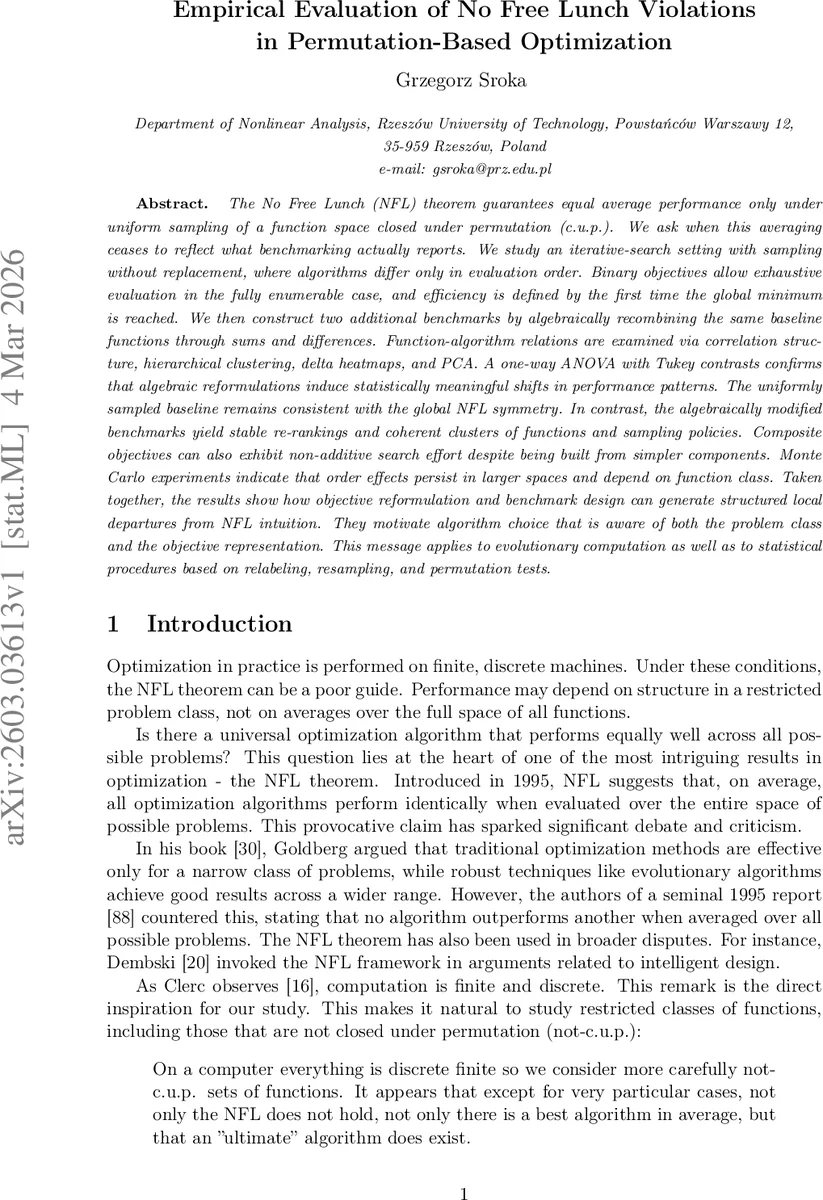
The No Free Lunch (NFL) theorem guarantees equal average performance only under uniform sampling of a function space closed under permutation (c.u.p.). We ask when this averaging ceases to reflect what benchmarking actually reports. We study an iterative-search setting with sampling without replacement, where algorithms differ only in evaluation order. Binary objectives allow exhaustive evaluation in the fully enumerable case, and efficiency is defined by the first time the global minimum is reached. We then construct two additional benchmarks by algebraically recombining the same baseline functions through sums and differences. Function-algorithm relations are examined via correlation structure, hierarchical clustering, delta heatmaps, and PCA. A one-way ANOVA with Tukey contrasts confirms that algebraic reformulations induce statistically meaningful shifts in performance patterns. The uniformly sampled baseline remains consistent with the global NFL symmetry. In contrast, the algebraically modified benchmarks yield stable re-rankings and coherent clusters of functions and sampling policies. Composite objectives can also exhibit non-additive search effort despite being built from simpler components. Monte Carlo experiments indicate that order effects persist in larger spaces and depend on function class. Taken together, the results show how objective reformulation and benchmark design can generate structured local departures from NFL intuition. They motivate algorithm choice that is aware of both the problem class and the objective representation. This message applies to evolutionary computation as well as to statistical procedures based on relabeling, resampling, and permutation tests.
💡 Research Summary
The paper investigates when the No‑Free‑Lunch (NFL) theorem’s prediction of equal average performance across all optimization algorithms breaks down in practice, focusing on permutation‑based search on binary objective functions. The authors restrict the problem to n = 4 binary inputs, which yields a tractable space of 2⁴ = 16 possible objective functions. They enumerate all 4! = 24 deterministic permutation algorithms that evaluate the four points in a fixed, non‑repeating order; efficiency is measured by the number of evaluations required to encounter the global minimum for a given function.
Three benchmark families are constructed. The first (“baseline”) consists of the original 16 functions sampled uniformly, preserving the closed‑under‑permutation (c.u.p.) property required by NFL. The second and third families are generated by algebraically recombining the same base functions via pairwise sums and differences, respectively. These transformations deliberately break the c.u.p. symmetry while keeping the underlying information content identical.
Statistical analyses—including Pearson correlation matrices, hierarchical clustering, delta heatmaps, and principal component analysis (PCA)—are applied to the 24 × 16 performance matrix for each benchmark. In the baseline case the correlation structure is essentially flat, and algorithm rankings fluctuate randomly, confirming the NFL prediction of equal average performance. By contrast, the sum and difference benchmarks exhibit pronounced block structures: certain permutations consistently outperform others, and the clustering clearly separates groups of algorithms and functions. A one‑way ANOVA with Tukey post‑hoc tests shows that the performance shifts induced by the algebraic reformulations are statistically significant (p < 0.01).
To assess scalability, Monte‑Carlo simulations are performed for larger n (5, 6, 7) using randomly sampled binary functions. Even as the search space grows exponentially, the order‑effect persists; its magnitude depends on the function class (e.g., highly imbalanced versus balanced output vectors). This demonstrates that the phenomenon is not an artifact of the tiny n = 4 setting but a genuine property of permutation‑based search when the objective representation is altered.
The authors argue that benchmark design and objective reformulation can create structured local departures from NFL intuition, leading to stable algorithm re‑rankings and coherent clusters of functions. Consequently, algorithm selection should be informed not only by the problem class but also by how the objective is mathematically expressed. The findings have implications for evolutionary computation, where permutation operators are common, and for statistical procedures such as permutation tests and resampling methods that rely on label‑shuffling symmetries.
In summary, the study (1) empirically confirms NFL under strict c.u.p. conditions, (2) shows that simple algebraic transformations of the objective break the NFL symmetry and produce statistically meaningful performance patterns, and (3) demonstrates that these effects survive in larger, sampled spaces. Limitations include the reliance on exhaustive enumeration for n = 4 and the focus on deterministic, non‑adaptive permutation policies. Future work is suggested on adaptive permutation strategies, higher‑dimensional sampling schemes, and real‑world applications where objective reformulation is commonplace.
Comments & Academic Discussion
Loading comments...
Leave a Comment