Highway Dimension: a Metric View
Realistic metric spaces (such as road/transportation networks) tend to be much more algorithmically tractable than general metrics. In an attempt to formalize this intuition, Abraham etal.\ (SODA 2010, JACM 2016) introduced the notion of highway dimension. A weighted graph $G$ has highway dimension $h$ if for every ball $B$ of radius $\approx4r$, there is a hitting set of size $h$ hitting all the shortest paths of length $>r$ in $B$. Unfortunately, this definition fails to incorporate some very natural metric spaces such as the grid graph, and the Euclidean plane. We relax the definition of highway dimension by demanding to hit only approximate shortest paths. In addition to generalizing the original definition, this new definition also incorporates all doubling spaces (in particular the grid graph and the Euclidean plane). We then construct a PTAS for TSP under this new definition (improving a QPTAS w.r.t.\ the original more restrictive definition of Feldmann etal.\ (SICOMP 2018)). Finally, we develop a basic metric toolkit for spaces with small highway dimension by constructing padded decompositions, sparse covers/partitions, and tree covers. An abundance of applications follow.
💡 Research Summary
The paper addresses a fundamental limitation of the original highway dimension (HD) concept introduced by Abraham et al., which requires that for every ball of radius roughly 4 r there exists a hitting set of size h intersecting all shortest paths of length greater than r that lie inside the ball. While this captures many road‑network phenomena, it fails to accommodate natural metric spaces such as the unweighted √n × √n grid or the Euclidean plane: both have constant doubling dimension but their HD under the original definition is Ω(√n). Moreover, the original definition is inherently graph‑centric and does not extend to continuous metric spaces.
To overcome these issues, the authors propose a relaxed definition of highway dimension. For any ε ≥ 0, r > 0 and center v, there must exist a set Hε of size h(ε) such that every pair of points u, z inside the ball B(v,(4+8ε)r) with true distance d(u,z) > r and whose induced distance inside the ball is at most (1+ε)·d(u,z) admits some (1+ε)-approximate shortest path that passes through a vertex of Hε. In other words, instead of hitting all exact shortest paths, we only need to hit a single approximate shortest path for each sufficiently long pair. The function h(·) captures the trade‑off between approximation quality and hub set size; for a fixed ε > 0 it suffices that h(ε) be bounded.
The new definition subsumes the original one: if a graph has HD = h under the original definition with constant c > 4, then for any ε ≤ (c−4)/8 the relaxed definition yields h(ε)=h. Conversely, any metric space with doubling dimension d admits a hitting set of size O(ε^{-d}) for each ε, showing that the relaxed HD is finite for all ε > 0. Thus the definition now covers road networks, hub‑and‑spoke systems, planar grids, and continuous Euclidean spaces.
Algorithmic contributions.
Using the relaxed HD, the authors design a polynomial‑time approximation scheme (PTAS) for the Traveling Salesperson Problem (TSP) on metric spaces with bounded h(ε). The algorithm builds a hierarchical structure of “hubs and nets”: at each scale i it selects a ball radius (4+8ε)·r_i, computes a hitting set Hε,i of size h(ε), and partitions the instance around these hubs. A divide‑and‑conquer recursion splits the TSP instance into sub‑instances confined to smaller balls; the conquer step stitches together tours using the hubs as connectors. Because each recursion level introduces at most a (1+ε) multiplicative error, after O(log (1/ε)) levels the total tour length is within (1+O(ε)) of optimal. The running time is polynomial in n for any fixed ε, improving the earlier quasi‑polynomial scheme (QPTAS) of Feldmann et al. (SICOMP 2018).
Metric toolkit.
Beyond TSP, the paper develops a suite of metric‑space tools for low‑HD spaces:
- Sparse covers – a collection of O(h·polylog n) balls of bounded radius that together cover the entire space while each point belongs to only O(1) balls.
- Padded decompositions – randomized partitions where each ball of radius δ is fully contained in a cluster with probability ≥ 1‑β, enabling locality‑preserving algorithms.
- Tree covers – a set of O(h·log n) trees such that for any pair of points the distance in at least one tree approximates the original distance within (1+ε). These trees serve as low‑stretch embeddings and facilitate distance oracles, spanners, and flow sparsifiers.
Applications.
The toolkit yields immediate improvements for several classic problems:
- ℓ_p embeddings with distortion depending only on h(ε) and ε.
- Zero‑extension and Lipschitz extension problems obtain PTAS‑type guarantees.
- Distance oracles with O(h) space and O(log h) query time.
- Oblivious Buy‑at‑Bulk network design with constant‑factor approximation.
- Flow sparsifiers and reliable spanners with near‑optimal size/quality trade‑offs.
All these results require only that h(ε) be bounded for a single constant ε > 0, not for ε = 0, which aligns with the practical need for a modest approximation tolerance.
Structure of the paper.
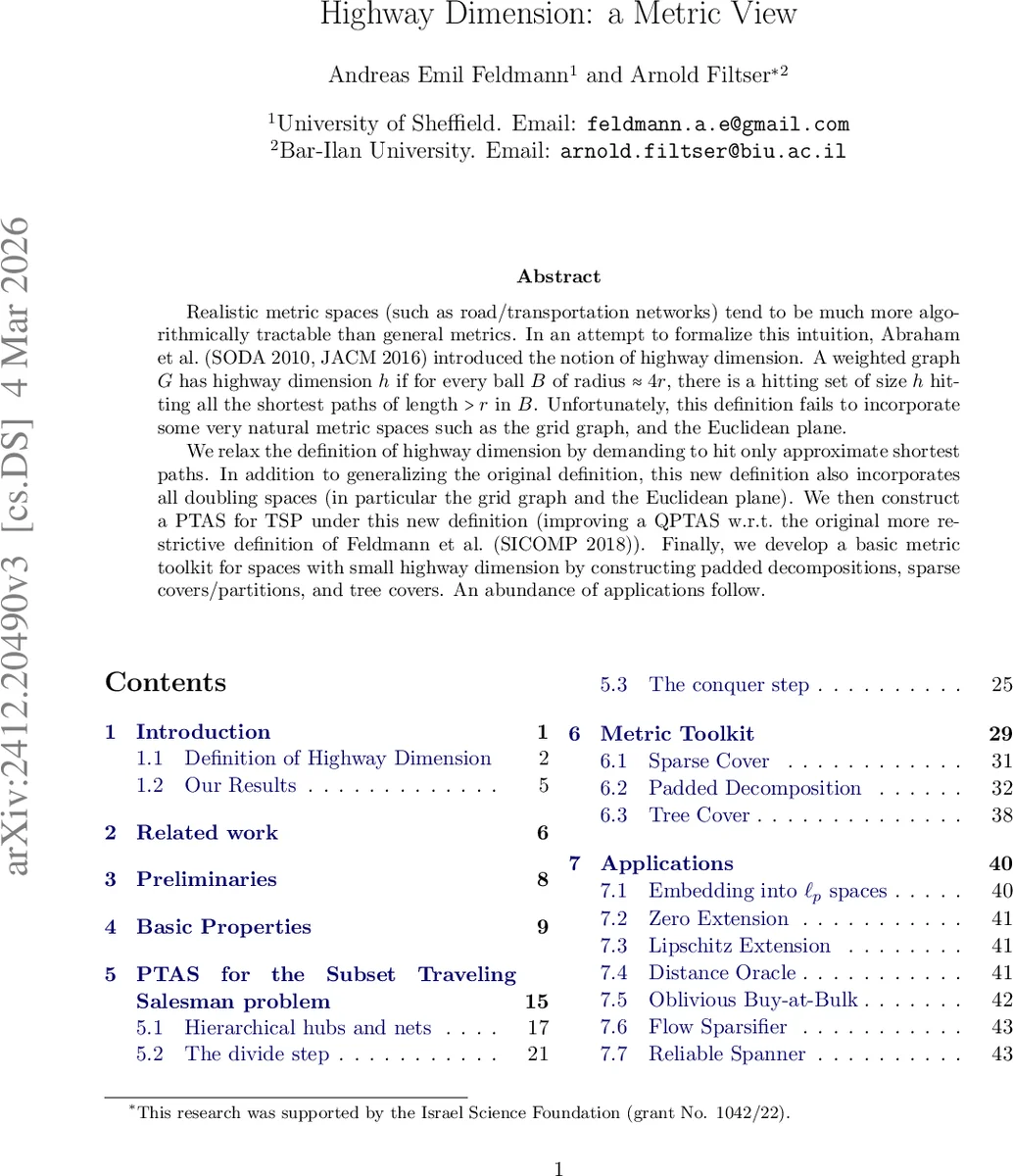
Section 1 introduces the motivation, critiques existing definitions, and presents the relaxed HD. Section 2 surveys related work. Section 3 formalizes preliminaries and notation. Section 4 proves basic properties of the new definition, including its relationship to doubling dimension and its closure under scaling. Section 5 details the PTAS for TSP, describing the hierarchical hub construction, the divide step, and the conquer step, and provides a rigorous error analysis. Section 6 constructs the metric toolkit (sparse covers, padded decompositions, tree covers) and proves their parameters. Section 7 showcases the aforementioned applications, each accompanied by theorem statements and proof sketches. The paper concludes with a discussion of open problems, such as tighter bounds on h(ε) for specific metric families and extensions to dynamic settings.
In summary, this work redefines highway dimension in a way that is both more expressive—capturing a broad class of realistic metrics—and algorithmically useful, enabling PTAS‑level algorithms for TSP and a host of other optimization problems, together with a versatile set of metric decomposition tools.
Comments & Academic Discussion
Loading comments...
Leave a Comment