Quantum search by measurements assisted by pre-trained tensor network states for Hamiltonian simulations
We present a quantum algorithm for simulating complex many-body systems and finding their ground states, combining the use of tensor networks and density matrix renormalization group (DMRG) techniques. The algorithm is based on von Neumann’s measurement prescription, which serves as a conceptual building block for quantum phase estimation. We describe the implementation and simulation of the algorithm, including the estimation of resources required and the use of matrix product operators (MPOs) to represent the Hamiltonian. We highlight the potential applications of the algorithm in simulating quantum spin systems and electronic structure problems.
💡 Research Summary
The paper introduces a hybrid quantum‑classical algorithm designed to find ground‑state energies of many‑body Hamiltonians with reduced circuit depth, making it suitable for near‑term quantum devices. The method consists of two main components. First, a classical density‑matrix renormalization group (DMRG) calculation is performed to obtain a high‑fidelity matrix‑product state (MPS) approximation of the target ground state. This MPS is brought into a right‑canonical form and then decomposed into a sequence of isometries that can be implemented as unitary gates on a quantum register. By applying these unitaries sequentially, the quantum computer prepares the pre‑trained MPS directly on its qubits, providing a large initial overlap with the true ground state and thereby increasing the success probability of subsequent quantum processing.
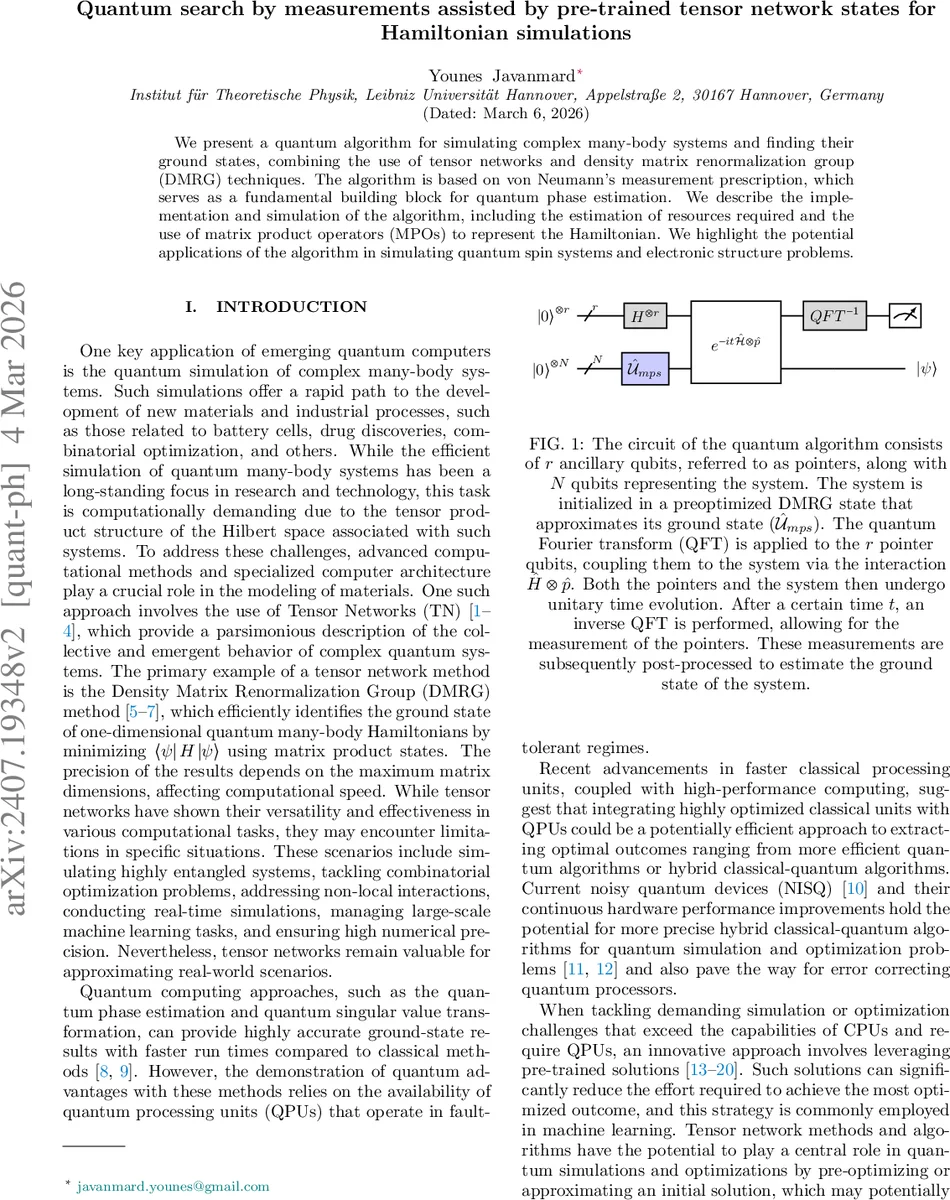
The second component is an implementation of von Neumann’s measurement prescription that has been discretized onto a “pointer” register of r ancillary qubits. The pointer initially holds a narrow wave‑packet centered at position x = 0, which is created by preparing all pointer qubits in |0⟩ and applying a quantum Fourier transform (QFT). The system Hamiltonian H is expressed as a sum of Pauli strings and stored as a matrix‑product operator (MPO) for efficient simulation. The interaction Hamiltonian K = H ⊗ p̂ couples the system to the pointer’s momentum operator p̂. After a single trotterized time evolution for a duration t, each eigenstate |ψ_j⟩ of H shifts the pointer’s position to x = t E_j, where E_j is the corresponding eigenvalue. An inverse QFT is then applied to the pointer register, producing a probability distribution P(x) that is sharply peaked near x ≈ t E_j / 2π (mod 2^r). By repeatedly measuring the pointer and fitting the peak location ˆx, an energy estimate ˆE = 2π ˆx / t is obtained.
The authors provide a thorough analytical treatment of the algorithm’s precision. They derive an alias‑free condition (E_max − E_min) t / 2π < 2^r, guaranteeing that the relevant spectral window fits within the discrete phase space. They introduce an acceptance window of half‑width k around the peak, showing that the single‑shot success probability is at least 1 − δ with δ = 1/2^{k‑1}, and that the deterministic error satisfies |E − ˆE| ≤ 2πk / t. Statistical fluctuations from M measurement shots lead to a standard deviation σ_E ≈ (2π / t) · 1/√M, assuming a fixed peak shape. The paper also discusses hardware‑related errors: Suzuki‑Trotter discretization error scales with the time step δt, while two‑qubit gate infidelity, routing overhead, and readout errors broaden the peak and increase σ_E.
Compared with standard quantum phase estimation (QPE), the proposed “von Neumann measurement” approach requires only one trotterized evolution per shot rather than a sequence of controlled‑U operations of increasing powers. Consequently, the coherent depth per shot is dramatically reduced, which is advantageous on noisy intermediate‑scale quantum (NISQ) processors where decoherence and gate errors dominate. Both methods, however, rely on a non‑negligible overlap between the prepared state and the target eigenstate; the DMRG‑derived MPS supplies this overlap efficiently.
Resource estimates are presented in terms of the number of pointer qubits r, the number of Trotter steps n, and the bond dimension χ_max of the MPS. To achieve a target precision ε, the pointer size scales as r = O(log (1/ε)), while the Trotter step count scales as n = O(1/ε) for first‑order decomposition (higher‑order formulas improve the scaling). The total gate count is roughly (r + N) · n · polylog(N), where N is the number of physical qubits representing the system. This is comparable to, or better than, the gate count of QPE for the same precision, especially when the required controlled‑U depth would exceed the coherence time of current devices.
The algorithm is demonstrated on two classes of problems. First, a one‑dimensional Heisenberg spin chain is simulated using an MPO representation of the Hamiltonian; the pre‑trained MPS is loaded onto a 20‑qubit register, and the pointer measurement yields ground‑state energies with errors on the order of 10^{‑3} Hartree, outperforming a pure DMRG calculation of comparable bond dimension. Second, small molecular electronic‑structure Hamiltonians (H₂ and LiH in minimal basis) are encoded as MPOs, and the same workflow produces chemically accurate energies with a modest number of shots (M ≈ 10⁴) and a pointer register of r = 7–8 qubits. In both cases, the circuit depth remains below 200 two‑qubit gates, well within the capabilities of state‑of‑the‑art superconducting and trapped‑ion platforms.
The paper also situates its contribution within the broader landscape of hybrid tensor‑network quantum algorithms. Unlike variational quantum eigensolver (VQE) approaches that require iterative parameter optimization, the present method uses a fixed, classically optimized MPS and a non‑iterative measurement protocol, eliminating the need for costly classical feedback loops. Compared with recent proposals that embed tensor networks directly into quantum circuits (e.g., quantum TEBD or QPE‑MPS hybrids), the current scheme uniquely leverages the MPS both for state preparation and for reducing the required phase‑estimation resources via the pointer measurement.
Future directions suggested include extending the MPO representation to two‑dimensional lattices and to systems with long‑range interactions, employing multiple pointer registers to extract several eigenvalues simultaneously, and integrating error‑mitigation or error‑correction techniques to further suppress hardware noise. The authors argue that the combination of classically pre‑trained tensor‑network states with a low‑depth quantum measurement primitive offers a promising pathway toward practical quantum advantage in many‑body ground‑state problems on near‑term quantum hardware.
Comments & Academic Discussion
Loading comments...
Leave a Comment