Spin Ruijsenaars-Schneider models are Coulomb branches
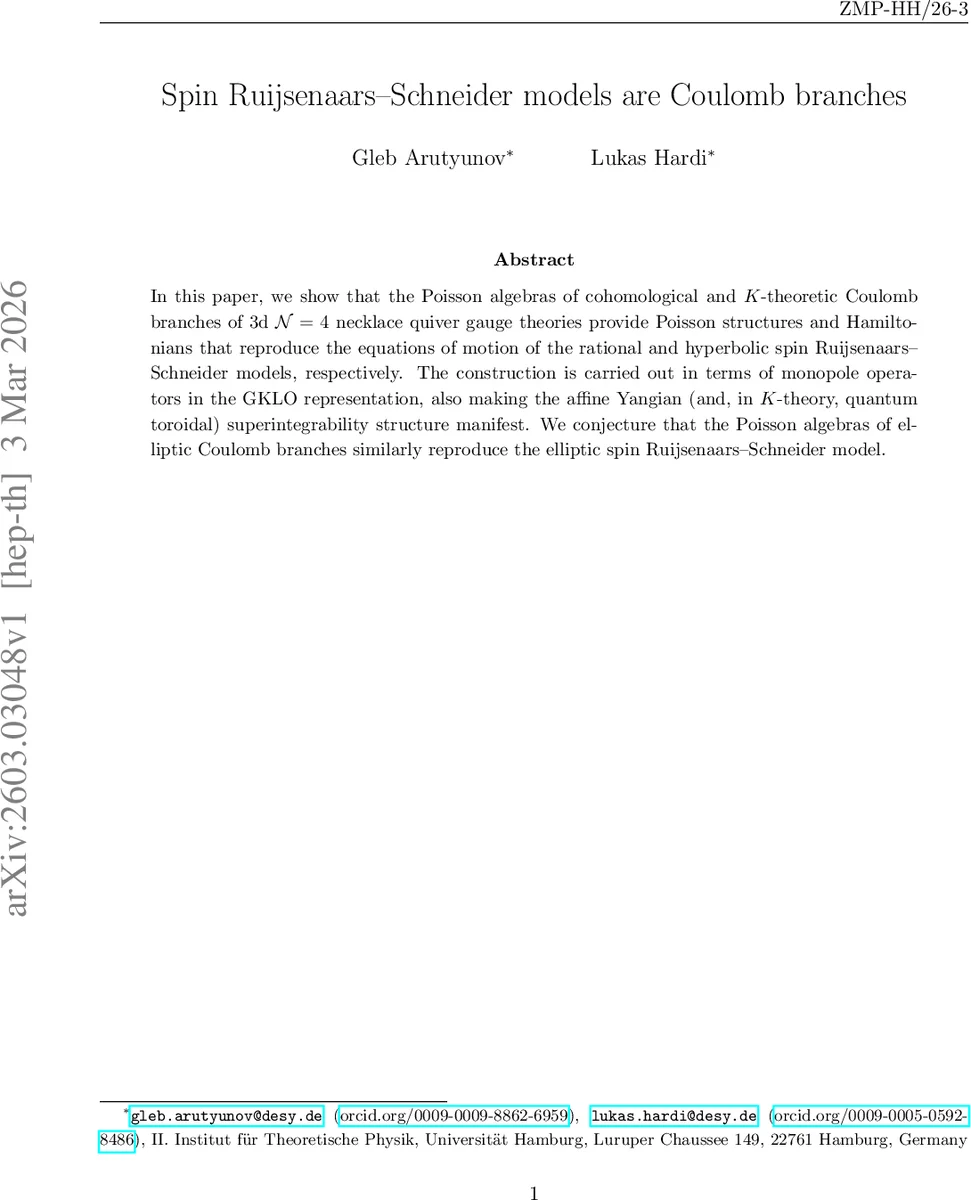
In this paper, we show that the Poisson algebras of cohomological and $K$-theoretic Coulomb branches of 3d $\mathcal{N}=4$ necklace quiver gauge theories provide Poisson structures and Hamiltonians that reproduce the equations of motion of the rational and hyperbolic spin Ruijsenaars-Schneider models, respectively. The construction is carried out in terms of monopole operators in the GKLO representation, also making the affine Yangian (and, in $K$-theory, quantum toroidal) superintegrability structure manifest. We conjecture that the Poisson algebras of elliptic Coulomb branches similarly reproduce the elliptic spin Ruijsenaars-Schneider model.
💡 Research Summary
The paper establishes a precise correspondence between the Poisson algebras of 3‑dimensional 𝒩=4 supersymmetric gauge theories and the classical spin Ruijsenaars–Schneider (RS) integrable systems. Starting from the “necklace” quiver with ℓ nodes and gauge rank N, the authors first recall the abelianized cohomological Coulomb branch algebra C_{N,ℓ} and its K‑theoretic analogue C^{K}{N,ℓ}. In the cohomological setting they introduce a γ‑deformed GKLO representation: monopole operators are realized as (P{αi})^{±1} χ_{α}^{±1}(q_{αi}), where γ is a mass parameter for a bifundamental hypermultiplet. From these they build generating series e_{α}(z), f_{α}(z) and h_{α}(z) that satisfy the classical limit of the affine Yangian Ŷ(gl_ℓ). The zero‑mode generators reproduce the sl_ℓ loop algebra, confirming the presence of the Yangian symmetry.
Next, a set of one‑site L‑operators L^{±}{α,ij}=u^{+}{α+1,i}/(q_{α+1,j}−q_{α,i}) is defined. Using the r‑matrices r_{α}, \bar r_{α}, r_{α} from the AF‑construction, the authors compute Poisson brackets {L^{±}1, L^{±}2} and show that the total L‑operator L=L{0}^{+}⋯L{ℓ−1}^{+} obeys the standard Poisson algebra of the rational RS L‑matrix. Traces of powers of L generate a commuting family of Hamiltonians whose equations of motion exactly match the rational spin RS model (the equations originally derived by Krichever‑Zabrodin). The associated spin variables a_{αi}, c_{αi} satisfy the Poisson brackets previously found in the literature, confirming super‑integrability.
In the K‑theoretic case the authors replace additive variables q_{αi} by multiplicative ones Q_{αi} and introduce a t‑deformed (multiplicative) GKLO representation. The resulting algebra is identified with the quantum toroidal algebra of gl_ℓ. Analogous L‑operators are constructed, and their Poisson brackets reproduce the hyperbolic (trigonometric) spin RS equations. The Poisson structure on the spin variables now involves multiplicative ratios Q_{0i}/Q_{ℓj}, matching results from multiplicative quiver varieties and illustrating mirror symmetry between K‑theoretic Coulomb branches and their multiplicative mirrors.
Finally, the authors conjecture that the elliptic Coulomb branch Poisson algebra should yield the elliptic spin RS model, extending the correspondence to the most general elliptic potential V(z)=ζ(z)−ζ(z+γ). They note that this has been achieved only for N=2 in previous work, and their framework suggests a systematic approach for arbitrary N.
Overall, the paper demonstrates that both cohomological and K‑theoretic Coulomb branches provide a unified, algebraic origin for spin RS models, making the underlying Yangian and quantum toroidal symmetries manifest and opening the way to elliptic generalizations.
Comments & Academic Discussion
Loading comments...
Leave a Comment