A cross-dimensional discrete Boltzmann framework for fluid dynamics
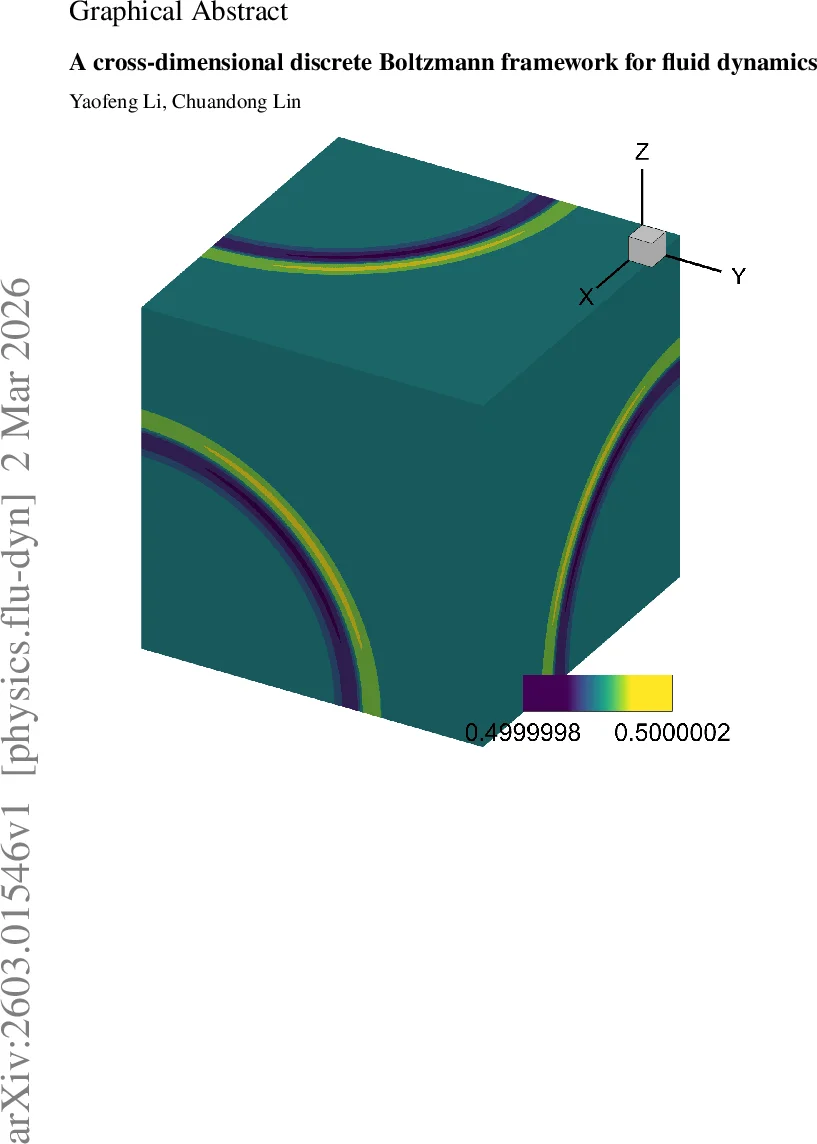
A simple and efficient one-dimensional discrete Boltzmann method is developed for compressible flows with tunable specific heat ratios by incorporating extra degrees of freedom. To guarantee Galilean invariance in numerical simulations, a discrete velocity set is constructed with high spatial symmetry. Furthermore, an operator-splitting scheme is proposed to extend the one-dimensional kinetic formulation to simulations of one-, two-, and three-dimensional flow systems within a unified framework. The proposed model and numerical method are verified and validated against several benchmark problems, including the Sod shock tube, Lax shock tube, uniform translational flow, and acoustic wave propagation. The results demonstrate the accuracy, robustness, and flexibility of the present approach for compressible flow simulations.
💡 Research Summary
The paper introduces a novel cross‑dimensional discrete Boltzmann framework (DBM) that enables the simulation of compressible flows in one, two, and three dimensions using a single one‑dimensional kinetic model. The authors start from a one‑dimensional D1V5 lattice, augmenting it with extra degrees of freedom (I = 4) to make the specific heat ratio γ = (D + I + 2)/(D + I) tunable. This is achieved by incorporating a vibrational/rotational energy variable η into the equilibrium distribution function, which retains the Maxwell‑Boltzmann form while allowing γ to be adjusted without changing the discrete velocity set.
A highly symmetric velocity set (v = {0, ±1, ±5}) is chosen; its symmetry guarantees Galilean invariance, meaning that a uniform translation of the whole flow field does not introduce numerical bias. The equilibrium distribution f_eq is constructed to exactly recover the first five kinetic moments, ensuring mass, momentum, and energy conservation at the Euler level.
To extend the model to higher dimensions, the authors adopt a first‑order operator‑splitting (Godunov) strategy. The three‑dimensional Boltzmann equation is decomposed into three successive one‑dimensional sub‑steps along the x, y, and z axes. Each sub‑step consists of: (i) applying the appropriate boundary conditions, (ii) computing the local equilibrium distribution based on the current macroscopic variables, (iii) advancing the distribution functions using the BGK collision term (∂f/∂t + v ∂f/∂x = −(f − f_eq)/τ), and (iv) updating density, velocity, and temperature from the post‑collision distributions. Spatial derivatives are discretized with a second‑order non‑oscillatory dissipative scheme, while time integration uses a forward Euler method. This modular approach allows the same 1D code to be reused for 2D and 3D simulations simply by adding the extra directional sweeps, eliminating the need for new velocity sets or lattice structures.
The framework is validated against four classical benchmarks.
- Sod shock tube – Using 5 000 cells (Δx = 2 × 10⁻⁴, Δt = 5 × 10⁻⁶) and γ = (1 + 4 + 2)/(1 + 4) = 1.2, the model reproduces the rarefaction fan, contact discontinuity, and shock wave with excellent agreement to the exact Riemann solution for density, pressure, velocity, and temperature.
- Lax shock tube – With different left/right states, the DBM again captures the smooth rarefaction region and the sharp shock front, confirming its ability to handle strong compressible gradients.
- Translational motion test – A circular density blob placed in a square domain is given a diagonal velocity (u_x = u_y = 0.5). After 0.4 s the blob has moved exactly the theoretical distance L_x, demonstrating that the scheme preserves Galilean invariance in multi‑dimensional settings.
- Acoustic wave propagation – Small pressure perturbations are introduced in 1D, 2D, and 3D domains. The resulting planar, circular, and spherical waves propagate outward at the sound speed v_s = √(γ T), and the measured wavefront positions follow the linear relation x = x₀ + v_s t. This confirms that the operator‑splitting correctly handles wave propagation in all dimensions.
Overall, the proposed cross‑dimensional DBM offers high accuracy, robustness, and flexibility while drastically simplifying code development for multi‑dimensional compressible flow problems. The main limitation identified is the lack of non‑equilibrium (higher‑order moment) effects in the 2D/3D extensions, which may affect simulations of highly turbulent or strongly shocked flows. Future work is suggested to incorporate multi‑speed sets, higher‑order moment closures, or second‑order splitting (Strang) to capture richer non‑equilibrium physics.
Comments & Academic Discussion
Loading comments...
Leave a Comment