Kronecker-product random matrices and a matrix least squares problem
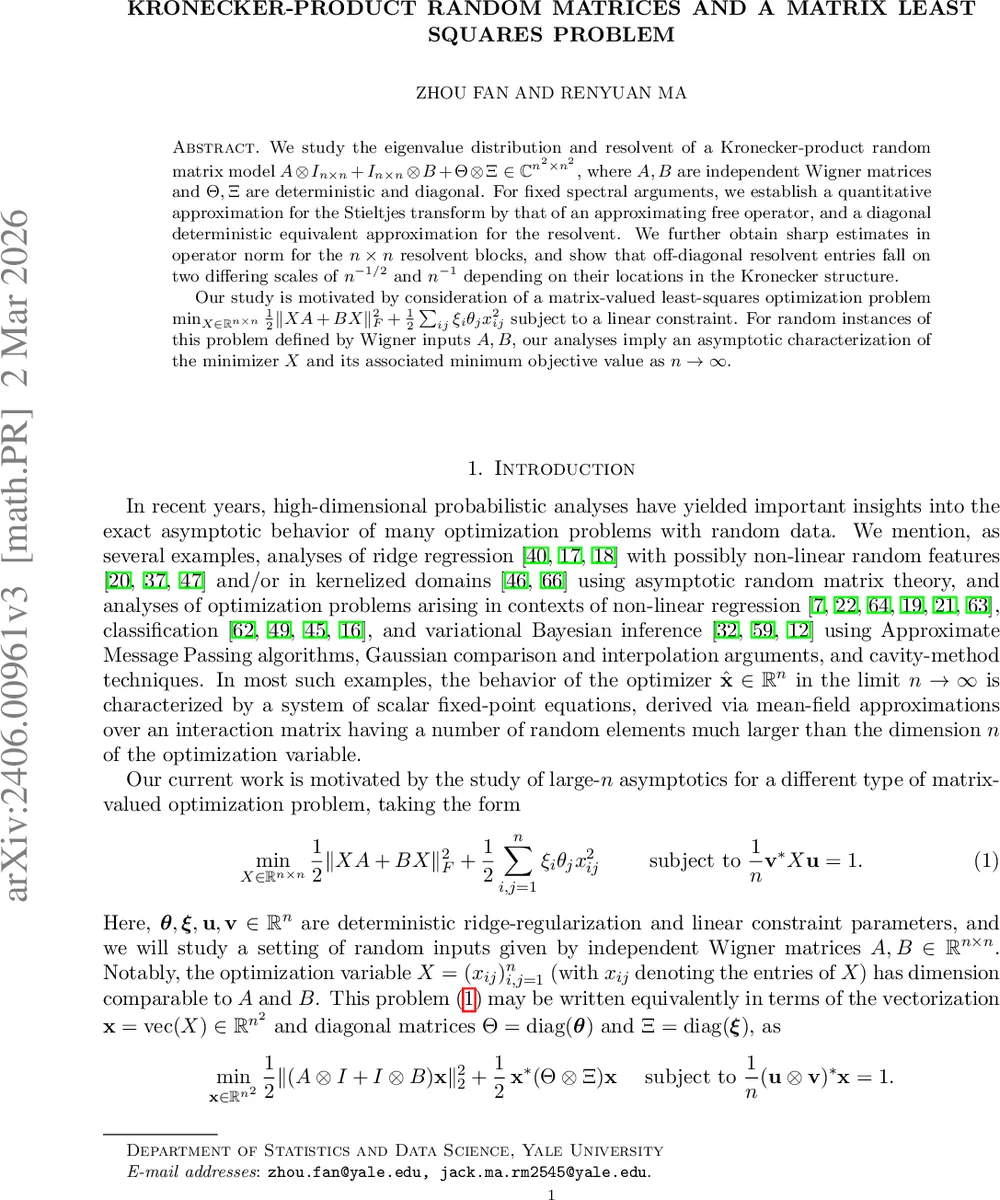
We study the eigenvalue distribution and resolvent of a Kronecker-product random matrix model $A \otimes I_{n \times n}+I_{n \times n} \otimes B+Θ\otimes Ξ\in \mathbb{C}^{n^2 \times n^2}$, where $A,B$ are independent Wigner matrices and $Θ,Ξ$ are deterministic and diagonal. For fixed spectral arguments, we establish a quantitative approximation for the Stieltjes transform by that of an approximating free operator, and a diagonal deterministic equivalent approximation for the resolvent. We further obtain sharp estimates in operator norm for the $n \times n$ resolvent blocks, and show that off-diagonal resolvent entries fall on two differing scales of $n^{-1/2}$ and $n^{-1}$ depending on their locations in the Kronecker structure. Our study is motivated by consideration of a matrix-valued least-squares optimization problem $\min_{X \in \mathbb{R}^{n \times n}} \frac{1}{2}|XA+BX|F^2+\frac{1}{2}\sum{ij} ξ_iθ_j x_{ij}^2$ subject to a linear constraint. For random instances of this problem defined by Wigner inputs $A,B$, our analyses imply an asymptotic characterization of the minimizer $X$ and its associated minimum objective value as $n \to \infty$.
💡 Research Summary
The paper investigates a random matrix model built from two independent Wigner matrices A and B together with two deterministic diagonal matrices Θ = diag(θ₁,…,θₙ) and Ξ = diag(ξ₁,…,ξₙ). The model is the Kronecker‑product matrix
Q = A ⊗ Iₙ + Iₙ ⊗ B + Θ ⊗ Ξ ∈ ℂ^{n²×n²}.
The authors’ primary goal is to understand the spectral distribution and the resolvent G(z) = (Q – zI)^{-1} for a fixed complex spectral parameter z in the upper half‑plane, and then to translate these results into a precise asymptotic description of a matrix‑valued least‑squares optimization problem.
1. Model and motivation
The optimization problem under study is
min_{X∈ℝ^{n×n}} ½‖XA + BX‖F² + ½∑{i,j} ξ_i θ_j x_{ij}²
subject to a linear constraint 1ₙᵀ X u = 1, where u ∈ ℝⁿ is deterministic. By vectorising X (x = vec(X)), the objective becomes
½‖(A ⊗ I + I ⊗ B) x‖₂² + ½ x* (Θ ⊗ Ξ) x,
and the constraint is a linear functional of x. Hence the problem reduces to solving a linear system involving the same Kronecker‑product operator that defines Q. Understanding the resolvent of Q therefore yields the limiting behaviour of the optimal X and the minimum value as n → ∞.
2. Two‑stage Schur complement analysis
The authors develop a novel two‑stage Schur‑complement scheme. In the first stage they condition on B and treat A ⊗ I as a block‑diagonal matrix with n blocks of size n. Applying the standard Schur complement identity to each block yields recursive formulas for the block resolvents G_{ii} and the off‑diagonal blocks G_{ij}. These formulas involve quadratic forms of the type
(1/n)∑r G^{(i)}{rj} G^{(i)*}_{rj},
where G^{(i)} denotes the resolvent with the i‑th row and column of A removed.
A non‑commutative Khintchine inequality is used to control the fluctuations of these quadratic forms. However, the inequality only provides bounds in terms of the spectrum of a partial trace G_t = (1/n)∑i e_i ⊗ G{ii}, which a priori could be as large as n‖G‖. To overcome this, the authors first work in a regime where |z| is large enough for a convergent power‑series expansion of the resolvent, allowing term‑by‑term scalar concentration estimates.
In the second stage they average over B. The partial trace
M_B = (1/n)∑{i=1}^n G{ii}
satisfies a matrix‑valued fixed‑point equation
M_B = (B + Θ_i Ξ – zI – M_B)^{-1}.
Because M_B depends on B in a non‑linear way, the authors embed the problem into a von Neumann algebra containing a free semicircular element a and a trace τ. They rewrite
M_B = (τ ⊗ I)
Comments & Academic Discussion
Loading comments...
Leave a Comment