Hyperbolicity of Staked Links and Lower Bounds on Their Volumes
We define a class of links in handlebodies called ``charm bracelets," which are a subset of staked links. We provide tools to construct infinitely many such hyperbolic links and bound the corresponding volumes from below in terms of volumes corresponding to the individual charms.
💡 Research Summary
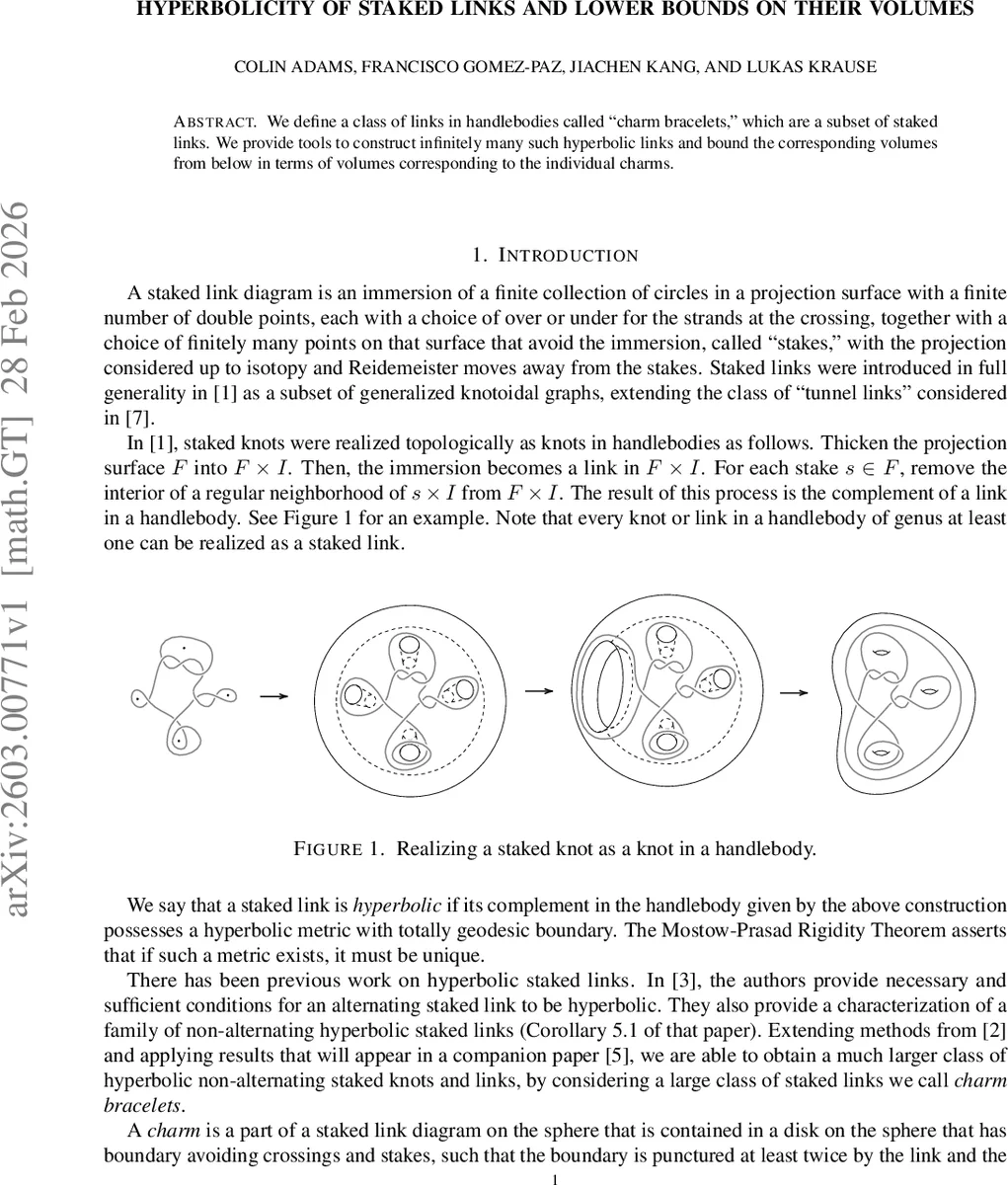
The paper introduces and studies a new class of links in handlebodies called “charm bracelets,” which are a special subset of staked links. A staked link is defined by taking a finite collection of circles immersed in a projection surface (here the sphere S²) together with a finite set of distinguished points called stakes. The immersion avoids the stakes, and Reidemeister moves are allowed everywhere except across the stakes, which act as forbidden fourth moves. By thickening the projection surface to F×I and removing tubular neighborhoods of the stakes, one obtains a link L inside a handlebody H = (F\U)×I. If the complement H\N(L) admits a complete hyperbolic metric with totally geodesic higher‑genus boundary, the staked link is called tg‑hyperbolic (or simply hyperbolic).
A “charm” is a disk on the projection sphere whose boundary meets the link projection transversely in at least two points, contains at least one crossing and at least one stake, and is equipped with distinguished top and bottom points t and b on the boundary. The intersection of the disk with the link yields left and right endpoints; a (p,q)‑strand charm has p left and q right endpoints. Charms can be concatenated when the right endpoints of one match the left endpoints of the next, respecting order. A cyclic sequence of concatenatable charms yields a staked link diagram called a charm bracelet; the sequence is called a bracelet word.
Given a charm C, reflect it across a vertical axis through t and b to obtain Cᴿ. The 2m‑replicant of C is the bracelet B = (C, Cᴿ, C, Cᴿ, …, C, Cᴿ) of length 2m. If the complement of B in its handlebody is tg‑hyperbolic, C is said to be 2m‑hyperbolic and its 2m‑volume is defined as vol₂ₘ(C) = vol(B)/(2m). The central result (Theorem 1.1) states: if each charm in an even bracelet B = (C₁,…,C₂ₘ) is 2m‑hyperbolic, then B itself is hyperbolic and its volume satisfies
vol(B) ≥ 2m · ∑_{i=1}^{2m} vol₂ₘ(Cᵢ).
Thus the total volume is bounded below by the sum of the individual charm volumes, scaled by the number of charms.
The authors prove a key amplification theorem (Theorem 3.1): if a charm C is 2‑hyperbolic, then it is 2m‑hyperbolic for every m ≥ 1. The proof proceeds by analyzing the structure of the 2n‑replicant D₂ₙ(C) = (H₂ₙ, C, L₂ₙ) using a decomposition into “sheets” (fixed point sets of the reflection), a “starburst” S′ (the union of all sheets), and the complementary “pieces” Pᵢ (balls with stakes removed). Each piece together with the portion of a sheet intersecting it, denoted bΣᵢ, forms an essential pair (incompressible and ∂‑incompressible). Lemmas 3.7–3.12 establish irreducibility of pieces, incompressibility of their boundaries, and essentiality of the sheets. By introducing a notion of minimal complexity for properly embedded essential surfaces (measured by intersections with the central axis E and with the starburst), the authors show that any hypothetical essential sphere, disk, torus, or annulus in D₂ₙ₊₂(C) can be isotoped into a single piece, contradicting the hyperbolicity of D₂ₙ(C). Consequently, hyperbolicity propagates to all higher even replicants.
The paper also presents concrete examples illustrating subtle behavior. Figure 9 shows an alternating charm that fails to be 2‑hyperbolic and 4‑hyperbolic because a compressible wedge creates an essential sphere or torus, yet it becomes 6‑hyperbolic. Figure 10 displays a charm whose 2‑replicant is non‑hyperbolic (an essential annulus appears), while its 4‑replicant is hyperbolic; by Theorem 3.6 all higher even replicants are then hyperbolic. These examples demonstrate that essentiality of (Pᵢ, bΣᵢ) is not necessary for hyperbolicity at a given replicant level, but once it holds at some level it persists for all larger even levels.
The authors relate their work to earlier studies of “bongles,” the simplest charm bracelets consisting of a single crossing and a single stake. They previously proved that bongles are hyperbolic iff they are alternating and identified cases with equal volumes. The present framework vastly generalizes this by allowing arbitrary numbers of crossings, stakes, and non‑alternating configurations, while still providing explicit volume lower bounds via Theorem 1.1.
In summary, the paper develops a robust combinatorial–geometric machinery for constructing infinite families of hyperbolic links in handlebodies. By decomposing links into charms, reflecting and replicating them, and proving that hyperbolicity of a single 2‑replicant forces hyperbolicity of all higher even replicants, the authors obtain a powerful method to generate non‑alternating hyperbolic links with controllable volume estimates. This contributes significantly to the understanding of hyperbolic structures on 3‑manifolds with boundary and offers new tools for estimating volumes in low‑dimensional topology.
Comments & Academic Discussion
Loading comments...
Leave a Comment