IOAgent: Democratizing Trustworthy HPC I/O Performance Diagnosis Capability via LLMs
As the complexity of the HPC storage stack rapidly grows, domain scientists face increasing challenges in effectively utilizing HPC storage systems to achieve their desired I/O performance. To identify and address I/O issues, scientists largely rely …
Authors: Chris Egersdoerfer, Arnav Sareen, Jean Luca Bez
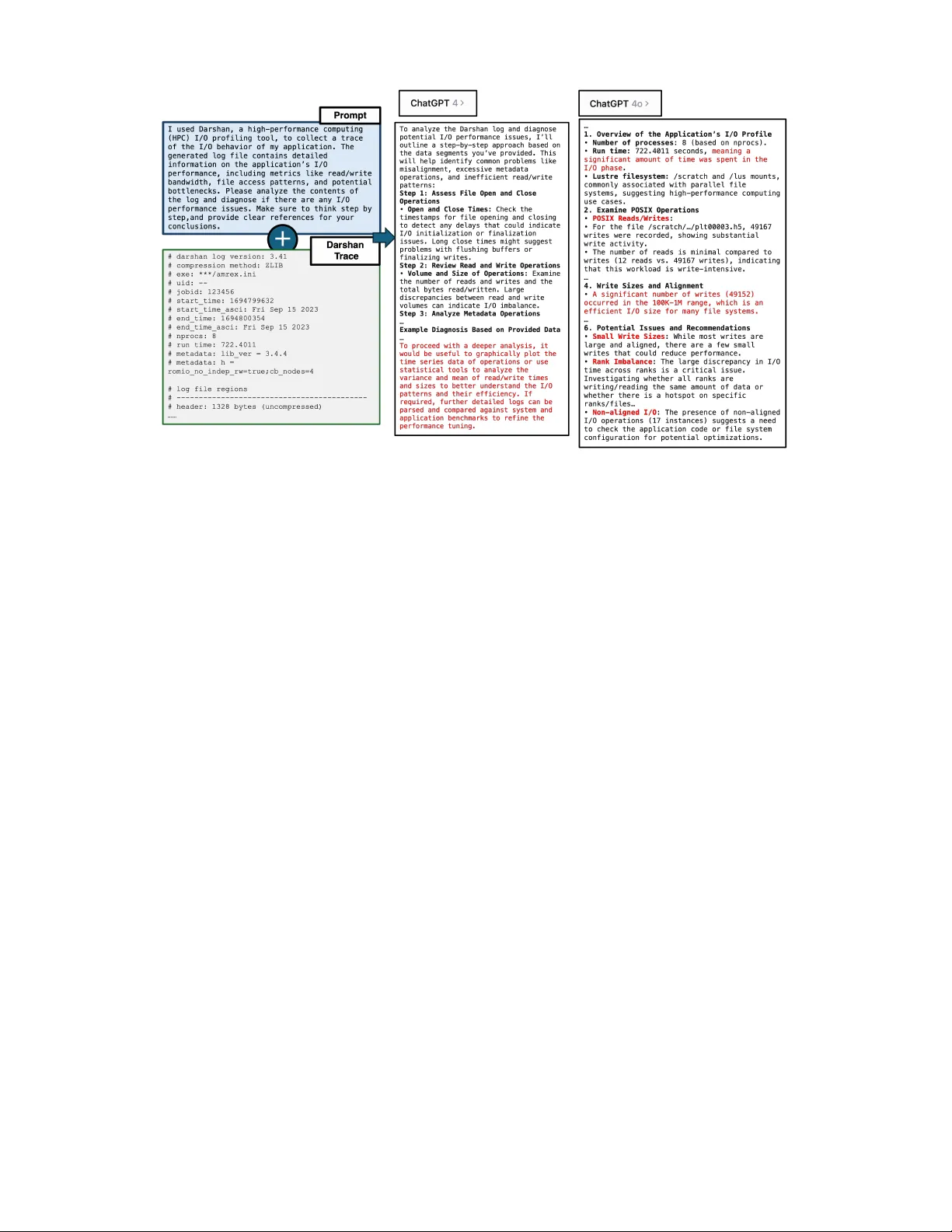
IO Agent: Democratizing T rustworth y HPC I/O Performance Diagnosis Capability via LLMs Chris Egersdoerfer 1 , Arnav Sareen 2 , Jean Luca Bez 3 , Suren Byna 4 , Dongkuan (DK) Xu 5 , and Dong Dai 1 1 Uni versity of Delaw are, USA, { cegersdo, dai } @udel.edu 2 Uni versity of North Carolina at Charlotte, USA, asareen2@charlotte.edu 3 Lawrence Berk eley National Laboratory , USA, jlbez@lbl.gov 4 The Ohio State Uni versity , USA, byna.1@osu.edu 5 North Carolina State Uni versity , USA, dxu27@ncsu.edu Abstract —As the complexity of the HPC storage stack rapidly gro ws, domain scientists face increasing challenges in effectively utilizing HPC storage systems to achieve their desir ed I/O performance. T o identify and address I/O issues, scientists largely rely on I/O experts to analyze their I/O traces and pro vide insights into potential pr oblems. Howe ver , with a limited number of I/O experts and the growing demand for data- intensive applications, inaccessibility has become a major bot- tleneck, hindering scientists from maximizing their productivity . The r ecent rapid progr ess in large language models (LLMs) opens the door to creating an automated tool that democratizes trustworthy I/O performance diagnosis capabilities to domain scientists. Howev er , LLMs face significant challenges in this task, such as the inability to handle long context windows, a lack of accurate domain knowledge about HPC I/O, and the generation of hallucinations during complex interactions. In this work, we propose IOAgent as a systematic effort to address these challenges. IO Agent integrates various new designs, including a module-based pre-pr ocessor , a RA G-based domain knowledge integrator , and a tree-based merger to accurately diagnose I/O issues from a given Darshan trace file. Similar to an I/O expert, IO Agent provides detailed justifica- tions and refer ences f or its diagnoses and offers an interactive interface for scientists to continue asking questions about the diagnosis. T o evaluate IOAgent, we collected a diverse set of labeled job traces and released the first open diagnosis test suite, TraceBench . Based on this test suite, extensi ve evaluations were conducted, demonstrating that IOAgent matches or out- performs state-of-the-art I/O diagnosis tools with accurate and useful diagnosis results. W e also show that IO Agent is not tied to specific LLMs, performing similarly well with both proprietary and open-source LLMs. W e believe IO Agent has the potential to become a powerful tool f or scientists navigating complex HPC I/O subsystems in the future. I . I N T RO D U C T I O N High-performance computing (HPC) clusters play a crucial role in enabling modern science, supporting a wide range of scientific applications and services across various domains, such as cosmology [1], quantum simulation [19], astron- omy [17], climate modeling [22], and life sciences [16]. In recent years, these scientific applications have be- come increasingly data-intensive, necessitating the efficient utilization of HPC I/O subsystems to meet performance requirements. Ho we ver , effecti vely leveraging the complex Published in the Proceedings of the 2025 IEEE International P arallel and Distributed Processing Symposium (IPDPS 2025). I/O stacks in HPC systems, which include high-lev el parallel I/O libraries (e.g., HDF5 [13], PnetCDF [24]), API inter- faces (e.g., MPI-IO, POSIX, STDIO), and file systems (e.g., Lustre [34], BurstBuffer [14]), remains a challenging task for most domain scientists. Large-scale scientific applications often experience slow I/O performance due to inef ficient use of data access APIs, misconfigurations, or the failure to apply key optimizations available in the storage systems [36, 40]. One proven approach to assist scientists in optimizing their I/O performance is to record the I/O traces of their applications for post-hoc analysis [10, 52]. Real-time I/O profiling tools, such as Darshan [7] and Recorder [44], have been de veloped and deployed in modern HPC facilities to col- lect detailed I/O traces. These traces provide comprehensiv e information about the I/O behavior of applications, including access patterns, I/O sizes, and timing data to help scientists understand their application’ s I/O beha viors. Additional tools, such as PyDarshan [31] and DXT -Explorer [4], have been introduced to interpret these traces, identify potential I/O issues, and ev en offer optimization suggestions [11, 51]. Despite these advancements, diagnosing I/O issues from application traces often requires the in volv ement of human I/O e xperts, who possess the specialized kno wledge needed to interpret trace data due to the inherent complexity of modern HPC storage systems. W ith the increasing number of scien- tists from various domains developing HPC applications, the shortage of readily av ailable I/O expertise presents a signif- icant barrier . Our interviews with I/O experts from NERSC also confirm that a substantial backlog of applications with I/O performance issues is frequently awaiting analysis, with no readily av ailable means to absolve such complications. This gap is further exacerbated by the growing complexity of HPC systems and the v ast amounts of data generated by modern applications. As a result, the difficulty in iden- tifying and resolving I/O performance bottlenecks limits the potential of scientists and leads to inefficient use of computational resources. Therefore, there is an urgent need for an automated tool that can democratize access to I/O optimization expertise. Recent dev elopments in large language models (LLMs) like ChatGPT and Claude ha ve shown some promises in ad- dressing such challenges. Pre-trained on large datasets, these models demonstrate ingenious abilities in understanding and generating human-like text, making them highly accessi- ble. Their in-context learning ability [38], combined with prompt engineering techniques [6] and Chain-of-Thought (CoT) reasoning [47], enables them to follow instructions and incorporate new information. Real-world examples span areas such as medical questioning [28], military simulation and strategy [37], log-based anomaly detection [11], and educational guidance [48]. Furthermore, recent adv ancements in Retrie val-Augmented Generation (RA G) allow LLMs to integrate external information from knowledge bases during the generation process [23], significantly enhancing their abil- ity to produce accurate or contextually appropriate responses by incorporating information beyond their pre-training. The capability of continuous interactions between LLM and users is another unique capability , making it extremely useful as an assistant in many tasks. These distinctiv e and compelling capabilities of LLMs illuminate a path to democratize domain scientists’ access to HPC I/O optimization. Given an I/O trace, LLMs may automate the I/O performance diagnostic process, making HPC I/O optimization expertise more accessible to domain scientists and removing the necessity for a human e xpert. This can ultimately accelerate scientific discov ery and en- hance computational efficienc y . Howe v er , realizing such an ambitious goal is not straight- forward, with traditional LLMs facing multiple significant challenges that inhibit their ability to interpret, analyze, and process I/O traces. First, although traces such as those generated by Darshan can be parsed into a human-readable format and hence are directly interpreted by LLMs, their lengths often surpass millions of lines which exceeds typical LLMs’ context window size. Due to this, directly querying LLMs with such traces leads to a multitude of problems and in many cases, an inability to lev erage the model entirely . For example, LLMs are known to encounter issues with long context windows, such as lost-in-the-middle truncation , where LLMs truncate the input, resulting in much of the information contained within center of the context being ignored in fa vor of text at extremities of the document [26], and losing long-range dependencies , where LLMs struggle to maintain coherence across distant parts of the input, pre- venting them from effecti vely modeling dependencies across lengthy documents [5]. Unfortunately , in practice, critical information about I/O issues could be located an ywhere in the trace, such as inefficient I/O behavior for a subset of files in the middle of the application ex ecution. Additionally , many I/O issues can only be identified by correlating multiple parts of the I/O trace, such as the amount of MPI-IO vs. the amount of POSIX IO, making it challenging, even for state-of-the-art LLMs to accurately diagnose I/O problems, as exemplified in the next section. Second, diagnosing I/O performance issues from I/O traces requires extensiv e domain knowledge, as these issues may be deeply rooted in specific I/O libraries or embedded within the nuances of storage systems. Ho wev er , such domain-specific knowledge might not be av ailable to LLMs during their training stage, especially considering that new findings are continuously being published. Even if domain knowledge is av ailable to LLMs during training, it may not be effecti vely utilized due to the vast corpus that these models are exposed to, which typically encompasses an e xtensiv e amount of general information, thus diluting the specificity necessary to effecti vely tackle domain-specific tasks (as demonstrated in an example later). While this generality is typically a prominent strength of modern LLMs, it significantly limits its capability to act with expert-le vel proficienc y in a particular domain. Third, LLMs are known to produce hallucinations, plau- sible but factually incorrect or non-sensical outputs, which are unacceptable for use as a diagnosis tool by domain scientists [18]. Although opting for more adv anced models such as GPT -4o instead of simpler versions such as GPT - 4 or open-source models like Llama [42], can help reduce hallucinations [55], larger models consequently introduce higher costs [33]. As a tool targeting general scientists working at the HPC scale, relying on expensiv e models is impractical. Therefore, addressing the hallucination challenge independently of an individual model is crucial to enable an LLM-based tool at the extensi ve magnitude commonly present in HPC applications. In this study , we explore the feasibility and strategy of using lar ge language models to provide trustworth y , expert- lev el HPC I/O performance diagnosis, thereby effecti vely guiding domain scientists in optimizing their I/O perfor- mance. T o this end, we introduce IOAgent , an LLM-based agent designed to analyze applications’ I/O traces. IOAgent incorporates key new designs to address the three challenges discussed earlier . First, IO Agent implements a module-based trace preprocessing strategy that groups relev ant I/O acti vities together , prev enting LLMs from truncating vital context or missing key I/O modules. Additionally , IO Agent introduces a set of summarization methods that accurately extract needed metadata from the trace file, rather than relying solely on the limited capabilities of LLMs for metadata retriev al. Second, IO Agent utilizes Retrie val-Augmented Generation (RA G) to integrate expert-le vel I/O kno wledge into the diagnosis process. This allows IOAgent to pro vide references for its diagnoses, helping to a void popular but incorrect claims while also increasing the transparency of the diagnosis process. Third, IO Agent employs a tree-based merging mechanism with self-reflection to minimize hallucinations in its diagno- sis. These mechanisms enable IOAgent to provide domain scientists with accurate diagnostic summaries of I/O issues based on Darshan I/O traces, akin to consulting with a human expert, ev en if the scientists utilize open-source LLMs such as Llama. T o ev aluate IO Agent and similar tools that may be dev el- oped in the future, we created a new benchmark suite for I/O issue diagnosis, named TraceBench . T raceBench includes ov er 40 Darshan traces collected from both I/O benchmarks and real-world applications, with each trace annotated with issues identified by I/O experts, and each I/O issue confirmed by at least two experts. By e v aluating the diagnostic results with these standard labels, one can assess and compare the quality of diagnostic tools from a variety of sources. Using Tracebench , we demonstrated that IO Agent outperforms state-of-the-art I/O diagnostic tools, such as Drishti [3] and ION [9] in terms of accurac y , clarity , and cov erage. The core v alue of IO Agent lies not only in diagnosing HPC I/O performance issues but also in its ability to pro- vide valuable design choices on how to lev erage powerful but difficult-to-manage LLMs for production-lev el systems, where both accurac y and cost are of utmost importance. W e believ e that similar tools can be dev eloped to democratize other optimization capabilities in the HPC en vironment, such as computation and networking in the near future. I I . B A C K G RO U N D A N D R E L A T E D W O R K In this section, we provide an ov erview of HPC I/O profiling tools, focusing on Darshan and its extensions. W e also discuss how researchers hav e utilized these tools to understand HPC I/O characteristics and its typical workflow . Subsequently , we introduce Drishti as a state-of-the-art I/O issue diagnosis tool. Finally , we provide background knowl- edge on large language models, their reasoning capabilities, and the concept of Retriev al-Augmented Generation (RA G). A. Darshan: HPC I/O Pr ofiling T ool Efficient I/O performance is critical for HPC applications, and as a result, understanding I/O behavior is essential for optimization. Multiple I/O profiling tools hav e been dev el- oped to facilitate this understanding, including ST A T [2], mpiP [43], IOPin [20], Recorder [44], and Darshan [7]. Among these, Darshan has gained widespread adoption in the HPC community due to its lightweight design and holistic descriptions of applications [32]. Darshan operates by instrumenting HPC applications to record key statistical metrics related to their I/O activities. In particular , it traces essential information for each file accessed across different I/O interfaces, including POSIX (Portable Operating System Interface) I/O, MPI (Message Passing Interface) I/O, and Standard I/O. The metrics col- lected encompass multiple aspects and can be mainly summa- rized as follows: 1) data volume , amount of data read from and written to each file, 2) operation counts , number of read, write, and metadata operations performed by the application, 3) temporal information , aggregate time spent on read, write and metadata operations, 4) rank information , identification of the MPI ranks issuing I/O requests, and 5) variability metrics , variance of I/O sizes and timing among different application ranks. Darshan also collects file system-specific metrics, such as Lustre stripe widths and Object Storage T ar get (OST) IDs ov er which a file is striped. This comprehensiv e data provides valuable insights into the I/O patterns and performance characteristics of HPC applications. Darshan eXtended Tracing (DXT) [49] is a recent develop- ment based on Darshan to capture fine-grained records of an application’ s I/O operations, covering details such as specific files in volv ed in I/O operations, each read/write operation, offset, and length of each I/O request, the start and end times of each I/O operation, and MPI rank IDs. Researchers hav e utilized Darshan DXT to analyze I/O behaviors across a variety of applications and systems [35]. Howe ver , since Darshan DXT introduces more noticeable overheads to HPC applications, it is typically not enabled by default. Hence, in this study , we focus only on the original Darshan I/O traces and leav e working with Darshan DXT traces as future work. B. Advanced I/O Issue Diagnosis: Drishti and ION While tools like Darshan provide the raw data neces- sary for I/O analysis, interpreting this data to diagnose performance issues remains challenging. Sev eral tools have been developed to address this gap, including IOMiner [45], UMAMI [30], TOKIO [29], DXT -Explorer [4], recorder - viz [44], and Drishti [3]. Of these, Drishti represents the most recent advancement in I/O issue diagnosis. Drishti tak es a Darshan trace as input and conducts an anal- ysis to report v arious I/O performance issues based on a set of heuristic-based triggers. Currently , Drishti includes a set of 30 triggers corresponding to different application behaviors and can identify nine distinct types of I/O issues, such as small I/O operations (excessiv ely small read/write requests), misaligned I/O (I/Os not aligned with the file system’ s block size), and imbalanced I/O (unev en distribution of I/O workload across ranks). Due to its lightweight design of checking key triggers in Darshan traces, Drishti can be an ef fectiv e tool for system administrators or scientists to quickly scan a large number of traces and identify applications with I/O issues. Howe ver , it has notable limitations when it comes to pro viding de- tailed I/O diagnoses for domain scientists working on their applications. First, Drishti relies on hard-coded threshold values (determined via expert knowledge and observations from past experience) for its triggers, which may not be accurate for all applications. F or instance, it flags write requests smaller than 1MB as small writes and raises an issue if more than 10% of all requests are small I/Os. While 10% is a reasonable threshold for general applications, this can be perplexing to domain scientists if their application only exhibits a minute percentage of such operations, with the resulting performance degradation being negligible. Domain scientists would benefit far more from a tool that provides personalized, per-application explanations for each diagnosis. Second, Drishti’ s explanations and recommendations are pre- defined, hard-coded messages tied to their specific triggers. This approach lacks the nuanced and context-specific rea- soning needed for domain scientists to fully understand and address performance problems. Lastly , Drishti does not of fer an interacti ve interface for users to ask follow-up questions or further explore the analysis. This reduces its utility as a learning and exploratory tool, especially for domain scientists who may not have extensiv e I/O expertise. These limitations motiv ated ION [9], a recent study that also uses large language models to diagnose HPC I/O issues. As a proof-of-concept work, ION directly queries the LLMs with engineered prompts to generate diagnoses. This strategy , Fig. 1: An example diagnosis done by directly querying two LLMs: gpt-4 and gpt-4o . howe v er , means ION will heavily rely on the capability of the selected LLMs as well as suffer from their shortcomings, which will be further discussed later in Section III. C. Larg e Language Models and Their Capabilities Recent advancements in artificial intelligence hav e led to the dev elopment of large language models (LLMs) like ChatGPT , Claude AI, and Gemini [41], which demonstrate remarkable capabilities in understanding and generating hu- manesque te xt. One of the k ey strengths of LLMs is their abil- ity to follo w instructions and address various tasks using their in-context learning capability . They can perform complex tasks such as summarization [53], translation [6], and ques- tion answering [8], and ev en exhibit emergent abilities like mathematics and programming reasoning [46]. This makes them well-suited for applications that require comprehension and synthesis of information across di verse domains. Another significant strength of LLMs is their enhance- ment via the utilization of Retrieval-Augmented Gener ation (RA G) [23]. RA G combines LLMs with external knowledge bases or documents, enabling the model to retrie ve relev ant information during the generation process. This approach enhances the model’ s ability to provide accurate and up-to- date information, particularly in specialized domains where the model’ s pre-training data may be insufficient and ad- vancements are made rapidly . In the context of HPC I/O analysis, LLMs offer a promis- ing opportunity to automate the diagnostic process. Howe v er , applying LLMs to interpret I/O trace data and pinpoint I/O issues requires addressing se veral critical challenges, as discussed earlier . Recognizing both the upside potential and challenges of applying LLMs to HPC I/O analysis, our goal in this study is to develop a solution that harnesses the strengths of LLMs while mitigating their limitations. I I I . P R E L I M I NA RY S T U DY : P L A I N L L M D I A G NO S I S In this section, we first report the diagnostic results of a real-world HPC application’ s Darshan trace using plain language models. For this, we collected the Darshan trace of AMReX running at the NERSC HPC center . AMReX [54] is a widely used frame work for highly concurrent, block- structured adapti ve mesh refinement. This AMReX execu- tion took around 722 seconds to finish, used 8 processes, and read/write 11 files to a Lustre file system mounted at /scratch . Since the original Darshan trace is in binary format, we first used darshan-parser to con vert it into a text-based, human-readable format. W e then queried various language models using the prompt shown in Figure 1. Due to space constraints, we omit the outputs of open-source models such as Llama [42], as the quality of their results is significantly lower compared to OpenAI’ s GPT models. The outputs from the ChatGPT -4 model are not particularly useful. It primarily generates a simple plan to assess different aspects of the I/O traces, such as open/close operations, read- /write operations, metadata operations, and stripe patterns, among others. In the end, it provides high-lev el recommenda- tions on what domain scientists should do for deeper analysis, which are hardly useful; they are still left with the burden of learning ho w to ‘ gr aphically plot the time series data of operations or use statistical tools. . . ’ to uncov er potential I/O issues. Compared to ChatGPT -4, the new 4o model makes signif- icant progress in addressing the I/O diagnosis problem, as shown by the output on the right of Figure 1. It follows the prompt’ s instructions accurately , checking the I/O details and providing corresponding diagnoses. Most of the diagnoses are accompanied by concrete data about the I/O operations, such as ‘ The file alignment was set at 1MB (1048576 bytes), which Fig. 2: The overall workflo w of IO Agent and its key components. matches the common Lustr e stripe size. This is optimal for minimizing the number of I/O r equests on Lustr e, ’. Although promising, ChatGPT -4o’ s outputs actually con- tain multiple incorrect answers, an issue commonly seen with plain LLM-based agent tools [15]. First, due to context truncation, it misses or forgets important information in the I/O traces. In this AMReX run, a k ey I/O performance issue is the predominant use of the POSIX interface for I/O instead of MPI-IO, which is expected to offer better performance at this scale. The 4o model overlooks this issue, likely because the information about the MPI-IO model appears in the latter half of the Darshan trace. Second, the 4o model tends to overly rely on widely prev alent misconceptions that are believ ed but not necessarily true due to the broad-scoped nature of how LLMs are trained, which can lead to incorrect diagnoses. For example, it outputs “ . . . 1MB. . . stripe size . . . is optimal for minimizing the number of I/O r equests on Lustr e , ” but giv en that the stripe count is set to 1 in this application, such a configuration actually restricts parallel I/O capabilities, resulting in limited bandwidth and parallelism. Additionally , the “small write sizes” issue reported by the 4o model at the end may confuse domain scientists, as it previously reports “ a significant number of writes (49152) occurr ed in the 100K- 1M range, which is an efficient I/O size . ” This inconsistency in the diagnosis mak es it difficult for domain scientists to fully trust or apply the tool. W e could not present the results from the latest OpenAI o1-preview model due to its limited context window , which is too small to process the complete AMReX Darshan trace. Our ev aluations using smaller Darshan traces show that o1-preview produces outputs of similar quality to the 4o model. Howe ver , the high cost of o1-preview mak es it largely impractical for our large-scale use. These issues highlight the limitations of naiv ely applying large language models to the I/O performance diagnosis task. W e propose IO Agent, an LLM-based I/O diagnosis tool designed with key features to ov ercome these deficiencies. I V . I OA G E N T D E S I G N A N D I M P L E M E N TA T I O N In order to address the aforementioned challenges which non-augmented LLMs face when analyzing I/O trace logs, IO Agent mainly consists of three primary components. The first component, the module-based pr e-pr ocessor primarily handles the context-length challenge faced by LLMs and guides IO Agent towards effecti ve downstream source re- triev al. The second component, the Domain Knowledge Inte- grator alleviates the non-augmented LLM’ s gaps in specific domain expertise with up-to-date and relev ant information. The final component, the T r ee-Merge (with self-reflection), enables comple x summarization for both frontier and short- of-frontier language models to form comprehensive and interpretable I/O performance diagnoses. A. Module-based Pre-pr ocessor T o address the challenge of integrating HPC trace logs into the limited context window of LLMs, IOAgent uses a log pre-processor based on two key insights. First, ef fectiv e and comprehensive reasoning over a trace log requires access to data from all key modules used by the application. T o meet this need, IOAgent’ s pre-processor separates the Darshan log into a set of CSV files, with each file containing the counters and values from a single Darshan module. Second, since module data may also be extensiv e, it must be reduced to a manageable length for the LLM to interpret. IO Agent accomplishes this through summary e xtraction func- tions for each module, which generate cate gorized summary fragments. The categories of these summaries are outlined by the column titles in T able I. Due to the v ariance in counters accumulated by Darshan for each supported module, each module e xtracts v arying categories of summary information. Due to these deviations, each module’ s summary category uses its own extraction function based on the av ailable counters, but the information follo ws consistent principles across categories. For example, the I/O volume function for the STDIO module extracts the total amount of read and Module Summary Category I/O Size I/O Request Count File Metadata Rank Alignment Order Mount Stripe Setting Server Usage POSIX ✓ ✓ ✓ ✓ ✓ ✓ ✓ - - - MPIIO ✓ ✓ ✓ ✓ ✓ - - - - - STDIO ✓ ✓ ✓ - - - - - - - LUSTRE - - - - - - - ✓ ✓ ✓ T ABLE I: Cov erage of Summary Categories Across Darshan Modules Fig. 3: An example prompt and response transforming JSON summary fragment to natural language written bytes, while for LUSTRE, it focuses on information about mount points, stripe settings, and server usage. B. Domain Knowledge Inte grator IO Agent uses Retriev al-Augmented Generation (RA G) to integrate domain knowledge to provide trustworthy diagnosis for HPC I/O issues. There are three key questions while using RA G: 1) ho w to construct the queries, 2) how to build the vector database, 3) and what are the key vector search parameters. W e describe each of them in detail below . 1) RAG Query Construction: RA G provides a database for the LLM to query and retriev e useful and relev ant information for their current task. Hence, the quality of the query to the RA G database matters significantly to retriev e the needed information. After module-based pre-processing, we split module in- formation into CSV files and compress it into manageable JSON summary fragments, which helps av oid overwhelming the limited context of LLMs. Each JSON fragment repre- sents specific information from a Darshan module, making it easier to locate rele vant information using techniques like cosine similarity between text embeddings. Ho wev er , JSON summaries are still not in the same format as expert knowledge, which is often communicated through research papers. This makes direct embedding searches o ver domain- specific knowledge ineffecti ve. T o address this, IO Agent transforms each JSON summary into a natural language format for better alignment for the domain kno wledge retrie val using language-based embedding similarity . This transformation is done by prompting an LLM with the code used to generate the summary , the JSON summary values, and a broader application context (total runtime, number of processes, and I/O size proportions from Darshan modules). An example of this transformation is shown in Figure 3, where the LLM provides a descriptiv e interpretation of the I/O size summary from the POSIX module. The natural language response aligns better with domain kno wledge, improving the accuracy of embedding similarity searches. For instance, the JSON summary may contain: “ read histogram: { ‘0-100’: 1.0 } ”, but the corre- sponding natural language would become: “ ...the value of 1.0 in the 1 to 100 bin indicates that 100% of the read operation fall within the 0 KB to 100 KB range ”. The latter representation makes it much easier to match relev ant studies in publications. 2) V ector Database Cr eation: The quality of the RA G database profoundly impacts the accuracy of subsequent diagnoses. Howe ver , to the best of our knowledge, there is no existing collection of text embeddings specifically targeting up-to-date HPC I/O performance diagnosis. Creating such a resource poses challenges, including the limits on how much data can be feasibly collected, embedded, and stored, which requires filtering and uncertainty about the best data sources. T o address these issues and gather relev ant, current knowledge on HPC I/O performance, we surveyed the past fiv e years of research using the query ‘HPC I/O Performance’ and ‘I/O Performance issue’ in the ACM Digital Library and IEEE Xplore databases. From the top 50 results in each, we manually filtered for relev ance, yielding 66 key works. T o process these works into a v ector index for retriev al by IO Agent, we use LlamaIndex [25], a popular open- source framew ork for vector index creation. LlamaIndex allows for configuring common hyperparameters such as the embedding model, chunk size, and overlap between chunks. W e found retriev al accuracy and relev ance to be consistent with reasonable variations in these settings, so we used the default configuration: a chunk size of 512, an overlap of 20, measured distance between embeddings via cosine similarity , and the text-embedding-3-lar ge model from OpenAI. 3) V ector Database Searc h: W ith the vector index imple- mented as described, IO Agent conducts a vector search to match specific, related domain kno wledge to each summary fragment as shown in Figure 2. Since in many cases the most useful information av ailable in the vector index for a giv en summary fragment may not be the most pertinent Label Description High Metadata Load The application spends a significant amount of time performing metadata operations (e.g., directory lookups, file system operations). Misaligned [Read | Write] Requests The application makes read or write requests that are not aligned with the file system’ s stripe boundaries. Random Access Patterns on [Read | Write] The application issues read or write requests in a random access pattern. Shared File Access The application has multiple processes or ranks accessing the same file. Small [Read | Write] I/O Requests The application is making frequent read or write requests with a small number of bytes. Repetitiv e Data Access on Read The application is making read requests to the same data repeatedly . Server Load Imbalance The application issues a disproportionate amount of I/O traffic to some servers compared to others or does not properly utilize the available storage resources. Rank Load Imbalance The application has MPI ranks issuing a disproportionate amount of I/O traffic compared to others. Multi-Process W ithout MPI The application has multiple processes but does not leverage MPI. No Collectiv e I/O on [Read | Write] The application does not perform collective I/O on read or write operations. Low-Le vel Library on [Read | Write] The application relies on a low-le vel library like STDIO for a significant amount of read or write operations outside of loading/reading configuration or output files. T ABLE II: T able of I/O Issues and Descriptions and potential additional context provided by other highly ranked but not highest ranked matches may still be incredibly useful for an accurate diagnosis, IOAgent retrieves the top 15 closest matches from the index. Howe v er , since this enlarges the context significantly for any subsequent query that should analyze the content of these retriev ed sources together , we implemented a self-r eflection step which uses a faster and cheaper language model (e.g., gpt-4o-mini) with less reasoning capability to rule out any sources which are found not to be relev ant to the given summary fragment used as the original query over the index. This source filtering is run in parallel over all retrieved sources and rules out nearly half of the retriev ed sources based on a more nuanced understanding of relev ance than what is provided by the vector retrie ver . Follo wing this parallel filtering step, IO Agent conducts its first true diagnosis of any potential I/O performance issues based on the information in the descriptiv e summary fragment generated by the LLM, as ex emplified in Figure 3, and the filtered domain knowledge retriev ed from the vector index. C. T r ee-based Mer ge Once IOAgent has generated an initial diagnosis for each summary category in the Darshan modules using the retriev ed domain knowledge, these diagnoses—and their rele vant ref- erences—must be merged into a single, comprehensi ve I/O performance diagnosis for the entire application. Intuitiv ely , one could mer ge all of the fragmented diag- noses and their source content via a single LLM query , as it is possible that all of this information could fit within the context window of some larger models. Howe ver , as later ev aluations will show , the task of effecti vely and consistently merging more than two diagnosis summaries is beyond the capabilities of existing LLMs, e ven proprietary ones. This is primarily because regardless of the size of an LLM’ s context window , the mer ging task itself requires diligent and precise reasoning. Effecti vely merging two diagnoses with their respective references in volv es removing redundant information, resolving contradictory details, and reflecting on both sets of provided sources to decide which should be retained in the ne w summary and where they should be cited. Additionally , adding any more summaries to the merging task beyond the minimal set of two introduces a more significant positional bias due to the increased cognitive load required in such a setting [26, 50]. In light of the challenges associated with merging diag- nosis summaries, IO Agent implements a pairwise mer ging strategy , in which two diagnosis fragments and their domain knowledge references are merged into a new , combined diagnosis and set of references. Since all pairs of diagnoses merged at the same lev el of the tree are independent of each other , all merging tasks for each le vel are conducted in parallel. The partial summaries are then further merged, effecti v ely forming a tree structure, as shown in Figure 2. This tree-based merging plays a critical role in deli vering concise and accurate diagnoses, as later ev aluation results demonstrate. V . B E N C H M A R K S U I T E : T R A C E B E NC H Accurate ev aluation of HPC I/O trace analysis tools presents a challenge due to the lack of publicly av ailable trace datasets with labeled I/O performance issues. T o address this, in line with our key contributions, we constructed the T r aceBench dataset, which includes a set of Darshan traces from three different sources. Each trace has been manually labeled based on a predefined set of labels covering common HPC I/O performance issues, as represented in T able II. The first data source consists of a set of Darshan logs gen- erated by simple C source codes that intentionally introduce at least one of the I/O performance issues defined in the label set. W e refer to this set as Simple-Bench . The second data source consists of a set of Darshan logs generated by the IO500 benchmark [21], where each configuration is designed to induce one or more I/O performance issues defined by the labels. The final data source primarily comprises real application traces, all collected on production HPC systems. 1) Simple-Bench (SB). The Simple-Bench set consists of 10 labeled Darshan logs, which were generated using 10 rudimentary scripts written in C to target at least one specific I/O performance issue category from T able II. Howe ver , as shown by the sample representation across different issue categories for each dataset in T able III, some traces from the Simple-Bench source contain more than one issue type. Despite this, the simplicity of these scripts results in Darshan trace logs that are small in size, with very low aggregate I/O volume and highly uniform behavior . As a result, these traces should be the easiest to diagnose accurately among all tools. 2) IO500. The second set of labeled Darshan trace logs was collected using the IO500 benchmark, a synthetic per- formance benchmark tool for HPC systems that simulates a broad set of commonly observed I/O patterns in HPC applications [21]. IO500 consists of many configurable work- loads, which can be tuned to simulate v arious sub-optimal I/O patterns. For example, IO500’ s ior-easy workload, which conducts intense sequential read and write phases, can be tuned to use 8k transfer sizes issued through independent POSIX operations across multiple ranks, resulting in dom- inant small I/O behavior that does not effecti vely leverage higher-le vel libraries such as MPI-IO for multi-rank I/O. In total, 21 traces were collected from 21 unique configurations of IO500, and as shown in T able III, a significant number of traces exhibit multiple ov erlapping issues. 3) Real Applications (RA). The final set of labeled Darshan trace logs was generated by running real application workloads on large-scale production HPC systems. This collection consists of nine samples, each originating from a unique application, except for two samples representing recollected traces for the E2E and OpenPMD applications. In these cases, the original trace for each application possessed a significant performance issue, and the recollected traces had their primary issues resolved. Labeled Issue SB IO500 RA T otal High Metadata Load 1 2 2 5 Misaligned Read requests 2 10 4 16 Misaligned Write requests 2 10 6 18 Random Access Patterns on Write 0 5 2 7 Random Access Patterns on Read 0 5 2 7 Shared File Access 1 14 4 19 Small Read I/O Requests 2 10 5 17 Small Write I/O Requests 2 10 6 18 Repetitiv e Data Access on Read 1 0 0 1 Server Load Imbalance 7 15 2 24 Rank Load Imbalance 1 0 1 2 Multi-Process W/O MPI 0 13 0 13 No Collectiv e I/O on Read 6 8 4 18 No Collectiv e I/O on Write 5 8 2 15 Low-Le vel Library on Read 1 0 0 1 Low-Le vel Library on Write 1 0 0 1 T ABLE III: Summary of traces and labeled issues. T able III summarizes all the I/O issues included in TraceBench and ho w different sources, such as SB (Single-Bench), IO500, RA (Real-Application), contribute to these issues. There are 182 issues reported in 40+ traces. V I . E V A L UA T I O N Summary . W e conducted comprehensiv e ev aluations of IO Agent using the TraceBench test suite. The diagnosis results were compared to those from the LLM-based diagno- sis tool ION [9] and the expert-guided I/O performance diag- nosis tool Drishti [3]. Additionally , we ev aluated examples of adv anced user interactions enabled by IO Agent’ s LLM- centric design and validated our tree-based merge design, as outlined in Section IV. A. Evaluation Metrics T o ev aluate IO Agent, an accuracy metric, which measures how well the diagnosis matches the ground truth, is certainly the most important criterion to consider . With this objecti ve in mind, we expect IO Agent to perform on par with state-of-the- art expert-based diagnosis tools, such as Drishti. Howe ver , accuracy should not be the only critical metric e v aluated. Since IO Agent is intended to assist domain scientists, the readability and understandability of the information provided in the diagnosis also become essential for users at any level of familiarity with HPC I/O. As an assistant, IO Agent should also be assessed based on how useful the information is. Follo wing practices from the NLP community for ev aluating agents [12, 27, 56], we propose the following three metrics for our ev aluations: • Accuracy : ev aluate ho w accurately the ground truth labels are diagnosed by each tool. • Utility : ev aluate ho w useful the information provided in each diagnosis is for understanding the overall I/O behavior of the application, identifying performance issues, and determining how to address each noted issue (regardless of the factuality of such statements). • Interpr etability : ev aluate how readable and understand- able the provided information is for users at any level of familiarity with HPC I/O. B. LLM-based Rating System W ith the metrics defined, the challenge shifts to provid- ing a quantitative judgment of each metric. Among them, accuracy is relativ ely easy as we can easily count the number of matched and mismatched issues. But Utility and Interpr etability are rather subjecti ve to indi viduals and their experience level with HPC I/O. In this study , we use LLM as the judge and follow the common practice of using a ranking- based system to compare different solutions. The intuition behind using a capable LLM to rate the diagnostic results is simple. Earlier results in Figure 1 have shown a qualified LLM, such as GPT -4o, is very capable of understanding high-lev el I/O relev ant concepts (with misun- derstanding in many details of course), which highly emulates our target users: domain scientists. W e believ e that letting capable LLM serve as the judge avoids personal bias, and more importantly , brings in the perspectiv es of domain users. Even with a capable LLM, quantitativ ely providing a score on Utility or Interpretability is still not feasible. Instead, we use an anon ymized rating system to compare different solutions and rank them. The ranking is done by the LLM itself by formatting a prompt with all diagnosis outputs from different tools, a description of the specified ev aluation criteria, and a description of how the ranking output should be formatted. The LLM, GPT -4o in this case, will rank the diagnosis outputs of different tools on a scale of 1 to 4, with 1 being the best and 4 being the worst. Due to the known potential for positional bias in LLM- based content ranking [26, 39] we further augment the prompt in three ke y ways to ensure a fair and reliable ranking result. The first augmentation is to anon ymize the T ABLE IV: Performance Results for Diagnosis T ools on T raceBench Subsets Metric Diagnosis T ool Simple-Bench IO500 Real-Applications Overall Accuracy Drishti 0 . 398 0 . 480 0 . 472 0 . 459 ION 0 . 343 0 . 381 0 . 417 0 . 380 IO Agent-gpt-4o 0 . 630 0 . 655 0 . 620 0 . 641 IO Agent-llama-3.1-70B 0 . 620 0 . 488 0 . 463 0 . 513 Utility Drishti 0 . 426 0 . 417 0 . 491 0 . 436 ION 0 . 352 0 . 401 0 . 380 0 . 385 IO Agent-gpt-4o 0 . 565 0 . 615 0 . 639 0 . 609 IO Agent-llama-3.1-70B 0 . 694 0 . 587 0 . 565 0 . 607 Interpretability Drishti 0 . 417 0 . 452 0 . 463 0 . 447 ION 0 . 343 0 . 417 0 . 352 0 . 385 IO Agent-gpt-4o 0 . 546 0 . 659 0 . 713 0 . 645 IO Agent-llama-3.1-70B 0 . 694 0 . 484 0 . 472 0 . 530 A verage Drishti 0 . 414 0 . 450 0 . 475 0 . 447 ION 0 . 346 0 . 399 0 . 383 0 . 383 IO Agent-gpt-4o 0 . 580 0 . 643 0 . 657 0 . 632 IO Agent-llama-3.1-70B 0 . 670 0 . 520 0 . 500 0 . 550 Fig. 4: A, B and C denote three augmentations applied. names of the diagnosis tools to eliminate any potential bias towards or against specific analysis tools. The second augmentation is to rotate the rank assignment order imposed by the response formatting portion of the prompt. The final augmentation is to rotate the order in which the content of each diagnosis appears in the prompt. All these measures are intended to eliminate positional bias for each diagnosis in the prompt context. These augmentations are outlined in Figure 4, denoted by the letters A, B, and C. Additionally , for each sample, we rank the diagnoses four times, ensuring that ev ery ranking prompt permutation appears at least once, further reducing potential bias. C. Quantitative Score Calculation Once the diagnoses hav e been ranked, we calculate the aggregated score using the follo wing approach: For each trace log L , the diagnosis result from each diagnosis tool T will be ev aluated three times on diagnosis criterion C ∈ { Accuracy , Utility , Interpretability } and assigned a Rank ∈ [1 , 4] . The score for each sample is calculated as S T ,C,L = (4 − Rank T ,C,L ) . A lower numerical rank (e.g. Rank 1) indicates a higher or better score. The total score ov er all samples for a given data source D ∈ { Simple-Bench , IO500 , Real-Applications } is therefore defined as the sum of S T ,C,L : S T ,C,D = X L ∈ D S T ,C,L (1) W e then normalize the score into a value between 0 and 1 by dividing it by the maximal score one can get: N S T ,C,D = S T ,C,D (4 − 1) · | D | (2) Here (4 − 1) is the highest score for each trace in D . Based on N S T ,C,D , we can define the a verage score of each tool across all three metrics over all data sources to show ho w the tool works across metrics. It is simply an average of N S T ,C,D ov er all three metrics. Similarly , we also define the average score of each tool across all data sources on each metric to show how the tool works across different data sources. Note that, to minimize hallucination by the LLM during ranking, we require the model to verify the reasoning behind the assigned positions by including a rank assignment expla- nation as part of the prompt. This approach provides signifi- cantly more insight into the assigned scores, as demonstrated by the follo wing example of an explanation provided by the ranking LLM: T ool-2 and T ool-3 both provided comprehen- siv e diagnoses that accurately identified all five I/O performance issues: small read and write I/O re- quests, misaligned read and write requests, and the use of multiple processes without MPI. T ool-2 pro- vided detailed recommendations and emphasized the need to align with the file system boundaries, making it a strong contender for the top rank. D. Ranking Results T able IV summarizes all the results. W e present the results for each metric (i.e., accuracy , utility , and interpretability) as well as the average across all metrics in the rows. The results for each type of job trace in TraceBench , along with the ov erall average, are sho wn in the columns. Each individual row represents one diagnosis tool, including the naive LLM- based tool (ION) using gpt-4o ( gpt-4o-2024-05-13 ) as its Fig. 5: Post-diagnosis example between user and IOAgent. backbone and the state-of-the-art heuristic tool (Drishti). F or IO Agent, we include two instances, labeled “IOAgent-*”: one uses the proprietary gpt-4o ( gpt-4o-2024-05-13 ) model from OpenAI, and the other uses the open-source Llama-3.1- 70B-Instruct model from Meta. By including results from both instances, we want to ev aluate that if IO Agent relies on specific proprietary models. The results in T able IV clearly show that both IO Agent tools perform exceptionally well across all metrics and job traces. As expected, IO Agent-gpt-4o performs particularly well, given that it uses a frontier-le vel LLM; howe v er , it is noteworth y that IO Agent-llama-3.1-70B also performs strongly . Its results are close to those of the gpt-4o model and surpass those of the state-of-the-art heuristic tool (Drishti) and the naiv e LLM-based tool (ION). Interestingly , Llama IO Agent seems to excel in more primitiv e cases like Simple- Bench. This may be due to IO Agent-gpt-4o providing too many details in such basic cases, making its output less useful or understandable from the user’ s perspectiv e. These results confirm that our carefully designed IOAgent workflo w makes LLMs a stable and practical tool for assisting scientists in understanding their applications’ I/O issues. E. Continued User Interaction A primary feature enabled by the LLM-centric design of IO Agent is the ability for users to gain a deeper under- standing and recei ve application-specific recommendations with implementation guidance through continued chat-based interaction. T o ev aluate this feature, we present a real interac- tion case summarized in Figure 5. In this example, IOAgent analyzed a log from the IO500 TraceBench subset, which performed a significant number of 4MB reads and writes but used the default Lustre stripe width and stripe size parameters of 1 and 1MB, respectively . The final diagnosis highlighted these potentially suboptimal stripe settings. Follo wing the diagnosis, the user simply prompted IOA- gent about how to fix such an issue (highlighted in blue). In this case, IOAgent ef fecti vely utilized the context of the diagnosis and its referenced sources to provide detailed assistance, of fering e xplanations of recommended actions and code samples, such as lfs setstripe -S 4M (high- lighted in orange). These responses were not only accurate but also tailored to the specific issue identified by the application (highlighted in green). Such cases demonstrate IO Agent’ s unique potential to effecti vely assist domain sci- entists at scale. F . Why T r ee-based Mer ge? The tr ee-based mer ge mechanism introduces both addi- tional time and monetary ov erhead, as merging is done in pairs rather than all at once through a single prompt. In this e valuation, we aim to demonstrate the necessity of this ov erhead. Specifically , we present a comparison of using the tree-based merge versus not using it, as shown in Figure 6. For this benchmark, we used a less capable open-source Llama-3-70B model to illustrate how direct merging can be problematic. Due to space constraints, we use the example of merging just four summary diagnoses: Size , Request Count , Metadata , and Request Or der . At the bottom of Fig. 6, we briefly list the issues identified with each category . W e then compare the mer ged results of our tree-based approach with the naiv e one-step solution, using the same prompts. The results of the 1-step mer ge show that important infor- mation re garding the non-sequential I/O patterns and insight into the stride sizes as well as the specific recommended use of higher lev el parallel I/O libraries (MPI-IO) are all lost, along with their respectiv e domain reference sources. In contrast, the tree-based merge successfully maintains the key points of each indi vidual summary diagnosis as well as the useful domain reference sources pertaining to each. Note that, this is just a simpler case where only four summaries need to be merged. In IOAgent, we typically need to deal with 13 summary diagnoses, which is extremely challenging ev en for the latest gpt-4o model based on our experiments. V I I . C O N C L U S I O N A N D F U T U R E W O R K In this study , we propose and implement IOAgent, a model-agnostic LLM-based framework for HPC I/O trace log analysis which fills the e xisting gaps f aced by non- augmented language models while analyzing logs. IO Agent implements a module-based log pre-processor, a vector index for domain information retriev al, and a tree-based summa- rization strategy to enable accurate, context-a ware, and user- friendly I/O performance analysis achie ving results on-par with or superior to existing, expert-lev el tools as ev aluated on multiple criteria. Lev eraging the con v ersational strengths of language models further democratizes access to interactiv e and accurate I/O performance diagnoses. Our future w ork includes the expansion of IO Agent’ s existing capabilities to provide in-depth user interaction capabilities, such as building the continually advancing reasoning capabilities of LLMs and the integration of continual analysis impro vements through interaction. A C K N O W L E D G M E N T S W e sincerely thank the anonymous revie wers for their valu- able feedback. This work was supported in part by National Science Foundation (NSF) under grants CNS-2008265, CCF- 2412345, O A C-2417850, and BCS-2416846. This effort was also supported in part by the U.S. Department of Ener gy (DOE), Office of Science, Of fice of Adv anced Scientific Computing Research (ASCR) under contract number DE- A C02-05CH11231 with LBNL and under an LBNL subcon- tract to OSU (GR130493). Fig. 6: Comparison of output using pair -wise vs 1-step merge between 4 diagnosis summaries R E F E R E N C E S [1] Ann S Almgren, John B Bell, Mike J Lije wski, Zarija Luki ´ c, and Ethan V an Andel. Nyx: A massi vely parallel amr code for computational cosmology . The Astr ophysical J ournal , 765(1):39, 2013. [2] Dorian C. Arnold, Dong H. Ahn, Bronis R. de Supinski, Gregory L. Lee, Barton P . Miller , and Martin Schulz. Stack trace analysis for large scale deb ugging. In 2007 IEEE International P ar allel and Distributed Pr ocessing Symposium , pages 1–10, 2007. [3] Jean Luca Bez, Hammad Ather, and Suren Byna. Dr - ishti: Guiding end-users in the i/o optimization journey . In 2022 IEEE/ACM International P arallel Data Systems W orkshop (PDSW) , pages 1–6, 2022. [4] Jean Luca Bez, Houjun T ang, Bing Xie, David W illiams-Y oung, Rob Latham, Rob Ross, Sarp Oral, and Suren Byna. I/O Bottleneck Detection and T uning: Connecting the Dots using Interactiv e Log Analysis. In 2021 IEEE/ACM Sixth International P arallel Data Systems W orkshop (PDSW) , pages 15–22, 2021. [5] Sebastian Borgeaud, Arthur Mensch, Jordan Hoffmann, T rev or Cai, Eliza Rutherford, Katie Millican, Geor ge van den Driessche, Jean-Baptiste Lespiau, Bogdan Damoc, Aidan Clark, Diego de Las Casas, Aurelia Guy , Jacob Menick, Roman Ring, T om Hennigan, Saffron Huang, Loren Maggiore, Chris Jones, Albin Cassirer , Andy Brock, Michela Paganini, Geoffre y Irving, Oriol V inyals, Simon Osindero, Karen Simonyan, Jack W . Rae, Erich Elsen, and Laurent Sifre. Improving lan- guage models by retrieving from trillions of tokens, 2022. [6] T om B. Brown, Benjamin Mann, Nick Ryder , Melanie Subbiah, Jared Kaplan, Prafulla Dhariwal, Arvind Neelakantan, Prana v Shyam, Girish Sastry , Amanda Askell, Sandhini Ag arwal, Ariel Herbert-V oss, Gretchen Krueger , T om Henighan, Rewon Child, Aditya Ramesh, Daniel M. Zie gler , Jef frey W u, Clemens W inter , Christopher Hesse, Mark Chen, Eric Sigler, Mateusz Litwin, Scott Gray , Benjamin Chess, Jack Clark, Christopher Berner, Sam McCandlish, Alec Radford, Ilya Sutskev er , and Dario Amodei. Language models are few-shot learners, 2020. [7] Philip Carns, Ke vin Harms, W illiam Allcock, Charles Bacon, Samuel Lang, Robert Latham, and Robert Ross. Understanding and improving computational science storage access through continuous characteri- zation. ACM T rans. Storage , 7(3), oct 2011. [8] Y upeng Chang, Xu W ang, Jindong W ang, Y uan W u, Linyi Y ang, Kaijie Zhu, Hao Chen, Xiaoyuan Y i, Cunxiang W ang, Y idong W ang, W ei Y e, Y ue Zhang, Y i Chang, Philip S. Y u, Qiang Y ang, and Xing Xie. A surve y on ev aluation of large language models, 2023. [9] Chris Egersdoerfer , Arnav Sareen, Jean Luca Bez, Suren Byna, and Dong Dai. Ion: Navigating the hpc i/o optimization journey using large language models. In Pr oceedings of the 16th A CM W orkshop on Hot T opics in Storag e and F ile Systems , pages 86–92, 2024. [10] Chris Egersdoerfer , Di Zhang, and Dong Dai. Clus- terlog: Clustering logs for effecti ve log-based anomaly detection. In 2022 IEEE/A CM 12th W orkshop on F ault T olerance for HPC at eXtr eme Scale (FTXS) , pages 1– 10. IEEE, 2022. [11] Chris Egersdoerfer , Di Zhang, and Dong Dai. Early exploration of using chatgpt for log-based anomaly detection on parallel file systems logs. In Proceed- ings of the 32nd International Symposium on High- P erformance P arallel and Distributed Computing , pages 315–316, 2023. [12] ExplodingGradients. Ragas Documentation , 2023. Ac- cessed: 2024-10-10. [13] The HDF Group. The hdf5® library & file format, 1997-. [14] Dave Henseler , Benjamin Landsteiner , Doug Petesch, Cornell Wright, and Nicholas J Wright. Architecture and design of cray datawarp. Cray User Gr oup CUG , 2016. [15] Lei Huang, W eijiang Y u, W eitao Ma, W eihong Zhong, Zhangyin Feng, Haotian W ang, Qianglong Chen, W ei- hua Peng, Xiaocheng Feng, Bing Qin, and T ing Liu. A surve y on hallucination in large language models: Principles, taxonomy , challenges, and open questions, 2023. [16] Pegasus ISI. 1000genomes workflo w , 2023. Accessed: 2024-08-04. [17] Joseph C Jacob, Daniel S Katz, G Bruce Berri- man, John C Good, Anastasia Laity , Ewa Deelman, Carl Kesselman, Gurmeet Singh, Mei-Hui Su, Thomas Prince, et al. Montage: a grid portal and software toolkit for science-grade astronomical image mosaick- ing. International Journal of Computational Science and Engineering , 4(2):73–87, 2009. [18] Ziwei Ji, Nayeon Lee, Rita Frieske, T iezheng Y u, Dan Su, Y an Xu, Etsuk o Ishii, Y e Jin Bang, Andrea Madotto, and Pascale Fung. Surv ey of hallucination in natural language generation. A CM Computing Surve ys , 55(12):1–38, March 2023. [19] Jeongnim Kim, Andrew D Baczewski, T odd D Beaudet, Anouar Benali, M Chandler Bennett, Mark A Berrill, Nick S Blunt, Edgar Josu ´ e Landinez Borda, Michele Casula, David M Ceperley , et al. Qmcpack: an open source ab initio quantum monte carlo package for the electronic structure of atoms, molecules and solids. Journal of Physics: Condensed Matter , 30(19):195901, 2018. [20] Seong Jo Kim, Seung W oo Son, W ei-keng Liao, Mah- mut Kandemir , Rajeev Thakur, and Alok Choudhary . Iopin: Runtime profiling of parallel i/o in hpc systems. In 2012 SC Companion: High P erformance Computing, Networking Storag e and Analysis , pages 18–23, 2012. [21] Julian M. Kunkel, John Bent, Jay Lofstead, and George S. Markomanolis. Establishing the io-500 benchmark. White Paper , the IO500 Foundation, T ech, 2016. [Online]. A v ailable: https://www .vi4io.or g/ media/io500/about/io500- establishing.pdf. [22] Thorsten Kurth, Sean T reichler , Joshua Romero, Mayur Mudigonda, Nathan Luehr , Everett Phillips, Ankur Ma- hesh, Michael Matheson, Jack Deslippe, Massimiliano Fatica, Prabhat, and Michael Houston. Exascale deep learning for climate analytics, 2018. [23] Patrick Le wis, Ethan Perez, Aleksandra Piktus, Fabio Petroni, Vladimir Karpukhin, Naman Goyal, Heinrich K ¨ uttler , Mike Lewis, W en-tau Y ih, T im Rockt ¨ aschel, et al. Retriev al-augmented generation for knowledge- intensiv e nlp tasks. Advances in Neural Information Pr ocessing Systems , 33:9459–9474, 2020. [24] Jianwei Li, W ei keng Liao, A. Choudhary , R. Ross, R. Thakur , W . Gropp, R. Latham, A. Siegel, B. Gal- lagher , and M. Zingale. Parallel netcdf: A high- performance scientific i/o interface. In SC ’03: Pro- ceedings of the 2003 A CM/IEEE Confer ence on Super - computing , pages 39–39, 2003. [25] Jerry Liu. LlamaInde x, 11 2022. [26] Nelson F . Liu, Ke vin Lin, John Hewitt, Ashwin Paran- jape, Michele Be vilacqua, F abio Petroni, and Perc y Liang. Lost in the middle: How language models use long contexts, 2023. [27] Y ang Liu, Dan Iter , Y ichong Xu, Shuohang W ang, Ruochen Xu, and Chenguang Zhu. G-e val: Nlg e valu- ation using gpt-4 with better human alignment, 2023. [28] V alentin Li ´ evin, Christoffer Egeberg Hother , An- dreas Geert Motzfeldt, and Ole Winther . Can large lan- guage models reason about medical questions?, 2023. [29] Glenn K. Lockwood, Nicholas J. Wright, Shane Snyder , Philip Carns, George Brown, and Ke vin Harms. T okio on clusterstor: Connecting standard tools to enable holistic i/o performance analysis. 2018. [30] Glenn K. Lockwood, W ucherl Y oo, Suren Byna, Nicholas J. Wright, Shane Sn yder , K e vin Harms, Zachary Nault, and Philip Carns. Umami: a recipe for generating meaningful metrics through holistic i/o performance analysis. In Pr oceedings of the 2nd Joint International W orkshop on P arallel Data Storag e & Data Intensive Scalable Computing Systems , PDSW - DISCS ’17, page 55–60, Ne w Y ork, NY , USA, 2017. Association for Computing Machinery . [31] Jakob Luettgau, Shane Snyder , T yler Reddy , Nikolaus A wtrey , K evin Harms, Jean Luca Bez, Rui W ang, Rob Latham, and Philip Carns. Enabling agile analysis of i/o performance data with pydarshan. In Proceedings of the SC ’23 W orkshops of The International Conference on High P erformance Computing, Network, Storage, and Analysis , SC-W ’23, page 1380–1391, New Y ork, NY , USA, 2023. Association for Computing Machinery . [32] Nafiseh Moti, Andr ´ e Brinkmann, Marc-Andr ´ e V ef, Philippe Deniel, Jesus Carretero, Philip Carns, Jean- Thomas Acquaviv a, and Reza Salkhordeh. The i/o trace initiativ e: Building a collaborati ve i/o archiv e to advance hpc. In Proceedings of the SC’23 W orkshops of The International Conference on High P erformance Com- puting, Network, Storage , and Analysis , pages 1216– 1222, 2023. [33] OpenAI. Openai — pricing. https://openai.com/pricing/, 2024. [34] OpenSFS and EOFS. Lustre file system, 2003-. [35] Tirthak Patel, Rohan Gar g, and De vesh T iw ari. { GIFT } : A coupon based { Throttle-and-Rew ard } mechanism for fair and efficient { I/O } bandwidth management on parallel storage systems. In 18th USENIX Conference on F ile and Storage T echnologies (F AST 20) , pages 103–119, 2020. [36] Md Hasanur Rashid, Y oubiao He, Forrest Sheng Bao, and Dong Dai. Iopathtune: Adaptive online parameter tuning for parallel file system i/o path. arXiv preprint arXiv:2301.06622 , 2023. [37] Juan-Pablo Ri vera, Gabriel Mukobi, Anka Reuel, Max Lamparth, Chandler Smith, and Jacquelyn Schneider . Escalation risks from language models in military and diplomatic decision-making, 2024. [38] Leonard Sale wski, Stephan Alaniz, Isabel Rio-T orto, Eric Schulz, and Zeynep Akata. In-context imper - sonation rev eals large language models’ strengths and biases, 2023. [39] Lin Shi, Chiyu Ma, W enhua Liang, W eicheng Ma, and Soroush V osoughi. Judging the judges: A systematic in vestigation of position bias in pairwise comparative assessments by llms, 2024. [40] Neda T avak oli, Dong Dai, and Y ong Chen. Log-assisted straggler-a ware i/o scheduler for high-end computing. In 2016 45th International Conference on P arallel Pr ocessing W orkshops (ICPPW) , pages 181–189. IEEE, 2016. [41] Gemini T eam, Rohan Anil, Sebastian Borgeaud, Jean- Baptiste Alayrac, Jiahui Y u, Radu Soricut, and et al. Gemini: A family of highly capable multimodal models, 2024. [42] Hugo T ouvron, Thibaut La vril, Gautier Izacard, Xavier Martinet, Marie-Anne Lachaux, T imoth ´ ee Lacroix, Bap- tiste Rozi ` ere, Naman Goyal, Eric Hambro, Faisal Azhar , Aurelien Rodriguez, Armand Joulin, Edouard Grav e, and Guillaume Lample. Llama: Open and ef ficient foundation language models, 2023. [43] Jeffre y S. V etter and Michael O. McCracken. Statistical scalability analysis of communication operations in distributed applications. In Pr oceedings of the Eighth A CM SIGPLAN Symposium on Principles and Practices of P arallel Pr ogramming , PPoPP ’01, page 123–132, New Y ork, NY , USA, 2001. Association for Computing Machinery . [44] Chen W ang, Jinghan Sun, Marc Snir, Kathryn Mohror, and Elsa Gonsiorowski. Recorder 2.0: Efficient parallel i/o tracing and analysis. In 2020 IEEE International P arallel and Distributed Processing Symposium W ork- shops (IPDPSW) , pages 1–8, 2020. [45] T eng W ang, Shane Snyder , Glenn Lockwood, Philip Carns, Nicholas Wright, and Suren Byna. Iominer: Large-scale analytics framew ork for gaining knowledge from i/o logs. In 2018 IEEE International Conference on Cluster Computing (CLUSTER) , pages 466–476, 2018. [46] Jason W ei, Y i T ay , Rishi Bommasani, Colin Raf fel, Bar- ret Zoph, Sebastian Borgeaud, Dani Y ogatama, Maarten Bosma, Denny Zhou, Donald Metzler , Ed H. Chi, T atsunori Hashimoto, Oriol V in yals, Percy Liang, Jeff Dean, and William Fedus. Emergent abilities of large language models, 2022. [47] Jason W ei, Xuezhi W ang, Dale Schuurmans, Maarten Bosma, Brian Ichter , Fei Xia, Ed Chi, Quoc Le, and Denny Zhou. Chain-of-thought prompting elicits rea- soning in large language models, 2023. [48] Changrong Xiao, Sean Xin Xu, K unpeng Zhang, Y ufang W ang, and Lei Xia. Evaluating reading comprehension ex ercises generated by LLMs: A showcase of ChatGPT in education applications. In Ekaterina Kochmar , Jill Burstein, Andrea Horbach, Ronja Laarmann-Quante, Nitin Madnani, Ana ¨ ıs T ack, V ictoria Y anev a, Zheng Y uan, and T orsten Zesch, editors, Pr oceedings of the 18th W orkshop on Innovative Use of NLP for Building Educational Applications (BEA 2023) , pages 610–625, T oronto, Canada, July 2023. Association for Computa- tional Linguistics. [49] Cong Xu, Shane Snyder , Omkar Kulkarni, V ishwanath V enkatesan, Phillip Carns, Surendra Byna, Robert Sis- neros, and Kalyana Chadalav ada. Dxt: Darshan ex- tended tracing. 1 2019. [50] Y angming Y ue, Y i Lei, W anghua Shi, and Y i Zhou. Selectiv e propositional reasoning: A cogniti ve load- aware strategy for enhanced reasoning. In 2023 2nd International Confer ence on Cloud Computing, Big Data Application and Software Engineering (CBASE) , pages 231–237, 2023. [51] Di Zhang, Dong Dai, Runzhou Han, and Mai Zheng. Sentilog: Anomaly detecting on parallel file systems via log-based sentiment analysis. In Pr oceedings of the 13th A CM workshop on hot topics in storage and file systems , pages 86–93, 2021. [52] Di Zhang, Chris Egersdoerfer , T abassum Mahmud, Mai Zheng, and Dong Dai. Drill: Log-based anomaly detection for large-scale storage systems using source code analysis. In 2023 IEEE International P arallel and Distributed Pr ocessing Symposium (IPDPS) , pages 189–199. IEEE, 2023. [53] Tian yi Zhang, Faisal Ladhak, Esin Durmus, Percy Liang, Kathleen McKeo wn, and T atsunori B. Hashimoto. Benchmarking large language models for news summarization, 2023. [54] W eiqun Zhang, Andrew Myers, Ke vin Gott, Ann Alm- gren, and John Bell. Amrex: Block-structured adapti ve mesh refinement for multiphysics applications. The International Journal of High P erformance Computing Applications , 35(6):508–526, 2021. [55] W enting Zhao, T anya Goyal, Y u Y ing Chiu, Li- wei Jiang, Benjamin Newman, Abhilasha Ra vichander , Khyathi Chandu, Ronan Le Bras, Claire Cardie, Y untian Deng, et al. Wildhallucinations: Ev aluating long-form factuality in llms with real-world entity queries. arXiv pr eprint arXiv:2407.17468 , 2024. [56] Lianmin Zheng, W ei-Lin Chiang, Y ing Sheng, Siyuan Zhuang, Zhanghao W u, Y onghao Zhuang, Zi Lin, Zhuo- han Li, Dacheng Li, Eric P . Xing, Hao Zhang, Joseph E. Gonzalez, and Ion Stoica. Judging llm-as-a-judge with mt-bench and chatbot arena. In Pr oceedings of the 37th International Conference on Neur al Information Pr ocessing Systems , NIPS ’23, Red Hook, NY , USA, 2024. Curran Associates Inc.
Original Paper
Loading high-quality paper...
Comments & Academic Discussion
Loading comments...
Leave a Comment