Speculating for Epiplexity: How to Learn the Most from Speculative Design?
Speculative design uses provocative "what if?" scenarios to explore possible sociotechnical futures, yet lacks rigorous criteria for assessing the quality of speculation. We address this gap by reframing speculative design through an information-theo…
Authors: Botao Amber Hu
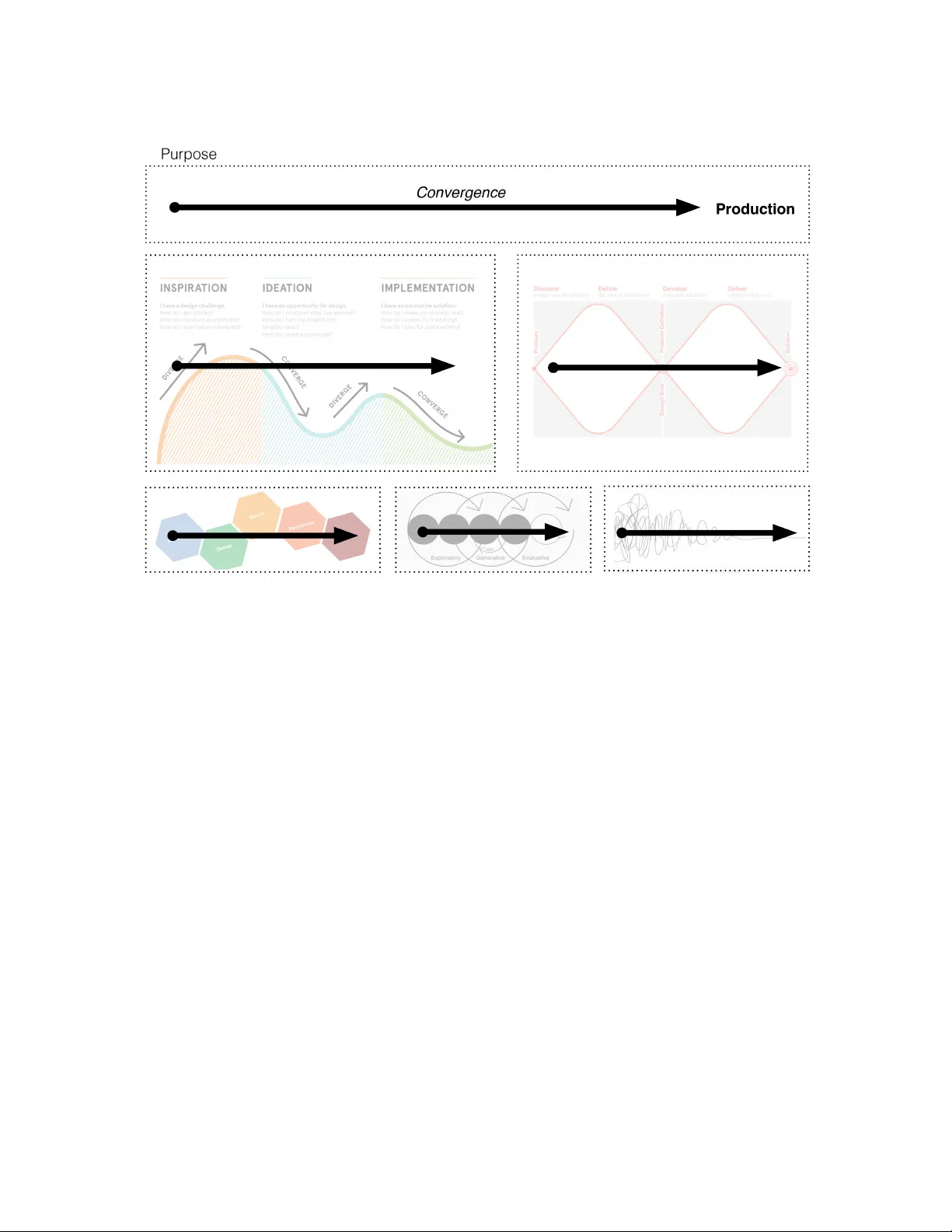
Speculating for Epiple xity: Ho w to Learn the Most from Speculative Design? Botao Amber Hu University of Oxford Oxford, UK botao.hu@cs.ox.ac.uk Abstract Speculative design uses prov ocative "what if ?" scenarios to ex- plore possible sociotechnical futures, yet lacks rigorous criteria for assessing the quality of speculation. W e address this gap by r efram- ing speculative design through an information-theoretic lens as a resource-bounded knowledge generation process that uses pro vo- types to strategically embrace surprise. Howev er , not all surprises are equally informative—some yield genuine insight while others remain aesthetic shock. Drawing on epiplexity—structured, learn- able information extractable by b ounded obser vers—we propose decomposing the knowledge generated by speculative artifacts into structured epistemic information (transferable implications about futures) and entropic noise (narrative, aesthetics, and surface-level surprise). W e conclude by introducing a practical audit framework with a self-assessment questionnaire that enables designers to e val- uate whether their speculations yield rich, high-epiplexity insights or remain at a supercial level. W e discuss implications for peer review , design pedagogy , and policy-oriented futuring. CCS Concepts • Human-centered computing → Collaborative and social computing theory , concepts and paradigms . Ke ywords Speculative Design, Epiplexity , Information Theory , Design Evalu- ation A CM Reference Format: Botao Amber Hu. 2026. Spe culating for Epiplexity: How to Learn the Most from Speculative Design? . In . A CM, New Y ork, N Y , USA, 16 pages. https: //doi.org/10.1145/nnnnnnn.nnnnnnn 1 Introduction Speculative design has be come a prominent approach for “what if ” inquiry in HCI, DIS, and adjacent design research communities, aiming to prov oke reection on sociotechnical trajectories rather than to optimize usability or market t [ 15 , 25 , 79 ]. Design artifacts— props, prototypes, scenarios, enacted experiences—operate as epis- temic devices: they externalize assumptions, materialize futures, Permission to make digital or hard copies of all or part of this work for personal or classroom use is granted without fee provided that copies are not made or distributed for prot or commercial advantage and that copies bear this notice and the full citation on the rst page. Copyrights for components of this work owned by others than the author(s) must be honor ed. Abstracting with credit is permitte d. T o copy otherwise, or republish, to post on servers or to redistribute to lists, r equires prior specic permission and /or a fee. Request p ermissions from permissions@acm.org. Conference’17, Washington, DC, USA © 2026 Copyright held by the owner/author(s). Publication rights licensed to ACM. ACM ISBN 978-x-xxxx-xxxx-x/Y YY Y/MM https://doi.org/10.1145/nnnnnnn.nnnnnnn and support discursive engagement around values, power , and con- sequence [ 14 , 53 , 62 ]. This orientation is increasingly rele vant for AI and data-intensive systems, wher e second-order eects—labor displacement, governance drift, contestability failures, racialized harm—are dicult to surface through conventional de velopment pipelines [ 18 , 50 ]. Behavioral scientists have independently con- verged on this challenge: Rahwan, Shari, and Bonnefon propose a “science ction science ” method that applies controlled experiments to speculative futures, demonstrating gro wing cross-disciplinary recognition that rigorous approaches to anticipator y inquiry are needed [56]. Howev er , the very qualities that make speculative design generative— openness, ambiguity , friction, plural futures [ 34 ]—also complicate how the eld judges rigor and contribution. In HCI, sp eculative and critical work is often read “in tension with pr ogression, ” where pr o- gressional design converges toward implementation while frictional design resists that vector to open interpretive space [ 52 ]. Recent synthesis work makes the evaluative problem explicit: a scoping review of speculative design quality nds criteria dispersed across heterogeneous traditions and pr oposes a taxonomy of qualities, but underscores that “ quality” remains hard to stabilize [ 57 ]. A sys- tematic literature review of speculative design processes identies recurring phases— select , explore , transform , provoke —and proposes an “inverted double diamond” framework [ 15 ]. T ogether , these syn- theses clarify both the spread and the methodological indeterminacy of speculative design: we hav e rich practices, but incomplete shared theory for what makes a provocation learnable . This paper oers an information-theoretic reframing of that problem. W e ask: How can we learn most from provocation? The urgency is sharpened by what Collingridge termed the dilemma of control : the point of maximum leverage over a technology’s social trajectory coincides with minimum knowledge of its consequences, while by the time conse quences b ecome clear , the technology is entrenched and resistant to change [ 16 , 56 ]. W e propose that spe c- ulative design can be treated as a bounded information process: it constructs partial models of futures and elicits interpretations from bounded obser vers under constraints of time, attention, and feasi- bility [ 28 , 66 ]. Within those bounds, not all information is equally useful. Some elements are structured and reusable; others are en- tropic noise. W e call the structured, learnable component epiple xity , adapting a recent information-theoretic construct that formalizes “useful information” for computationally bounded intelligence [ 28 ]. W e contribute: (1) A theoretical model of speculative design as a bounded information process, contrasting progr essional (negentropic) Conference’17, July 2017, W ashington, DC, USA Botao Amber Hu and frictional (strategically entropic) design logics, and de- composing what obser vers learn into structured information ( 𝑆 𝑡 ) and residual entropy ( 𝐻 𝑡 ). (2) A four-quadrant diagnostic map distinguishing qualita- tively dierent outcomes of speculative design— structured provocation , familiar extrapolation , aestheticize d noise , and buried treasure —that gives designers and review ers a shared evaluative vocabulary . (3) A practical audit tool : a reective checklist for designers to diagnose, evaluate, and impro ve their speculations (Ap- pendix A). 2 Background and related work 2.1 Speculation as knowledge generation Speculative design is a mo de of inquir y that uses designed ar- tifacts to explore possibilities and provoke reection, emphasiz- ing problem-nding over problem-solving [ 3 , 15 , 25 ]. Its adjacent traditions—critical design, adversarial design, design ction—use representational and material practices to interrogate sociotechnical assumptions rather than optimize adoption [ 21 , 24 , 72 ]. In HCI, this work is articulated as research through design (RtD): knowledge is produced through designing and reecting on artifacts [ 32 , 61 , 80 ]. A core tension shapes how we understand sp eculative work. Pierce distinguishes progressional design—“arro w-like, ” oriented toward production and adoption—from frictional design, which is “in tension with progression, ” creating interpretive resistance rather than smooth movement toward implementation [ 52 ]. Fric- tional work carries teleological ambiguity : the artifact’s purp ose is not to b ecome a product but to enable inquiry and discourse. Pierce identies ve frictional tendencies— diverging , opposing , ac- celerating , counterfactualizing , and analogizing —that disrupt pro- gressional trajectories by opening alternatives, resisting dominant trends, pushing to extremes, imagining “what if ” scenarios, and drawing cross-domain parallels [52]. Epistemically , sp eculative design draws on Cr oss’s “designerly ways of knowing” [ 19 ], Schön’s reective practice [ 61 ], and philo- sophical thought experiments. Blythe and Encinas argue that design ctions function analogously to thought experiments, allowing us to test intuitions about unfamiliar situations without building com- plete systems [ 12 ]. Within RtD , designed artifacts can function as “strong concepts” or intermediate-level knowledge: portable abstractions more general than single cases [ 33 , 38 ]. Cardenas Cor- dova et al. ’s systematic re view identies four phases— select , explore , transform , provoke —suggesting a recognizable process logic across heterogeneous practices [15]. Rahwan, Shari, and Bonnefon’s “science ction science” (sci-- sci) method represents a complementary approach fr om behavioral science: applying controlled experiments to simulated futures— text vignettes, mock applications, virtual environments, physical stagings—to measure how people actually respond to speculate d technologies [ 56 ]. Where qualitative speculative traditions gen- erate rich prov ocations, sci--sci provides experimental rigor for testing behavioral r esponses. Epiplexity , we argue, provides the the- oretical criteria both traditions need: a principle d account of what makes a speculative scenario worth engaging with—qualitatively or experimentally . 2.2 Why sp eculative quality is hard to judge Sterling, a foundational gure in design ction, obser ved that while the practice has become “almost standard, ” “most design ction is very bad” [ 68 ]—raising the question of what distinguishes insightful speculation from supercial provocation. Critics note that many speculative designs remain “gallery pieces” without clear impact [ 73 ], and that without careful grounding, speculation can reinforce rather than challenge present norms [ 55 ]. HCI has cautioned against judging all design research by usability logics; such criteria can be inappropriate when the goal is exploration or critique [32, 37]. Ringfort-Felner et al. ’s scoping review crystallizes the problem: quality criteria are distributed across traditions and often implicit [ 57 ]. They propose a taxonomy of nine qualities across three cate- gories: speculative qualities (ctional, critical, socio-p olitical), dis- cursive qualities (experienceable, thought-pr ovoking), and process qualities (grounded, participative, reected, playful). Y et a persistent question remains: what are we tr ying to maximize? These quali- ties may conict—highly ctional work may sacrice grounding; deeply participative processes can produce diuse insi ghts under limited time; highly critical work may sacrice experienceability for polemic. The eld needs a way to r elate these qualities to a more basic account of learning from speculation. Lindley and Green propose a provocative criterion: “the ulti- mate measure of success for speculative design is to disapp ear completely”—to have its insights absorbed into mainstream think- ing [ 45 ]. This suggests the value lies in transferable content : ideas that can be internalized beyond the original artifact. But what de- termines whether insights transfer? What makes one speculation’s lessons “sticky” while another’s fade? This points toward the need for an account of structured, learnable information in speculative design. 2.3 Existing approaches to evaluating speculative design Despite the acknowledged diculty , a range of evaluative approaches has emerged. W e r eview them her e to clarify what each contributes and what remains unaddressed. The approaches fall into four br oad families: taxonomic, typological, analytical, and experimental. T axonomic approaches: cataloguing qualities. The most system- atic eort is Ringfort-Felner et al. ’s scoping re view , which synthe- sizes nine qualities across three categories from 63 publications [ 57 ]. Cardenas Cordova et al. ’s systematic review contributes a complementary process-level taxonomy— select , explore , transform , provoke —but addresses what designers do rather than what makes their outputs goo d [ 15 ]. Baumer , Blythe, and T anenbaum argue that design ction is too heterogeneous for unied criteria and in- stead propose matching evaluation methods to contribution types— critical readings, narratological analysis, studio critique, user stud- ies, or thought experiments [ 6 ]. These taxonomic works map the landscape with increasing precision, but they share a common lim- itation: they describe what the eld values without explaining why certain qualities matter more than others or how to resolve conicts between them. A speculation cannot simultane ously maximize all nine of Ringfort-Felner et al. ’s qualities; the eld needs a principle for adjudicating trade-os. Speculating for Epiplexity: How to Learn the Most from Speculative Design? Conference’17, July 2017, W ashington, DC, USA T ypological approaches: classifying design orientations. Pierce’s progressional/frictional distinction provides the foundational ty- pology: ve frictional tendencies—diverging, opposing, accelerat- ing, counterfactualizing, and analogizing—describe how sp eculative work r esists progr essional vectors [ 52 ]. This is powerful for classi- cation but stops short of evaluation: it tells us what frictional designs do but not how well they do it. A speculation can b e clearly frictional and still fail to teach anyone anything. Bardzell and Bardzell draw on 150 years of critical the ory to de velop “ close readings” of critical designs [ 4 ], sho wing how analytical rigour can b e brought to bear— but the resulting evaluations remain interpr etive and case-specic rather than generalizable across projects. Practice-based approaches: design heuristics. Auger’s perceptual bridge identies a crucial design variable: speculation must be grounded enough to engage audiences but strange enough to pro- voke [ 3 ]. This oers practical guidance for creating eective spe culations— six bridging techniques for managing the gap between the familiar and the ctional. Y et the bridge metaphor addresses only engage- ment (can audiences relate?), not learning (what do they extract?). A well-bridged speculation may prov oke a strong reaction while leav- ing observers with nothing transferable. Sterling’s inuential but informal criterion—design ction should “suspend disbelief ab out change” through diegetic prototypes [ 68 ]—operates similarly: it r ec- ognizes quality when present but cannot specify the mechanisms that produce it. T onkinwise’s sustained critique pr ovides sharper evaluative te eth, identifying failures of political engagement, di- versity , and actionability [ 73 ], but the critique is destructive rather than constructive: it identies what is wrong without proposing a principled alternative account of what “right” would look like. Experimental approaches: testing speculative scenarios. Rahwan, Shari, and Bonnefon’s science ction science method represents a fundamentally dierent strategy: rather than evaluating the artifact , it tests audience responses through controlled experiments [ 56 ]. This provides rigorous e vidence about how people actually respond to speculated futures across a delity spectrum from text vignettes to physical stagings. Howe ver , the method does not pro vide criteria for what makes a speculation worth testing in the rst place—it presumes that the scenario has already b een judged interesting enough to warrant experimental investment. The persistent gap. Table 1 summarises the co verage of existing approaches across four evaluative dimensions. Three systematic gaps emerge: (1) No shared account of what to optimize. T axonomies enumerate qualities but provide no principle for choosing among them when they conict. The eld can describe “goo d speculation” in multiple ways but cannot say what makes one description more fundamental than another . (2) No account of obser ver constraints. With the partial ex- ception of Auger’s perceptual bridge and Rahwan et al. ’s delity spectrum, existing frameworks treat quality as a property of the artifact rather than a relation b etween ar- tifact and observer . Y et what people learn depends on who they are, how much time they have, and what scaolding supports their engagement. (3) No distinction b etween productive and unproductive surprise. Gaver et al. established ambiguity as a design re- source over two decades ago [ 34 ], but the critical follow-up question— when is ambiguity productive and when is it merely confusing? —has remained unanswered. Existing frameworks cannot distinguish a speculation that generates genuine in- sight from one that generates only aective shock. These gaps motivate our information-theoretic reframing. What is needed is not another taxonomy of qualities but a more fundamental account of what observers learn from speculative encounters under realistic constraints—and what determines whether that learning is structured enough to transfer . The remainder of this section develops the theoretical foundations for such an account. 2.4 Information the ory in design: entropy and two design logics Shannon entropy quanties average uncertainty in a message source: higher entropy means more possible states, more “surprise” per observation [ 63 ]. Gero and Kan applied this to design processes, developing entropy measur es for linkographs showing that higher entropy indicates more diversied ideas and opportunity for quality outcomes [ 35 , 42 ]. Crucially , entropy captures the distribution of possibilities , not their quality . W e can sharpen the progressional/frictional distinction using information-theoretic language. Progressional design is fundamen- tally negentropic : each decision eliminates alternatives, converging toward a single specied artifact. Many design process models (including double-diamond variants) make this convergence logic explicit [ 20 ]. Frictional design is deliberately entropic : it maintains uncertainty by introducing alternatives, tensions, and counterfac- tuals that resist closure. Ng’s account of “preemptive futures” develops this framing explicitly [ 49 ]. Sp eculation, in this view , is tied to preemption — anticipatory action to secure options and mitigate losses in a world where pr ediction and surprise are entangled. Speculative design be- comes “the increase in entropy or the maximization of surprises in a system” [ 49 ]. Rather than forecasting a single future, it multiplies possibilities to reveal dependencies, vulnerabilities, and interven- tion points. Howev er , raw entropy is not the same as value . A random scenario generator produces maximal entropy without insight. W e need to distinguish structured uncertainty that enables learning from un- structured noise. As Frederik Pohl observed—and as Rahwan et al. foreground—“a good science ction stor y should be able to predict not the automobile but the trac jam” [ 56 ]: what matters is not the technology itself but the second-order social consequences it gener- ates. In the language of this paper , the trac jam is 𝑆 𝑡 —structured, transferable insight about how systems reshape behavior—while the automobile is surface-lev el novelty that contributes primar- ily to 𝐻 𝑡 . This distinction—between productive surprise and mere randomness—is the central concern of the next section. 2.5 Structured complexity and the cognitive science of productive surprise A convergent bo dy of work across complexity science, psychol- ogy , and neuroscience establishes that valuable information lies at Conference’17, July 2017, W ashington, DC, USA Botao Amber Hu T able 1: Coverage of existing evaluation approaches across four dimensions. ✓ = explicitly addressed; ( ✓ ) = partially addressed; — = not addressed. Framework Theoretical basis Observer awareness Practical tool Empirical validation Ringfort-Felner et al. [57] ( ✓ ) — ( ✓ ) ( ✓ ) Pierce [52] ✓ — — — Gaver [34] ✓ — ( ✓ ) — Cordova et al. [15] ( ✓ ) — ( ✓ ) ( ✓ ) A uger [3] ( ✓ ) ( ✓ ) ✓ — T onkinwise [73] ( ✓ ) ( ✓ ) — — Rahwan et al. [56] ✓ ✓ ✓ ✓ Baumer et al. [6] ( ✓ ) — ( ✓ ) — Epiplexity (this paper) ✓ ✓ ✓ — the boundary b etween order and randomness. Langton’s “ edge of chaos” identies a critical zone where complex systems exhibit max- imal computational capacity—neither frozen nor chaotic, but poised where structure and surprise co exist [ 44 ]. Berlyne’s arousal the- ory established the inverted-U: stimuli of intermediate complexity generate optimal engagement [ 10 ]. Schmidhuber formalizes “inter- estingness” as the rate of compression progress—only learnable- but-not-yet-learned structure sustains engagement [ 60 ]. Itti and Baldi’s Bayesian surprise measures ho w much data changes beliefs, showing that random noise carries high Shannon information but virtually zero belief-updating impact [ 39 ]. Silvia’s appraisal theor y adds that interest requires stimuli appraised as both no vel and com- prehensible [ 65 ]. The predictive processing framework provides the neurocognitive architecture: the brain minimizes prediction error , and aesthetic engagement accompanies the resolution of reducible ambiguity —prediction errors the observer can eventually resolve [ 30 , 75 ]. For spe culative design, the extension is from perceptual prediction error (surprise at what y ou see ) to epistemic prediction error (surprise at what y ou think is possible ). Gaver , Beaver , and Benford’s “ Ambiguity as a Resour ce for De- sign” reframed ambiguity from design failure to design strategy [ 34 ]. But the critical question has r emained unanswered since 2003: how do you distinguish productive ambiguity from mere confusion? This is precisely the gap that epiplexity addresses. All frameworks converge on one principle: optimal cognitive engagement oc- curs at intermediate levels of reducible complexity , where bounded observers encounter structure that rewards eort . This resonates with A uger’s “perceptual bridge ”: speculation fails if too fantastical (pure noise) or too familiar (no surprise) [ 3 ]. Qual- ity in speculative design thus becomes a problem of information allocation: given bounded resour ces, what aspects of a future-space does an artifact help people reliably infer? 2.6 Epiplexity: structured information for bounded observers Classical information measures abstract away obser ver constraints. Shannon entropy 𝐻 ( 𝑋 ) quanties uncertainty assuming idealized channels; Kolmogorov complexity 𝐾 ( 𝑥 ) quanties description length assuming unbounded computation. But real observers are bounded. Finzi et al. introduce epiplexity (from epistemic complexity) to for- malize what computationally bounded obser vers can actually learn from data [28]. Formally , given a random variable 𝑋 and a computational time bound 𝑡 , epiplexity 𝑆 𝑡 ( 𝑋 ) is dened as the description length of the optimal probabilistic model that minimizes total description length under computational constraints, grounded in Minimum Descrip- tion Length (MDL) theory augmented with time b ounds drawn from cryptography [ 28 ]. The total description length decomposes into: 𝐿 𝑡 ( 𝑋 ) = 𝑆 𝑡 ( 𝑋 ) + 𝐻 𝑡 ( 𝑋 ) where 𝑆 𝑡 ( 𝑋 ) is the epiplexity —the structured, learnable patterns that a time-bounded observer can extract—and 𝐻 𝑡 ( 𝑋 ) is the time- bounded entropy —residual randomness that appears as noise to any observer operating within budget 𝑡 . As 𝑡 → ∞ , 𝑆 𝑡 approaches the total learnable structure; for nite 𝑡 , much potential structure remains inaccessible. Epiplexity (Denition): From epi- (upon) + -plexity (complexity/perplexity ): “epistemic complexity . ” The minimum description length of data achievable within a time-b ounded computation, capturing the structural information—learnable patterns, regularities, and order— that a computationally bounde d observer can extract. Unlike Shannon entropy (which measures total un- certainty assuming ideal channels) or Kolmogorov complexity (which assumes unbounded computation), epiplexity is inherently observer-relative: the same data can have high epiplexity for one computational budget and low epiplexity for another . The concept resolves three paradoxes in classical information theory: for b ounded observers, deterministic transformations can create information, data ordering does matter , and models can de- velop representations richer than the generating process [ 28 ]. The intellectual lineage runs through Simon’s bounde d rationality [ 66 ], Kahneman and T versky’s work on cognitive constraints [ 41 ], and Pirolli and Card’s information foraging theory [ 54 ]. This tradition establishes that learning is always constrained : what pe ople extract depends not only on the source but on the observer’s computational and attentional budget. Speculating for Epiplexity: How to Learn the Most from Speculative Design? Conference’17, July 2017, W ashington, DC, USA W e propose translating epiplexity— by analogy —into spe culative design. Speculative artifacts are “data” for human sensemaking, but observers are bounded in ways that shap e what they can learn. The key question is not whether a scenario contains “a lot of in- formation” absolutely , but whether it enables obser vers to extract structured insight that transfers across plausible futures given realis- tic constraints. A high-epiplexity speculation yields patterns—about incentives, governance , values, invariants—that observers can iden- tify and reuse; a low-epiplexity speculation may be surprising but leaves observers with little they can articulate or apply elsewhere . This translation is p erspectival, not formal : we do not claim to quantify epiplexity in speculative design with mathematical preci- sion. The framework pro vides a lens —questions to ask about what observers can learn from a speculation, given their constraints. 3 Modeling speculative design through information the ory The central question this paper addresses is: What can people actually learn from your spe culation? Not just “what will they feel” or “will they be surprised”—but what structured, reusable insights will they walk away with? This section develops the theo- retical model; the next section provides practical tools for applying it. 3.1 Speculative design as a bounded information process W e model speculative design as a bounded information process . A speculative artifact—scenario, prop, enactment, prototype—encodes a partial model of a possible future. An observer—participant, reader , review er , policymaker—engages with that artifact under constraints: limited time, limited background kno wledge, limited attention. The observer’s task is to extract useful understanding from the en- counter . This model requires understanding two fundamentally dierent design logics. Pierce distinguishes progressional design—convergent, “arrow-like, ” oriented toward pr oduction (Figure 1)—from frictional design that resists that vector (Figure 2) [ 52 ]. Progressional design is negentropic: each decision eliminates alternativ es, converging toward a single artifact [ 20 ]. Speculative design works dierently— it deliberately keeps possibilities open. The futures cone (Figure 3) visualizes this: trajectories fan outward into possible, plausible, and preferable futures [ 31 , 76 ]. The goal is not to predict or build, but to surface what is at stake —to increase the legibility of a future- space so that observers can reason ab out trajectories, risks, and interventions [49]. This framing matters because frictional design resists the eval- uation criteria that work for pr ogressional design. W e cannot ask “does it r educe uncertainty toward a product?” because frictional work deliberately maintains uncertainty . But this does not mean frictional work is unevaluable—it means we need dierent criteria. Epiplexity provides such criteria: it asks not whether uncertainty is reduced toward implementation, but whether the maintained un- certainty yields learnable structure ab out possibility space [ 28 , 52 ]. A sp eculation can be deliberately open-ended and still be well- designed for learning. The analogy to computational learning is productive: just as a machine learning mo del extracts patterns from a dataset within a compute budget, a human observer ex- tracts patterns from a speculative artifact within a cognitive budget. The value of the encounter depends not on the total “information” present, but on what the bounded agent can actually learn. Rahwan et al. ’s analysis of validity thr eats in science ction science provides empirical evidence for this bounded-observer model: participants struggle to simulate unfamiliar decision contexts (the participant simulation gap ), depicted technologies inevitably diverge from ac- tual implementations, and social contexts shift between the time of speculation and the time of realization [ 56 ]. These are not merely methodological inconveniences but empirical manifestations of the observer-boundedness that epiplexity formalizes: what pe ople can extract from a speculative encounter is constrained by their cognitive and experiential budget 𝑡 . 3.2 The epiplexity decomp osition in spe culative design Opening up possibilities does not, by itself, guarantee learning. A random scenario generator produces endless surprises but teaches nothing; shock without structure is noise. The cognitive science re- viewed in Section 2.4 converges on this p oint: random stimuli carry high Shannon information but virtually zero Bayesian surprise [ 39 ], enable no compression pr ogress [ 60 ], and produce vicious rather than virtuous confusion cycles [ 22 ]. What distinguishes a specula- tion that leaves people saying “that’s creepy” from one that equips them with transferable insight about governance , incentives, or contestability is not elaboration but structure —patterns that p er- sist across variations of the scenario and compress into reusable understanding. Epiplexity provides the formal anchor for this distinction. Recall from Section 2.5 that epiplexity decomposes information into struc- tured patterns ( 𝑆 𝑡 ) that bounde d observers can extract and residual entropy ( 𝐻 𝑡 ) that remains noise given their constraints. Applied to speculative design: • 𝑆 𝑡 ( structured information ): Learnable patterns the observer can extract and generalize—second-order eects, value ten- sions, governance questions, boundary conditions. These are insights people can articulate and apply elsewhere. • 𝐻 𝑡 ( residual entrop y ): Contingent detail, aesthetic noise, com- plexity that exceeds the observer’s extractive capacity . This may include striking imagery , elaborate worldbuilding tex- ture, or scenario specics that do not compress into reusable insight. A high-epiplexity speculation yields patterns pe ople can articu- late and apply elsewher e. A low-epiplexity speculation provokes reactions but leaves people with nothing transferable. This fram- ing shifts the evaluation question fr om “Is it surprising?” to “Is it learnably surprising?” The decomposition yields a natural diagnostic space dene d by two axes— 𝑆 𝑡 and 𝐻 𝑡 —that distinguishes four qualitatively dierent outcomes of speculative design: (1) High epiplexity , calibrate d entropy . The ideal. Rich ex- tractable structure that rewar ds engagement, with genuine uncertainty that compels interpretation. The artifact oper- ates at Auger’s “perceptual bridge” [ 3 ]—plausible enough Conference’17, July 2017, W ashington, DC, USA Botao Amber Hu Figure 1: Progressional design converges toward production through successive phases of inspiration, ideation, and implemen- tation. Reproduced from Pierce [52], Figure 2f. to engage but strange enough to prov oke. Observers en- counter learnable-but-not-yet-learned structure, sustaining what Schmidhuber formalizes as compression progress [ 60 ]. (2) Low epiplexity , low entropy . Obvious, shallow specula- tion. Futures that merely extrapolate present trends without structural complexity—the “smart fridge” problem. This is what T onkinwise critiques as futures operating within a “shopping framework” [ 73 ]: both 𝑆 𝑡 and 𝐻 𝑡 are low because there is little to learn and little surprise. (3) Low epiplexity , high entropy . Aestheticized noise. Visu- ally or conceptually complex surfaces with no extractable structure underneath. The design e quivalent of a crypto- graphically secure pseudorandom generator: it looks com- plex but contains trivial information for any bounde d ob- server [ 28 ]. An artifact that is merely stylistically provocative— dramatic aesthetics, shocking imager y—without underlying extractable structure registers as high 𝐻 𝑡 but low 𝑆 𝑡 . This provides a non-subjective criterion for the critique that rst- wave speculative design often produced “fashion editorial” provocations [ 68 , 73 ]: the question shifts fr om “is this shock- ing?” to “is there learnable structure here that r ewards cog- nitive investment?” (4) High epiplexity , excessive entropy . Dense but chaotic. Po- tentially rich structure that is practically inaccessible b ecause the noise oor overwhelms the signal. Genuine insight is buried in incoherence—the 𝑆 𝑡 is present but the engagement budget 𝑡 is insucient for extraction. This is not necessarily a design failure but a curatorial or facilitation challenge: the same artifact may shift from this quadrant to the rst when scaolding increases the observer’s eective budget [ 11 , 22 ]. These quadrants are developed further in Section 4 with illustra- tive examples. The decomposition also suggests a design analog of Finzi et al. ’s practical estimation methods. In machine learning, the “prequential coding” heuristic approximates epiplexity as the area b etween a model’s initial training loss and its nal asymptotic loss—intuitively , the cumulative learning that occurs as a model e xtracts structure from data [ 28 ]. The design analog would track ho w audience un- derstanding evolves during sustained engagement with an artifact. A high-epiplexity artifact would show continuous learning: dimin- ishing but persistent insight extraction over time, as observers progressively compr ess the speculation into reusable patterns. A low-epiplexity artifact would sho w either immediate comprehen- sion (no learning curve—familiar extrapolation) or a at line (no learning at all, just persistent confusion—aestheticize d noise). While we do not propose formal measurement here , this suggests concrete empirical operationalizations: think-aloud protocols tracking inter- pretive progr ession, longitudinal studies of how extracted insights evolve acr oss multiple encounters, or analysis of whether audience responses converge on structural themes over time . Speculating for Epiplexity: How to Learn the Most from Speculative Design? Conference’17, July 2017, W ashington, DC, USA Figure 2: Five frictional tendencies of alternative designs—counterfactual, analogical, oppositional, divergent, deviational, and accelerational—and the progressional vector they work in relation to. Reproduced from Pierce [52]. Figure 3: The revised futures cone showing how spe culative design op ens p ossibility space across probable, plausible, possible, and preposterous futures. Reproduced from Gall et al. [31], Figure 6. 3.3 What counts as structured information in speculative design The epiplexity decomposition raises a concrete question: what kinds of structure can bounded observers actually extract from speculative design artifacts? In machine learning, structure means compressible regularities—patterns a model can exploit to reduce prediction error . In spe culative design, the rele vant structures are epistemic: they concern how sociotechnical systems work, who they aect, and what conditions shape outcomes acr oss dierent futures. W e identify four recurring forms of structured informa- tion ( 𝑆 𝑡 ) that are particularly valuable because they compress into transferable insight: (1) Second-order ee cts and causal coupling. How do sys- tems reshape behavior , labor , and power through incentives and institutional feedback loops? A speculation that makes Conference’17, July 2017, W ashington, DC, USA Botao Amber Hu incentive structures inferable —not merely asserted—lets ob- servers trace causal chains from technological inter ventions to social consequences [ 27 , 36 , 58 ]. A high- 𝑆 𝑡 speculation encodes these coupling mechanisms so that observers can extract them from the scenario itself, rather than needing them to be didactically explained. (2) V alue tensions and moral framings. Competing values that are other wise latent—privacy vs. convenience, auton- omy vs. safety , eciency vs. justice—become extractable structure when a speculation forces observers to confront trade-os rather than resolv e them prematurely [ 17 , 29 ]. The value tension is structural precisely because it p ersists: changing the spe cic technology does not dissolve the dilemma. (3) Governance and contestability conditions. Who can dis- pute, audit, or refuse? What institutional arrangements en- able or foreclose accountability? These questions constitute learnable structure b ecause they identify invariant gover- nance requirements —conditions that any legitimate deploy- ment of a technology must address regardless of implemen- tation details [1, 46]. (4) Boundary conditions and persistent constraints. Data locality , information asymmetries, infrastructural path de- pendence, and asymmetric power ov er technical standards constitute constraints that persist across dierent futures [ 47 , 81 ]. These are the structural “walls” of possibility space— they compress w ell because the y hold across many scenarios. These four forms share a common property: they ar e robust to supercial variation . Change the interface, the brand, the geography , or the aesthetic wrapper , and the structure persists. This robustness is pr ecisely what makes them compressible in the MDL sense—the y are regularities that a bounde d observer can identify and reuse across contexts, rather than contingent details that apply only to one scenario. The connection to epistemic objects claries why structure mat- ters. Boserman argues, drawing on Rheinberger’s concept of epis- temic things , that speculative design prototypes function as objects characterized by productive incompleteness—they embody “what one does not yet know” and generate knowledge through experi- mental engagement [ 13 ]. The critical distinction is between struc- tured incompleteness and random indeterminacy : an epistemic obje ct is generative precisely because its gaps are patterned, inviting spe- cic forms of inquiry rather than diuse confusion. In epiplexity terms, a well-designed speculative artifact has high 𝑆 𝑡 because its incompleteness is structured—the missing pieces constrain what observers can hypothesize, directing interpretive eort toward pr o- ductive territor y . By contrast, an artifact whose incompleteness is random (high 𝐻 𝑡 , low 𝑆 𝑡 ) oers no such direction: observers may generate hypotheses, but the artifact provides no foothold for selecting among them. This distinction also sharp ens the bound- ary between epistemic objects and boundary obje cts [ 67 ]: boundary objects coordinate across communities thr ough stability (low en- tropy ), while epistemic objects generate new knowledge thr ough structured openness (high epiplexity). This connects to the logic of ab ductive reasoning —inference from surprising observations to explanator y hypotheses—which is the fundamental cognitive mode that speculative design triggers [ 23 , 43 ]. The quality of abduction a speculation supports depends on the relationship between its structured information and its resid- ual noise. T oo much structure with too little entropy (Quadrant II) constrains abduction to a single predetermined interpretation—the observer is told what to conclude. T oo much noise with too lit- tle structure ( Quadrant III) provides no foothold for abduction at all—the observer encounters surprise but cannot generate testable hypotheses about why things are as they are. The pr oductive zone (Quadrant I) enables genuine hypothesis generation: enough struc- ture that obser vers can reason ab ductively ab out causal mecha- nisms, governance failures, and value conicts, with enough en- tropy that the reasoning r emains open and contestable. A high-epiplexity speculation thus makes structures inferable — not by explaining them didactically , but by designing provocations that force interpretation at structural lev els . This is the speculative design analog of defamiliarization: the familiar is made strange in a way that reveals structure, rather than in a way that merely disorients [ 7 , 64 ]. Suvin’s “cognitive estrangement” captures the same principle from science ction theory: the novum (radically new element) must be simultaneously estranging and cognitive—it disrupts existing models while providing sucient regularity for new models to form [ 71 ]. In the language of this paper , cognitive estrangement is high epiplexity: structur ed surprise that a bounded observer can compress into reusable understanding. 3.4 Observer-dependence: for whom, with what resources, what transfers A crucial feature of epiplexity—and a central contribution of this paper—is its explicit observer-dependence . Unlike quality criteria that aspire to universal validity , epiplexity acknowledges that what people learn from a speculation dep ends on who they are, what resources they bring, and what they do with the insight afterward. This is not a limitation but a design consideration to be embraced. The epiplexity framing translates into three practical questions: 1. For whom? Who is your intended audience? A designer learn- ing about problem spaces extracts dierent patterns than a policy- maker anticipating governance needs, who learns dierently than a public reecting on values. Clarify y our target: Who should learn from this? What do they already kno w? 2. With what resources? What is the realistic engagement budget? A sp eculation that works in a facilitated workshop may fail in a portfolio scr oll. Consider: How much time will people spend? What scaolding (facilitation, documentation, props) supports interpreta- tion? 3. What transfers? Will the insight matter next year? Does it apply beyond this spe cic scenario? The most valuable patterns are robust (persist if supercial details change) and reusable (can be articulated as design principles, policy questions, or governance considerations that transfer) [38]. This observer-dependence means an artifact’s epiplexity is not xed: the same work may be richly informative in a facilitated workshop and opaque in a galler y walkthrough. As D’Mello and Graesser’s work shows, whether confusion b ecomes productive or destructive depends on scaolding and the observer’s capacity for resolution [ 22 ]. Rahwan et al. ’s delity spectrum of simulation Speculating for Epiplexity: How to Learn the Most from Speculative Design? Conference’17, July 2017, W ashington, DC, USA methods—from text vignettes thr ough mock applications and vir- tual reality to physical stagings—operationalizes this same principle [ 56 ]. Each step up the delity ladder expands the observer’s eective engagement budget 𝑡 : a text vignette provides minimal perceptual scaolding, risking Quadrant IV outcomes where structure remains buried; an immersive VR environment or physical staging extends the budget, enabling extraction of richer causal and institutional structure. The choice of simulation delity is, in epiplexity terms, a choice about how much computational resource to allocate to the observer . This is not a aw in the framework but an actionable insight: design the engagement, not just the artifact . 4 A uditing sp eculative design for epiplexity Section 3 developed a theoretical mo del. This se ction pr ovides prac- tical tools: a diagnostic map for understanding where a speculation falls, and a reective audit for evaluating and improving specu- lations. W e use illustrative examples throughout to ground the framework. Methodological note. The examples in this section are illustrative , not conrmatory . W e selected cases retrospectively to demonstrate how the framew ork applies, not to test whether it predicts outcomes. Cases were chosen for diversity of domain and because they are well-documented in prior literature. Our assessments reect our interpretation as informed readers; systematic empirical validation remains future work. 4.1 A diagnostic map: four quadrants of speculative design quality The epiplexity mo del yields a natural diagnostic map (Figure 4). T wo axes—the degr ee of surprise or entropy an artifact generates (how unfamiliar and disorienting the encounter is) and the degree of epiplexity (how much of that surprise contains learnable, transfer- able structure)—dene four qualitatively distinct outcomes. These quadrants are not categories to impose but a diagnostic vocabular y for reection. 4.1.1 adrant I: Structured Provocation (High Epiplexity , Cali- brated Entropy). Rich extractable structure that rewards engage- ment, with genuine uncertainty that compels interpretation. The artifact operates at the “ edge of chaos” [ 44 ]—strange enough that observers must build new models, structured enough that they can. This is D’Mello and Graesser’s “virtuous cycle ”: productive confusion that resolves into deeper understanding [22]. Feels like: “I didn’t expect that—but now I see why it would happen, and it changes how I think about this. ” Illustrative examples. “Contestable Camera Cars” frames public AI as open to dispute, emb edding governance tensions—contestability , legitimacy , evidence standards—that persist even if the specic sensing modality changes [ 1 ]. Swap the camera car for dr ones or wearable sensors: the structural questions r emain. Superux’s “Mit- igation of Shock” constructs a future London apartment adapted to climate disruption, grounding speculation in material constraints (modied furniture, preserved foods, o-grid energy) that make adaptation strategies inferable and policy-relevant [ 70 ]. The Near Future Laboratory’s “TBD Catalog” embeds sp eculative technolo- gies within mundane consumer contexts, making visible se cond- order eects and behavioral adaptations that transfer beyond any specic product [ 48 ]. In each case , 𝑆 𝑡 is high because the work fore- grounds forces —governance gaps, institutional inertia, incentive structures—not merely technologies. 4.1.2 adrant II: Familiar Extrap olation (Low Epiplexity , Low En- tropy ). Incremental sp eculation that extends present trends without structural complexity . No r eal surprise, no deep insight. The “smart fridge” pr oblem. Feels like: “Y es, and? This is basically what we have now but shinier . ” Illustrative examples. Speculative concepts that add “ AI” to ex- isting products without interrogating what restructures: a smarter voice assistant, a faster recommendation engine, a more r esponsive smart home. Such work conrms existing assumptions rather than challenging them—what T onkinwise critiques as futures operating within the “shopping framework” [ 73 ]. Both 𝑆 𝑡 and 𝐻 𝑡 are low: ob- servers learn little b ecause there is little to learn, and little surprise because the scenario is already familiar . 4.1.3 adrant III: Aestheticized Noise (Low Epiplexity , High En- tropy ). Visually or conceptually complex surfaces with no extractable structure underneath. Strong aect, zero transfer . Shock is the en- tire content. The design equivalent of a cryptographically secure pseudorandom generator: it looks complex but contains trivial in- formation for any bounded obser ver [28]. Feels like: “That’s disturbing—but I can’t tell you what I’m sup- posed to do with that. ” Illustrative examples. “Gadget dystopias” that scale up a current technology (e .g., facial recognition) into a nightmare future without specifying institutions, incentives, or contestability mechanisms. Observers conclude “sur veillance is bad”—something they already knew—but gain no tools for reasoning about conditions under which harms emerge or can be mitigated. The causal model is underdevel- oped; 𝐻 𝑡 is high (contingent scenario details, dramatic aesthetics) while 𝑆 𝑡 is low . Similarly , a spe culative AI companion concept that simply anthropomorphizes an LLM (“a holographic friend who talks like you”) may elicit aect but remain structurally thin: observers focus on novelty or persona without converging on reusable insight about data governance, incentive misalignment, or algorithmic au- thority over personal narrative . Sterling’s observation that “most design ction is very bad” [ 68 ] targets this quadrant: pro vocative surfaces that cannot be compressed into reusable understanding. 4.1.4 adrant I V: Buried Treasure (High Epiplexity , Excessive En- tropy ). Genuine structural richness that is practically inaccessible because the noise oor overwhelms the signal. The insight exists but bounded obser vers cannot extract it within realistic engagement budgets. Feels like: “I sense there’s something important here, but I can’t gure out what it is in the time I have. ” Illustrative examples. Deliberately uncomfortable artifacts—a provocatively designed object that disrupts norms of comfort and consumption—may contain genuine insight about bodily expecta- tion, consumer habituation, and designe d compliance, but under typical gallery engagement (30 seconds) observers converge on Conference’17, July 2017, W ashington, DC, USA Botao Amber Hu I: Structured Provocation IV : Buried T reasure II: F amiliar Extrapolation III: Aestheticized Noise engagement loss S t H t engagement loss engagement loss H t t engagement loss S t H t E n t r o p y ( H t ) E p i p l e x i t y ( S t ) L ow High L ow High S t : l e a r n a b l e s t r u c t u r e ( e p i p l e x i t y ) H t : r e s i d u a l e n t r o p y ( n o i s e ) Figure 4: Four quadrants of speculative design quality . The vertical axis represents epiplexity ( 𝑆 𝑡 )—how much structured, learnable information b ounded obser vers can extract. The horizontal axis represents entropy ( 𝐻 𝑡 )—the degree of surprise or noise. Eective spe culation o ccupies Quadrant I: high epiplexity with calibrated entropy . the surface message (“comfort is taken for granted”) rather than the deep er causal structures [ 52 , 77 ]. The 𝑆 𝑡 is present but the 𝑡 (engagement budget) is insucient. Similarly , dense participatory speculations where rich structural content is generate d but diused across too many threads, with no curatorial frame to help obser vers compress, may produce Q4 outcomes: meaningful process, inacces- sible output. Speculative work in sensitive social domains—such as “Magic Machines for Refugees” [ 2 ]—can surface rich infrastructural and bureaucratic constraints shaping displacement and agency , but the insight may require facilitation and contextual knowledge that casual observers lack. Q4 is not necessarily a design failure—it may b e a curatorial or facilitation challenge. The same artifact can shift from Q4 to Q1 when the engagement context changes: a facilitated workshop, documentation layer , or interpretive scaold may make buried structure extractable. This connects to the gro wing use of specula- tive methods in policy contexts, wher e the challenge is often not generating rich speculation but making its insights accessible to time-constrained policymakers [74]. Speculating for Epiplexity: How to Learn the Most from Speculative Design? Conference’17, July 2017, W ashington, DC, USA 4.2 The epiplexity audit: a practical tool for designers The four quadrants provide a diagnostic map; to make it action- able, we developed a comprehensive r eective checklist organize d around the framework’s four conceptual dimensions: structured information ( 𝑆 𝑡 ), residual entropy ( 𝐻 𝑡 ), observer-dependence, and process reection. The checklist (presented in full in Appendix A) oers tiered questions that help designers diagnose where their speculation falls on the quadrant map, identify concrete moves for improving epiplexity , and conrm whether engagement yields transferable structural insight rather than mere aect. It is intended as a reference for design iteration, not a scoring rubric. 5 Discussion 5.1 Reframing quality: from plural criteria to learnable structure Our framework does not replace existing speculative quality crite- ria; rather , it oers a unifying rationale for why certain qualities matter . In Ringfort-Felner et al. ’s taxonomy , “grounded, ” “reected, ” and “participative ” process qualities can be understood as mecha- nisms for increasing 𝑆 𝑡 : grounding constrains the futur e-space so causal inference becomes possible; reection externalizes assump- tions and makes learning traceable; participation diversies inter- pretive frames so that extracted structures are less parochial [ 57 , 59 ]. Discursive qualities (“ experienceable, ” “thought-prov oking”) matter because they shape the channel through which observers extract structure under bounded attention [ 54 ]. Speculative qualities (“crit- ical, ” “socio-political”) matter b ecause the relevant structures of sociotechnical futures are often political and institutional [40, 78]. The four quadrants provide a more precise vocabulary for com- mon failure mo des. The complaint that speculative design pro- duces “interesting but unclear contribution” (a familiar peer-revie w phrase) often describes Q3—high entropy , low epiplexity . The com- plaint that sp eculative work is “incremental” or “insuciently spec- ulative ” describes Q2. The obser vation that a project had “great potential but didn’t quite land” may describ e Q4—genuine struc- ture that the presentation or engagement context failed to make extractable. The framework also complements emerging experimental ap- proaches to speculative futures. Rahwan et al. ’s science ction science method provides rigorous tools for testing b ehavioral re- sponses to spe culated technologies, but it does not provide crite- ria for what makes a spe culative scenario worth testing [ 56 ]. Epi- plexity lls this gap: it identies whether a spe culation contains learnable structure that justies the cost of controlled experimenta- tion. A high-epiplexity scenario (Quadrant I) is a strong candidate for sci--sci investigation because its structured content—second- order eects, governance conditions, value tensions—generates testable hypotheses about human behavior . A low-epiplexity sce- nario (Quadrant III) w ould be a poor investment of experimental resources, no matter how pr ovocative its surface. Conv ersely , sci-- sci provides the empirical validation methods that epiple xity needs: controlled experiments can test whether scenarios designe d for high 𝑆 𝑡 actually pr oduce more transferable learning than those that are not. Crucially , our framework does not impose progressional crite- ria on frictional work. Pierce argues that frictional design resists progressional evaluation [ 52 ]—and we agree. Epiplexity is not a progressional metric: it does not ask “ does this reduce uncertainty toward implementation?” It asks “ does this yield learnable structure about possibility space?” Frictional design can have high epiplexity precisely because it maintains entropy—but good frictional design makes patterns inferable within that maintained uncertainty . The friction is not random; it is strategically placed to reveal structure . 5.2 Implications for peer review and pedagogy Epiplexity suggests practical revie w questions aligned with spe cu- lative design’s epistemic aims: • What structures does the work help us infer? (Second- order eects, governance conditions, value tensions.) • Are these structures robust to supercial changes? (W ould insights hold if the artifact’s aesthetics or setting changed?) • What are the bounds of inference? (What remains uncer- tain or intentionally open, and why?) • What is the intermediate-level knowledge claim? (How is learning made reusable?) [38, 69]. These questions complement, rather than supplant, existing expec- tations for reective accounts in RtD [32, 80]. The four quadrants are directly teachable. A design studio ex- ercise: students analyze existing speculations and place them on the 2 × 2, using the diagnostic questions to identify why work falls where it does and how to move it. The quadrant labels (“familiar extrapolation, ” “aestheticized noise, ” “buried treasure”) pr ovide ac- cessible v ocabular y that students can internalize and apply without needing to master information theor y . This makes the framework immediately deployable in speculative design pedagogy . 5.3 Observer-dependence and epistemic pluralism The observer-dependence of epiplexity reects a valuable feature of speculative design: dierent audiences ne e d dierent speculations . A policymaker anticipating governance frameworks extracts dierent structure than a designer exploring a problem space or a public reecting on values. This is not a aw but a design consideration. This observer-dependence has implications for participator y and justice-oriented design [ 17 , 59 ], as well as for policy-oriented futuring [ 74 ]. If structured information dep ends on observers’ back- grounds, then whose perspectives are centered in speculation mat- ters deeply . Sp eculative design that achieves high epiplexity for privileged audiences may yield low epiplexity for marginalized communities—and vice versa. The framework formalizes the Prado and Oliv eira critique [ 55 ] as an information-theoretic claim: an arti- fact with high epiplexity only for a narrow audience has genuinely lower epistemic quality than one with high epiplexity across di- verse audiences. This reinforces calls for participatory approaches and reexivity about whose futures are being made legible [5, 51]. Addressing the pluralism-evaluation tension. A reasonable con- cern is that obser ver-dependence threatens meaningful evaluation: if epiplexity is always relative , how can reviewers make compara- tive judgments? W e propose that legitimate comparison requires: Conference’17, July 2017, W ashington, DC, USA Botao Amber Hu (1) Explicit audience spe cication. A uthors should state their target obser vers and engagement conditions. Revie wers then evaluate whether the speculation is well-designed for those observers. (2) Internal coherence. Given stated goals, do es the artifact’s design support the intended learning? A speculation can fail on its own terms. (3) Proportionality of claims. Broader claims require broader transfer . A spe culation claiming insight about “ AI futures” generally should demonstrate robustness across observer types; one claiming insight for “policymakers in healthcare AI” can be evaluated more narrowly . This is not pure relativism—it is contextualized rigor . 6 Limitations and future work This paper oers a p erspectival rather than formal contribution. W e have not empirically validated epiple xity as a measurable construct in sp eculative design, nor have we provided quantitative opera- tionalizations of 𝑆 𝑡 and 𝐻 𝑡 . The translation from computational information theor y to design contexts is analogical : we borrow conceptual structure without claiming mathematical equivalence. This is intentional—we believe the value lies in the new questions the framework prompts—but futur e work could explore more sys- tematic approaches. 6.1 Epiplexity and the p olitics of futures An epiplexity lens risks being misread as a search for “inevitable ” futures, which could slip into technological determinism. W e em- phasize that “structure ” in spe culative design should include socio- political contingency and contestation. Sociotechnical imaginar- ies are historically situate d and politically constructed [ 40 , 81 ]. Feminist and p ostcolonial HCI remind us that whose futures b e- come legible is itself a design and epistemic question [ 5 , 51 ]. In this sense, increasing 𝑆 𝑡 can mean increasing the legibility of marginal- ized structures—racialized harms, labor extraction, accessibility barriers—that dominant imaginaries obscure [9, 17, 50]. 6.2 Generative AI as a spe culative partner Generative AI systems can accelerate ideation and scenario gen- eration, but they also risk homogenizing futures by reproducing dominant narratives and training-data biases [ 8 , 26 ]. The quadrant framework sharpens this concern: LLMs are adept at generating Quadrant II outputs (bland extrapolations that recombine famil- iar tropes) and Quadrant III outputs (elaborate, dramatic scenarios that lack structural depth). They struggle with Quadrant I b ecause high 𝑆 𝑡 requires genuine understanding of causal, institutional, and political structure—not merely plausible-sounding prose. Epiplexity thus serves as a steering criterion for AI-assisted spe c- ulation: not “generate more futures, ” but “generate futures that maximize learnable structure under bounded attention. ” Designers can use AI to expand the explored future-space in the explore phase [ 15 ], then apply the audit questions to curate toward Quadrant I—selecting and developing scenarios that surface governance ten- sions, value conicts, and institutional dynamics rather than merely novel content. What would falsify the framework? A p erspectival contribution resists straightfor ward falsication, but we can articulate conditions under which the epiplexity lens would pro ve unhelpful: (1) Practitioners nd the 𝑆 𝑡 / 𝐻 𝑡 distinction unmappable to their design decisions—they cannot reliably distinguish “struc- tured insight” from “ contingent noise ” even with the audit questions. (2) Inter-observer agreement on what counts as structured infor- mation prov es systematically low , suggesting the distinction is too subjective to guide evaluation. (3) Speculations designed to maximize epiplexity (using the design moves) do not yield mor e transferable insights than those designed without this lens. (4) The observer-dependence proves so thoroughgoing that no meaningful comparative judgments become possible, col- lapsing into pure relativism. Empirical directions. W e pr opose four concrete study designs for validation: (1) Controlled comparison. Hold engagement budget 𝑡 con- stant while var ying grounding, participation, and discursive format; measure convergence and transferability of inferred structures across observers. (2) Inter-observer agreement. Present the same speculation to diverse observer groups; assess whether they extract sim- ilar structural patterns ( 𝑆 𝑡 ) or whether extracted structures diverge unpredictably . (3) Robustness testing. Generate controlled variations of sce- narios (changing supercial details while pr eserving struc- tural content); measure which insights persist across varia- tions. (4) Prospective application. Have designers explicitly use the epiplexity audit during the design process; compare the learn- ing outcomes of speculations designed with versus without this lens. Rahwan et al. ’s science ction science method provides a natural experimental framework for these studies [ 56 ]. Their approach— controlled simulation of speculative futures with systematic mea- surement of behavioral responses—could be adapted to vary 𝑆 𝑡 and 𝐻 𝑡 levels experimentally: present participants with speculations de- signed for dierent quadrants and measure whether high-epiplexity scenarios produce more transferable learning (study design 1) and more convergent structural inferences (study design 2). Their - delity spectrum (text vignettes → mock applications → VR → physical staging) oers a concrete op erationalization of the en- gagement budget 𝑡 , enabling direct tests of how observer resources aect structure extraction. T emp orality and shifting assessments. W e acknowledge that epi- plexity assessments are not xed across time. What is Q4 (buried treasure) in a gallery setting may become Q1 (structured provoca- tion) in a facilitated workshop with appropriate scaolding. What is Q1 today may drift to Q2 (familiar extrapolation) as the future it speculates ab out becomes the present. Future work should explore how the temporal dimension aects framework application. Speculating for Epiplexity: How to Learn the Most from Speculative Design? Conference’17, July 2017, W ashington, DC, USA W e also acknowledge that our account foregrounds structured learning; we do not claim that ambiguity , aect, or aesthetic experi- ence are secondary in speculative design. Rather , we argue that for speculative design to sustain its legitimacy in HCI venues, it needs clearer accounts of how such experiences translate into reusable knowledge under bounded conditions [ 52 , 57 ]. Epiplexity provides one such account, but others may complement it. 7 Conclusion W e proposed an information-theoretic view of speculative design that centers bounde d learning from provocation. By adapting epiplexity— structured information extractable by computationally b ounded observers [ 28 ]—we modeled spe culative design as a bounded infor- mation process and developed practical tools for evaluation and improvement. Our theoretical contribution decomposes what obser vers learn into structured information ( 𝑆 𝑡 ) and residual entropy ( 𝐻 𝑡 ), con- necting this to emerging quality and process framew orks [ 15 , 57 ] and to convergent ndings from complexity science, psy chology , and neuroscience about why structured surprise produces learning while noise does not. Our practical contribution—the four-quadrant diagnostic map and the epiplexity audit checklist (Appendix A )— gives designers, revie wers, and educators a shared vocabular y and a concrete tool for reasoning about speculative design quality . Crucially , our contribution is persp ectival : we provide new ques- tions to ask ab out sp eculative design (for whom? with what re- sources? what transfers?) rather than numerical metrics. The obser ver- dependence of epiplexity is a feature that reects how speculative design actually works and pro vides guidance for designers about audience, context, and engagement. W e hope this lens provides a practical bridge between speculative design’s provocative ambi- tions and HCI’s ongoing need to evaluate and communicate the value of frictional, discursive design research [32, 52]. References [1] Kars Alfrink, Ianus K eller , Gerd Kortuem, and Neelke Doorn. 2023. Contestable Camera Cars: A Speculative Design Exploration of Public AI That Is Open to Dispute. In Proceedings of the 2023 CHI Conference on Human Factors in Computing Systems (CHI ’23) . ACM. doi:10.1145/3544548.3581489 [2] Asam Almohamed and Dhaval Vyas. 2020. Designing for Refugees’ Dignity: Lessons Learned from “Magic Machines” Design W orkshops. In Proceedings of the 2020 ACM Designing Interactive Systems Conference (DIS ’20) . A CM, 1829–1844. doi:10.1145/3357236.3395445 [3] James A uger . 2013. Speculative Design: Crafting the Speculation. Digital Creativ- ity 24, 1 (2013), 11–35. doi:10.1080/14626268.2013.767276 [4] Jerey Bardzell and Shaowen Bardzell. 2013. What is “Critical” About Critical Design? . In Proceedings of the SIGCHI Conference on Human Factors in Computing Systems (CHI ’13) . ACM, 3297–3306. doi:10.1145/2470654.2466451 [5] Shaowen Bardzell. 2011. Feminist HCI: T aking Stock and Outlining an A genda for Design. In Proceedings of the SIGCHI Conference on Human Factors in Computing Systems (CHI ’11) . ACM, 1301–1310. doi:10.1145/1978942.1979041 [6] Eric P. S. Baumer , Mark Blythe, and Theresa Jean Tanenbaum. 2020. Evalu- ating Design Fiction: The Right Tool for the Job. In Procee dings of the 2020 ACM Designing Interactive Systems Conference (DIS ’20) . ACM, 1901–1913. doi:10.1145/3357236.3395464 [7] Genevieve Bell, Mark Blythe, and Phoeb e Sengers. 2005. Making by Making Strange: Defamiliarization and the Design of Domestic T echnologies. ACM Transactions on Computer-Human Interaction 12, 2 (2005), 149–173. doi:10.1145/ 1067860.1067862 [8] Emily M. Bender , Timnit Gebru, Angelina McMillan-Major , and Shmargaret Shmitchell. 2021. On the Dangers of Stochastic Parrots: Can Language Models Be T oo Big? . In Proceedings of the 2021 ACM Conference on Fairness, Accountability , and Transparency (F AccT ’21) . ACM, 610–623. doi:10.1145/3442188.3445922 [9] Ruha Benjamin. 2019. Race After T echnology: Abolitionist T o ols for the New Jim Code . Polity Press, Cambridge, UK. [10] Daniel E. Berlyne. 1960. Conict, A rousal, and Curiosity . McGraw-Hill, New Y ork. [11] Robert A. Bjork. 1994. Memor y and Metamemory Considerations in the T raining of Human Beings. In Metacognition: Knowing About Knowing , Janet Metcalfe and Arthur P. Shimamura (Eds.). MIT Press, Cambridge, MA, 185–205. [12] Mark Blythe and Enrique Encinas. 2018. Research Fiction and Thought Experi- ments in Design. Foundations and Trends in Human-Computer Interaction 12, 1 (2018), 1–105. doi:10.1561/1100000070 [13] Carla Boserman. 2019. Rescuing Epistemic Objects from Speculative Design. Diseña 14 (2019), 118–137. doi:10.7764/disena.14.118- 137 [14] Stuart Candy and Jake Dunagan. 2017. Designing an Experiential Scenario: The People Who V anished. Futures 86 (2017), 136–153. doi:10.1016/j.futures.2016.05. 006 [15] David Cardenas Cordova, Nick Kelly , and Leo Rezayan. 2025. A Systematic Literature Review of the Speculative Design Process and a Proposed Framework for Speculative Design. Design Science 11 (2025). doi:10.1017/dsj.2025.10030 [16] David Collingridge. 1980. The So cial Control of T echnology . Frances Pinter , London. [17] Sasha Costanza-Chock. 2020. Design Justice: Community-Led Practices to Build the W orlds W e Nee d . MI T Press, Cambridge, MA. [18] Kate Crawford and Vladan Joler . 2018. Anatomy of an AI System: The Amazon Echo as an Anatomical Map of Human Labor, Data and Planetary Resources. AI Now Institute and Share Lab. https://anatomyof.ai [19] Nigel Cross. 1982. Designerly Ways of Knowing. Design Studies 3, 4 (1982), 221–227. doi:10.1016/0142- 694X(82)90040- 0 [20] Design Council. 2005. The Double Diamond: A universally accepted depiction of the design process. https://ww w .designcouncil.org.uk/our- resources/the- double- diamond/. Originally published 2005; updated 2019. [21] Carl DiSalvo. 2012. Adversarial Design . MI T Press, Cambridge, MA. [22] Sidney D’Mello and Art Graesser . 2014. Confusion and Its Dynamics During Device Comprehension with Breakdown Scenarios. Acta Psychologica 151 (2014), 106–116. doi:10.1016/j.actpsy .2014.06.005 [23] Kees Dorst. 2011. The Core of “Design Thinking” and Its Application. Design Studies 32, 6 (2011), 521–532. doi:10.1016/j.destud.2011.07.006 [24] Anthony Dunne. 2005. Hertzian Tales: Electronic Products, Aesthetic Exp erience, and Critical Design . MI T Press, Cambridge, MA. [25] Anthony Dunne and Fiona Raby . 2013. Speculative Everything: Design, Fiction, and Social Dreaming . MI T Press, Cambridge, MA. [26] Mathias Østvold Ek, Magnus Paulsen, and June Kyong Trondsen. 2024. Spec- ulative Design Through the Lens of AI. In Proce edings of the 26th Interna- tional Conference on Engine ering and Product Design Education (E&PDE 2024) . doi:10.35199/EPDE.2024.106 [27] Virginia Eubanks. 2018. A utomating Inequality: How High-T ech T ools Prole, Police, and Punish the Poor . St. Martin’s Press, New Y ork. [28] Marc Finzi, Sanyam Qiu, Yilun Jiang, Pavel Izmailov , J. Zico Kolter , and An- drew Gordon Wilson. 2025. From Entropy to Epiplexity: Rethinking Information for Computationally Bounded Intelligence . arXiv preprint arXiv:2601.03220 (2025). doi:10.48550/arXiv .2601.03220 [29] Batya Friedman and David G. Hendr y . 2019. Value Sensitive Design: Shaping T echnology with Moral Imagination . MI T Press, Cambridge, MA. [30] Karl Friston. 2010. The Free-Energy Principle: A Unied Brain Theor y? Nature Reviews Neuroscience 11, 2 (2010), 127–138. doi:10.1038/nrn2787 [31] Tjark Gall, Flore Vallet, and Bernard Yannou. 2022. How to Visualise Futures Studies Concepts: Revision of the Futures Cone. Futures 143 (2022), 103024. doi:10.1016/j.futures.2022.103024 [32] William Gaver . 2012. What Should W e Expect from Research Through Design? . In Proceedings of the SIGCHI Conference on Human Factors in Computing Systems (CHI ’12) . ACM, 937–946. doi:10.1145/2207676.2208538 [33] William Gaver and John Bowers. 2012. Annotated Portfolios. interactions 19, 4 (2012), 40–49. doi:10.1145/2212877.2212889 [34] William W . Gaver , Jacob Beaver , and Steve Benford. 2003. Ambiguity as a Re- source for Design. In Proceedings of the SIGCHI Conference on Human Factors in Computing Systems (CHI ’03) . ACM, 233–240. doi:10.1145/642611.642653 [35] John S. Gero and Je W . T . Kan. 2018. Characterizing Innovative Processes in Design Spaces Through Measuring the Information Entropy of the Design Space. AI EDAM: Articial Intelligence for Engineering Design, A nalysis and Manufacturing 32, 1 (2018), 32–43. doi:10.1017/S0890060416000548 [36] Mary L. Gray and Siddharth Suri. 2019. Ghost W ork: How to Stop Silicon V alley from Building a New Global Underclass . Houghton Miin Harcourt, Boston. [37] Saul Greenberg and Bill Buxton. 2008. Usability Evaluation Considered Harmful (Some of the Time). In Procee dings of the SIGCHI Conference on Human Factors in Computing Systems (CHI ’08) . ACM, 111–120. doi:10.1145/1357054.1357074 [38] Kristina Höök and Jonas Löwgren. 2012. Strong Concepts: Intermediate-Level Knowledge in Interaction Design Research. ACM Transactions on Computer- Human Interaction 19, 3 (2012), Article 23. doi:10.1145/2362364.2362371 Conference’17, July 2017, W ashington, DC, USA Botao Amber Hu [39] Laurent Itti and Pierre Baldi. 2009. Bayesian Surprise Attracts Human Attention. Vision Research 49, 10 (2009), 1295–1306. doi:10.1016/j.visres.2008.09.007 [40] Sheila Jasano and Sang-Hyun Kim. 2009. Containing the Atom: Sociotechnical Imaginaries and Nuclear Power in the United States and South Korea. Miner va 47, 2 (2009), 119–146. doi:10.1007/s11024- 009- 9124- 4 [41] Daniel Kahneman and Amos T versky . 1979. Prospect Theory: An Analysis of Decision under Risk. Econometrica 47, 2 (1979), 263–291. doi:10.2307/1914185 [42] Je W . T . Kan and John S. Gero. 2007. Comparing Entropy Measures of Idea Links in Design Protocols: Linkography Entropy Measurement and Analysis of Dierently Conditioned Design Sessions. AI EDAM: A rticial Intelligence for Engineering Design, A nalysis and Manufacturing 21, 4 (2007), 367–377. doi:10. 1017/S0890060407000339 [43] Jon Kolko. 2010. Ab ductive Thinking and Sensemaking: The Drivers of Design Synthesis. Design Issues 26, 1 (2010), 15–28. doi:10.1162/desi.2010.26.1.15 [44] Christopher G. Langton. 1990. Computation at the Edge of Chaos: P hase Transi- tions and Emergent Computation. Physica D: Nonlinear Phenomena 42, 1-3 (1990), 12–37. doi:10.1016/0167- 2789(90)90064- V [45] Joseph Lindley and David Philip Green. 2022. The Ultimate Measure of Suc- cess for Speculative Design is to Disappear Completely . Interaction Design and A rchitecture(s) 51 (2022), 32–51. doi:10.55612/s- 5002- 051- 002 [46] Margaret Mitchell, Simone Wu, Andr ew Zaldivar , Parker Barnes, Lucy V asserman, Ben Hutchinson, Elena Spitzer , Inioluwa Deborah Raji, and Timnit Gebru. 2019. Model Cards for Model Reporting. In Proceedings of the Conference on Fairness, Accountability , and Transparency (F A T* ’19) . ACM, 220–229. doi:10.1145/3287560. 3287596 [47] Richard Mortier , Hamed Haddadi, Tristan Henderson, Derek McAuley , Jon Crowcroft, and Andy Crabtree. 2014. Human-Data Interaction: The Human Face of the Data-Driven Society . SSRN Electronic Journal (2014). doi:10.2139/ssrn. 2508051 [48] Near Future Laboratory. 2014. TBD Catalog. Near Future Laboratory. https: //nearfuturelaboratory .com/projects/en/tbd- catalog/ [49] Phoebe Ng. 2022. Preemptive Futures: Entropic and Negentropic Information in Speculative Design. In Procee dings of the 10th Conference on Computation, Communication, Aesthetics & X (xCoAx 2022) . 85–103. https://2022.xcoax.org/ pdf/xcoax2022- ng.p df [50] Saya Umoja Noble. 2018. Algorithms of Oppression: How Search Engines Reinforce Racism . NY U Press, New Y ork. [51] Kavita Philip, Lilly Irani, and Paul Dourish. 2012. Postcolonial Computing: A T actical Survey . Science, T echnology, & Human V alues 37, 1 (2012), 3–29. doi:10. 1177/0162243910389594 [52] James Pierce. 2021. In T ension with Progression: Grasping the Frictional Ten- dencies of Speculative, Critical, and other Alternative Designs. In Proceedings of the 2021 CHI Conference on Human Factors in Computing Systems (CHI ’21) . ACM. doi:10.1145/3411764.3445406 [53] James Pierce, Phoeb e Sengers, Tad Hirsch, Tom Jenkins, William Gaver , and Carl DiSalvo. 2015. Expanding and Rening Design and Criticality in HCI. In Proceedings of the 33rd A nnual ACM Conference on Human Factors in Computing Systems (CHI ’15) . ACM, 2083–2092. doi:10.1145/2702123.2702438 [54] Peter Pirolli and Stuart Card. 1999. Information Foraging. Psychological Review 106, 4 (1999), 643–675. doi:10.1037/0033- 295X.106.4.643 [55] Luíza Prado and Pe dro Oliveira. 2015. Futuristic Gizmos, Conser vative Ideals: On Anachronistic Design. Mo des of Criticism 1 (2015), 14–27. [56] Iyad Rahwan, Azim Shari, and Jean-François Bonnefon. 2025. The Science Fiction Science Method. Nature 644 (2025), 51–58. doi:10.1038/s41586- 025- 09194- 6 [57] Ronda Ringfort-Felner , Judith Dörrenbächer , and Marc Hassenzahl. 2025. The Quality of Sp eculation – A Scoping Review . In Proce edings of the 2025 ACM Designing Interactive Systems Conference (DIS ’25) . ACM, 2373–2394. doi:10.1145/ 3715336.3735794 [58] Alex Rosenblat and Luke Stark. 2016. Algorithmic Labor and Information Asym- metries: A Case Study of Uber’s Drivers. International Journal of Communication 10 (2016), 3758–3784. [59] Elizabeth B.-N. Sanders and Pieter Jan Stappers. 2008. Co-creation and the New Landscapes of Design. CoDesign 4, 1 (2008), 5–18. doi:10.1080/15710880701875068 [60] Jürgen Schmidhub er . 2010. Formal Theory of Creativity , Fun, and Intrinsic Motivation (1990–2010). IEEE Transactions on A utonomous Mental Development 2, 3 (2010), 230–247. doi:10.1109/T AMD.2010.2056368 [61] Donald A. Schön. 1983. The Reective Practitioner: How Professionals Think in Action . Basic Books, New Y ork. [62] Phoebe Sengers, Kirsten Bo ehner , Shay David, and Joseph “Josh” Kaye . 2005. Reective Design. In Proceedings of the 4th Decennial Conference on Critical Computing (CC ’05) . ACM, 49–58. doi:10.1145/1094562.1094569 [63] Claude E. Shannon. 1948. A Mathematical Theory of Communication. The Bell System Technical Journal 27, 3 (1948), 379–423. doi:10.1002/j.1538- 7305.1948. tb01338.x [64] Viktor Shklovsky . 1965. Art as T echnique. In Russian Formalist Criticism: Four Essays , Lee T . Lemon and Marion J. Reis (Eds.). University of Nebraska Press, Lincoln, NE, 3–24. Originally published in Russian, 1917. [65] Paul J. Silvia. 2005. What Is Interesting? Exploring the Appraisal Structure of Interest. Emotion 5, 1 (2005), 89–102. doi:10.1037/1528- 3542.5.1.89 [66] Herbert A. Simon. 1955. A Behavioral Model of Rational Choice. The Quarterly Journal of Economics 69, 1 (1955), 99–118. doi:10.2307/1884852 [67] Susan Leigh Star and James R. Griesemer . 1989. Institutional Ecology , ‘Transla- tions’ and Boundary Objects: Amateurs and Professionals in Berkeley’s Museum of V ertebrate Zoology, 1907-39. Social Studies of Science 19, 3 (1989), 387–420. doi:10.1177/030631289019003001 [68] Bruce Sterling. 2013. Patently Untrue: Fleshy Debrillators and Synchronised Shelf Wiping. Wired UK (2013). Discusses design ction methodology . [69] Erik Stolterman and Mikael Wib erg. 2010. Concept-Driven Interaction De- sign Research. Human-Computer Interaction 25, 2 (2010), 95–118. doi:10.1080/ 07370020903586696 [70] Superux. 2017. Mitigation of Shock (London 2050). Superux Project. https: //superux.in/index.php/work/mitigation- of- shock/ [71] Darko Suvin. 1979. Metamorphoses of Science Fiction: On the Poetics and History of a Literary Genre . Y ale University Press, New Haven, CT . [72] Joshua Tanenbaum, Karen Tanenbaum, and Ron Wakkary . 2012. Steampunk as Design Fiction. In Proceedings of the SIGCHI Conference on Human Factors in Computing Systems (CHI ’12) . ACM, 1583–1592. doi:10.1145/2207676.2208279 [73] Cameron T onkinwise. 2014. How W e Intend to Future: Review of Dunne and Raby, Speculative Everything. Design Philosophy Papers 12, 2 (2014), 169–187. doi:10.2752/144871314X14159818277602 [74] Emmanuel T sekleves and Ming Hung Lee. 2022. Exploring the Use of Speculative Design as a Participatory Approach to More Inclusive Policy-Making. Design Studies 80 (2022), 101100. doi:10.1016/j.destud.2022.101100 [75] Sander V an de Cruys and Johan W agemans. 2011. Putting Reward in Art: A T entative Prediction Error A ccount of Visual Art. i-Perception 2, 9 (2011), 1035– 1062. doi:10.1068/i0466aap [76] Joseph V oros. 2003. A Generic Foresight Pr ocess Framework. Foresight 5, 3 (2003), 10–21. doi:10.1108/14636680310698379 [77] Ron W akkary and Leah Maestri. 2007. The Resourcefulness of Ever yday Design. In Proceedings of the 6th A CM SIGCHI Conference on Creativity & Cognition (C&C ’07) . ACM, 163–172. doi:10.1145/1254960.1254984 [78] Langdon Winner . 1980. Do Artifacts Have Politics? Daedalus 109, 1 (1980), 121–136. https://w ww .jstor .org/stable/20024652 [79] Richmond Y . W ong and V era Khovanskaya. 2018. Speculative Design in HCI: From Corporate Imaginations to Critical Orientations. In New Directions in Third Wav e Human-Computer Interaction: V olume 2 - Methodologies , Michael Filimowicz and V eronika Tzankova (Eds.). Springer , 175–202. doi:10.1007/978- 3- 319- 73374- 6_10 [80] John Zimmerman, Jodi Forlizzi, and Shelley Evenson. 2007. Research Through Design as a Method for Interaction Design Research in HCI. In Proceedings of the SIGCHI Conference on Human Factors in Computing Systems (CHI ’07) . ACM, 493–502. doi:10.1145/1240624.1240704 [81] Shoshana Zubo. 2019. The Age of Surveillance Capitalism: The Fight for a Human Future at the New Frontier of Power . PublicAairs, New Y ork. Speculating for Epiplexity: How to Learn the Most from Speculative Design? Conference’17, July 2017, W ashington, DC, USA A Expanded Epiplexity Checklist for Speculative Designers This appendix expands the audit questions from Section 4 into a comprehensive reective checklist, organized by the four concep- tual dimensions of the epiplexity framework. It is intende d as a reference document for design iteration, not a scoring rubric. A. Structured Information ( 𝑆 𝑡 ): Do es the speculation yield learnable structure? Second-Order Ee cts and Incentive Structures. • Does the speculation surface downstream consequences be- yond the immediate technology change? • Are incentive structures and behavioral adaptations made inferable? • Can obser vers trace causal chains from the speculated change to social/institutional eects? • Does the scenario r eveal how metrics, algorithms, or policies reshape behavior over time? V alue T ensions and Moral Imaginaries. • Does the speculation make competing values visible (e.g., privacy vs. convenience, autonomy vs. safety )? • Are moral trade-os embedded in the scenario in ways ob- servers can identify? • Does the speculation conne ct to justice concerns (who bene- ts, who is harmed, who decides)? • Can observers articulate the value tensions after engagement, not just feel discomfort? Governance and Contestability Conditions. • Does the speculation raise questions about who decides, who audits, who can refuse? • Are accountability structures (or their absence) made visible? • Can observers infer what institutional arrangements would be neede d for legitimacy? • Does the scenario make it possible to ask “who would contest this, and how?” Boundary Conditions and Invariants. • Are there constraints that persist across variations of the scenario? • W ould the insights transfer if we changed sup ercial details (technology brand, geographic setting, interface style)? • Does the speculation reveal something that would matter across multiple plausible futures? • Can observers distinguish what is contingent (could be oth- erwise) from what is structural (likely to persist)? B. Residual Entropy ( 𝐻 𝑡 ): What is noise, and is it calibrated? Identifying Noise. • Are there scenario elements that are merely aesthetic or decorative without contributing to inference? • Are there contingent details that could be changed without aecting the core insight? • Is there comple xity that exceeds observers’ capacity to inter- pret given the engagement budget? • What would be lost if we removed the most “striking” elements— insight or just aect? Checking for Shock Without Structure. • If observers react emotionally , can they articulate why be- yond “it’s disturbing”? • Does the provocation direct attention toward specic struc- tural questions, or diuse it? • After the initial surprise fades, what remains to be learned? • Is the shock strategically placed to rev eal structure, or is it the entire point? C. Obser ver-Dependence: Who is learning, and under what conditions? For Whom? • Who is the intended audience for this speculation? • What background knowledge and interpretive frames do they bring? • What do we hope they sp ecically will learn? • How might dierent audiences extract dierent structur es from the same artifact? With What Resources? • What is the realistic engagement budget (time, attention, facilitation)? • Is the sp eculation legible within that budget, or does it re- quire extensive e xplanation? • Are there scaolds (documentation, workshops, props, guided discussion) to support interpretation? • What would observers miss if they had half the engagement time? What Transfers? • Can insights from this speculation inform decisions b eyond this specic project? • Will the learnings matter in six months? T wo years? • Can the structured information be articulated as interme diate- level knowledge (str ong concepts, design considerations, p ol- icy questions)? • W ould a dierent design team, encountering this speculation, extract similar structures? D . Process Reection: How do es the design process ae ct epiplexity? Grounding. • Is the sp eculation connected to plausible trajectories, real constraints, or lived realities? • Are the assumptions explicit and contestable? • What research ( empirical, historical, technical) informs the scenario? Participation. • Whose perspectives shape d the speculation? • Are marginalized structures (labor conditions, racialized harm, accessibility barriers) made legible? Conference’17, July 2017, W ashington, DC, USA Botao Amber Hu • Did diverse observers help test whether structure is ex- tractable? Reexivity . • What are our own biases as speculative designers? • What futures did we not explore, and why? • How would dierent positionalities produce dierent spe culations— and dierent epiplexity? This che cklist is not a scoring rubric; it is a set of prompts for reection and design iteration. High-quality speculation need not answer “yes” to every question, but engaging with these questions can help designers craft provocations that yield learnable structure rather than mere shock. B Disclosure of the Usage of LLM W e used Claude (Claude 4.5 Opus model) to assist with writing this manuscript. Specic uses included: • Brainstorming and rening the conceptual framework • Literature review and reference v erication • Drafting and editing prose • Developing the Epiplexity Checklist and audit questions
Original Paper
Loading high-quality paper...
Comments & Academic Discussion
Loading comments...
Leave a Comment