Solving the tetrahedron equation by Teichmüller TQFT
We propose an approach to construct three-dimensional lattice models using line defects in state integral models on shaped triangulations of 3-manifolds. The Boltzmann weights for these models satisfy a variant of the tetrahedron equation, which impl…
Authors: Myungbo Shim, Xiaoyue Sun, Hao Ellery Wang
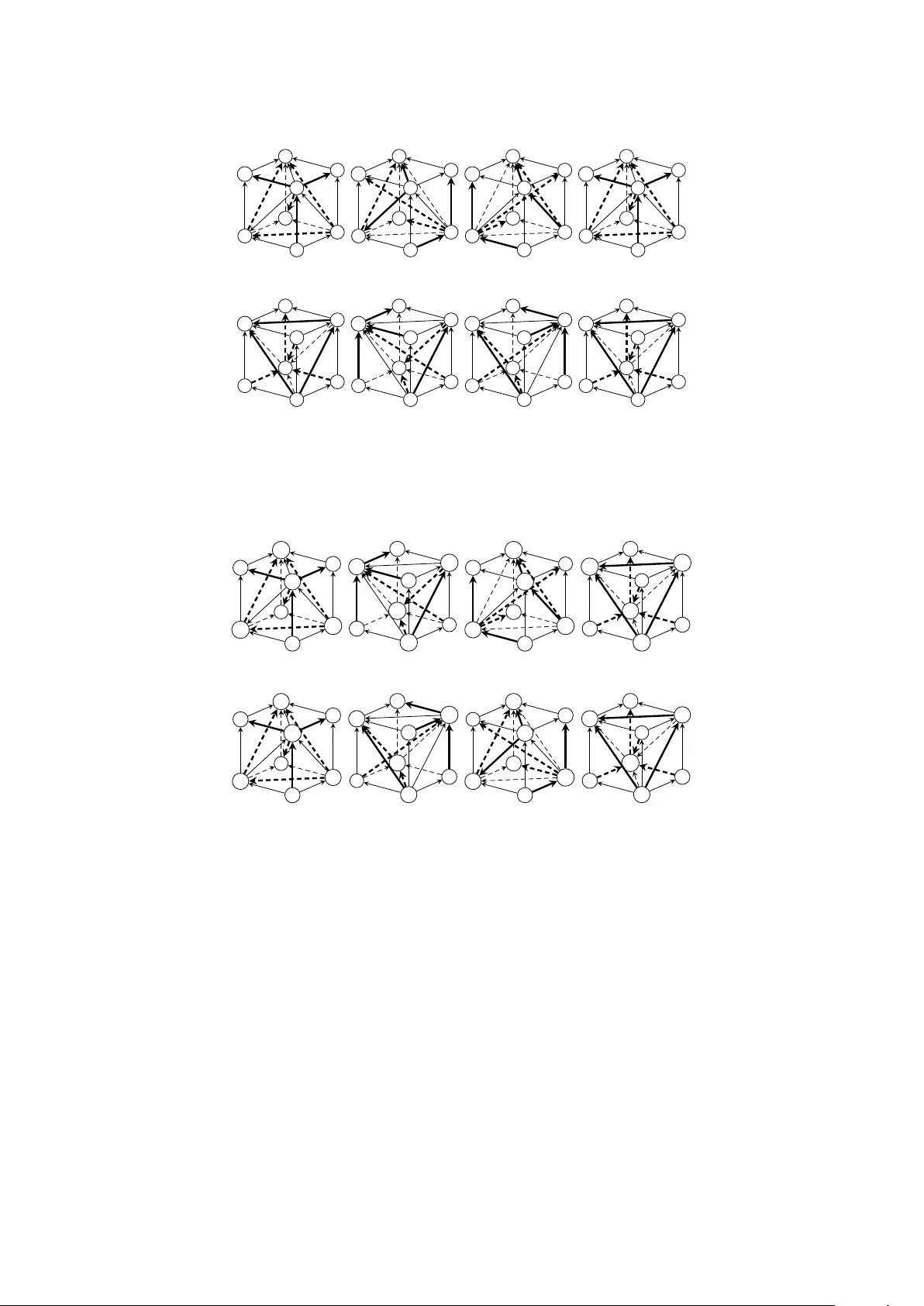
Solving the tetrahedron equation b y T eichmüller TQFT Myungb o Shim, 1 Xiao yue Sun, 2 , 1 Hao Ellery W ang, 1 Juny a Y agi 1 1 Y au Mathematic al Scienc es Center, Tsinghua University Beijing 100084, China 2 Beijing Institute of Mathematic al Scienc es and Applic ations Beijing 101408, China E-mail: mbshim@tsinghua.edu.cn , sunxiaoyue@bimsa.cn , wh2022@tsinghua.edu.cn , junyagi@tsinghua.edu.cn Abstra ct: W e prop ose an approach to construct three-dimensional lattice mo dels using line defects in state integral mo dels on shap ed triangulations of 3 -manifolds. The Boltz- mann weigh ts for these mo dels satisfy a v ariant of the tetrahedron equation, which implies in tegrabilit y under suitable assumptions on R-matrices and transfer matrices. As an explicit example, we present a solution pro duced by T eic hm üller TQFT. Con tents 1 In tro duction 1 2 Three-dimensional bipartite lattice mo dels 3 2.1 Spin mo dels on bipartite cubic lattices 3 2.2 Bicolored tetrahedron equations and integrabilit y 5 3 State integrable mo dels and the BTEs 7 3.1 State in tegral mo dels on shap ed triangulations 7 3.2 BTEs from state integral mo dels 9 4 Solution by T eic hm üller TQFT 12 4.1 T eic hm üller TQFT 12 4.2 T eic hm üller TQFT solv es the BTEs 14 5 Conclusions 15 1 In tro duction The tetrahedron equation, in tro duced by Zamolo dchik o v [ 1 , 2 ], is a three-dimensional analog of the Y ang–Baxter equation and plays a fundamental role in three-dimensional integrable lattice mo dels and ( 2 + 1 ) -dimensional in tegrable quan tum field theories. Compared with the Y ang–Baxter equation, ho wev er, the tetrahedron equation is substan tially more complicated and our understanding of it remains somewhat limited. F or recen t developmen ts, see e.g. [ 3 – 15 ]. In this w ork, we present a geometric construction of solutions to a v ariant of the tetra- hedron equation, consisting of a pair of equations which we call the bicolored tetrahedron equations (BTEs), using state in tegral mo dels on shap ed triangulations of 3 -manifolds. 1 Solutions of the BTEs can b e used to construct three-dimensional bipartite lattice mo dels, whic h are integrable if the solutions hav e suitable prop erties. Our construction is based on the following three observ ations: • F or in teraction-round-a-cub e (IR C) mo dels [ 17 ], the tetrahedron equation admits a graphical interpretation as the equiv alence of tw o decomp ositions of the rhom bic do- decahedron into four cub es, with eac h cub e corresp onding to an R-matrix, as illus- trated in Figure 1 . 1 The BTEs hav e app eared in the literature under the name “mo dified tetrahedron equation”; see e.g. [ 16 ]. W e prefer the term “bicolored,” whic h more transparently reflects the structure of the mo dification. – 1 – d a 1 a 2 a 3 a 4 b 1 b 2 b 3 b 4 c 1 c 2 c 3 c 4 c 5 c 6 = d a 1 a 2 a 3 a 4 b 1 b 2 b 3 b 4 c 1 c 2 c 3 c 4 c 5 c 6 Figure 1 : The tetrahedron equation for IRC mo dels. • In top ological quantum field theories (TQFT s) of T uraev–Viro t yp e [ 18 ], the par- tition function is defined using a triangulation of the spacetime 3 -manifold, but is indep enden t of the choice of triangulation. • In state in tegral mo dels such as T eichm üller TQFT [ 19 , 20 ], which are defined on tri- angulated 3 -manifolds equipp ed with an additional structure called a shap e structure, one can introduce line defects around which the total angle is not equal to 2 π . Geometrically , what we do is to consider shaped triangulations of the rhom bic do decahedron represen ting eac h side of each BTE, and demonstrate that the t wo sides of each BTE are connected by a sequence of shap ed 2 – 3 mov es. A similar idea was proposed by Maillet [ 21 ], who related the tetrahedron equation to the p en tagon identit y for an op erator represen ted b y a tetrahedron. F rom this viewp oint, the tetrahedron equation arises as the condition for trivial holonomy of the parallel transport op erator from three adjacen t faces of a cub e consisting of six tetrahedra to the opposite three faces. How ever, when this idea is implemented using T uraev–Viro TQFT s, the resulting partition function is a top ological inv arian t and therefore do es not enco de the size of the lattice. 2 The crucial difference b et w een our construction and Maillet’s construction applied to T uraev–Viro TQFT s is that when our R-matrix is used to build a three-dimensional cu- bic lattice, the corresp onding triangulated manifold necessarily contains a net work of line defects. Consequently , the asso ciated partition function is not a top ological in v arian t and dep ends on the size of the lattice. The organization of this pap er is as follows. In section 2 , w e discuss three-dimensional bipartite lattice mo dels and their in tegrabil- it y . W e explain how the BTEs implies in tegrability if the transfer matrix satisfies a certain nondegeneracy condition (Lemma 2.3 ). In section 3 , we present the geometric construction of solutions to the BTEs. F or our c hoice of triangulations, it is necessary to introduce defects in the cubes and rhom bic do decahedra. W e identify a c hoice of shap e structures (Figure 6 and Figure 9 ) that solv es the BTE s (Prop osition 3.1 ). 2 Besides Maillet’s w ork, there hav e been several solutions to the tetrahedron equation and its v ariants based on the pentagon identit y of quantum dilogarithms. See, e.g., [ 14 , 22 , 23 ]. – 2 – 3 n 1 l 2 m ( 2 m 3 n ) ( 1 l 2 m ) ( 1 l 3 n ) (a) x 1 x 2 x 3 ( 1 1 3 n ) ( 1 2 3 n ) ( 1 3 3 n ) ( 1 2 L 3 n ) ( 2 1 3 n ) ( 2 2 3 n ) ( 2 3 3 n ) ( 2 2 M 3 n ) (b) Figure 2 : (a) A neigh b orho o d of v ertex ( 1 l 2 m 3 n ) with l + m + n even. (b) A neighborho o d of plane 3 n with n even. In section 4 , w e prov e that the R-matrices pro duced by T eic hm üller TQFT exactly solv e the BTEs. 2 Three-dimensional bipartite lattice mo dels In this section, we discuss classical spin mo dels on bipartite cubic lattices and their in te- grabilit y . 2.1 Spin mo dels on bipartite cubic lattices A bip artite gr aph is a graph whose vertex is colored either black or white, [ 0 ] or [ 1 ] ∈ Z / 2 Z . Eac h edge connects exactly one blac k v ertex and one white vertex. In what follo ws, w e will consider classical spin mo dels on a p erio dic bipartite cubic lattice of size 2 L × 2 M × 2 N , where the tw o vertex colors represent tw o kinds of in teractions. The lattice consists of three sets of planes intersecting in a 3 -torus parametrized b y co ordinates ( x 1 , x 2 , x 3 ) with p erio dic iden tification ( x 1 , x 2 , x 3 ) ∼ ( x 1 + 2 L, x 2 , x 3 ) ∼ ( x 1 , x 2 + 2 M , x 3 ) ∼ ( x 1 , x 2 , x 3 + 2 N ) . W e tak e these planes to b e • planes 1 l lo cated at x 1 = l , l = 1 , . . . , 2 L ; • planes 2 m lo cated at x 2 = m , m = 1 , . . . , 2 M ; and • planes 3 n lo cated at x 3 = n , n = 1 , . . . , 2 N . W e order the planes lexicographically: 1 1 < 1 2 < ⋯ < 1 2 L < 2 1 < 2 2 < ⋯ < 2 2 M < 3 1 < 3 2 < ⋯ < 3 2 N . The in tersections of planes α and β with α < β are lines ( α β ) . The in tersections of planes α , β and γ with α < β < γ are v ertices ( αβ γ ) . The lines are oriented to ward vertices of larger lexicographic order. W e assign color [ l + m + n ] to vertex ( 1 l 2 m 3 n ) . See Figure 2 . Spin mo dels are statistical mec hanics mo dels of inter acting state v ariables (or “spins”) lo cated in space according to some patterns. Differen t types of spin mo dels can b e con- structed on the bipartite cubic lattice dep ending on where spins are lo cated and ho w they – 3 – ( β γ ) ( αβ ) ( αγ ) i i ′ j j ′ k k ′ (a) b c d h γ α β a e f g (b) Figure 3 : Spins around vertex ( αβ γ ) in (a) a vertex mo del and (b) an IRC mo del. in teract. W e will consider mo dels in whic h classical spins interact lo cally at the vertices of the lattice. Spins may b e lo cated on • the e dges formed by the intersection of the planes; • the fac es on the planes b ounded by the edges; and • the r e gions in the 3 -torus b ounded by the planes. A single v ertex is surrounded b y 26 spins (6 on edges, 12 on faces, and 8 in regions). The lo cal Boltzmann w eight W describing their in teraction is a function of the v ertex color and the v alues of the 26 spins, as well as the sp e ctr al p ar ameters assigned to the three planes meeting at the vertex: W ∶ Z 2 × C 3 × R 6 e × R 12 f × R 8 r → C . Here, C is the set of p ossible v alues of sp ectral parameters, and R e , R f and R r are the sets in which spins on edges, faces, and regions tak e v alues, resp ectiv ely . The Boltzmann weigh t of the mo del is the pro duct of lo cal Boltzmann w eights o v er all v ertices. A model that has spins only on the edges is called a vertex mo del . Supp ose that in a v ertex model the six spins adjacen t to v ertex ( αβ γ ) of color [ σ ] take v alues i , j , k , i ′ , j ′ , k ′ , as shown in Figure 3(a) . F ollo wing the standard conv ention, we will write R [ σ ] ( r α , r β , r γ ) i ′ j ′ k ′ ij k (2.1) to denote the lo cal Boltzmann w eight for this configuration, where r α , r β , r γ are the sp ectral parameters of planes α , β , γ . A mo del on a cubic lattice with spins living only on the regions is traditionally called an Inter action-R ound-a-Cub e (IR C) mo del . The eight spins at the corners of a cub e interact around the cub e. The local Boltzmann w eight around vertex ( α β γ ) in an IR C model is denoted by W [ σ ] ( a ef g bcd h ; r α , r β , r γ ) , where the eight spins with v alues a , b , c , d , e , f , g , h are arranged as in Figure 3(b) . Giv en a mo del of the type describ ed ab o v e, w e can alwa ys reform ulate it as a vertex mo del. This can b e done in tw o steps. First, w e replace the spin in eac h region with six spins and distribute them to the surrounding six faces. No w spins are only on the edges and the faces. Eac h face has three – 4 – spins (the original spin plus the t wo coming from the adjacen t regions), and we com bine them in to a single spin v alued in S f = R f × R 2 r . Using this new set of spins, we define a mo del whose partition function is equal to the partition function of the original mo del: if a spin configuration can arise from that in the original mo del, w e assign to it the corresp onding original Boltzmann weigh t; otherwise, we set the Boltzmann weigh t to zero. Next, w e con v ert the model just obtained in to a vertex mo del. W e replace the spin on each face with four spins and distribute them to the four surrounding edges. Then, all spins are lo cated on edges, and they take v alues in S e = R e × S 4 f . Using these spins, we can define a v ertex mo del equiv alent to the model constructed in the previous paragraph, hence to the original mo del, by choosing the lo cal Boltzmann w eigh t appropriately . 2.2 Bicolored tetrahedron equations and in tegrability As explained ab ov e, any mo del of the type considered in the present pap er can b e reformu- lated as a vertex mo del on the bipartite cubic lattice. Introducing the vector space V = i C i , (2.2) define an op erator-v alued function R ∶ Z 2 × C 3 → End ( V ⊗ V ⊗ V ) by R [ σ ] ( r α , r β , r γ ) i ⊗ j ⊗ k = i ′ ,j ′ ,k ′ R [ σ ] ( r α , r β , r γ ) i ′ j ′ k ′ ij k i ′ ⊗ j ′ ⊗ k ′ . (2.3) In the following we discuss conditions on R that imply the in tegrabilit y of this vertex mo del. Supp ose that the mo del is defined on a p erio dic 2 L × 2 M × 2 N bipartite cubic lattice, whic h we think of as consisting of 2 N lay ers of p erio dic 2 L × 2 M bipartite square lattices that are parallel to the x 1 - x 2 plane and stac k ed in the x 3 direction. T ake one of those la y ers. Its neighborho o d is illustrated in Figure 2(b) . Let V ( αβ ) denote the copy of vector space V assigned to the line ( αβ ) , and let R [ σ ] ( αβ γ ) b e the op erator acting on V ( αβ ) ⊗ V ( αγ ) ⊗ V ( β γ ) b y R [ σ ] ( r α , r β , r γ ) . Consider the in tersections of the planes 1 1 , . . . , 1 2 L and t wo planes α , β . The Boltz- mann weigh t for spin configurations in their neighborho o d is giv en b y R [ σ ] αβ ∶ = T r V ( αβ ) l R [ σ + l ] ( 1 l αβ ) ∈ End ( V α ⊗ V β ) , (2.4) where V α ∶ = l V ( 1 l α ) . (2.5) This defines an op erator R ∶ Z 2 × C 2 L × C 2 → End ( V ⊗ V ) with V = V ⊗ 2 L , called the tr ac e r e duction of R . Similarly , the neighborho o d of plane 3 n defines the layer tr ansfer matrix T ∶ Z 2 × C → End ( l,m V ( 1 l 2 m ) ) b y T [ σ ] ( r 3 n ) ∶ = T r l,m V ( 1 l 3 n ) ⊗ V ( 2 m 3 n ) m,n R [ σ + l + m ] ( 1 l 2 m 3 n ) = T r V 3 n m R [ σ + m ] 2 m 3 n , (2.6) – 5 – where the op erator pro duct is tak en in the lexicographic order consistent with the orienta- tion of lines in Figure 2(b) . Using the lay er transfer matrix, the partition function of the mo del can b e expressed as Z = T r l,m V ( 1 l 2 m ) n T [ n ] ( r 3 n ) . (2.7) No w, supp ose that R , ˙ R , ¨ R , ... R ∶ Z 2 × C 3 → End ( V ⊗ 3 ) satisfy the bic olor e d tetr ahe dr on e quations R [ σ ] ( 123 ) ( r 1 , r 2 , r 3 ) ˙ R [ σ + 1 ] ( 124 ) ( r 1 , r 2 , r 4 ) ¨ R [ σ ] ( 134 ) ( r 1 , r 3 , r 4 ) ... R [ σ + 1 ] ( 234 ) ( r 2 , r 3 , r 4 ) = ... R [ σ ] ( 234 ) ( r 2 , r 3 , r 4 ) ¨ R [ σ + 1 ] ( 134 ) ( r 1 , r 3 , r 4 ) ˙ R [ σ ] ( 124 ) ( r 1 , r 2 , r 4 ) R [ σ + 1 ] ( 123 ) ( r 1 , r 2 , r 3 ) . (2.8) W e refer to ( 2.8 ) as BTE[ σ ]. Lemma 2.1. If ... R is invertible, then R , ˙ R , ¨ R satisfy the bicolored Y ang–Baxter equation R [ σ ] 23 ˙ R [ σ + 1 ] 24 ¨ R [ σ ] 34 = ¨ R [ σ + 1 ] 34 ˙ R [ σ ] 24 R [ σ + 1 ] 23 . (2.9) Pr o of. The left-hand side of ( 2.9 ) is equal to T r V ( 23 ) l R [ σ + l ] ( 1 l 23 ) T r V ( 24 ) l ˙ R [ σ + 1 + l ] ( 1 l 24 ) T r V ( 34 ) l ¨ R [ σ + l ] ( 1 l 34 ) = T r V ( 23 ) ⊗ V ( 24 ) ⊗ V ( 34 ) 2 L l = 1 R [ σ + l ] ( 1 l 23 ) ˙ R [ σ + 1 + l ] ( 1 l 24 ) ¨ R [ σ + l ] ( 1 l 34 ) R [ σ ] ( 234 ) ( R [ σ ] ( 234 ) ) − 1 . (2.10) By rep eated use of the BTEs, we can rewrite it as T r V ( 23 ) ⊗ V ( 24 ) ⊗ V ( 34 ) R [ σ ] ( 234 ) l ¨ R [ σ + l ] ( 1 l 34 ) ˙ R [ σ + 1 + l ] ( 1 l 23 ) R [ σ + l ] ( 1 l 23 ) ( R [ σ ] ( 234 ) ) − 1 = T r V ( 23 ) ⊗ V ( 24 ) ⊗ V ( 34 ) l ¨ R [ σ + l ] ( 1 l 34 ) ˙ R [ σ + 1 + l ] ( 1 l 23 ) R [ σ + l ] ( 1 l 23 ) = T r V ( 34 ) l ¨ R [ σ + 1 + l ] ( 1 l 34 ) T r V ( 24 ) l ˙ R [ σ + l ] ( 1 l 24 ) T r V ( 23 ) l R [ σ + 1 + l ] ( 1 l 23 ) , (2.11) whic h is the right-hand side of ( 2.9 ). Prop osition 2.2. If ... R and ¨ R ar e invertible, the layer tr ansfer matric es T of R and ˙ T of ˙ R satisfy T [ σ ] ( r ) ˙ T [ σ + 1 ] ( r ′ ) = ˙ T [ σ ] ( r ′ ) T [ σ + 1 ] ( r ) . (2.12) – 6 – Pr o of. Relation ( 2.12 ) follows from the bicolored Y ang–Baxter equation ( 2.11 ): T r V 3 n m R [ σ + m ] 2 m 3 n T r V 4 n ′ m ˙ R [ σ + 1 + m ] 2 m 4 n ′ = T r V 3 n ⊗ V 4 n ′ m R [ σ + m ] 2 m 3 n ˙ R [ σ + 1 + m ] 2 m 4 n ′ ¨ R [ σ ] 3 n 4 n ′ ( ¨ R [ σ ] 3 n 4 n ′ ) − 1 = T r V 3 n ⊗ V 4 n ′ ¨ R [ σ ] 3 n 4 n ′ m ˙ R [ σ + m ] 2 m 4 n ′ R [ σ + 1 + m ] 2 m 3 n ( ¨ R [ σ ] 3 n 4 n ′ ) − 1 = T r V 4 n ′ m ˙ R [ σ + m ] 2 m 4 n ′ T r V 3 n m R [ σ + 1 + m ] 2 m 3 n . (2.13) Let T ( r , r ′ ) ∶ = T [ 0 ] ( r ) T [ 1 ] ( r ′ ) (2.14) b e the combined transfer matrix for tw o adjacent la y ers. By Prop osition 2.2 , we ha v e [ T ( r , r ′ ) , ˙ T ( s, s ′ )] = 0 . (2.15) This commutativit y implies that the expansion of T and ˙ T in p ow ers of sp ectral parameters pro duces tw o families of op erators suc h that any op erator from one family comm utes with an y op erator from the other family . This is different from the integrabilit y of the model defined by R (or ˙ R ), unless the t wo families coincide. The following lemma provides a sufficient condition for the mo del to b e integrable: Lemma 2.3. If ther e exists ( t, t ′ ) ∈ C 2 such that ˙ T ( t, t ′ ) is diagonalizable with nonde gen- er ate eigenvalues, then [ T ( r , r ′ ) , T ( s, s ′ )] = 0 for any ( r, r ′ ) , ( s, s ′ ) ∈ C 2 . Pr o of. Let Ψ b e an eigen vector of ˙ T ( t, t ′ ) with eigenv alue λ . Since ˙ T ( t, t ′ ) comm utes with T ( r, r ′ ) , the vector T ( r, r ′ ) Ψ is zero or an eigenv ector of ˙ T ( t, t ′ ) with eigen v alue λ . By the assumption of nondegeneracy , T ( r, r ′ ) Ψ is a scalar multiple of Ψ . Similarly , T ( s, s ′ ) Ψ is prop ortional to Ψ , hence [ T ( r, r ′ ) , T ( s, s ′ )] Ψ = 0 . By assumption there is a basis consisting of eigenv ectors of ˙ T ( t, t ′ ) . It follows that [ T ( r , r ′ ) , T ( s, s ′ )] = 0 . 3 State integrable mo dels and the BTEs 3.1 State integral mo dels on shap ed triangulations Consider a tetrahedron with totally ordered v ertices 0 , 1 , 2 , 3 , with each edge directed from a smaller to a larger vertex. Up to eve n p erm utations, there are t w o equiv alence classes of v ertex orderings, corresp onding to the tw o possible orien tations of the tetrahedron, whic h w e call p ositive and ne gative . W e sa y that the tetrahedron is given the shap e of an ideal h yp erb olic tetrahedron if to each edge e is assigned a p ositive real n umber α ( e ) , called the dihe dr al angle of e , suc h that α ( 01 ) = α ( 23 ) = ∶ α , α ( 02 ) = α ( 13 ) = ∶ β , α ( 03 ) = α ( 12 ) = ∶ γ (3.1) – 7 – 2 α 3 0 α 1 β γ γ β 2 α 3 0 α 1 β γ γ β Figure 4 : The tetrahedral w eights for a p ositiv e tetrahedron (left) and a negative tetrahe- dron (right). and α + β + γ = π . (3.2) See Figure 4 for an illustration of dihedral angles and our con ven tion for positive and negativ e orien tations. An oriente d triangulate d pseudo 3 -manifold is a geometric ob ject constructed from finitely man y tetrahedra with ordered v ertices by gluing them along faces while matching the directions of identified edges. The set of the tetrahedra glued together provides its trian- gulation . A shap e structur e of an orien ted triangulated pseudo 3 -manifold is an assignmen t of the shap e of an ideal h yp erb olic tetrahedron to each tetrahedron in the triangulation. An oriented pseudo 3 -manifold endow ed with a shape structure is called a shap e d pseudo 3 -manifold . An internal edge of a shaped pseudo 3 -manifold is b alanc e d if the total angle around that edge (that is, the sum of the dihedral angles of the edge in all tetrahedra con taining it) is equal to 2 π . A shap e gauge tr ansformation with parameter θ p erformed on edge 0 v ( v ∈ { 1 , 2 , 3 } ) or xy ( x , y ∉ { 0 , v } ) of a tetrahedron with ordered v ertices 0 , 1 , 2 , 3 is the shift of dihedral angles α ( 0 w ) → α ( 0 w ) ± θ 3 x = 1 ϵ v wx , (3.3) where ϵ is a completely an tisymmetric tensor with ϵ 123 = 1 and the sign is determined b y the orientation of the tetrahedron. A shap e gauge transformation p erformed on an edge of a shaped pseudo 3 -manifold is defined by the same action on all tetrahedra containing that edge in the triangulation. Shape gauge transformations lea v e the total angles of internal edges inv ariant. Consider a shap ed bip yramid consisting of tw o tetrahedra. A shap e d 2 – 3 move applied to this bipyramid is a change of shaped triangulation to another one consisting of three tetrahedra in such a w ay that the total angle around each external edge is preserved and the induced in ternal edge is balanced. 3 F or a shap ed 2 – 3 mo ve to b e applicable, there must b e a total ordering among the five vertices of the bipyramid consistent with the directions of edges; an y pair of v ertices is con tained in the same tetrahedron either b efore or after the 3 Shap ed 2 – 3 mov es are bidirectional, but in some contexts it is conv enient to reserve this term to b e used for the direction from t wo to three tetrahedra, distinguishing them from “ 3 – 2 mo ves” which go in the opp osite direction. – 8 – ← 2 4 1 0 3 → Figure 5 : An example of a shap ed 2 – 3 mov e. mo v e is applied. See Figure 5 for an illustration of a shaped 2 – 3 mo ve. There are more than one shaped 2 – 3 mov e that can b e applied to a giv en bip yramid, differing b y shap e gauge transformations on the internal edge. W e will sa y tw o shaped pseudo 3 -manifolds are e quivalent if they are related b y a sequence of shap ed 2 – 3 mov es and shap e gauge transformations on in ternal edges. F or the purp ose of the presen t work, b y a state inte gr al mo del on shap e d triangulations w e mean a statistical mechanics model defined on shap ed pseudo 3 -manifolds such that its partition functions on equiv alent shap ed pseudo 3 -manifolds are equal. Suc h a mo del assigns a lo cal Boltzmann w eigh t to a configuration of state v ariables lo cated on a single tetrahedron. T ypically , state v ariables are contin uous and lo cated on the edges and faces. State v ariables on internal edges and faces are integrated o ve r. 3.2 BTEs from state integral mo dels W e wish to solve the BTEs geometrically b y representing the eight R-matrices R [ σ ] , ˙ R [ σ ] , ¨ R [ σ ] , ... R [ σ ] , σ = 0 , 1 , with shap ed cub es. F rom this geometric p oint of view, eac h of the BTEs is a statemen t that t w o shap ed rhom bic do decahedra, obtained from t wo sets of four shap ed cub es glued together, are equiv alent. See Figure 1 . W e choose to triangulate each cub e by six tetrahedra as in Figure 6 . (The meaning of line thic kness will b e explained shortly .) F or this choice, the rhombic do decahedra appearing in BTE[0] and BTE[1] consist of the cub es shown in Figure 7 and Figure 8 , resp ectiv ely . W e must find shap e structures for these triangulated cub es for whic h the BTEs hold. One may hop e to mak e all b o dy diagonal edges (such as edge ah in R [ 0 ] ) balanced so that for each σ , all R [ σ ] , ˙ R [ σ ] , ¨ R [ σ ] , ... R [ σ ] can b e transformed by shap ed 2-3 mov es to hav e the same shap ed triangulation with fiv e tetrahedra. Unfortunately , this is not p ossible. Looking at the tetrahedra con taining the b o dy diagonal edges on the left-hand side of BTE[0], we deduce 4 i = 1 ω ( da i ) = 12 π − 4 i = 1 ω ( db i ) , (3.4) where ω ( da i ) and ω ( db i ) denote the total angle around the edges da i and db i . The edges db 1 , db 2 , db 3 , db 4 , ho w ev er, are b o dy diagonal on the right-hand side of BTE[0]. Therefore, some b o dy diagonal edges must b e un balanced. – 9 – b c d h a e f g b c d h a e f g b c d h a e f g b c d h a e f g R [ 0 ] ˙ R [ 0 ] ¨ R [ 0 ] ... R [ 0 ] b c d h a e f g b c d h a e f g b c d h a e f g b c d h a e f g R [ 1 ] ˙ R [ 1 ] ¨ R [ 1 ] ... R [ 1 ] Figure 6 : The shap ed triangulations of cub es b 1 b 3 b 2 d a 4 c 2 c 1 c 3 c 4 d c 6 b 4 c 1 b 2 a 3 b 1 a 2 b 3 b 4 c 5 b 1 d c 4 c 3 c 5 c 2 c 6 a 1 d b 2 b 4 b 3 R [ 0 ] ˙ R [ 1 ] ¨ R [ 0 ] ... R [ 1 ] a 2 a 4 a 3 d b 1 c 1 c 4 c 3 d c 2 c 6 a 1 c 1 b 2 a 3 a 4 a 2 b 3 a 1 c 5 a 4 c 2 d c 3 c 4 c 5 c 6 b 4 d a 1 a 3 a 2 ... R [ 0 ] ¨ R [ 1 ] ˙ R [ 0 ] R [ 1 ] Figure 7 : The cub es for the shap ed rhom bic do decedra on the left-hand side (top) and the right-hand side (b ottom) of BTE[0]. The constraint ( 3.4 ) is satisfied if we tak e the total angles around the b o dy diagonal edges to b e all equal to 3 π / 2 . A symmetric choice is the following angle assignmen t whic h uses only tetrahedra whose angles are π / 2 , π / 4 , π / 4 . As w e will see shortly , the BTEs are satisfied if we c ho ose, for each tetrahedron, the edges drawn b y thic k lines in Figure 6 to ha v e dihedral angle π / 2 . In order to introduce parameters to the R-matrices, w e can make use of shap e gauge transformations. T o the eigh t cub es in BTE[0], let us apply the shap e gauge transformations – 10 – b 1 b 3 b 2 d a 4 c 2 c 1 c 3 c 4 d c 6 b 4 c 1 b 2 a 3 b 1 a 2 b 3 b 4 c 5 b 1 d c 4 c 3 c 5 c 2 c 6 a 1 d b 2 b 4 b 3 R [ 1 ] ˙ R [ 0 ] ¨ R [ 1 ] ... R [ 0 ] a 2 a 4 a 3 d b 1 c 1 c 4 c 3 d c 2 c 6 a 1 c 1 b 2 a 3 a 4 a 2 b 3 a 1 c 5 a 4 c 2 d c 3 c 4 c 5 c 6 b 4 d a 1 a 3 a 2 ... R [ 1 ] ¨ R [ 0 ] ˙ R [ 1 ] R [ 0 ] Figure 8 : The cub es for the shap ed rhom bic do decedra on the left-hand side (top) and the right-hand side (b ottom) of BTE[1]. b c d h a e f g s 1 s 3 s 2 s 2 s 3 s 1 s 2 s 3 s 1 s 1 s 3 s 2 u 23 u 12 u 13 t 12 t 23 t 13 s 4 Figure 9 : The parameter assignment for R [ 0 ] . with parameters • s i on the edges parallel to da i and db i ; • t ij , i < j , on a i a j and b i b j ; and • u ij , i < j , { i, j } ⊔ { k, l } = { 1 , 2 , 3 , 4 } , on a k b l and a l b k . This results in deformed shap ed cub es that define R-matrices dep ending on parameters. F or example, R [ 0 ] is deformed b y the shap ed gauge transformations with parameters assigned to the edges as in Figure 9 . The deformed R [ 0 ] is a function of the nine parameters s 1 , s 2 , s 3 , t 12 , t 13 , t 23 , u 12 , u 13 , u 14 ; it is indep enden t of s 4 since this parameter is assigned to the in ternal edge ah . Prop osition 3.1. F or generic values of p ar ameters, the ab ove R-matric es satisfy the BTEs. Pr o of. F or BTE[1], the rhom bic do decahedra on the tw o sides are equiv alent b ecause their shap ed triangulations differ only by shap e gauge transformations on in ternal edges. – 11 – F or BTE[0], each rhombic do decahedron consists of six shap ed octahedra whose vertices are sets of the form { a i , a j , b k , b l , c m , d } , with { i, j } ⊔ { k , l } = { 1 , 2 , 3 , 4 } . The corresponding o ctahedra on the tw o sides are related b y tw o shap ed 2 – 3 mov es, hence the tw o rhombic do decahedra are equiv alent. T o b e more concrete, let us consider the o ctahedron consisting of four tetrahedra with v ertices { a 1 , b 3 , b 4 , c 5 } , { a 2 , b 3 , b 4 , c 5 } , { a 1 , b 3 , b 4 , d } and { a 2 , b 3 , b 4 , d } in the rhombic do dec- ahedron on the left-hand side. Depending on whether u 13 + u 24 − u 23 − u 14 is p ositiv e or negativ e, w e can apply the 2 – 3 mo v e to the bip yramid consisting of the first t wo tetrahedra or the last t w o tetrahedra. Consider the former case. The 2 – 3 mo ve pro duces three tetra- hedra with vertices { a 1 , a 2 , b 3 , b 4 } , { a 1 , a 2 , b 3 , c 5 } , { a 1 , a 2 , b 4 , c 5 } . Then, we apply the 3 – 2 mo v e to the bip yramid consisting of { a 1 , a 2 , b 3 , b 4 } , { a 1 , b 3 , b 4 , d } , { a 2 , b 3 , b 4 , d } to obtain four tetrahedra { a 1 , a 2 , b 3 , c 5 } , { a 1 , a 2 , b 4 , c 5 } , { a 1 , a 2 , b 3 , d } , { a 1 , a 2 , b 4 , d } , whic h comprise the corresp onding o ctahedron on the right-hand side. If we c ho ose t ij = t ( t i , t j ) , u ij = u ( u i , u j ) for some functions t , u of tw o v ariables, then the triplet r i = ( s i , t i , u i ) may b e thought of as a parameter assigned to the i th plane. Ho w- ev er, it cannot be interpreted as a sp ectral parameter b ecause, as a gauge transformation parameter, it cannot change the partition function on a p erio dic cubic lattice, unless the b oundary condition is mo dified to break shap e gauge inv ariance. 4 Solution by T eic hmüller TQFT In this section, w e discuss a solution of the BTEs pro duced by T eichm üller TQFT, whic h is a state in tegral mo del introduced b y Andersen and Kashaev [ 19 ] and built on earlier w orks, including [ 24 – 28 ]. 4.1 T eichm üller TQFT Let b b e a complex num b er such that Re b ≠ 0 and c b ∶ = i 2 ( b + b − 1 ) ∈ i R , (4.1) and let p i , q i b e position and momen tum op erators obeying the canonical comm utation relations [ p i , p j ] = [ q i , q j ] = 0 , [ p i , q j ] = 1 2 π i δ i,j . (4.2) Using F addeev’s noncompact quantum dilogarithm Φ b , define the char ge d tetr ahe dr al op er- ator T ij ( a, c ) ∶ = e 2 π i p i q j ψ a,c ( q i − q j + p j ) , (4.3) where a , c ∈ R > 0 and ψ a,c ( x ) ∶ = Φ b x − 2 c b ( a + c ) − 1 e − 4 π ic b a ( x − c b ( a + c )) e − π ic 2 b ( 4 ( a − c ) + 1 )/ 6 . (4.4) It satisfies the identit y T ij ( a 4 , c 4 ) T ik ( a 2 , c 2 ) T j k ( a 0 , c 0 ) = e π ic 2 b P e / 3 T j k ( a 1 , c 1 ) T ij ( a 3 , c 3 ) , (4.5) – 12 – where P e = 2 ( c 0 + a 2 + c 4 ) − 1 / 2 and a 1 = a 0 + a 2 , a 3 = a 2 + a 4 , c 1 = c 0 + a 4 , c 3 = a 0 + c 4 , c 2 = c 1 + c 3 . (4.6) In the original form ulation of T eichm üller TQFT [ 19 ], state v ariables are lo cated on the faces of shap ed triangulations. Let x v , v = 0 , 1 , 2 , 3 , b e the state v ariable on the face opp osite to vertex v of a tetrahedron with ordered vertices and dihedral angles ( α, β , γ ) = ( 2 π a, 2 π b, 2 π c ) . The Boltzmann weigh t assigned to this state configuration is giv en by the exp ectation v alue T ( a, c ) x 0 x 2 x 1 x 3 ∶ = x 0 , x 2 T ( a, c ) x 1 , x 3 , (4.7) or T ( a, c ) x 1 x 3 x 0 x 2 ∶ = x 0 , x 2 T ( a, c ) x 1 , x 3 , (4.8) dep ending on whether the tetrahedron is p ositive or negativ e. Explicitly , we hav e 4 x 0 , x 2 T ( a, c ) x 1 , x 3 = δ ( x 0 + x 2 − x 1 ) ˜ ψ ′ a,c ( x 3 − x 2 ) e 2 π ix 0 ( x 3 − x 2 ) , (4.9) where ˜ ψ ′ a,c ( x ) ∶ = e − π ix 2 R ψ a,c ( y ) e − 2 π ixy dy . (4.10) T eichm üller TQFT has the following prop erties: • Shap e gauge invarianc e . Under a shap e gauge transformation with parameter θ p er- formed on an in ternal edge e that has a total angle ω ( e ) shared by n tetrahedra, the partition function gets multiplied by the factor e ic 2 b θ ( n / 3 − ω ( e )/ π ) . (4.11) • T etr ahe dr al symmetry . There exist cones o ver bigons, which can b e attached to a tetrahedron to change the v ertex ordering. As a result, the partition function on a closed shap ed pseudo 3 -manifold is indep enden t of the c hoice of vertex ordering of tetrahedra. • Invarianc e under shap e d 2 – 3 moves . The iden tity ( 4.5 ) expresses the inv ariance, up to a phase, of the partition function of the bipyramid in Figure 5 under the shap ed 2 – 3 mo v e. By the tetrahedral symmetry , the inv ariance under 2 – 3 mov es holds for an y v ertex ordering of the bipyramid. Therefore, the partition functions of T eichm üller TQFT on equiv alent shap ed pseudo 3 - manifolds are equal up to a phase. 4 The R-matrix dep ends on the gauge parameter assigned to the b ody diagonal edges through a phase factor. Such phase factors cancel in the BTEs and can b e omitted from the definitions of the R-matrices. – 13 – 4.2 T eichm üller TQFT solv es the BTEs The R-matrices pro duced by T eichm üller TQFT carry real state v ariables placed on the external faces of the shap ed cub es. As suc h, they are of vertex t yp e, with eac h edge carrying a pair of state v ariables. Explicitly , the matrix elements of R [ 0 ] are given by R [ 0 ] ( x ′ 3 , ¯ x ′ 3 )( x ′ 2 , ¯ x ′ 2 )( x ′ 1 , ¯ x ′ 1 ) ( x 3 , ¯ x 3 )( x 2 , ¯ x 2 )( x 1 , ¯ x 1 ) = dy 1 dy 2 dy 3 dz 1 dz 2 dz 3 T 1 8 + 1 2 π ( s 2 − s 3 + u 13 − t 12 ) , 1 8 + 1 2 π ( s 3 − s 1 + t 12 − u 23 ) x ′ 1 y 1 x 2 x 3 × T 1 8 + 1 2 π ( s 4 − s 1 + t 12 − u 13 ) , 1 8 + 1 2 π ( s 2 − s 4 − t 12 + u 23 ) z 1 z 2 ¯ x ′ 1 y 1 × T 1 8 + 1 2 π ( s 2 − s 3 + t 13 − u 12 ) , 1 8 + 1 2 π ( s 1 − s 2 − t 13 + u 23 ) ¯ x 3 ¯ x 1 y 2 ¯ x ′ 2 × T 1 8 + 1 2 π ( s 4 − s 3 + t 13 − u 23 ) , 1 8 + 1 2 π ( s 1 − s 4 + u 12 − t 13 ) x ′ 2 y 2 z 2 z 3 × T ( 1 8 + 1 2 π ( s 1 − s 2 + t 23 − u 13 ) , 1 4 + 1 2 π ( s 2 − s 3 + u 13 − u 12 ) ¯ x 2 y 3 ¯ x ′ 3 x 1 × T 1 8 + 1 2 π ( s 3 − s 4 + u 13 − t 23 ) , 1 4 + 1 2 π ( s 2 − s 3 + u 12 − u 13 ) x ′ 3 z 3 z 1 y 3 . (4.12) This is prop ortional to the delta function δ ( ¯ x ′ 1 − x ′ 1 + ¯ x ′ 3 − x ′ 3 + x 2 − ¯ x 2 ) , (4.13) whic h expresses the conserv ation law x 2 − ¯ x 2 = x ′ 1 − ¯ x ′ 1 + x ′ 3 − ¯ x ′ 3 . A priori, the R-matrices pro duced by T eichm üller TQFT are guaranteed to solv e the BTEs only up to a phase since the equality of partition functions b et ween equiv alent shap ed pseudo 3 -manifolds holds only up to a phase. Th us, the left-hand side of BTE[ σ ] is equal to the righ t-hand side of BTE[ σ ], m ultiplied by a phase factor e i ∆ σ whic h may dep end on the parameters s i , t ij , u ij . It turns out that the BTEs are exactly satisfied for T eichm üller TQFT: Prop osition 4.1. e i ∆ σ = 1 . Pr o of. Let us embed eac h of the shap ed rhombic do decahedra represen ting the t wo sides of BTE[ σ ] into a larger shap ed pseudo 3 -manifold so that all edges b ecome internal. W e do this in suc h a wa y that the obtained shap ed pseudo 3 -manifolds differ only in the shap ed triangulations of the embedded rhombic do decahedra; therefore, their partition functions differ by the same phase factor e i ∆ σ . Recall that the parameters s i , t ij , u ij w ere introduced b y shape gauge transformations. Th us, we can shift any of them b y a shap e gauge transformation, and if we do so, the partition functions of the ab o ve tw o shap ed pseudo 3 -manifolds are m ultiplied b y phase factors according to ( 4.11 ). It is easily c hec k that these phase factors coincide. Therefore, e i ∆ σ is indep endent of the parameters. Let us consider the case in which u ij = u kl for { i, j } ⊔ { k , l } = { 1 , 2 , 3 , 4 } . – 14 – F or BTE[1], the t wo shap ed rhombic do decahedra ha ve identical shap ed triangulations in this case. Hence, e i ∆ 1 = 1 . F or BTE[0], the bipyramid with vertices { a i , a j , b k , b l , c m , d } on the left-hand side and the bipyramid with vertices { b j , b i , a l , a k , d, c m } on the right-hand side ha ve exactly the same shap ed triangulation. Therefore, during the sequence of 2 – 3 and 3 – 2 mov es that transforms the left-hand side to the right-hand side, the phase factor pro duced by the 2 – 3 mo v e on the former is canceled by the phase factor pro duced by the 3 – 2 mov e to obtain the latter. 5 Conclusions In this work w e presen ted a construction of three-dimensional bicolored lattice mo dels using line defects in state integral mo dels on shap ed pseudo 3 -manifolds. The R-matrices of these mo dels solve the BTEs. W e ha ve seen, ho w ever, that there are some obstacles to establishing the integrabilit y of these mo dels. Most notably , the parameters of these R-matrices are introduced b y shape gauge transformations, and consequently the lay er transfer matrix with simple p erio dic b oundary conditions lac ks sp ectral parameters. T wisting the boundary conditions with symmetries of the R-matrices can introduce parameter dep endence to the transfer matrix (as done in [ 13 ]), but how exactly this is done dep ends on the sp ecific state integral mo del used. Ev en if spectral parameters could be in tro duced in to the transfer matrices, the R- matrices and the transfer matrices m ust still satisfy additional conditions in order for the lattice mo dels to b e integrable, as explained in section 2 . That said, we b elieve that the lattice mo dels constructed in this w ork are in teresting whether or not they are in tegrable. One reason is that their R-matrices satisfy the BTEs, whic h w e exp ect to p ossess ric h algebraic structures generalizing the quantum algebras in the case of the Y ang–Baxter equation. Another reason is that T eichm üller TQFT is thought to capture asp ects of three-dimensional quantum gra vit y , so the associated lattice mo del should also admit a gravit y in terpretation. W e leav e the exploration of these directions for future work. A ckno wledgmen ts The authors are grateful to Hyun Kyu Kim and Nicolai Reshetikhin for v aluable discussions. This w ork is supp orted b y the National Natural Science F oundation of China (NSF C) under Gran t No. 12375064. MS is also supp orted in part by the Beijing Natural Science F oundation (BJNSF) under Grant No. IS24010 and by the Shuim u Scholar Program of T singhua Univ ersit y . XS is supp orted by the Beijing Natural Science F oundation (BJNSF) under Grant No. IS25024. – 15 – References [1] A. B. Zamolodchik ov, T etr ahe dr a e quations and inte gr able systems in thr e e-dimensional sp ac e , Soviet Phys. JETP 52 (1980), no. 2 325–336. [2] A. B. Zamolodchik ov, T etr ahe dr on e quations and the r elativistic S -matrix of str aight-strings in 2 + 1 -dimensions , Comm. Math. Phys. 79 (1981), no. 4 489. [3] P . Ga vrylenko, M. Semeny akin and Y. Zenk evich, Solution of tetr ahe dr on e quation and cluster algebr as , JHEP 05 (2021) Paper No. 103, 33 [ 2010.15871 ]. [4] J. Y agi, Inte gr able 3D lattic e mo del in M-the ory , JHEP (2023), no. 1 P ap er No. 22, 37 [ 2203.09706 ]. [5] A. Kuniba, S. Matsuik e and A. Y oneyama, New solutions to the tetr ahe dr on e quation asso ciate d with quantize d six-vertex mo dels , Comm. Math. Phys. 401 (2023), no. 3 3247–3276 [ 2208.10258 ]. [6] X. Sun and J. Y agi, Cluster tr ansformations, the tetr ahe dr on e quation and thr e e-dimensional gauge the ories , A dv. The or. Math. Phys. 27 (2023), no. 4 1065–1106 [ 2211.10702 ]. [7] R. Inoue, A. Kuniba and Y. T erashima, Quantum cluster algebr as and 3D inte gr ability: tetr ahe dr on and 3D r efle ction e quations , Int. Math. R es. Not. (2024), no. 16 11549–11581 [ 2310.14493 ]. [8] R. Inoue, A. Kuniba and Y. T erashima, T etr ahe dr on e quation and quantum cluster algebr as , J. Phys. A 57 (2024), no. 8 085202 [ 2310.14529 ]. [9] R. Inoue, A. Kuniba, X. Sun, Y. T erashima and J. Y agi, Solutions of tetr ahe dr on e quation fr om quant um cluster algebr a asso ciate d with symmetric butterfly quiver , SIGMA 20 (2024) P ap er No. 113, 45 [ 2403.08814 ]. [10] P . P admanabhan and V. K orepin, Solving the Yang-Baxter, tetr ahe dr on and higher simplex e quations using Cliffor d algebr as , Nucle ar Phys. B 1007 (2024) P ap er No. 116664, 24 [ 2404.11501 ]. [11] J. Y agi, T etr ahe dr on duality , JHEP (2024), no. 8 P ap er No. 24, 24 [ 2405.02870 ]. [12] S. Iwao, K. Motegi and R. Ohk aw a, T etr ahe dr on e quation and Schur functions , J. Phys. A 58 (2025), no. 1 P ap er No. 015201, 31 [ 2405.10011 ]. [13] R. Inoue, A. Kuniba, Y. T erashima and J. Y agi, Quantize d six-vertex mo del on a torus , 2505.08924 . [14] V. V. Bazhanov, R. M. Kashaev, V. V. Mangazeev and S. M. Sergeev, Quantum dilo garithms and new inte gr able lattic e mo dels in thr e e dimensions , 2512.23338 . [15] R. Inoue and A. Kuniba, Solutions of 3d r efle ction e quation fr om quantum cluster algebr a asso ciate d with symmetric butterfly quiver , 2512.22004 . [16] V. V. Mangazeev and Y. G. Stroganov, El liptic solution for mo difie d tetr ahe dr on e quations , Mo d. Phys. L ett. A 8 (1993) 3475–3482 [ hep-th/9305145 ]. [17] R. J. Baxter, On Zamolo dchikov’s solution of the tetr ahe dr on e quations , Comm. Math. Phys. 88 (1983), no. 2 185–205. [18] V. G. T uraev and O. Y. Viro, State sum invariants of 3-manifolds and quantum 6 j-symb ols , T op olo gy 31 (1992) 865–902. – 16 – [19] J. E. Andersen and R. Kashaev, A TQFT fr om quantum Teichmül ler the ory , Comm. Math. Phys. 330 (2014), no. 3 887–934 [ 1109.6295 ]. [20] J. E. Andersen and R. Kashaev, A new formulation of the Teichmül ler TQFT , 1305.4291 . [21] J.-M. Maillet, On p entagon and tetr ahe dr on e quations , Algebr a i Analiz 6 (1994), no. 2 206–214 [ hep-th/9312037 ]. [22] V. V. Bazhano v and N. Y. Reshetikhin, R emarks on the quantum dilo garithm , J. Phys. A 28 (1995), no. 8 2217–2226. [23] J.-M. Maillard and S. M. Sergeev, Thr e e-dimensional inte gr able mo dels b ase d on mo difie d tetr ahe dr on e quations and quantum dilo garithm , Phys. L ett. B 405 (1997), no. 1-2 55–63. [24] K. Hik ami, Hyp erb olicity of p artition function and quantum gr avity , Nucle ar Phys. B 616 (2001), no. 3 537–548 [ hep-th/0108009 ]. [25] K. Hik ami, Gener alize d volume c onje ctur e and the A -p olynomials: the Neumann-Zagier p otential function as a classic al limit of the p artition function , J. Ge om. Phys. 57 (2007), no. 9 1895–1940 [ math/0604094 ]. [26] T. Dimofte, Quantum Riemann surfac es in Chern-Simons the ory , A dv. The or. Math. Phys. 17 (2013), no. 3 479–599 [ 1102.4847 ]. [27] T. Dimofte, S. Guk ov, J. Lenells and D. Zagier, Exact r esults for p erturb ative Chern-Simons the ory with c omplex gauge gr oup , Commun. Numb er The ory Phys. 3 (2009), no. 2 363–443 [ 0903.2472 ]. [28] R. Dijkgraaf, H. F uji and M. Manab e, The volume c onje ctur e, p erturb ative knot invariants, and r e cursion r elations for top olo gic al strings , Nucle ar Phys. B 849 (2011), no. 1 166–211 [ 1010.4542 ]. – 17 –
Original Paper
Loading high-quality paper...
Comments & Academic Discussion
Loading comments...
Leave a Comment