Maximal Recoverability: A Nexus of Coding Theory
In the modern era of large-scale computing systems, a crucial use of error correcting codes is to judiciously introduce redundancy to ensure recoverability from failure. To get the most out of every byte, practitioners and theorists have introduced t…
Authors: Joshua Brakensiek, Venkatesan Guruswami
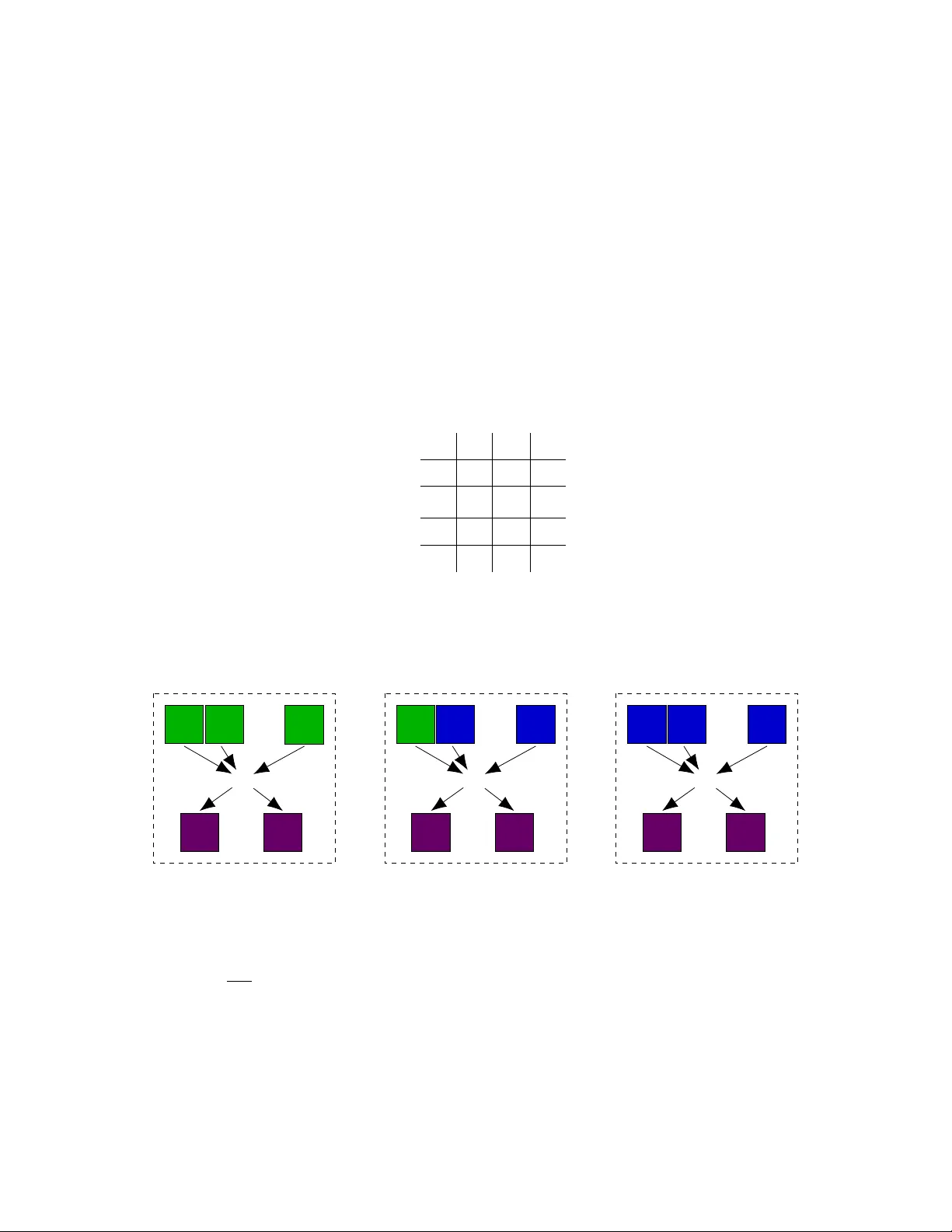
Maximal Reco v erabilit y: A Nexus of Co ding Theory ∗ Josh ua Brak ensiek † V enk atesan Gurusw ami ‡ F ebruary 26, 2026 Abstract In the mo dern era of large-scale computing systems, a crucial use of error correcting codes is to judiciously in tro duce r e dundancy to ensure r e c over ability from failure. T o get the most out of ev ery byte, practitioners and theorists hav e introduced the framew ork of maximal r e c over ability (MR) to study optimal error-correcting co des in v arious architectures. In this survey , we div e in to the study of tw o families of MR co des: MR lo cally recov erable co des (LRCs) (also known as partial MDS co des) and grid co des (GCs). F or each of these tw o families of codes, w e discuss the primary recov erability guarantees as w ell as what is kno wn concerning optimal constructions. Along the wa y , we discuss man y surpris- ing connections b et ween MR co des and broader questions in computer science and mathematics. F or MR LRCs, the use of skew p olynomial co des has unified man y previous constructions. F or MR GCs, the theory of higher order MDS co des sho ws that MR GCs can b e used to construct optimal list-deco dable co des. F urthermore, the optimally reco v erable patterns of MR GCs ha v e close ties to long-standing problems on the structural rigidity of graphs. 1 In tro duction In the design of storage architectures, one often enco des data using suitable error-correcting co des to ensure global data integrit y in spite of many lo cal failures. The fundamental goal of the study of error-correcting co des is to understand the tradeoff b et ween r e dundancy and r e c over ability . In this surv ey , we fo cus on the study of line ar error-correcting codes, where the co de C is a subspace of the v ector space F n q , where F q is a finite field. If the dimension of C is k , we say C is an [ n, k ] co de. F or example, the seminal family of Reed–Solomon co des [RS60] consider the ev aluations of a degree < k p olynomial at n ev aluation p oin ts in F q , where q ≥ n ≥ k . It is kno wn that Reed–Solomon co des ha ve optimal recov erability among all [ n, k ] co des in that they attain the Singleton b ound (i.e., they are maximum distance separable (MDS) co des) [Sin64]. More precisely , every subset of n − k erased sym b ols can b e recov ered b y in terp olation on the remaining k symbols. This optimality of Reed–Solomon co des is a sp ecial case of a more general notion called maximal r e c over ability . W e sa y that a pattern E ⊆ [ n ] := { 1 , 2 , . . . , n } is r e c over able (in terchangeably c orr e ctable ) if for an y c ∈ C , if w e erase the co ordinates indexed by E from c , we can still uniquely ∗ This article is an extended version of a surv ey app earing in IEEE BITS. If one plans to cite this survey , please cite the magazine version [BG25]. † JB is with the Departmen t of Electrical Engineering and Computer Sciences, Universit y of California, Berkeley . Con tact: josh.brakensiek@berkeley .edu ‡ V G is with the Simons Institute for the Theory of Computing, and the Departments of EECS and Mathematics, Univ ersity of California, Berkeley . Contact: venk atg@berkeley .edu 1 iden tify c . F or this surv ey , we in tro duce the notation recov( C ) to denote the set of recov erable patterns. F or any family F of [ n, k ] -codes, we let recov( F ) denote the union of recov( C ) for all C in F . Note that recov erability is monotone: if E ⊆ [ n ] is recov erable for C and E ′ ⊆ E , then E ′ is reco verable for C . Since C is a linear co de, a partial conv erse is true: if E ⊆ [ n ] is reco verable for C , then there alwa ys exists E ′ ⊇ E of size n − k which is recov erable for C . As suc h, reco v( C ) (and th us recov( F ) ) is completely determined b y sets E ∈ recov( C ) of size n − k . W e no w define maximal reco verabilit y . W e remark that the term “maximally recov erable” was coined by Chen, Huang, and Li [CHL07, HCL13] in the context of distributed storage although the notion w as inspired by earlier results in the field of network c o ding [KM03, JSC + 05]. Definition 1 (MR) . An [ n, k ] -code C is maximal ly r e c over able (MR) for F if recov C = recov F . In particular, any [ n, k ] -Reed–Solomon co de is maximally reco verable for the family F of all [ n, k ] -co des. In general, given a family F , it is not alwa ys clear whether such a MR co de C exists! Ho wev er, for our applications, which are families of co des defined by the top ological constraints of a data center, the family F has sufficient algebraic structure that there are infinitely many maximally reco verable co des, among whic h we seek to iden tify and construct the co des of minimal field size. In combinatorics, such questions are closely related to the theory of the r epr esentability of matr oids , see Section 3.4 and Section 4 for more details. W e also note that it is not alwa ys clear for a given family F if there is an efficien t description of the recov erable patterns recov( F ) . W e now dive in to the study of MR co des by carefully studying t w o families of MR co des: MR L o c al ly R e c over able Co des (MR LR C) and MR Grid Co des (MR GC). Although the tw o families of co des are quite similar in definition, the underlying nature of the co des are quite differen t. F or example, merely describing the recov erable patterns of a MR LR C is a routine exercise, while doing the same for a MR GC is an op en question in matroid theory . 1.1 Preliminaries T o establish some common notation, given a [ n, k ] -code C ⊆ F n q , w e define a gener ator matrix of C to b e a matrix G ∈ F k × n q suc h that the k rows of G form a basis for C . The generator matrix of C is not unique, but given an y t w o generators G 1 , G 2 ∈ F k × n q , there alw ays exists an inv ertible matrix M ∈ F k × k q suc h that G 2 = M G 1 . W e let ⟨ u, v ⟩ := P n i =1 u i v i denote the dot pro duct b et ween tw o vectors u, v ∈ F n q . Given a [ n, k ] -co de C ⊆ F n q , w e define its dual co de C ⊥ ⊆ F n q to b e { c ′ ∈ F n q | ∀ c ∈ C, ⟨ c, c ′ ⟩ = 0 } . One can sho w that C ⊥ is alwa ys a [ n, n − k ] -co de. W e t ypically use the letter H ∈ F ( n − k ) × n q to denote a generator matrix of C ⊥ , which is also the p arity che ck matrix of C . Note that c ∈ C if and only if H c = 0 n − k . Giv en a matrix M ∈ F k × n q and a set S ⊆ [ n ] , we let M | S denote the k × | S | matrix consisting of the columns of M indexed by S . Giv en a [ n, k ] -code C and a generator matrix G , we let the puncturing C | S denote the co de generated by G | S . W e also note that puncturing the parity chec k matrix gives a simple test for recov erability . Prop osition 2. L et H b e the p arity che ck matrix of a [ n, k ] -c o de C . W e have that E ⊆ [ n ] is r e c over able if and only if the c olumns of H sp anne d by E ar e line arly indep endent–that is, rank H | E = | E | . In p articular, when | E | = n − k , E is r e c over able iff det( H | E ) = 0 . By conv en tion, we define a p arity che ck c o de to b e the [ n, n − 1] co de which has the row v ector 1 n as a parity chec k matrix. 2 2 Maximally Recov erable Lo cally Recov erable Co des One disadv antage of an MDS code suc h as a Reed–Solomon co de is that it lacks lo c ality . That is, to correct ev en a single erasure in an [ n, k ] -Reed–Solomon co de, one needs to read k other sym b ols. An alternativ e family of co des which reduces the n um b er of reads is that of lo c al ly r e c over able c o des (LR C) (e.g., [CHL07, HSX + 12]). The topology of an LRC consists of four parameters ( n, r , a, h ) . Here, n is the num b er of symbols, r is the size of each lo cal groups ( g := n/r total groups), a is the n umber of parity c hecks p er lo cal group, and h is the n umber of global parit y c hecks—a fail-safe for more than a erasures in a lo cal group. The dimension of such a co de is k = n − ( n/r ) a − h . W e further imp ose that eac h of the groups are “lo cally MDS” in the sense that any r − a symbols within a group can reconstruct the other a symbols. A more precise description of an MR LR C, whic h w as also studied earlier under the name partial MDS co des [BHH13], can b e made in terms of its parit y c heck matrix. F or all i ∈ [ g ] , consider matrices A i ∈ F a × r q and B i ∈ F h × r q . The parity chec k matrix of our MR LRC is then (cf. [GGY20]) H := A 1 0 · · · 0 0 A 2 · · · 0 . . . . . . . . . . . . 0 0 · · · A g B 1 B 2 · · · B g . (1) Equiv alen tly , from an enco ding p oin t of view, an ( n, r, h, a ) -LRC is obtained by adding h global parit y c hecks to k data sym b ols, partitioning these k + h sym b ols into local groups of size r − a , and then adding ‘ a ’ lo cal parity chec ks for each lo cal group. See Figure 1 for an illustration. each local group has size r a lo cal parities p er group h heavy (global) parities X 1 X 2 · · · X r − a L L 1 · · · L a · · · X k P 1 · · · L · · · · · · · · · P h L · · · Figure 1: This diagram visualizes the enco ding map of a lo cally reco verable co de. First, k data sym b ols are expanded to k + h symbols using h global parity c hec ks. Then, these symbols are brok en up into k + h r − a lo cal groups, each of which is expanded with a more parit y c hec ks. Illustration adapted from Figure 1 of [GGY20]. Sub ject to these restrictions, what do es it mean for an LR C to b e maximally reco verable? That is, whic h erasure patterns are recov erable? It turns out there is a simple description (e.g., [GHJY14]). 3 Theorem 3. In an ( n, r , a, h ) -MR LRC, a p attern E ⊆ [ n ] is r e c over able, if and only if ther e exists E ′ ⊆ E of size at le ast | E | − h such that e ach lo c al gr oup interse cts with E ′ in at most a symb ols. Pr o of. First we pro v e that if E is reco verable, then E ′ exists. By Prop osition 2 it suffices to determine which subsets of the columns of H are linearly indep enden t for some choice of A 1 , . . . , A g and B 1 , . . . , B g with g = n/r . Assume that E ⊆ [ n ] is a reco verable erasure pattern so that rank H | E = | E | , and assume for sake of contradition that no claimed E ′ exists. As such, there is F ⊆ E which spans ℓ ≤ g lo cal groups of E but | F | > aℓ + h . Note that H | F has at most aℓ + h nonzero ro ws. Therefore, rank H | F < | F | , a con tradiction of the fact that E and thus F is correctable. Therefore, the claimed E ′ indeed exists. Con versely , we prov e the existence of E ′ implies E is reco verable. Assume that E = E 0 ∪ E 1 ∪ · · · ∪ E g ⊆ [ n ] has a symbols E i from eac h lo cal group i ∈ [ g ] plus h additional symbols E 0 . It suffices to exhibit one sp ecific c hoice of A 1 , . . . , A g , B 1 , . . . , B g for whic h H | E has rank | E | . One w ay to do this is as follows: • F or all i ∈ [ g ] , set A i to b e an MDS matrix suc h that A i | E i to b e a copy of the identit y matrix. • Set h B 1 B 2 · · · B g i E 0 to b e a copy of I h , with the remainder of the ro w blo c k equal to zero. With this choice of H , the submatrix H | E is a p erm utation matrix and th us has rank | E | . Th us, E is reco verable in a ( n, r , a, h ) -MR LRC. With the recov erable patterns fully c haracterized, the primary challenge in the study of MR LR Cs as follows: given parameters ( n, r , a, h ) what is the size of the smallest field size q for whic h an ( n, r, a, h ) -MR LRC exists ov er F q ? W e b egin with a random co ding result o v er large fields, whic h is in fact protot ypical of the wa y one establishes the existenc e of MR co des in the first place. Theorem 4. In the p arity che ck matrix H fr om (1) , let the matric es A i al l b e e qual to the same p arity che ck matrix of some [ r , r − a ] MDS c o de over F q , say a R e e d-Solomon c o de. L et the matric es B i , i ∈ [ g ] , b e fil le d in with indep endent uniformly r andom entries fr om F q . Then pr ovide d q ≫ r a n/r n h , the r esulting c o de is ( n, r , a, h ) -MR LRC with high pr ob ability. The pro of idea is as follows. In (1), replace each B i with distinct indeterminate v ariables X t,j , t ∈ [ h ] , j ∈ [ n ] . F or every maximal correctable erasure pattern E meeting the criteria of Theorem 3, w e seek to prov e det H | E is a nonzero p olynomial of degree at most h . One can do column op erations to zero out all columns within eac h A i except the first a columns erased within group i . The resulting determinan t will b e a nonzero multiple of a determinan t of an h × h matrix whose entries are some linear forms in the X t,j ’s. Thus, if we assign the indeterminates random v alues from F q , the determinant will v anish with probabilit y at most h q b y the Sch w arz-Zipp el lemma. There are in total at most r a n/r n − ar h correctable patterns and thus determinants to worry about, so the c hance any of them v anishes for random F q -v alues is at most h r a n/r n h /q . F or q ≫ r a n/r n h , this tends to 0 . The result ab o ve has tw o significan t drawbac ks—it is non-constructive and only works ov er very large fields. There has b een a h uge amoun t of w ork giving v aried, often incomparable, MR LRC constructions, tailored to different parameter regimes (whether r is close to n or ≪ n , how small h is, how h and r compare, etc.) In terms of settings most relev an t to distributed storage practice, one should think of the n umber of lo cal groups g = n/r as a constant and n as growing. Typical 4 v alues of g used in practice are g = 2 , 3 , 4 . The num b er of global parities h is also a small constant and the num b er of lo cal parities a is usually 1 or 2 . F or example, an early version of Microsoft’s Azure storage used ( n = 14 , r = 7 , h = 2 , a = 1) -MR LRCs with g = 2 lo cal groups [HSX + 12]. These choices are dictated b y the need to maximize storage efficiency while balancing reliabilit y and fast reconstruction. Con trast this with the parameters of in terest from a theoretical p oin t of view, where r is sublinear in n or even a constant in order to get go o d lo calit y , and one might consider large h to correct many erasures. Returning to constructions of MR LR Cs, let us articulate the main challenge. If our goal is to only reco ver from a erasures in eac h group, taking each A i to b e a V andermonde matrix ac hieves this. If the goal is to reco ver from h arbitrarily distributed global erasures, that’s also easy by simply taking the hea vy parities (the B i ’s) to b e an h × n V andermonde matrix. The challenge is to b e able to handle any combination of these lo cal and global erasures. One elegan t construction of MR LRCS, due to [GHJY14], is to take the heavy parities to b e a Mo or e matrix . Compared to a V andermonde matrix where w e tak e successive p o wers of the first ro w, in a Mo ore matrix we successively apply the F robenius automorphism to eac h preceding row. The following is an h × n Mo ore matrix, where we require the α i ∈ F q in the first row to b e line arly indep endent o ver a subfield F p of F q (whic h is stronger than the distinctness requiremen t in the V andermonde case. This requires q ≥ p n and to keep the field size small, w e in fact tak e q = p n . α 1 α 2 . . . α n α p 1 α p 2 . . . α p n . . . . . . . . . . . . α p h − 1 1 α p h − 1 2 . . . α p h − 1 n It is a well-kno wn algebraic fact that an y h columns of the ab o ve Mo ore matrix are linearly inde- p enden t ov er F q (the larger field). This asp ect is similar to the guaran tee offered b y V andermonde matrices. The additional p o wer offered by the Mo ore matrix in the con text of MR LRCs is the fol- lo wing: if w e mo dify any column of the ab o ve matrix using column op erations (with F p co efficien ts), the resulting matrix is also a Mo ore matrix (this follows b ecause α 7→ α p is a F p -linear map on F q ). One can then sho w, using a reasoning similar to the one used in the initial part of the random co ding argument, that if the A i ’s are V andermonde matrices ov er F p (whic h w e can achiev e with p = O ( r ) , and even p = 2 when a = 1 ), the ov erall construction is an MR LRC. This achiev es a field size q ≤ O ( r ) n (and at most 2 n in the case where a = 1 ). A closer insp ection of the pro of reveals that we don’t really need all the α i ’s to b e linearly indep enden t, and it suffices if any ( a + 1) h of them are linearly indep enden t ov er F p . This can b e ac hieved with q ≤ O ( n ) ( a +1) h using suitable Reed-Solomon or BCH co des. In fact, for a = 1 , w e can tak e p = 2 and use binary BCH co des and achiev e q ≤ O ( n ) ⌊ ( a +1) h/ 2 ⌋ ; see [GHJY14] for details. F or small v alues of h (a setting relev ant in practice), one can get b etter field sizes, e.g., O ( r ) for h = 0 , 1 [BHH13], O ( n ) for h = 2 and O ( n 3 ) for h = 3 [GGY20]. F or a small num b er of lo cal groups g = n/r (also relev ant in practice), a field size of O ( n ) ( g − 1)( a + h/g ) can b e ac hiev ed [HY16, DG23]. See T able 1 of [DG23] and T able 1 of [CMST22] for p oin ters to several constructions of MR LR Cs tailored to differen t parameter settings. F or most ranges of parameters, the b est current constructions in terms of field size are due to [MK19, GG22, CMST22]. In particular, a field size of O (max { n/r , r } )) min { h,r − a } (2) can b e achiev ed [GG22], based on the theory of sk ew p olynomials. Skew p olynomials are a non- comm utative analog of p olynomials studied b y Ore bac k in 1933. They are defined b y the ring 5 K [ x ; σ ] of p olynomials in x with co efficien ts o ver K and righ t m ultiplication by a scalar co efficien t defined as x · a = σ ( a ) x for a field homomorphism σ : K → K . The construction of [GG22] works with the sp ecific case where K = F p m is an extension field and σ ( a ) = a p is the F rob enius automorphism. One can partition K ∗ in to p − 1 “conjugacy classes" such that an y non-zero degree d sk ew p olynomial has ro ots in at most d distinct conjugacy classes, and at most d F p -linearly indep enden t roots in an y single conjugacy class. In the asso ciated MR LRC construction, the lo cal groups corresp onds to these conjugacy classes. This approach yields matrices that blend together V andermonde and Mo ore matrices in a manner conducive to MR LRCs ov er smaller fields; see [CMST22, GG22] for details. Despite significant efforts, the b est constructions for most regimes still require sup er-linear, and t ypically n Ω( h ) , field sizes. Is this necessary? In [GGY20], it was shown that the field size q of an ( n, r , a, h ) -MR LRC m ust ob ey the low er b ound q ≥ Ω h,a ( n · r min { a,h − 2 } ) (for h ≤ n/r ). This sho ws that for small h ≤ a + 2 and r = n Ω(1) , one needs a field size of n Ω( h ) , giving some justification for the large field sizes in the constructions. In fact, when h is a fixed constant with h ≤ a + 2 and r , r − a = Θ( √ n ) , the field size (2) ac hieved b y the skew p olynomials based construction b ecomes O ( n ) h/ 2 , whic h asymptotically matches the abov e lo wer b ound! Besides the case of h = 2 where the optimal field size is Θ( n ) , this is the only case where we know the optimal field size. 3 Maximally Recov erable Grid and T ensor Co des A natural extension of MR LRCs is to ha ve m ultiple sets of lo cal repair groups. Such an extension w as formulated in the context of co des with grid-like top ologies by Gopalan et al. [GHK + 17]. More precisely , giv en parameters ( m, n, a, b, h ) , we can construct a grid co de with mn symbols, which we iden tify as the en tries of an m × n matrix. F or each of the n columns we place a parity chec ks on the m sym b ols within that column. Likewise, for each of the m rows, we place b parit y c hec ks on the n symbols within that row. The parity c hec ks are the same b et ween columns and b et ween ro ws. Finally , we add h additional parit y c hecks, so the dimension of our co de is k = ( m − a )( n − b ) − h . Suc h a top ology has b een used b y Meta [SLR + 14] with ( m, n, a, b, h ) = (3 , 14 , 1 , 4 , 0) . Note that if a = 0 , we hav e the top ology of an ( mn, n, b, h ) LR C. Going forward, we alwa ys assume that a, b ≥ 1 . 3.1 Characterizations of Correctable P atterns Unlik e LR Cs, reco verable patterns of MR grid co des (GCs) are generally p oorly understo od; how- ev er, ma jor progress was made by Holzbauer, Puc hinger, Y aakobi, and W ach ter-Zeh [HPYW21]. Theorem 5 ([HPYW21]) . A p attern E ⊆ [ m ] × [ n ] is c orr e ctable for an ( m, n, a, b, h ) -MR GC if and only if ther e is E ′ ⊆ E with | E ′ | ≥ | E | − h that is c orr e ctable for an ( m, n, a, b, 0) -MR GC. Th us, to obtain a description of the correctable patterns for MR GCs, it suffices to consider the case h = 0 . These are known as ( m, n, a, b ) - MR tensor c o des (TCs) , and ha v e b een a frequent topic of interest in the literature. As the name suggests, a [ mn, ( m − a )( n − b )] -co de C whic h is an ( m, n, a, b ) -MR tensor co de can b e written 1 as C col ⊗ C row , where C col is a [ m, m − a ] -co de and C row is a [ n, n − b ] -co de. In other w ords, C col enforces the a parit y chec ks p er column, and C row enforces the b parity chec ks p er ro w. See Figure 2. 1 Here, we define the tensor pro duct of tw o co des to b e the code whose generator matrix is the Kro enec ker pro duct of the constituen t generator matrices. 6 ∈ C row ∈ C row ∈ C row ∈ C row ∈ C row ∈ ∈ ∈ ∈ ∈ C col C col C col C col C col Figure 2: An illustration of a pattern which is not correctable in a (5 , 5 , 2 , 2) -MR tensor co de as disco vered b y Holzbauer et al. [HPYW21]. Eac h represents an erased sym b ol. 3.1.1 Case Study: a = b = 1 Before we describ e some general results for MR tensor co des, we start with the simplest sp ecial case: where a and b are b oth 1 . In other words, every ro w and column of our m × n grid has a single parit y c hec k. Let’s no w in vestigate which patterns E ⊆ [ m ] × [ n ] are correctable. Fix a co dew ord c ∈ F m × n q and assume the symbols c | E ha ve b een erased. As a key change in p erspective, think of E as the edges of a bipartite graph whose v ertices are V := [ m ] ⊔ [ n ] , the disjoint union of [ m ] and [ n ] . If a vertex of ( V , E ) has its degree equal to 1 , then some row or column of the grid has a single error e ∈ E . In that case, w e can use the parit y chec k of the row or column to recov er e ∈ E . As suc h, the recov ery problem for E is now reduced to the reco v ery problem for E ′ := E \ { e } . By recursively applying this pro cedure, it suffices to study the recov erability of graphs ( V , E ) suc h that each vertex has degree zero or degree at least 2 . In that case, either our graph has zero edges or has a cycle. The former case is trivially correctable, as no symbols were erased. Ho wev er, if the graph has a cycle, then the pattern is not correctable. T o see wh y , it suffices to exhibit a nonzero co dew ord c whose supp ort (i.e., nonzero co ordinates) lies entirely in E . W e can build such a co dew ord b y alternately assigning ± 1 along the edges of one such cycle and setting all other co ordinates of the co dew ord to b e 0 . Thus, any pattern E that con tains a cycle is not correctable. Unrolling our recursive argument, we hav e prov ed the following theorem. Theorem 6 (e.g., [GHK + 17]) . A p attern E ⊆ [ m ] × [ n ] is c orr e ctable for an ( m, n, 1 , 1) -MR tensor c o de if and only if E lacks a cycle. F urthermore, our argumen t shows that the tensor pro duct of any tw o parity chec k co des (ov er an y field) is a ( m, n, 1 , 1) -MR tensor co de. W e now build on this case study to consider b > 1 . 3.1.2 The a = 1 Case The more general setting of a = 1 and b ≥ 1 w as studied in the original pap er on MR GCs b y Gopalan et al. [GHK + 17]. T o lead up to this result, w e first understand the limitations of the a = b = 1 analysis. Recall that we can view a given pattern E ⊆ [ m ] × [ n ] as a bipartite graph. When a = b = 1 , w e could WLOG assume that no v ertex has degree equal to 1 . F or a = 1 and general b , we can mo dify this trick as follows. If an y column of E has 1 sym b ol, w e can immediately correct it. Lik ewise, if any of the m ro ws of E has b or fewer symbols, w e can immediately correct those. Thus, in the graph interpretation of E , if we think of [ m ] as the “left” side and [ n ] as the “right” side, then w e 7 can without loss of generality assume that the degree of eac h vertex on the right side is at least 2 , and the degree of each v ertex on the left side is at least b + 1 . With this reduction, one may hop e like in the a = b = 1 case that such patterns E are either empt y or non-recov erable, but this is not the case. F or example, for ( m, n, a, b ) = (3 , 6 , 1 , 2) , the follo wing pattern is recov erable even though every column has at least 2 = a + 1 erasures and every ro w has at least 3 = b + 1 erasures. The justification that suc h patterns are correctable requires muc h more subtle understanding of what mak es ( C col ⊗ C row ) | ¯ E ha ve full dimension. A key contribution by Gopalan et al. [GHK + 17] w as describing these correctable patterns using a prop ert y which is known as r e gularity . 2 Definition 7. A pattern E ⊆ [ m ] × [ n ] is ( a, b ) -regular if for all S ⊆ [ m ] and T ⊆ [ n ] with | S | ≥ a and | T | ≥ b , we ha v e that | E ∩ ( S × T ) | ≤ a | T | + b | S | − ab . It is straightforw ard to show for any choice of a, b ≥ 1 that if E ⊆ [ m ] × [ n ] is recov erable in an ( m, n, a, b ) -tensor co de, then E is ( a, b ) -regular. The pro of follows by an information-theoretic v ersion of the pigeonhole principle. Assume that E is recov erable but not regular. Th us, there is S ⊆ [ m ] and T ⊆ [ n ] with | S | ≥ a and | T | ≥ b but | E ∩ ( S × T ) | > a | T | + b | S | − ab . Subtracting | S × T | from b oth sides, we get that | ( S × T ) \ E | < ( | S | − a )( | T | − b ) . (3) Ho wev er, our co de only has a parity chec ks p er column and b parity c hecks p er row, so any | S | × | T | - sized b o x m ust hav e at least ( | S | − a )( | T | − b ) symbols of information. Thus, (3) implies that some information was destroy ed, con tradicting that E is recov erable. The other direction—that regularit y implies recov erabilit y—is muc h more difficult to establish. Pro ving this direction for a = 1 and general b is one of the main results in [GHK + 17]. Theorem 8 ([GHK + 17]) . A p attern E ⊆ [ m ] × [ n ] is c orr e ctable for an ( m, n, 1 , b ) -MR tensor c o de if and only E is (1 , b ) -r e gular. The key idea b ehind the pro of of Theorem 8 is a careful application of Hall’s marriage theorem. W e remark that an alternativ e pro of of Theorem 8 w as established by Brak ensiek, Gopi, and Mak am using the theory of higher order MDS co des [BGM22, BGM24], which are explained in more detail in Section 3.3. They also giv e multiple p olynomial-time algorithms for chec king whether a given pattern E ⊆ [ m ] × [ n ] is (1 , b ) -regular and thus recov erable in an ( m, n, 1 , b ) -MR tensor co de. 3.1.3 The a ≥ 2 Case One migh t hop e that Theorem 8 extends for general ( a, b ) . Suc h a statemen t w as conjectured b y Gopalan et al. (and even partially verified [SRLS18]) but such hop es turned out to b e false. 2 As we shall discuss in Section 3.4, Kalai, Nevo, and Novik [KNN16] indep enden tly discov ered this prop ert y , which they called a L aman c ondition , in the context of bipartite rigidity. 8 Holzbauer, Puc hinger, Y aakobi, and W ach ter-Zeh [HPYW21] show ed that for the parameters ( m, n, a, b ) = (5 , 5 , 2 , 2) , there exists a pattern E ⊆ [5] × [5] which is (2 , 2) -regular but not recov erable. See Figure 2 for a description of the pattern. As suc h, even for a = b = 2 , the problem of c haracterizing the correctable patterns is v astly more challenging. A purely combinatorial description for a = b = 2 is given by Bernstein [Ber17], although its applicabilit y to MR tensor co des was only recently observ ed b y Brakensiek, Dhar, Gao, Gopi, and Larson [BDG + 24a]. See Section 3.4 for more details on Bernstein’s original motiv ation. Theorem 9 ([Ber17] as stated in [BDG + 24a]) . A p attern E ⊆ [ m ] × [ n ] is c orr e ctable in an ( m, n, 2 , 2) -MR tensor c o de if and only if it has a two-c oloring σ : E → { 1 , 2 } of the e dges with the fol lowing pr op erties. • No cycle of E is mono chr omatic (in the sense that every e dge is assigne d the same c olor). • No cycle of E is alternating (in the sense that every vertex has an e dge c olor e d 1 and an e dge c olor e d 2 ). Compared to the combinatorial metho ds of Theorem 8, Theorem 9 is pro ved using machinery of matr oid the ory and tr opic al ge ometry . As remarked by [BDG + 24a], finding a p olynomial-time description of Theorem 9 is op en, although a conditional algorithm was recently pro vided by Brak- ensiek, Chen, Dhar, and Zhang [BCDZ25]; see Section 3.4.3 for further discussion. F or other reco verabilit y results, such as descriptions of recov erable patterns when m is b ounded in addition to a and b , see [BDG + 24a] and the references therein. Sketch of Pr o of of The or em 9. F or simplicity of this sketc h, we assume that E has size 2 m + 2 n − 4 , so that b y Prop osition 2 the condition that E is correctable is equiv alen t to det( H | E ) = 0 , where H ∈ F (2 m +2 n − 4) × mn is the parity chec k matrix of an ( m, n, 2 , 2) -MR tensor co de. “If ” direction. W e first pro ve that if E has a tw o coloring σ : E → { 1 , 2 } with the prescrib ed prop erties (whic h w e henceforth call a “go od” coloring), then det( H | E ) = 0 . F or the sp ecial case in which F is the complex field (i.e., a field of characteristic zero), this direction was pro ved by Bernstein [Ber17] using tropical geometry . Ho wev er, we present a more elementary argument due to Brakensiek, Dhar, Gao, Gopi, and Larson [BDG + 24a] which applies to every field c haracteristic. The first step is to express the parity c heck matrix in terms of the parit y chec k matrices of the underlying [ m, m − 2] and [ n, n − 2] co des. More precisely , assume the parity chec k matrix of C col and C row are x 1 , 1 · · · x m, 1 x 1 , 2 · · · x m, 2 ! and y 1 , 1 · · · y n, 1 y 1 , 2 · · · y n, 2 ! , resp ectiv ely , where w e think of these entries as v ariables ov er a p olynomial ring. Then, for each ( i, j ) ∈ [ m ] × [ n ] , the ( i, j ) th column of H has four 3 nonzero entries: H 2 i − 1 , ( i,j ) = y j, 1 , H 2 i, ( i,j ) = y j, 2 , H 2 m +2 j − 1 , ( i,j ) = x i, 1 , H 2 m +2 j, ( i,j ) = x i, 2 . As such, when we compute det( H | E ) in terms of these sym b olic v ariables, each monomial in the determinan t expansion requires picking one of these four v ariables { x i, 1 , x i, 2 , y j, 1 , y j, 2 } for eac h ( i, j ) ∈ E , sub ject to the constrain t that eac h ro w has exactly one monomial selected. Using our go od tw o-coloring σ : E → { 1 , 2 } , w e select our monomials using the following pro cedure. 3 An astute reader will notice that this description of H in volv es 2 m + 2 n rows rather than 2 m + 2 n − 4 . F our of these rows need to b e deleted to get a true parity c heck matrix, but we omit such technical details from this sketc h. 9 • First, let T 1 , . . . , T ℓ mono c hromatic comp onen ts of E with respect to σ . Since E has no mono c hromatic cycle, eac h T k is a tree. • Assign an arbitrary root r k ∈ V ( T k ) for each tree and pic k an orien tation of the edges of T k suc h that all edges are orien ted aw a y from r k (lik e in a breadth-first search). • F or each ( i, j ) ∈ E , we select the monomial corresp onding to ( i, j ) as follo ws. – If the edge is oriented i → j , pick x i,σ ( i,j ) . – If the edge is oriented j → i , pick y j,σ ( i,j ) . The pro duct of these monomials, which we call M , app ears in the determinant expansion of det( H | E ) . Con v ersely , an y monomial of det( H | E ) can b e view ed an oriented tw o-coloring of E . Ho wev er, with a careful analysis, one can show M is sp ecial in the sense that M appears exactly once in the determinant expansion of det( H | E ) and thus cannot cancel out, so det( H | E ) = 0 . T o prov e this, assume for contradiction that M app ears a second time in the expansion. That means there is a second oriented tw o-coloring of E yielding this monomial. By carefully trac king ho w the monomials corresp ond to the structure of the graph, one can deduce this is only p ossible if the second tw o-coloring rev erses some alternating cycles of E . Ho wev er, our hypothesis ab out E states that it lacks alternating cycles, thus M is indeed unique. “Only if ” direction. A first question one migh t ask is if the com binatorial pro of we just gav e can pro v e the con verse. The answ er is no, although we sho w that our sp ecial monomial do es not cancel out if E has a sp ecial coloring, w e do not know (at least curren tly) a direct pro of that the monomials corresp onding to ‘bad’ colorings of E alw a ys cancel out. As suc h, w e presen t Bernstein’s proof using tropical geometry [Ber17]. W e again assume that E ⊆ [ m ] × [ n ] has size 2 m + 2 n − 4 . Like in the pro of of the “if ” direction, we think of det( H | E ) as an arithmetic circuit using only symbolic v ariables { x i,c , y j,c } and the arithmetic op erators { + , − , ×} . Th us, the circuit b eing zero in characteristic zero implies it is zero in all characteristics. In other w ords, we may without loss of generality think of det( H | E ) as a symbolic p olynomial ov er C . In tropical geometry , w e replace this arithmetic circuit whic h with its tr opic alization , where (in general) the + / − op erators b ecome the max op erator, and the × op erator b ecomes the + op erator. With such a transformation, a complicated algebraic function turns into a system of (partial) hyperplanes stitc hed together. W e recommend the textb ook of Maclagan and Sturmfels for an in tro duction to the field [MS15]. A crucial prop ert y of this tropicalization is that it preserv es the underlying matroid structure of H [Y u17], that is for every E ⊆ [ m ] × [ n ] , whether the columns of H | E are linearly indep enden t is captured in the structure of the tropicalization. Using a num b er of to ols in tropical geometry , one can recast the structure of MR tensor co des in to the structure of a tw o-dimensional Grassmannian, more precisely the set of 2 × 2 determinants of the 2 × ( m + n ) matrix x 1 , 1 · · · x m, 1 y 1 , 1 · · · y n, 1 x 1 , 2 · · · x m, 2 y 1 , 2 · · · y n, 2 ! . Crucially for us, the tropicalization of the t wo-dimensional Grassmannian is very w ell under- sto od [MS15]. In particular, the primary structure of the Grassmannian corresp onds to the structure of phylo genetic tr e es with m + n leav es. That is, trees with m + n and m + n − 2 internal no des eac h of degree 3 , so 2 m + 2 n − 3 edges total. Using this prop ert y of the tropical Grassmannian, 10 Bernstein shows that a pattern E ⊆ [ m ] × [ n ] is correctable if and only if there exists a phylogenetic tree T with m + n lea v es (indexed by [ m ] ⊔ [ n ] ) with the following prop ert y: • Let Q b e a | E | × | T | matrix suc h that for ev ery edge ( i, j ) ∈ E and every edge e ∈ T , we hav e that Q ( i,j ) ,e = 1 if e lies on the unique path from i to j in T and Q ( i,j ) ,e = 0 otherwise. Then, E is correctable if and only if the rank 4 of Q is | E | . Although the abov e prop ert y is com binatorial, it is not quite enough to deduce the prescrib ed coloring of E when det( H | E ) = 0 . Bernstein p erforms another tric k in which he shows the ab o ve fact do es not merely hold for some tree T , but rather T can b e a more structured c aterpil lar tr e e where the m + n − 2 in ternal no des all lie on the same path. W alking along these m + n − 2 internal no des, we induce an ordering on the m + n lea ves (with an inconsequen tial am biguity on how to order the first tw o and last tw o leav es). Effectively , this caterpillar tree T induces a p erm utation π on the vertex set [ m ] ⊔ [ n ] . W e now color E as follows: if ( i, j ) in E has π ( i ) < π ( j ) , set σ ( i, j ) = 1 . Otherwise, set σ ( i, j ) = 2 . Bernstein sho ws that since rank Q = | E | and T is a caterpillar tree, this t wo coloring has no mono c hromatic cycle and no alternating cycle, as desired. 3.2 Field Size Bounds and Explicit Constructions No w that we ha ve describ ed the correctable patterns of MR tensor and GCs, we next turn to a more practical question: ov er what field sizes q do these ( m, n, a, b, h ) MR GCs exist? And, can we construct such co des explicitly? F or simplicity of discussion, we assume that a and b are constant. 3.2.1 MR T ensor Co des First w e lo ok at the case in which h = 0 , i.e., the setting of MR tensor co des. Recall by our discussion in Section 3.1.1, that the case in which a = b = 1 can realized b y the tensor pro duct of t wo parit y chec ks. As suc h, ( m, n, 1 , 1) -MR tensor co des can b e explicitly constructed ov er every field, with the smallest b eing F 2 . Ho wev er, this clean picture is unique to a = b = 1 , as Kong, Ma, and Ge [KMG21] show ed that ev ery ( m, n, 1 , 2) -MR tensor co de with m ≥ 4 requires q = Ω( n 2 ) . F urther, Brakensiek, Dhar, and Gopi [BDG24b] show ed that for m ≥ 3 , an y ( m, n, 1 , b ) -MR tensor code requires field size at least Ω( n b − 1 ) . More results are known in terms of upp er b ound for general ( m, n, a, b ) -MR tensor co des. Such b ounds are typically prov ed using tec hniques similar to the pro of of Theorem 4. More precisely , one sho ws that C col ⊗ C row b eing a ( m, n, a, b ) -MR tensor co de is equiv alent to f ( m, n, a, b ) nonzero p olynomials of degree at most d having a nonzero ev aluation at certain entries of the generator (or parity c hec k) matrices of C col and C row , where each p olynomial t ypically corresp onds to the correctabilit y of some pattern E ⊆ [ m ] × [ n ] . By the Sc h w arz-Zipp el lemma, we can then set q ≈ d · f ( m, n, a, b ) . Using such an argumen t, Kong, Ma, and Ge [KMG21] prov ed that when n ≫ m , ( m, n, 1 , b ) -MR tensor co des exist o v er field size ≈ n b ( m − 1) . Brakensiek, Gopi, and Mak am [BGM22] generalized this by sho wing for n ≫ m , ( m, n, a, b ) -MR tensor co des exist ov er field sizes ≈ n b ( m − a ) . 4 Since Q has | T | = 2 m + 2 n − 3 columns, one migh t think this implies there are correctable patterns with 2 m +2 n − 3 lea ves. How ever, a rank of 2 m + 2 n − 3 is only p ossible of E has at least one edge which connects tw o vertices of [ m ] or t wo vertices of [ n ] . This do es not make sense in the context of tensor co des, but this do es make sense in the context of the more general “skew-symmetric matrix completion” problem which Bernstein studies. See [Ber17, BDG + 24a] for more details. 11 W e also remark that Athi, Chigullapally , Krishnan, and Lalitha [ACKL23] hav e improv ed upp er b ounds in the regime for which n − b is muc h larger than m , where q ≈ 2 m 2 ( n − b ) suffices. Only a few explicit constructions are known. In the case in whic h m and n are b oth growing, the b est explicit constructions hav e size doubly exp onen tial in m and n (e.g., [ST23, Rot22, BDG24b]). Ho wev er, when m = 3 and b ≤ 5 , some n O (1) -sized explicit constructions are known. F or a more detailed o v erview of known field size b ound for MR tensor co des and the closely related higher order MDS co des (see Section 3.3), please refer to [BDG24b]. 3.2.2 MR Grid Co des Muc h less is known for field size b ounds in the setting h ≥ 1 . Holzbauer, Puchinger, Y aakobi, and W ach ter-Zeh [HPYW21] show that if an ( m, n, a, b ) -MR tensor co de exists o ver field size q , then the co de can b e transformed into a ( m, n, a, b, h ) -MR GC ov er field size q ( m − a )( n − b ) for any h ≥ 1 . W e remark this exp onen tial increase in field size is actually necessary in the case a = b = 1 . More precisely , Kane, Lov ett, and Rao [KLR19] pro ve the following result. Theorem 10. If C ∈ F n × n q is a ( n, n, 1 , 1 , 1) -MR GC then q ≥ Ω(2 n/ 2 ) . They further show that one can pic k q = O (8 n ) for infinitely man y n (and the construction is explicit). A follo w-up pap er by Coregliano and Jeronimo [CJ22] impro ved the low er b ound to q ≥ Ω(1 . 97 n ) . See also a very recent study by Brakensiek, Dhar, and Gopi [BDG25] of the setting where m is muc h smaller than n . Sketch of Pr o of of The or em 10. An essential idea b y Kane, Lo vett, and Rao is that constructing an ( n, n, 1 , 1 , 1) -MR grid co de is equiv alen t to finding a coloring of the Birkhoff p olytop e gr aph B n whose vertices are the elemen ts of the symmetric group S n , i.e., the family of all n ! p erm utations of n . T wo p erm utations π , τ ∈ S n are connected b y an edge if σ := π − 1 ◦ τ is a cycle p erm utation, i.e., there are i 1 , . . . , i m ∈ [ n ] such that σ maps i 1 → i 2 → · · · → i m → i 1 and all other indices are fixed by σ . T o see why this is the case, recall that a ( n, n, 1 , 1 , 1) -MR grid co de has exactly one “global” parit y c hec k. This parity c heck can b e in terpreted as a lab eling γ : [ n ] × [ n ] → F q , where γ ( i, j ) ∈ F q is the ( i, j ) th entry of the global parit y c hec k v ector. Using Theorem 6, one can show that γ is indeed the parity c heck of a ( n, n, 1 , 1 , 1) -MR grid co de if and only if for every (simple) cycle graph E ⊆ [ n ] × [ n ] , the alternating sum of the terms γ ( i, j ) for edges ( i, j ) ∈ E is nonzero. Henceforth, w e call such a lab eling γ valid . Kane, Lo v ett, and Rao prov e in Claim 1.5 of [KLR19] that given a v alid γ , B n has a v alid q -coloring via the map π 7→ P n i =1 γ ( i, π ( i )) . In particular, by the pigeonhole principle, the existence of a v alid γ implies the existence of an indep enden t set of B n of size n ! /q . Th us, to low er b ound q , it suffices to upp er b ound the size of the largest indep enden t set of B n . Let A ⊆ S n b e a maximum-sized indep enden t set. The high-lev el strategy used by Kane, Lov ett, and Rao is to consider the following pseudorandomness test: • Giv en ev en m ≤ n and distinct i 1 , . . . , i m ∈ [ n ] and distinct j 1 , . . . , j m ∈ [ n ] , how likely is it for a random π ∈ A to map π ( i a ) = j a for all a ∈ [ m ] ? If there is a choice of m and indices suc h that the answer is larger than 2 m/ 2 · m ! n ! , then the set A fails the pseudorandomness test, and the authors find an indep enden t set A ′ ⊆ S n − m whic h is denser than it should b e. Otherwise, A lo oks pseudorandom, and the authors b ound the size of A using the 12 crucial to ol of r epr esentation the ory . One can define a group ring R [ S n ] consisting of class functions of the form φ = P π ∈ S n a π π , where eac h a π ∈ R . T o test whether A ⊆ S n is an indep enden t set, Kane, Lov ett and Rao construct t wo class functions φ A := 1 | S n | 1 | A | 2 X σ ∈ S n π ,π ′ ∈ A σ π ( π ′ ) − 1 σ − 1 ψ n := 1 | C n | X τ ∈ C n τ , where C n is the set of cycles of S n of length n . Crucially , one can sho w that A b eing an indep enden t set implies 5 the inner pro duct ⟨ φ A , ψ n ⟩ = 0 . T o understand this inner pro duct, one can decomp ose the φ A and ψ n in to Sp e cht mo dules (whic h can b e though t of as a non-Ab elian analogue of a F ourier basis), with the co efficien ts of these Sp ec h mo dules b eing the char acters . By standard results in the represen tation theory of the symmetric group, these c haracters corresp ond to the Y oung table aux of size n . F urthermore, b ecause ψ n is only a sum of full-length cycles, the only c haracters that need to b e considered are the m uch smaller set of ho ok table aux . Because of the pseudorandomness prop ert y assumed for A , the ho ok tableaux c haracters of φ A can b e computed to suitable precision which enables showing that whenev er | A | > n ! / 2 n/ 2 , one m ust ha v e ⟨ φ A , ψ n ⟩ > 0 , a contradiction to the fact that A is an indep enden t set. Therefore every indep enden t set in B n m ust hav e size at most n ! / 2 n/ 2 . The follo w-up work by Coregliano and Jeronimo [CJ22] builds on the tec hniques of Kane– Lo vett–Rao b y in tro ducing some new ideas. Instead of just considering ψ n (i.e., cycles of length n ), Coregliano and Jeronimo consider others class functions corresp onding to cycles of length n − ℓ for some parameter ℓ ≥ 0 . This makes the represen tation theory considerably more complicated as a ric her family of c haracters need to b e considered. Ho wev er, together with the pseudorandomness prop ert y for A , one can also imp ose many more constraints on the characters of φ A . In general, such constrain ts are difficult to analyze by hand, so Coregliano and Jeronimo automate the computations using linear programming. The authors strongly suggest that the limit of their tec hniques should yield a b ound of n ! / 2 n − o (1) , but no finite linear program can certify such a b ound, causing them to stop short at approximately n ! / 1 . 97 n . 3.3 Higher Order MDS Co des As w e previous discussed, due to the results of Gopalan et al. [GHJY14], we hav e a full description of the correctable patterns of ( m, n, 1 , b ) -MR tensor co des. This leads to the next natural question: whic h co des C col and C row ha ve the prop ert y that C col ⊗ C row is a ( m, n, 1 , b ) -MR tensor co de? As a first step, note that C col is a [ m, m − 1] -co de. As such, w e can assume essentially WLOG that C col is the parity chec k co de: it has 1 m as its parity chec k matrix. In other w ords, whether C col ⊗ C row is a ( m, n, 1 , b ) -MR tensor co de dep ends en tirely on the structure of C row . T o get some in tuition for what prop erties C row should hav e, let’s lo ok at the sp ecial case of m = 2 . F or any c ∈ C col ⊗ C row , the C col parit y chec k enforces that c 1 ,i = − c 2 ,i for all i ∈ [ n ] . Therefore, up to a scaling of the second ro w, c is a rep etition enco ding of some c ′ ∈ C row . No w, consider an arbitrary erasure pattern E ⊆ [2] × [ n ] which is (1 , b ) -regular. Note that for all i ∈ [ n ] , a symbol c ′ i is only lost if b oth (1 , i ) , (2 , i ) ∈ E . Let T ⊆ [ n ] b e the maxim um-sized set for which 5 This condition only c hecks for edges corresponding to full-length cycles, so it is not equiv alen t to b eing an indep enden t set. 13 [2] × T ⊆ [ n ] , (i.e., the symbols of T are “lost”). By Definition 7, we ha ve for S = [2] and T , w e ha ve that 2 | T | = | E ∩ ( S × T ) | ≤ | T | + 2 b − b . Th us, | T | ≤ b . In other w ords, the prop ert y of C col ⊗ C row b eing a (2 , n, 1 , b ) -MR tensor co de is equiv alen t to the prop er t y that C row can recov er from an y b symbols b eing erased. Since C row is a [ n, n − b ] -co de, this is equiv alen t to C row attaining the Singleton b ound. In other words, we pro v ed the following. Prop osition 11. C col ⊗ C row is a (2 , n, 1 , b ) -MR tensor c o de if and only if C row is MDS. F or example, w e can set C row to b e any Reed-Solomon co de with the appropriate length and dimension. It is not hard to prov e by similar logic that for any m ≥ 3 , if C col ⊗ C row is a ( m, n, 1 , b ) - MR tensor code then C row is MDS. Ho wev er, the conv erse is not true. F or example, the follo wing pattern is correctable by an y (3 , 6 , 1 , 3) -MR tensor co de, but there exist Reed-Solomon co des C row for which C col ⊗ C row cannot correct this pattern. Therefore, for m ≥ 3 , the prop ert y of C col ⊗ C row b eing a ( m, n, 1 , b ) -MR tensor co de is a strictly stronger condition than C row b eing MDS. This observ ation led to Brakensiek, Gopi, and Mak am (BGM) [BGM22] defining a notion of higher or der MDS (higher order MDS). Definition 12 ([BGM22]) . W e say that a [ n, n − b ] -co de C is MDS( m ) (i.e., higher order MDS of order m ) if C col ⊗ C is a ( m, n, 1 , b ) -MR tensor co de, where C col is the [ m, m − 1] parity chec k co de. By Prop osition 11, w e ha ve that MDS(2) is equiv alen t to “ordinary” MDS. How ev er, MDS(3) is a strictly stronger notion. The paper [BGM22] establishes a num b er of prop erties of higher order MDS co des. F or example, it is sho wn that for an y co de C whic h is MDS(3) , its dual co de is also MDS(3) , generalizing the analogous prop ert y of MDS co des. How ever, such duality fails for MDS( m ) for m ≥ 4 , although some weak er results can b e prov ed. 3.3.1 Connections to List-deco ding So on after [BGM22] app eared, Roth [Rot22] indep enden tly form ulated a notion of higher order MDS co des in a seemingly rather different context: aver age-r adius list de c o ding . Concretely , given a [ n, k ] -co de C and parameters τ , L ∈ N , we say that C is ( τ , L ) -a verage radius list deco dable if for all distinct c 1 , . . . , c L +1 ∈ C and y ∈ F n q , we ha ve that wt( c 1 − y ) + · · · + wt( c L +1 − y ) > τ ( L + 1) , where wt denoted Hamming w eight. A natural question is given fixed parameters n, k , L , what is the optimal v alue of τ ? Note that for L = 1 , av erage-radius list deco ding simply demands that the co de has minimum distance at least 2 τ , and thus the optimal τ equals ( n − k ) / 2 by the Singleton b ound. In general 6 , the optimal choice of τ is L ( n − k ) L +1 . This leads to the follo wing definition. Definition 13 ([Rot22]) . An [ n, k ] -co de C is 7 L -MDS if C is ( L ( n − k ) L +1 , L ) -a verage radius list deco d- able. Roth used the notion of L -MDS to abstract a conjecture of Shangguan and T amo [ST23] concern- ing the optimal list-deco dabilit y of Reed-Solomon co des. In Roth’s language, the Shangguan-T amo 6 F or the purp oses of this survey , we ignore issues concerning extreme parameters–see Roth [Rot22] for more details. 7 Brak ensiek, Gopi, and Mak am [BGM24] used the notation “ LD-MDS( L ) ” to refer to suc h co des. 14 conjecture asserts that for all n, k , L there exists a [ n, k ] -Reed-Solomon co de C o v er some field F q whic h is L -MDS. Serendipitously , Roth prov es a num b er of notions concerning L -MDS co des whic h were similar to results prov ed in [BGM22]. F or example, 1 -MDS are equiv alen t to MDS, while 2 -MDS is a strictly stronger notion. Likewise, 2 -MDS co des are dual to 2 -MDS co des, but this fails for 3 -MDS co des. These facts led Brakensiek, Gopi, and Mak am [BGM24] to find a deep er reason for the coincidence: dualit y! Theorem 14 ([BGM24]) . F or al l L ∈ N , a c o de C is MDS( L + 1) iff C ⊥ is ℓ -MDS for al l ℓ ≤ L . Pro ving the Shangguan-T amo conjecture is then equiv alent 8 to sho wing for all n, b, m there exists a [ n, n − b ] -Reed-Solomon co de C row for which C col ⊗ C row is a ( m, n, 1 , b ) -MR tensor co de! In the same pap er [BGM24], the authors manage to prov e suc h a result by connecting higher order MDS co des with the GM-MDS the or em in co ding theory. 3.3.2 Connections to the GM-MDS Theorem Recall that a given [ n, k ] -code C ⊆ F n q can ha ve many generator matrices G ∈ F k × n q . One combi- natorial wa y to distinguish these different generator matrices is to lo ok at their zer o p atterns . W e define the zero pattern of a matrix G , which w e denote by zp( G ) is a list of k subsets ( S 1 , . . . , S k ) of [ n ] , where S i for each i ∈ [ k ] is the set of indices j ∈ [ n ] for whic h G i,j = 0 . W e let ZP( C ) denote the set of all zero patterns zp( G ) where G is a generator matrix of C . The set ZP( C ) reveals muc h information ab out the structure of C . F or example if C has a zero pattern zp( G ) = ( S 1 , . . . , S k ) where some | S i | ≥ k , then the i th row of G is a co dew ord of C with Hamming weigh t at most n − k . Therefore, C cannot b e MDS. A natural question ask ed b y Dau, Song, and Y uen [DSY15] is given a MDS C , which zero patterns are attainable? They prov e the follo wing. Theorem 15 ([DSY15]) . F or any S 1 , . . . , S k ⊆ [ n ] , we have that ( S 1 , . . . , S k ) ∈ ZP( C ) for some MDS c o de C if and only if for al l nonempty I ⊆ [ k ] , we have that T i ∈ I S i ≤ k − | I | . Note this result leads to a question similar to maximal reco verabilit y , namely which co des C attain all (or at least man y) of the zero patterns identified by Theorem 15? [BGM24] giv e a precise answ er to this question. W e sa y that ( S 1 , . . . , S k ) is an or der- m zer o p attern if it satisfies the inequalities of Theorem 15 and there are most m distinct non-empty sets among S 1 , . . . , S k . Theorem 16 ([BGM24]) . F or al l m ≥ 2 , a c o de C is MDS( m ) if and only if every or der- m zer o p attern is attaine d by C . Com bining Theorem 14 and Theorem 16, one can resolve the Shangguan-T amo conjecture by sho wing that there exist Reed-Solomon co des attaining every generic zero pattern. This question, ho wev er, was already answ ered independently by Lov ett [Lov21] and Yildiz and Hassibi [YH19] in the form of the GM-MDS theorem. Theorem 17 (GM-MDS Theorem, [Lov21, YH19]) . F or every zer o p attern identifie d by The or em 15, ther e is a R e e d-Solomon c o de attaining that zer o p attern. 8 The dual of a Reed-Solomon co de is only a gener alize d Reed-Solomon co de, but if a GRS co de is L -MDS then there exists a corresp onding RS co de which is L -MDS. 15 As a corollary (via an application of the Sch warz-Zippel lemma similar to that of Theorem 4), there exists a Reed-Solomon code o v er an exp onen tial size field that satisfies al l p ossible zero patterns, and thus is an MDS( m ) co de for all m ≥ 2 . The dual of this co de resolves the Shangguan- T amo conjecture. 3.4 F urther Applications So far, w e hav e discussed in detail v arious prop erties of MR tensor co des. W e now discuss broader applications of MR tensor co des. 3.4.1 F urther Applications to List Deco ding Although the pap er [BGM24] resolved Shangguan-T amo’s conjecture, it did not fully resolve the question of the minimum field size for whic h Reed-Solomon co des can achiev e (aver age r adius) list- de c o ding c ap acity . More precisely , instead of requiring our co de C to b e precisely ( L ( n − k ) L +1 , L ) -a verage radius list deco dable, what if we relax the condition to b eing ((1 − ε )( n − k ) , O (1 /ε )) -av erage radius list deco dable, for some ε ∈ (0 , 1) ? Alrabiah, Guo, Gurusw ami, Li, and Zhang [A GG + 25] sho w that random Reed-Solomon co des achiev e list-deco ding capacity at field size q = n + k · 2 O (1 /ε 2 ) . W e note that this relaxation parameter ε is necessary , as the MR tensor co de lo wer b ound of Brak ensiek, Dhar, and Gopi [BDG24b] sho wed precisely optimal list-deco dabilit y requires exp o- nen tial field size. In fact, Alrabiah, Guruswami, and Li [A GL25] show ed that b eing ((1 − ε )( n − k ) , O (1 /ε )) -a verage radius list deco dable requires a field size at least exp(Ω(1 /ε )) , even if the co de is non-linear! This nearly matc hes an upp er b ound of exp( O (1 /ε 2 )) they establish for random linear co des. W e note that these list-deco ding results inspired Brakensiek, Dhar, Gopi, and Zhang [BDGZ25] to define a notion of r elaxe d higher order MDS co des in the sense that not every p ossible pattern needs to b e correctable. This framew ork was used to show that other families of co des can achiev e list-deco ding capacity , including random algebraic geometry co des [BDGZ25]. 3.4.2 Applications to V ariable P ack et-error Co ding V ery recently , higher order MDS co des w ere applied by Kong, W ang, Roth, and T amo [KWR T25] in the context of variable p acket-err or c o ding (VPEC) arising from motiv ations in the field of netw ork error correction (NEC). Here, the ob jectiv e of VPEC is to transmit data across man y pac kets, where the redundancy within each pack et dynamically adjusts to take adv an tage of fluctuations in the error rate of transmission. One of their constructions inv olves interle aving multiple higher order MDS co des together. 3.4.3 Connections to Structural Rigidity Theory So far, all the connections w e ha ve describ ed for MR tensor co des hav e b een within the realm of error-correcting co des. Ho w ever, recent w ork has shown that the study of correctable patterns in MR tensor co des is equiv alent to w ell-studied questions in matr oid the ory , more precisely in structur al rigidity the ory . 16 Informally , an undirected graph G = ( V , E ) is d -rigid 9 if there is an em b edding 10 of the vertices V in to d -dimensional space R d suc h that ev ery infinitesimal motion of the vertices changes the length of some edge (except for rotations and translations). F or example, three p oin ts forming a path is not 2 -rigid because one can flex the t wo edges around the cen tral vertex. A complete classification of 2-rigid graphs was established by Pollaczek-Geiringer [PG27] and Laman [Lam70]. A recent article b y Brak ensiek, Eur, Larson, and Li [BELL25] deriv ed a nov el pro of of this classification using the GM-MDS theorem via connections to the algebraic geometry concept of cr oss-r atio de gr e es (e.g., [JK15, GGS20, Sil22]). The study of 3 -rigid graphs w as initiated by James Clerk Maxwell in 1864 [Max64, Max25]. It is a long-standing op en question to give a deterministic p olynomial-time characterization of 3 - rigid graphs. See the survey of Cruickshank, Jac kson, Jordán, and T anigaw a [CJJT25] for further bac kground on rigidity problems. In a related v ein, a recent result by Brak ensiek, Dhar, Gao, Gopi, and Larson [BDG + 24a] builds a precise connection b et ween MR and bip artite rigidity , coined by Kalai, Nevo, and Novik [KNN16] where one embeds the tw o sides of a bipartite graph in to orthogonal spaces. Theorem 18 ([BDG + 24a], informal) . A p attern E ⊆ [ m ] × [ n ] of size ( m − a )( n − b ) in a ( m, n, a, b ) - MR tensor c o de over F is c orr e ctable 11 if and only if ther e is a bip artite rigid emb e dding of E into ( F a , F b ) . The bridge built by Theorem 18 connected v arious results for bipartite rigidity and MR tensor co des. F or example, Bernstein’s Theorem (Theorem 9) w as pro v ed in the con text of bipartite rigidit y , but could be p orted 12 to MR tensor co des via Theorem 18. F urthermore, an equiv alent v ersion of Theorem 8 is prov ed in [KNN16]. See [BDG + 24a] for a more thorough discussion of the rigidit y literature as w ell as connections to other problems such as the matrix c ompletion pr oblem . A systematic understanding of which graphs are bipartite rigid is a topic of activ e research. A recen t pap er by Jackson and T aniga w a [JT24] gav e a conditional coNP c haracterization of bipartite rigid graphs. In other words, assuming a combinatorial conjecture, if a graph is not bipartite rigid, there is a short certificate (informally a “co vering” of the bipartite graph) asserting this fact. A subsequen t work by Brak ensiek, Chen, Dhar, and Zhang [BCDZ25] gav e a deterministic p olynomial time algorithm for chec king bipartite rigidit y assuming the truth of a 45-y ear-old op en question due to Mason [Mas81]. This latter work builds on [BDG + 24a] by constructing an explicit family of error-correcting co des known as folde d R e e d-Solomon c o des [GR08, GK16] which when tensored together app ears to simulate MR co des. 3.4.4 Connections to Quan tum Co des In quantum computing, quantum err or-c orr e cting c o des provide vital hop e to ensure that com- putations are done accurately ev en when the underlying qubits are not p erfectly reliable. In re- cen t y ears, a p o werful metho d for constructing quan tum co des (sp ecifically , those with lo w-weigh t stabilizers) has emerged via the so-called pr o duct exp ansion property of classical co des, with the constructions themselv es using tensor products of t wo or more suc h co des. In particular, this 9 As far as the authors are aw are, graph rigidity is unrelated to the computer science problem of matrix rigidity . 10 There’s a precise requirement that the embedding must b e sufficiently “generic.” F or instance, one cannot map all the p oin ts to the same line. 11 The geometric definition of rigidity only makes sense in characteristic zero fields like R , but there are alternative definitions for finite fields for which the equiv alence still holds. 12 The reduction is not immediate since [Ber17] only considers R , but [BDG + 24a] patc hes the gap using combina- torial metho ds. 17 has led to breakthrough constructions of asymptotically go o d quantum LDPC codes as well as classical lo cally testable co des [DEL + 22, PK22]. In order to study pro duct expansion and its ap- plications to quantum error-correction more systematically , Kalachev and Pan telev in a series of w orks [KP22, PK24, KP25] ha v e initiated the study of maximal ly extendable (ME) codes, drawing inspiration from the study of MR co des. W e no w give an informal description of the ME prop ert y . Consider an ( m, n, a, b ) tensor co de C 1 ⊗ C 2 as well as a pattern E ⊆ [ m ] × [ n ] and a partial message c ∈ F E . W e seek to understand when c can b e extended to a full co dew ord ¯ c ∈ C 1 ⊗ C 2 . W e sa y that a subset ℓ ⊆ [ m ] × [ n ] is a line if is of the form { ( i, j 0 ) : i ∈ [ m ] } for some j 0 ∈ [ n ] or of the form { ( i 0 , j ) : j ∈ [ n ] } for some i 0 ∈ [ m ] . If ℓ ⊆ E , then for c ∈ F m to hav e an extension in C 1 ⊗ C 2 , it m ust be the case that the restriction c | ℓ b e contained in either C 1 or C 2 (dep ending on the direction of the line). In this case, w e sa y that c passes all line chec ks. W e say that E is extendable if for any c ∈ F E whic h passes all line chec ks induced by E , we can extend c to a (not necessarily unique) co dew ord c ∈ C 1 ⊗ C 2 . Lik e in the study of MR, we seek to understand whic h co des C 1 and C 2 ha ve the prop ert y that C 1 ⊗ C 2 has the maximal num b er of extendable patterns (i.e., C 1 ⊗ C 2 is ME). Understanding how our understanding of MR co des could impact the study of ME co des is an imp ortan t op en question mo ving forward. 4 Conclusion and Op en Questions In this survey , we scratched the surface of the b eautiful notion of maximal reco v erabilit y in co ding theory . In the case of MR LRCs, the use of ric h algebraic techniques such as sk ew p olynomial co des highlight s the non triviality of optimal constructions. Lik ewise, in the case of MR GCs, even understanding the combinatorial underpinning leads to diverse connections suc h as list-deco ding, matroid theory , represen tation theory , and more. More generally , maximal recov erabilit y is closely tied to matr oid r e alizability , where one seeks to find an explicitly sp ecified (typically linear) matroid isomorphic to a giv en combinatoria l matroid. Although studying such questions for general matroids is p oten tially hop eless, we hop e that these bridges built b et ween the maximal recov erability of real-world co des and questions in matroid theory will introduce new synergies b et ween the resp ectiv e domains. W e conclude this survey with a few exciting directions for future exploration. Impro ved field-size Bounds for MR LR Cs. F or MR LR Cs, when r = O (1) (i.e., constant- sized lo cal groups), w e do not kno w any sup er-linear in n lo w er b ound on the field size, ev en though the constructions use muc h larger fields. Can one narrow this v ast gap in our understanding via new low er b ound techniques or constructions? Characterization of correctable patterns in MR GCs. As discussed at length, outside of some limited parameter settings, we lack an efficien tly-computable c haracterization of which pat- terns are correctable in an ( m, n, a, b, h ) MR grid co de. A substantial step forw ard by Holzbauer, Puc hinger, Y aakobi, and W ach ter-Zeh [HPYW21] sho ws that it suffices to characterize the cor- rectable patterns of ( m, n, a, b ) MR tensor co des. More precisely , a pattern E ⊆ [ m ] × [ n ] is correctable for an ( m, n, a, b, h ) tensor co de if and only if at most h elements of E can b e remo ved to create a pattern correctable for an ( m, n, a, b ) MR tensor co de. Th us, we fo cus on the tensor co de setting. The (presumably) simplest case for which an efficient characterization is lac king is when a = b = 18 2 . The breakthrough due to Bernstein [Ber17] (Theorem 9) gives a nov el com binatorial condition for testing correctabilit y , but it is an op en problem to make this condition efficient. One p oten tial step to ward this goal is a recen t c onditional p olynomial time algorithm for testing correctability due to Brakensiek, Chen, Dhar, and Zhang [BCDZ25]. How ever, one must first resolve an op en question due to Mason [Mas81] on the theory of abstr act tensor matr oids ; see the survey of Cruickshank, Jac kson, Jordán, and T aniga w a [CJJT25] (particularly Conjecture 5.31) for further discussion. W e lea ve resolving such gaps in the literature as the central op en direction in this space. Impro ved field size b ounds and constructions for higher order MDS co des. Returning to the theory of higher order MDS co des, what is the optimal size of a [ n, k ] -code which is MDS( m ) when k and n are related by a m ultiplicative constant? Approximately , the b est low er and upp er b ounds are appro ximately exp(Ω( n )) [BDG24b] and exp( O ( mn )) [BGM24], resp ectiv ely . This factor of m is quite significan t, and app ears (at least sup erficially) related to the currently b est kno wn lo wer and upp er b ounds of exp(Ω(1 /ε )) [A GL25] and exp( O (1 /ε 2 )) [AGG + 25], resp ectiv ely , for the optimal list size for a linear co de which is ε -close to list-deco ding capacity . Another significan t problem is explicitly constructing higher order MDS co des, for which the b est known constructions hav e field size doubly-exp onen tial in n (when k is of size Θ( n ) ). Impro ved field size b ounds and constructions for MR GCs. As a final op en question, recall w e discussed in depth the characterization of correctable patterns of MR grid co des with parameters ( m, n, a, b, h ) = ( m, n, 1 , 1 , 1) . The b est known construction with field size O (8 n ) is not to o different from the b est kno wn field size low er b ound of Ω(1 . 97 n ) . How ev er, for ( m, n, a, b, h ) = ( m, n, a, b, h ) m uch less is known. The same low er b ound of Ω(1 . 97 n ) applies [BDG25], but the best known construction has field size n O ( n ) [GHJY14, GHK + 17]. Resolving this gap is an in triguing op en question. See the recent work of Brak ensiek, Dhar, and Gopi [BDG25] for other op en questions in this parameter regime. Disco vering further applications of the MR notion. As a final op en-ended direction, we encourage the exploration of further connections b et ween maximal reco v erability and other problems in mathematics and computer science. F rom direct technical applications to inspirations, MR has found use in fields as disparate as list deco ding [BGM24], structural rigidit y [BDG + 24a], and quan tum computing [KP25]. W e are eager to see what new discov eries the information theory comm unity migh t unearth via further exploration of the MR notion in the years to come. A ckno wledgmen ts JB and V G are supp orted in part by a Simons In vestigator aw ard and NSF grant CCF-2211972. JB is also supp orted by NSF gran t DMS-2503280. JB and VG thank Y eyuan Chen, Manik Dhar, Jiy ang Gao, Parikshit Gopalan, Siv ak an th Gopi, Matt Larson, Visu Mak am, Chaoping Xing, Sergey Y ekhanin, and Zihan Zhang for many v aluable conv ersations ab out MR co des ov er the years. JB and VG further thank anonymous review ers of IEEE BITS for their feedback. References [A CKL23] Harshithanjani A thi, Rasagna Chigullapally , Prasad Krishnan, and V. Lalitha. On the structure of higher order MDS co des. In IEEE International Symp osium on Information 19 The ory, ISIT 2023, T aip ei, T aiwan, June 25-30, 2023 , pages 1009–1014. IEEE, 2023. doi:10.1109/ISIT54713.2023.10206712 . [A GG + 25] Omar Alrabiah, Zeyu Guo, V enk atesan Guruswami, Ra y Li, and Zihan Zhang. Random Reed-Solomon co des achiev e list-deco ding capacity with linear-sized alphab ets. A dv. Comb. , pages Paper No. 8, 39, 2025. URL: https://doi.org/10.19086/aic.2025.8 . [A GL25] Omar Alrabiah, V enk atesan Gurusw ami, and Ray Li. A G co des hav e no list-deco ding friends: Approaching the generalized singleton b ound requires exp onen tial alphabets. IEEE T r ans. Inf. The ory , 71(4):2443–2451, 2025. doi:10.1109/TIT.2024.3405392 . [BCDZ25] Josh ua Brakensiek, Y eyuan Chen, Manik Dhar, and Zihan Zhang. F rom random to explicit via subspace designs with applications to lo cal prop erties and matroids. CoRR , abs/2510.13777, 2025. , doi:10.48550/arXiv.2510.13777 . [BDG + 24a] Josh ua Brakensiek, Manik Dhar, Jiy ang Gao, Siv ak anth Gopi, and Matt Larson. Rigidit y matroids and linear algebraic matroids with applications to matrix com- pletion and tensor co des. CoRR , abs/2405.00778, 2024. a r X i v : 2 4 0 5 . 0 0 7 78 , doi:10.48550/arXiv.2405.00778 . [BDG24b] Josh ua Brakensiek, Manik Dhar, and Siv ak an th Gopi. Impro ved field size b ounds for higher order MDS co des. IEEE T r ans. Inf. The ory , 70(10):6950–6960, 2024. d o i : 10.1109/TIT.2024.3449030 . [BDG25] Josh ua Brakensiek, Manik Dhar, and Siv ak an th Gopi. Impro v ed constructions and lo w er b ounds for maximally recov erable grid co des. CoRR , abs/2509.15013, 2025. a rX iv : 2509.15013 , doi:10.48550/arXiv.2509.15013 . [BDGZ25] Josh ua Brakensiek, Manik Dhar, Siv ak anth Gopi, and Zihan Zhang. AG co des achiev e list-deco ding capacity o ver constan t-sized fields. IEEE T r ans. Inf. The ory , 71(8):5935– 5956, 2025. doi:10.1109/TIT.2025.3577506 . [BELL25] Josh ua Brakensiek, Christopher Eur, Matt Larson, and Shiyue Li. Kapranov degrees. Int. Math. R es. Not. IMRN , (20):Paper No. rnaf306, 16, 2025. doi :10 .109 3/im rn/r naf306 . [Ber17] Daniel Irving Bernstein. Completion of tree metrics and rank 2 matrices. Line ar Algebr a Appl. , 533:1–13, 2017. doi:10.1016/j.laa.2017.07.016 . [BG25] Josh ua Brakensiek and V enk atesan Gurusw ami. Maximal recov erabilit y: A nexus of co ding theory . IEEE BITS the Information The ory Magazine , 2025. doi:10. 1109/MB ITS.2025.3633197 . [BGM22] Josh ua Brakensiek, Siv ak an th Gopi, and Visu Mak am. Low er b ounds for maximally reco verable tensor co des and higher order MDS co des. IEEE T r ans. Inf. The ory , 68(11):7125–7140, 2022. doi:10.1109/TIT.2022.3187366 . [BGM24] Josh ua Brak ensiek, Siv ak anth Gopi, and Visu Mak am. Generic reed–solomon co des ac hieve list-deco ding capacit y . SIAM Journal on Computing , pages STOC23–118, 2024. doi:10.1137/23M1598064 . [BHH13] Mario Blaum, James Lee Hafner, and Stev en Hetzler. P artial-mds co des and their application to RAID type of architectures. IEEE T r ans. Inf. The ory , 59(7):4510–4519, 2013. doi:10.1109/TIT.2013.2252395 . [CHL07] Minghua Chen, Cheng Huang, and Jin Li. On the maximally recov erable prop ert y for m ulti-protection group co des. In IEEE International Symp osium on Information The ory, ISIT 2007, Nic e, F r anc e, June 24-29, 2007 , pages 486–490. IEEE, 2007. doi: 20 10.1109/ISIT.2007.4557272 . [CJ22] Leonardo Nagami Coregliano and F ernando Granha Jeronimo. Tigh ter b ounds on the indep endence num b er of the birkhoff graph. Eur. J. Comb. , 105:103564, 2022. doi:10.1016/j.ejc.2022.103564 . [CJJT25] James Cruic kshank, Bill Jackson, Tib or Jordán, and Shin-ichi T aniga wa. Rigidity of graphs and framew orks: A matroid theoretic approach. arXiv , 2025. arXiv:2508.116 36 , doi:10.48550/arXiv.2508.11636 . [CMST22] Han Cai, Ying Miao, Moshe Sch w artz, and Xiaohu T ang. A construction of maximally reco verable co des with order-optimal field size. IEEE T r ans. Inf. The ory , 68(1):204– 212, 2022. doi:10.1109/TIT.2021.3120016 . [DEL + 22] Irit Dinur, Shai Evra, Ron Livne, Alexander Lub otzky , and Shahar Mozes. Lo cally testable codes with constan t rate, distance, and lo calit y . In Stefano Leonardi and An upam Gupta, editors, STOC ’22: 54th Annual ACM SIGACT Symp osium on The ory of Computing, R ome, Italy, June 20 - 24, 2022 , pages 357–374. ACM, 2022. d o i : 10.1145/3519935.3520024 . [DG23] Manik Dhar and Siv ak an th Gopi. A construction of maximally recov erable lrcs for small n umber of lo cal groups. In IEEE International Symp osium on Information The ory, ISIT 2023, T aip ei, T aiwan, June 25-30, 2023 , pages 1753–1757. IEEE, 2023. d o i: 10.1109/ISIT54713.2023.10206554 . [DSY15] Son Hoang Dau, W entu Song, and Chau Y uen. On simple multiple access netw orks. IEEE J. Sel. A r e as Commun. , 33(2):236–249, 2015. doi:10.1109/JSAC.2014.2384295 . [GG22] Siv ak an th Gopi and V enk atesan Guruswami. Impro ved maximally recov erable LRCs using sk ew p olynomials. IEEE T r ans. Inf. The ory , 68(11):7198–7214, 2022. d o i : 10.1109/TIT.2022.3176807 . [GGS20] Matteo Gallet, Georg Grasegger, and Josef Sc hic ho. Coun ting realizations of Laman graphs on the sphere. Ele ctr on. J. Combin. , 27(2):Paper No. 2.5, 18, 2020. d o i : 10.37236/8548 . [GGY20] Siv ak an th Gopi, V enk atesan Gurusw ami, and Sergey Y ekhanin. Maximally reco verable lrcs: A field size low er b ound and constructions for few hea vy parities. IEEE T r ans. Inf. The ory , 66(10):6066–6083, 2020. doi:10.1109/TIT.2020.2990981 . [GHJY14] Parikshit Gopalan, Cheng Huang, Bob Jenkins, and Sergey Y ekhanin. Explicit maxi- mally recov erable co des with lo calit y . IEEE T r ans. Inf. The ory , 60(9):5245–5256, 2014. doi:10.1109/TIT.2014.2332338 . [GHK + 17] Parikshit Gopalan, Guangda Hu, Sw astik Koppart y , Sh ubhangi Saraf, Carol W ang, and Sergey Y ekhanin. Maximally reco verable co des for grid-like top ologies. In Philip N. Klein, editor, Pr o c e e dings of the Twenty-Eighth A nnual A CM-SIAM Symp osium on Discr ete Algorithms, SODA 2017, Bar c elona, Sp ain, Hotel Porta Fir a, January 16-19 , pages 2092–2108. SIAM, 2017. doi:10.1137/1.9781611974782.136 . [GK16] V enk atesan Gurusw ami and Sw astik K opparty . Explicit subspace designs. Comb. , 36(2):161–185, 2016. doi:10.1007/S00493- 014- 3169- 1 . [GR08] V enk atesan Guruswami and Atri Rudra. Explicit co des achieving list deco ding capacit y: error-correction with optimal redundancy . IEEE T r ans. Inform. The ory , 54(1):135–150, 2008. doi:10.1109/TIT.2007.911222 . [HCL13] Cheng Huang, Mingh ua Chen, and Jin Li. Pyramid codes: Flexible schemes to trade 21 space for access efficiency in reliable data storage systems. ACM T r ans. Stor age , 9(1):3, 2013. doi:10.1145/2435204.2435207 . [HPYW21] Luk as Holzbaur, Sv en Puchinger, Eitan Y aakobi, and An tonia W ac hter-Zeh. Cor- rectable erasure patterns in pro duct top ologies. In IEEE International Symp osium on Information The ory, ISIT 2021, Melb ourne, Austr alia, July 12-20, 2021 , pages 2054– 2059. IEEE, 2021. doi:10.1109/ISIT45174.2021.9518208 . [HSX + 12] Cheng Huang, Huseyin Simitci, Yik ang Xu, Aaron Ogus, Brad Calder, Parikshit Gopalan, Jin Li, and Sergey Y ekhanin. Erasure co ding in windo ws azure storage. In Gernot Heiser and Wilson C. Hsieh, editors, Pr o c e e dings of the 2012 USENIX An- nual T e chnic al Confer enc e, USENIX A TC 2012, Boston, MA, USA, June 13-15, 2012 , pages 15–26. USENIX Asso ciation, 2012. URL: https://www.usenix.org/conferenc e/atc12/technical- sessions/presentation/huang . [HY16] Guangda Hu and Sergey Y ekhanin. New constructions of SD and MR co des ov er small finite fields. In IEEE International Symp osium on Information The ory, ISIT 2016, Bar c elona, Sp ain, July 10-15, 2016 , pages 1591–1595. IEEE, 2016. doi:10.1109/ISIT .2016.7541567 . [JK15] Tib or Jordán and Viktória E. Kaszanitzky . Sparse h yp ergraphs with applications in com binatorial rigidit y . Discr ete Appl. Math. , 185:93–101, 2015. do i:10.1 0 16/j.d am. 2014.12.020 . [JSC + 05] Sidharth Jaggi, P eter Sanders, Philip A. Chou, Michelle Effros, Sebastian Egner, Kamal Jain, and Ludo M. G. M. T olhuizen. Polynomial time algorithms for multicast netw ork co de construction. IEEE T r ans. Inf. The ory , 51(6):1973–1982, 2005. doi:10.1109/T I T.2005.847712 . [JT24] Bill Jackson and Shin-ichi T anigaw a. Maximal matroids in weak order p osets. J. Comb. The ory B , 165:20–46, 2024. doi:10.1016/j.jctb.2023.10.012 . [KLR19] Daniel Kane, Shachar Lo v ett, and Sank eerth Rao. The indep endence n umber of the birkhoff p olytope graph, and applications to maximally recov erable co des. SIAM J. Comput. , 48(4):1425–1435, 2019. doi:10.1137/18M1205856 . [KM03] Ralf Koetter and Muriel Médard. An algebraic approac h to net w ork co ding. IEEE/A CM T r ans. Netw. , 11(5):782–795, 2003. doi:10.1109/TNET.2003.818197 . [KMG21] Xiangliang Kong, Jingxue Ma, and Gennian Ge. New bounds on the field size for maximally recov erable co des instantiating grid-lik e top ologies. J. Algebr aic Combin. , 54(2):529–557, 2021. doi:10.1007/s10801- 021- 01013- 1 . [KNN16] Gil Kalai, Eran Nev o, and Isab ella Novik. Bipartite rigidity . T r ans. Amer. Math. So c. , 368(8):5515–5545, 2016. doi:10.1090/tran/6512 . [KP22] Gleb Kalac hev and P av el P anteleev. T w o-sided robustly testable co des. CoRR , abs/2206.09973, 2022. , doi:10.48550/arXiv.2206.09973 . [KP25] Gleb Kalachev and Pa v el P anteleev. Maximally extendable pro duct co des are go od cob oundary expanders. CoRR , abs/2501.01411, 2025. arX iv: 250 1.01 411 , do i:1 0.4 8550/arXiv.2501.01411 . [KWR T25] Xiangliang Kong, Xin W ang, Ron M. Roth, and Itzhak T amo. New b ounds and con- structions for v ariable pack et-error co ding. In IEEE International Symp osium on Infor- mation The ory, ISIT 2025, Ann Arb or, MI, USA, June 22-27, 2025 , pages 1–6. IEEE, 2025. doi:10.1109/ISIT63088.2025.11195254 . 22 [Lam70] G. Laman. On graphs and rigidity of plane skeletal structures. J. Engr g. Math. , 4:331– 340, 1970. doi:10.1007/BF01534980 . [Lo v21] Shac har Lov ett. Sparse MDS Matrices o ver Small Fields: A Pro of of the GM-MDS Conjecture. SIAM Journal on Computing , 50(4):1248–1262, January 2021. do i:10. 1 137/20M1323345 . [Mas81] J. H. Mason. Glueing matroids together: a study of Dilworth truncations and matroid analogues of exterior and symmetric pow ers. In Algebr aic metho ds in gr aph the ory, Vol. I, II (Sze ge d, 1978) , volume 25 of Col lo q. Math. So c. János Bolyai , pages 519–561. North-Holland, Amsterdam-New Y ork, 1981. [Max64] James Clerk Maxw ell. On the calculation of the equilibrium and stiffness of frames. Philos. Mag. , 27:294––299, 1864. [Max25] James Clerk Maxw ell. On the calculation of the equilibrium and stiffness of frames. In The ge ometry of e quilibrium—James Clerk Maxwel l and 21st-c entury structur al me- chanics , pages 225–230. Cam bridge Univ. Press, Cambridge, 2025. Annotated reprin t of Philos. Mag. (4) 27 (1864), no. 182, 294–299. URL: https://doi.org/10.1017/97 81009397643 . [MK19] Um b erto Martínez-Peñas and F rank R. Ksc hischang. Univ ersal and dynamic lo cally repairable co des with maximal recov erabilit y via sum-rank co des. IEEE T r ans. Inf. The ory , 65(12):7790–7805, 2019. doi:10.1109/TIT.2019.2924888 . [MS15] Diane Maclagan and Bernd Sturmfels. Intr o duction to tr opic al ge ometry , v olume 161 of Gr aduate Studies in Mathematics . American Mathematical So ciet y , Providence, RI, 2015. doi:10.1090/gsm/161 . [PG27] Hilda Pollaczek-Geiringer. Üb er die gliederung eb ener fac hw erke. Z.Angew. Math. Me ch. , 7:58–72, 1927. [PK22] P av el Pan teleev and Gleb Kalachev. Asymptotically go od quan tum and lo cally testable classical LDPC co des. In Stefano Leonardi and Anupam Gupta, editors, STOC ’22: 54th A nnual ACM SIGACT Symp osium on The ory of Computing, R ome, Italy, June 20 - 24, 2022 , pages 375–388. A CM, 2022. doi:10.1145/35199 35.3520017 . [PK24] P av el P anteleev and Gleb Kalac hev. Maximally extendable sheaf codes. CoRR , abs/2403.03651, 2024. , doi:10.48550/arXiv.2403.03651 . [Rot22] Ron M. Roth. Higher-order MDS co des. IEEE T r ans. Inf. The ory , 68(12):7798–7816, 2022. doi:10.1109/TIT.2022.3194521 . [RS60] I. S. Reed and G. Solomon. P olynomial Co des Ov er Certain Finite Fields. Journal of the So ciety for Industrial and Applie d Mathematics , 8(2):300–304, June 1960. doi: 10.1137/0108018 . [Sil22] Rob Silv ersmith. Cross-ratio degrees and p erfect matchings. Pr o c. Amer. Math. So c. , 150(12):5057–5072, 2022. doi:10.1090/proc/16016 . [Sin64] Ric hard C. Singleton. Maxim um distance q -nary co des. IEEE T r ans. Inf. The ory , 10(2):116–118, 1964. doi:10.1109/TIT.1964.1053661 . [SLR + 14] Muralidhar Subramanian, W yatt Lloyd, Saby asachi Roy , Cory Hill, Ernest Lin, W eiwen Liu, Satadru P an, Shiv a Shank ar, Siv akumar Visw anathan, Linp eng T ang, and Sanjeev Kumar. f4: F acebo ok’s warm BLOB storage system. In Jason Flinn and Hank Levy , editors, 11th USENIX Symp osium on Op er ating Systems Design and Implementation, OSDI ’14, Br o omfield, CO, USA, Octob er 6-8, 2014 , pages 383–398. USENIX Asso ci- 23 ation, 2014. URL: https : //www.usenix . org/conferen c e/osdi14/tec hnical- sessi ons/presentation/muralidhar . [SRLS18] D. Shiv akrishna, V. Arvind Ramesh war, V. Lalitha, and Birenjith Sasidharan. On Maximally Recov erable Co des for Pro duct T op ologies. In 2018 Twenty F ourth National Confer enc e on Communic ations (NCC) , pages 1–6, F ebruary 2018. doi:10.1109/NCC. 2018.8599965 . [ST23] Chong Shangguan and Itzhak T amo. Generalized Singleton Bound and List-Deco ding Reed–Solomon Co des Beyond the Johnson Radius. SIAM Journal on Computing , 52(3):684–717, June 2023. doi:10.1137/20M138795X . [YH19] Hikmet Yildiz and Babak Hassibi. Optimum Linear Co des With Supp ort-Constrained Generator Matrices Over Small Fields. IEEE T r ansactions on Information The ory , 65(12):7868–7875, December 2019. doi:10.1109/TIT.2019.2932663 . [Y u17] Josephine Y u. Algebraic matroids and set-theoretic realizability of tropical v arieties. J. Comb. The ory A , 147:41–45, 2017. doi:10.1016/j.jcta.2016.11.007 . 24
Original Paper
Loading high-quality paper...
Comments & Academic Discussion
Loading comments...
Leave a Comment