Bridging Through Absence: How Comeback Researchers Bridge Knowledge Gaps Through Structural Re-emergence
Understanding the role of researchers who return to academia after prolonged inactivity, termed "comeback researchers", is crucial for developing inclusive models of scientific careers. This study investigates the structural and semantic behaviors of…
Authors: Somyajit Chakraborty, Angshuman Jana, Avijit Gayen
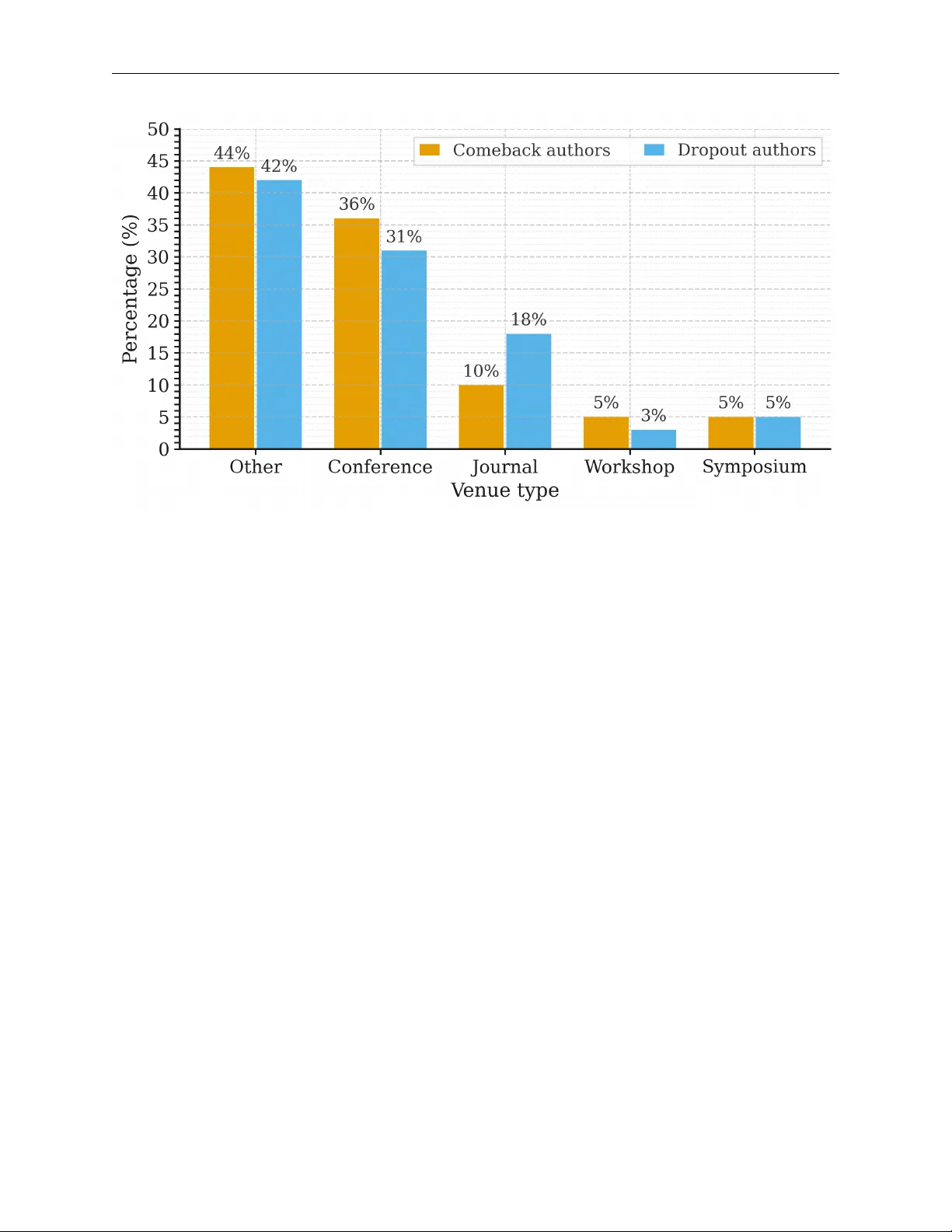
B R I D G I N G T H R O U G H A B S E N C E : H O W C O M E B A C K R E S E A R C H E R S B R I D G E K N O W L E D G E G A P S T H R O U G H S T R U C T U R A L R E - E M E R G E N C E A P R E P R I N T Somyajit Chakraborty Univ ersity College Cork, Cork, Ireland Shanghai Jiao T ong Univ ersity , Shanghai, China chksomyajit@sjtu.edu.cn Angshuman Jana Indian Institute of Information T echnology , Guwahati, India angshuman@iiitg.ac.in A vijit Gay en Indian Institute of Information T echnology , Guwahati, India T echno India Univ ersity , W est Bengal, Kolkata, India avijit.gayen@iiitg.ac.in, avijit.g@technoindiaeducation.com February 26, 2026 A B S T R AC T Understanding the role of researchers who return to academia after prolonged inactivity—termed “comeback researchers”—is crucial for dev eloping inclusiv e models of scientific careers. This study in vestigates the structural and semantic beha viors of comeback researchers, focusing on their role in cross-disciplinary kno wledge transfer and network reintegration. Using the AMiner citation dataset, we analyze 113,637 early-career researchers and identify 1,425 comeback cases based on a three-year - or-long er publication gap follo wed by rene wed acti vity . W e find that comeback researchers cite 126% more distinct communities and exhibit 7.6% higher bridging scores compared to dropouts. They also demonstrate 74% higher gap entropy , reflecting more irregular yet strategically impactful publication trajectories. Predictiv e models trained on these bridging- and entropy-based features achie ve a 97% R OC-A UC—far outperforming the 54% ROC-A UC of baseline models using traditional metrics like publication count and h-index. Finally , we substantiate these results via a multi-lens validation. These findings highlight the unique contrib utions of comeback researchers and of fer data-dri ven tools for their early identification and institutional support. Keyw ords comeback researchers · citation networks · knowledge bridging · early-career researchers · bibliometrics · community silos · research discontinuity · machine learning 1 Introduction Scientific progress is not solely the product of indi vidual ideas but emerges from the e volving structures that connect them in citation flo ws, collaboration ties, and disciplinary transitions. These interconnections shape the trajectory of research fields and the position of indi vidual scholars within the broader scientific ecosystem. Over the past two decades, the integration of netw ork science and bibliometrics has provided rob ust methodological frame works for modelling such structures. Citation netw orks, in particular , represent scholarly communication as graphs, where papers are nodes, and citations form directional edges that signify intellectual influence and epistemic lineage. On the other hand, collaboration network, can be represented by co-authorship relationship among the researchers, where authors are represented as nodes and their collaborati ve relationship as edge in the network. These networks are dynamic, reflecting both the emergence of ne w research themes and the consolidation or decline of older paradigms. W ithin these ev olving systems, certain structural roles—such as hubs, authorities, and particularly bridges—hav e been recognized as critical to the flow of kno wledge across disciplinary and conceptual boundaries. Bridging Through Absence A P R E P R I N T Amid these structural dynamics, early-career researchers (ECRs) play a pi votal role in shaping the future contours of scientific inquiry . T ypically defined as researchers under the age of 35, often pursuing or having recently completed a doctoral degree Nicholas et al. [2017, 2019], Gayen et al. [2023a, 2024, 2023b], ECRs are characterized by high intellectual curiosity , adaptability , and the willingness to engage in emerging or interdisciplinary fields. Despite their limited academic tenure, ECRs have been shown to contrib ute significantly to innov ativ e research, especially when embedded in collaborativ e environments that offer access to mentorship, resources, and diverse scholarly perspectiv es Ev ans and Cvitanovic [2018]. Their contributions are not merely incremental; they often bring new methods, disruptiv e questions, and transdisciplinary perspectiv es that challenge established norms. Howe ver , the early-career phase is also marked by a heightened risk of professional discontinuity . Numerous studies hav e highlighted the precarious position of ECRs, citing structural challenges such as short-term contracts, funding scarcity , pressure to publish in high-impact venues, and dif ficulties balancing academic w ork with personal or family responsibilities Stratford et al. [2024] Krauss et al. [2023]. These pressures frequently result in prolonged gaps in publishing or complete disengagement from academic research. This phenomenon is commonly referred to as academic dropout as explored in our previous study Gayen et al. [2025]. While dropout is often framed as a terminal stage in academic careers, such a binary perspective overlooks a critical but underexamined phenomenon. A small subset of researchers return to academic publishing after extended periods of inacti vity—these are the indi viduals we term “comeback researchers”. A recent bibliometric study by Sidelmann and Grimstrup Sidelmann and Grimstrup [2025] further evidences this trend, sho wing that only 50% or fe wer researchers remained activ e a decade after their initial publication in the 2010s, marking a sharp rise in academic attrition compared to earlier cohorts. These indi viduals, whom we refer to as “comeback researchers” Gayen et al. [2025] of fer a unique lens through which to examine the non-linear dynamics of scientific careers and the structural reintegration of dormant e xpertise. Despite their potential significance, comeback researchers remain lar gely in visible in mainstream science-of-science analyses. Most prior research has focused either on those who sustain continuous producti vity or those who drop out entirely , leaving a blind spot in our understanding of academic re-entry and re-integration. This gap is particularly striking gi ven the potential structural distincti veness of comeback researchers. The structural and intellectual rein- tegration of comeback researchers opens up several intriguing possibilities and also open up various questions— Do the y resume former r esearc h lines, or does their re-entry r eflect a deeper transformation—perhaps shaped by industry experience , exposur e to new domains, or per sonal r eflection? Their temporal discontinuity may function as a crucible, refining scholarly focus and enabling more eclectic, interdisciplinary engagements upon return. As such, comeback researchers could serve as latent bridges across research silos—facilitating kno wledge diffusion in w ays distinct from both acti ve and dropout peers. It is unclear whether these individuals simply resume previous research trajectories or whether their return coincides with a broader reconfiguration of their academic roles. For instance, ha ving experi- enced time away from academia, comeback researchers may bring with them exposure to new disciplines, industry insights, or non-traditional knowledge sources, allo wing them to serve as boundary-crossers within the citation netw ork. Alternativ ely , the disruption itself may reorient their publishing strategies to ward more diverse or interdisciplinary collaborations, enhancing their bridging capacity within the scientific landscape. T o address these questions, we frame our study around three core research questions: • RQ1 : T o what e xtent do comeback r esear cher s engage in cr oss-community knowledge transfer , as compar ed to their dr opout counterparts, based on citation and community interaction patterns? • RQ2 : Do comeback r esear chers exhibit a higher tendency to structurally bridge knowledge silos within scientific citation networks? • RQ3 : Can network-based bibliogr aphic metrics r eliably distinguish between r esear cher s who permanently dr op out and those who r e-emer ge after discontinuation? T o see why comeback researchers deserve special attention, we first present three empirical snapshots dra wn from our AMiner data (Figures 1 – 3). Figure 1 compares dropout and comeback authors in terms of their publication-count distributions (binned logarithmically) alongside scaled probability curves. On the left, the dropout cohort’ s heatmap (Y ears 1–7) is overlaid with its empirical and model dropout-probability curves. W e fit an exponential–decay model to the year index t , p model ( t ) = p 0 e − λt (curves min–max scaled for visualization). In Fig. 1, the empirical probability is the solid line and the model fit is the dashed line; on the right, the comeback cohort’ s heatmap (Y ears 1–6) is similarly ov erlaid with its empirical and model comeback-probability curves. Although both sets of probability curv es decline ov er time, the comeback authors (right) concentrate their publications in dif ferent log-bins compared to permanent dropouts (left), suggesting a distinct distribution of producti vity upon re-entry . In figure 2, we observe the differences in venue-type shares for both cohorts. For the comeback venues: “Other” accounts for 44 %, “Conference” 36 %, “Journal” 10 %, “W orkshop” 5 %, and “Symposium” 5 %. By contrast, for the dropout cohort: “Other” 42 %, “Conference” 31 %, “Journal” 18 %, “Symposium” 5 %, and “W orkshop” 3 %. The 2 Bridging Through Absence A P R E P R I N T Figure 1: Figure shows the publication-count heatmaps (log-bins) for (Left) Dropout and (Right) Comeback authors. The heatmaps are ov erlaid with scaled probability curves, where the empirical probability is sho wn as a solid line and the model fit as a dashed line. The x-axis represents the year inde x, and the y-axis represents the log arithmic bin of publication counts. noticeably larger “Journal” slice among dropouts (18 %) versus comeback authors (10 %) and the larger “Other” slice among comeback authors (44 %) highlight how comeback researchers publish in a broader mix of v enues. The higher Confer ence + Other share among comeback authors (80 % vs. 73 %) together with their lower journal share (10 % vs. 18 %) is consistent with a r e-entry strategy that favors fast-cycle, boundary-cr ossing outlets . Conferences and “Other” (e.g., preprints/tech reports, book chapters, demos) typically host earlier-stage, applied, or cross-domain work and draw heterogeneous audiences. In contrast, the relatively lar ger journal share among dropouts suggests earlier specialization that did not diversify before e xit. If comeback authors disproportionately use outlets that sit at interfaces between topical communities, then their citation ego-nets should span mor e communities and occupy mor e connective positions. This v enue-lev el signal moti v ates our netw ork-lev el tests. More Conference/Other at (re-)entry leads to more cross-community citations. A higher Journal share corresponds to lo wer cross-community engagement and lower bridging. Finally , Figure 3 displays the global geographic distrib ution of comeback-publication percentages by country (with a zoom-inset on Europe). Here, China (20.5 %) and the United States (18.7 %) lead in comeback shares, whereas most European nations re-enter at much lo wer percentages (e.g., Germany 3.9 %, France 4.4 %, Sweden 1.3 %). This worldwide pattern underscores that the phenomenon of returning to academic publishing is particularly pronounced in a handful of countries, further moti vating our focus on the structural and conte xtual factors that dif ferentiate comeback researchers from both dropouts and consistently activ e peers. Guided by these empirical differences in v enue mix and geography , we study whether comeback researchers systematically bridge kno wledge silos— and if so, why —by examining their positions in dynamic citation networks and their di versity of cross-community eng agement. The objectiv e of this study is to systematically characterize comeback researchers through structural, semantic, and temporal dimensions. Guided by the three research questions, we aim to (i) measure their engagement in cross- community citation flows, (ii) e v aluate their bridging roles within dynamic citation networks, and (iii) b uild predictiv e models that distinguish comeback authors from permanent dropouts. Our broader goal is to unco ver whether career discontinuity , far from signaling decline, may in f act reposition certain researchers as pi votal agents in interdisciplinary knowledge transfer . This study posits that the structural trajectories of comeback researchers—marked by disruption followed by re-entry—may predispose them to occupy unique positions in citation networks, particularly as brokers or bridges between otherwise disconnected communities. While hubs typically accumulate influence through sustained output and citation accrual, bridges enable the diffusion of knowledge across disciplinary or thematic silos, facilitating innov ation through recombination. Identifying whether comeback researchers disproportionately assume these bridging roles is of both theoretical and practical interest. Theoretically , it challenges cumulativ e adv antage models that prioritize continuous producti vity . Practically , it informs institutional policies around reintegration, mentorship, and support for researchers with non-linear careers. In addition to their potential structural distinctiv eness within citation networks, comeback researchers may also exhibit unique semantic and temporal beha viors that warrant systematic in vestigation. Their re-entry into academia is often characterized by irregular publication rhythms, thematic shifts, or broader topical engagement, reflecting either a reorientation of scholarly focus or the inte gration of new perspecti ves acquired during their hiatus. T emporally , their return may not follow a gradual reinte gration pattern but could inv olve concentrated 3 Bridging Through Absence A P R E P R I N T Figure 2: Figure shows the grouped bar chart sho wing the percentage share of dif ferent venue types for Comeback versus Dropout authors. The y-axis shows the percentage (%), and the x-axis categorizes the venue types: Other, Conference, Journal, W orkshop, and Symposium. bursts of acti vity indicativ e of renewed engagement or strategic publishing ef forts. Moreover , modeling these attributes enables the development of predictiv e framew orks that differentiate between researchers likely to re-engage with academic publishing and those who permanently disengage. Such insights not only adv ance theoretical understanding of non-linear academic careers but also of fer practical tools for early identification and institutional support. T o answer these questions, we propose a comprehensi ve empirical frame work grounded in dynamic citation network analysis and career trajectory modeling. Using the AMiner academic graph dataset, we first classify authors into three cohorts—comeback, dropout, and consistently activ e—based on temporal patterns of publication continuity and discontinuity . W e then construct yearly citation networks to capture the e volving structure of scholarly communication ov er time. T o identify topical groupings within these networks, we apply community detection using the Louv ain algorithm. This helps to identify groups of papers that cite one another more densely than the rest of the graph. This step serv es two purposes. First, it gi ves a data-driven notion of “field” or “topic cluster” without relying on v enue tags. Second, it lets us measure ho w often an author engages across these groups versus staying within one. This enables us to analyze whether comeback researchers cite across, or are cited by , multiple research communities—an indicator of interdisciplinary influence. Using these graphs and communities, we compute a small set of indicators that summarize (i) where an author sits in the network, (ii) how broadly the y engage across groups, and (iii) how re gular or irregular their career timing is. W e compare comeback and dropout cohorts on these indicators and assess whether the observed dif ferences are statistically meaningful. Predicting comeback beha vior is useful for polic y and practice. Early identification enables targeted support (e.g., re-entry fello wships, bridge funding, mentorship) for scholars with non-linear careers. For funders and institutions, it of fers a fairer alternati ve to productivity-only screening, which can miss latent integrators who are valuable for cross-domain kno wledge flo w . Statistical comparisons are performed to ev aluate whether comeback researchers differ significantly from their dropout counterparts across these dimensions. Furthermore, we dev elop interpretable machine learning models to test whether comeback behavior is predictable using these features, thereby offering a data-dri ven foundation for early identification and support of re-entry trajectories. The major nov el contributions of this work can be listed as belo w: Our Contributions: • W e pro vide the first lar ge-scale, cohort-le vel characterization of comeback resear c hers defined by a ≤ 3 − year publication gap follo wed by renewed acti vity . 4 Bridging Through Absence A P R E P R I N T Figure 3: The figure represents global geographic distribution of comeback-publication percentages by country . A zoomed inset focuses on Europe. The color intensity or value on the map corresponds to the percentage of comeback publications for each country . • W e sho w that comebacks engage more broadly across detected communities and occup y more connective positions than dropouts, evidencing a bridging role in citation netw orks. • W e introduce simple, interpretable indicators that encode cross-community engagement and temporal irre gu- larity , and demonstrate that they pr edict comebacks with high ROC–A UC. • W e release a clear , reproducible pipeline for dynamic netw ork construction, cohort labeling, and e valuation, suitable for extension to other fields and time windo ws. • W e discuss policy implications for re-entry support, ar guing for ev aluation criteria that go beyond producti vity- only metrics. The rest of the paper is organized as follo ws: Section 2 revie ws related work to figure out the scope of our w ork. In section 3, we define the bibliographic metrics used in our analysis. A detailed description of our data preprocessing, author classification, citation network construction, metric formulation, and modeling strategy is provided in Section 4, with each step designed to progressi vely uncover the distinct roles of comeback researchers. Section 4 describes the methodology adopted in our work which include dataset description, cohort labeling, network construction, community detection, and modeling pipeline. In section 5, we present empirical results and the discussion of the implications is integrated there. Finally , we conclude in section 6 where we also discuss the limitation of the w ork and possible future directions. 2 Related W orks This section revie ws prior studies rele vant to early-career researchers (ECRs), research discontinuation, and structural knowledge integration in citation networks. W e organize the discussion into fiv e key strands: trends in scientific collaboration, challenges of early career researchers, discontinuation and return patterns, structural bridging in citation networks, and predicti ve modeling of academic trajectories. T rends in Scientific Collaboration The need for collaborativ e research work has long been recognized, particularly for addressing complex, interdisciplinary problems. Ov er the past few decades, the v olume and di versity of scientific collaboration hav e grown substantially Borgman and Furner [2002], W agner et al. [2015]. Advances in communication technology hav e facilitated both local and international collaborations K ong et al. [2016], Abbasi et al. [2010]. Several 5 Bridging Through Absence A P R E P R I N T studies hav e emphasized the rise in international scientific collaborations Leclerc and Gagné [1994] and the increasing demand for researchers capable of bridging disciplinary divides Montoya et al. [2018]. Collaborativ e efforts are sho wn to increase knowledge exchange, with many researchers identifying “increased knowledge” as the most valuable outcome Melin [2000]. Early-Career Resear chers: Roles and Challenges ECRs—commonly defined as Ph.D. candidates or postdoctoral researchers—play a vital role in adv ancing scientific innov ation Nicholas et al. [2019], Bridle et al. [2013], Laudel and Bielick [2019], W ang et al. [2019], Allen and Mehler [2019], Morriss [2019], Gayen et al. [2023a], Thomsen et al. [2021]. Their efforts often dri ve interdisciplinary research Bridle et al. [2013] and benefit from international exposure Djerasimovic and V illani [2020]. Ho wev er , they face sev eral challenges, including time management, funding scarcity , and limited institutional recognition Ortlieb and W eiss [2018], Maer -Matei et al. [2019], Barkhuizen [2021]. In interdisciplinary settings, these barriers are e xacerbated by steep learning curves, publication pressure, and limited supervisory support Andrews et al. [2020], Horta et al. [2018], Castelló et al. [2021]. Additionally , ECRs often encounter systemic instability , described as a ‘risk-career’ en vironment in higher education polic y Skakni et al. [2019], Castelló et al. [2015]. Exploitation in peer revie w McDowell et al. [2019] and challenges in publishing in high-impact venues Drosou et al. [2020] further compound these issues. Research Discontinuation and Comeback P atterns Despite increasing attention to research careers, the phenomenon of discontinuation remains underexplored. Prior works ha ve observed that publication gaps—often due to life events, job changes, or burnout—are particularly common among ECRs Jadidi et al. [2018], Larcombe et al. [2022], Krausk opf [2018]. Gender-specific barriers, such as unequal access to funding and collaborations, are also linked to higher dropout rates among women Jadidi et al. [2018]. In our recent study Gayen et al. [2025], we analysed o ver 113,000 researchers and found that nearly 90% of those with early-career publication g aps nev er returned to academia. Y et a small fraction, termed comeback r esearc hers , do resume publication after se veral years, often re-entering through interdisciplinary or translational domains. These indi viduals, while rare, exhibit distinct patterns of knowledge integration and often bridge disconnected areas of scientific inquiry . Citation Network Structur e and Knowledge Bridging Scientific progress is deeply influenced by the structure of citation and co-authorship networks. Nodes with high betweenness centrality are often brokers across research communities, enabling nov el recombinations of knowledge Chen et al. [2025]. Se veral studies hav e sho wn that these bridge-like positions—also kno wn as spanning structural holes—are correlated with higher citation impact Fleming et al. [2007], Uzzi et al. [2013], W ang et al. [2015], W ang et al. [2023]. Citation network studies hav e emphasized the role of interdisciplinary connections in fostering innov ation and knowledge diffusion W ang et al. [2015],W ang et al. [2023]. Ho wev er , many research areas remain isolated as knowledge silos , with limited citation flows between them Cunningham and Greene [2025]. By applying dynamic community detection, recent work in explainable AI has rev ealed significant “kno wledge gaps” between foundational and contemporary research areas, underscoring the need for agents that activ ely connect these communities Cunningham and Greene [2025]. Comeback researchers—returning after career interruptions—may fill this structural role by importing div erse knowledge g ained during hiatuses. Predicti ve Modeling of Research Careers The emergence of large-scale scholarly databases has enabled predictiv e modeling of research trajectories. Sev eral studies hav e shown that early-career publication counts and network features (e.g., co-author centrality) are strong predictors of long-term impact Li et al. [2019], Momeni et al. [2023]. In our recent studies Gayen et al. [2024, 2025] we also see the importance of such metrics as predictors of impact. It is seen that the inclusion of network centrality measures significantly improv ed the prediction of academic promotions W apman et al. [2022], Li et al. [2022]. Howe ver , recent work emphasizes the importance of randomness and serendipity in scientific careers. The random impact rule suggests that major scientific breakthroughs can occur at an y point in a career Sinatra et al. [2016], W ang et al. [2019]. Sinatra et al. Sinatra et al. [2016] in 2016 introduced the concept of a person-specific “Q-factor” that reflects inherent impact potential, independent of age or publication order . These models provide a framew ork for identifying researchers with comeback potential—e ven those with non-linear or erratic publication histories. The observed “hot streak” phenomenon further supports the possibility of late-career resurgence Liu et al. [2018], Oliv eira et al. [2023]. While the challenges of ECRs and dropout phenomena have been partially explored, the structural contributions and reintegration potential of comeback researchers remain underexamined. Most existing models and policies assume linear , uninterrupted careers. Our study fills this gap by empirically analyzing comeback researchers from a netw ork-theoretic perspectiv e—e valuating their roles in bridging communities and enhancing cross-domain knowledge transfer . In doing so, we aim to shift focus from mere attrition metrics to the latent v alue of re-engagement and structural rein vention within science. 6 Bridging Through Absence A P R E P R I N T 3 Bibliographic Metrics This section details the quantitative indicators used to characterize and distinguish comeback researchers. The rationale for this section is twofold: first, to formally define the established and novel metrics that operationalize our in vestigation into cross-community bridging and temporal career patterns; and second, to provide a transparent foundation for our analytical and predictiv e modeling pipeline. W e begin by establishing the foundational concepts of the citation network and research communities, which are central to our metric definitions. W e then systematically present the established bibliographic metrics that serve as our baseline, follo wed by our three no vel proposed metrics designed to capture bridging behavior and career irregularity . Finally , we subject these proposed metrics to a multi-faceted validation framew ork to ensure their robustness, v alidity , and fitness for purpose. F oundational Concepts: Citation Network and Communities Our analysis is grounded in a dynamic, author-centric view of the scientific citation netw ork. The foundational elements are defined as follows: Citation Network: W e construct a directed graph G t = ( V t , E t ) for each year t , where V t is the set of all published papers up to year t , and a directed edge ( p i → p j ) ∈ E t exists if paper p i cites paper p j . Research Communities: T o identify topical groupings in a data-dri ven manner , we apply the Louvain algorithm to the paper-paper citation netw ork for each year . This yields a partition of papers into communities, where papers within a community cite each other more densely than they cite papers outside it. Let c ( p ) denote the community assignment of a paper p . This concept of a “community” serves as our operational definition of a research field or topic silo. Observation W indow: For a fair comparison, all author -lev el metrics are computed within a non-leak y observation window . For a comeback author a , this windo w spans from their first publication year up to the year immediately preceding their return. For a matched dropout author , the windo w is of equal length, ending at their last activ e year . All subsequent metrics are computed based on an author’ s activity within this framew ork. Let P a denote the set of papers authored by a within the observation windo w , and R ( p ) the set of references of a paper p ∈ P a . 3.1 Established Metrics In this section, we formally define se veral e xisting well-known metrics in the context of citation network used in our work. Publication Count(P): The total number of publications authored by a researcher is given by: P = T X i =1 P i (1) where: • P i is the number of publications in i -th year by the author . Citation Count( C ): Citation count calculates the frequency with which other researchers hav e referenced an author’ s work in their papers. T o calculate it, we consider all citations recei ved from each of his or her publications cumulati vely during his research tenure. This is a widely used, straightforward metric to assess how much a researcher’ s work has affected and influenced their field. C = P X i =1 C i (2) where: • C i is the quantity of citations that the i th publication has receiv ed. • P is the amount of publications overall. h-index (h): The h -index Hirsch [2005] is a widely used measure to estimate the impact and productivity of a researcher’ s publications. It is defined as the maximum value of h such that the researcher has at least h papers, each of which has been cited at least h times. h = max { h | at least h papers ha ve ≥ h citations } (3) 7 Bridging Through Absence A P R E P R I N T Cross-Community Citation Rate (XCC). This metric ev aluates interdisciplinary citation behavior . For an author a , let P a be their set of papers and R ( p ) be the references of a paper p . Let c ( p ) be the community of p (from Louv ain detection De Meo et al. [2011]). The XCC is: XCC ( a ) = 1 | P a | X p ∈ P a |{ q ∈ R ( p ) : c ( q ) = c ( p ) }| | R ( p ) | (4) This value captures the extent to which an author cites outside their own disciplinary silo, making it useful for detecting knowledge diffusion across communities Cunningham and Greene [2025]. Note that B and XCC differ only by weighting (edges vs. papers) and therefore track similar behavior . 3.2 Proposed Metrics While established bibliometric indicators capture producti vity and impact, the y are often ill-suited for characterizing the unique structural and temporal patterns of researchers with non-linear careers. T o specifically quantify the behaviors we hypothesize for comeback researchers—namely , their role as kno wledge bridges and their irregular career trajectories— we propose three nov el metrics. These are designed to measure an author’ s cr oss-community engagement ( Bridging Scor e ), the breadth of their own r esearch ( A uthor ed-Community Count ), and the temporal irregularity of their publication history ( Gap Entr opy ). The rationale for these metrics is to move be yond volume-based assessment and instead capture the nuanced ways in which researchers, especially those re-integrating after a hiatus, connect disparate parts of the scientific landscape and manage their scholarly output ov er time. Bridging Score (B) The Bridging Score is an edge-weighted metric that quantifies the extent to which an author’ s citations connect dif ferent research communities. It is defined as the fraction of an author’ s outgoing citation edges that point to papers outside the citing paper’ s own community . Formally , for an author a , let E a be the multiset of all outgoing citation edges from their papers (i.e., each p → q where p is a paper by a and q is a reference of p ). The Bridging Score is calculated as: B ( a ) = |{ ( p → q ) ∈ E a : c ( q ) = c ( p ) }| | E a | (5) Here, c ( p ) and c ( q ) denote the communities of paper p and reference q , respectiv ely . A higher B ( a ) indicates a greater propensity to import kno wledge from outside an author’ s immediate research silo, suggesting a stronger bridging role in the citation network. While both XCC and B measure cross-community engagement, B is edge-weighted (normalizing by the total number of citation edges) and captures overall cross-silo intensity , whereas XCC av erages the cross-community share per paper , highlighting how e venly that eng agement is distributed across an author’ s publication portfolio. Distinct A uthored-Community Count (A CC) This metric captures the topical breadth of an author’ s o wn body of work by simply counting the number of distinct research communities in which they ha ve published. It is defined as the cardinality of the set of communities represented by all papers authored by a within the observation windo w: A CC ( a ) = |{ c ( p ) : p ∈ P a }| (6) where P a is the set of papers authored by a . A higher A CC v alue signifies that the author’ s research spans a wider range of topics or fields, as defined by the community structure of the citation network. Gap Entropy ( H g ) Gap Entrop y measures the irregularity or “b urstiness” of an author’ s publication timeline, which is a hypothesized characteristic of non-linear careers. It is calculated using the information entropy of the distrib ution of gaps (in years) between consecuti ve publications. F or an author a , let ∆ i = y i +1 − y i be the sequence of inter-publication gaps deriv ed from their sorted publication years. W e first compute the probability distribution q j ov er these gap lengths (e.g., from a histogram). The Gap Entropy is then defined as: 8 Bridging Through Absence A P R E P R I N T H g ( a ) = − X j q j log q j (7) A perfectly regular publisher , who publishes e very year , would ha ve a Gap Entrop y of 0. Con versely , a higher H g indicates a more unpredictable and erratic publication pattern, with a mix of short and long gaps. All H g values use log 2 and gap-length histograms with a bin width of 1 year . Existing Metric Reference / Origin Use in This Study Publication Count ( P ) Standard bibliometric Baseline for author producti vity (v olume con- trol) Citation Count ( C ) Standard bibliometric Baseline for impact (volume control) h-index ( h ) Hirsch et al. Hirsch [2005] Career performance baseline; used in baseline- only models Cross-Community Citation Rate (XCC) Cunningham (2025)Cunning- ham and Greene [2025] Paper -weighted share of citations outside the paper’ s community; reported in Fig. 7 Proposed Metric Reference / Origin Use in This Study Bridging Score ( B ) This work Edge-weighted fraction of an author’ s outgoing citations that cross communities; main struc- tural indicator (Figs. 4, 5, 11, 8, 9) Distinct Authored- Community Count (A CC) This work Number of distinct communities spanned by the author’ s own papers; breadth of topical en- gagement (Figs. 4, 5) Gap Entropy ( H g ) This work T emporal irregularity of publishing (career burstiness); used in Fig. 6 T able 1: Summary of bibliographic metrics used in this study , categorized as Existing and Proposed. For each metric, the table lists its name, reference or origin, and its specific use within this study . Figure 4: Figure represents distribution of Distinct Communities (log-scaled, left) and Bridging Score (right) across author categories (Comeback, Dropout, Active). The y-axis for the left plot is the log-scaled count of distinct communities. The y-axis for the right plot is the Bridging Score value. 3.3 Metric V alidation T o ensure the proposed metrics—Bridging Score ( B ), Distinct Authored-Community Count (ACC), and Gap Entropy ( H g )—are robust, meaningful, and fit for purpose, we subject them to a multi-faceted validation framework. This 9 Bridging Through Absence A P R E P R I N T Figure 5: Figure shows the bootstrapped distributions of the mean dif ference (Comeback – Dropout) for (left) Bridging Score and (right) Distinct Authored-Community Count (A CC). The x-axis sho ws the mean dif ference value, and the y-axis shows the frequenc y from bootstrapping. The vertical dashed lines indicate the observed mean dif ferences. section details the rationale and results of four ke y validation tests: statistical sanity , correlational analysis, discriminant validation, and rob ustness checks. 3.3.1 Statistical Sanity Check Rationale: A fundamental requirement for any metric is that it behaves in an intuiti ve and mathematically sound manner . The sanity check verifies that the metrics mov e monotonically in the expected direction as the underlying behavior the y are designed to capture becomes more pronounced. Observation: Our analysis confirms the expected monotonic beha vior for all proposed metrics: • Bridging Score ( B ) and XCC: Both metrics increase consistently as a larger share of an author’ s references cross community boundaries. B provides an edge-weighted perspecti ve, while XCC of fers a paper-weighted one, but both track the same core beha vior of cross-community citation. • A uthor ed-Community Count (A CC): This count increases directly as an author’ s own publications span a greater number of distinct research communities, accurately reflecting topical breadth. • Gap Entropy ( H g ): For an author with a perfectly re gular annual publication record (all gaps ∆ i = 1 ), the gap entropy is zero. The value of H g grows as the probability mass shifts towards longer or more varied inter-publication gaps, correctly quantifying temporal irre gularity . Inference: The proposed metrics pass the basic sanity check, confirming their mathematical formulation correctly translates the intended scholarly behaviors—bridging, breadth, and irre gularity—into quantifiable scores. 3.3.2 Correlational V alidation with Known Metrics Rationale: T o establish con vergent and diver gent validity , we examine the relationships between the new metrics and established bibliometric indicators. W e expect the ne w metrics to capture unique dimensions of a research career not reflected by traditional volume-based measures. Observation: The correlation analysis re veals a clear pattern: • Con vergent V alidity: The edge-weighted Bridging Score ( B ) and the paper-weighted Cross-Community Citation Rate (XCC) are strongly positiv ely associated (Spearman ρ ≈ 0 . 75 ), as expected, since they are tw o operationalizations of the same cross-community engagement construct. • Diver gent V alidity: Crucially , all three cross-community indicators ( B , XCC, and A CC) sho w near-zero correlations with volume metrics such as total publication count ( P ), total citation count ( C ), and the h-index ( h ). This holds for both Spearman and partial Spearman correlations (controlling for P ). Inference: The proposed bridging and breadth metrics are not merely proxies for producti vity or impact. They capture orthogonal aspects of scholarly behavior related to kno wledge integration and topical di versity , thereby validating their utility as distinct constructs in career trajectory analysis. 10 Bridging Through Absence A P R E P R I N T Figure 6: Figure represents the distribution of Gap Entropy for Comeback vs. Dropout authors. The y-axis represents the density or frequency , and the x-axis represents the Gap Entropy v alue. Figure 7: Figure shows the boxplot of Cross-Community Citation Rate (XCC) for Comeback vs. Dropout authors. The y-axis shows the Cross-Community Citation Rate. 3.3.3 Discriminant V alidation on Labeled Groups Rationale: A powerful test of a metric’ s utility is its ability to systematically distinguish between pre-defined, meaningful groups. Here, we test whether the proposed metrics can dif ferentiate between comeback (CB) and dropout (DO) researchers, which is a central thesis of this work. Observation: As detailed in Section 5 and visualized in Figures 4, 5, 6, and 7, the group contrasts are pronounced and statistically significant: • Community Engagement & Bridging: Comeback authors cite a substantially broader range of communi- ties (A CC: CB mean=74.78, DO mean=33.08) and hold higher bridging scores ( B : CB mean=0.608, DO mean=0.565). Bootstrap resampling confirms the mean differences are stable and their 95% confidence intervals e xclude zero (Fig. 5). 11 Bridging Through Absence A P R E P R I N T • T emporal Irr egularity: Comeback researchers exhibit significantly higher gap entropy ( H g : CB mean=2.65, DO mean=1.52), confirming their more erratic publishing timelines (Fig. 6). • Statistical Significance: Non-parametric Mann–Whitney U and K olmogoro v–Smirnov tests confirm these separations are highly significant ( p < 10 − 24 for B , p < 10 − 185 for ACC, p < 10 − 50 for H g ) with meaningful effect sizes (T able 5). Inference: The proposed metrics demonstrate high discriminant validity . They are not just different in theory; they empirically and robustly separate comeback researchers from dropouts, supporting the hypothesis that returnees ha ve structurally and temporally distinct career patterns. 3.3.4 Robustness T est Rationale: The conclusions drawn from these metrics must not be fragile artifacts of specific analytical choices. Robustness testing ensures that the core findings hold under v ariations in methodology and parameters. Observation: W e subjected our analysis to multiple sensiti vity checks, and the key conclusions remained stable: • Community Detection: The CB–DO contrasts in B and A CC persist under alternati ve community resolutions (Louvain γ ∈ [0 . 8 , 1 . 4] ) and when using the Leiden algorithm instead of Louvain. • Data Prepr ocessing: The results are robust to the exclusion of self-citations, the use of dif ferent reference windows ( ± 5 years), and alternative binning strate gies or logarithmic bases for calculating H g . • Predicti ve Criterion: The out-of-sample predictive power of these metrics serves as a final, powerful robustness check. Classifiers using B , A CC, and H g consistently achiev e high R OC–A UC (0.97, Fig. 13), far outperforming a baseline model using only P and h -index (R OC–A UC ≈ 0.54). SHAP analysis consistently ranks these proposed metrics as the most important features (Fig. 14), confirming their stable and critical role in identifying comeback behavior . Inference: The observ ed patterns are not methodological artifacts. The discriminati ve po wer and predictiv e utility of the proposed metrics are robust to a wide range of analytical decisions, strengthening the credibility of our findings and their applicability to real-world science policy and support systems. Figure 8: Figure sho ws the moving window comparison of the a verage Bridging Score for Comeback vs. Dropout authors across 5, 10, and 15-year intervals. The x-axis likely represents the midpoint of the time window , and the y-axis represents the av erage Bridging Score. These metrics jointly allow us to assess the structural and temporal distinctiv eness of comeback researchers and support robust comparati ve and predicti ve modeling. 4 Proposed W ork This section presents the comprehensiv e methodological framework de veloped to systematically in v estigate the structural roles and behavioral patterns of comeback researchers. Our approach is specifically designed to address the three core 12 Bridging Through Absence A P R E P R I N T Figure 9: The figure represents Kaplan-Meier survival curv es showing the probability of academic persistence ov er time, stratified by a binary Bridging Score group (High vs. Lo w). The x-axis represents time (e.g., years), and the y-axis represents the surviv al probability . research questions outlined in Section 1: (RQ1) cross-community kno wledge transfer, (RQ2) structural bridging in citation networks, and (RQ3) predicti ve distinction between comeback and dropout researchers. T o achieve this, we employ a multi-stage empirical pipeline that integrates large-scale bibliometric analysis with netw ork science and machine learning. The methodology progresses from foundational data processing through sophisticated analytical modeling, ensuring each phase b uilds upon the previous to provide robust, interpretable insights. W e begin with data collection and preprocessing from the AMiner dataset, follo wed by systematic author classification based on career discontinuity patterns. Subsequently , we construct dynamic citation networks and apply community detection to identify research fields, enabling the computation of both established and nov el bibliometric indicators. Finally , we implement rigorous statistical testing and predicti ve modeling to v alidate our hypotheses and unco ver the distincti ve signatures of comeback researchers. This integrated approach allows us to mo ve beyond traditional bibliometric analysis and provide a network-theoretic understanding of ho w career interruptions can paradoxically enhance researchers’ capacity for kno wledge integration and interdisciplinary bridging. 4.1 Dataset Summary In this study , we utilize the AMiner dataset Dataset, a publicly available bibliometric corpus containing structured metadata on scientific publications, authorship, venues, and citation links. The dataset spans several decades and has been widely adopted in scholarly network analysis. For our experiments, we e xtracted and processed four main components: the paper dataset, author dataset, comeback author list, and dropout author list. Basic data schema and attributes are summarized in T able 2. Paper Author Attributes Attribute Definition Attributes Attribute Definition index Paper ID index Author ID Paper T itle T itle of the publication Author Author name Authors List of authors (separated by ‘;’) Affiliation Current affiliation Published Y ear Y ear of publication Papers T otal paper count Publication V enue Conference or journal name Citations T otal citation count Reference ID List of cited paper IDs H-index Hirsch index Abstract Abstract of the paper pi, upi Productivity inde xes T able 2: Data attributes extracted and processed from AMiner . 13 Bridging Through Absence A P R E P R I N T The cleaned paper dataset contains over 2 million entries, with fields such as paper ID, title, authors, year, venue, reference list, and abstract. The author dataset includes more than 1.7 million author profiles with publication counts, citation counts, h-index v alues, af filiations, and inferred research interests. Additionally , curated lists of 1,425 comeback researchers and 11,351 dropout researchers were used to support comparativ e analysis. Raw Dataset Summary V alue T otal Papers Processed 2,092,356 T otal Authors Processed 1,712,433 V alid Authors with Parsed Details 1,132,637 Parsed Author -Paper Pairs ∼ 4.7 million Reference Edges Extracted > 20 million T able 3: Summary statistics of the raw parsed AMiner dataset. Curated Researcher Statistics V alue Number of Comeback Authors 1,425 A verage Y ear Gap (Comeback) 6.2 years Number of Dropout Authors 11,351 A verage Acti ve Y ears (Dropouts) 4.7 years Publication Span Considered 1980—2014 T able 4: Basic statistics of comeback and dropout researchers used in this study . The curated comeback set consists of authors who showed substantial early acti vity , had a discontinuity of at least 3 years, and later resumed publication. Each author record includes the starting year , discontinuation year , comeback year , and total gap duration. The dropout list consists of authors with no activity in the last 3+ years of the dataset, confirming their permanent exit. These author labels form the core of our comparative analysis pipeline and prediction experiments. 4.2 Methodology T o systematically explore the knowledge transfer roles of comeback researchers, we adopt a multi-phase empirical pipeline built on large-scale bibliometric data. Our methodology integrates data preprocessing, career trajectory modeling, dynamic citation network analysis, community detection, semantic embedding-based topic modeling, and statistical classification using bridging and entrop y-based metrics. This section elaborates each stage in detail, including mathematical formulations. Figure 10: The figure represents the schematic ov erview of the methodological w orkflow . The diagram shows the pipeline from data preprocessing and author segmentation to network analysis, metric computation, and final statistical and predictiv e ev aluation. 14 Bridging Through Absence A P R E P R I N T Figure 10 illustrates the entire workflow . Raw author and publication datasets are preprocessed to isolate discontinued researchers. These are then se gregated into comeback and dropout cases based on return-to-publication status. W e compute metrics like bridging centrality and entropy , followed by comparati ve and predicti ve analyses to understand structural roles. 4.2.1 Data Collection and Preprocessing Our analysis is grounded in the Aminer academic graph dataset, which includes metadata for millions of academic publications, including paper titles, authors, years, and reference lists. W e begin by parsing the dataset to retain only entries with complete information. The author lists are tokenized and e xploded into individual ro ws to construct tuples of the form ( a, p, y ) , where a is an author, p a paper ID, and y the year of publication. W e then standardize all reference lists by replacing delimiters (e.g., commas and semicolons) with a consistent separator , and parse citation edges such that for a giv en paper p i citing a set of references R ( p i ) , we generate directed edges ( p i → p j ) for all p j ∈ R ( p i ) . This results in a yearly citation graph G t = ( V t , E t ) , where V t represents papers up to year t , and E t is the set of directed citation edges. 4.2.2 A uthor Career Classification T o classify researchers, we use their publication timelines deri ved from the preprocessed data. Let P a = { y 1 , y 2 , . . . , y n } represent the sorted publication years of author a . W e define the largest inter -publication gap as: G ( a ) = max i ( y i +1 − y i ) An author is labeled a comeback (CB) if G ( a ) ≥ 3 and there exists at least one publication after the gap. A dropout (DO) is defined as someone with G ( a ) ≥ 3 and no subsequent publications for the remaining time windo w (at least 3 years before the dataset’ s end). Authors with no significant publishing gap ( G ( a ) < 3 ) are categorized as acti ve (A C). This temporal filtering is used to study re-entry behavior and publication inacti vity . 4.2.3 Statistical Modeling T o rigorously validate the distincti veness of comeback researchers, we emplo y a statistical modeling framework designed to test for significant dif ferences between the comeback (CB) and dropout (DO) cohorts. The primary objectiv e is to ascertain whether the observ ed disparities in network-based and temporal metrics are statistically meaningful and not attributable to random chance. This forms the foundational empirical e vidence for addressing our core research questions (RQ1 and RQ2). Our statistical analysis proceeds as follo ws, with each author treated as an independent unit of observation: • Hypothesis T esting f or Group Differences: W e conduct non-parametric tests to compare the distributions of all proposed and baseline metrics (e.g., Bridging Score B , A CC, H g , publication count P ) between the CB and DO groups. The Mann–Whitney U test is used to assess whether one group tends to ha ve lar ger v alues than the other , while the K olmogorov–Smirno v (KS) test determines if the underlying distributions of the two groups differ significantly . T o quantify the magnitude of these dif ferences, beyond mere statistical significance, we report ef fect sizes: Cliff ’ s δ for the Mann–Whitney test and the KS statistic D for the K olmogorov–Smirno v test. Giv en the multiple comparisons across different metrics, we control the F alse Discovery Rate (FDR) by applying the Benjamini–Hochberg procedure to the obtained p -v alues. • Correlational Analysis: T o understand the relationships between our proposed metrics and to check for con ver gent and diver gent validity , we estimate Spearman’ s rank correlation coefficients. Specifically , we examine the correlation between the edge-weighted Bridging Score ( B ) and the paper-weighted Cross- Community Citation Rate (XCC) to verify the y capture a similar construct (con ver gent validity). W e further compute partial Spearman correlations, controlling for total publications ( P ), to ensure that the bridging and div ersity metrics provide information orthogonal to simple producti vity measures (div ergent v alidity). • Ensuring a Fair Comparison: A critical aspect of our methodology is the use of a non-leaky observation window . For comeback authors, features are computed using only their publications from their first paper up to the year immediately preceding their return. For dropout authors, we use a matched-length career windo w ending at their last acti ve year . This ensures we are comparing early-career signals and not the consequences of the comeback ev ent itself. T o further reinforce the reliability of our key findings, we deri ve bootstrap confidence interv als for the mean dif ferences in critical metrics like Bridging Score and Community Count between the CB and DO cohorts. 15 Bridging Through Absence A P R E P R I N T This comprehensi ve statistical approach allo ws us to move beyond anecdotal observation and provide quantitati ve, robust e vidence for the unique structural and temporal signatures of comeback researchers. 4.2.4 Predictive Modeling Beyond establishing statistical dif ferences, a critical test of the practical utility of our proposed metrics is their ability to prospecti vely identify researchers with the potential to return after a hiatus. Therefore, we de velop a predictiv e modeling frame work to answer Research Question 3 (RQ3): Can we reliably distinguish future comeback authors from permanent dropouts? Success in this task would not only v alidate the discriminativ e power of our features but also pav e the way for data-driv en tools to support early interv ention and targeted institutional policies for researchers on non-linear career paths. Our predictiv e modeling pipeline is designed for robustness, interpretability , and real-world applicability: • Model Selection and T raining: W e train a diverse set of po werful, non-linear classifiers, including Random Forest, XGBoost, and LightGBM, kno wn for their strong performance on tab ular data. T o ensure a rigorous ev aluation, we employ stratified 5-fold cr oss-validation with an author -le vel split, guaranteeing that all papers from a single author remain within either the training or test set in each fold, thus preventing data leakage. Giv en the inherent class imbalance between comeback and dropout researchers, we utilize class-weighted loss functions to ensure the models learn from both classes effecti vely . • F eatur e Sets for Ablation Study: T o isolate the contrib ution of our nov el metrics, we conduct a comparati ve ablation study using two distinct feature sets: 1. Baseline Featur e Set: This set comprises traditional bibliometric indicators—total paper count ( P ) and the h-index ( h )—serving as a benchmark to represent con ventional ev aluation criteria. 2. Bridging & Entropy F eature Set: This is our proposed set, containing the nov el metrics introduced in Section 3.2: Cross-Community Citation Rate (XCC), Bridging Score ( B ), Authored-Community Count (A CC), and Gap Entropy ( H g ). The performance g ap between models trained on these two sets directly quantifies the added value of our proposed features. • Perf ormance Evaluation and Interpr etation: W e ev aluate model performance using a comprehensive suite of metrics: Accuracy , Precision, Recall, F1-score, and the Area Under the Receiv er Operating Characteristic Curve (R OC-A UC). Probability calibration via Platt scaling is applied for reliable threshold-based analysis. T o demystify the “black box” nature of ensemble models and provide criterion validity for our proposed metrics, we compute SHAP (SHapley Additive exPlanations) v alues. This allo ws us to globally rank feature importance and understand the mar ginal contribution of each feature (e.g., H g , A CC, B ) to the model’ s prediction, thereby linking model decisions back to our theoretical framew ork. This predicti ve frame work transforms our theoretical insights into a practical tool, testing whether the structural and temporal signatures of comeback researchers are not only significant but also suf ficiently patterned to be predictable. 5 Results and Analysis This section presents a comprehensi ve analysis of the structural, temporal, and predicti ve characteristics of comeback researchers, systematically addressing our three research questions. Through rigorous statistical testing, network analysis, and machine learning e valuation, we demonstrate the distinct bridging behavior and predictable patterns of researchers who return to academia after prolonged hiatus. Metric CB mean DO mean Mean diff [95% CI] t (CB–DO), p Effects (d/ δ ) Bridging B 0.608 0.565 0.044 [0.035, 0.052] 10.08, 7 . 84 × 10 − 24 0.131 / 0.016 A CC (communities) 74.78 33.08 41.70 [38.88, 44.57] 29.34, 4 . 33 × 10 − 185 0.402 / 0.616 T able 5: Statistical comparison of the Bridging Score (B) and Authored-Community Count (A CC) between Comeback (CB) and Dropout (DO) cohorts within the observ ation windo w . The table reports group means, mean dif ferences with 95% confidence intervals, W elch’ s t-test results (t-statistic and p-v alue), and effect sizes (Cohen’ s d / Cliff ’ s δ ) 5.1 Bridging Behavior and Structural Diversity T o address RQ1 (cross-community knowledge transfer) and RQ2 (structural bridging in citation netw orks), we first examine whether comeback researchers engage with a broader range of research communities and occupy more 16 Bridging Through Absence A P R E P R I N T connectiv e positions compared to dropout and acti ve researchers. W e ev aluate tw o k ey metrics: Community Count (A CC) , representing the number of distinct communities cited or engaged with, and Bridging Scor e (B) , reflecting the fraction of an author’ s outgoing citations that cross community boundaries. Our analysis reveals that comeback researchers cite a substantially broader range of communities (mean: 74.78) compared to dropout researchers (33.08) and active researchers (10.70). Similarly , the average bridging score for comeback authors is higher (0.608) than both dropouts (0.565) and actives (0.579). Figure 4 visualizes these distributions, showing comeback authors with both higher medians and wider spreads in community engagement and bridging roles. Statistical tests confirm these differences are highly significant (T able 5), with bootstrap confidence interv als for mean differences e xcluding zero (Figure 5). The substantial ef fect sizes (Cliff ’ s δ = 0.616 for ACC, 0.016 for B) indicate meaningful practical differences be yond statistical significance 1 . These results provide strong af firmati ve answers to both RQ1 and RQ2. Comeback researchers not only engage with more di verse research communities b ut also consistently occupy structural positions that facilitate kno wledge flo w across disciplinary boundaries, functioning as true bridges rather than merely broad participants. 5.2 Cross-Community Citation Patterns T o further in vestigate RQ1 regarding cross-community kno wledge transfer , we examine the Cr oss-Community Citation Rate (XCC) , which measures the proportion of citations directed outside an author’ s own community . W e compare XCC distributions between comeback and dropout cohorts using statistical testing and visualization. As sho wn in Figure 7, comeback researchers maintain significantly higher median cross-community citation rates. A two-sample t-test confirms this observation with high significance ( t = 10 . 08 , p < 10 − 23 ). The near-zero Spearman correlation ( ρ ≈ 0 . 004 ) between A CC (breadth) and B (edge-weighted cross-share) indicates these metrics capture complementary facets of cross-community engagement. Qualitati ve analysis of topical breadth through sunburst visualization (Figure 12) further supports these findings, sho wing comeback authors cover a wider spread of high-le vel topics with a heavier tail of specific terms. These results reinforce our answer to RQ1, demonstrating that comeback researchers’ cross-community engagement extends be yond mere breadth to include acti ve kno wledge importation from external domains, consistent with their role as interdisciplinary integrators. Figure 11: The figure represents heatmap of the a verage Bridging Score across publication years, segmented by author category (Comeback, Dropout, Active). The x-axis represents the year, and the y-axis represents the author category . The color intensity corresponds to the av erage Bridging Score value. 1 Note: The last column in T able 5 reports effect sizes as (Cohen’ s d / Cliff ’ s δ ). F or B , the difference is statistically significant but pr actically modest ( d ≈ 0 . 13 , δ ≈ 0 . 016 ), whereas A CC shows a lar ge practical dif ference ( d ≈ 0 . 40 , δ ≈ 0 . 616 ). 17 Bridging Through Absence A P R E P R I N T Figure 12: Figure represents the sunburst visualization of the topic mix for each author cohort. Each ring aggregates the top subject terms by frequency within the observ ation window , with segment size proportional to term frequenc y . 5.3 T emporal Dynamics of Bridging T o understand ho w bridging behavior e volv es over time and whether it correlates with re-entry patterns, we examine the temporal dynamics of bridging activity . W e construct heatmaps of yearly av erage bridging scores and perform sliding window analyses across 5, 10, and 15-year spans. The temporal heatmap (Figure 11) re veals that comeback authors exhibit bursts of high bridging acti vity centered around their return years. Activ e researchers maintain consistent but moderate bridging, while dropouts show gradual decline. Sliding window analysis (Figure 8) sho ws comeback researchers outperform dropouts in 55% of 5-year windows, with this advantage diminishing in lar ger windo ws. These temporal patterns suggest that bridging is not merely a stable trait b ut a strategic beha vior concentrated around re-entry periods. The episodic nature of high bridging activity supports the hypothesis that comeback researchers activ ely lev erage network connecti vity as a reintegration mechanism. 5.4 Publication Irregularity and Career Patter ns T o characterize the temporal signatures of non-linear careers, we examine publication re gularity through gap entropy analysis. W e compute Gap Entropy ( H g ) for each author , quantifying the irregularity of publication timelines. Comeback researchers exhibit significantly higher gap entrop y (mean: 2.65) than dropouts (mean: 1.52), with t = 48 . 46 and p < 10 − 50 (Figure 6). Surviv al analysis further rev eals that high-bridging authors demonstrate marginally longer academic persistence ( χ 2 = 477 . 93 , p < 10 − 100 ). The elev ated gap entropy confirms that career v olatility is a hallmark of comeback beha vior . Rather than indicating academic weakness, this irregularity appears to coincide with structurally significant re-eng agements, challenging con ventional metrics that prioritize steady output. 18 Bridging Through Absence A P R E P R I N T Model Accuracy Precision Recall F1 R OC–A UC Random Forest 0.927 0.974 0.888 0.929 0.972 XGBoost 0.911 0.971 0.858 0.911 0.965 LightGBM 0.906 0.959 0.862 0.908 0.963 KNN (k=5) 0.900 0.950 0.859 0.902 0.943 Gradient Boosting 0.871 0.943 0.809 0.871 0.927 SVM (RBF) 0.735 0.802 0.672 0.731 0.792 Logistic Regression 0.731 0.739 0.768 0.753 0.756 T able 6: The T able shows the out-of-sample performance metrics for various classification models predicting comeback status, using the bridging and entropy feature set (A CC, B, XCC, H g ). The metrics reported are Accuracy , Precision, Recall, F1-score, and R OC-A UC, obtained via stratified cross-validation. 5.5 Predictive Distinction of Comeback Resear chers T o address RQ3 regarding the reliable distinction between comeback and dropout researchers, we dev elop predictiv e models using our proposed bridging and entropy metrics. W e train multiple classifiers using two feature sets: (1) traditional bibliometric indicators (baseline), and (2) our proposed bridging and entropy metrics. Ensemble methods achieve exceptional performance, with Random Forest and XGBoost reaching R OC-A UC of 0.97, indicating excellent separability—well above the logistic baseline (0.76) and the volume-only baseline ( ≈ 0.54).(Figure 13, T able 6). In stark contrast, a baseline model using only publication count and h-inde x yields near- chance performance (R OC-A UC = 0.54). SHAP analysis (Figure 14) consistently ranks Gap Entropy ( H g ) as the dominant driv er , followed by Community Count (A CC) and Bridging Score (B). It identifies that higher v alues of these features push predictions tow ard ‘comeback’, while lower v alues push to ward ‘dropout’. These results provide a strong af firmativ e answer to RQ3. The superior predictive performance demonstrates that bridging-based features capture distincti ve signatures of comeback trajectories that are in visible to traditional metrics. The high feature importance of our proposed metrics validates their utility for early identification and targeted support. Qualitativ e analysis of topical breadth through sunburst visualization (Figure 12) further supports these findings, showing comeback authors co ver a wider spread of high-le vel topics with a hea vier tail of specific terms. Figure 13: Figure sho ws the recei ver Operating Characteristic (ROC) curv es for v arious machine learning models predicting comeback status. The x-axis represents the False Positi ve Rate, and the y-axis represents the T rue Positi ve Rate. The diagonal dashed line represents a random classifier . 19 Bridging Through Absence A P R E P R I N T Figure 14: The figure represents the SHAP summary plot sho wing the impact of the top features on the model’ s output. Each point represents a researcher instance. The x-axis is the SHAP v alue (impact on model output), and the y-axis lists the features. The color represents the feature value from lo w (blue) to high (red). Metric / Model CB vs. DO (or Score) Primary test / stat Where sho wn A. CB–DO Metric contrasts Distinct authored communi- ties (A CC) CB: 74.78 (mean); DO: 33.08 (mean); CI excludes 0 Bootstrap mean diff (95% CI > 0 ) Figs. 4, 5 Bridging score ( B ) CB: 0.608 (mean); DO: 0.565 (mean); CI excludes 0 Bootstrap mean diff (95% CI > 0 ) Figs. 4, 5 Cross-community citation (XCC) CB higher than DO t = 10 . 08 , p < 10 − 23 Fig. 7 Gap entropy ( H g ) CB: 2.65 (mean); DO: 1.52 (mean) t = 48 . 46 , p < 10 − 50 Fig. 6 Kaplan-Meier survi val (shows persistence) CB shows higher survi v al log-rank χ 2 = 477 . 93 , p < 10 − 100 Fig. 9 B. Predicti ve (criterion) validation RF / XGB (bridging+entropy features) R OC–A UC = 0 . 97 ; SHAP: H g , A CC, B/XCC top Calibrated; stratified CV Figs. 13, 14 Logistic regression (same features) R OC–A UC = 0 . 76 Interpretable baseline Fig. 13 Baseline ( P , h only) R OC–A UC = 0 . 54 Near-chance (criterion check) Fig. 13 T able 7: Metrics & validation scores summarizing Comeback (CB)–Dropout (DO) contrasts and predictiv e performance, with statistical tests and figure references. 5.6 Integrated Discussion and Implications This section synthesizes the empirical findings from our analyses into a cohesive interpretation, drawing out their broader significance for the science of science, academic practice, and research policy . The rationale for this integrated discussion is to mov e beyond reporting statistical results and to articulate a coherent narrativ e about the unique role of comeback researchers. W e have established that the y are structurally and behaviorally distinct; here, we explore the why and so what of these dif ferences. Specifically , we will first consolidate the evidence to describe the general phenomenon of the comeback researcher . W e will then discuss the theoretical implications of our findings, challenging established models of scientific careers. Finally , we will translate these insights into actionable practical strategies and concrete policy recommendations, arguing for a systemic re-e valuation of ho w non-linear academic paths are perceiv ed and supported. 5.6.1 General Discussion The con vergent evidence across all analyses rev eals that comeback researchers are structurally distinct, temporally adaptiv e, and highly predictable actors in scientific networks. A central finding is their broad community engagement; as sho wn in Figure 4, they cite a significantly larger number of distinct communities and maintain higher bridging scores than both dropouts and active peers. This suggests their return is characterized by a strategic re-engagement with a div erse scholarly landscape, positioning them as integrati ve agents rather than passi ve rejoiners. 20 Bridging Through Absence A P R E P R I N T This role is further supported by their citation behavior . Our analysis demonstrates that comeback researchers direct a higher proportion of their citations tow ard e xternal communities (Figure 7), acti vely operating at disciplinary boundaries where knowledge transfer is most valuable. Qualitativ e analysis of topical breadth through sunburst visualization (Figure 12) reinforces this, showing comeback authors co ver a wider spread of high-le vel topics. These structural adv antages manifest in distinct temporal patterns. The bridging acti vity of comeback researchers peaks around their return year (Figure 11), indicating a burst-like, strategic ef fort to reintegrate. This episodic bridging, coupled with significantly higher gap entropy (Figure 6), confirms that their careers are non-linear , marked by pauses and surges that correlate with structurally significant re-engagements. Critically , these behavioral signatures are highly predictable. Classifiers using our proposed bridging and entropy features achie ve exceptional performance (R OC-A UC of 0.97, Figure 13), far outperforming models based on traditional metrics like publication count and h-index (R OC-A UC ≈ 0.54). SHAP analysis (Figure 14) confirms that Gap Entrop y ( H g ), Community Count (A CC), and Bridging Score ( B ) are the most impactful predictors. A comprehensiv e summary of these results is provided in T able 7, underscoring the robustness of our findings. 5.6.2 Theoretical Implications Our findings challenge foundational theories in the science of science. The cumulative advantage (Matthew Effect) model Merton [1988], which posits that continuous productivity be gets further success, is insuf ficient to explain the comeback phenomenon. W e demonstrate that strate gic discontinuity , follo wed by re-entry , can paradoxically enhance a researcher’ s capacity for boundary-spanning and knowledge integration. The observ ed “ bridge-on-retur n ” pattern suggests that career interruptions can serv e as a crucible for refining scholarly focus and fostering eclectic, interdisciplinary engagements. This positions comeback researchers as k ey agents in filling “structural holes” within citation networks, facilitating nov el kno wledge recombinations in a way that challenges models prioritizing uninterrupted, linear career progression. 5.6.3 Practical Implications The predictiv e utility of our metrics enables a shift from retrospectiv e assessment to proactive support. The high feature importance of Gap Entropy , A CC, and Bridging Score provides a data-dri ven foundation for: • Early Identification: Institutions and mentors can use these interpretable features to identify early-career researchers with high comeback potential after a hiatus, enabling timely intervention. • T argeted Support: This identification can facilitate tar geted support mechanisms such as re-entry fellowships, bridge funding, and dedicated mentorship programs designed for researchers on non-linear paths. • Fair er Evaluation: For hiring and promotion committees, these metrics of fer tools to recognize and value the unique integrati ve contrib utions of researchers with career gaps, mo ving beyond a narrow focus on continuous productivity . 5.6.4 Policy Recommendations T o foster a more inclusive and resilient scientific ecosystem, we advocate for policy changes that recognize the value of non-linear careers: 1. Integrate Network-Based Indicators: Funding agencies and academic institutions should complement traditional bibliometric indicators (e.g., h-index, publication count) with network-based metrics of knowledge integration and bridging in their e valuation criteria. 2. Create Re-entry Funding Lines: Dedicated grant programs and fellowships should be established specifically for researchers returning after a prolonged career break, reducing the financial and professional barriers to re-entry . 3. Promote Mentorship and Community: De velop institutional policies that create formal mentorship pipelines and community-building initiati ves for comeback researchers, helping them navigate the challenges of reinte- gration and lev erage their unique cross-disciplinary potential. The inter-dependencies between bridging behavior , di versity of engagement, and predictability illustrate that the comeback phenomenon is a multifaceted engine for scientific connecti vity . Supporting these researchers through informed policies and practices can strengthen the structural integrity of the entire kno wledge ecosystem. 21 Bridging Through Absence A P R E P R I N T 6 Discussion and Conclusions This study systematically characterized “comeback researchers”—those returning to academia after a hiatus of three or more years—through a large-scale bibliometric analysis of the AMiner dataset, encompassing 113,637 early-career researchers, of which 1,425 were curated as comeback cases. Our findings demonstrate that these individuals do not merely resume pre vious trajectories but engage in strate gically distinct behaviors, citing across a substantially broader range of research communities (126% more than dropouts) and exhibiting a 7.6% higher Bridging Score, which underscores their pronounced role as kno wledge bridges between otherwise disconnected scientific silos—a role further e videnced by their preference for fast-c ycle, boundary-crossing publication v enues. T emporally , their careers are mark ed by significantly higher Gap Entropy (74% higher than dropouts), reflecting strategic, non-linear publication patterns where bridging acti vity peaks specifically around their return years, suggesting a deliberate reintegration mechanism. Crucially , these structural and temporal signatures are highly predictable, with models using our nov el bridging- and entropy-based metrics achieving an R OC-A UC of 97%, far outperforming models based on traditional metrics like publication count and h-index (R OC-A UC = 54%), thereby confirming that the v alue of comeback researchers is invisible to con ventional, v olume-based ev aluation frame works and pro viding the first large-scale, network-theoretic e vidence that career discontinuity can paradoxically reposition researchers as piv otal agents of interdisciplinary knowledge transfer and structural cohesion within science. While this study offers no vel insights, it is subject to several limitations inherent to its data and methodological choices. The analysis is grounded in the AMiner bibliographic dataset, which, while extensi ve, may have cov erage biases affecting generalizability . The operational definition of a “comeback researcher” is based exclusi vely on observ able publication gaps and does not capture the underlying reasons for the hiatus (e.g., personal leav e, industry work) or the qualitativ e experiences during the break, limiting a richer understanding of reintegration mechanisms. The community detection via the Louv ain algorithm provides a data-dri ven b ut abstract notion of “research community”, whose stability and interpretability are sensiti ve to resolution parameters. Further , the predicti ve models, while highly accurate, are trained on historical data and require continuous validation as scientific norms e v olve. Consequently , this work opens sev eral promising avenues for future research, including v alidating the generalizability of our findings across dif ferent disciplines, countries, and institutional contexts. Particularly , the observed geographic patterns (e.g., higher comeback shares in China and the U.S.) suggests that structural and cultural factors significantly influence re-entry patterns and warrant deeper in vestigation. Future work should move be yond publication metadata to incorporate qualitati ve and surve y-based methods to understand the subjecti ve e xperiences, challenges, and strategic decisions of comeback researchers, thereby explaining the why behind the observed structural patterns. It can be extended the predictiv e framework into real-time, ethically deployed decision-support systems for funders and institutions to identify and provide targeted support, such as re-entry fello wships and mentorship. The e xploration of the semantic content of the research produced before and after their hiatus using te xt mining and NLP techniques could re veal the precise nature of the kno wledge transferred and the thematic shifts under gone. By pursuing these directions, we can build more inclusive and accurate models of scientific careers that recognize the latent v alue in non-linear paths and strengthen the entire knowledge ecosystem. Declarations • Funding : No funds, grants, or other support were receiv ed to conduct this study . • Conflict of interest/Competing inter ests : On behalf of all authors, the corresponding author states that there is no conflict of interest. • Data availability : Publicly av ailable. • A uthor contribution : Somyajit Chakraborty: Conceptualization, Methodology , Experiment, Writing. Angshuman Jana: Writing re view & editing. A vijit Gayen: Supervision, Writing revie w & editing. References David Nicholas, Anthony W atkinson, Cherifa Boukacem-Zeghmouri, Blanca Rodríguez-Brav o, Jie Xu, Abdullah Abrizah, Marzena ´ Swigo ´ n, and Eti Herman. Early career researchers: Scholarly behaviour and the prospect of change. Learned Publishing , 30(2):157–166, 2017. David Nicholas, Anthony W atkinson, Cherifa Boukacem-Zeghmouri, Blanca Rodríguez-Brav o, Jie Xu, Abdullah Abrizah, Marzena ´ Swigo ´ n, David Clark, and Eti Herman. So, are early career researchers the harbingers of change? Learned Publishing , 32(3):237–247, 2019. 22 Bridging Through Absence A P R E P R I N T A vijit Gayen, T amoghna Mukherjea, and Angshuman Jana. Characterization of ‘early career stage’ researchers from their co-authorship network. In 2023 IEEE Guwahati Subsection Conference (GCON) , pages 1–6. IEEE, 2023a. A vijit Gayen, Somyajit Chakraborty , Nilotpal Chakraborty , and Angshuman Jana. How can i gro w!!: Analysis of co-authorship network of early career stage researchers. In International Conference on Smart Computing and Communication , pages 341–351. Springer , 2024. A vijit Gayen, T amoghna Mukherjea, Soumik Mukherjee, and Angshuman Jana. Identification of ‘early career stage’ researchers from large scale bibliographic dataset. In 2023 14th International Conference on Computing Communi- cation and Networking T echnologies (ICCCNT) , pages 1–7, 2023b. doi:10.1109/ICCCNT56998.2023.10307427. Megan C Ev ans and Christopher Cvitano vic. An introduction to achieving polic y impact for early career researchers. P algrave Communications , 4(1):1–12, 2018. Elaine Stratford, Phillipa W atson, and Brett Paull. What impedes and enables flourishing among early career academics? Higher Education , 88(1):259–277, Jul 2024. ISSN 1573-174X. doi:10.1007/s10734-023-01115-8. URL https: //doi.org/10.1007/s10734- 023- 01115- 8 . Alexander Krauss, Lluís Danús, and Marta Sales-P ardo. Early-career factors largely determine the future impact of prominent researchers: evidence across eight scientific fields. Scientific Reports , 13(1):18794, Nov 2023. ISSN 2045-2322. doi:10.1038/s41598-023-46050-x. URL https://doi.org/10.1038/s41598- 023- 46050- x . A vijit Gayen, Somyajit Chakraborty , Saikat Mitra, and Angshuman Jana. Comeback or dropout: study of discontinued researchers at early career stage. Scientometrics , pages 1–36, 2025. Jarl Sidelmann and Jesper M Grimstrup. Competition and surviv al in modern academia: A bibliometric case study of theoretical high-energy physics. arXiv pr eprint arXiv:2502.01508 , 2025. Christine L Borgman and Jonathan Furner . Scholarly communication and bibliometrics. Annual re view of information science and technology , 36(1):2–72, 2002. Caroline S W agner , Han W oo P ark, and Loet Leydesdorf f. The continuing gro wth of global cooperation networks in research: A conundrum for national governments. PloS one , 10(7):e0131816, 2015. Xiangjie K ong, Huizhen Jiang, Zhuo Y ang, Zhenzhen Xu, Feng Xia, and Amr T olba. Exploiting publication contents and collaboration networks for collaborator recommendation. PloS one , 11(2):e0148492, 2016. Alireza Abbasi, Jörn Altmann, and Junseok Hwang. Ev aluating scholars based on their academic collaboration activities: two indices, the rc-index and the cc-inde x, for quantifying collaboration acti vities of researchers and scientific communities. Scientometrics , 83(1):1–13, 2010. Michel Leclerc and Jean Gagné. International scientific cooperation: The continentalization of science. Scientometrics , 31(3):261–292, 1994. Francisco G Montoya, Alfredo Alcayde, Raúl Baños, and Francisco Manzano-Agugliaro. A fast method for identifying worldwide scientific collaborations using the scopus database. T elematics and Informatics , 35(1):168–185, 2018. Göran Melin. Pragmatism and self-organization: Research collaboration on the indi vidual lev el. Resear ch policy , 29(1): 31–40, 2000. Helen Bridle, Anton Vrieling, Monica Cardillo, Y oseph Araya, and Leonith Hinojosa. Preparing for an interdisciplinary future: A perspectiv e from early-career researchers. Futur es , 53:22–32, 2013. Grit Laudel and Jana Bielick. Ho w do field-specific research practices affect mobility decisions of early career researchers? Resear ch P olicy , 48(9):103800, 2019. Y ang W ang, Benjamin F Jones, and Dashun W ang. Early-career setback and future career impact. Nature communica- tions , 10(1):4331, 2019. Christopher Allen and David MA Mehler . Open science challenges, benefits and tips in early career and beyond. PLoS biology , 17(5):e3000246, 2019. Lisa Morriss. Enhancing the visibility of early career researchers in social work, 2019. Patrick Thomsen, Lana Lopesi, and Marcia Leenen-Y oung. Introduction: Charting prov ocations and exploring ne w directions for pacific research in aotearoa-new zealand from pacific early career academic (peca) perspectiv es, 2021. Sanja Djerasimovic and Marialuisa V illani. Constructing academic identity in the european higher education space: Experiences of early career educational researchers. Eur opean Educational Researc h Journal , 19(3):247–268, 2020. Renate Ortlieb and Silvana W eiss. What makes academic careers less insecure? the role of indi vidual-lev el antecedents. Higher Education , 76(4):571–587, 2018. 23 Bridging Through Absence A P R E P R I N T Monica Mihaela Maer -Matei, Cristina Mocanu, Ana-Maria Zamfir , and T iberiu Marian Geor gescu. Skill needs for early career researchers—a text mining approach. Sustainability , 11(10):2789, 2019. Gary Barkhuizen. Identity dilemmas of a teacher (educator) researcher: T eacher research versus academic institutional research. Educational Action Resear ch , 29(3):358–377, 2021. Evan J Andrews, Sarah Harper, Tim Cashion, Juliano Palacios-Abrantes, Jessica Blythe, Jack Daly , Sondra Eger, Carie Hoov er , Nicolás T alloni-Alvarez, Louise T eh, et al. Supporting early career researchers: insights from interdisciplinary marine scientists. ICES Journal of Marine Science , 77(2):476–485, 2020. Hugo Horta, Mattia Cattaneo, and Michele Meoli. Phd funding as a determinant of phd and career research performance. Studies in Higher Education , 43(3):542–570, 2018. Montserrat Castelló, L ynn McAlpine, Anna Sala-Bubaré, Kelsey Inouye, and Isabelle Skakni. What perspecti ves underlie ‘researcher identity’? a revie w of two decades of empirical studies. Higher Education , 81:567–590, 2021. Isabelle Skakni, María del Carmen Calatrav a Moreno, Mariona Corcelles Seuba, and L ynn McAlpine. Hanging tough: post-phd researchers dealing with career uncertainty . Higher Education Researc h & Development , 38(7):1489–1503, 2019. Montserrat Castelló, Sofie Kobayashi, Michelle K McGinn, Hans Pechar , Jenna V ekkaila, and Gina W isker . Researcher identity in transition: Signals to identify and manage spheres of activity in a risk-career . F r ontline Learning Resear ch , 3(3):39–54, 2015. Gary S McDowell, John D Knutsen, June M Graham, Sarah K Oelker , and Rebeccah S Lijek. Co-revie wing and ghostwriting by early-career researchers in the peer revie w of manuscripts. Elife , 8:e48425, 2019. Nafsika Drosou, Monia Del Pinto, Mohammed A Al-Shuw aili, Susie Goodall, and Elisabeth Marlow . Overcoming fears: a pathway to publishing for early career researchers. Disaster Pre vention and Management: An International Journal , 29(3):340–351, 2020. Mohsen Jadidi, Fariba Karimi, Haiko Lietz, and Claudia W agner . Gender disparities in science? dropout, productivity , collaborations and success of male and female computer scientists. Advances in Complex Systems , 21(03n04): 1750011, 2018. W endy Larcombe, T racii Ryan, and Chi Baik. What makes phd researchers think seriously about discontinuing? an exploration of risk factors and risk profiles. Higher Education Resear ch & Development , 41(7):2215–2230, 2022. Erwin Krauskopf. An analysis of discontinued journals by scopus. Scientometrics , 116(3):1805–1815, 2018. W ei Chen, Y an Y an, Zijie Shen, and Shusheng W ang. Approach central partners? exploring the association of the kno wledge network with the dynamics of the collaboration network. IEEE T ransactions on Engineering Management , 72:2736–2752, 2025. Lee Fleming, Stephen Mingo, and Da vid Chen. Collaborative brokerage, generativ e creativity , and creati ve success. Administrative Science Quarterly , 52(3):443–475, 2007. doi:10.2189/asqu.52.3.443. Brian Uzzi, Satyam Mukherjee, Michael Stringer , and Benjamin F . Jones. Atypical combinations and scientific impact. Science , 342(6157):468–472, 2013. doi:10.1126/science.1240474. Jian W ang, Bart Thijs, and W olfgang Glänzel. Interdisciplinarity and long-term citation impact of scientific publications. Pr oceedings of the National Academy of Sciences , 112(49):15694–15699, 2015. doi:10.1073/pnas.1510820112. X. W ang, X. Li, H. Zhang, Y . Huang, S. W u, and Q. W ang. The effect of structural holes on producing nov el and disruptiv e research in physics. Scientometrics , 128(3):1801–1823, 2023. doi:10.1007/s11192-023-04635-3. Eoghan Cunningham and Derek Greene. Knowledge transfer , kno wledge gaps, and kno wledge silos in citation networks. PloS one , 20(8):e0329302, 2025. Ang Li, T omaso Aste, Fabio Caccioli, and Giacomo Liv an. Early coauthorship with top scientists predicts success in academic careers. Natur e Communications , 10(1):5170, 2019. doi:10.1038/s41467-019-11415-0. Fakhri Momeni, Philipp Mayr , and Stefan Dietze. Inv estigating the contribution of author - and publication-specific features to scholars’ h-index prediction. EPJ Data Science , 12(45), 2023. doi:10.1140/epjds/s13688-023-00421-6. K Hunter W apman, Sam Zhang, Aaron Clauset, and Daniel B Larremore. Quantifying hierarchy and dynamics in us faculty hiring and retention. Nature , 610(7930):120–127, 2022. W eihua Li, Sam Zhang, Zhiming Zheng, Skyler J Cranmer , and Aaron Clauset. Untangling the network effects of productivity and prominence among scientists. Natur e communications , 13(1):4907, 2022. Roberta Sinatra, Dashun W ang, Pierre Deville, Chaoming Song, and Albert-László Barabási. Quantifying the e v olution of individual scientific impact. Science , 354(6312):aaf5239, 2016. 24 Bridging Through Absence A P R E P R I N T Lu Liu, Y ang W ang, Roberta Sinatra, C Lee Giles, Chaoming Song, and Dashun W ang. Hot streaks in artistic, cultural, and scientific careers. Natur e , 559(7714):396–399, 2018. Gabriel P Oli veira, Mariana O Silv a, Danilo B Seufitelli, Gabriel RG Barbosa, Bruna C Melo, and Mirella M Moro. Hot streaks in the music industry: identifying and characterizing above-av erage success periods in artists’ careers. Scientometrics , 128(11):6029–6046, 2023. J. E. Hirsch. An index to quantify an indi vidual’ s scientific research output. Pr oceedings of the National Academy of Sciences , 102(46):16569–16572, 2005. doi:10.1073/pnas.0507655102. URL https://www.pnas.org/doi/abs/ 10.1073/pnas.0507655102 . Pasquale De Meo, Emilio Ferrara, Giacomo Fiumara, and Alessandro Provetti. Generalized louvain method for community detection in lar ge networks. In 2011 11th international confer ence on intellig ent systems design and applications , pages 88–93. IEEE, 2011. Dataset. Arnetminer . https://www.kaggle.com/kmader/aminer- academic- citation- dataset , accessed 20th February , 2021. R. Merton. The matthew ef fect in science, ii: Cumulativ e adv antage and the symbolism of intellectual property . Isis , 79: 606 – 623, 1988. URL https://api.semanticscholar.org/CorpusID:17167736 . 25
Original Paper
Loading high-quality paper...
Comments & Academic Discussion
Loading comments...
Leave a Comment