Traffic-aware Hierarchical Integrated Thermal and Energy Management for Connected HEVs
The energy and thermal management systems of hybrid electric vehicles (HEVs) are inherently interdependent. With the ongoing deployment of intelligent transportation systems (ITSs) and increasing vehicle connectivity, the integration of traffic infor…
Authors: Jie Han, Arash Khalatbarisoltani, Hai L. Vu
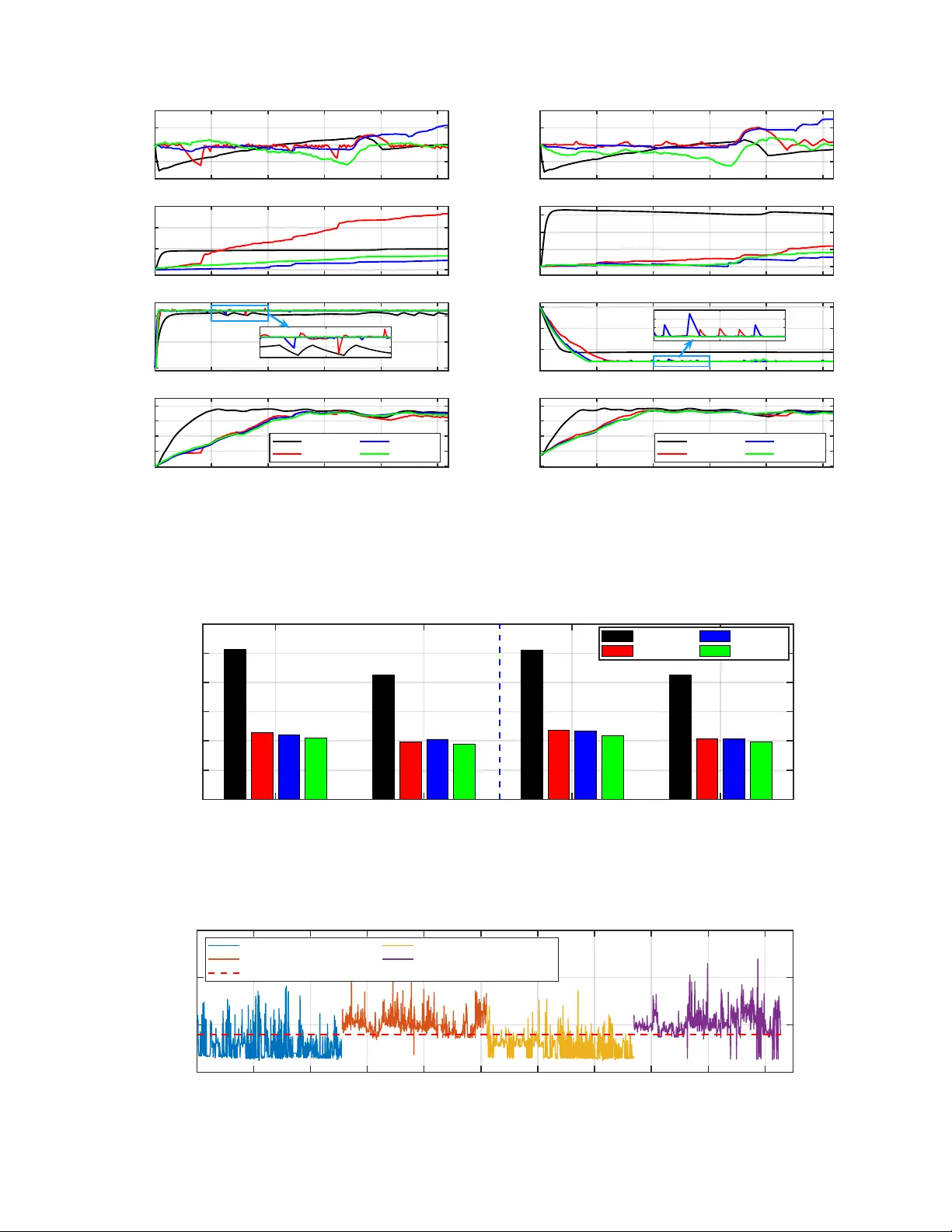
IEEE TRANSA CTIONS ON INTELLIGENT VEHICLES, 2026 1 T raf fic-aw are Hierarchical Inte grated Thermal and Ener gy Management for Connected HEVs Jie Han, Member , IEEE, Arash Khalatbarisoltani, Member , IEEE, Hai L. V u, Senior Member , IEEE, Xiaosong Hu, F ellow , IEEE, Jun Y ang, F ellow , IEEE Abstract —The energy and thermal management systems of hybrid electric vehicles (HEVs) are inherently interdependent. With the ongoing deployment of intelligent transportation sys- tems (ITSs) and increasing vehicle connectivity , the integration of traffic inf ormation has become crucial for improving both energy efficiency and thermal comfort in modern vehicles. T o enhance fuel economy , this paper pr oposes a nov el traffic- aware hierarchical integrated thermal and energy management (T A-ITEM) strategy for connected HEVs. In the upper layer , global r eference trajectories for battery state of charge (SOC) and cabin temperature ar e planned using traffic flow speed information obtained from ITSs. In the lower layer , a real- time model predictive control (MPC)-based ITEM controller is developed, which incorporates a novel T ransf ormer -based speed predictor with dri ving condition recognition (TF-DCR) to enable anticipatory tracking of the r eference trajectories. Numerical simulations are conducted under various driving cycles and ambient temperature conditions. The results demonstrate that the proposed T A-ITEM approach outperforms conv entional rule- based and MPC-SP appr oaches, with a verage fuel consumption reductions of 56.36% and 5.84%, respectively , while maintaining superior thermal regulation and cabin comfort. These findings confirm the effectiveness and str ong generalization capability of T A-ITEM and underscore the advantages of incorporating traffic information. Index T erms —Integrated thermal and energy management, traffic inf ormation, speed prediction, connected hybrid electric vehicles I . I N T RO D U C T I O N W ITH the gro wing worldwide issues of energy sustain- ability and climate change, it is essential to accelerate the promotion of low-carbon and ecologically friendly trans- portation electrification [1]. Hybrid electric v ehicles (HEVs) hav e emerged as a promising solution for the transition from internal combustion engine vehicles (ICEVs) to pure electric vehicles (EVs) [2]. Giv en that HEVs constitute a highly coupled thermal and mechanical system, it is necessary to realize the ef ficient coordination between ener gy and thermal This work was funded in part by the T echnical Innovation and Ap- plication Development Special Program of Chongqing Major Project (CSTB2024TIAD-STX0031), the National Natural Science Foundation of China (No. U23A20327 and 72361137006), and the Basic Research Funds for Central Univ ersities (No. 2023CDJQCZX-001). ( Corr esponding author: J un Y ang ) J. Han and J. Y ang are with the Department of Aeronautical and Automoti ve Engineering, Loughborough University , LE11 3TU Loughborough, U.K. (e- mail: j.han@lboro.ac.uk, j.yang3@lboro.ac.uk). A. Khalatbarisoltani and X. Hu is with the Department of Mechanical and V ehicle Engineering, Chongqing University , Chongqing 400044, China (e- mail: arash.khalatbarisoltani@cqu.edu.cn, xiaosonghu@ieee.org). H. V u is with the Department of Civil Engineering, Monash Uni versity , Melbourne, VIC 3800, Australia (e-mail: hai.vu@monash.edu). management subsystems to fully tap into the energy-saving potential [3]. Nevertheless, most existing approaches rely on rule-based strategies [4] or decoupled optimization of thermal and energy domains [5], which results in suboptimal fuel economy and limits control adaptability and rob ustness in dynamic real-world driving conditions. Recent inte grated thermal and energy management (ITEM) research has made substantial advances in inv estigating the impact of component thermal dynamics on v ehicular energy consumption. Shams-Zahraei et al. [6] proposed an ITEM strategy based on dynamic programming (DP) for HEVs to optimize both battery energy and engine temperature, which in vestigated the ef fects of engine thermal dynamics on vehic- ular fuel economy and emissions. T o balance the real-time implementation and optimum control, Hu et al. [7] dev eloped a multihorizon model predictive control (MH-MPC) approach that integrates a short receding horizon using accurate vehicle speed pre views and a long shrinking horizon using approxi- mate v ehicle speed pre views for global cost-to-go estimation. Similarly , W u et al. [8] introduced a hierarchical MH-MPC approach that optimizes the battery thermal regulation and power flow sequentially , resulting in significant reductions in battery degradation and energy consumption. Despite the excellent energy-sa ving performance of these ITEM strategies, they mainly focus on onboard optimization and overlook external factors such as traf fic conditions, which limits their ability to anticipate and adapt to dynamic driving conditions [9]. The emergence of intelligent transportation systems (ITSs) and v ehicle connecti vity has enabled HEVs to access traffic information (e.g. future speed profiles, road gradients, and traf- fic signal phases). Inte grating traf fic information has opened a ne w optimization dimension for predicti ve ITEM control. Zhao et al. [10] designed a two-layer ITEM strategy , where the upper-le vel controller first optimizes battery temperature trajectories based on a priori speed previe w , while the lo wer- lev el controller performs energy consumption optimization by tracking the planned thermal trajectories. Amini et al. [11] pre- sented a hierarchical MPC approach incorporating both short- term vehicle speed prediction and long-term traffic condition prediction. This approach also utilized a novel intelligent online constraint handling (IOCH) method to optimize cabin and battery cooling strategies. Howe ver , the power split ratio wasn’ t optimized in real time, which was only determined by a rule-based strategy . Dong et al. [12] introduced a predictiv e battery thermal and energy management (p-BTEM) strategy , combining DP-based global trajectory planning in the cloud IEEE TRANSA CTIONS ON INTELLIGENT VEHICLES, 2026 2 controller with the MPC-based real-time energy optimization in the onboard controller . Furthermore, advanced artificial intelligence techniques such as deep reinforcement learning (DRL) have also been employed for smart ITEM control. Zhang et al. [13] proposed a TD3-based ITEM approach that integrates multi-source traf fic and terrain data to enhance energy-sa ving performance via coordination engine warm-up and heating strategies. Khalatbarisoltani et al. [14] dev eloped a federated reinforcement learning framew ork that enables collaborativ e ITEM across multiple v ehicles while preserving data pri vacy . Howe ver , a common limitation among existing methods lies in the insufficient integration of traf fic foresight into the lower- lev el control loop [15], [16]. Specifically , predicted speed profiles or traf fic information are typically leveraged in upper- lev el planners to generate reference trajectories, while the real- time controllers often rely on static setpoints or predefined rules, lacking adaptability to dynamic driving conditions [4], [17]. These limitations constrain the control ability to respond effecti vely to real-world traf fic fluctuations and diminish the potential benefits of predictive control. Recent advances in deep learning offer promising tools to address this g ap. High- fidelity data-driv en speed predictors, particularly those based on adv anced architectures such as Recurrent Neural Networks (RNNs) [18], Long Short-T erm Memory (LSTM) networks [19], and T ransformer [20], hav e shown remarkable accuracy in forecasting future vehicle states. When integrated with MPC, these predictors significantly enhance the anticipatory capability and robustness of real-time decision-making, en- abling proactive coordination between thermal and energy domains under dynamic and uncertain en vironments [21]. While the integration of traf fic foresight and predictiv e speed profiles has shown promising potential in enhancing energy and thermal management, most existing approaches ov erlook the critical influence of driving condition cate gories on vehicle speed dynamics [22]. Each dri ving condition e x- hibits distinct statistical patterns and temporal dependencies. For instance, urban driving is characterized by frequent stop- and-go beha vior and high v ariability , highw ay driving typically features smoother and more stable speed trajectories, while suburban conditions lie between these two extremes with moderate fluctuations [23]. Ignoring these differences can lead to suboptimal prediction accuracy and diminished control ro- bustness, especially in naturalistic driving environments where transitions between dri ving modes are common [24], [25]. T o address this challenge, this study proposes a nov el traf fic- aware hierarchical integrated thermal and energy management (T A-ITEM) strategy that improves real-time control perfor- mance in fuel economy and cabin comfort. Specifically , in the upper layer , the global reference trajectories of battery state of char ge (SOC) and cabin temperature are optimized using traffic flow speed. Then, an MPC-based ITEM framework is employed by integrating a Transformer -based speed prediction model with driving condition recognition (TF-DCR) to explic- itly identify current driving conditions and adapt the prediction model accordingly . The main contrib utions of this study are summarized as follo ws: • A control-oriented thermal model is de veloped and val- Fig. 1. Schematic of the powertrain and thermal management system of Prius HEV . idated against high-fidelity simulations, achieving an optimal balance between computational efficienc y and modeling accuracy . • A novel TF-DCR speed predictor is proposed, capable of better capturing the influence of driving style on v e- hicle speed v ariation and yielding significantly improv ed prediction accuracy over traditional approaches. • A novel traffic-aw are hierarchical ITEM strategy is de- signed and validated, demonstrating consistent enhance- ments in fuel efficiency and cabin comfort across div erse naturalistic dri ving scenarios. The remainder of this paper is organized as follows: Section II presents the powertrain and thermal management system models. Section III details the traffic dataset and traffic flow speed extraction methodology . Section IV introduces the T A-ITEM strategy and the TF-DCR speed predictor . Simulation results and comparativ e analyses are provided in Section V, followed by conclusions and future work directions in Section VI. I I . M O D E L I N G O F P O W E RT R A I N A N D T H E R M A L M A NA G E M E N T S Y S T E M S The powertrain dynamics and thermal management systems of the Prius HEV are presented in this section, as depicted in Fig. 1. The parameters of the vehicle and the powertrain [26] are listed in T able I. A. Longitudinal Dynamics The vehicle longitudinal dynamics [27] are expressed in (1), F v = m v · g ( c r · cos θ + sin θ ) + 0 . 5 ρ air · c d · A f · v 2 + m v · a (1) where F v is the demanded force for a gi ven driving cycle, m v is the vehicle mass, g is the gravity constant, c r is the rolling resistance coef ficient, θ is the road slope, ρ air is the aerodynamic drag coefficient, A f is the vehicle front area, v is the vehicle speed, and a is the acceleration. Then the output torque T ps and speed ω ps of the power -split device are calculated by [28] T ps = F v · r w r d · ( η d · η w ) sign( F v ) (2) IEEE TRANSA CTIONS ON INTELLIGENT VEHICLES, 2026 3 T ABLE I V E HI C L E A N D P OW E RT RA I N P A R AM E T ER S Category Parameter V alue V ehicle V ehicle mass m v 1350 kg Gravity constant g 9.8 m/s 2 Air density ρ air 1.184 kg/m 3 Rolling resistance c r 0.007 Air drag coefficient c d 0.3 Front area A f 1.746 m 2 T ire radius r w 0.28 m Wheel efficienc y η w 0.95 Power -split PG1 ratio r 1 78/30 PG2 ratio r 2 2.5 Engine Max. power P e,max 110 kW Max. torque T e,max 220 N m MG1 Max. power P mg 1 ,max 40 kW Max. torque T mg 1 ,max 170 N m MG2 Max. power P mg 2 ,max 60 kW Max. torque T mg 2 ,max 207 N m Battery cell Nominal voltage u nom 1.2 V Nominal capacity Q nom 6.5 A h Cell number n b 168 Final driv e Gear ratio r d 3.26 Efficienc y η d 0.97 ω ps = v · r d r w (3) where r w is the wheel radius, r d is the final dri ve gear ratio, and η d and η w denote the transmission ef ficiencies of the final driv e and the wheel, respecti vely . B. P ower-split De vice In the Prius powertrain, there are two planetary gears (PGs) that connect the engine, motor/generator 1 (MG1), and motor/generator 2 (MG2). As shown in Fig. 1, the engine and MG1 are connected to the planet carrier and the sun gear of PG1, respectively . In PG2, the planet carrier is held stationary and the MG2 is connected to the sun gear . In addition, the ring gears of both PG1 and PG2 are interconnected and coupled to the final driv e. Quasi-static equations for the power -split device are [29] T r 1 = r 1 · T e r 1 + 1 = − r 1 · T mg 1 ω mg 1 = ( r 1 + 1) · ω e − r 1 · ω ps ω mg 2 = r 2 · ω ps r 2 · T mg 2 = T ps − T r 1 (4) where r 1 and r 2 are the gear ratios of PG1 and PG2, T and ω represent the torque and speed, and the subscript r 1 , e , mg 1 , and mg 2 refer to the ring gear of PG1, engine, MG1, and MG2, respecti vely . C. Engine Model The engine fuel consumption is modeled as a lookup table with engine torque and speed as inputs. The instantaneous fuel consumption rate ˙ m f is ˙ m f = δ f · f f ( ω e , T e ) (5) P e = ω e · T e (6) where P e is the engine mechanical po wer , δ f is the factor of additional fuel consumption reflected by the engine tempera- ture. In this paper , the engine coolant temperature is treated as the engine temperature and is expressed as ˙ T e = 1 m e · C e ( Q f − P e − Q exh − Q air − Q cl − Q heat ) (7) where m e represents the equiv alent thermal mass of the engine, C e is its equiv alent specific heat capacity , Q f denotes the total heat released from fuel combustion, Q exh , Q air , and Q cl represent the heat dissipated through exhaust gas, engine compartment air , and coolant, respectiv ely , and Q heat is the heat transferred to the cabin. Then the heat dissipation can be calculated by (8). Q f = δ h · ˙ m f · Q lhv Q exh = δ exh · ( Q f − P e ) Q air = h e · A e · ( T e − T com ) Q cl = f cl ( T e , T amb , W e,cl , W e,air ) (8) where δ h is the heat ratio by engine temperature, δ exh is the heat added ratio by air temperature, and Q lhv is the low heating value of the fuel. h e is the heat transfer coefficient of the engine, A e is the equiv alent heat transfer area, T com refers to the engine compartment temperature, and f cl represents the heat exchange model of the radiator, which depends on engine temperature, ambient temperature T amb , coolant flow rate W e,cl , and intak e air flo w rate W e,air . D. Motor/Generator Model In this subsection, the ef ficiency of MG η mg is characterized as a function of torque and speed. P mg = ω mg · T mg P mg ,dc = P mg η mg ( ω mg , T mg ) sign( P mg ) (9) where P mg and P mg ,dc are the mechanical power and electric power of MG, respecti vely . E. Battery Model Ref. [30] demonstrated that a battery model coupling the internal resistance model with a lumped-mass thermal model provides a satisfactory balance between computational ef- ficiency and simulation accuracy under room temperature conditions. Therefore, the internal resistance model is adopted to capture the electrical dynamics. u = u oc − i · R 0 (10) i = u oc − p u 2 oc − 4 R 0 · P cell 2 R 0 (11) P cell = P mg 1 ,dc + P mg 2 ,dc + P pump + P f an + P bl n b (12) ˙ soc = − i 3600 · Q nom (13) IEEE TRANSA CTIONS ON INTELLIGENT VEHICLES, 2026 4 where u oc is the open-circuit voltage, u is the terminal voltage, R 0 refers to the internal resistance. i represents the cell current, and P cell represents the output po wer of the cell. n b is the number of cells in the battery pack, Q nom is the nominal capacity of the cell, and ˙ soc is the state of charge (SOC) rate. Additionally , P pump , P f an , and P bl are the po wer consumption of the engine coolant pump, the battery cooling fan, and the HV A C ventilation blower , respecti vely . The generated thermal Q b and thermal dynamics ˙ T b of the battery can be expressed as Q b = i 2 · R 0 · n b ˙ T b = 1 m b · C b ( Q b − Q cool ) (14) where m b is the equiv alent thermal mass of the battery and C b is its equiv alent specific heat capacity . Q cool represents the heat dissipated through the battery cooling system and can be calculated by Q cool = f cool ( T b , T c , W b,air ( κ f an , v )) (15) where f cool represents the function of the battery cooling sys- tem, which depends on battery temperature, cabin temperature T c , cooling air flow rate W b,air , and κ f an is the fan duty cycle of the battery cooling system. F . Cabin Thermal Model In this paper , cabin thermal comfort is also considered as one of the optimization objectiv es. The cabin temperature rise rate can be expressed as ˙ T c = 1 m c · C c + C add ( Q hv ac + Q sun + Q trans + Q conv ) (16) where m c is the equiv alent thermal mass of the cabin, C c denotes the specific heat capacity of the cabin, and C add represents the additional heat capacity contributed by other materials in the cabin. The heat flows Q hv ac , Q sun , Q trans , and Q conv represent the heat input/output from the HV A C system, solar radiation, heat transmission through the cabin structure, and conv ective heat exchange, respectiv ely , which can be calculated by: Q sun = η · I · β · A w Q trans = ( h c,b · A c,b + h c,s · A c,s ) · ( T amb − T c ) Q conv = − Q c 2 w − Q c 2 r Q c 2 w = h w · A w · ( T c − T w ) Q c 2 r = h r · A r · ( T c − T r ) (17) where η is the radiation transmission coefficient of the glass, I is the solar radiation intensity , and β is the perpendicular component of solar radiation on the windo w . A w , A r , A c,b , and A c,s denote the areas of the window , roof, cabin bottom, and cabin side surfaces, respecti vely . h c,b , h c,s , h w , and h r are the heat transfer coefficients of the corresponding surfaces. Q c 2 w and Q c 2 r represent the con vectiv e heat flows from the windows and the roof to the cabin air . T w and T r denote the temperatures of the window and roof surfaces. 09:00 10:00 11:00 12:00 13:00 14:00 15:00 16:00 17:00 18:00 19: 00 Time 16 18 20 22 24 26 28 Speed (m/s) Fig. 2. Individual vehicle trajectories for northbound trips collected during the Mobile Century field experiment conducted on the I-880 highway [32]. I I I . T R A FFI C I N F O R M A T I O N D E S C R I P T I O N A. T raf fic Dataset The deployment of large-scale traf fic monitoring systems, such as the performance measurement system (PeMS) in California [31], enables vehicle users to access historical and real-time traffic data to improv e vehicular energy con- sumption. Howe ver , traditional traffic monitoring methods (e.g. inductiv e loop detectors and surveillance cameras) are costly and difficult to maintain. In contrast, GPS-enabled smartphones hav e emerged as a promising alternativ e due to their widespread adoption and high-precision positioning capabilities. The Mobile Century experiment [32] collected trajectory data from 100 individual vehicles equipped with GPS-enabled Nokia N95 smartphones along California’ s I- 880 highway on February 8, 2008 (10:00–18:00 PST). The collected 1388 v ehicle trajectories are sho wn in Fig. 2. T o reconstruct the spatiotemporal traffic flow speed, the vehicle trajectory data were aggregated over a predefined time-space grid. The observation period (10:40–14:40) was divided into 5-minute intervals (the same as the updating frequency of PeMS [33]), and the highway segment (mile 16.7–27.6) was di vided into 0.1-mile intervals [34]. F or each vehicle, the instantaneous speed records were mapped to their corresponding time-space cells, and the mean speed per cell was calculated. The av erage traffic speed ¯ v s,t in spatial cell s and temporal interval t was then obtained by aggre gating speed measurements from all vehicles as follo ws: ¯ v s,t = 1 N s,t N s,t X i =1 v i,s,t (18) where N s,t denotes the number of vehicle speed records within the ( s, t ) cell, and v i,s,t is the instantaneous speed of the i - th sample. For cells without data, the av erage speed is set to the road speed limit to maintain matrix consistency and prev ent artificial congestion signals caused by missing data. The spatio-temporal average traffic flow speed is illustrated in Fig. 3. IEEE TRANSA CTIONS ON INTELLIGENT VEHICLES, 2026 5 11:00 11:30 12:00 12:30 13:00 13:30 14:00 14:30 Time F eb 08, 2008 18 20 22 24 26 Space Position (mile) mph 10 20 30 40 50 60 70 80 Fig. 3. The average spatio-temporal traffic flow speed. B. T raf fic Flow Speed Extraction T o extract the traffic flo w speed along a specific vehicle trajectory , a dynamic interpolation method is applied ov er a discretized spatio-temporal speed field ¯ v ( s, t ) . The vehicle’ s initial time and position ( t 0 , s 0 ) are first determined from the raw data. Then, at each integration step, the traffic speed ¯ v i = ¯ v ( s i , t i ) is obtained from the a verage traf fic speed matrix. Based on this local speed, the vehicle is assumed to traverse a small spatial cell ∆ s , and the corresponding time increment ∆ t is computed as: ∆ t i = ∆ s i ¯ v i (19) The vehicle position and time are iterati vely updated as: s i +1 = s i + ∆ s i , t i +1 = t i + ∆ t i (20) until the terminal time or position is reached. The recon- structed velocity profile is then interpolated to match the sampling resolution of the original trajectory for subsequent control. This method ensures that the extracted traffic flow speed v tra ( t ) accurately reflects the spatial-temporal distri- bution of traffic conditions experienced by each individual vehicle. T wo vehicle trajectories were randomly selected, and the corresponding traffic flow speeds were extracted using the aforementioned method. As illustrated in Fig. 4, the extracted traffic flo w speeds can ef fectiv ely capture the ov erall trend of vehicle speed variations. Therefore, in Section IV -A, the traffic flow speed is utilized to plan the trajectories of battery SOC and cabin temperature, thereby o vercoming the limitations of con ventional MPC-based control strategies, particularly their inability to fully exploit the entire SOC range. I V . T R A FFI C - AW A R E H I E R A R C H I C A L I N T E G R A T E D T H E R M A L A N D E N E R G Y M A N AG E M E N T In this section, a novel traffic-aw are hierarchical ITEM strategy is proposed as shown in Fig. 5. In the upper layer, the optimal reference trajectories of battery SOC soc ∗ and cabin temperature T ∗ c are planned by utilizing the traf fic flo w speed extracted as described in Section III-B. In the lower 0 100 200 300 400 500 600 10 20 30 40 Speed (m/s) (a) T r a j. No 418 V ehicle speed T ra / c speed 0 100 200 300 400 500 600 Time (s) 10 20 30 Speed (m/s) (b) T r a j. No 1377 Fig. 4. Comparison between extracted traffic flow speed and individual vehicle speed for two trajectories. (a) No.418 and (b) No. 1377. layer , a real-time ITEM is implemented based on MPC, which integrates TF-DCR to track the reference trajectories. A. Global Refer ence T rajectory Planning F ormulation In this subsection, the global ITEM strategy is dev eloped based on traf fic flow speed v tra , aiming to minimize total fuel consumption while ensuring cabin comfort and SOC le vel. The control actions include engine speed and torque, the battery cooling fan duty cycle, and the HV A C heat flow . u = [ ω e , T e , κ f an , Q hv ac ] (21) The state v ariables consist of battery SOC, and the temper- atures of battery , cabin air, roof surface, windows, engine coolant, and engine compartment. x = [ soc, T b , T c , T r , T w , T e , T com ] (22) The corresponding optimal control problem (OCP) minimizes the sum of the instantaneous fuel consumption ov er the whole horizon and a penalty term weighted by α , which accounts for deviations from the target cabin temperature. min u ( t ) N X i =1 ˙ m f ( t ) + α · δ T c ( t ) s.t 0 ≤ κ f an ( t ) ≤ 1 Q hv ac,min ≤ Q hv ac ( t ) ≤ Q hv ac,max ω j,min ( t ) ≤ ω j ( t ) ≤ ω j,max ( t ) T j,min ( t ) ≤ T j ( t ) ≤ T j,max ( t ) x 0 ( 2:7 ) = T amb soc (0) = soc ( N ) soc min ≤ soc ( t ) ≤ soc max T b,min ≤ T b ( t ) ≤ T b,max T c,tar − δ T c ( t ) ≤ T c ( t ) ≤ T c,tar + δ T c ( t ) (23) where N is the total control horizon length. The variable δ T c represents the allowable de viation of the cabin air temperature T c ( t ) from the desired comfort temperature T c,tar , forming a time-varying comfort constraint [ T c,tar − δ T c ( t ) , T c,tar + δ T c ( t )] . The initial state vector x 0 includes key thermal IEEE TRANSA CTIONS ON INTELLIGENT VEHICLES, 2026 6 Fig. 5. Control framework for traffic-aware hierarchical integrated thermal and energy management. variables such as battery , cabin, and engine-related temper- atures, which are initialized as the ambient temperature T amb . soc (0) = soc ( N ) aims to maintain the battery SOC lev el. The cabin temperature T c ( t ) is thus regulated throughout the control horizon to stay within the predefined comfort range while coordinating with the energy-saving objectives. Considering the complexity and nonlinearity of the OCP , the IPOPT solver in the CasADi toolbox [35] is employed to solve the optimization problem efficiently . B. TF-DCR Speed Pr edictor In real-world driving scenarios, vehicle speed profiles ex- hibit substantial v ariability due to div erse traffic conditions and driv er behaviors, such as stop-and-go traffic, steady cruising, or aggressiv e dri ving in congested environments. These behav- ioral patterns correspond to distinct dri ving condition styles that significantly influence the dynamics and predictability of vehicle speed. T o address this issue, as illustrated in Fig. 6, a novel speed prediction model, referred to as TF-DCR, is proposed by integrating unsupervised driving condition recognition (DCR) with a T ransformer-based architecture. This speed prediction model is further incorporated into the MPC- based ITEM control frame work to enhance prediction accurac y and decision-making rob ustness. 1) Unsupervised Driving Condition Reco gnition: T o effec- tiv ely identify dri ving conditions, an unsupervised classifica- tion framew ork based on Gaussian Mixture Models (GMM) is dev eloped. The training dataset [30] comprises eight standard driving cycles along with two naturalistic cycles selected from the V ehicle Energy Dataset (VED) [36]. The standard driving cycles are sourced from Autonomie , a v ehicle simula- tion platform dev eloped by the V ehicle & Mobility Systems Department at Ar gonne National Laboratory [26]. As a preprocessing step, the training dataset is segmented using a 60-second time window . For each segment, a total of ten statistical features are extracted, including maximum speed, minimum speed, av erage speed, speed standard devia- tion, av erage acceleration, av erage deceleration, acceleration standard deviation, idle proportion, cruise proportion, and acceleration proportion. Then, Principal Component Analysis (PCA) is applied for feature dimensionality reduction. As illustrated in Fig. 7, the first fiv e principal components account for over 95% of the cumulative contribution rates, which are retained for subsequent clustering. A GMM-based clustering algorithm is subsequently applied to classify dri ving condition segments into three distinct driv- ing styles: urban, highway , and city . The GMM assumes that the input feature vector z = ϕ ( v ) ∈ R d is generated from a mixture of K multiv ariate Gaussian distributions: p ( z ) = K X k =1 π k N ( z | µ k , Σ k ) (24) where ϕ ( · ) denotes the feature extraction function, including a PCA process applied to the raw driving data v . d is the dimension of the extracted feature vector z , K is the total number of Gaussian components, π k is the non-negati ve mixing weight of the k -th component satisfying P K k =1 π k = 1 ; µ k is the mean vector , and Σ k is the covariance matrix of the k -th Gaussian component. The term N ( z | µ k , Σ k ) represents the multi variate Gaussian distrib ution, which is defined as: N ( z | µ , Σ ) = 1 (2 π ) d 2 | Σ | 1 2 exp − 1 2 ( z − µ ) ⊤ Σ − 1 ( z − µ ) (25) T o improve numerical stability and a void ov erfitting, the regularized GMM is implemented using MA TLAB’ s fitgmdist function. Fig. 8 illustrates the clustering results through the distrib u- tions of speed and acceleration for each recognized category . The average speeds for these three driving styles are 10.68 m/s, 29.43 m/s, and 4.78 m/s, respecti vely . Correspondingly , the standard de viations of acceleration are 0.9468 m/s 2 , 0.7209 m/s 2 , and 1.2403 m/s 2 . These distinct statistical characteristics of dri ving styles validate the effecti veness and rationality of the clustering approach. T o enable real-time recognition, a lightweight nearest- cluster classification (LNCC) approach is emplo yed. Specif- ically , a test feature vector z ∈ R d , after normalization and PCA projection, is compared against the K GMM cluster centers { µ k } , and the driving condition style is recognized according to the index of the closest cluster mean: c t = arg min k ∈{ 1 ,...,K } ∥ z − µ k ∥ 2 (26) where c t denotes the recognized driving condition style, and the Euclidean distance ∥ · ∥ 2 is used to determine the nearest cluster center . This classification approach reduces IEEE TRANSA CTIONS ON INTELLIGENT VEHICLES, 2026 7 Fig. 6. Speed prediction model integrating driving condition recognition and T ransformer 0 50 100 Cumulativ e rates (%) 1 2 3 4 5 6 7 8 9 10 Principal Comp onen t 0 10 20 30 40 50 Contribution rates (%) Contribution rates Cumulativ e rates 95% thre shold 5 prin cipal compone n ts Fig. 7. Principal component analysis results. computational ov erhead and is well suited for online inference scenarios. For e valuation, 20 driving segments are randomly selected from each driving style. As shown in Fig. 9, the recogni- tion results demonstrate high accuracy , with urban, highway , and city driving condition styles achieving 100%, 90%, and 75% accuracy , respecti vely . The confusion matrix and sample statistics further verify the ef fectiv eness of the proposed DCR model. 2) T ransformer -Based Speed Pr ediction Model: T o enhance the accurac y and rob ustness of v ehicle speed forecasting across div erse traf fic en vironments, a dri ving condition-a ware Trans- former framework is proposed. The key idea is to incorporate driving scenario semantic into the prediction model. Specif- ically , the driving condition for each historical observation window is first identified using a GMM-based clustering approach, and the recognized style label is then embedded and integrated with the sequence input to the T ransformer model. Let N his and N pre denote the historical window length and the prediction horizon, respecti vely . At time t , the historical driving data, including speed and acceleration, are defined as: v his = [ v t − N his +1 , . . . , v t ] , a his = [ a t − N his +1 , . . . , a t ] . (27) T o embed scenario semantics, the current driving condition style c t ∈ { Urban , Cit y , High w a y } is identified through the GMM-based clustering and LNCC framework described in Section IV -B1. The label c t is encoded as a one-hot vector o t ∈ R 3 and broadcast across the temporal dimension. The T ABLE II C O NFI G U R A T I ON O F T H E T R A N SF O R M ER S P E ED P R E DI C T OR Component Parameter V alue Input features [ ˜ v , ˜ a , o 1 t , o 2 t , o 3 t ] 5 Historical window size N his 60 Prediction horizon N pre 5 Position embedding Maximum sequence length 256 Self-attention Number of heads 4 Self-attention Ke y dim per head 32 Attention mask T ype Causal Fully connected layer 1 Output dimension 128 Activ ation function T ype ReLU Fully connected layer 2 Output dimension 5 Optimizer T raining algorithm Adam Initial learning rate V alue 0.001 Mini-batch size T raining batch 128 T raining epochs Max iterations 50 normalized input features are then constructed as: X t = ˜ v t − N his +1: t ˜ a t − N his +1: t o 1 t o 2 t o 3 t ∈ R 5 × N his , (28) where ˜ v and ˜ a represent normalized speed and acceleration sequences, and o i t denotes the i -th repeated channel of the one-hot label. The constructed sequence X t is then processed by a causal T ransformer encoder that utilizes multi-head self-attention to model temporal dependencies. The output is projected to the future predicted speed over the next N pre steps: ˆ v t +1: t + N pre = f T r ans ( X t ) (29) where f T r ans ( · ) represents the T ransformer network. The model is trained by minimizing the mean squared error (MSE) between the predicted and actual vehicle speeds. The key configuration parameters of the T ransformer-based architecture are summarized in T able II. C. MPC-based Inte grated Thermal and Energy Management T o ov ercome the energy-saving potential limitation caused by hard constraints on battery SOC and cabin temperature, a nonlinear MPC strategy is proposed to track the globally optimal battery SOC and cabin temperature profiles. These reference trajectories are generated in the upper layer by in- corporating traffic information. The proposed MPC formulates the control problem as a constrained nonlinear optimization problem ov er a finite prediction horizon, aiming to achie ve optimal trade-of fs between energy consumption and thermal comfort while satisfying system dynamics and operational constraints. The objecti ve function is designed to minimize a weighted IEEE TRANSA CTIONS ON INTELLIGENT VEHICLES, 2026 8 0 1000 2000 3000 4000 5000 Time (s) 0 10 20 30 Speed (m/s) (a) 7 v 1 = 10 : 68 m = s 0 10 20 30 Speed (m/s) 0 100 200 300 400 500 Count (b) < a; 1 = 0 : 9468 m/s 2 -5 0 5 Acc (m/s 2 ) 0 500 1000 1500 2000 Count 0 0.5 Probability (c) 0 500 1000 1500 2000 Time (s) 0 10 20 30 40 Speed (m/s) (d) 7 v 2 = 29 : 43 m = s 0 10 20 30 40 Speed (m/s) 0 50 100 150 200 Count (e) < a; 2 = 0 : 7209 m/s 2 -5 0 5 Acc (m/s 2 ) 0 500 1000 1500 2000 Count 0 0.5 Probability (f ) 0 500 1000 1500 2000 2500 3000 3500 Time (s) 0 10 20 30 Speed (m/s) (g) 7 v 3 = 4 : 78 m = s 0 10 20 30 Speed (m/s) 0 500 1000 1500 Count (h) < a; 3 = 1 : 2403 m/s 2 -5 0 5 Acc (m/s 2 ) 0 500 1000 1500 2000 Count 0 0.5 Probability (i) Fig. 8. Speed and acceleration time series and distributions under three representati ve driving conditions: (a)-(c) Urban, (d)-(f) Highway , and (g)-(i) City . 20 0 0 2 18 0 5 0 15 Urban Highw ay City Recognized driving style Urban Highw ay City Observed drivi ng style (a) 0 5 10 15 20 100.0% 90.0% 75.0% Urban Highw ay City Driving style 0 20 40 60 80 100 Accuracy (%) (b) Fig. 9. Performance ev aluation of the driving condition recognition. (a) Confusion matrix; (b) Recognition accuracy for each driving style. sum of tracking errors and fuel consumption. min u ( ℓ | t ) J = t + N pre − 1 X ℓ = t ˙ m f ( ℓ | t ) + t + N pre X ℓ = t +1 w soc ( soc ( ℓ | t ) − soc ∗ ( ℓ | t )) 2 + t + N pre X ℓ = t +1 w c ( T c ( ℓ | t ) − T ∗ c ( ℓ | t )) 2 s.t 0 ≤ κ f an ( ℓ | t ) ≤ 1 Q hv ac,min ≤ Q hv ac ( ℓ | t ) ≤ Q hv ac,max ω j,min ( ℓ | t ) ≤ ω j ( ℓ | t ) ≤ ω j,max ( ℓ | t ) T j,min ( ℓ | t ) ≤ T j ( ℓ | t ) ≤ T j,max ( ℓ | t ) x 0 ( 2:7 ) = T amb soc min ≤ soc ( ℓ | t ) ≤ soc max T b,min ≤ T b ( ℓ | t ) ≤ T b,max T c,min ( ℓ | t ) ≤ T c ( ℓ | t ) ≤ T c,max ( ℓ | t ) (30) where ℓ is the prediction step, t is the current time step, soc ( ℓ | t ) and T c ( ℓ | t ) are the predicted battery SOC and cabin temperature at time ℓ based on information at time t . soc ∗ ( ℓ | t ) and T ∗ c ( ℓ | t ) are the corresponding global reference trajectories from the upper layer . w soc and w c are the weighting factors balancing SOC tracking and cabin thermal comfort. V . R E S U LT S A N D D I S C U S S I O N A. Model verification of Thermal Management System The control-oriented thermal management model is vali- dated against reference data obtained from Autonomie under the WL TC driving cycle. As shown in Fig. 10, the predicted temperatures of the cabin air , roof, window glass, engine, and battery exhibit a strong agreement with the reference data, with an average estimation error within 1 ◦ C. This high le vel of consistency across all thermal subsystems demonstrates the model’ s ability to accurately capture both transient and steady- state thermal behaviors, confirming its suitability for real-time MPC applications in ITEM control. B. Speed Pr ediction Analysis T able III presents a comparison of speed prediction per- formance across various driving cycles using three models: extreme learning machine (ELM), backpropagation neural network (BP), and the proposed TF-DCR. The results demon- strate that TF-DCR consistently outperforms the baseline models, achieving the lo west root mean square error (RMSE) in all scenarios. Notably , TF-DCR achieves up to a 53.17% improv ement over ELM on the No. 1283 v ehicle trajectory and shows substantial gains ranging from 9% to 43% across most driving cycles. These results highlight the superior generaliza- tion ability and robustness of the proposed method under both standard and naturalistic driving conditions, making it highly suitable for real-time speed prediction in modern vehicle applications. IEEE TRANSA CTIONS ON INTELLIGENT VEHICLES, 2026 9 0 500 1000 1500 20 21 22 T c ( / C) Max error: 1 : 48 / C Ave error: 0 : 09 / C Experiment Model 0 500 1000 1500 20 21 22 T r ( / C) Max error: 0 : 23 / C Ave error: 0 : 02 / C 0 500 1000 1500 20 20.5 21 T w ( / C) Max error: 0 : 04 / C Ave error: 0 : 01 / C 0 500 1000 1500 50 100 T e ( / C) Max error: 4 : 65 / C Ave error: 1 : 00 / C 0 500 1000 1500 Time (s) 20 25 30 T b ( / C) Max error: 0 : 87 / C Ave error: 0 : 20 / C Fig. 10. The validation of thermal management model under WL TC cycle. T ABLE III S P EE D P R ED I C T IO N P E RF O R M AN C E C O M P A R I S ON U N D ER D I FF ER E N T D R IV I N G C Y C LE S Driving Cycle Predictor RMSE Improvement ARB02 ELM 2.5464 - BP 2.1294 16.38% TF-DCR 1.7422 31.58% UDDS ELM 1.3611 - BP 1.3058 4.06% TF-DCR 1.1482 15.64% HWFET ELM 0.6415 - BP 0.5906 7.93% TF-DCR 0.5080 20.81% T raj. No 418 ELM 0.7094 - BP 0.6683 5.79% TF-DCR 0.6418 9.53% T raj. No 724 ELM 0.8964 - BP 0.6168 31.19% TF-DCR 0.5081 43.32% T raj. No 1283 ELM 2.3899 - BP 1.6607 30.51% TF-DCR 1.1191 53.17% ELM : Extreme learning machine-based predictor [37]; BP : Backpropagation neural network-based predictor [38]; TF-DCR : T ransformer-based predictor with driving condition recognition. C. MPC-based ITEM Str ate gy T o implement the real-time ITEM control, the proposed TF-DCR speed predictor is integrated into the MPC-based control strategy , referred to as MPC-SP . Fig. 11 compares the performance of the rule-based approach (implemented in Autonomie ) and the MPC-SP ITEM strategy under the WL TC driving cycle. It can be seen that the MPC-SP strategy employs more frequent battery utilization, resulting in a higher battery temperature as sho wn in Fig. 11(b), approaching the 0 200 400 600 800 1000 1200 1400 1600 1800 55 60 65 70 SOC (%) (a) 0 200 400 600 800 1000 1200 1400 1600 1800 20 30 40 T b ( / C) (b) Rule-based MPC-SP 0 200 400 600 800 1000 1200 1400 1600 1800 20 21 22 23 T c ( / C) (c) 0 200 400 600 800 1000 1200 1400 1600 1800 Time (s) 20 40 60 80 100 T e ( / C) (d) Fig. 11. Comparison of rule-based and MPC-SP ITEM strategies under the WL TC cycle. 498 367 26.3 % 1249 747 40.2 % UDDS WL TC Driving Cycle 0 500 1000 1500 F uel Consumption (g) Rule-based MPC-SP Fig. 12. Fuel consumption under UDDS and WL TC cycles. optimal battery temperature threshold [12]. Although the cabin temperature exhibits fluctuations within the first 0–800 s, it rapidly con verges to the desired setpoint. Meanwhile, the increased battery usage reduces engine operations, leading to a lower engine temperature. Furthermore, as illustrated in Fig. 12, the MPC-SP strategy achie ves up to 26.3% and 40.2% reductions in fuel consumption under the UDDS and WL TC cycles, respecti vely , which highlights the superior capability of MPC in jointly optimizing energy ef ficiency and thermal comfort. D. T raf fic-aware Hierar chical ITEM strate gy Fig. 13 compares the dynamic responses of battery SOC, battery temperature, cabin temperature, and engine tempera- ture under different control strategies at ambient temperatures of 20 ◦ C and 35 ◦ C. Compared to rule-based, MPC-SP , and two-layer control strategies, the proposed T A-ITEM method IEEE TRANSA CTIONS ON INTELLIGENT VEHICLES, 2026 10 maintains battery SOC trajectories closer to predefined ref- erence values while expanding the SOC operating window , thereby enhancing the energy b uffer for power distribution optimization. Regarding thermal management, T A-ITEM en- ables faster conv ergence of cabin temperature to setpoints with smaller steady-state deviations. Furthermore, compared to rule-based and MPC-SP strategies, the T A-ITEM results in reduced battery temperature rise, particularly maintaining closer to the optimal thermal operating point at 35 ◦ C, which benefits both efficiency and battery lifespan. Additionally , through more ef fective battery utilization and load balancing, T A-ITEM reduces engine operating temperatures, thereby in- directly lo wering thermal load and fuel consumption. As sho wn in Fig. 14, the proposed T A-ITEM strategy consistently deliv ers the lowest fuel consumption across all cases. Specifically , under the No. 1377 cycle at 20 ◦ C, T A-ITEM achiev es up to 55.42%, 2.96%, and 7.71% fuel reductions relativ e to the rule-based, MPC-SP , and two-layer strategies, respecti vely . Moreov er, at 35 ◦ C, the fuel reductions are 53.58%, 4.58%, and 4.96% respectiv ely . These results clearly demonstrate that T A-ITEM not only improves fuel efficienc y but also outperforms the MPC-SP strategy . The superior performance of T A-ITEM can be attributed to its traffic-a ware ability . By lev eraging traffic information to plan reference SOC and cabin temperature, T A-ITEM allows for a more flexible and optimal scheduling of battery usage and engine operation, thereby improving overall fuel economy . Furthermore, the improv ement becomes more pronounced at elev ated ambient temperatures, highlighting the robustness of T A-ITEM in mitigating increased cooling demands and maintaining ener gy-thermal balance. Moreov er, the computational efficienc y of the proposed T A- ITEM strategy is ev aluated under dif ferent vehicle trajectories and ambient temperatures. As sho wn in Fig. 15, the total av erage computation time is 39.5 ms, demonstrating that the proposed strategy is suitable for real-time application [39]. These results collectiv ely demonstrate that T A-ITEM exhibits significant adv antages in achie ving coordinated energy-thermal optimization. Compared to con ventional rule-based, MPC-SP , and two-layer strategies, it enhances energy efficiency , thermal regulation performance, and cabin comfort. V I . C O N C L U S I O N This study proposes a traffic-aw are hierarchical ITEM control approach for connected HEVs. By incorporating a T ransformer-based speed prediction model with dri ving con- dition recognition, the framew ork enables anticipatory control that improves both energy ef ficiency and thermal comfort. The main findings are summarized as follows: • A control-oriented thermal model is dev eloped and vali- dated against high-fidelity simulation data, demonstrating high accuracy in capturing both transient and steady-state thermal beha viors. • The proposed TF-DCR predictor improves speed predic- tion accuracy by up to 53.17% compared to the ELM baseline. • Comparative ev aluations under both standard and real- world driving cycles show that T A-ITEM consistently outperforms rule-based and MPC-SP approaches, achiev- ing average fuel savings of 56.36% and 5.84%, respec- tiv ely , along with better battery thermal regulation and enhanced cabin thermal comfort. These results confirm the strong generalization capability of the T A-ITEM framework and underscore the value of incorporating traffic foresight into multi-domain vehicle en- ergy management. Future work will explore the extension of this approach to multi-vehicle coordination scenarios and its v alidation through real-time hardware-in-the-loop (HIL) experiments. R E F E R E N C E S [1] J. Han, A. Khalatbarisoltani, Y . Y ang, and X. Hu, “Energy management in plug-in hybrid electric vehicles: preheating the battery packs in low-temperature driving scenarios, ” IEEE Tr ansactions on Intelligent T ransportation Systems , vol. 25, no. 2, pp. 1978–1991, 2023. [2] C. Liang, X. Xu, D. J. Auger, F . W ang, and S. W ang, “Efficient mode transition control for dm-phev with mechanical hysteresis based on piecewise affine h ∞ strategy , ” IEEE T ransactions on T ransportation Electrification , vol. 9, no. 3, pp. 4366–4379, 2023. [3] C. W ei, T . Hofman, E. Ilhan Caarls, and R. v an Iperen, “Integrated energy and thermal management for electrified powertrains, ” Ener gies , vol. 12, no. 11, p. 2058, 2019. [4] X. Gong, H. W ang, M. R. Amini, I. Kolmano vsky , and J. Sun, “In- tegrated optimization of power split, engine thermal management, and cabin heating for hybrid electric vehicles, ” in 2019 IEEE Confer ence on Control T echnology and Applications (CCT A) . IEEE, 2019, pp. 567–572. [5] L. He, H. Jing, Y . Zhang, P . Li, and Z. Gu, “Revie w of thermal management system for battery electric vehicle, ” Journal of Ener gy Storag e , vol. 59, p. 106443, 2023. [6] M. Shams-Zahraei, A. Z. Kouzani, S. Kutter , and B. B ¨ aker , “Integrated thermal and energy management of plug-in hybrid electric vehicles, ” Journal of power sources , vol. 216, pp. 237–248, 2012. [7] Q. Hu, M. R. Amini, I. Kolmanovsk y , J. Sun, A. W iese, and J. B. Seeds, “Multihorizon model predicti ve control: An application to integrated power and thermal management of connected hybrid electric vehicles, ” IEEE T ransactions on Control Systems T echnology , vol. 30, no. 3, pp. 1052–1064, 2021. [8] Y . W u, Z. Huang, D. Li, H. Li, J. Peng, J. M. Guerrero, and Z. Song, “Integrated battery thermal and energy management for electric vehicles with hybrid energy storage system: A hierarchical approach, ” Energy Con version and Management , vol. 317, p. 118853, 2024. [9] Q. Y ang, T . Zeng, C. Zhang, W . Zhou, L. Xu, J. Zhou, P . Jiang, and S. Jiang, “Modeling and simulation of v ehicle inte grated thermal management system for a fuel cell hybrid vehicle, ” Energy Con version and Management , vol. 278, p. 116745, 2023. [10] S. Zhao, M. R. Amini, J. Sun, and C. C. Mi, “ A two-layer real-time optimization control strategy for integrated battery thermal management and hvac system in connected and automated hevs, ” IEEE T ransactions on V ehicular T echnology , vol. 70, no. 7, pp. 6567–6576, 2021. [11] M. R. Amini, H. W ang, X. Gong, D. Liao-McPherson, I. K olmanovsky , and J. Sun, “Cabin and battery thermal management of connected and automated hevs for improved energy efficiency using hierarchical model predictiv e control, ” IEEE T ransactions on Control Systems T echnology , vol. 28, no. 5, pp. 1711–1726, 2019. [12] H. Dong, Q. Hu, D. Li, Z. Li, and Z. Song, “Predictive battery thermal and energy management for connected and automated electric vehicles, ” IEEE T ransactions on Intelligent Tr ansportation Systems , 2024. [13] H. Zhang, B. Chen, N. Lei, B. Li, R. Li, and Z. W ang, “Integrated thermal and energy management of connected hybrid electric vehicles using deep reinforcement learning, ” IEEE T ransactions on Tr ansporta- tion Electrification , vol. 10, no. 2, pp. 4594–4603, 2023. [14] A. Khalatbarisoltani, J. Han, M. Saeed, C.-z. Liu, and X. Hu, “Pri vac y- preserving integrated thermal and ener gy management of multi con- nected hybrid electric vehicles with federated reinforcement learning, ” Applied Ener gy , vol. 385, p. 125386, 2025. [15] P . Lokur, N. Murgo vski, and K. Nicklasson, “Distributed model predic- tiv e controller for thermal energy management system of battery electric vehicles, ” in 2023 62nd IEEE Confer ence on Decision and Contr ol (CDC) . IEEE, 2023, pp. 8363–8368. IEEE TRANSA CTIONS ON INTELLIGENT VEHICLES, 2026 11 0 100 200 300 400 500 50 55 60 65 70 SOC (%) 0 100 200 300 400 500 20 24 28 T b ( / C) 0 100 200 300 400 500 20 21 22 T c ( / C) 100 150 200 22 22.1 22.2 22.3 0 100 200 300 400 500 Time (s) 20 40 60 80 100 T e ( / C) (a) T amb = 20 / C Rule-based MPC-SP Two-la yer T A-ITEM 0 100 200 300 400 500 50 55 60 65 70 SOC (%) 0 100 200 300 400 500 35 36 37 38 T b ( / C) 0 100 200 300 400 500 20 25 30 35 T c ( / C) 200 250 300 22.2 22.4 22.6 22.8 0 100 200 300 400 500 Time (s) 20 40 60 80 100 T e ( / C) (b) T amb = 35 / C Rule-based MPC-SP Two-la yer T A-ITEM Fig. 13. Comparison of different control strategies under No. 1377 vehicle trajectory . (T wo-layer strategy is from [10]) (a) T amb = 20 ◦ C and (b) T amb = 35 ◦ C . 1028.0 457.4 439.4 420.3 853.9 392.3 412.5 380.7 1021.5 472.2 466.4 435.8 853.8 415.3 417.0 396.3 T amb = 20 / C T amb = 35 / C No. 418 No. 1377 No. 418 No. 1377 Driving cycle 0 200 400 600 800 1000 1200 F uel consumption (g) Rule-based MPC-SP Two-la yer T A-ITEM Fig. 14. Fuel consumption under different vehicle trajectories and ambient temperatures. 0 200 400 600 800 1000 1200 1400 1600 1800 2000 Control step 0 50 100 150 Calculation Time (ms) T amb = 20 / C, T ra j. No. 418 T amb = 35 / C, T ra j. No. 418 Average calculation time T amb = 20 / C, T ra j. No. 1377 T amb = 35 / C, T ra j. No. 1377 Fig. 15. Calculation time of the proposed T A-ITEM strategy under different test scenarios. IEEE TRANSA CTIONS ON INTELLIGENT VEHICLES, 2026 12 [16] M. R. Amini, I. Kolmano vsky , and J. Sun, “Hierarchical mpc for robust eco-cooling of connected and automated vehicles and its application to electric vehicle battery thermal management, ” IEEE T ransactions on Contr ol Systems T echnology , vol. 29, no. 1, pp. 316–328, 2020. [17] Q. Hu, M. R. Amini, A. W iese, J. B. Seeds, I. K olmanovsky , and J. Sun, “ A multirange vehicle speed prediction with application to model predictiv e control-based integrated power and thermal management of connected hybrid electric v ehicles, ” Journal of Dynamic Systems, Measur ement, and Control , vol. 144, no. 1, p. 011105, 2022. [18] S. Lu, Q. Zhang, G. Chen, and D. Seng, “ A combined method for short-term traffic flo w prediction based on recurrent neural network, ” Alexandria Engineering Journal , vol. 60, no. 1, pp. 87–94, 2021. [19] L. Pulvirenti, L. Rolando, and F . Millo, “Ener gy management system optimization based on an lstm deep learning model using vehicle speed prediction, ” T ransportation Engineering , vol. 11, p. 100160, 2023. [20] Q. Zhu, D. Chen, Z. W ang, B. Lv , Z. Zhao, and J. Zhao, “Vspnet: a vehicle speed prediction model incorporating transformer and bilstm, ” Measur ement Science and T echnology , vol. 36, no. 2, p. 026118, 2025. [21] S. Quan, Y .-X. W ang, X. Xiao, H. He, and F . Sun, “Real-time energy management for fuel cell electric vehicle using speed prediction-based model predictive control considering performance degradation, ” Applied Ener gy , vol. 304, p. 117845, 2021. [22] Z. Zhou, Z. Y ang, Y . Zhang, Y . Huang, H. Chen, and Z. Y u, “ A comprehensiv e study of speed prediction in transportation system: From vehicle to traffic, ” Iscience , vol. 25, no. 3, 2022. [23] X. Lin, G. Zhang, and S. W ei, “V elocity prediction using markov chain combined with driving pattern recognition and applied to dual- motor electric v ehicle energy consumption ev aluation, ” Applied Soft Computing , vol. 101, p. 106998, 2021. [24] J. Li, Q. Zhou, Y . He, H. Williams, and H. Xu, “Driver -identified su- pervisory control system of hybrid electric vehicles based on spectrum- guided fuzzy feature extraction, ” IEEE Tr ansactions on Fuzzy Systems , vol. 28, no. 11, pp. 2691–2701, 2020. [25] J. Li, Q. Zhou, Y . Wu, and H. Xu, “Driv er behavior prediction and driv er-oriented control of electric vehicles, ” in Big Data and Electric Mobility . CRC Press, 2025, pp. 171–189. [26] Argonne National Laboratory , V ehicle & Mobility Systems Department, “Autonomie: V ehicle system simulation tool, ” Argonne National Laboratory , 2024, accessed: 2025-06-12. [Online]. A vailable: https: //vms.taps.anl.gov/tools/autonomie/ [27] S. Onori, L. Serrao, and G. Rizzoni, Hybrid electric vehicles: Energy management strategies . Springer , 2016, vol. 13. [28] S. A. Bonab and A. Emadi, “Fuel-optimal energy management strategy for a power-split powertrain via conv ex optimization, ” IEEE Access , vol. 8, pp. 30 854–30 862, 2020. [29] J. Han, X. Hu, Y . Y ang, L. M. Grzesiak, and D. K um, “Joint optimization of configuration, component sizing, and energy management for input- split hybrid powertrains, ” IEEE T ransactions on V ehicular T echnology , vol. 72, no. 2, pp. 1649–1661, 2022. [30] J. Han, W . Liu, Y . Zheng, A. Khalatbarisoltani, Y . Y ang, and X. Hu, “Health-conscious predictive energy management strategy with hybrid speed predictor for plug-in hybrid electric vehicles: In vestigating the impact of battery electro-thermal-aging models, ” Applied Ener gy , vol. 352, p. 121986, 2023. [31] C. Chen, K. Petty , A. Skabardonis, P . V araiya, and Z. Jia, “Freeway performance measurement system: mining loop detector data, ” T rans- portation r esearch recor d , vol. 1748, no. 1, pp. 96–102, 2001. [32] J. C. Herrera, D. B. W ork, R. Herring, X. J. Ban, Q. Jacobson, and A. M. Bayen, “Ev aluation of traf fic data obtained via gps-enabled mobile phones: The mobile century field experiment, ” T ransportation Researc h P art C: Emerging T echnologies , vol. 18, no. 4, pp. 568–583, 2010. [33] C. D. of Transportation. (2025) Performance measurement system (pems). Accessed: Jun. 2025. [Online]. A v ailable: https://pems.dot.ca. gov/ [34] C. Sun, S. J. Moura, X. Hu, J. K. Hedrick, and F . Sun, “Dynamic traffic feedback data enabled energy management in plug-in hybrid electric vehicles, ” IEEE Tr ansactions on Control Systems T echnology , vol. 23, no. 3, pp. 1075–1086, 2015. [35] J. A. E. Andersson, J. Gillis, G. Horn, J. B. Ra wlings, and M. Diehl, “CasADi – A software framework for nonlinear optimization and opti- mal control, ” Mathematical Pr ogramming Computation , vol. 11, no. 1, pp. 1–36, 2019. [36] G. Oh, D. J. Leblanc, and H. Peng, “V ehicle energy dataset (ved), a large-scale dataset for vehicle energy consumption research, ” IEEE T ransactions on Intelligent T ransportation Systems , vol. 23, no. 4, pp. 3302–3312, 2020. [37] X. T ang, T . Jia, X. Hu, Y . Huang, Z. Deng, and H. Pu, “Naturalistic data-driv en predictive energy management for plug-in hybrid electric vehicles, ” IEEE T ransactions on T ransportation Electrification , vol. 7, no. 2, pp. 497–508, 2020. [38] J. Han, H. Shu, X. T ang, X. Lin, C. Liu, and X. Hu, “Predictive energy management for plug-in hybrid electric vehicles considering electric motor thermal dynamics, ” Energy Con version and Mana gement , vol. 251, p. 115022, 2022. [39] K. Deng, H. Peng, S. Dirkes, J. Gottschalk, C. ¨ Unl ¨ ubayir , A. Thul, L. L ¨ owenstein, S. Pischinger , and K. Hameyer , “ An adaptive pmp- based model predictive energy management strategy for fuel cell hybrid railway vehicles, ” eT ransportation , vol. 7, p. 100094, 2021.
Original Paper
Loading high-quality paper...
Comments & Academic Discussion
Loading comments...
Leave a Comment