Teachable normal approximations to binomial and related probabilities or confidence bounds
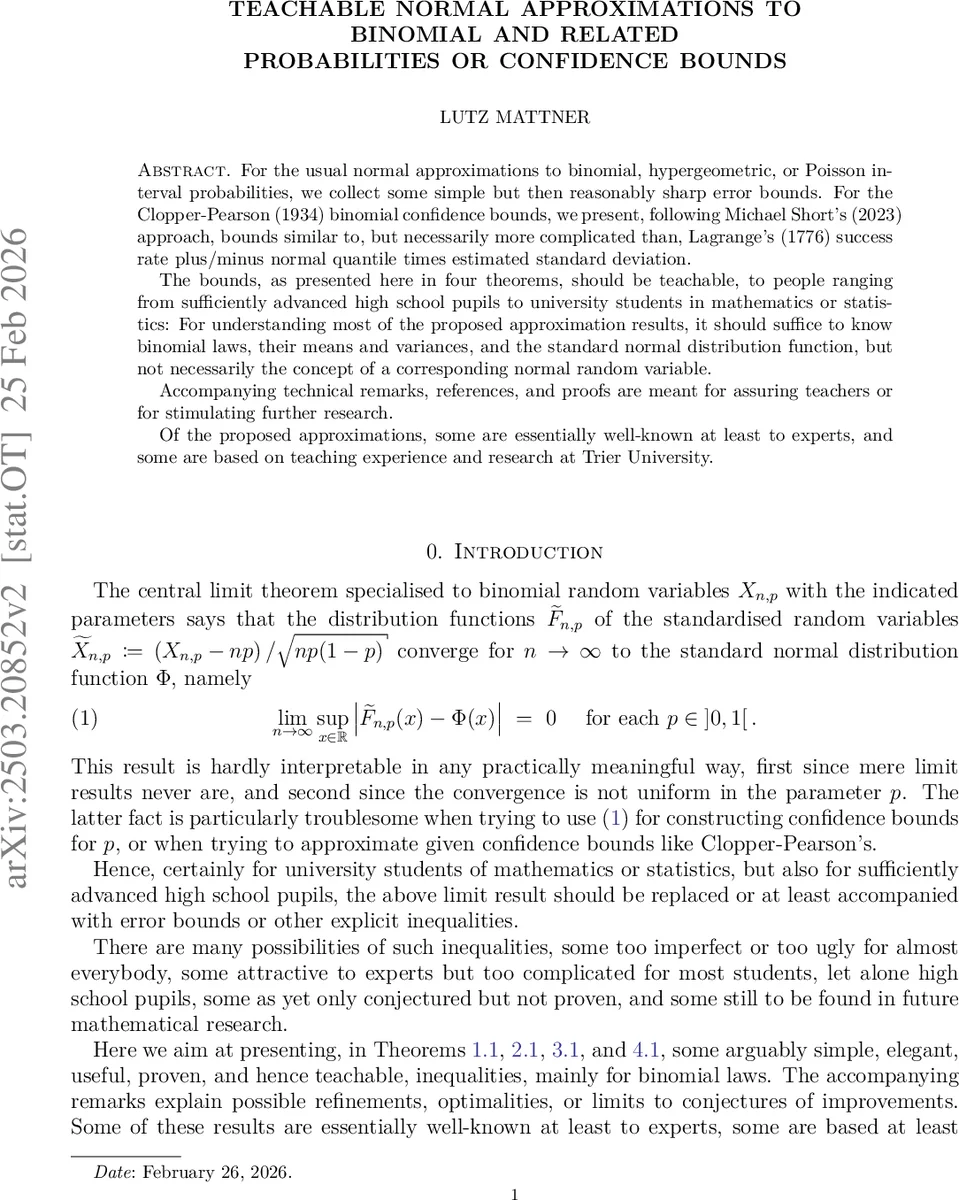
For the usual normal approximations to binomial, hypergeometric, or Poisson interval probabilities, we collect some simple but then reasonably sharp error bounds. For the Clopper-Pearson~(1934) binomial confidence bounds, we present, following Michael Short’s~(2023) approach, bounds similar to, but necessarily more complicated than, Lagrange’s (1776) success rate plus/minus normal quantile times estimated standard deviation. The bounds, as presented here in four theorems, should be teachable, to people ranging from sufficiently advanced high school pupils to university students in mathematics or statistics: For understanding most of the proposed approximation results, it should suffice to know binomial laws, their means and variances, and the standard normal distribution function, but not necessarily the concept of a corresponding normal random variable. Accompanying technical remarks, references, and proofs are meant for assuring teachers or for stimulating further research. Of the proposed approximations, some are essentially well-known at least to experts, and some are based on teaching experience and research at Trier University.
💡 Research Summary
The paper addresses a pedagogically important gap in the teaching of normal approximations for discrete distributions. While the Central Limit Theorem guarantees convergence of the standardized binomial, hypergeometric, and Poisson distributions to the standard normal, the limit statement alone is not useful for constructing confidence intervals or for practical calculations, especially because the convergence is not uniform in the underlying parameter p. The author therefore supplies explicit, easily understandable error bounds that can be taught from high‑school through university level without requiring deep measure‑theoretic machinery.
Four main theorems are presented.
Theorem 1.1 gives a universal bound for any of the three distributions. For an interval I=
Comments & Academic Discussion
Loading comments...
Leave a Comment