Yet another look at narrow escape through a tube
The narrow escape problem concerns the time needed for a diffusing particle to exit a confining domain through a small hole in the boundary. While this problem is now well-understood, determining the escape time for a particle that must exit through …
Authors: Victorya Richardson, Yick Hin Ling, Sean D Lawley
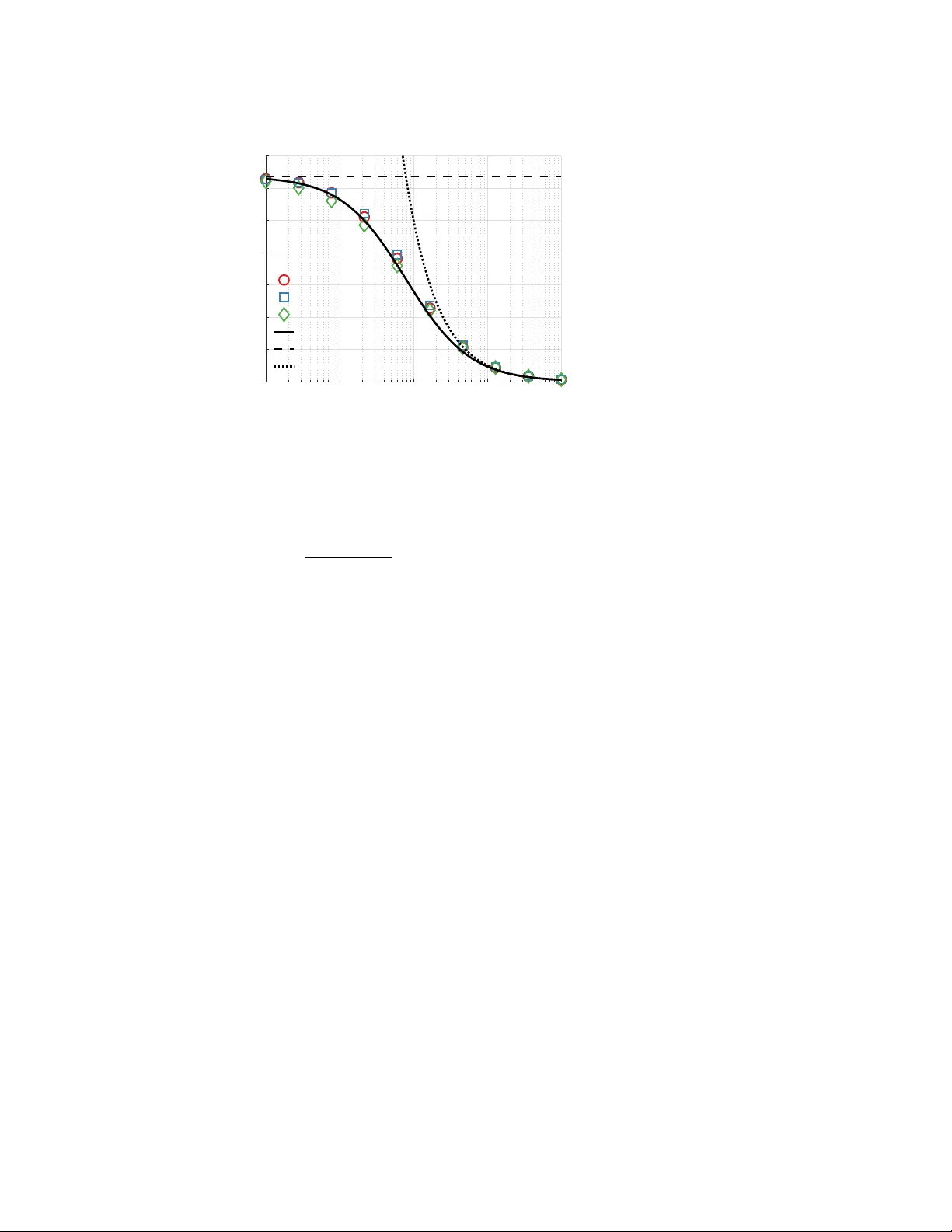
YET ANOTHER LOOK A T NARR O W ESCAPE THR OUGH A TUBE ∗ VICTOR Y A RICHARDSON † , YICK HIN LING ‡ , AND SEAN D. LA WLEY § Abstract. The narrow escape problem concerns the ti me needed for a diffusing particle to exit a confining domain through a small hole in the b oundary . While this problem is now well- understoo d, determining the escape time for a particle that must exit through a narrow tub e has prov en challenging. Indeed, relying on analogies with electro dynamics, parameter fits to simulations, and heuristics, a v ariety of conflicting estimates for this escape time hav e been offered o ver the last three decades, some of which are counterin tuitive and arguably non-physical. In this pap er, w e combine matc hed asymptotic analysis and probabilistic methods to determine the exact asymptotics of the narrow escape time through a tube. W e obtain a new escape time formula whic h reduces to the v arious prior estimates in certain special cases. If the diffusivit y in the tub e differs from the diffusivity in the rest of the domain, our results reveal the imp ortance of the form of the multiplicativ e noise inherent to any diffusivit y that v aries in space. W e discuss our results in the context of asymmetric cell division. 1. In tro duction. The narrow escape problem is to calculate the av erage time it tak es a diffusing particle to escap e from a b ounded domain through a small hole in an otherwise reflecting b oundary . Owing to (i) its many applications in physical, chemi- cal, and biological problems, and (ii) the rich mathematics en tailed in its analysis, the narro w escape problem has attracted great attention from applied mathematicians and physicists in the past tw o decades (see [ 2 , 10 , 14 , 15 , 16 , 18 , 24 , 25 , 28 , 30 , 31 , 35 ] as a sample). F or diffusion in three dimensions, this a verage escap e time is [ 14 , 15 ], E [ τ ] ∼ | Ω 0 | 4 D a as a/ | Ω 0 | 1 / 3 → 0 + , (1.1) where | Ω 0 | is the volume of the confining domain, D > 0 is the particle diffusivity , and the hole is a disk of radius a ≪ | Ω 0 | 1 / 3 . A series of works ha ve sought to determine the escap e time when the diffusing particle m ust pass through a tube to escap e (see Figure 1 for an illustration). Muc h of this work has b een in neuroscience [ 7 , 8 , 33 , 43 ], as researchers ha ve sought to understand how the diffusion of calcium ions and other molecules is regulated b y dendritic spine geometry (mo deled by a large head connected to the dendritic shaft b y a narrow cylindrical neck). A mathematically related problem is to understand the time it takes diffusing molecules to reach “buried sites” [ 5 , 37 , 51 , 52 ], whic h are mo deled as absorbing traps lo cated at the end of narrow tub es. In addition, though narro w escap e models typically assume that the particle has “escap ed” as so on as it en ters the hole in the b oundary , the escap e time through a tub e is relev ant if the particle must pass all the wa y through the hole to fully escap e (i.e. if the b oundary is not assumed to b e infinitesimally thin). Escap e through a tube is also highly relev an t to organisms undergoing closed mitosis. Budding yeast asymmetric segregation provides a clear example. During anaphase, the nucleus elongates into a dum bb ell shap e where tw o nuclear lob es are ∗ F unding: The first and third authors were supp orted by the National Science F oundation (DMS-2325258 and CAREER DMS-1944574). The second author was supp orted b y the Croucher F oundation. † Department of Mathematics, Universit y of Utah, Salt Lake City , UT 84112 USA. ‡ Department of Biology , Johns Hopkins Universit y , Baltimore, MD 21218 USA § Department of Mathematics, Universit y of Utah, Salt Lak e Cit y , UT 84112 USA ( lawley@math.utah.edu ). 1 2 VICTOR Y A RICHARDSON, YICK HIN LING, AND SEAN D. LA WLEY D 0 D 1 Fig. 1 . Diffusive p ath of a particle in a thr e e-dimensional domain c onsisting of a “bulk” volume c onne cte d to a tub e. The p article starts at the gr e en b al l and is eventual ly absorb e d at the r ed r e gion at the end of the tub e. The diffusivity is D 0 in the bulk and D 1 in the tub e connected b y a thin tub e, whic h is called the nuclear bridge [ 9 ]. This nuclear bridge main tains asymmetric conten t b et ween the mother and daughter compartments by limiting molecular exchange, whic h is imp ortan t for parental iden tity and asymmet- ric aging [ 39 ]. Notably , genetic mutan ts that alter bridge dimensions disrupt this asymmetry [ 9 ]. Determining the diffusiv e escap e time through a tube is th us es- sen tial for understanding ho w geometry con trols the balance b etw een diffusion and compartmen talization in biological systems. Indeed, it is not well understo o d how compartmen talization in asymmetric cell division depends on (i) pure geometry ver- sus (ii) hindered diffusion in the nuclear bridge (i.e. a slow er diffusivity in the n uclear bridge compared to the nuclear lob es) [ 9 , 50 ]. Despite its apparen t simplicity , determining the diffusiv e escap e time through a tub e has prov en challenging. Indeed, a v ariet y of different mathematical approxima- tions ha ve b een offered ov er the past three decades. F or a cylindrical tube of length L and radius a that connects to a “bulk” domain of v olume | Ω 0 | , the following escap e time was suggested in [ 43 ] using an analogy with electrical currents, E [ τ ] ≈ | Ω 0 | L π a 2 D , (1.2) where D is the diffusivity . The formula ( 1.2 ) was used in [ 43 ] and later in [ 33 ] and [ 8 ] to interpret neuronal activity data, but the v alidity of ( 1.2 ) was not inv estigated. F or this same geometry , the follo wing escap e time estimate was derived mathematically from a three-dimensional diffusion mo del [ 23 , 38 , 40 , 41 ], E [ τ ] ≈ | Ω 0 | 4 D a + L 2 2 D . (1.3) The estimate ( 1.3 ) assumes that the particle cannot return to the bulk Ω 0 after en tering the tub e, and th us the escap e time in ( 1.3 ) is the time to exit the bulk (i.e. | Ω 0 | / (4 D a ) in ( 1.1 )) plus the time to escap e a one-dimensional tube of length L (i.e. L 2 / (2 D )). Relaxing this simplifying ‘no return’ assumption, the following estimate w as later p osited in [ 7 ] b y summing ov er the num b er of times that the particle returns to the bulk, E [ τ ] ≈ 1 β | Ω 0 | L 4 D a 2 + L 2 2 D , (1.4) where β = 0 . 84 was obtained by fitting the functional form ( 1.4 ) to sto c hastic sim- ulations. Note that 4 β = 3 . 36 ≈ 1 . 07 π , and thus the first term in ( 1.4 ) differs from NARRO W ESCAPE THROUGH A TUBE 3 ( 1.2 ) by around 7%. It w as later shown in [ 3 ] that the sum of ( 1.2 ) and ( 1.3 ) agreed with some numerical estimates of E [ τ ] obtained by n umerically solving the diffusion equation describing the escape time with a finite element metho d. In fact, Ref. [ 3 ] gen- eralized the sum of ( 1.2 ) and ( 1.3 ) to allow the particle to ha v e different diffusivities in the bulk and the tub e, E [ τ ] ≈ | Ω 0 | L π a 2 D 1 + | Ω | 4 D 0 a + L 2 2 D 1 , (1.5) where D 0 is the diffusivity in the bulk and D 1 is the diffusivity in the tub e. The form ula in ( 1.5 ) was derived b y p ositing an elegant formalism in which (i) particles en ter the tub e from the bulk at exp onentially distributed times with mean given b y ( 1.1 ), (ii) particles mo ve in the tub e according to a one-dimensional diffusion equation, and (iii) particles can return to the bulk from the tube via a partially absorbing b oundary condition at their in terface. Reviewing the prior estimates in ( 1.2 )-( 1.5 ) raises several questions. Can the nar- ro w escap e time through a tub e b e determined more precisely? F or narrow escap e through a hole (rather than a tube), the estimate in ( 1.1 ) can be obtained b y studying the go verning three-dimensional diffusion equation via the method of matc hed asymp- totic expansions [ 15 ] or rigorous analytical metho ds [ 14 ] (and higher order corrections to ( 1.1 ) can b e obtained with similar systematic metho ds). In contrast, ( 1.2 )-( 1.5 ) rely on electrical analogies, heuristics, and/or parameter fits to n umerical sim ulations. F urthermore, can a single formula b e derived which remains v alid in parameter regimes where ( 1.2 )-( 1.5 ) break down? F or instance, the times in ( 1.2 ) and ( 1.4 ) b oth v anish if the tube length L v anishes, but the escape time should reduce to the “narro w hole” time | Ω 0 | / (4 D a ) in ( 1.1 ) in this limit. While ( 1.3 ) has the (presumably) correct asymptotic b ehavior when L v anishes, ( 1.3 ) diverges like 1 /a if the tub e radius a v an- ishes, whereas ( 1.2 ), ( 1.4 ), and ( 1.5 ) diverge like 1 /a 2 . F urthermore, the predictions of ( 1.5 ) are coun terintuitiv e if the bulk and tub e diffusivities are not equal (i.e. if D 0 = D 1 ). F or instance, ( 1.5 ) predicts that the bulk diffusivity D 0 is irrelev ant if the tub e radius a v anishes. In addition, one might exp ect the escap e time to reduce to L 2 /D 1 if D 0 → ∞ , but this con tradicts ( 1.5 ). F urthermore, supp ose the timescale of diffusion in the tube v anishes, L 2 /D 1 → 0. It is natural to exp ect the escape time to reduce to the narrow hole time | Ω 0 | / (4 D a ) in ( 1.1 ) in this limit, but the time in ( 1.5 ) could diverge in this limit (for instance, if L ∝ ε and D 1 ∝ ε 3 / 2 , then L 2 /D 1 → 0 but L/D 1 → ∞ for ε → 0, and thus the time in ( 1.5 ) diverges). Can these predictions of ( 1.5 ) b e correct? The purp ose of this pap er is to answer these questions. By combining matc hed asymptotic analysis [ 15 , 48 ] with probabilistic tec hniques, we determine the exact asymptotics of E [ τ ] as the tub e radius a v anishes compared to the lengthscales of the bulk Ω 0 (i.e. as a/ | Ω 0 | 1 / 3 → 0 as in ( 1.1 )) under v arious scalings of the tub e length L , bulk diffusivit y D 0 , and tube diffusivity D 1 . F urthermore, we suggest a single form ula that accurately appro ximates E [ τ ] for v anishing tub e radius a and arbitrary v alues of L , D 0 , and D 1 . If D 0 = D 1 , then our results dep end crucially on the parameter α ∈ [0 , 1] that sp ecifies the form of the multiplicativ e noise inheren t to an y diffusivity that dep ends on space. That is, if the diffusivit y changes from D 0 in the bulk to D 1 in the tube (with D 0 = D 1 ), then one m ust necessarily specify α ∈ [0 , 1]. The most common choices in the literature are α = 0 (Itˆ o calculus [ 26 ]) and α = 1 / 2 (Stratonovic h calculus [ 42 ]) [ 34 ]. The so-called “Itˆ o versus Stratonovic h” contro versy sparked debate for almost a decade, but it was ev entually settled that there is no universally “correct” choice of 4 VICTOR Y A RICHARDSON, YICK HIN LING, AND SEAN D. LA WLEY α [ 34 , 47 ]. That is, the parameter α ∈ [0 , 1] is part of the model and must b e c hosen on physical grounds [ 34 , 47 ]. W e now summarize our results. T o compare with ( 1.2 )-( 1.5 ), supp ose that the tub e is a cylinder with radius a and length L (though w e establish our results for tub es of general cross-sectional shap e). Assume that the particle starts in the bulk a wa y from the en trance to the tub e. Decompose the mean escap e time in to the mean residence time in the bulk, E [ τ 0 ], plus the mean residence time in the tub e, E [ τ 1 ], E [ τ ] = E [ τ 0 ] + E [ τ 1 ] . W e first show the exact equalit y E [ τ 1 ] = L 2 / (2 D 1 ). W e then deriv e the follo wing exact asymptotic escape time, E [ τ ] ∼ 1 C ( L/a, ( D 0 /D 1 ) α ) | Ω 0 | 2 π D 0 a + L 2 2 D 1 as a/ | Ω 0 | 1 / 3 → 0 , (1.6) where C = C ( L/a, ( D 0 /D 1 ) α ) is determined by a certain “inner problem” that arises in the matc hed asymptotic analysis. In w ords, C ( L/a, ( D 0 /D 1 ) α ) is the “capacitance” of a unit disk that is in a “pit” of depth L/a b elow a reflecting surface, where the diffusivit y is D 0 ab o ve the pit and D 1 in the pit, and the change in diffusivity is in ter- preted with parameter α ∈ [0 , 1]. W e further obtain the follo wing exact asymptotics of C , C ( L/a, ( D 0 /D 1 ) α ) → 2 /π as ρ → 0 , (1.7) C ( L/a, ( D 0 /D 1 ) α ) ∼ 1 / (2 ρ ) as ρ → ∞ , (1.8) where the dimensionless parameter ρ := ( L/a )( D 0 /D 1 ) α > 0 com bines the tub e asp ect ratio L/a and the change in diffusivity ( D 0 /D 1 ) α . If α = 0, notice that we can ha ve ρ ≪ 1 if the tube is short ( L/a ≪ 1) and/or has fast diffusivit y (( D 0 /D 1 ) α ≪ 1). Similarly , if α = 0, then w e can hav e ρ ≫ 1 if the tub e is long and/or has slow diffusivity . Combining ( 1.6 ) with ( 1.7 )-( 1.8 ) yields the mean escap e time estimates E [ τ ] ≈ | Ω 0 | 4 D 0 a + L 2 2 D 1 if a/ | Ω 0 | 1 / 3 ≪ 1 , ρ ≪ 1 , E [ τ ] ≈ | Ω 0 | L π a 2 D 1 − α 0 D α 1 + L 2 2 D 1 if a/ | Ω 0 | 1 / 3 ≪ 1 , ρ ≫ 1 . F urthermore, we use kinetic Mon te Carlo simulations to show that C ( L/a, ( D 0 /D 1 ) α ) is w ell-approximated by the following sigmoidal function whic h in terp olates betw een the tw o limits in ( 1.7 )-( 1.8 ), C ( L/a, ( D 0 /D 1 ) α ) ≈ 2 /π 1 + (4 /π ) ρ , for all ρ > 0 . (1.9) Com bining ( 1.9 ) with ( 1.6 ) yields the following mean escap e time estimate that is accurate for all ρ > 0 as a/ | Ω 0 | 1 / 3 v anishes, E [ τ ] ≈ | Ω 0 | L π a 2 D 1 − α 0 D α 1 + | Ω 0 | 4 D 0 a + L 2 2 D 1 if a/ | Ω 0 | 1 / 3 ≪ 1 . NARRO W ESCAPE THROUGH A TUBE 5 The rest of the pap er is organized as follo ws. Section 2 is devoted to the afore- men tioned inner problem. Section 2 contains the inner problem’s (i) formulation as a partial differential equation (PDE) b oundary v alue problem, (ii) probabilistic repre- sen tation, (iii) asymptotics, and (iv) comparison to kinetic Mon te Carlo sim ulations. Relying on this inner problem analysis, Section 3 uses matched asymptotics [ 15 , 48 ] to study the narrow escap e time through a tub e. W e conclude in section 4 by (a) describing relations to previous work, including the prior estimates in ( 1.2 )-( 1.5 ) and partially absorbing traps [ 13 , 17 , 18 , 19 , 20 , 21 ], and (b) discussing our results in the con text of asymmetric protein segregation in closed mitosis. 2. Inner problem. W e now present some probabilistic analysis of a certain PDE b oundary v alue problem. This problem arises in our study of the “inner problem” in the matched asymptotic analysis in section 3 b elow. 2.1. PDE. Fix a depth δ ∈ (0 , ∞ ) and a simply connected op en set Γ ∈ R 2 with b oundary ∂ Γ and finite area | Γ | ∈ (0 , ∞ ). W e are most interested in the case that Γ is a disk, but we can perform most of our analysis for more general shap es. Supp ose that u = u ( x, y, z ) satisfies ∆ u = 0 , { ( x, y , z ) ∈ R 3 : x > 0 } ∪ { ( x, y , z ) ∈ ( − δ, 0) × Γ } , u = 1 , x = − δ, ( y , z ) ∈ Γ , ∂ x u = 0 , x = 0 , ( y , z ) / ∈ Γ , ∂ n u = 0 , x ∈ ( − δ, 0) , ( y, z ) ∈ ∂ Γ , (2.1) where ∆ = ∂ xx + ∂ y y + ∂ z z is the Laplacian and ∂ n is the out ward normal deriv ative to ∂ Γ. In words, the function u is harmonic in the union of upp er half space with a “tub e” or “pit” of depth δ ≥ 0 and cross-sectional shape Γ. F urthermore, u satisfies a unit Dirichlet b oundary condition at the b ottom of the pit and reflecting b oundary conditions everywhere else. Using f ( y ± ) := lim x → y ± f ( x ) to denote one-sided limits, w e further imp ose the follo wing con tinuit y conditions [ 11 , 46 ], u (0 − , y , z ) = u (0 + , y , z ) , ( y , z ) ∈ Γ , D α 1 ∂ x u (0 − , y , z ) = D α 0 ∂ x u (0 + , y , z ) , ( y , z ) ∈ Γ , (2.2) for given diffusivities D 0 > 0 and D 1 > 0 and a giv en multiplicativ e noise parameter α ∈ [0 , 1]. 2.2. Probabilistic in terpretation. The solution u = u ( x ) = u ( x, y , z ) of ( 2.1 )- ( 2.2 ) is the probability that a diffusing particle that starts at x = ( x, y , z ) will even tu- ally hit the b ottom of the tub e. More precisely , consider a path X = { X ( t ) } t ≥ 0 that reflects from the b oundary of the domain in ( 2.1 ) and diffuses according to the fol- lo wing sto chastic differen tial equation written in term of its infinitesimal increments, X ( t + d t ) = X ( t ) + p 2 D ( X ∗ ) d W , where W = { W ( t ) } t ≥ 0 is a standard three-dimensional Brownian motion, D : R 3 7→ (0 , ∞ ) is a given space-dep endent diffusivit y , and X ∗ is the following weigh ted av erage of X ( t ) and X ( t + d t ), X ∗ = (1 − α ) X ( t ) + α X ( t + d t ) , 6 VICTOR Y A RICHARDSON, YICK HIN LING, AND SEAN D. LA WLEY for a given parameter α ∈ [0 , 1]. Imp ortantly , the path X dep ends on the choice of α ∈ [0 , 1] (unless the diffusivity is constant D ( x ) ≡ D ). Common c hoices are α = 0 (Itˆ o), α = 1 / 2 (Stratono vich), and α = 1 (isothermal). The probabilit y density p ( x, y , z , t ) = P ( X ( t ) = ( x, y , z )) d x d y d z ev olves according to the follo wing forw ard F okk er-Planck equation [ 11 , 46 ], ∂ t p = ∇ · [ D α ∇ · [ D 1 − α p ]] . If we take the diffusivit y to be D 0 outside the tube and D 1 inside the tube, D ( x, y , z ) = ( D 0 if x > 0 , D 1 if x < 0 , ( y , z ) ∈ Γ , then the solution u = u ( x, y , z ) = u ( x ) of ( 2.1 ) is u ( x ) = P ( τ < ∞ | X (0) = x ) , where τ := inf { t ≥ 0 : X ( t ) ∈ {− δ } × Γ } is the first time that X hits the b ottom of the tub e. 2.3. F ar-field b ehavior. W e claim that u has the following monop ole decay at far-field, u ∼ C (Γ , δ, ( D 0 /D 1 ) α ) p x 2 + y 2 + z 2 as p x 2 + y 2 + z 2 → ∞ , (2.3) for a function C = C (Γ , δ, ( D 0 /D 1 ) α ) of the depth δ , shap e Γ, and ratio ( D 0 /D 1 ) α . The monop ole C in ( 2.3 ) can b e interpreted as the “electrostatic capacitance” of the shap e Γ that is buried in a pit of depth δ > 0, where the diffusivit y c hanges from D 0 to D 1 up on entering the pit, and this change in diffusivit y is interpreted via α ∈ [0 , 1]. T o see that ( 2.3 ) holds, note first that the strong Marko v property implies that P ( τ < ∞ | X (0) = x ) = P ( τ R < ∞ | X (0) = x ) Z ∂ H R u ( x ′ ) ρ R ( x ′ | x ) d x ′ , ∥ x ∥ > R, (2.4) where τ R := inf { t ≥ 0 : X ( t ) ∈ H R } is the first time that X hits the hemisphere H R := { ( x ′ , y ′ , z ′ ) ∈ R 3 : ∥ ( x ′ , y ′ , z ′ ) ∥ < R, x ′ > 0 } , (2.5) whose radius is an ything large enough that it encapsulates the top of the pit (i.e. y 2 + z 2 < R 2 for all ( y , z ) ∈ Γ), and ρ R ( x ′ | x ) is the distribution of first hitting p osition to the b oundary of the hemisphere ∂ H R for a particle starting from x (conditioned that the particle hits H R ). It is w ell-kno wn that P ( τ 0 < ∞ | X (0) = x ) is a harmonic function of x that v anishes as ∥ x ∥ → ∞ and is equal to unity if ∥ x ∥ = R . Hence, P ( τ 0 < ∞ | X (0) = x ) = R ∥ x ∥ , if ∥ x ∥ ≥ R > 0 . NARRO W ESCAPE THROUGH A TUBE 7 T aking ∥ x ∥ → ∞ in ( 2.4 ) yields ( 2.3 ). F urthermore, it follows from symmetry that as ∥ x ∥ → ∞ , the hitting distribution ρ R ( x ′ | x ) b ecomes uniform on the upp er part of the b oundary of the hemisphere, ∂ H + R := { ( x ′ , y ′ , z ′ ) ∈ R 3 : ∥ ( x ′ , y ′ , z ′ ) ∥ = R, x ′ ≥ 0 } . Th us, taking ∥ x ∥ → ∞ in ( 2.4 ) implies that ( 2.3 ) holds with monop ole given in terms of the follo wing in tegral of u ov er the surface ∂ H + R , C = C (Γ , δ, ( D 0 /D 1 ) α ) = R 1 2 π R 2 Z ∂ H + R u d S . (2.6) W e use the relation ( 2.6 ) in section 2.6 to estimate C (Γ , δ , ( D 0 /D 1 ) α ) from sto c hastic sim ulations of X that start uniformly distributed on ∂ H + R . Note also that ( 2.6 ) gives the following simple b ound since u ≤ 1, C = C (Γ , δ, ( D 0 /D 1 ) α ) ≤ R for all δ ≥ 0 , ( D 0 /D 1 ) α > 0 . (2.7) 2.4. Inner problem asymptotics. W e now use probability theory to determine the asymptotics of the monop ole C (Γ , δ, ( D 0 /D 1 ) α ). W e used a simpler v ersion of this argument in the App endix of [ 36 ] for the case that D 0 = D 1 and Γ is a square. Consider X starting uniformly distributed in the lateral directions of Γ at a “heigh t” x ∈ [ − δ, ∞ ), u ( x ) := 1 | Γ | Z Γ u ( x, y , z ) d y d z . If x ∈ [ − δ, 0) (i.e. the height is b elo w the surface), then it follo ws from the strong Mark ov prop ert y and splitting probabilities for a one-dimensional Bro wnian motion that u ( x ) = | x | /δ + (1 − | x | /δ ) u (0) , if x ∈ [ − δ, 0) . (2.8) In words, the first term in the right hand side of ( 2.8 ) is the probability that the particle hits the b ottom of the pit b efore hitting the top of the pit. The second term is the complementary probabilit y , 1 − | x | /δ , multiplied by the probabilit y that the particle even tually hits the b ottom of the pit having started at the top of the pit, u (0). Imp ortantly , since the particle is initially uniformly distributed in the lateral directions of Γ, this distribution remains uniform until exiting the pit. Differentiating ( 2.8 ) in x yields ∂ x u ( x ) = − (1 − u (0)) /δ < 0 , if x ∈ [ − δ, 0) . (2.9) Let H R ∈ R 3 b e the hemisphere in ( 2.5 ). Integrating ∆ u ov er H R and using ( 2.1 ) and the div ergence theorem yields 0 = Z H R ∆ u d V = Z ∂ H + R ∂ n u d S − Z Γ ∂ x u (0 + , y , z ) d y d z , (2.10) where we hav e used the reflecting b oundary conditions in ( 2.1 ) to eliminate the b ound- ary integrals on the reflecting parts of the b oundary . The far-field b ehavior in ( 2.3 ) implies that as R → ∞ , the surface integral ov er ∂ H + R in ( 2.10 ) limits to Z ∂ H + R ∂ n u d S ∼ (2 π R 2 ) − C R 2 = − 2 π C as R → ∞ . (2.11) 8 VICTOR Y A RICHARDSON, YICK HIN LING, AND SEAN D. LA WLEY T o determine the second term in ( 2.10 ), w e use the second contin uity condition in ( 2.2 ) to obtain Z Γ ∂ x u (0 + , y , z ) d y d z = D − α 0 D α 1 Z Γ ∂ x u (0 − , y , z ) d y d z = D − α 0 D α 1 | Γ | ∂ x u (0 − ) = − D − α 0 D α 1 | Γ | (1 − u (0)) /δ, (2.12) where we hav e interc hanged differen tiation and in tegration to obtain the second equal- it y and used ( 2.9 ) to obtain the third equality . Com bining ( 2.10 ), ( 2.11 ), and ( 2.12 ) yields 0 = − 2 π C + D − α 0 D α 1 | Γ | (1 − u (0)) /δ, and rearranging yields the following exact represen tation for the monop ole C in ( 2.3 ), C = C (Γ , δ, ( D 0 /D 1 ) α ) = | Γ | (1 − u (0)) 2 π ( D 0 /D 1 ) α 1 δ . (2.13) Though ( 2.13 ) is an exact equation that holds for all δ > 0, we do not know the v alue of u (0) or its exact dep endence on δ , Γ, and ( D 0 /D 1 ) α . How ever, w e can use ( 2.13 ) to determine the asymptotics of C = C (Γ , δ, ( D 0 /D 1 ) α ). 2.4.1. T aking ρ := ( D 0 /D 1 ) α δ → 0 . First, supp ose w e tak e ρ := ( D 0 /D 1 ) α δ → 0 in ( 2.13 ). Since C is b ounded by ( 2.7 ), the relation ( 2.13 ) ensures that u (0) = 1 | Γ | Z Γ u (0 , x, y ) d y d z → 1 as ρ := ( D 0 /D 1 ) α δ → 0 . Since u ≤ 1, w e th us hav e p oin twise conv ergence, u (0 , y , z ) → 1 as ρ → 0 for all ( y , z ) ∈ Γ . (2.14) F urthermore, com bining the strong Mark ov prop erty with ( 2.6 ) implies that C R = 1 2 π R 2 Z ∂ H + R u d S = C 0 (Γ) R Z Γ u (0 , y , z ) p R ( y , z ) d y d z , (2.15) where p R is the probability distribution of where the particle hits Γ, given that the particle hits Γ after starting uniformly distributed on ∂ H + R , and C 0 (Γ) = C (Γ , 0 , 1) is the electrostatic capacitance of Γ. That is, C 0 (Γ) is given in terms of the probability that the particle hits Γ giv en that it starts uniformly on a hemisphere containing Γ, C 0 (Γ) = R P τ Γ < ∞ | X (0) = d uniform( ∂ H + R ) , (2.16) where τ Γ := inf { t ≥ 0 : X ( t ) ∈ { 0 } × Γ } is the first hitting time to Γ. T aking ρ → 0 in ( 2.15 ) and using ( 2.14 ) yields the small ρ asymptotics of C , C = C (Γ , δ, ( D 0 /D 1 ) α ) → C 0 (Γ) as ρ := ( D 0 /D 1 ) α δ → 0 . (2.17) 2.4.2. T aking ρ := ( D 0 /D 1 ) α δ → ∞ . T o obtain the large ρ asymptotics of C , w e first claim that u (0 , y , z ) → 0 as ρ := ( D 0 /D 1 ) α δ → ∞ for all ( y , z ) ∈ Γ . (2.18) NARRO W ESCAPE THROUGH A TUBE 9 T o prov e ( 2.18 ), consider a one-dimensional diffusion pro cess with space-dep endent diffusivit y D ( x ) = D 0 > 0 if x > 0 and D ( x ) = D 1 > 0 if x < 0, where the c hange in diffusivity at x = 0 is interpreted with multiplicativ e noise parameter α . If P ( x 0 ) = P ( x 0 ; δ, η ) is the probabilit y that the pro cess reaches x = − δ < 0 b efore x = η > 0 giv en that it starts at x 0 ∈ [ − δ, η ], then P ( x 0 ) satisfies P ′′ = 0 , if x ∈ ( − δ, 0) ∪ (0 , η ) , with contin uity conditions at x = 0, P (0 − ) = P (0 + ) , D α 0 P ′ (0 − ) = D α 1 P ′ (0 + ) , and b oundary conditions P ( − δ ) = 1 and P ( η ) = 0. Hence, P ( x 0 ) = ( 1 − 1+ x/δ 1+ η /ρ if x ∈ [ − δ, 0] , 1 − x/η 1+ ρ/η if x ∈ [0 , η ] , (2.19) where ρ = ( D 0 /D 1 ) α δ > 0. Let τ 0 = inf { t ≥ 0 : X ( t ) ∈ {− δ, η }} b e the first time that X hits either x = − δ < 0 or x = η > 0. The strong Mark o v prop erty implies that u (0 , y , z ) ≤ P ( X ( τ 0 ) = − δ | X (0) = (0 , y , z )) + sup ( y ′ ,z ′ ) u ( η , y ′ , z ′ ) ≤ P (0) + sup ( y ′ ,z ′ ) u ( η , y ′ , z ′ ) . (2.20) No w, the deca y in ( 2.3 ) ensures that lim η →∞ sup ( y ′ ,z ′ ) ∈ R 2 u ( η , y ′ , z ′ ) = 0 . Therefore, taking η = √ ρ → ∞ in ( 2.20 ) and using that P (0) = 1 / (1 + ρ/η ) from ( 2.19 ) yields ( 2.18 ). T aking ρ := ( D 0 /D 1 ) α δ → ∞ in ( 2.13 ) and using ( 2.18 ) yields the follo wing asymptotics of C , C (Γ , δ, ( D 0 /D 1 ) α ) ∼ | Γ | 2 π ( D 0 /D 1 ) α 1 δ = | Γ | 2 π ρ as ρ := ( D 0 /D 1 ) α δ → ∞ . (2.21) Note that the shap e Γ affects ( 2.21 ) solely via its area | Γ | . 2.5. Sigmoid approximation. Ha ving determined the small ρ and large ρ asymptotics of C in ( 2.17 ) and ( 2.21 ), w e prop ose the follo wing heuristic sigmoid appro ximation to C which interpolates b etw een these t wo limits, C (Γ , δ, ( D 0 /D 1 ) α ) ≈ C sigmoid (Γ , ρ ) := C 0 (Γ) 1 + 2 π ρC 0 (Γ) / | Γ | , ρ := ( D 0 /D 1 ) α δ ≥ 0 , (2.22) where C 0 (Γ) = C (Γ , 0 , 1) is the electrostatic capacitance of Γ in ( 2.16 ), which is kno wn for some choices of the shap e Γ. F or instance, if Γ is a disk of area | Γ | = π r 2 , then [ 27 ] C 0 (Γ) = 2 r π if Γ = { ( y , z ) : y 2 + z 2 < r 2 } , 10 VICTOR Y A RICHARDSON, YICK HIN LING, AND SEAN D. LA WLEY 10 ! 2 10 ! 1 10 0 10 1 10 2 ; = ( D 0 =D 1 ) , / 0 0.1 0.2 0.3 0.4 0.5 0.6 0.7 C , = 0 , = 1, D 0 < D 1 , = 1, D 0 > D 1 sigmoid 2 = : 1 = (2 ; ) Fig. 2 . The markers show estimates of C in ( 2.3 ) compute d fr om KMC simulations for the c ase that Γ is the unit disk. The solid curve is the sigmoid appr oximation in ( 2.23 ) . and thus C sigmoid (Γ , ρ ) = (2 /π ) r 1 + (4 /π ) ρ/r if Γ = { ( y , z ) : y 2 + z 2 < r 2 } , (2.23) Though the sigmoid approximation C sigmoid in ( 2.22 ) has the correct large and small δ b ehavior, the interpolation betw een these asymptotics is heuristic. Neverthe- less, w e show b elow using sto chastic simulations that C sigmoid accurately appro ximates C (Γ , δ, ( D 0 /D 1 ) α ) for all δ ≥ 0 if Γ is a disk. 2.6. KMC simulations. Figure 2 plots estimates of the monop ole C in ( 2.3 ) computed from KMC simulations for the case that Γ is the unit disk. Each marker is the result of 10 5 indep enden t sto chastic paths. The details of the sto chastic simulation algorithm are in the App endix. The mark ers lab eled “ α = 0” in Figure 2 are for Itˆ o multiplicativ e noise, and the v alues of D 0 and D 1 are irrelev ant. The markers lab eled “ α = 1” in Figure 2 are for isothermal multiplicativ e noise, and for either D 0 /D 1 = 10 or D 0 /D 1 = 1 / 10. The solid curv e is the sigmoid appro ximation in ( 2.23 ), which agrees well with the sim ulations. F or the case of a partially reactive trap with reactivit y κ (rather than a “buried” trap at depth δ ), the sigmoid formula in ( 2.23 ) with ( D 0 /D 1 ) α δ replaced by 1 /κ was previously p osited in [ 4 ], and a similar interpolation formula was suggested b y Zwanzig and Szab o [ 53 ]. 3. Narro w escape through a tub e. W e now combine our analysis in section 2 with matched asymptotics to determine the narro w escape time through a tub e. 3.1. Constructing the domain. Let Ω ′ 0 ⊂ R 3 b e a b ounded, three-dimensional domain with a smo oth b oundary ∂ Ω ′ 0 . W e no w attac h a “tub e” Ω ′ 1 to the “bulk” Ω ′ 0 . Let x 1 ∈ ∂ Ω ′ 0 and choose our Cartesian co ordinate system ( x, y , z ) ∈ R 3 so that the origin is x 1 = (0 , 0 , 0), with x along the normal v ector from x 1 (with x < 0 p oin ting outside Ω ′ 0 ) and ( y , z ) ∈ R 2 sp ecifying p oints in the tangent plane to ∂ Ω ′ 0 at x 1 . Let Γ ∈ R 2 b e a simply connected op en set containing the origin with diameter NARRO W ESCAPE THROUGH A TUBE 11 diam(Γ) = 2 > 0. Let a Γ := { ( y , z ) ∈ R 2 : ( y /a, z /a ) ∈ Γ } b e a rescaling of Γ so that diam( a Γ) = 2 a . Define Ω ′ 1 := { ( x, y , z ) ∈ R 3 : x ∈ ( − L, ξ ) , ( y , z ) ∈ a Γ } , for some L > 0, where ξ ≥ 0 is suc h that { ( x, y , z ) ∈ R 3 : x = ξ , ( y , z ) ∈ a Γ } ⊂ Ω ′ 0 . (3.1) In words, ξ ≥ 0 in ( 3.1 ) is large enough so that the tub e Ω ′ 1 stic ks into Ω ′ 0 , but not so large that it p ok es out of Ω ′ 0 . Note that we can alwa ys take a > 0 small enough to ensure that ( 3.1 ) holds for some ξ ≥ 0. Assume that Ω ′ 0 ∩ Ω ′ 1 is simply connected for all a > 0, whic h ensures that the tub e Ω ′ 1 do es not in tersect the domain Ω ′ 0 in more than one place. Finally , define a new “tub e” Ω 1 and a new “bulk” Ω 0 so that their interface is flat and lies in the x = 0 plane, Ω 1 := Ω ′ 1 \{ ( x, y , z ) ∈ R 3 : x ≥ 0 } , Ω 0 := { Ω ′ 0 ∪ Ω ′ 1 }\ Ω 1 . (3.2) 3.2. Diffusion pro cess. Consider a path X = { X ( t ) } t ≥ 0 of a particle that diffuses in the union of the bulk and the tube, Ω := Ω 0 ∪ Ω 1 , according to the follo wing sto c hastic differential equation written in terms of its infinitesimal increments X ( t + d t ) = X ( t ) + p 2 D ( X ∗ ) d W , (3.3) where D : R 3 7→ (0 , ∞ ) is a given space-dependent diffusivity , W = { W ( t ) } t ≥ 0 is a standard three-dimensional Bro wnian motion, and X ∗ in terp olates b etw een X ( t ) and X ( t + d t ), X ∗ = (1 − α ) X ( t ) + α X ( t + d t ) , for a given multiplicativ e noise parameter α ∈ [0 , 1]. Recall that α = 0, α = 1 / 2, and α = 1 corresp ond resp ectively to the Itˆ o, Stratono vic h, and isothermal in terpretations of the m ultiplicative noise in ( 3.3 ). Supp ose the particle has absorbing b oundary conditions at the b ottom of the tub e, ∂ Ω a := { ( x, y , z ) ∈ R 3 : x = − L, ( y , z ) ∈ a Γ } , and reflecting boundary conditions on the rest of the b oundary , ∂ Ω r = ∂ Ω \ ∂ Ω a . Let τ b e the random absorption time, τ := inf { t ≥ 0 : X ( t ) ∈ ∂ Ω a } = τ 0 + τ 1 , whic h we hav e decomp osed into the resp ective residence times in Ω 0 and Ω 1 , τ 0 := Z τ 0 1 X ( t ) ∈ Ω 0 d t, τ 1 := Z τ 0 1 X ( t ) ∈ Ω 1 d t, where 1 A denotes the indicator function on the even t A (i.e. 1 A = 1 if A o ccurs and 1 A = 0 otherwise). 12 VICTOR Y A RICHARDSON, YICK HIN LING, AND SEAN D. LA WLEY Let v ( x ) denote the mean residence time in Ω 0 conditioned on the starting position X (0) = x , v ( x ) = E [ τ 0 | X (0) = x ] . The mean residence time satisfies the follo wing P oisson equation with mixed Diric hlet- Neumann b oundary conditions [ 11 , 46 ], D 1 − α ∇ · [ D α ∇ v ] = − 1 x ∈ Ω 0 , x ∈ Ω , ∂ n v = 0 , x ∈ ∂ Ω r , v = 0 , x ∈ ∂ Ω a , (3.4) where ∂ n denotes the normal deriv ative. Supp ose that the space-dependent diffusion coefficient D ( x ) is D 0 in the bulk and D 1 in the tube, D ( x ) = ( D 0 if x ∈ Ω 0 , D 1 if x ∈ Ω 1 . Hence, the boundary v alue problem ( 3.4 ) b ecomes D 0 ∆ v = − 1 x ∈ Ω 0 , x ∈ Ω , ∂ n v = 0 , x ∈ ∂ Ω r , v = 0 , x ∈ ∂ Ω a , (3.5) with the condition that v ( x ) and D ( x ) α ∇ v ( x ) are con tinuous at the in terface of the bulk and the tub e, v (0 + , y , z ) = v (0 − , y , z ) , ( y , z ) ∈ a Γ , D α 0 ∂ x v (0 + , y , z ) = D α 1 ∂ x v (0 − , y , z ) , ( y , z ) ∈ a Γ . (3.6) 3.3. T ub e residence ti me. Before studying the residence time τ 0 in the bulk Ω 0 , we first consider the residence time τ 1 in the tub e Ω 1 . Since we defined Ω 0 and Ω 1 in ( 3.2 ) so that their interface is flat, it follows that the residence time τ 1 in the tub e Ω 1 can b e obtained by studying a mere one-dimensional diffusion pro cess. In particular, τ 1 is equal in distribution to the absorption time of a one-dimensional diffusion pro cess e X in the interv al [ − L, 0] with diffusivity D 1 > 0, an absorbing b ound- ary condition at − L , and a reflecting b oundary condition at 0. The initial p osition of e X is either 0 if X (0) ∈ Ω 0 or x if X (0) = ( x, y , z ) ∈ Ω 1 . Hence, it is straightforw ard to obtain the full probability distribution of τ 1 . How ever, for our purp oses, we need only the mean residence time, whic h is E [ τ 1 | X (0) = x = ( x, y , z )] = ( L 2 / (2 D 1 ) if x ∈ Ω 0 , ( L − | x | )( L + | x | ) / (2 D 1 ) if x ∈ Ω 1 . (3.7) W e emphasize that ( 3.7 ) is exact. 3.4. Matc hed asymptotic analysis. W e now use matc hed asymptotic analysis to study the solution to ( 3.5 ) as the tub e radius v anishes. The analysis follows [ 15 ] and is related to the strong lo calized p erturbation analysis pioneered in [ 49 ]. NARRO W ESCAPE THROUGH A TUBE 13 W e first nondimensionalize the problem by rescaling space by the lengthscale of the bulk domain, | Ω 0 | 1 / 3 , so that the tube now has cross-section diameter diam( ε Γ) = 2 ε > 0 and length L/ | Ω 0 | 1 / 3 = εL/a > 0, where ε = a/ | Ω 0 | 1 / 3 ≪ 1 . W e further rescale time so that the particle has unit diffusivity in the bulk domain and diffusivity D 1 /D 0 in the tube. In the region in Ω 0 a wa y from an O ( ε ) neighborho o d of the tub e, w e expand the outer solution as v ∼ ε − 1 v 0 + v 1 + · · · , (3.8) where v 0 is an unknown constant and v 1 is a function of x . Substituting ( 3.8 ) in to ( 3.5 ) and matc hing the O (1) terms yields ∆ v 1 = − 1 , x ∈ Ω 0 , (3.9) ∂ n v 1 = 0 , x ∈ ∂ Ω 0 \ x 1 . (3.10) Notice that from the persp ective of the outer solution, the tube has shrunk to a p oint. In the region near the tub e, we in tro duce the inner v ariables around x 1 = (0 , 0 , 0), x ′ := ε − 1 ( x − x 1 ) = ε − 1 x , w ( x ′ ) := v ( x 1 + ε x ′ ) = v ( ε x ′ ) . Applying the Laplacian in x ′ to the inner solution expansion w ∼ ε − 1 w 0 yields ∆ w 0 = 0 , { ( x ′ , y ′ , z ′ ) ∈ R 3 : x ′ > 0 } ∪ { ( x ′ , y ′ , z ′ ) ∈ [0 , − δ ) × Γ } , w 0 = 0 , x ′ = − L/a, ( y ′ , z ′ ) ∈ Γ , ∂ x ′ w 0 = 0 , x ′ = 0 , ( y ′ , z ′ ) / ∈ Γ , ∂ n w 0 = 0 , x ′ ∈ ( − L/a, 0) , ( y ′ , z ′ ) ∈ ∂ Γ , where Γ has diameter diam(Γ) = 2. F urthermore, the contin uity conditions on v in ( 3.6 ) imply that w 0 satisfies the con tinuit y conditions in ( 2.2 ). The matc hing condition ensures that the near-field b ehavior of the outer solution as x → x 1 agrees with the far-field b ehavior of the inner solution, ε − 1 v 0 + v 1 + · · · ∼ ε − 1 w 0 + · · · . (3.11) Therefore, if u solves ( 2.1 )-( 2.2 ) with depth δ = L/a , then w 0 = v 0 (1 − u ) . (3.12) The far-field b ehavior in ( 2.3 ), the relation ( 3.12 ), and the matching condition ( 3.11 ) yields the following singularity condition on v 1 , v 1 ∼ − v 0 C ( L/a, Γ , ( D 0 /D 1 ) α ) ∥ x − x n ∥ as x → x 1 . (3.13) Using the div ergence theorem, the solv ability condition for ( 3.9 )-( 3.10 ) with the sin- gularit y in ( 3.13 ) is − 1 = − 2 π v 0 C , and therefore v 0 = 1 2 π C ( L/a, Γ , ( D 0 /D 1 ) α ) . (3.14) 14 VICTOR Y A RICHARDSON, YICK HIN LING, AND SEAN D. LA WLEY Recalling that v ∼ ε − 1 v 0 from ( 3.8 ), the leading order b ehavior of the (dimensionless) exp ected residence time τ 0 in Ω 0 is v ( x ) = E [ τ 0 | X (0) = x ] ∼ 1 2 π εC ( L/a, Γ , ( D 0 /D 1 ) α ) as ε → 0 , (3.15) whic h is v alid for initial p ositions x ∈ Ω 0 whic h are outside of an O ( ε ) neigh b orho o d of the en trance to the tube. 3.5. Escap e time. W e no w use the analysis ab o ve to in vestigate the mean es- cap e time. Putting the bulk residence time ( 3.15 ) in dimensional form (i.e. dividing b y D 0 / | Ω 0 | 2 / 3 and recalling that ε = a/ | Ω 0 | 1 / 3 ) and com bining with the tub e residence time in ( 3.7 ) yields the follo wing mean escap e time asymptotic, E [ τ ] ∼ | Ω 0 | 2 π aD 0 1 C ( L/a, Γ , ( D 0 /D 1 ) α ) + L 2 2 D 1 as a/ | Ω 0 | 1 / 3 → 0 , (3.16) whic h is v alid for an y starting lo cation x ∈ Ω 0 whose distance from the tube is m uch greater than the tub e cross-section diameter (i.e. ∥ x ∥ ≫ diam( a Γ) = 2 a ). W e now inv estigate ( 3.16 ) using the analysis of C = C ( L/a, Γ , ( D 0 /D 1 ) α ) from section 2 . By ( 2.18 ), E [ τ ] ≈ | Ω 0 | 2 π aD 0 1 C 0 (Γ) + L 2 2 D 1 if a/ | Ω 0 | 1 / 3 ≪ 1 and ( L/a )( D 0 /D 1 ) α ≪ 1 , (3.17) where C 0 (Γ) is the electrostatic capacitance of Γ. By ( 2.14 ), E [ τ ] ≈ | Ω 0 | L | Γ | a 2 D 1 − α 0 D α 1 + L 2 2 D 1 if a/ | Ω 0 | 1 / 3 ≪ 1 and ( L/a )( D 0 /D 1 ) α ≫ 1 . (3.18) Using the sigmoid approximation to C in ( 2.22 ), E [ τ ] ≈ | Ω 0 | 2 π aD 0 1 C 0 (Γ) + | Ω 0 | L | Γ | a 2 D 1 − α 0 D α 1 + L 2 2 D 1 if a/ | Ω 0 | 1 / 3 ≪ 1 . (3.19) Note that if Γ is the unit disk (i.e. the tub e is a cylinder with radius a > 0), then C 0 (Γ) = 2 /π and | Γ | = π . The results in ( 3.17 )-( 3.19 ) show the imp ortance of the parameter α ∈ [0 , 1] describing the multiplicativ e noise inherent to a space-dep endent diffusivit y . F or in- stance, the residence time in the bulk is indep endent of the tub e diffusivity D 1 if and only if α = 0 (i.e. if any only if the noise is Itˆ o). F urthermore, if α = 1 (sometimes called isothermal noise), then the escap e time is indep endent of the bulk diffusivit y D 0 in the regime in ( 3.18 ). F urthermore, if α = 0, then decreasing the tub e diffusivity D 1 can shift the escap e time from ( 3.17 ) to ( 3.18 ), whereas if α = 0, then only the tub e asp ect ratio L/a determines the v alidity of ( 3.17 ) v ersus ( 3.18 ). 4. Discussion. In this pap er, we determined the exact asymptotics of the dif- fusiv e escap e time through a tub e. F or a cylindrical tub e, our results can b e most succinctly stated with the single form ula, E [ τ ] ≈ | Ω 0 | L π a 2 D 1 − α 0 D α 1 + | Ω 0 | 4 D 0 a + L 2 2 D 1 if a/ | Ω 0 | 1 / 3 ≪ 1 , (4.1) NARRO W ESCAPE THROUGH A TUBE 15 whic h gives the exact asymptotic escap e time if ρ ≪ 1 or ρ ≫ 1, where ρ := ( L/a )( D 0 /D 1 ) α . If D 0 = D 1 and ρ ≫ 1, then the first term in ( 4.1 ) reduces to the time in ( 1.2 ) suggested in [ 43 ] from electrical analogies and used in [ 8 , 33 , 43 ] to in terpret neuron activity . In this regime of D 0 = D 1 and ρ ≫ 1, our estimate ( 4.1 ) is iden tical to the estimate ( 1.4 ), except for a numerical prefactor in the first term that differs by around 7% (( 1.4 ) was obtained by fitting a functional form to numerical sim ulations). If D 0 = D 1 and ρ ≪ 1, then ( 4.1 ) reduces to ( 1.3 ), which was deriv ed b y assuming that the particle cannot return to the bulk after entering the tub e. If D 0 = D 1 , then our estimate ( 4.1 ) differs from the estimate ( 1.5 ) deriv ed in [ 3 ] unless α = 1. T aking α = 1 is termed the isothermal (or kinetic or Hanggi-Klimonto vich) in terpretation of m ultiplicative noise [ 1 , 22 , 29 ] and is kno wn to pro duce counterin tu- itiv e first passage time predictions [ 44 , 45 , 46 ]. Our results sho w that escape through a tube is similar to absorption at a partially absorbing (or partially reactive) trap [ 13 , 17 , 18 , 19 , 21 ]. T o explain, if the tub e is replaced by a partially absorbing disk with radius a > 0 and reactivity κ > 0, then the mean absorption time can b e approximated by [ 13 , 20 ] E [ τ κ ] ≈ | Ω 0 | π a 2 κ + | Ω 0 | 4 D 0 a . (4.2) The estimate ( 4.2 ) is iden tical to the first tw o terms in ( 4.1 ) (which give the mean residence time in the bulk Ω 0 ) if w e tak e the reactivit y parameter to b e κ = D 1 − α 0 D α 1 L > 0 . Naturally , a long tub e (large L ) is akin to lo w reactivity (small κ ), and vice v ersa. Finally , as described in the Introduction section, the escap e time through a tub e is relev ant to understanding the mechanism(s) underlying the compartmentalization observ ed in budding y east asymmetric protein segregation. The dum bb ell shap e of the anaphase n ucleus of budding yeast can b e appro ximated b y tw o spheres connected b y a cylindrical tub e, where the volume of each sphere and the length and radius of the tub e are resp ectively [ 9 ] | Ω 0 | = 4 3 π (0 . 8) 3 µ m 3 ≈ 2 . 1 µ m 3 , L = 2 . 5 µ m , a = 0 . 15 µ m . (4.3) Giv en estimates of the diffusivity of a protein (i.e. D 0 , D 1 , and α ), the form ula ( 4.1 ) predicts the time it takes that protein to diffuse from the mother nuclear lob e to the daugh ter nuclear lob e (and vice v ersa). It is difficult to directly compare such predicted times to exp erimental data, since the relev ant experimental data is t ypically describ ed in terms of fluorescence deca y rates from fluorescence loss in photobleac hing (FLIP) exp eriments. Nevertheless, ( 4.1 ) predicts how this time dep ends on nuclear en velope geometry , and these predictions agree with some prior estimates. Specifically , using the parameters in ( 4.3 ), simulated FLIP experiments found that increasing the tub e radius a by a factor of 3.4 “decreased the compartmentalization of T etR-GFP appro ximately eigh tfold” [ 9 ], where the degree of compartmen talization w as estimated b y comparing the fluorescence decay rates in the mother and daugh ter nuclear lob es, whic h is “in versely proportional to the exchange r ate b etw een the t wo compartments” [ 9 ] (and is th us prop ortional to the escap e time E [ τ ]). If w e plug these parameters in to ( 4.1 ) and increase a by a factor of 3.4, then E [ τ ] decreases by a factor of 7.8, whic h agrees closely with the aforementioned eigh tfold decrease found in simulations [ 9 ]. 16 VICTOR Y A RICHARDSON, YICK HIN LING, AND SEAN D. LA WLEY Similarly , dividing L b y 3 “reduced compartmentalization ∼ 2 . 5-fold” in sim ulations [ 9 ], and the formula ( 4.1 ) predicts that this decrease in L decreases E [ τ ] by a factor of 2.8. Finally , replacing a by 3 . 4 a and L b y L/ 3 “ab olished compartmen talization” in simulations [ 9 ], and these geometric c hanges decrease ( 4.1 ) b y a factor of 23. App endix A. KMC simulation algorithms. W e no w describe the KMC sim ulation algorithms we use to numerically approximate the monop ole C in ( 2.3 ). Our simulation algorithm supp oses that Γ is the unit disk, Γ = { ( y , z ) ∈ R 2 : y 2 + z 2 < 1 } . In brief, w e sim ulate paths ( X , Y , Z ) of man y diffusing particles and count the fraction that get absorb ed before reac hing a large distance from the absorbing trap. This fraction approximates u in section 2.2 , from which we approximate C via ( 2.6 ). Eac h mark er is for 10 5 indep enden t trials. More precisely , the algorithm takes the follo wing steps. Step 1: Start a particle uniformly distributed on the surface of the unit hemi- sphere centered at the origin (i.e. on the surface of H R in ( 2.5 ) with R = 1). Step 2: F ollowing the algorithm devised b y Bernoff, Lindsay , and Schmidt [ 6 ], sim ulate the path of the particle un til it either (i) hits the in tersection of Γ with the x = 0 plane or (ii) reac hes a distance R ∞ ≫ 1 from the origin (w e tak e R ∞ = 10 10 ). If (ii) occurs, then we assume that the particle will never get absorb ed (its probabilit y of getting absorb ed is on the order of 1 /R ∞ if it reaches distance R ∞ ≫ 1) and end the sim ulation. If (i) o ccurs, then w e pro ceed to Step 3. The sp ecifics of Step 3 dep end on the v alues of D 0 , D 1 , and/or α ∈ [0 , 1]. Step 3 for approximating C when D 0 = D 1 : T o simplify the exp osition, set t = 0. Sample the time τ disk , which is the first time that ( Y , Z ) hits the b oundary of the unit disk Γ. Letting r 0 = p Y 2 (0) + Z 2 (0) < 1, a straigh tforward separation of v ariables calculation yields that the cumulativ e distribution function of τ disk is F ( t ; r 0 ) = P ( τ disk ≤ t | Y 2 (0) + Z 2 (0) = r 2 0 ) = 1 − ∞ X n =1 2 J 0 ( a n r 0 ) a n J 1 ( a n ) e − Da 2 n t , (A.1) where D = D 0 = D 1 , J 0 and J 1 are the Bessel functions of the first kind of resp ec tiv e order 0 and 1, and a n is the n th p ositive zero of J 0 (i.e. J 0 ( a n ) = 0). The realization τ disk is then sampled b y numerically solving F ( τ disk ; r 0 ) = U , where U ∈ (0 , 1) is uniformly distributed on (0 , 1). On the time in terv al (0 , τ disk ), we are assured that ( Y , Z ) ∈ Γ and X is a one- dimensional diffusion pro cess on the semi-infinite in terv al ( − δ, ∞ ) with an absorbing b oundary condition at x = − δ < 0 and initial p osition X (0) = 0. Define the shifted pro cess b X = X + δ (which thus b egins at b X (0) = δ > 0 and gets absorbed if b X = 0), and consider the following partial cum ulative distribution function of b X ( t ), F ( x ; x 0 , t ) := P ( b X ( t ) ≤ x | b X (0) = x 0 ) = 1 2 erf x − x 0 √ 4 D t − erf x + x 0 √ 4 D t + 2erf x 0 √ 4 D t . (A.2) The formula A.2 can b e obtained via the metho d of images [ 12 ]. The probability that X do es not hit get absorbed before time τ disk is P survive := lim x →∞ F ( x ; δ, τ disk ) = erf( δ / p 4 D τ disk ) . NARRO W ESCAPE THROUGH A TUBE 17 Let U ∈ (0 , 1) b e another indep endent uniform random v ariable. If U > P survive , then the particle got absorb ed and the simulation ends. Otherwise, we n umerically solve F ( b X ( τ disk ); δ, τ disk ) = U for b X ( τ disk ) and set X ( τ disk ) = b X ( τ disk ) − δ . If X ( τ disk ) > 0 (i.e. the particle is ab ov e the pit), then we set ( Y ( τ disk ) , Z ( τ disk )) = (1 , 0) (note that we assured that Y 2 ( τ disk ) + Z 2 ( τ disk ) = 1, and rotating ab out the y = z = 0 line do es not affect the fate of the particle), and we return to Step 2 ab ov e. Step 3b: If X ( τ disk ) < 0 (i.e. the particle is in the pit), then we set t = 0 and x 0 = X ( τ disk ) < 0. W e need to determine if the particle gets absorb ed at x = − δ b efore reaching x = 0. Consider the partial cum ulative distribution function [ 32 ] Φ( s, w ) = ( P ∞ k =1 (1 − e − k 2 π 2 s ) 2 kπ sin( k π w ) , P ∞ k = −∞ sgn(2 k + w )erfc | 2 k + w | √ 4 s . T o explain Φ, let X b e a one-dimensional diffusion pro cess in the interv al (0 , 1) with unit diffusivit y , initial p osition X (0) = w ∈ (0 , 1), and absorbing b oundary conditions at b oth x = 0 and x = 1. If τ right = inf { t ≥ 0 : X ( t ) = 1 } is the first time that X hits x = 1 (with τ right = + ∞ if X hits x = 0), then Φ is the partial cumulativ e distribution function of τ right , where the tw o expressions for Φ are its large-time and small-time expansions (i.e. the first expression conv erges rapidly for large time s and the second expression conv erges rapidly for small time s ). The probability that τ right = + ∞ is lim s →∞ Φ( s, w ) = 1 − w . Let U ∈ (0 , 1) b e another independent uniform random v ariable and set w = x 0 /δ . If U > 1 − w , then the particle got absorb ed and the simulation ends. Otherwise, w e sample the time τ top b y n umerically solving Φ( D τ top /δ 2 , w ) = U and w e set X ( τ top ) = 0. T o determine ( Y ( τ top ) , Z ( τ top )), w e note that on the time interv al (0 , τ top ), the co ordinates ( Y , Z ) diffuse in a unit disk with reflecting b oundary conditions. Letting r 0 = p Y 2 (0) + Z 2 (0) < 1, a straightforw ard separation of v ariables calculation shows that the probability density function for the radial p osition of such a pro cess at time t ∈ (0 , τ top ) is p ( r , t ; r 0 ) = 2 + ∞ X n =1 J 0 ( β n r 0 ) R 1 0 J 2 0 ( β n s ) s d s J 0 ( β n r ) e − Dβ 2 n t , where β n is the n th p ositive zero of J 1 , i.e. J 1 ( β n ) = 0. Since the corresp onding cum ulative distribution function is G ( r , t ; r 0 ) = P ( Y 2 ( t ) + Z 2 ( t ) ≤ r 2 | Y 2 (0) + Z 2 (0) = r 2 0 ) = Z r 0 p ( r ′ , t ; r 0 ) r ′ d r ′ , w e sample Y ( τ top ) b y numerically solving G ( Y ( τ top ) , τ top ; r 0 ) = U where U ∈ (0 , 1) is another indep endent uniform random v ariable, and set Z ( τ top ) = 0 (again, recall that rotating along the y = z = 0 line do es not affect the fate of the particle). W e then pro ceed to Step 2 ab ov e. Step 3 for approximating C when D 0 = D 1 and α = 0 : If α = 0, then the particle simply mov es faster or slow er dep ending on if X > 0 or X < 0 and the v alues of D 0 and D 1 . How ev er, the ultimate fate of the particle (i.e. getting absorb ed or not) is not affected by suc h a time change. Hence, Step 3 for the case α = 0 is the same as Step 3 for the case D 0 = D 1 describ ed ab ov e. Step 3 for appro ximating C when D 0 = D 1 and α = 0 : If D 0 = D 1 and α = 0, then there is an effective “force” at x = 0 that either pushes the particle up if D 0 > D 1 (i.e. larger diffusivit y ab ov e the pit) or down if D 0 < D 1 (i.e. smaller 18 VICTOR Y A RICHARDSON, YICK HIN LING, AND SEAN D. LA WLEY diffusivit y ab ov e the pit). Introduce a small simulation parameter η > 0 and set t = 0 so that X (0) = 0 and Y 2 (0) + Z 2 (0) < 1 at the start of this step. In our sim ulations, w e take η = min { 0 . 1 , δ / 2 } . As an approximation, we assume that Y ( t ) = Y (0) and Z ( t ) = Z (0) for all t ∈ [0 , τ esc ], where τ esc = inf { t ≥ 0 : X ( t ) / ∈ ( − η , η ) } is the first time that X reac hes ± η . Let P up ∈ (0 , 1) be the probability that X ( τ esc ) = + η , which w e show b elow is P up = D α 0 D α 0 + D α 1 . (A.3) With probabilit y P up , w e set ( X ( τ esc ) , Y ( τ esc ) , Z ( τ esc )) = (+ η , Y (0) , Z (0)) and go to Step 2 ab ov e. Otherwise, we pro ceed as in Step 3b ab o ve, which tak es the particle either to absorption at x = − δ or to x = 0. If the particle reaches x = 0, then we return to the start of this Step 3. T o obtain ( A.3 ), consider a one-dimensional diffusion pro cess. Supp ose that the particle has diffusivity D 0 if x < L/ 2 and diffusivity D 1 if x > L/ 2, where the change in diffusivit y at x = L/ 2 is interpreted with m ultiplicative noise parameter α . If P ( x 0 ) is the probabilit y that the particle reaches x = L b efore x = 0 giv en that it starts at x 0 ∈ [0 , L ], then P ( x 0 ) satisfies P ′′ = 0 , if x ∈ (0 , L/ 2) ∪ ( L/ 2 , L ) , with contin uity conditions at L/ 2, P ( L/ 2 − ) = P ( L/ 2+) , D α 0 P ′ ( L/ 2 − ) = D α 1 P ′ ( L/ 2+) , with b oundary conditions P (0) = 0 = 1 − P ( L ). Hence, P ( x 0 ) = ( 2 D α 1 D α 0 + D α 1 x L if x ∈ [0 , L/ 2] , 1 − 2 D α 0 D α 0 + D α 1 + 2 D α 0 D α 0 + D α 1 x L if x ∈ [ L/ 2 , L ] . Hence, P up = 1 − P ( L/ 2), which yields ( A.3 ). References. [1] P. A o, C. Kwon, and H. Qian , On the existenc e of p otential landsc ap e in the evolution of c omplex systems , Complexit y , 12 (2007), pp. 19–27. [2] O. B ´ enichou and R. V oituriez , Narr ow-esc ap e time pr oblem: Time ne e de d for a p article to exit a c onfining domain thr ough a smal l window , Physical review letters, 100 (2008), p. 168105. [3] A. M. Berezhk ovskii, A. V. Barzykin, and V. Y. Zitserman , Esc ap e fr om c avity thr ough narr ow tunnel , The Journal of chemical ph ysics, 130 (2009). [4] A. M. Berezhko vskii, Y. A. Makhnovskii, M. I. Monine, V. Y. Zitser- man, and S. Y. Shv ar tsman , Boundary homo genization for tr apping by p atchy surfac es , J. Chem. Phys, 121 (2004), pp. 11390–11394. [5] A. M. Berezhkovskii, A. Szabo, and H.-X. Zhou , Diffusion-influenc e d lig- and binding to burie d sites in macr omole cules and tr ansmembr ane channels , The Journal of c hemical ph ysics, 135 (2011). [6] A. Bernoff, A. Lindsa y, and D. Schmidt , Boundary Homo genization and Captur e Time Distributions of Semip erme able Membr anes with Perio dic Patterns of R e active Sites , Multiscale Mo deling & Simulation, 16 (2018), pp. 1411–1447. NARRO W ESCAPE THROUGH A TUBE 19 [7] A. Biess, E. Kork otian, and D. Holcman , Diffusion in a dendritic spine: the r ole of ge ometry , Ph ysical Review E—Statistical, Nonlinear, and Soft Matter Ph ysics, 76 (2007), p. 021922. [8] B. L. Bloodgood and B. L. Saba tini , Neur onal activity r e gulates diffusion acr oss the ne ck of dendritic spines , Science, 310 (2005), pp. 866–869. [9] B. Boettcher, T. T. Mar quez-Lago, M. Ba yer, E. L. Weiss, and Y. Barral , Nucle ar envelop e morpholo gy c onstr ains diffusion and pr omotes asymmetric pr otein se gr e gation in close d mitosis , Journal of Cell Biology , 197 (2012), pp. 921–937. [10] P. C. Bressloff and S. D. La wley , Esc ap e fr om sub c el lular domains with r andomly switching b oundaries , Multiscale Mo del Sim, 13 (2015), pp. 1420–1445. [11] , T emp or al disor der as a me chanism for sp atial ly heter o gene ous diffusion , Ph ys Rev E - Rapid Comm, 95 (2017), p. 060101. [12] H. S. Carsla w and J. C. Jaeger , Conduction of he at in solids , Oxford: Clarendon Press, 2 ed., 1959. [13] A. Chaigneau and D. S. Grebenkov , First-p assage times to anisotr opic p ar- tial ly r e active tar gets , Ph ysical Review E, 105 (2022), p. 054146. [14] X. Chen and A. Friedman , Asymptotic analysis for the narr ow esc ap e pr oblem , SIAM journal on mathematical analysis, 43 (2011), pp. 2542–2563. [15] A. F. Cheviakov, M. J. W ard, and R. Straube , An asymptotic analysis of the me an first p assage time for narr ow esc ap e pr oblems: Part II: The spher e , Multiscale Mo deling & Simulation, 8 (2010), pp. 836–870. [16] D. Gomez and A. F. Cheviakov , Asymptotic analysis of narr ow esc ap e pr oblems in nonspheric al thr e e-dimensional domains , Phys Rev E, 91 (2015), p. 012137. [17] D. S. Grebenko v, R. Metzler, and G. Oshanin , Effe cts of the tar get as- p e ct r atio and intrinsic r e activity onto diffusive se ar ch in b ounde d domains , New Journal of Ph ysics, 19 (2017), p. 103025. [18] , F ul l distribution of first exit times in the narr ow esc ap e pr oblem , New Journal of Ph ysics, 21 (2019), p. 122001. [19] D. S. Grebenko v and G. Oshanin , Diffusive esc ap e thr ough a narr ow op ening: new insights into a classic pr oblem , Physical Chemistry Chemical Physics, 19 (2017), pp. 2723–2739. [20] D. S. Grebenk ov and M. J. W ard , The asymptotic analysis of some p de and steklov eigenvalue pr oblems with p artial ly r e active p atches in 3-d , arXiv preprint arXiv:2509.17394, (2025). [21] T. Gu ´ erin, M. Dolgushev, O. B ´ enichou, and R. V oituriez , Imp erfe ct narr ow esc ap e pr oblem , Physical Review E, 107 (2023), p. 034134. [22] P. H ¨ anggi and H. Thomas , Sto chastic pr o c esses: Time evolution, symmetries and line ar r esp onse , Ph ysics Rep orts, 88 (1982), pp. 207–319. [23] D. Holcman and Z. Schuss , Esc ap e thr ough a smal l op ening: r e c eptor tr affick- ing in a synaptic membr ane , Journal of Statistical Physics, 117 (2004), pp. 975– 1014. [24] D. Holcman and Z. Schuss , The narr ow esc ap e pr oblem , SIAM Rev, 56 (2014), pp. 213–257. [25] S. A. Isaacson, A. J. Mauro, and J. Newby , Uniform asymptotic appr ox- imation of diffusion to a smal l tar get: Gener alize d r e action mo dels , Physical Review E, 94 (2016), p. 042414. [26] K. It ˆ o , Sto chastic inte gr al , Pro ceedings of the Imp erial Academ y , 20 (1944), pp. 519–524. 20 VICTOR Y A RICHARDSON, YICK HIN LING, AND SEAN D. LA WLEY [27] J. D. Jackson , Classic al Ele ctr o dynamics , Wiley , New Y ork, 2nd edition ed., Oct. 1975. [28] J. Ka ye and L. Greengard , A fast solver for the narr ow c aptur e and narr ow esc ap e pr oblems in the spher e , Journal of Computational Physics: X, 5 (2020), p. 100047. [29] Y. L. Klimontovich , Ito, str atonovich and kinetic forms of sto chastic e qua- tions , Ph ysica A: Statistical Mec hanics and its Applications, 163 (1990), pp. 515– 532. [30] S. D. La wley and C. E. Miles , Diffusive se ar ch for diffusing tar gets with fluctuating diffusivity and gating , Journal of Nonlinear Science, (2019). h ttps://doi.org/10.1007/s00332-019-09564-1. [31] A. E. Lindsa y, T. Kolok olniko v, and J. C. Tzou , Narr ow esc ap e pr oblem with a mixe d tr ap and the effe ct of orientation , Ph ys Rev E, 91 (2015). [32] S. Linn and S. D. La wley , Extr eme hitting pr ob abilities for diffusion* , Journal of Physics A: Mathematical and Theoretical, 55 (2022), p. 345002. [33] A. Majewska, A. T ashiro, and R. Yuste , R e gulation of spine c alcium dy- namics by r apid spine motility , Journal of Neuroscience, 20 (2000), pp. 8262– 8268. [34] R. Mannella and P. V. McClintock , Itˆ o versus str atonovich: 30 ye ars later , Fluctuation and Noise Letters, 11 (2012), p. 1240010. [35] S. Pilla y, M. J. W ard, A. Peirce, and T. Kolok olniko v , An asymptotic analysis of the me an first p assage time for narr ow esc ap e pr oblems: Part I: Two- dimensional domains , Multiscale Model Sim ul., 8 (2010), pp. 803–835. [36] V. Richardson and S. D. La wley , Quantifying the tr ansition fr om single file to Fickian diffusion , Journal of Chemical Ph ysics, 163 (2025). [37] R. Samson and J. Deutch , Diffusion-c ontr ol le d r e action r ate to a burie d active site , The Journal of Chemical Ph ysics, 68 (1978), pp. 285–290. [38] Z. Schuss, A. Singer, and D. Holcman , The narr ow esc ap e pr oblem for diffu- sion in c el lular micr o domains , Pro ceedings of the National Academ y of Sciences, 104 (2007), pp. 16098–16103. [39] Z. Shchepro v a, S. Baldi, S. B. Frei, G. Gonnet, and Y. Barral , A me chanism for asymmetric se gr e gation of age during ye ast budding , Nature, 454 (2008), pp. 728–734. [40] A. Singer, Z. Schuss, and D. Holcman , Narr ow esc ap e, p art ii: The cir cular disk , Journal of statistical physics, 122 (2006), pp. 465–489. [41] A. Singer, Z. Schuss, D. Holcman, and R. S. Eisenberg , Narr ow esc ap e, p art i , Journal of Statistical Ph ysics, 122 (2006), pp. 437–463. [42] R. Stra tono vich , A new r epr esentation for sto chastic inte gr als and e quations , SIAM Journal on Control, 4 (1966), pp. 362–371. [43] K. Sv oboda, D. W. T ank, and W. Denk , Dir e ct me asur ement of c oupling b etwe en dendritic spines and shafts , Science, 272 (1996), pp. 716–719. [44] H.-R. Tung and S. D. La wley , Esc ap e fr om heter o gene ous diffusion , arXiv preprin t arXiv:2512.19646, (2025). [45] , Sto chastic se ar ch with sp ac e-dep endent diffusivity , arXiv preprin t arXiv:2601.08740, (2026). [46] G. V accario, C. Antoine, and J. T albot , First-p assage times in d - dimensional heter o gene ous me dia , Phys Rev Lett, 115 (2015), p. 240601. [47] N. G. V an Kampen , Itˆ o versus str atonovich , Journal of Statistical Ph ysics, 24 (1981), pp. 175–187. [48] M. J. W ard, W. D. Hesha w, and J. B. Keller , Summing lo garithmic ex- NARRO W ESCAPE THROUGH A TUBE 21 p ansions for singularly p erturb e d eigenvalue pr oblems , SIAM J. Appl. Math, 53 (1993), pp. 799–828. [49] M. J. W ard and J. B. Keller , Str ong lo c alize d p erturb ations of eigenvalue pr oblems , SIAM J Appl Math, 53 (1993), pp. 770–798. [50] E. Za v ala and T. T. Marquez-La go , The long and visc ous r o ad: unc over- ing nucle ar diffusion b arriers in close d mitosis , PLoS computational biology , 10 (2014), p. e1003725. [51] H.-X. Zhou , The ory of the diffusion-influenc e d substr ate binding r ate to a burie d and gate d active site , The Journal of chemical physics, 108 (1998), pp. 8146–8154. [52] , Diffusion-influenc e d tr ansp ort of ions acr oss a tr ansmembr ane channel with an internal binding site , The journal of physical chemistry letters, 1 (2010), pp. 1973–1976. [53] R. Zw anzig and A. Szabo , Time dep endent r ate of diffusion-influenc e d ligand binding to r e c eptors on c el l surfac es , Bioph ysical Journal, 60 (1991), pp. 671–678.
Original Paper
Loading high-quality paper...
Comments & Academic Discussion
Loading comments...
Leave a Comment