The $d$-dimensional realisation number of a rigid graph
Determining the number of (complex) realisations of a rigid graph for a specific choice of edge lengths is a fundamental problem in discrete geometry. In this article we provide two new tools for determining realisation numbers in arbitrary dimension…
Authors: Sean Dewar, Anthony Nixon, Ben Smith
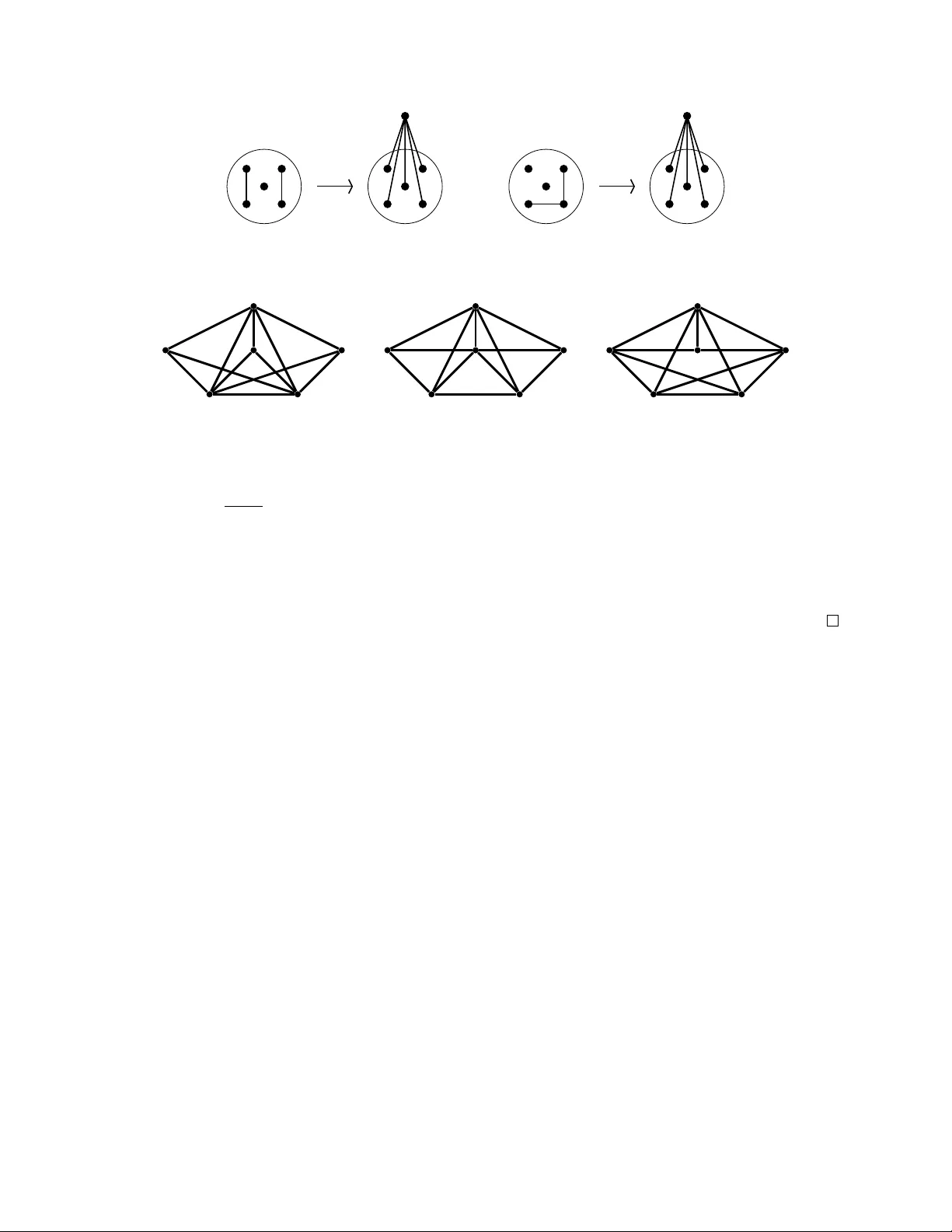
The d -dimensional realisation n um b er of a rigid graph Sean Dew ar ∗ An thony Nixon † Ben Smith ‡ Abstract Determining the n umber of (complex) realisations of a rigid graph for a sp ecific choice of edge lengths is a fundamen tal problem in discrete geometry . In this article w e provide t wo new to ols for determining realisation num b ers in arbitrary dimensions: (i) w e pro v e that subgraph inclusion translates to realisation n umber divisibility; and (ii) w e provide lo wer b ounds on realisation n umbers under sp ecific graph op erations in all dimensions. W e use these metho ds to pro ve that every triangulated sphere with n v ertices has at least 2 n − 4 edge-length equiv alent realisations in 3-dimensions, extending a 2-dimensional result of Jackson and Owen in the case of planar graphs. A dditionally , our tools solv e a family of conjectures set b y Grasegger regarding ho w 1-extensions, X-replacements, and V-replacements affect realisation num b ers. MSC2020: 52C25, 05C10, 68R12, 14C17 Keyw ords: rigid graph, bar-join t framew ork, realisation num ber, complex realisations, v ertex splitting, triangulation 1 In tro duction A (bar-joint) framew ork ( G, p ) in R d is the combination of a finite, simple graph G = ( V , E ) and a realisation p : V → R d . The framew ork is rigid if the only edge-length-preserving con tinuous deformations of the vertices arises from isometries of R d , and is flexible otherwise. Asimo w and Roth [ 2 ] show ed that rigidit y of a graph is a generic prop ert y . That is, if there exists one generic realisation p evidencing that G is rigid then it is certain that ev ery generic framew ork ( G, q ) is rigid. Because of this, w e say a graph is d -rigid if there exists a generic rigid framew ork ( G, p ) in R d . A n umber of applications require more detailed information suc h as the follo wing: giv en a rigid framew ork, ho w man y edge-length equiv alen t realisations exist up to isometries of R d ? F or a framework ( G, p ) , w e denote this v alue b y r ( G, p ) . The com bined results of Connelly [ 12 ] and Gortler, Healy and Thurston [ 18 ] give that, if p is generic, then the case of r ( G, p ) = 1 dep ends solely on the underlying graph. W e th us say that G is glob al ly d -rigid if there exists a generic realisation p suc h that ( G, p ) is the unique realisation of G in R d with the giv en edge lengths up to isometries. ∗ Departmen t of Computer Science, KU Leuven. E-mail: sean.dewar@kuleuven.be † Sc ho ol of Mathematical Sciences, Lancaster Universit y . E-mail: a.nixon@lancaster.ac.uk ‡ Sc ho ol of Mathematical Sciences, Lancaster Universit y . E-mail: b.smith9@lancaster.ac.uk 1 Figure 1: T wo different c hoices of edge lengths for the same graph. The left realisation gives r ( G, p ) = 4 : the tw o realisations pictured plus t w o more via reflecting the degree 2 vertex through the line passing through its neigh bours. The right realisation only giv es r ( G, p ) = 2 : again, the additional realisation can b e found via reflecting the degree 2 vertex. More generally though, the v alue r ( G, p ) is not a generic prop ert y . Indeed, it is not hard to construct small examples of graphs that hav e differen t n umbers of realisations dep ending on the edge lengths chosen; see for example Figure 1 . T o get around this, w e can asso ciate a single ‘generic realisation num b er’ to a graph in t w o differen t wa ys: (i) W e define the r e al d -r e alisation numb er – here denoted r d ( G ) – to b e the largest v alue of r ( G, p ) ov er all generic realisations. (ii) W e extend r ( G, p ) to additionally coun t complex realisations, here denoted c ( G, p ) . The v alue c ( G, p ) is a generic prop ert y , hence we define the (c omplex) d -r e alisation numb er – here denoted c d ( G ) – to b e c ( G, p ) for any generic p . It is immediate that c d ( G ) ≥ r d ( G ) for all graphs, and it w as prov en b y Gortler and Th urston [ 19 ] that r d ( G ) = 1 (i.e., G is globally d -rigid) if and only if c d ( G ) = 1 . Outside of the almost-trivial case of d = 1 , b oth real and complex realisation n umbers are often difficult to compute. F or example, using Gröbner basis to compute c d ( G ) v ery quickly b ecomes computationally un tenable. A combinatorial algorithm for computing c 2 ( G ) for minimally 2-rigid graphs is known [ 9 ], which w as recently extended to all 2-rigid graphs [ 14 ]. Unfortunately , no such com binatorial algorithms are kno wn for computing c d ( G ) when d ≥ 3 or r d ( G ) when d ≥ 2 . Man y tec hniques hav e b een developed on the last t wo decades to provide exact v alues and b ounds for b oth c d ( G ) and r d ( G ) : see for example [ 3 , 4 , 7 , 21 , 29 ]. 1.1 Our con tributions Our main con tributions on the topic can b e split into tw o main subtopics. 1.1.1 Subgraph realisation n um b ers and divisibilit y It is easy to see that, if H is a d -rigid spanning subgraph of a d -rigid graph G , then c d ( G ) ≤ c d ( H ) . W e prov e that this inequalit y is actually due to the divisibility of c d ( H ) by c d ( G ) . Theorem 1.1. L et G b e a d -rigid gr aph on at le ast d + 1 vertic es. If H is a sp anning d -rigid sub gr aph of G , then c d ( G ) | c d ( H ) . 2 W e also prov e that, under specific circumstances, the realisation of a d -rigid (but not necessarily spanning) subgraph divides the realisation num b er of the larger d -rigid graph. This result is a generalisation of a recent result of Grasegger [ 20 , Lemma 3], who prov ed the statemen t for minimally d -rigid graphs. Theorem 1.2. L et G and H b e d -rigid gr aphs with at le ast d + 1 vertic es such that H is a sub gr aph of G . F urther supp ose that for some minimal ly d -rigid sub gr aph e H of H , we have that G − E ( H )+ E ( e H ) is minimal ly d -rigid. Then c d ( H ) | c d ( G ) . As a application of these results, w e c haracterise how the realisation num b er c hanges under rigid sub gr aph substitution ( Corollary 5.2 ). W e then use this to prov e Conjectures 1, 3 and 4 of Grasegger [ 20 ], which describ e conditions for which 1-extensions, X-replacements and V-replacemen ts exactly double the realisation num ber ( Corollaries 5.3 and 5.4 ). 1.1.2 Beha viour of realisation n umbers under certain graph op erations In [ 21 ], Jackson and Owen explored ho w different graph op erations affected b oth the real and com- plex 2-realisation num b ers of 2-rigid graphs. T wo imp ortan t cases they explored were 2-dimensional 0-extensions and 2-dimensional vertex-splits : see Section 4 for descriptions of these op erations. W e extend these results to all dimensions in b oth the real and complex case ( Prop osition 4.5 , Theo- rem 4.9 , Theorem 4.13 ). W e additionally pro vide low er b ounds for the d -dimensional spider-split ( Theorem 4.11 , Theorem 4.16 ). Jac kson and Ow en [ 21 ] prov ed that when a graph G is b oth minimally 2-rigid and planar, then the inequality c 2 ( G ) ≥ r 2 ( G ) ≥ 2 | V |− 3 holds. The pro of combines low er b ounds pro vided by 2-dimensional vertex-splitting with a kno wn construction of planar minimally 2-rigid graphs via 2-dimensional vertex splitting. Utilising our results on higher dimensional graph op erations, we approac h the 3-dimensional v ariant of this in a similar wa y . Building on w ork of Cauch y [ 11 ], Gluc k [ 17 ] prov ed that triangulated spheres are minimally 3-rigid. Moreov er, Steinitz [ 30 ] prov ed that ev ery triangulated sphere can b e constructed from K 4 using 3-dimensional vertex splits. By com bining these observ ations with our o wn results regarding v ertex-splitting, w e deriv e a lo w er b ound on the realisation num b er of a triangulated sphere in 3-space. Theorem 1.3. L et G = ( V , E ) b e a triangulate d spher e. Then c 3 ( G ) ≥ r 3 ( G ) ≥ 2 | V |− 4 . W e additionally extend Theorem 1.3 to minimally 3-rigid pro jectiv e planar graphs ( Theo- rem 5.1 ). 1.2 La y out of pap er The pap er has the following la yout. W e first review notation, terminology and provide preliminary results from rigidity theory and algebraic geometry in Section 2 . In Section 3 , we prov e our divi- sion theorems: Theorem 1.1 and Theorem 1.2 . In Section 4 we then analyse the effect of graph op erations on the d -dimensional realisation num b er. In Section 5 , w e use the theory built up in 3 the previous sections to derive low er b ounds on the realisation num ber of a triangulated sphere ( Theorem 1.3 ), characterise the effect of rigid subgraph substitution on realisation num b ers ( Corol- lary 5.2 ) and resolv e several conjectures on whic h 1-extensions, X-replacemen ts and V-replacements exactly double the realisation num b er ( Corollaries 5.3 and 5.4 ). 2 Preliminaries W e now fix F to be either the field of real n um b ers or the field of complex num bers. W e will equip eac h vector space F d with the quadratic form || ( x 1 , . . . , x d ) || 2 := P d i =1 x 2 i . The notation here is inten tional, as when F = R our chosen quadratic form is exactly the square of the standard Euclidean norm. The isometries of the quadratic space ( F d , ∥ · ∥ 2 ) are exactly the affine transfor- mations x 7→ Ax + b where b ∈ F d and A ∈ O ( d, F ) , i.e., the group of d × d matrices with entries in F where M T M = M M T = I d . 2.1 Rigidit y theory for real and complex frameworks Recall that a d -dimensional fr amework ( G, p ) in F d is the combination of a finite, simple graph G = ( V , E ) and a realisation p : V → F d . The linear space of all suc h realisations of G is denoted b y ( F d ) V . A realisation p is said to be generic if the set of co ordinates of p forms an algebraically indep enden t set of d | V | elements. W e say that tw o realisations p, q of G in F d are e quivalent if || p ( v ) − p ( w ) || 2 = || q ( v ) − q ( w ) || 2 holds for every edge vw ∈ E . F urthermore, w e sa y that tw o realisations p, q of G in F d are c ongruent (denoted p ∼ q ) if there exists an isometry of F d that sends p to q . F or the case where F = R , this is equiv alent to the condition that || p ( v ) − p ( w ) || = || q ( v ) − q ( w ) || holds for all v , w ∈ V . An y realisation that is congruent to a generic realisation is said to b e quasi-generic . A c ontinuous flex of a framework ( G, p ) in F d is a contin uous path ρ : ( − ε, ε ) → ( F d ) V where ρ 0 = p and each framew ork ( G, ρ t ) is equiv alen t to ( G, p ) . W e say a con tinuous flex ρ is trivial if ρ t ∼ p for all t ∈ ( − ε, ε ) . W e no w say ( G, p ) is rigid if ev ery contin uous flex of ( G, p ) is trivial. Determining whether a real framework is rigid is NP-hard [ 1 ]. How ev er, when a framework ( G, p ) is generic, we can reduce this problem to linear algebra b y p erforming a standard linearisation tec hnique on the length constrain ts. More precisely , w e define the rigidity matrix R ( G, p ) of a d - dimensional framew ork ( G, p ) to b e the | E | × d | V | matrix whose rows are indexed by the edges and d -tuples of columns indexed by the v ertices. The ro w for an edge e = uv is giv en by: h 0 · · · 0 p ( u ) − p ( v ) 0 · · · 0 p ( v ) − p ( u ) 0 · · · 0 i where p ( u ) − p ( v ) o ccurs ov er the d -tuple of columns indexed b y u and p ( v ) − p ( u ) o ccurs in the d -tuple of columns indexed by v . Maxw ell [ 24 ] observ ed that for real frameworks, rank R ( G, p ) ≤ d | V | − d +1 2 whenev er p affinely spans R d ; moreov er, this observ ation can be extended to complex framew orks. W e sa y that ( G, p ) is infinitesimal ly rigid if rank R ( G, p ) = d | V | − d +1 2 , or ( G, p ) is a simplex (i.e., G = K n for n ≤ d + 1 ) with affinely indep enden t v ertices. A fundamental result of Asimow and Roth [ 2 ] tells us that, when p is generic and G has at least d + 1 v ertices, ( G, p ) is rigid in R d if and only if it is infinitesimally rigid; additionally , this 4 result can b e easily extended to complex frameworks. The set of realisations in ( F d ) V whic h are not infinitesimally rigid framew orks is an algebraic set defined by rational coefficient p olynomials, and hence b oth rigidit y and infinitesimal rigidit y are generic prop erties for framew orks in F d . W e observ e here that a framew ork in R d is infinitesimally rigid when considered as a framework in R d if and only if it is infinitesimally rigid when considered as a framework in C d . Hence, giv en generic framew orks ( G, p ) , ( G, q ) in R d and C d resp ectiv ely , w e hav e that ( G, p ) is (infinitesimally) rigid if and only if ( G, q ) is (infinitesimally) rigid. This motiv ates the following definition: Definition 2.1. W e sa y that a graph G = ( V , E ) is d -rigid if there exists a generic framework ( G, p ) in either R d or C d that is rigid. If, in addition, G − e is not d -rigid for any edge e ∈ E , then w e sa y that G is minimal ly d -rigid . The last bit of terminology we require from classical rigidit y theory is the follo wing. A framework ( G, p ) in F d is glob al ly rigid if every equiv alent framework to ( G, p ) is congruent to ( G, p ) . It was pro ven b y Connelly [ 12 ] and Gortler, Healy and Th urston [ 18 ] that a single generic framework ( G, p ) in R d is globally rigid if and only if every generic framew ork ( G, q ) in R d is globally rigid. Gortler and Thurston [ 19 ] later extended this to frameworks in C d , and further pro v ed that a generic globally rigid framework in R d remains globally rigid when considered as a framew ork in C d . Since ev ery generic framew ork in R d is also a generic framew ork in C d , the follo wing definition is consisten t: a graph G is glob al ly d -rigid if and only if every (equiv alently , some) generic framework ( G, p ) in R d (equiv alently , C d ) is globally rigid. 2.2 Dominan t maps Throughout, we use the conv ention that an algebr aic set is the zero set of p olynomials, and an algebr aic variety is an irreducible algebraic set (i.e. cannot b e written as the union of non-trivial algebraic sets). Giv en a morphism f : X → Y , we write d f ( p ) for its deriv ative at a p oin t p ∈ X , i.e. the linear map given b y the Jacobian of f from the tangen t space of X at p to the tangent space of Y at f ( p ) . Recall the Zariski top olo gy on C n is the top ology whose closed sets are the algebraic sets. In particular, ev ery non-empty op en set is dense in C n . A morphism f : X → Y b et ween algebraic sets X ⊆ C m and Y ⊆ C n is dominant if f ( X ) is Zariski dense in Y . W e sa y f is generic al ly finite if it is dominan t and there exists a Zariski op en subset U ⊂ Y where f − 1 ( q ) is finite for eac h q ∈ U . Lemma 2.2 ([ 8 , Theorem 17.3]) . L et X ⊆ C n b e an algebr aic set and Y ⊆ C m b e a variety. Then the fol lowing ar e e quivalent for any morphism f : X → Y : (i) f is dominant, (ii) F or some irr e ducible c omp onent X ′ of X , ther e exists a p oint p ∈ X ′ such that p is a non- singular p oint of X ′ and rank d f ( p ) = dim Y , (iii) Ther e exists a Zariski op en subset U ⊂ X wher e for e ach p ∈ U , we have p is a non-singular p oint of X and rank d f ( p ) = dim Y . Mor e over, ther e exists a non-empty Zariski op en subset V ⊂ Y such that V ⊂ f ( X ) , and for every q ∈ V , every irr e ducible c omp onent of the algebr aic set f − 1 ( q ) has dimension dim X − dim Y . 5 2.3 Realisation n um b ers Giv en a graph G = ( V , E ) that is d -rigid, w e wish to study the num b er of equiv alent realisations for a generic real framework ( G, p ) up to isometry . F ormally , we define r ( G, p ) = n q ∈ ( R d ) V : p, q equiv alent o / ∼ , where p ∼ q if p, q congruent. As sho w cased in Figure 1 , this is no longer a generic property: r ( G, p ) v aries as w e range ov er generic realisations p : V → R d . As such, authors define the r e al d -r e alisation numb er to b e r d ( G ) = max n r ( G, p ) : p : V → R d generic o . W e make a p oin t here that the combined results of Connelly [ 12 ] and Gortler, Healy and Thurston [ 18 ] imply that r d ( G ) = 1 if and only if r ( G, p ) = 1 for some generic d -dimensional framework ( G, p ) . The v alue r d ( G ) is somewhat difficult to work with, as often there will exist generic realisations whic h do not hav e this num b er of equiv alen t frameworks. T o av oid this issue, we often instead approac h this problem algebraically b y counting complex realisations also. T o do so, we introduce the (c omplex) rigidity map asso ciated to G : f G,d : ( C d ) V → C E , p 7→ 1 2 ∥ p ( v ) − p ( w ) ∥ 2 v w ∈ E . W e denote the Zariski closure of the image of f G,d b y ℓ d ( G ) . Since the domain of f G,d is irreducible, ℓ d ( G ) is a v ariet y . With this, w e observ e that tw o d -dimensional frameworks ( G, p ) , ( G, q ) are equiv alent if and only if f G,d ( p ) = f G,d ( q ) . If the set of vertices of ( G, p ) affinely span C d , then tw o realisations p, q are congruen t if and only if f K V ,d ( p ) = f K V ,d ( q ) , where K V is the complete graph with vertex s et V (see [ 19 , Section 10] for more details). W e observe here that the Jacobian of f G,d at p is exactly the rigidit y matrix R ( G, p ) . F or all p ∈ ( C d ) V , we define C d ( G, p ) := f − 1 G,d ( f G,d ( p )) / ∼ to b e the r e alisation sp ac e of ( G, p ) . The cardinalit y of C d ( G, p ) is constant ov er a Zariski op en dense subset of ( C d ) V (e.g., [ 13 , Proposition 3.4]). Definition 2.3. The (c omplex) d -r e alisation numb er of a d -rigid graph G = ( V , E ) is an elemen t of N ∪ {∞} given by c d ( G ) := | C d ( G, p ) | for generic p ∈ ( C d ) V if | V | ≥ d + 1 , 1 if | V | ≤ d and G is complete , ∞ if | V | ≤ d and G is not complete . R emark 2.4 . Giv en a prop ert y P , if there exists a Zariski op en subset U ⊂ C n of p oin ts where prop ert y P holds, w e call any p oin t in U a gener al p oint (with r esp e ct to P ) . W e reserv e the term 6 generic point for p ∈ ( C d ) V corresp onding to a generic framew ork. Note that as Zariski open sets are dense, a generic framework p ∈ ( C d ) V has probabilit y one of b eing con tained in any such set, hence we can treat them as general p oin ts of ( C d ) V . In practice, C d ( G, p ) is often awkw ard to w ork with as quotienting b y isometries destro ys the algebraic v ariet y structure. W e will instead restrict the domain of f G,d to ‘pinned frameworks’, remo ving almost all isometries b eforehand. W e do this as follows. Let G = ( V , E ) be a graph with at least d + 1 vertices and fix a sequence of d vertices v 1 , . . . , v d . W e now define the linear space X G,d := n p ∈ ( C d ) V : p j ( v k ) = 0 for all 1 ≤ k ≤ j ≤ d o . (1) In tuitively , this is the space of framew orks where v 1 is p inned to the origin, v 2 is pin ned to the x -axis, v 3 is pinned to the xy -plane, etc. W e further note that X G,d has dimension d | V | − d +1 2 . Almost ev ery framew ork is congruent to a framew ork in X G,d ; in particular, every quasi-generic framew ork is congruent to a framework in X G,d . (The precise condition is giv en in Lemma A.1 .) W e note that the framew orks in X G,d are nev er generic as they ha ve been pinned in special p osition, but X G,d do es con tain a dense subset of quasi-generic framew orks. With this, w e define the pinne d rigidity map ˜ f G,d : X G,d → ℓ d ( G ) , p 7→ f G,d ( p ) , i. e., the restriction of f G,d to the domain X G,d and the co domain ℓ d ( G ) . As can b e seen by the follo wing lemma, the map ˜ f G,d allo ws us to more easily define the cardinalit y of the set C d ( G, p ) for most realisations p . Lemma 2.5 ([ 13 ]) . L et G = ( V , E ) b e a gr aph with | V | ≥ d + 1 . The image of ˜ f G,d is Zariski dense in the image of f G,d , and so ˜ f G,d is dominant. Mor e over, ther e exists a Zariski op en subset U ⊂ ( C d ) V such that ˜ f − 1 G,d ( f G,d ( p )) = 2 d | C d ( G, p ) | for al l p ∈ U . The deriv ative of the pinned rigidit y map can b e related to infinitesimal rigidit y if our pinned v ertices are affinely indep endent: Lemma 2.6. Cho ose p ∈ X G,d such that the p oints p ( v 1 ) , . . . , p ( v d ) ar e affinely indep endent. Then d ˜ f G,d ( p ) has r ank d | V | − d +1 2 if and only if ( G, p ) is infinitesimal ly rigid. Pr o of. Observe that the matrix representing d ˜ f G,d ( p ) can b e obtained from R ( G, p ) by deleting the columns lab elled by ( j, v k ) for all j ≥ k . If d ˜ f G,d ( p ) has rank d | V | − d +1 2 , it necessarily implies that R ( G, p ) is also full rank and so ( G, p ) is infinitesimally rigid. No w supp ose ( G, p ) is infinitesimally rigid. Cho ose an y d × d complex matrix A which is skew- symmetric, i.e., A T = − A . Then w e observe that for an y x ∈ C d w e ha ve x T Ax = ( x T Ax ) T = x T A T x = − x T Ax, 7 and so x T Ax = 0 . This implies that the set T ( p ) := n ( Ap ( v ) + b ) v ∈ V : A is d × d skew-symmetric and b ∈ C d o is contained in ker R ( G, p ) . Claim 2.7. k er R ( G, p ) = T ( p ) . Pr o of. As ( G, p ) is infin itesimally rigid, it suffices to sho w dim T ( p ) = d +1 2 . In fact, since p ( v 1 ) = 0 , w e only need to sho w that the restriction of T ( p ) to v ectors where b = 0 has dimension d 2 . Supp ose for contradiction that this is not the case. Then there m ust exist some non-zero skew- symmetric matrix A where Ap ( v i ) = 0 for eac h i ∈ [ d ] . Since p oin ts p ( v 2 ) , . . . , p ( v d ) are a linear basis of C d − 1 × { 0 } , the left d − 1 columns of A only con tain zero entries. Ho wev er, A b eing sk ew-symmetric then implies that A is the all-zero es matrix, a con tradiction. ■ No w choose any v ector u = ( Ap ( v ) + b ) v ∈ V ∈ ker R ( G, p ) ∩ X G,d . W e immediately see that b = 0 as p ( v 1 ) = Ap ( v 1 ) + b = 0 . Since ( Ap ( v )) v ∈ V also satisfies the pinning conditions describ ed b y X G,d , we ha ve that for eac h 1 ≤ i ≤ j ≤ d , the j -th coordinate of Ap ( v i ) is 0. Claim 2.8. A is the al l-zer o es matrix. Pr o of. Fix A 1 , . . . , A d to b e the columns of A . W e no w prov e A is the all-zero es matrix b y induction on its columns. First, take the v ector Ap ( v 2 ) . Since 0 = p ( v 1 ) , p ( v 2 ) are affinely independent, we hav e that the first coordinate of p ( v 2 ) , here denoted λ , is non-zero. With this, w e ha ve that Ap ( v 2 ) = λA 1 , and th us A 1 = λ − 1 Ap ( v 2 ) . As the diagonal of A only takes zero v alues, the first co ordinate of A 1 is 0. As j -th co ordinate of Ap ( v 2 ) is 0 for eac h 2 ≤ j ≤ d , w e hav e that all other coordinates of A 1 are 0. Thus A 1 = 0 . No w suppose that A 1 = · · · = A i − 1 = 0 . Since the v ectors p ( v 1 ) , . . . , p ( v i +1 ) are affinely indep enden t with p ( v 1 ) , . . . , p ( v i ) ∈ C i − 1 × { 0 } d − i +1 , we hav e that the i -th co ordinate of p ( v i +1 ) , here denoted ψ , is non-zero. By our assumption, w e now hav e that Ap ( v i +1 ) = ψ A i , and thus A i = ψ − 1 Ap ( v i +1 ) . Since the first i − 1 rows of A hav e zero entries, the first i − 1 co ordinates of A i are 0. As the diagonal of A only tak es zero v alues, the i -th coordinate of A i is 0. As j -th co ordinate of Ap ( v i ) is 0 for each i + 1 ≤ j ≤ d , w e ha ve that all other coordinates of A i are 0. Th us A i = 0 . The claim no w follows by induction. ■ The result now follows as the k ernel of d ˜ f G,d ( p ) is exactly the linear space k er d f G,d ( p ) ∩ X G,d . Finally , we note a useful (but non-trivial) fact that an y realisation equiv alent to a generic realisation in C d is also quasi-generic. This w as shown in [ 21 ] in the case where d = 2 ; the general case prov ed similarly , but w e include a proof for completeness in Section A . Lemma 2.9. L et G b e a d -rigid gr aph with at le ast d + 1 vertic es, let ( G, p ) b e generic in C d and let ( G, q ) b e e quivalent to ( G, p ) . Then ( G, q ) is quasi-generic. 8 3 Dividing the realisation n um b er In this section we obtain t wo different division rules for rigid subgraphs of rigid graphs. 3.1 Spanning rigid subgraphs W e b egin this section b y proving that the realisation n umber of any spanning d -rigid subgraph is divisible by the realisation n umber of the larger d -rigid graph. Theorem 1.1. L et G b e a d -rigid gr aph on at le ast d + 1 vertic es. If H is a sp anning d -rigid sub gr aph of G , then c d ( G ) | c d ( H ) . Pr o of. Cho ose a generic realisation p ∈ ( C d ) V for G with d -rigid subgraph H . Let [ p 1 ] , . . . , [ p k ] denote the equiv alence classes of C d ( H , p ) . Then c d ( H ) = k . Define an equiv alence relation ∼ G on f − 1 H,d ( f H,d ( p )) by putting p ′ ∼ G p ′′ if and only if f G,d ( p ′ ) = f G,d ( p ′′ ) . No w note that if p ′ , p ′′ ∈ [ p i ] , then p ′ ∼ G p ′′ . Hence, ∼ G giv es an equiv alence relation on the elements of C d ( H , p ) . Let [[ p k 1 ]] , . . . , [ [ p k ℓ ]] be the equiv alence classes of ∼ G on C d ( H , p ) . Pic k an y s ∈ [ ℓ ] , and label the elemen ts of [[ p k s ]] b y [ q 1 ] , . . . , [ q t ] . If we choose some q ∈ [ q j ] for an y j ∈ [ t ] , then C d ( G, q ) = { [ q 1 ] , . . . , [ q t ] } . Since f H,d ( p ) = f H,d ( q ) and p is generic, the realisation q is congruen t to a generic realisation by Lemma 2.9 . Hence, c d ( G ) = | C d ( G, p ) | = | C d ( G, q ) | = t. Since this holds for eac h of the equiv alence classes [[ p k 1 ]] , . . . , [ [ p k ℓ ]] , it follows that c d ( H ) = k = ℓt = ℓc d ( G ) . It is easy to see that some realisation num b ers are not the common divisor of their spanning minimally d -rigid subgraphs: the graph K 4 is globally 2-rigid (and hence c 2 ( G ) = 1 ), but the only minimally 2-rigid spanning subgraph of G is K 4 − e which has 2-realisation n umber 2. Example 3.1. Consider the graphs G 1 , G 2 , G 3 in Figure 2 . The graph G 1 is globally rigid in the plane (see, for example, [ 6 , Theorem 6.1]). W e show this fact follo ws from Theorem 1.1 . Note that G 2 and G 3 are obtained from G 1 b y deleting single edges. Their 2-realisation num bers are c 2 ( G 2 ) = 45 and c 2 ( G 3 ) = 32 : the former is computed in [ 21 , Section 8] and b oth can b e found in [ 10 ]. Hence the greatest common divisor is 1 and Theorem 1.1 implies that c 2 ( G 1 ) = 1 i.e. G 1 is globally rigid. Corollary 3.2. L et G b e a d -rigid gr aph. Supp ose ther e exists an e dge ij ∈ E and r e alisations p, q ∈ ( C d ) V such that p is generic, f G,d ( p ) = f G,d ( q ) but ∥ p i − p j ∥ 2 = ∥ q i − q j ∥ 2 . Then c d ( G + ij ) ≤ 1 2 c d ( G ) , and this b ound is tight. Pr o of. The h yp otheses on p and q imply that c d ( G + ij ) < c d ( G ) . Hence, c d ( G + ij ) ≤ 1 2 c d ( G ) b y Theorem 1.1 . T o see that the result is tigh t, choose G such that c d ( G ) = 2 (for example, the union of tw o complete graphs with more than d vertices that share exactly d v ertices). Rep eated uses of Corollary 3.2 leads to the follo wing result. 9 Figure 2: Three 2-rigid graphs: (left) G 1 with c 2 ( G 1 ) = 1 ; (middle) G 2 with c 2 ( G 2 ) = 45 ; (righ t) G 3 with c 2 ( G 3 ) = 32 . Corollary 3.3. L et G b e a d -rigid gr aph with a se quenc e of non-e dges { v 1 w 1 } , . . . , { v k w k } . L et G 0 , . . . , G k b e a se quenc e of gr aphs wher e G 0 = G and G i = G i − 1 + v i w i for e ach i ∈ [ k ] . If G k is glob al ly d -rigid and c d ( G i ) < c d ( G i − 1 ) for e ach i ∈ [ k ] , then c d ( G ) ≥ 2 k . While it is unlik ely to lead to an efficient algorithm, w e use these ideas to giv e a simple upp er b ound on the n umber of edges one must add to a d -rigid graph G so that the resulting sup ergraph is globally d -rigid. W e note that this global rigidit y augmen tation problem is w ell studied but seemingly only in low dimensions. In particular, [ 23 ] gives a p olynomial time algorithm for the global rigidit y augmen tation problem in 2-dimensions. The 1-dimensional case is b etter known as the 2-connectivity augmen tation problem [ 15 ]. Corollary 3.4. L et G b e a d -rigid gr aph. L et F b e the smal lest set of non-e dges of G such that G + F is glob al ly d -rigid. If c d ( G ) = p 1 · · · p k for (p ossibly not distinct) primes p i , then | F | ≤ k . Pr o of. As c d ( G ) > 1 , there exists a pair of non-adjacen t vertices i, j such that c d ( G + ij ) < c d ( G ) . By Theorem 1.1 , it follows that the prime decomp osition of c d ( G + ij ) has length at most k − 1 . The pro of now follo ws from rep eated application. Corollary 3.4 is not tight in general. F or example, the graph G 2 giv en in Figure 2 has 2- realisation num b er 45 = 3 · 3 · 5 , how ev er, adding any non-edge to G 2 alw ays pro duces a globally 2-rigid graph. On the other hand, there do exist some graphs for whic h it is tight. Let G be the complete m ultipartite graph K 1 ,..., 1 ,t with d parts of size 1 and one part of size t ≥ 1 . Then c d ( G ) = 2 t − 1 . An y sup ergraph obtained from G by adding strictly less than t − 1 edges is not ( d + 1) -connected and hence not globally d -rigid. Hence Corollary 3.4 implies that the smallest set of non-edges required to augment G to a globally d -rigid graph has cardinalit y t − 1 . 3.2 Prop er rigid graphs W e no w pro v e Theorem 1.2 . Theorem 1.2. L et G and H b e d -rigid gr aphs with at le ast d + 1 vertic es such that H is a sub gr aph of G . F urther supp ose that for some minimal ly d -rigid sub gr aph e H of H , we have that G − E ( H )+ E ( e H ) is minimal ly d -rigid. Then c d ( H ) | c d ( G ) . Pr o of. Cho ose vertices v 1 , . . . , v d ∈ V ( H ) to define b oth X G,d and X H,d . Let ( G, p ) b e a quasi- generic framework in X G,d . 10 Claim 3.5. The map h : ˜ f − 1 G − E ( H ) ,d ( ˜ f G − E ( H ) ,d ( p )) → X H,d , q 7→ ( q ( v )) v ∈ V ( H ) is generic al ly finite. Pr o of. F or notational con venience, we write Z p = f − 1 G − E ( H ) ,d ( f G − E ( H ) ,d ( p )) ⊆ ( C d ) V , e Z p = ˜ f − 1 G − E ( H ) ,d ( ˜ f G − E ( H ) ,d ( p )) ⊆ X G,d ∼ = C d | V |− ( d +1 2 ) , hence e Z p is the domain of h . W e first note that dim( e Z p ) = | E ( e H ) | = dim( X H,d ) . The second equalit y follows from e H b eing minimally d -rigid. F or the first equalit y , e Z p has the dimension of a generic fib er of ˜ f G − E ( H ) ,d . As ˜ f G − E ( H ) ,d is dominant b y Lemma 2.5 , it follo ws from Lemma 2.2 that dim e Z p = dim X G − E ( H ) ,d − dim ℓ d ( G − E ( H )) = d | V | − d + 1 2 ! − | E ( G ) | + | E ( H ) | = | E ( e H ) | , where the final equality follows from e G := G − E ( H ) + E ( e H ) b eing minimally d -rigid. As the domain and co domain of h hav e the same dimension, it suffices to pro ve that h is dominant by Lemma 2.2 . W e show this by showing p is non-singular and rank dh ( p ) = | E ( e H ) | . As the Jacobian of f G − E ( H ) ,d at p is the rigidity matrix R ( G − E ( H ) , p ) , it follo ws that the tangen t space of Z p at p is ker R ( G − E ( H ) , p ) . As e Z p = Z p ∩ X G,d , it follows that the tangent space of e Z p at p is k er R ( G − E ( H ) , p ) ∩ X G,d . Hence, the deriv ativ e of h at p is the linear projection map dh ( p ) : k er R ( G − E ( H ) , p ) ∩ X G,d → X H,d , q 7→ ( q ( v )) v ∈ V ( H ) . W e observe that the space k er R ( G − E ( H ) , p ) ∩ X G,d has dimension | E ( e H ) | as follows. As e G is a minimally d -rigid, all the rows of R ( e G, p ) are linearly indep enden t, and the intersection of its k ernel with X G,d is zero-dimensional. W e get R ( G − E ( H ) , p ) from R ( e G, p ) by removing | E ( e H ) | ro ws, hence k er R ( G − E ( H ) , p ) ∩ X G,d has dimension | E ( e H ) | . This implies that e Z p and the tangen t space at p hav e the same d imension, hence p is non-singular. It remains to show that dh ( p ) has rank | E ( e H ) | . Recall that as e G is minimally d -rigid, w e ha v e k er( R ( e G, p )) ∩ X G,d = 0 and eac h ro w of R ( e G, p ) is linearly independent. Hence for each edge xy ∈ E ( e H ) , there exists a unique (up to scaling) infinitesimal flex u xy ∈ ker R ( e G − xy , p ) ∩ X G,d . Explicitly , w e ha v e p ( x ) − p ( y ) · u xy ( x ) − u xy ( y ) = 0 , p ( v ) − p ( w ) · u xy ( v ) − u xy ( w ) = 0 for all v w ∈ E ( G ) \ { xy } . These conditions imply that n dh ( p ) u xy : xy ∈ E ( e H ) o is a linearly indep enden t set. This then implies that the rank of dh ( p ) is | E ( e H ) | as required. ■ 11 x w 3 w 3 w 1 w 1 w 2 w 2 Figure 3: A schematic of 3-dimensional 0-extension. No w fix a general p oin t q ∈ ˜ f − 1 G − E ( H ) ,d ( ˜ f G − E ( H ) ,d ( p )) . It is immediate that ˜ f − 1 G,d ( ˜ f G,d ( q )) = ( ˜ f H,d ◦ h ) − 1 ( ˜ f H,d ◦ h )( q ) . Since b oth h and ˜ f H,d are generically finite (the latter b eing a consequence of Lemma 2.5 and H b eing d -rigid), their composition m ultiplies their degrees: ( ˜ f H,d ◦ h ) − 1 ( ˜ f H,d ◦ h )( q ) = deg( ˜ f H,d ◦ h ) = (deg ˜ f H,d )(deg h ) . Hence, by Lemma 2.5 w e ha v e c d ( G ) = 2 d ˜ f − 1 G,d ( ˜ f G,d ( q )) = 2 d deg( ˜ f H,d ◦ h ) = 2 d (deg ˜ f H,d )(deg h ) = c d ( H )(deg h ) . (2) This now concludes the proof. 4 Graph op erations In this section we inv estigate the behaviour of realisation n umbers with resp ect to a v ariet y of differen t graph op erations. 4.1 0-extensions The simplest graph op eration that preserv es rigidity is the d -dimensional 0-extension . This op- eration on G adds a new v ertex x and d new edges xw 1 , . . . , xw d to distinct v ertices w i of G . A sc hematic of a 3-dimensional 0-extension is given in Figure 3 . It is well known that this op era- tion preserves (minimal) rigidity [ 31 , Lemma 11.1.1]. Moreo v er, it precisely doubles the realisation n umber. Lemma 4.1 ([ 13 , Lemma 7.1]) . L et G = ( V , E ) b e a d -rigid gr aph with at le ast d + 1 vertic es. If G ′ is obtaine d fr om G via a 0-extension, then c d ( G ′ ) = 2 c d ( G ) . In fact, we can sho w that d -dimensional 0-extensions also double the n umber of real realisations. T o sho w this, w e first need to in tro duce the follo wing terminology . A Euclide an distanc e matrix is an y square matrix of the form D := ∥ y i − y j ∥ 2 i,j ∈ [ n ] 12 for some set of p oin ts y 1 , . . . , y n in R d ; w e additionally sa y that D is the Euclidean distance matrix for the p oin ts y 1 , . . . , y n . W e can exactly c haracterise which matrices are Euclidean distance matrices using a famous result of Schoenberg. Theorem 4.2 (Sc ho en b erg [ 26 ]) . L et D b e an n × n matrix with non-ne gative entries and zer o entries for its diagonal. Then D is a Euclide an distanc e matrix for a set of p oints with d -dimensional affine sp an if and only if the ( n − 1) × ( n − 1) matrix G := D i,n + D j,n − D i,j i,j ∈ [ n − 1] is p ositive semi-definite with r ank d . W e also require the follo wing corollary to Theorem 4.2 . Corollary 4. 3 (see, for example, [ 27 , Corollary 3.3.3]) . If D is an n × n Euclide an distanc e matrix, then it is ne gative semi-definite on the p oints in the line ar sp ac e ortho gonal to (1 , . . . , 1) ∈ R d . Lemma 4.4. Given affinely indep endent p oints y 1 , . . . , y d in R d , let f : R d → R d , z 7→ ∥ z − y i ∥ 2 i ∈ [ d ] . Then ther e exists an non-empty op en subset U ⊂ R d c ontaine d in the image of f wher e the fol lowing holds: (i) F or any λ ∈ U , ther e exist exactly two solutions to the e quation f ( z ) = λ . (ii) F or some R > 0 , the set U c ontains the r ay { ( r , . . . , r ) : r > R } . Pr o of. Fix U to b e the image under f of the set of p oin ts that are not in the affine span of y 1 , . . . , y d . W e observe that the Jacobian d f ( z ) is singular if and only if z lies in the affine span of y 1 , . . . , y d . Hence, b y the in verse function theorem (e.g., [ 25 , Theorem 9.24]) the set U is non-empt y and op en. T ake any p oin t z ∗ not in the affine span of y 1 , . . . , y d and supp ose that z satisfies the equation f ( z ) = f ( z ∗ ) . Then there exists an isometry of R d whic h maps z to z ∗ and maps each y i to itself. Since the p oints y 1 , . . . , y d are affinely indep endent, there exists a single isometry that fixes each p oin t y i : the reflection through the affine span of y 1 , . . . , y d . Hence either z = z ∗ or z is the unique p oin t found b y reflecting through the affine span of y 1 , . . . , y d . F or eac h r > 0 , fix the matrix G ( r ) = 2 r − ∥ y i − y j ∥ 2 i,j ∈ [ d ] . By Theorem 4.2 , ( r, . . . , r ) is con tained in U if and only if G ( r ) is p ositiv e definite. It is immediate that G ( r ) = 2 r J − Y , where J is the all-ones matrix and Y := ∥ y i − y j ∥ 2 i,j ∈ [ d ] . Since Y is the Euclidean distance matrix, the matrix Y is negativ e semi-definite on the linear space orthogonal to e := (1 , . . . , 1) b y Corollary 4.3 . It is clear that e is the eigenv ector of J with 13 eigen v alue d and J is zero on the linear space orthogonal to e . Hence G ( r ) is p ositiv e definite if and only if e T G ( r ) e = e T (2 r J − Y ) e = 2 r d 2 − e T Y e > 0 . It is no w easy to see that the ab o ve equation holds for sufficiently large r > 0 . Prop osition 4.5. L et G = ( V , E ) b e a d -rigid gr aph with at le ast d + 1 vertic es. If G ′ is obtaine d fr om G via a 0-extension, then r d ( G ′ ) = 2 r d ( G ) . Pr o of. W e first prov e that r d ( G ′ ) ≥ 2 r d ( G ) . Fix x to b e the new vertex added to G to form G ′ , and let w 1 , . . . , w d b e its neigh b ours in G ′ . Choose a real generic realisation p of G where r d ( G, p ) = r d ( G ) = t . Let ( G, p 1 ) , . . . , ( G, p t ) b e pairwise non-congruen t but equiv alen t d -dimensional real framew orks where p 1 = p . As each p k is quasi-generic ( Lemma 2.9 ), the p oin ts p k ( w 1 ) , . . . , p k ( w d ) are affinely independent for each k ∈ [ t ] . F or eac h k ∈ [ t ] , fix f k and U k to b e the map f and non-empty open set U k from Lemma 4.4 for the p oin ts y 1 = p k ( w 1 ) , . . . , y d = p k ( w d ) . By Lemma 4.4 , the set U := T t k =1 U k is a non- empt y op en set in R d ; that it is non-empty stems from the fact that U must contain some ray { ( r , . . . , r ) : r > R } for some ra y R > 0 . Hence w e can pic k λ ∈ U whose coordinates are algebraically independent ov er the set of co ordinates for p . By Lemma 4.4 , there exists tw o solutions to the equation f k ( z ) = λ that we label a k , b k . F or eac h 1 ≤ k ≤ t , we define the realisations p ′ k,a and p ′ k,b of G ′ b y p ′ k,a ( v ) = p ′ k,b ( v ) = p k ( v ) for all v ∈ V , and p ′ k,a ( x ) = a k and p ′ k,b ( x ) = b k . A dditionally , w e set p ′ = p ′ 1 ,a : our c hoice of λ as algebraically indep enden t o v er p implies that the co ordinates of a 1 m ust also b e algebraic indep enden t o ver p , hence p ′ is a generic realisation of G ′ . It follows that r d ( G ′ ) ≥ r d ( G ′ , p ′ ) ≥ n p ′ 1 ,a , p ′ 1 ,b , p ′ 2 ,a , p ′ 2 ,b , . . . , p ′ t,a , p ′ t,b o = 2 t = 2 r d ( G ) . W e no w show that r d ( G ′ ) ≤ 2 r d ( G ) . Cho ose a generic realisation p ′ of G ′ in R d with r d ( G ′ , p ′ ) = r d ( G ′ ) and fix p to b e the restriction of p ′ to V . Now c ho ose any ( G ′ , q ′ ) in R d that is equiv alent to ( G ′ , p ′ ) . Then, giv en q is the restriction of q ′ to V , we hav e that ( G, q ) is equiv alen t to ( G, p ) . By Lemma 2.9 , both ( G ′ , q ′ ) and ( G, q ) are quasi-generic, and thus q ( w 1 ) , . . . , q ( w d ) are affinely inde- p enden t. Let ( G ′ , q ∗ ) be another framework where q ∗ ( v ) = q ( v ) for eac h v ∈ V . Then there exists an isometry that maps q ′ ( x ) to q ∗ ( x ) and fixes each p oint q ( w 1 ) , . . . , q ( w d ) . Since q ( w 1 ) , . . . , q ( w d ) are affinely independent, there exists a single isometry that fixes each p oin t q ( w i ) : the reflection through the affine span of q ( w 1 ) , . . . , q ( w d ) . Hence either q ∗ ( x ) = q ′ ( x ) or q ∗ ( x ) is the unique p oin t found by reflecting through the affine span of q ( w 1 ) , . . . , q ( w d ) . It no w follows that r d ( G ′ ) = r d ( G ′ , p ′ ) ≤ 2 r d ( G, p ) ≤ 2 r d ( G ) whic h concludes the pro of. 4.2 V ertex-splitting and spider-splitting 4.2.1 Lo wer b ounds for complex realisations In this subsection we prov e that the realisation num ber is preserv ed, and p ossibly ev en doubled, under tw o other graph op erations: vertex-splitting and spider-splitting. Before we do so, w e require 14 some technical lemmas regarding realisation num b ers. The pro of of the following lemma requires the notion of multiplicity of an isolated p oint. F or the formal definition, w e refer to [ 28 , P age 224]. Ho wev er, w e will only need the fact that an isolated solution p ∈ C n of n p olynomial equations has m ultiplicit y one if the Jacobian is rank n , and multiplicit y greater than one otherwise. Lemma 4.6. L et f : C n → C n b e a dominant p olynomial map, i.e. f ( x ) = ( f 1 ( x ) , . . . , f n ( x )) for n -variate p olynomials f 1 , . . . , f n . F or a p oint µ ∈ C n , define S µ := n p ∈ f − 1 ( µ ) : p is an isolate d p oint o and S ′ µ := { p ∈ S µ : rank d f ( p ) < n } . Then for a gener al p oint λ ∈ C n , we have | f − 1 ( λ ) | ≥ | S µ | + | S ′ µ | . Pr o of. W rite N i ( µ ) for the isolated p oin ts of f − 1 ( µ ) of m ultiplicity i . As f is dominan t, it follows from Lemma 2.2 that f − 1 ( λ ) is zero dimensional for general λ ∈ C n , and that eac h p oin t of f − 1 ( λ ) is non-singular. Hence | f − 1 ( λ ) | = P i ≥ 1 i · N i ( λ ) = N 1 ( λ ) . By [ 28 , Theorem 7.1.6], w e ha v e | f − 1 ( λ ) | = X i ≥ 1 i · N i ( λ ) ≥ X i ≥ 1 i · N i ( µ ) ≥ X i ≥ 1 N i ( µ ) + X i ≥ 2 N i ( µ ) = | S µ | + | S ′ µ | . F or a realisation p ∈ X G,d , we define rig( G, p ) := { q ∈ X G,d : f G,d ( p ) = f G,d ( q ) , and ( G, q ) is rigid } , fig( G, p ) := n q ∈ rig( G, p ) : ( G, q ) is not infinitesimally rigid , { q ( v i ) } d i =1 are affinely independent o . Note that fig( G, p ) is the set of rigid realisations equiv alen t to p that hav e infinitesimal flexes. Lemma 4.7. L et G b e minimal ly d -rigid, and take p ∈ X G,d . Then 2 d c d ( G ) ≥ | rig( G, p ) | + | fig ( G, p ) | . Pr o of. Cho ose λ, µ ∈ C E suc h that λ is a general point and f G,d ( p ) = µ . Recall S µ and S ′ µ from Lemma 4.6 , where f := ˜ f G,d . It follows from the definition of ˜ f G,d that S µ = rig( G, p ) . F or eac h q ∈ fig ( G, p ) , Lemma 2.6 implies that d ˜ f G,d ( q ) is not full rank, and hence q ∈ S ′ µ . It follows from Lemma 4.6 that | rig ( G, p ) | + | fig( G, p ) | ≤ | S µ | + | S ′ µ | ≤ ˜ f − 1 G,d ( λ ) . The result no w follows from Lemma 2.5 . A d -dimensional vertex-split tak es as input a graph G , a vertex x ∈ V ( G ) and a partition of its neighbourho o d into N 1 , N 2 and { w 1 , . . . , w d − 1 } . The output is the graph G ′ constructed from G − x by adding tw o new vertices x 1 , x 2 joined to N 1 , N 2 resp ectiv ely , along with the edges { x i w j : i = 1 , 2 , 1 ≤ j ≤ d − 1 } and the edge x 1 x 2 . A sc hematic of a 3 -dimensional v ertex split is giv en in Figure 4 . V ertex-splitting preserv es rigidity; see [ 32 , Corollary 11]. 15 N 2 N 1 N 2 N 1 x x 1 x 2 w 1 w 2 w 1 w 2 . . . . . . . . . . . . Figure 4: A schematic of the 3-dimensional vertex split. Lemma 4.8. L et ( G, p ) b e a generic minimal ly d -rigid fr amework and let G ′ = ( V ′ , E ′ ) b e forme d fr om G by a d -dimensional vertex-split. L et p ′ b e the r e alisation of G ′ wher e p ′ ( v ) = p ( v ) for al l v ∈ V − x and p ′ ( x 1 ) = p ′ ( x 2 ) = p ( x ) . Then ( G ′ , p ′ ) is rigid but not infinitesimal ly rigid. Pr o of. W e first observ e that ( G ′ , p ′ ) has an edge of length zero, namely x 1 x 2 , and so cannot b e infinitesimally rigid. T o pro v e rigidity , w e observ e the following. By identifying x 1 with x , w e can assume that V ′ = V ∪ { x 2 } . If ( G ′ , q ′ ) is equiv alent to ( G ′ , p ′ ) with q ′ ( x 1 ) = q ′ ( x 2 ) , then the framew ork ( G, q ) with realisation q = q ′ | V is equiv alen t to ( G, p ) . As w e wan t to prov e that ( G ′ , p ′ ) is rigid, we only need to sho w that for sufficiently close realisations, the v ertices x 1 , x 2 lie at the same p oin t. W e measure the concept of ‘sufficien tly close’ using the complex Euclidean norm metric on ( C d ) V , here denoted by m ( · , · ) . Cho ose any framew ork ( G ′ , q ′ ) equiv alen t to ( G ′ , p ′ ) . By applying translation, w e ma y supp ose that b oth p ′ ( x 1 ) = 0 and q ′ ( x 1 ) = 0 . With this, w e ha ve ∥ q ′ ( x 2 ) ∥ 2 = ∥ q ′ ( x 2 ) − q ′ ( x 1 ) ∥ 2 = ∥ p ′ ( x 2 ) − p ′ ( x 1 ) ∥ 2 = 0 . (3) No w c ho ose 1 ≤ i ≤ d − 1 . Since ( G ′ , q ′ ) is equiv alent to ( G ′ , p ′ ) , we ha ve ∥ q ′ ( x 2 ) − q ′ ( w i ) ∥ 2 = ∥ p ′ ( x 2 ) − p ′ ( w i ) ∥ 2 = ∥ p ′ ( x 1 ) − p ′ ( w i ) ∥ 2 = ∥ q ′ ( x 1 ) − q ′ ( w i ) ∥ 2 = ∥ q ′ ( w i ) ∥ 2 . (4) Next, we note the follo wing reform ulation holds: ∥ q ′ ( x 2 ) − q ′ ( w i ) ∥ 2 = ∥ q ′ ( x 2 ) ∥ 2 − 2 q ′ ( x 2 ) · q ′ ( w i ) + ∥ q ′ ( w i ) ∥ 2 = ∥ q ′ ( w i ) ∥ 2 − 2 q ′ ( x 2 ) · q ′ ( w i ) . (5) By combining ( 4 ) and ( 5 ), we see that ∥ q ′ ( w i ) ∥ 2 − 2 q ′ ( x 2 ) · q ′ ( w i ) = ∥ q ′ ( w i ) ∥ 2 = ⇒ q ′ ( x 2 ) · q ′ ( w i ) = 0 . As p ′ is generic, the p oin ts { p ′ ( w i ) } d − 1 i =1 are con tained in a unique linear h yp erplane. Hence, there exists ε > 0 suc h that for any q ′ satisfying m ( p ′ , q ′ ) < ε , there exists a unique non-zero vector z ∈ C d (up to scaling by ± 1 ) where z · q ′ ( w i ) = 0 for eac h 1 ≤ i ≤ d − 1 , and ∥ z ∥ 2 = 1 . In such a situation, we then hav e that q ′ ( x 2 ) = λz for some λ ∈ C \ { 0 } . When w e substitute this into ( 3 ), w e see that λ = 0 . Hence, q ′ ( x 2 ) = 0 = q ′ ( x 1 ) if m ( p ′ , q ′ ) < ε . This now concludes the pro of. Theorem 4.9. L et G = ( V , E ) b e minimal ly d -rigid with at le ast d + 1 vertic es and let G ′ = ( V ′ , E ′ ) b e forme d fr om G by a d -dimensional vertex-split. Then c d ( G ′ ) ≥ 2 c d ( G ) . 16 N 2 N 1 N 2 N 1 x x 1 x 2 w 1 w 3 w 2 w 1 w 3 w 2 . . . . . . . . . . . . Figure 5: A schematic of the 3-dimensional spider split. Pr o of. Fix vertices v 1 , . . . , v d ∈ V as our pinned vertices to define the spaces X G,d , X G ′ ,d and the maps ˜ f G,d , ˜ f G ′ ,d . No w choose a quasi-generic realisation p ∈ X G,d . F or eac h q ∈ ˜ f − 1 G,d ( ˜ f G,d ( p )) , let ( G ′ , q ′ ) b e the framew ork defined b y q ′ ( v ) = q ( v ) for all v ∈ V and q ′ ( x 2 ) = q ( x 1 ) . As eac h q ∈ ˜ f − 1 G,d ( ˜ f G,d ( p )) is quasi-generic ( Lemma 2.9 ), each resulting q ′ has the prop ert y that { q ′ ( v 1 ) , . . . , q ′ ( v d ) } are affinely indep enden t. It no w follows from Lemma 4.8 that for eac h q ∈ ˜ f − 1 G,d ( ˜ f G,d ( p )) , the realisation q ′ is contained in fig ( G ′ , q ′ ) . By Lemma 4.7 and Lemma 2.5 , we hav e 2 d c d ( G ′ ) ≥ | rig( G ′ , p ′ ) | + | fig( G ′ , p ′ ) | ≥ 2 | fig ( G ′ , p ′ ) | ≥ 2 ˜ f − 1 G,d ( ˜ f G,d ( p )) = 2 · 2 d c d ( G ) whic h implies the desired inequalit y . A d -dimensional spider-split tak es as input a graph G , a vertex x ∈ V ( G ) and a partition of its neigh bourho o d in to N 1 , N 2 and { w 1 , . . . , w d } . The output is the graph G ′ constructed from G − x by adding tw o new vertices x 1 , x 2 joined to N 1 , N 2 resp ectiv ely , along with the edges { x i w j : i = 1 , 2 , 1 ≤ j ≤ d } . A schematic of a 3 -dimensional vertex split is given in Figure 5 . Spider-splitting also preserves rigidity: it was known to follo w using a simplified version of the pro of for v ertex-splitting in [ 32 ]. In particular, it preserves infinitesimal rigidit y ev en when in sp ecial p osition. Lemma 4.10. L et ( G, p ) b e an infinitesimal ly rigid fr amework in C d and let G ′ = ( V ′ , E ′ ) b e forme d fr om G by a d -dimensional spider-split. L et p ′ to b e the r e alisation of G ′ wher e p ′ ( v ) = p ( v ) for al l v ∈ V − x and p ′ ( x 1 ) = p ′ ( x 2 ) = p ( x ) . Then ( G ′ , p ′ ) is also infinitesimal ly rigid. Pr o of. By identifying x 1 with x , we can assume that V ′ = V ∪ { x 2 } . Let ω ′ ∈ C E ′ b e a stress of ( G ′ , p ′ ) , i.e. around each vertex v ∈ V ′ w e ha v e P u ∈ N ( v ) ω ′ v u ( p ( v ) − p ( u )) = 0 . By setting ω x 1 v = ω ′ x 1 v + ω ′ x 2 v and ω uv = ω ′ uv for all u, v = x 1 , x 2 , this reduces to a stress ω ∈ C E of ( G, p ) . W e can also obtain another stress ω ′ G ∈ C E of ( G, p ) by restricting ω ′ to G . As ( G, p ) is infinitesimally rigid, w e ha v e both ω = ω ′ G = 0 . It follo ws that ω ′ = 0 , hence ( G ′ , p ′ ) is also infinitesimally rigid. Theorem 4.11. L et G = ( V , E ) b e minimal ly d -rigid with at le ast d +1 vertic es and let G ′ = ( V ′ , E ′ ) b e forme d fr om G by a d -dimensional spider-split. Then c d ( G ′ ) ≥ c d ( G ) . Pr o of. Fix vertices v 1 , . . . , v d ∈ V as our pinned vertices to define the spaces X G,d , X G ′ ,d and the maps ˜ f G,d , ˜ f G ′ ,d . No w choose a quasi-generic realisation p ∈ X G,d . F or eac h q ∈ ˜ f − 1 G,d ( ˜ f G,d ( p )) , 17 let ( G ′ , q ′ ) b e the framew ork defined b y q ′ ( v ) = q ( v ) for all v ∈ V and q ′ ( x 2 ) = q ( x 1 ) . As eac h q ∈ ˜ f − 1 G,d ( ˜ f G,d ( p )) is quasi-generic ( Lemma 2.9 ), each resulting q ′ has the prop ert y that { q ′ ( v 1 ) , . . . , q ′ ( v d ) } are affinely indep enden t. It now follows from Lemma 4.10 that for each q ∈ ˜ f − 1 G,d ( ˜ f G,d ( p )) , the realisation q ′ is contained in rig ( G ′ , q ′ ) . By Lemma 4.7 and Lemma 2.5 , we hav e 2 d c d ( G ′ ) ≥ | rig( G ′ , p ′ ) | + | fig( G ′ , p ′ ) | ≥ | rig ( G ′ , p ′ ) | ≥ ˜ f − 1 G,d ( ˜ f G,d ( p )) = 2 d c d ( G ) whic h implies the desired inequalit y . 4.2.2 Lo wer b ounds for real realisations W e can adapt our previous metho ds to provide lo wer b ounds to the num ber of real realisations after vertex-splitting and spider-splitting. W e first require a lemma b ounding the real realisation n umber via real frameworks in special position. Lemma 4.12. L et G b e minimal ly d -rigid and v 1 , . . . , v d a se quenc e of d vertic es. Supp ose ( G, p 1 ) , . . . , ( G, p t ) ar e infinitesimal ly rigid r e al fr ameworks that ar e p airwise e quivalent but non- c ongruent, and p i ( v 1 ) , . . . , p i ( v d ) affinely indep endent for al l 1 ≤ i ≤ t . Then r d ( G ) ≥ t . Pr o of. After applying isometries, we can assume that p 1 , . . . , p t ∈ X G,d where v 1 , . . . , v d are the pinned vertices. Consider the pinned rigidity map ˜ f G,d restricted to the domain X G,d ∩ ( R d ) V . By Lemma 2.6 , d ˜ f G,d ( p i ) is inv ertible for all 1 ≤ i ≤ t . Applying the in verse function theorem (e.g., [ 25 , Theorem 9.24]), there exists disjoint open sets U i around p i and V around ˜ f G,d ( p i ) such that f maps each U i diffeomorphically onto V . As suc h, w e can pic k some general p oin t λ ∈ V and there exists unique q i ∈ U i suc h that ˜ f G,d ( q i ) = λ . Moreo ver, as the co ordinates of λ are algebraically indep enden t, it follo ws that eac h q i is quasi-generic. Therefore r d ( G ) ≥ r d ( G, q 1 ) ≥ t . Theorem 4.13. L et G = ( V , E ) b e minimal ly d -rigid with at le ast d +1 vertic es and let G ′ = ( V ′ , E ′ ) b e forme d fr om G by a d -dimensional vertex-split. Then r d ( G ′ ) ≥ 2 r d ( G ) . Pr o of. Fix vertices v 1 , . . . , v d ∈ V \ { x } as our pinned vertices to define the spaces X G,d , X G ′ ,d and the maps ˜ f G,d , ˜ f G ′ ,d . No w c ho ose a quasi-generic real realisation p ∈ X G,d . F or eac h real q ∈ ˜ f − 1 G,d ( ˜ f G,d ( p )) , let ( G ′ , q ′ ) b e the real framework defined by q ′ ( v ) = q ( v ) for all v ∈ V \ { x } and q ′ ( x 1 ) = q ′ ( x 2 ) = q ( x ) . Claim 4.14. The left kernel of R ( G ′ , q ′ ) is { tψ : t ∈ R } , wher e ψ ∈ R E ′ satisfies ψ ( x 1 x 2 ) = 1 and ψ ( e ) = 0 for al l e = x 1 x 2 . Pr o of. As q ′ ( x 1 ) = q ′ ( x 2 ) , it is clear that ψ ∈ k er R ( G ′ , q ′ ) T . Cho ose an y λ ′ ∈ k er R ( G ′ , q ′ ) T and fix λ ∈ R E to b e the v ector where λ ( v w ) := λ ′ ( x 1 w i ) + λ ′ ( x 2 w i ) if v = x and w = w i , or vice versa , λ ′ ( x i w ) if v = x and w ∈ N i , or vice versa , λ ′ ( v w ) otherwise . (6) 18 Then λ ∈ ker R ( G, q ) T also. As ( G, q ) is rigid and q is quasi-generic b y Lemma 2.9 , it is infinites- imally rigid and hence λ = 0 . This implies that λ ′ ( v w ) = 0 in the second and third cases of ( 6 ), and λ ′ ( x 1 w i ) = − λ ′ ( x 2 w i ) for eac h i ∈ [ d − 1] . As λ ′ ∈ ker R ( G ′ , q ′ ) T and q ′ ( x 1 ) − q ′ ( x 2 ) = 0 , the follo wing equation holds around v ertex x 1 : d − 1 X i =1 λ ′ ( x 1 w i )( q ( x ) − q ( w i )) = d − 1 X i =1 λ ′ ( x 1 w i )( q ′ ( x 1 ) − q ′ ( w i )) = 0 . As the p oin ts q ( x ) , q ( w 1 ) , . . . , q ( w d − 1 ) are affinely independent, w e thus ha v e λ ′ ( x 1 w i ) = λ ′ ( x 2 w i ) = 0 for eac h i ∈ [ d − 1] . Hence λ ′ = λ ′ ( x 1 x 2 ) ψ . ■ No w fix the sets S := n q ′ ∈ ( R d ) V ′ ∩ X G ′ ,d : q ∈ ˜ f − 1 G,d ( ˜ f G,d ( p )) o , C := n ρ ∈ ( R d ) V ′ ∩ X G ′ ,d : ˜ f G ′ − x 1 x 2 ,d ( ρ ) = ˜ f G ′ − x 1 x 2 ,d ( p ′ ) , rank R ( G ′ − x 1 x 2 , ρ ) = | E ′ | − 1 o . As a consequence of the constant rank theorem (e.g., [ 25 , Theorem 9.32]), C is a 1-dimensional smo oth manifold. By Claim 4.14 , the set S is a finite set con tained in C . In fact, giv en the morphism h : C → R , ρ 7→ ∥ ρ ( x 1 ) − ρ ( x 2 ) ∥ 2 , the zero es of h are exactly the realisations contained in S . Since h is a con tin uous p olynomial map, it follows that there exists ε > 0 and an injective con tinuous map for eac h q ′ ∈ S ( − ε, ε ) → C, t 7→ q ′ t satisfying q ′ 0 = q ′ and h ( q ′ t ) = | t | for eac h t ∈ ( − ε, ε ) . Claim 4.15. F or e ach q ′ ∈ S , ther e exists δ q ′ > 0 such that ( G ′ , q ′ t ) is minimal ly infinitesimal ly rigid whenever 0 < | t | < δ q ′ . Pr o of. Assume the claim do es not hold. Then for all δ > 0 there exists infinitely man y 0 < | t | < δ suc h that rank( G ′ , q ′ t ) < | E ′ | . As the set S is finite and q ( w 1 ) − q ( x ) , . . . , q ( w d − 1 ) − q ( x ) are linearly indep enden t, there exists δ > 0 suc h that for each 0 < t < δ we hav e q ′ t ( x 1 ) = q ′ t ( x 2 ) and q ′ t ( w 1 ) − 1 2 q ′ t ( x 1 ) + q ′ t ( x 2 ) , . . . , q ′ t ( w d − 1 ) − 1 2 q ′ t ( x 1 ) + q ′ t ( x 2 ) (7) are linearly indep enden t. As the p oin ts q ′ t ( x 1 ) and q ′ t ( x 2 ) are equidistan t from the d p oin ts q ′ t ( w 1 ) , . . . , q ′ t ( w d − 1 ) and 1 2 ( q ′ t ( x 1 ) + q ′ t ( x 2 )) , the v ector q ′ t ( x 1 ) − q ′ t ( x 2 ) is orthogonal to eac h vector in ( 7 ) when 0 < t < δ . By Bolzano-W eierstrass, there exists a decreasing sequence ( t n ) n ∈ N with 0 < t n < δ and t n → 0 as n → ∞ such that ( G ′ , q ′ t n ) is not infinitesimally rigid for all n and q ′ t n ( x 1 ) − q ′ t n ( x 2 ) ∥ q ′ t n ( x 1 ) − q ′ t n ( x 2 ) ∥ → z as n → ∞ , where z ∈ R d some vector with ∥ z ∥ = 1 . As q ′ t n ( x 1 ) − q ′ t n ( x 2 ) is orthogonal to eac h v ector in ( 7 ) when t = t n for all n ∈ N , the v ector z is orthogonal to the v ectors q ( w 1 ) − q ( x ) , . . . , q ( w d − 1 ) − q ( x ) . 19 With this, we no w fix M t to be the matrix R ( G ′ , q ′ t ) where each ro w vw is m ultiplied b y ∥ q ′ t ( v ) − q ′ t ( w ) ∥ − 1 , and we fix M 0 to b e the matrix R ( G ′ , q ′ ) where each row v w = x 1 x 2 is multiplied b y ∥ q ′ ( v ) − q ′ ( w ) ∥ − 1 , and the row x 1 x 2 is replaced b y the ro w [ 0 · · · 0 x 1 z}|{ z T 0 · · · 0 x 2 z }| { − z T 0 · · · 0 ] . By construction, rank M t n = rank R ( G ′ , q ′ t n ) ≤ | E ′ | − 1 for each n and M t n → M 0 as n → ∞ . W e can adapt the argumen t given in Claim 4.14 to sho w that an y elemen t ψ in the left k ernel of M 0 m ust satisfy ψ ( x 1 w i ) = − ψ ( x 2 w i ) for each i ∈ [ d − 1] and ψ ( v w ) = 0 for all other edges aside from x 1 x 2 . Hence, the follo wing equation holds around x 1 ψ ( x 1 x 2 ) z + d − 1 X i =1 ψ ( x 1 w i )( q ( x ) − q ( w i )) = 0 . As q ( w 1 ) − q ( x ) , . . . , q ( w d − 1 ) − q ( x ) and z are a basis, w e hav e that ψ = 0 and hence rank M 0 = | E ′ | . Ho wev er, lo wer-semicon tin uity of matrix rank implies that rank M 0 ≤ rank M t n ≤ | E ′ | − 1 for all sufficien tly large n , a con tradiction. ■ Giv en 0 < δ < min { δ q ′ : q ′ ∈ S } , the set { ( G ′ , q ′ δ ) , ( G ′ , q ′ − δ ) : q ′ ∈ S } consists of 2 | S | minimally infinitesimally rigid framew orks with the same edge lengths. Hence r d ( G ′ ) ≥ 2 | S | b y Lemma 4.12 . The result no w follows as | S | = r d ( G ) . Theorem 4.16. L et G = ( V , E ) b e minimal ly d -rigid with at le ast d +1 vertic es and let G ′ = ( V ′ , E ′ ) b e forme d fr om G by a d -dimensional spider-split. Then r d ( G ′ ) ≥ r d ( G ) . Pr o of. Fix vertices v 1 , . . . , v d ∈ V as our pinned vertices to define the spaces X G,d , X G ′ ,d and the maps ˜ f G,d , ˜ f G ′ ,d . Now c ho ose a real quasi-generic realisation p ∈ X G,d and fix S ⊂ X G,d ∩ ( R d ) V to b e the set of equiv alen t but non-congruen t real realisations of G in X G,d . F or each q ∈ S , let ( G ′ , q ′ ) b e the real framework defined b y q ′ ( v ) = q ( v ) for all v ∈ V and q ′ ( x 1 ) = q ′ ( x 2 ) = q ( x ) . As each q ∈ S is quasi-generic ( Lemma 2.9 ), each resulting q ′ has the prop ert y that { q ′ ( w 1 ) , . . . , q ′ ( w d ) } are affinely independent. It now follows from Lemma 4.10 that for each q ∈ S , the framework ( G ′ , q ′ ) is infinitesimally rigid. The result no w follo ws from Lemma 4.12 . 5 Applications 5.1 Lo w er b ounds for triangulated spheres Using our b ounds on how the realisation num b er c hanges under vertex-splitting, we are ready to pro ve the following: Theorem 1.3. L et G = ( V , E ) b e a triangulate d spher e. Then c 3 ( G ) ≥ r 3 ( G ) ≥ 2 | V |− 4 . Pr o of. Steinitz [ 30 ] prov ed that the graph of a triangulated sphere can b e reduced to K 4 using edge con tractions, the in verse operation to v ertex-split. As suc h, G = ( V , E ) can b e obtained from K 4 b y p erforming | V | − 4 v ertex splits. As c 3 ( K 4 ) = r 3 ( K 4 ) = 1 , it follows from Theorem 4.9 and Theorem 4.13 that c 3 ( G ) ≥ 2 | V |− 4 and r 3 ( G ) ≥ 2 | V |− 4 . 20 In [ 22 ], Kastis and P o wer extended Gluc k’s result on the minimal 3-rigidit y of triangulated spheres to pr oje ctive planar graphs ; i.e., any graph that has a top ological embedding in to the real pro jectiv e plane. Sp ecifically , they pro ved that a pro jective planar graph is minimally 3-rigid if and only if it is (3 , 6) -tight ; i.e., | E | = 3 | V | − 6 and | E ( H ) | ≤ 3 | V ( H ) | − 6 for all subgraphs with at least 3 v ertices. W e can adapt their constructiv e pro of to extend Theorem 1.3 to (3 , 6) -tigh t pro jectiv e planar graphs. Theorem 5.1. L et G = ( V , E ) b e a (3 , 6) -tight pr oje ctive planar gr aph. Then c 3 ( G ) ≥ r 3 ( G ) ≥ 2 | V |− 4 . Pr o of. By [ 22 , Theorem 5.1], G can b e reduced to one of the follo wing graphs b y edge contractions: K 4 , a graph formed from K 4 via 0-extensions, the 1-skeleton of the octahedron, or the graph formed from K 3 , 3 b y adding a new vertex adjacen t to all other vertices (here denoted H ). The first t wo t yp es of graph satisfy c 3 ( G ) = 2 | V |− 4 and r 3 ( G ) = 2 | V |− 4 b y Lemma 4.1 and Proposition 4.5 , and the 1-sk eleton of the o ctahedron satisfies c 3 ( G ) ≥ 2 | V |− 4 and r 3 ( G ) ≥ 2 | V |− 4 b y Theorem 1.3 . Using Bartzos and Legerský’s database on 3-realisation num b ers for small graphs [ 5 ], we see that c 3 ( H ) = r 3 ( H ) = 8 = 2 | V ( H ) |− 4 . The result no w follo ws from Theorem 4.9 . 5.2 Rigid subgraph substitution W e no w sho w how the pro of of Theorem 1.2 can b e adapted to understand how rigid subgraph substitution effects realisation num bers. Let G = ( V , E ) b e a graph with a d -rigid subgraph H = ( W, F ) on at least d + 1 vertices. R igid sub gr aph substitution replaces H with some other d -rigid subgraph H ′ = ( W ′ , F ′ ) that satisfies W ⊆ W ′ and W ′ \ V = W ′ \ W . The output is the graph G ′ = ( V ′ , E ′ ) with V ′ = ( V \ W ) ∪ W ′ , E ′ = ( E \ F ) ∪ F ′ . Rigid subgraph substitution preserves rigidity; see [ 16 , Corollary 2.3]. Corollary 5.2. L et G and H b e d -rigid gr aphs with at le ast d + 1 vertic es such that H is a sub gr aph of G . F urther supp ose that for some minimal ly d -rigid sub gr aph ˜ H of H , we have that G − E ( H ) + E ( ˜ H ) is minimal ly d -rigid. L et G ′ b e obtaine d fr om G via the rigid sub gr aph substitution of H for some d -rigid gr aph H ′ . Then c d ( G ′ ) = c d ( H ′ ) c d ( H ) c d ( G ) . Pr o of. First supp ose that V ( H ′ ) = V ( H ) . W e observe here that the map h describ ed in Theorem 1.2 for the pair ( G, H ) is the same as the map h giv en for the pair ( G ′ , H ′ ) . Hence, by ( 2 ) given in Theorem 1.2 , w e hav e c d ( G ′ ) = (deg h ) c d ( H ′ ) = c d ( G ) c d ( H ) c d ( H ′ ) . No w supp ose that V ( H ′ ) ⊋ V ( H ) . W e apply k = | V ( H ′ ) \ V ( H ) | d -dimensional 0-extensions to H (and hence also G ) to get the graphs H ′′ and G ′′ suc h that V ( H ′′ ) = V ( H ′ ) and V ( G ′′ ) = V ( G ′ ) . 21 As c d ( G ′′ ) = 2 k c d ( G ) and c d ( H ′′ ) = 2 k c d ( H ) b y Lemma 4.1 and Prop osition 4.5 , it now follows from the previous case that c d ( G ′ ) = c d ( H ′ ) c d ( H ′′ ) c d ( G ′′ ) = c d ( H ′ ) 2 k c d ( H ) 2 k c d ( G ) = c d ( H ′ ) c d ( H ) c d ( G ) . 5.3 Sp ecial cases of 1-extensions, X-replacements and V-replacements Using Corollary 5.2 , we can describ e how the realisation num ber changes under a sp ecial case of d -dimensional 1-extension . This op eration tak es a graph G = ( V , E ) with edge v 1 v 2 ∈ E and distinct vertices v 3 , . . . , v d +1 , and outputs the graph G ′ = ( V ′ , E ′ ) with V ′ = V ∪ { v 0 } , E ′ = E \ { v 1 v 2 } ∪ { v 0 v i : 1 ≤ i ≤ d + 1 } . W e show that when v 1 , . . . , v d +1 form a clique in G , this op eration doubles the realisation num b er. This pro ves Conjectures 1 and 3 of Grasegger [ 20 ], which are the cases where d = 2 , 3 resp ectiv ely . Corollary 5.3. L et G b e a minimal ly d -rigid gr aph c ontaining a clique with d +1 vertic es v 1 , . . . , v d +1 . L et G ′ b e the gr aph forme d fr om G by adding a new vertex v 0 adjac ent to v 1 , . . . , v d +1 and deleting the e dge v 1 v 2 . Then c d ( G ′ ) = 2 c d ( G ) . Pr o of. Set H to be the complete graph on the v ertex set { v 1 , . . . , v d +1 } and set H ′ to b e the graph formed from the complete graph on the vertex set { v 0 , v 1 , . . . , v d +1 } b y removing the edge v 1 v 2 . Since H ′ is formed from K d +1 b y a single d -dimensional 0-extension, we hav e c d ( H ′ ) = 2 b y Lemma 4.1 . The result no w follo ws from Corollary 5.2 . Moreo ver, we can additionally prov e [ 20 , Conjecture 4], whic h describ es ho w the realisation n umber of G can be altered under a sp ecial t yp e of X -r eplac ement or V -r eplac ement . A graph G ′ is said to b e obtained from another graph G b y • a ( d -dimensional) X -r eplac ement if there exists non-adjacent edges v 1 v 2 and v 3 v 4 in G such that G ′ is G − { v 1 v 2 , v 3 v 4 } plus an additional vertex v 0 of degree d + 2 adjacent to v 1 , . . . , v d +2 . • a ( d -dimensional) V -r eplac ement if there exists adjacent edges v 1 v 2 and v 2 v 3 in G suc h that G ′ is G − { v 1 v 2 , v 2 v 3 } plus an additional vertex v 0 of degree d + 2 adjacent to v 1 , . . . , v d +2 . W e are particularly interested in the d = 3 case, where these op erations are key candidates for generating all minimally 3 -rigid graphs. Ev en in this case, it is known that V -replacement do es not preserv e rigidit y and X -replacement is only conjectured to. How ever, if the induced subgrap h of G on v 1 , . . . , v 5 is minimally 3 -rigid, then rigidity is preserv ed and the 3-realisation num b er doubles. Corollary 5.4. L et G b e a minimal ly 3-rigid gr aph c ontaining a minimal ly 3-rigid sub gr aph H with 5 vertic es. L et G ′ b e a minimal ly 3-rigid gr aph forme d fr om G by deleting two e dges e, f ∈ E ( H ) and adding a new vertex x adjac ent to e ach vertex in V ( H ) . Then c 3 ( G ′ ) = 2 c 3 ( G ) . 22 Figure 6: Illustration of X -replacemen t and V -replacement in three dimensions. Figure 7: The three minimally 3-rigid graphs on six v ertices with a vertex of degree 5. Pr o of. Fix H ′ to b e the subgraph of G ′ induced b y the vertex set V ( H ) ∪ { x } . By Corollary 5.2 , c 3 ( G ′ ) = c 3 ( G ) c 3 ( H ′ ) c 3 ( H ) , so it suffices to show that c 3 ( H ′ ) = 2 c 3 ( H ) . There is exactly one minimally 3-rigid graph with 5 v ertices, namely K 5 min us an edge, and this has a 3-realisation n umber of 2. Moreo ver, there are exactly three minimally 3-rigid graphs with 6 vertices and a degree 5 v ertex as listed in the database [ 5 ]; these are given in Figure 7 . Since each graph in Figure 7 can b e constructed from K 4 using 3-dimensional 0-extensions, they each hav e a 3-realisation num b er of 4. Hence c 3 ( H ′ ) = 2 c 3 ( H ) as required. A c knowledgemen ts S. D. w as supported b y the Heilbronn Institute for Mathematical Research, and partially supp orted b y the KU Leuven gran t iBOF/23/064 and the FWO gran ts G0F5921N (Odysseus) and G023721N. A. N. and B. S. were partially supp orted b y EPSRC gran t EP/X036723/1. A. N. was partially sup- p orted b y UK Researc h and Inno v ation (gran t num b er UKRI1112), under the EPSRC Mathematical Sciences Small Grant scheme. F or the purp ose of op en access, the authors ha ve applied a Creative Commons Attribution (CC-BY) licence to any Author Accepted Manuscript v ersion arising. References [1] Timoth y G. Abb ott. Generalizations of Kemp e’s universalit y theorem. Master’s thesis, Massac h usetts Institute of T echnology , 2008. URL: https://hdl.handle.net/1721.1/44375 . [2] Leonard Asimow and Ben Roth. The rigidity of graphs. T r ansactions of the A meric an Mathematic al So ciety , 245:279–289, 1978. doi:10.2307/1998867 . [3] Ev angelos Bartzos, Ioannis Z. Emiris, Jan Legerský , and Elias T sigaridas. On the maximal num b er of real embeddings of minimally rigid graphs in R 2 , R 3 and S 2 . Journal of Symb olic Computation , 102:189–208, 2021. doi:10.1016/j.jsc.2019.10.015 . 23 [4] Ev angelos Bartzos, Ioannis Z. Emiris, and Raimundas Vidunas. New upp er b ounds for the num b er of embeddings of minimally rigid graphs. Discr ete & Computational Ge ometry , 68(3):796–816, 2022. doi:10.1007/s00454- 022- 00370- 3 . [5] Ev angelos Bartzos and Jan Legerský . Graph em b eddings in the plane, space and sphere – source co de and results, 2018. doi:10.5281/zenodo.1495153 . [6] Alex R. Berg and Tibor Jordán. A proof of Connelly’s conjecture on 3-connected circuits of the rigidity matroid. Journal of Combinatorial The ory, Series B , 88(1):77–97, 2003. doi:10.1016/S0095- 8956(02) 00037- 0 . [7] Ciprian Borcea and Ileana Streinu. The num b er of em b eddings of minimally rigid graphs. Discr ete & Computational Ge ometry , 31(2):287–303, 2004. doi:10.1007/s00454- 003- 2902- 0 . [8] Armand Borel. Line ar algebr aic gr oups. , v olume 126 of Gr ad. T exts Math. New Y ork etc.: Springer- V erlag, 2nd enlarged ed. edition, 1991. [9] Jose Cap co, Matteo Gallet, Georg Grasegger, Christoph K outschan, Niels Lubbes, and Josef Schic ho. The num b er of realizations of a Laman graph. SIAM Journal on Applie d A lgebr a and Ge ometry , 2(1):94– 125, 2018. doi:10.1137/17M1118312 . [10] Jose Cap co, Matteo Gallet, Georg Grasegger, Christoph K outschan, Niels Lubbes, and Josef Schic ho. The n umber of realizations of all Laman graphs with at most 12 v ertices, 2018. Data set. doi: 10.5281/zenodo.1245517 . [11] A ugustin Louis Cauch y . Sur les p olygones et p oly edres. Journal de l’Éc ole p olyte chnique , 16:87–99, 1813. [12] Robert Connelly . Generic global rigidity . Discr ete & Computational Ge ometry. A n International Journal of Mathematics and Computer Scienc e , 33(4):549–563, 2005. doi:10.1007/s00454- 004- 1124- 4 . [13] Sean Dew ar and Georg Grasegger. The n um b er of realisations of a rigid graph in Euclidean and spherical geometries. Algebr aic Combinatorics , 7(6):1615–1645, 2024. doi:10.5802/alco.390 . [14] Sean Dew ar, Georg Grasegger, Josef Sc hicho, A yush Kumar T ewari, and Audie W arren. Computing the n umber of realisations of a rigid graph, 2025. . [15] Kapali P . Eswaran and Rob ert Endre T arjan. A ugmentation problems. SIAM Journal on Computing , 5(4):653–13, 1976. doi:10.1137/0205044 . [16] W endy Finbow, Elissa Ross, and W alter Whiteley . The rigidity of spherical frameworks: sw apping blo c ks and holes. SIAM J. Discr ete Math. , 26(1):280–304, 2012. doi:10.1137/090775701 . [17] Herman Gluck. Almost all simply conne cted closed surfaces are rigid. In Leslie Curtis Glaser and Thomas Benjamin R ushing, editors, Ge ometric T op olo gy , pages 225–239, Berlin, Heidelb erg, 1975. Springer Berlin Heidelb erg. doi:10.1007/BFb0066118 . [18] Stev en J. Gortler, Alexander D Healy , and Dylan P Thurston. Characterizing generic global rigidity . A meric an Journal of Mathematics , 132(4):897–939, 2010. doi:10.1353/ajm.0.0132 . [19] Stev en J. Gortler and Dylan P . Thurston. Generic global rigidity in complex and pseudo-Euclidean spaces. In Rob ert Connelly , Asia Ivić W eiss, and W alter Whiteley , editors, Rigidity and Symmetry , pages 131–154. Springer, New Y ork, 2014. doi:10.1007/978- 1- 4939- 0781- 6_8 . [20] Georg Grasegger. Explorations on the num b er of realizations of minimally rigid graphs, 2025. arXiv: 2502.04736 . 24 [21] Bill Jac kson and John C. Ow en. Equiv alent realisations of a rigid graph. Discr ete Applie d Mathematics , 256:42–58, 2019. Distance Geometry Theory and Applications (DGT A 16). doi:10.1016/j.dam.2017. 12.009 . [22] Eleftherios Kastis and Stephen P ow er. Pro jectiv e plane graphs and 3-rigidity , 2023. . [23] Csaba Király and András Mihálykó. Globally rigid augmen tation of rigid graphs. SIAM Journal on Discr ete Mathematics , 36(4):2473–2496, 2022. doi:10.1137/21M1432417 . [24] James Clerk Maxwell. On the calculation of the equilibrium and stiffness of frames. The L ondon, Edinbur gh, and Dublin Philosophic al Magazine and Journal of Scienc e , 27(182):294–299, 1864. doi: 10.1080/14786446408643668 . [25] W alter Rudin. Principles of mathematic al analysis . International Series in Pure and Applied Mathe- matics. McGraw-Hill Book Co., New Y ork-A uckland-Düsseldorf, third edition, 1976. [26] Isaac Jacob Sc ho en b erg. Remarks to Maurice F réchet’s article “Sur la définition axiomatique d’une classe d’espace distancés v ectoriellement applicable sur l’espace de Hilbert” . A nnals of Mathematics , 36(3):724–732, 1935. doi:10.2307/1968654 . [27] An thony Man-Cho So. A Semidefinite Pr o gr amming Appr o ach to the Gr aph R e alization Pr oblem: The- ory, Applic ations and Extensions . PhD thesis, Stanford Universit y , 2007. URL: https://www1.se. cuhk.edu.hk/~manchoso/papers/thesis.pdf . [28] Andrew J. Sommese and Charles W. W ampler, I I. The numeric al solution of systems of p olynomials . W orld Scien tific Publishing Co. Pte. Ltd., Hack ensack, NJ, 2005. Arising in engineering and science. doi:10.1142/9789812567727 . [29] Reinhard Steffens and Thorsten Theobald. Mixed volume techniques for embeddings of Laman graphs. Computational Ge ometry , 43(2):84–93, 2010. Sp ecial Issue on the 24th Europ ean W orkshop on Com- putational Geometry (EuroCG’08). [30] Ernst Steinitz. Poly eder und raumein teilungen. Ge ometries , 1, 1922. [31] W. Whiteley . Some matroids from discrete applied geometry . In J. E. Bonin, J. G. Oxley , and B. Ser- v atius, editors, Matr oid the ory , n umber 197 in Con temp orary Mathematics, pages 171–311. American Mathematical So ciet y , Providence, RI, 1996. doi:10.1090/conm/197/02540 . [32] W alter Whiteley . V ertex splitting in isostatic frameworks. Structur al T op olo gy , 16:23–30, 1990. URL: https://hdl.handle.net/2099/1055 . A Genericit y and quasi-genericit y W e recall that a realisation p of a graph G = ( V , E ) is generic if td[ Q ( p ) : Q ] = d | V | , and quasi- generic if it is congruent to a generic realisation. Lemma A.1 ([ 13 , Lemma B.1]) . L et G = ( V , E ) b e a gr aph with | V | ≥ d + 1 , and fix a se quenc e of d vertic es v 1 , . . . , v d . F or e ach r e alisation p ∈ ( C d ) V , define the ( d − 1) × ( d − 1) symmetric matrix G ( p ) := ( p ( v 2 ) − p ( v 1 )) T . . . ( p ( v d ) − p ( v 1 )) T h p ( v 2 ) − p ( v 1 ) · · · p ( v d ) − p ( v 1 ) i . 25 Then ther e exists a r e alisation q ∈ X G,d c ongruent to p if G ( p ) only has non-zer o le ading princip al minors. 1 Lemma A.2. L et ( G, p ) b e a quasi-generic rigid fr amework in C d with at le ast d + 1 vertic es. Then for any choic e of vertic es v 1 , . . . , v d defining the sp ac e X G,d , ther e exists a c ongruent fr amework ( G, q ) with q ∈ X G,d . Pr o of. Let ( G, p ′ ) b e a generic realisation that is equiv alen t to ( G, p ) . It follows from p, p ′ b eing congruen t that G ( p ′ ) = G ( p ) . As p ′ is generic, the matrix G ( p ′ ) has only non-zero leading principal minors. The result no w holds by Lemma A.1 . The next lemma follo ws using the argumen t giv en in [ 21 , Lemma 3.4] since w e mak e the addi- tional assumption that ( G, p ) is rigid. Lemma A.3. L et ( G, p ) b e a quasi-generic rigid fr amework in C d . Then ∥ p ( v ) − p ( w ) ∥ 2 = 0 for e ach distinct p air v , w ∈ V , and td [ Q ( f G,d ( p )) : Q ] = rank R ( G, p ) . F urthermor e, if p is in X G,d then Q ( p ) = Q ( f G,d ( p )) . W e no w ha v e the necessary to ols to pro ve the following lemma from Section 2 : Lemma 2.9. L et G b e a d -rigid gr aph with at le ast d + 1 vertic es, let ( G, p ) b e generic in C d and let ( G, q ) b e e quivalent to ( G, p ) . Then ( G, q ) is quasi-generic. Pr o of. Lemma A.3 with the assumption that ( G, p ) is rigid implies that td [ Q ( f G,d ( p )) : Q ] = rank R ( G, p ) = d | V | − d + 1 2 ! . As f G,d ( p ) = f G,d ( q ) , using Lemma A.1 we can deduce that there exists a framework ( G, q ∗ ) in X G,d that is congruen t to ( G, q ) . Moreov er, Lemma A.3 gives td [ Q ( q ∗ ) : Q ] = td [ Q ( f G,d ( q ∗ )) : Q ] = td [ Q ( f G,d ( p )) : Q ] = d | V | − d + 1 2 ! , and hence some set I of d | V | − d +1 2 co ordinates of q ∗ are algebraically indep enden t. No w c ho ose A ∈ O ( d, C ) and x ∈ C d so that the combined set of en tries from the upp er left triangle of A and the coordinates of x are algebraically independent o v er Q ( q ∗ ) . When w e apply the affine transformation of ( A, x ) to q ∗ , we get a generic framework ( G, ˜ q ) . As ( G, q ) is congruent to ( G, ˜ q ) , it is quasi-generic. 1 A le ading princip al minor (of or der n ) of a square matrix is the determinant of the matrix formed by taking the first n rows and columns. 26
Original Paper
Loading high-quality paper...
Comments & Academic Discussion
Loading comments...
Leave a Comment