Time-Varying Hazard Patterns and Co-Mutation Profiles of KRAS G12C and G12D in Real-World NSCLC
Background: KRAS mutations are the largest oncogenic subset in NSCLC. While KRAS G12C is now targetable, no approved therapies exist for G12D. We examined time-to-next-treatment (TTNT) and overall survival (OS) differences between G12C and G12D, allo…
Authors: Robert Amevor, Dennis Baidoo, Emmanuel Kubuafor
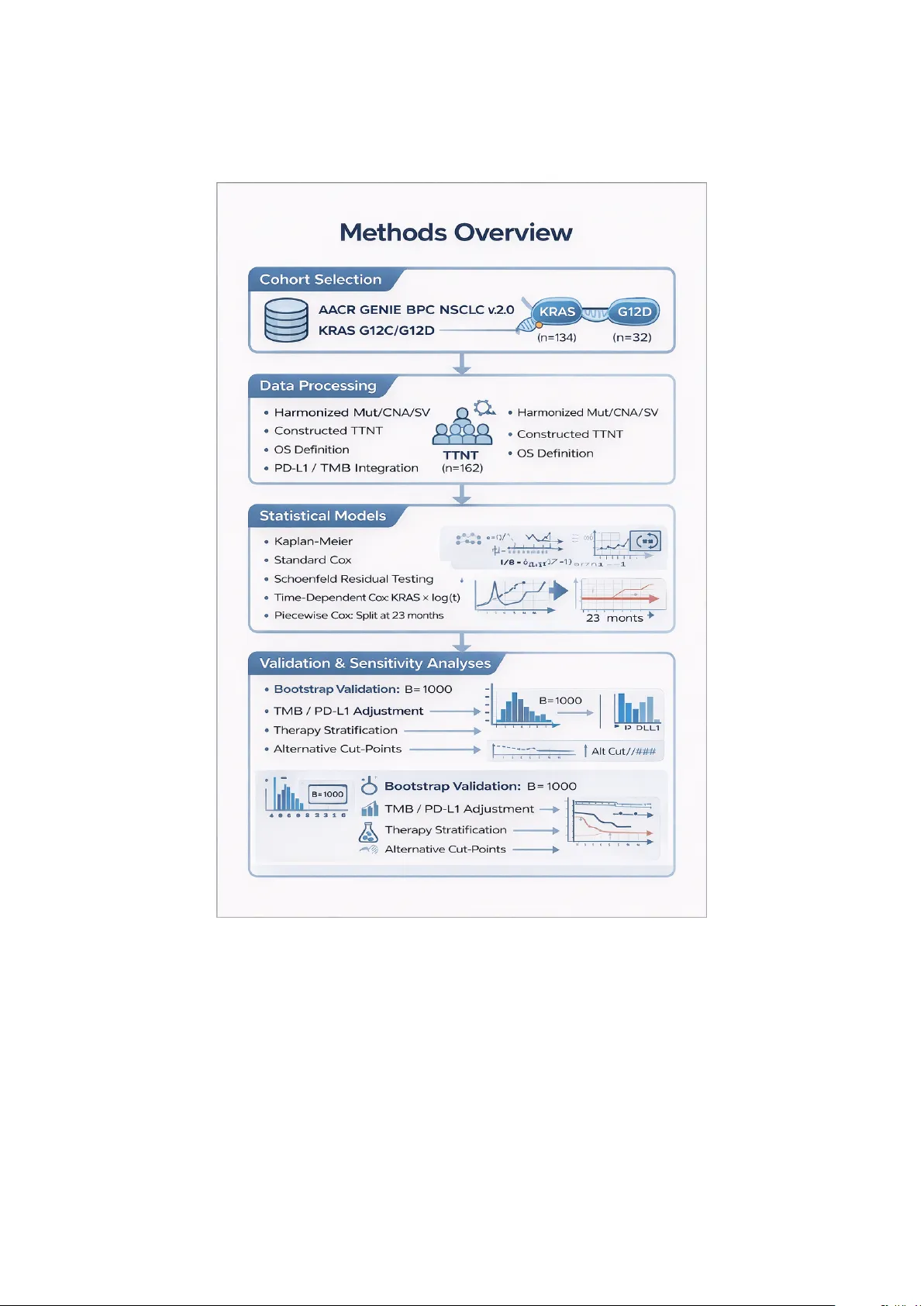
Time-V arying Hazard P atterns and Co-Mutation Profiles of KRAS G12C and G12D in Real-W orld NSCLC Rob ert Amev or ∗ 1 , Emman uel Kubuafor 2 , and Dennis Baido o 2 1 Arnold Sc ho ol of Public Health, Universit y of South Carolina, Columbia, SC, USA 2 Departmen t of Mathematics and Statistics, Universit y of New Mexico, Albuquerque, NM, USA Abstract Bac kground: KRAS m utations represent the largest oncogenic subset in non–small cell lung cancer (NSCLC), y et allele-sp ecific clinical behavior in real-w orld settings remains incompletely c haracterized. While KRAS G12C is now targetable with approv ed inhibitors, no equiv alent agents exist for G12D. W e examined time-to-next-treatment (TTNT) and o v erall surviv al (OS) differences betw een KRAS G12C and G12D using harmonized clinical– genomic data, allo wing for time-v arying hazard effects. Metho ds: De-iden tified data from the AACR Pro ject GENIE BioPharma Collab orativ e (BPC) NSCLC v2.0-public release w ere analyzed. TTNT served as a pragmatic real-world surrogate for progression-free surviv al, deriv ed from curated systemic therap y timelines. Co-alterations in TP53 , STK11 , KEAP1 , SMARCA4 , and MET w ere harmonized across m utation, copy-n umber, and structural v ariant data. Kaplan–Meier, multiv ariable Cox, time-dep enden t Co x, and a pre-sp ecified piecewise Co x mo del (split at median TTNT = 23.0 months) were applied. Prop ortional hazards w ere assessed via Schoenfeld residuals; nonparametric b o otstrap resampling ( B = 1000) ev aluated stability of time-v arying esti- mates. Results: The TTNT cohort comprised 162 patients (G12C n = 130; G12D n = 32). Me- dian TTNT was 28.6 months for G12C v ersus 32.0 mon ths for G12D (log-rank p = 0 . 79). Adjusted Co x regression sho wed no o verall TTNT hazard difference (HR G12D vs G12C = 0 . 85; 95% CI 0.53–1.37; p = 0 . 50). Sc ho enfeld testing indicated b orderline non-prop ortionality for KRAS ( p = 0 . 053). Piecewise Cox mo deling revealed a time-v arying pattern: an early ∗ Corresp onding author: ramevor@email.sc.edu 1 TTNT hazard fav oring G12D (HR early = 0 . 41; 95% CI 0.17–0.97; p = 0 . 043) with a statis- tically significant KRAS × p erio d interaction (HR = 3.33; 95% CI 1.19–9.31; p = 0 . 021) and atten uation in the late p erio d (HR late = 1 . 38; 95% CI 0.77–2.47; p = 0 . 285). Bo otstrap re- sampling confirmed these patterns (median HR early = 0 . 39; median HR late = 1 . 41). Among 278 OS-ev aluable patients (133 deaths), m ultiv ariable Cox regression indicated improv ed OS for G12D (adjusted HR = 0.63; 95% CI 0.39–0.99; p = 0 . 048). KRAS G12C tumors exhibited higher median TMB (9.79 vs. 7.83 mut/Mb; p = 0 . 002) and greater enrichmen t of STK11 and KEAP1 co-m utations. Conclusions: KRAS G12D and G12C dem onstrate distinct temporal treatment tra jecto- ries in this multi-institutional real-world cohort. G12D w as asso ciated with an early TTNT adv an tage and im pro ved ov erall surviv al; these patterns were directionally consistent across b ootstrap and sensitivit y analyses. The late-p erio d TTNT difference did not reac h statistical significance, likely reflecting limited p ow er (p ost-ho c p ow er: 12.3%) given the small G12D cohort. These findings are exploratory and hypothesis-generating, requiring prosp ective v al- idation in larger, allele-resolved cohorts. They nonetheless supp ort contin ued inv estigation of allele-sp ecific biology and dedicated therapeutic developmen t for KRAS G12D. Keyw ords: KRAS G12C; KRAS G12D; non–small cell lung cancer; time-to-next-treatmen t; o v erall surviv al; time-v arying hazards; piecewise Cox regression; tumor mutational burden; AA CR Pro ject GENIE. Figure 1: Graphical result 2 1 In tro duction KRAS mutations are the most prev alent oncogenic drivers in non–small cell lung cancer (NSCLC), o ccurring in appro ximately 25–30% of lung adenocarcinomas w orldwide [F risc h et al., 2025, Lim et al., 2023]. Among these, the glycine-to-cysteine substitution (G12C) accounts for approx- imately 13% of all NSCLC cases, while co don-12 v arian ts including G12D, G12V, and G12S con tribute to the remaining molecular heterogeneity [Shahnam et al., 2025]. This allele-level heterogeneit y is clinically meaningful: KRAS substitutions differ in do wnstream biochemical signaling, co-m utation profiles, tumor immune micro en vironment (TIME) characteristics, and sensitivit y to therap eutic agents [Zhang et al., 2022, Bazheno v a, 2023]. The developmen t of allele-specific KRAS G12C inhibitors has transformed treatment op- tions for this molecular subgroup. Sotorasib and adagrasib ha ve pro duced clinically mean- ingful resp onse rates and progression-free surviv al b enefits in previously treated KRAS G12C NSCLC [Sk oulidis et al., 2021, J¨ anne et al., 2022], and next-generation agents such as div ara- sib contin ue to expand the landscap e [Brazel and Nagasak a, 2024]. By contrast, no approv ed targeted therapies exist for KRAS G12D, although early-phase G12D-directed agents including zoldonrasib ha ve sho wn preliminary activit y [Hippensteele]. These div ergent therap eutic tra jec- tories underscore the imp ortance of characterizing allele-sp ecific clinical b eha vior in real-world p opulations. Real-w orld evidence suggests that allele-sp ecific outcomes ma y b e substantially modified b y co-occurring genomic alterations. KRAS G12C tumors frequently exhibit higher tumor m utational burden (TMB), tobacco-related m utational signatures, and enriched baseline im- m unogenicity relative to non-G12C alleles [Zhao et al., 2024, Ge¸ cgel et al., 2025]. Concurren tly , alterations in STK11 , KEAP1 , and SMAR CA4 define immunologically cold phenot yp es with atten uated b enefit from immune chec kp oint blo ck ade (ICB) [Bazhenov a, 2023], and these co- m utations o ccur at differing frequencies across KRAS alleles [Galan-Cob o et al., 2025, Zhang et al., 2022]. Most existing retrosp ectiv e studies of KRAS allele outcomes rely on static surviv al com- parisons or trial-enric hed cohorts, limiting real-world generalizability [Shahnam et al., 2025]. Imp ortan tly , conv en tional Cox prop ortional-hazards mo dels assume a constan t hazard ratio o ver the en tire follo w-up perio d; if allele-sp ecific effects are time-v arying, suc h analyses ma y obscure clinically meaningful dynamics. Time-to-next-treatmen t (TTNT) has emerged as a pragmatic and v alidated real-world surrogate for progression-free surviv al in observ ational on- cology datasets, permitting longitudinal assessmen t of treatment durability [de Bruijn et al., 2023, Khozin et al., 2019, Campb ell et al., 2020]. 3 The AA CR Pro ject GENIE BioPharma Collab orativ e (BPC) NSCLC dataset pro vides a uniquely comprehensive platform for allele-resolved, time-adaptiv e outcome analyses, in tegrat- ing harmonized m ulti-institutional clinical timelines with matc hed genomic profiles [GEN, 2023, de Bruijn et al., 2023]. Using this resource, we sough t to: (1) compare TTNT and OS b et w een KRAS G12C and G12D in a real-w orld multi-institutional cohort; (2) ev aluate whether allele- sp ecific hazards are time-v arying using piecewise and time-dep enden t Co x mo dels; and (3) c haracterize allele-sp ecific co-m utation profiles and assess their relationship to outcomes. 2 Metho ds 2.1 Data Source De-iden tified clinical and genomic data w ere obtained from the AA CR Pro ject GENIE Bio- Pharma Collab orative (BPC) NSCLC v2.0-public release, accessed through cBioPortal [de Bruijn et al., 2023, AACR Pro ject GENIE Consortium, 2017]. This dataset includes harmonized clin- ical annotations, curated systemic treatment timelines, and link ed somatic mutation, copy- n umber alteration, and structural v ariant files for patients treated at multiple U.S. academic cancer cen ters. Because all data are fully de-identified, this analysis w as exempt from institu- tional review b oard ov ersight. 2.2 Cohort Construction P atients were included if they had: (1) a diagnosis of lung adeno carcinoma; (2) a confirmed somatic KRAS p.G12C or p.G12D m utation on next-generation sequencing; and (3) ev aluable systemic therapy timelines enabling deriv ation of TTNT. Patien ts lacking therapy start dates, missing TTNT ev ent indicators, or without linked genomic data were excluded. OS analyses used a v ailable diagnosis-to-death timelines and harmonized vital status fields. Cohort construc- tion is summarized in Figure 2. 2.3 Endp oin t Definitions Time-to-Next-T reatmen t (TTNT). TTNT serv ed as the primary real-w orld endpoint and pragmatic surrogate for progression-free surviv al [Khozin et al., 2019, Campb ell et al., 2020]. TTNT w as defined as the maxim um recorded duration across all systemic therap y episo des in GENIE BPC. The ev ent indicator w as the initiation of a subsequent regimen (n umber of cancer-directed regimens > 1); patien ts on a single regimen w ere censored at last follo w-up. This definition reflects clinician-assessed treatmen t failure or progression necessitating a regimen 4 1,775 NSCLC patients AA CR GENIE BPC v2.0-public KRAS-m utant subset G12C = 214; G12D = 64 Ev aluable treatmen t timelines, TTNT mon ths and ev en t status TTNT analytic cohort n = 162 (G12C=130; G12D=32) Piecewise Cox dataset 243 start–stop in terv als (162 patien ts) OS analytic cohort n = 278 (133 deaths) Figure 2: CONSOR T-style flow diagram of patien t selection for TTNT and OS analyses. c hange. Ov erall Surviv al (OS). OS was measured from the date of pathological diagnosis to death or last known contact. Vital status w as deriv ed from harmonized “OS Status from start of [therap y]” fields across all curated treatment lines; a patient was classified as deceased if an y field indicated “1:DECEASED o.” 2.4 Genomic V ariable Harmonization Binary alteration indicators for five co-m utation genes of clinical interest ( TP53 , STK11 , KEAP1 , SMAR CA4 , MET ) were derived by merging m utation, cop y-n umber alteration, and structural v arian t tables. A gene w as considered altered if any data source indicated a non-wild-type call; samples with missing data were conserv atively assigned wild-type status. TMB was extracted from the curated nonsynonymous mutation coun t field and analyzed as a contin uous v ariable. PD-L1 p ositivit y w as binarized (p ositiv e vs. negative/unkno wn) using harmonized institutional rep ort v alues. 2.5 Statistical Analysis 2.5.1 Descriptiv e and Comparativ e Analyses Baseline c haracteristics were summarized by allele group using medians for con tin uous v ari- ables and prop ortions for categorical v ariables. Bet w een-group differences were assessed with 5 Wilco xon rank-sum tests (contin uous) and Fisher’s exact tests (categorical). 2.5.2 Kaplan–Meier and Standard Co x Mo dels Unadjusted TTNT and OS were compared using Kaplan–Meier curves and log-rank tests. Mul- tiv ariable Cox prop ortional-hazards mo dels were adjusted for age at sequencing, sex, and STK11 and TP53 co-m utation status. Prop ortional hazards assumptions w ere assessed using Sc ho en- feld residuals for each cov ariate and globally . 2.5.3 Time-V arying Hazard Mo dels Because KRAS exhibited b orderline non-prop ortionality (Schoenfeld p = 0 . 053), t w o comple- men tary time-adaptiv e approac hes were applied: Time-dep enden t Co x mo del. A KRAS × log( t ) in teraction term w as fitted to quan tify con tinuous temp oral c hange in the allele-sp ecific hazard, without imposing a fixed cut-p oint. Pre-sp ecified piecewise Co x mo del. F ollow-up time w as partitioned at the median TTNT (23.0 months), a cut-p oin t selected a priori based on the distribution of follo w-up times rather than outcome-dep endent optimization, thereby a voiding data-driven selection bias. Using the coun ting-pro cess data structure, each patient con tributed one or tw o start–stop in terv als ([0 , c ] and ( c, T i ]). The KRAS × Period in teraction term quantified the change in allele-sp ecific hazard b et ween early and late interv als. P erio d-sp ecific HRs and 95% confidence in terv als were deriv ed using the delta metho d. 2.5.4 Bo otstrap In ternal V alidation T o assess the robustness of early and late HR estimates, nonparametric b o otstrap resampling w as p erformed ( B = 1000 iterations). In eac h iteration, patien ts were resampled with replace- men t at the patient lev el, the piecewise Co x mo del was refit, and p erio d-sp ecific HRs were extracted. Results were summarized as medians and 95% p ercentile confidence interv als across b o otstrap replicates. 2.5.5 Sensitivit y Analyses Pre-sp ecified sensitivit y analyses included: (1) adjustmen t for TMB (p er 5 mut/Mb) to ev aluate p oten tial confounding by mutational burden; (2) alternative piecewise cut-p oints at the 25th, 75th, and 95th TTNT p ercen tiles to assess cut-point dep endence; and (3) exclusion of treatment c hanges within 2 months to reduce administrativ e censoring bias. 6 All analyses were performed in R (version 4.3.1) using the survival , survminer , flexsurv , dplyr , and ggplot2 pack ages [Therneau, 2023, Kassambara et al., 2019, Wickham et al., 2023]. Figure 3 7 3 Results 3.1 Cohort Characteristics and Molecular F eatures Of 1,775 NSCLC patients in the AA CR GENIE BPC v2.0-public dataset, 278 patien ts with KRAS G12C ( n = 214) or KRAS G12D ( n = 64) mutations had ev aluable OS data and formed the molecular characterization cohort. A subset of 162 patients met all criteria for TTNT analysis (G12C n = 130; G12D n = 32; T able 1). KRAS G12C tumors sho wed significan tly higher median TMB (9.79 vs. 7.83 mut/Mb; Wilco xon p = 0 . 002) and greater co-mutation enrichmen t in STK11 (31.8% vs. 17.2%; Fisher’s p = 0 . 027). KEAP1 alteration show ed a similar directional trend (18.7% vs. 9.4%; p = 0 . 087). TP53 , SMAR CA4 , and MET frequencies did not differ significantly b etw een alleles. PD-L1 p ositivit y rates w ere comparable (57% G12C vs. 50% G12D; p = 0 . 623). T able 1: Baseline clinical and genomic c haracteristics by KRAS allele (OS cohort, n = 278). The TTNT cohort ( n = 162) is a subset with complete treatment timeline data. TMB = tumor m utational burden; PD-L1 = programmed death-ligand 1. Con tinuous v ariables compared by Wilco xon rank-sum test; categorical v ariables by Fisher’s exact test. Characteristic G12C ( n = 214 ) G12D ( n = 64 ) T otal ( N = 278 ) p -v alue Sex: male, n (%) 82 (38.3%) 19 (29.7%) 101 (36.3%) 0.238 TMB, median (mut/Mb) 9.79 7.83 9.40 0.002 PD-L1 p ositiv e (%) 49 (57.0%) 10 (50.0%) 59 (55.1%) 0.623 an y- STK11 (%) 68 (31.8%) 11 (17.2%) 79 (28.4%) 0.027 an y- TP53 (%) 92 (43.0%) 27 (42.2%) 119 (42.8%) 1.000 an y- KEAP1 (%) 40 (18.7%) 6 (9.4%) 46 (16.5%) 0.087 an y- SMARCA4 (%) 27 (12.6%) 5 (7.8%) 32 (11.5%) 0.375 an y- MET (%) 21 (9.8%) 3 (4.7%) 24 (8.6%) 0.309 3.2 TTNT: Kaplan–Meier and Multiv ariable Co x Analyses Kaplan–Meier analysis demonstrated no significant ov erall TTNT difference b etw een alleles (Figure 4). Median TTNT was 28.6 mon ths (95% CI: 24.9–34.7) for G12C versus 32.0 mon ths (95% CI: 23.9–45.4) for G12D (log-rank p = 0 . 787). In m ultiv ariable Cox regression adjusting for age, sex, STK11 , and TP53 , KRAS allele subt yp e w as not significan tly asso ciated with ov erall TTNT hazard (HR G12D vs G12C = 0 . 85; 95% CI 0.53–1.37; p = 0 . 50; T able 2). STK11 alteration show ed a directional trend tow ard shorter TTNT (HR = 1.30; 95% CI 0.85–1.99; p = 0 . 23) consistent with published literature, though it did not reac h statistical significance in this sample. Sc ho enfeld residual testing indicated b orderline non-proportionality for the KRAS term ( p KRAS = 0 . 053; global p = 0 . 334), motiv ating additional time-adaptiv e mo deling. 8 + + + + + + + + + + + + + + + + + + + + + + + + + + + + + + + + + + + + + + + + + + + + + + p = 0.79 0.00 0.25 0.50 0.75 1.00 0 50 100 150 200 Months Probability of remaining on therap y (TTNT) KRAS + + G12C G12D 130 13 2 1 0 32 4 0 0 0 G12D G12C 0 50 100 150 200 Months KRAS Number at risk Figure 4: Kaplan–Meier curv es for time-to-next-treatmen t (TTNT) by KRAS allele (G12C n = 130; G12D n = 32). Median TTNT: 28.6 vs. 32.0 months; log-rank p = 0 . 787. T able 2: Multiv ariable Cox prop ortional-hazards mo del for TTNT. V ariable HR 95% CI p -v alue KRAS G12D vs G12C 0.85 0.53–1.37 0.50 Age (p er year) 1.01 0.99–1.03 0.55 Sex: F emale (ref: Male) 1.35 0.87–2.10 0.18 STK11 altered 1.30 0.85–1.99 0.23 TP53 altered 0.77 0.52–1.15 0.20 3.3 Time-V arying Hazard Analysis 3.3.1 Piecewise Co x Mo del The pre-sp ecified piecewise Cox mo del (cut at median TTNT = 23.0 months) generated 243 start–stop in terv als from 162 patients con tributing 114 ev ents. The mo del rev ealed a time- v arying hazard pattern (T able 3; Figure 5). During the early interv al (0–23 mon ths), G12D was asso ciated with a low er TTNT hazard compared with G12C (HR early = 0 . 41; 95% CI 0.17–0.97; p = 0 . 043). A statistically significan t KRAS × P erio d interaction (HR = 3.33; 95% CI 1.19–9.31; p = 0 . 021) indicated that this early difference did not persist: the late-perio d HR w as 1.38 (95% CI 0.77–2.47; p = 0 . 285), with the confidence in terv al crossing unity and not reaching statistical significance. The in teraction indicates a directional shift in the relativ e hazard b et ween perio ds, though late-p erio d estimates should b e interpreted with caution giv en their imprecision (see Limitations). Overall mo del fit 9 w as supp orted by concordance = 0.614 (SE = 0.029) and a significant lik eliho o d ratio test ( p = 0 . 04). Complemen tary time-dep enden t Co x mo deling using a KRAS × log ( t ) interaction pro duced directionally consistent findings, confirming that the temp oral pattern is not an artifact of the sp ecific 23-mon th cut-p oint choice. T able 3: Piecewise Co x mo del for TTNT. The KRAS coefficient represents the early-perio d HR; the late-p erio d HR (1.38; 95% CI 0.77–2.47) is derived from the sum of the KRAS and in teraction co efficien ts using the delta metho d. V ariable HR 95% CI p -v alue KRAS G12D (early p erio d) 0.41 0.17–0.97 0.043 Age (p er year) 1.01 0.99–1.03 0.532 Sex (Male vs F emale) 0.73 0.47–1.12 0.149 STK11 altered 1.22 0.79–1.89 0.359 TP53 altered 0.78 0.52–1.17 0.225 KRAS × late p erio d 3.33 1.19–9.31 0.021 n = 162 patien ts; even ts = 114; concordance = 0.614 (SE = 0.029) Lik eliho od ratio p = 0 . 04; W ald p = 0 . 05; Score p = 0 . 05 Late-p eriod KRAS HR (delta metho d): 1.38 (95% CI 0.77–2.47; p = 0 . 285) 0.41 1.37 0.3 0.5 1.0 Early Late Hazard Ratio (log scale) Early HR < 1 (protective); late HR > 1 (not statistically significant) Piecewise Hazard Ratios f or KRAS G12D vs G12C Figure 5: P erio d-sp ecific hazard ratios for KRAS G12D vs G12C from the piecewise Cox mo del (cut-p oin t: 23 months). HR early = 0 . 41 (95% CI 0.17–0.97); HR late = 1 . 38 (95% CI 0.77–2.47). Dashed line at HR = 1.0. Late-perio d HR did not reach statistical significance ( p = 0 . 285). 3.3.2 Bo otstrap V alidation Nonparametric b o otstrap resampling ( B = 1000) at the patien t lev el confirmed the directional stabilit y of the time-v arying pattern (Figure 6). Bo otstrap-deriv ed HR distributions yielded median HR early = 0 . 39 (95% p ercen tile in terv al: 0.11–0.87) and median HR late = 1 . 41 (95% p ercen tile in terv al: 0.75–3.24). The close agreement betw een point estimates and bo otstrap 10 medians supp orts the internal robustness of the observ ed pattern. The wider p ercen tile interv al for the late HR reflects gen uine uncertaint y arising from the limited G12D sample size (see Limitations). 0 20 40 60 0.0 0.3 0.6 0.9 hr_early count Bootstrap Early HR Distribution 0 25 50 75 1 2 3 4 hr_late count Bootstrap Late HR Distribution Figure 6: Bo otstrap distributions ( B = 1000 resamples) for early and late perio d-sp ecific hazard ratios. Median HR early = 0 . 39 (95% PI: 0.11–0.87); median HR late = 1 . 41 (95% PI: 0.75–3.24). Dashed vertical lines indicate medians; solid red lines indicate HR = 1. 3.4 Ov erall Surviv al Among 278 OS-ev aluable patients (G12C n = 214; G12D n = 64; 133 deaths), Kaplan–Meier analysis show ed improv ed surviv al for G12D (log-rank p = 0 . 019; Figure 7). Median OS was 44.8 months for G12C versus 72.4 mon ths for G12D. After m ultiv ariable adjustmen t for age, sex, STK11 , and TP53 , the OS b enefit for G12D remained statistically significant (HR = 0.63; 95% CI 0.39–0.99; p = 0 . 048; T able 4). Proportional hazards assumptions were satisfied (global p = 0 . 91). Age (HR = 1.02 p er y ear; p = 0 . 023) and STK11 alteration (HR = 1.48; p = 0 . 042) w ere additional significan t predictors. 11 T able 4: Multiv ariable Cox prop ortional-hazards mo del for o verall surviv al (OS). V ariable HR 95% CI z p -v alue KRAS G12D vs G12C 0.63 0.39–0.99 − 1 . 98 0.048 Age (p er year) 1.02 1.00–1.04 2 . 27 0.023 Sex: Male 1.01 0.70–1.46 0 . 05 0.960 STK11 altered 1.48 1.01–2.16 2 . 03 0.042 TP53 altered 1.41 0.99–2.01 1 . 91 0.056 + + + + + + + + + + + + + + + + + + + + + + + + + + + + + + + + + + + + + + + + + + + + + + + + + + + + + + + + + + + + + + + + + + + + + + + + + + + + + + + + + + + + + + + + + + + + + + + + + + + + + + + + + + + + + + + + + + + + + + + + + + + + + + + + + + + + + + + p = 0.019 0.00 0.25 0.50 0.75 1.00 0 50 100 150 200 Months from diagnosis Ov erall survival probability KRAS + + G12C G12D 214 34 2 1 1 64 10 3 0 0 G12D G12C 0 50 100 150 200 Months from diagnosis KRAS Number at risk Figure 7: Kaplan–Meier ov erall surviv al curves by KRAS allele (mon ths from diagnosis; n = 278; 133 deaths). Log-rank p = 0 . 019 (unadjusted). Adjusted HR for G12D = 0.63 (95% CI 0.39– 0.99; p = 0 . 048; T able 4). 3.5 Sensitivit y and Robustness Analyses TMB-adjusted mo del. Addition of TMB (p er 5 mut/Mb) as a cov ariate did not materially alter the allele effect: HR early = 0 . 39 (95% CI 0.16–0.92); interaction HR = 3.38 (95% CI 1.21– 9.44; p = 0 . 020). TMB itself was not significan tly asso ciated with TTNT in the piecewise mo del ( p = 0 . 319). Alternativ e cut-p oin ts. Piecewise mo dels at the 25th (12.0 months), 75th (34.7 mon ths), and 95th (65.4 months) TTNT percentiles consisten tly yielded early HRs b elo w 1.0 (range: 12 0.19–0.83) and late HRs ab ov e 1.0 (range: 1.02–1.42), supp orting directional consistency across cut-p oin t choices, though confidence interv als widened with more extreme splits due to smaller risk sets. Exclusion of early even ts ( ≤ 2 mon ths). Censoring treatment changes within 2 months did not alter the primary findings: HR early = 0 . 41 (95% CI 0.18–0.97); interaction HR = 3.33 (95% CI 1.19–9.31; p = 0 . 022). 4 Discussion In this real-world, allele-resolv ed analysis of the AACR Pro ject GENIE BPC NSCLC cohort, w e found that KRAS G12C and G12D lung adeno carcinomas exhibit distinct co-mutation profiles and directionally different temp oral treatmen t durabilit y patterns. Although unadjusted TTNT and standard multiv ariable Cox mo dels did not iden tify a significant ov erall difference b et ween alleles, time-structured mo deling revealed a statistically supp orted early TTNT adv an tage for G12D that attenuated during later follow-up. This time-v arying pattern was directionally con- sisten t across b o otstrap resampling, alternative cut-p oin ts, and TMB-adjusted sensitivity anal- yses. Additionally , G12D w as asso ciated with significantly impro ved OS in a larger ev aluable cohort. 4.1 Biological Con text for Observ ed P atterns The allele-sp ecific molecular features observ ed in our cohort pro vide a plausible biological frame- w ork for the time-v arying outcomes. G12C tumors displa yed significan tly higher TMB and greater enrichmen t of STK11 and KEAP1 co-m utations, findings concordant with prior trans- lational and registry studies [Sk oulidis et al., 2015, Prior et al., 2020, Zhang et al., 2022]. STK11 and KEAP1 alterations define immunologically cold tumor phenotypes with attenuated b enefit from ICB and are asso ciated with p o orer outcomes across KRAS alleles [Skoulidis et al., 2015, Bazheno v a, 2023]. The relative paucity of these co-mutations in G12D tumors may contribute to more durable early treatment resp onses, including to ICB-containing regimens commonly used in first-line NSCLC. The G12D OS adv antage (adjusted HR = 0.63; p = 0 . 048) p ersisted despite G12D’s low er median TMB and late-p erio d TTNT conv ergence. This is noteworth y b ecause lo wer TMB is generally asso ciated with reduced immunotherap y b enefit, suggesting that the co-mutation landscap e — particularly the relative absence of STK11 / KEAP1 alterations — ma y preserve treatmen t resp onsiv eness across sequential lines in G12D tumors more than TMB alone would 13 predict. These observ ations are concordan t with published evidence that co-mutation context, rather than TMB in isolation, is a more reliable predictor of KRAS allele-sp ecific ICB out- comes [Zhao et al., 2024, Can tor et al., 2025]. The late-p erio d atten uation of G12D’s early TTNT adv an tage may reflect sev eral non- m utually exclusiv e mechanisms: emergence of resistant sub clones, clonal evolution under ther- ap eutic pressure, exhaustion of immune-mediated tumor control, or differen tial do wnstream KRAS signaling ov er time. These dynamic c hanges w ould not b e detectable using conv entional prop ortional-hazards mo dels [D´ esage et al., 2022, Chao and Di, 2025], underscoring the v alue of time-adaptive analytical frameworks for molecular subgroup analyses. 4.2 Therap eutic Con text An imp ortant consideration is that G12C-targeted inhibitors (sotorasib, adagrasib) became clin- ically a v ailable during the study p erio d co v ered by the GENIE BPC dataset. Our analysis could not separately identify patients who received these agents. If G12C patien ts disprop ortionately accessed targeted therapies in later lines, this could contribute to the attenuation of G12D’s early durabilit y adv an tage indep endent of biological mechanisms. F uture analyses with explicit capture of allele-targeted therapy exp osure will b e necessary to separate treatmen t-era effects from underlying allele biology . F or G12D sp ecifically , early-phase inhibitors including zoldonrasib represent the first tar- geted options for this subgroup [Hipp ensteele]. Our real-w orld TTNT and OS data provide pre-targeted-era b enc hmarks that ma y con textualize future comparative effectiveness analyses as G12D-directed therapies mature. 4.3 Limitations This study has several imp ortant limitations that require careful consideration. First and most critically , the G12D cohort in the TTNT analyses was small ( n = 32), whic h substan tially constrained statistical p o w er, particularly for late-perio d inferences. P ost-ho c p o wer analysis using the Schoenfeld formula indicated that detecting the observed late-p erio d HR of 1.38 with 80% pow er at α = 0 . 05 would require appro ximately 489 even ts among patien ts surviving b ey ond 23 months, corresp onding to roughly 193 G12D and 785 G12C patients. With appro ximately 40 late-p erio d even ts observ ed, the achiev ed pow er for the late-p erio d comparison w as only 12.3%. Consequently , the non-significant late-p erio d HR ( p = 0 . 285) most plausibly reflects inadequate p ow er rather than absence of a true effect, and late-p erio d estimates should b e treated as exploratory and h yp othesis-generating. Confirmation of the late-p erio d pattern 14 requires prosp ectiv e v alidation in larger, allele-resolved cohorts or po oled multi-institutional analyses. Second, TTNT is an imp erfect surrogate for radiographic progression: clinician decisions to c hange therapy may b e influenced b y tolerabilit y , patient preference, or administrative factors indep enden t of disease progression. Nonetheless, TTNT is a widely used and pragmatically v alidated real-world endp oin t in observ ational oncology research [Khozin et al., 2019, Campb ell et al., 2020]. Third, incomplete or v ariable rep orting of genomic data (CNAs, SVs, TMB, PD- L1) across institutions ma y in tro duce differen tial misclassification of co-m utation and biomarker v ariables. F ourth, unmeasured confounding by treatmen t selection, cen ter-sp ecific practice pat- terns, or p erformance status not captured in the BPC public release cannot b e fully excluded despite multiv ariable adjustmen t. Fifth, OS follow-up in the BPC v2.0 public release may be incomplete or v ariably mature across centers, and the OS findings, while statistically significan t, should b e interpreted in that con text. 4.4 Strengths Strengths include the use of deeply curated, harmonized treatment timelines from GENIE BPC enabling high-resolution TTNT measuremen t; comprehensiv e co-m utation harmonization across three genomic data t yp es; application of multiple complemen tary surviv al mo deling frameworks that explicitly ev aluated prop ortional hazards ass umptions; and rigorous b o otstrap in ternal v alidation demonstrating directional stabilit y of time-v arying estimates. Pre-sp ecifying the median cut-p oint prior to analysis av oids data-driv en selection bias that commonly inflates t yp e-I error in piecewise mo deling. 4.5 Implications and F uture Directions These findings supp ort several practical implications. First, KRAS-mutan t NSCLC should not b e treated as a uniform molecular en tity in clinical or researc h settings; allele-sp ecific and temp o- rally stratified outcome rep orting is warran ted. Second, prospective studies and registries should presp ecify time-v arying surviv al analyses and ensure sufficient allele-level sample sizes to de- tect dynamic effects with adequate pow er. Third, in tegrative m ulti-omic approaches—including imm une profiling, longitudinal circulating tumor DNA sampling, and p ost-progression genomic c haracterization, are needed to mechanistically dissect the early-to-late transition in allele- sp ecific hazards. Finally , patients with KRAS G12D should b e considered high-priority candi- dates for G12D-directed clinical trials as targeted agents adv ance through developmen t. 15 4.6 Conclusions In this multi-institutional real-w orld analysis, KRAS G12D lung adeno carcinomas demonstrated an early TTNT durability adv antage and significantly impro ved OS compared with G12C, de- spite similar ov erall TTNT. Time-structured surviv al mo deling identified allele-sp ecific hazard dynamics that conv entional prop ortional-hazards analyses did not reveal. The early-p erio d KRAS effect was statistically significant and b o otstrap-confirmed; the late-p erio d pattern was directionally consistent but did not reach significance, reflecting limited p ow er from the small G12D cohort rather than evidence against the effect. These exploratory findings challenge the treatmen t of KRAS-m utant NSCLC as a homogeneous en tity and support prosp ective in vesti- gation of allele-sp ecific treatment tra jectories, particularly as G12D-targeted therap eutics en ter clinical practice. Ac kno wledgemen ts W e thank the AACR Pro ject GENIE Consortium and all contributing institutions for public access to de-identified data. Data Av ailabilit y Data are publicly av ailable from the AACR Pro ject GENIE BPC NSCLC v2.0-public release via cBioPortal. Conflicts of In terest The authors declare no conflicts of interest. F unding No sp ecific funding was received for this w ork. References A F risch, E Martin, S Y Kim, J W Riess, T Sen, and N Karim. Kras mutated nsclc: Past, presen t, and future directions in a rapidly evolving landscap e. The Onc olo gist , 30(6):oy af153, 2025. doi:10.1093/oncolo/o yaf153. 16 T K H Lim, F Skoulidis, K M Kerr, M J Ahn, J R Kapp, F A Soares, and Y Y atabe. Kras g12c in adv anced nsclc: Prev alence, co-mutations, and testing. Lung Canc er , 184:107293, 2023. doi:10.1016/j.lungcan.2023.107293. Epub 2023 Jul 13. A Shahnam, A Da vis, L J Bro wn, I Sulliv an, K Lin, C Ng, N Y eo, B Y Kong, T Khoo, L W arburton, I P Da Silv a, W Mullally , W Xu, K O’Byrne, V Bray , A Pal, A Mersaides, M Itchins, S Arulananda, A Nagrial, S Kao, M Alexander, C K Lee, B Solomon, and T John. Real-w orld outcomes of non-small cell lung cancer patients harb ouring kras g12c and kras g12d mutations. Lung Canc er , 201:108421, 2025. doi:10.1016/j.lungcan.2025.108421. Epub 2025 F eb 12. Bo Zhang, Jingtong Zeng, Hao Zhang, Shuai Zhu, Hanqing W ang, Jinling He, Lingqi Y ang, Ning Zhou, Lingling Zu, Xiaohong Xu, Zuoqing Song, and Song Xu. Characteristics of the imm une microenvironmen t and their clinical significance in non-small cell lung can- cer patients with ALK-rearranged mutation. F r ontiers in Immunolo gy , 13:974581, 2022. doi:10.3389/fimm u.2022.974581. Published 2022 Sep 07. L Bazhenov a. Exploring the role of accessory biomarkers tm b, stk11, k eap1, and kras in non- small-cell lung cancer: confused, but on a m uc h higher lev el. Annals of Onc olo gy , 34(4):327– 332, 2023. doi:10.1016/j.annonc.2023.02.013. Erratum in: Ann Oncol. 2023 Aug;34(8):725– 726. doi:10.1016/j.annonc.2023.05.007. F Skoulidis, B T Li, G K Dy , T J Price, G S F alc ho ok, J W olf, A Italiano, M Sch uler, H Borghaei, F Barlesi, T Kato, A Curioni-F on tecedro, A Sacher, A Spira, S S Ramalingam, T T ak ahashi, B Besse, A Anderson, A Ang, Q T ran, O Mather, H Henary , G Ngarmchamnanrith, G F rib erg, V V elc heti, and R Govindan. Sotorasib for lung cancers with kras p.g12c m utation. The New England Journal of Me dicine , 384(25):2371–2381, 2021. doi:10.1056/NEJMoa2103695. Epub 2021 Jun 4. P A J¨ anne, G J Riely , S M Gadgeel, R S Heist, S I Ou, J M P ac heco, M L Johnson, J K Sabari, K Lev en takos, E Y au, L Bazhenov a, M V Negrao, N A Pennell, J Zhang, K Anderes, H Der-T orossian, T Kheoh, K V elastegui, X Y an, J G Christensen, R C Chao, and A I Spira. Adagrasib in non-small-cell lung cancer harb oring a kras g12c mutation. The New England Journal of Me dicine , 387(2):120–131, 2022. doi:10.1056/NEJMoa2204619. Epub 2022 Jun 3. D Brazel and M Nagasak a. Div arasib in the evolving landscape of kras g12c inhibitors for nsclc. T ar gete d Onc olo gy , 19(3):297–301, 2024. doi:10.1007/s11523-024-01055-y. Epub 2024 May 13. 17 Alana Hippensteele. AA CR 2025: Oral in vestigational agen t Zoldon- rasib elicits ob jectiv e resp onses in patients with KRAS G12D- m utated NSCLC. URL https://www.pharmacytimes.com/view/ oral- investigational- agent- zoldonrasib- elicits- objective- responses- in- patients- with- kras- g12d- mutated- nsclc . Rui Zhao, Y ang Shu, W ei Xu, F engxian Jiang, P ancen Ran, Liying Pan, Jingliang W ang, W eihao W ang, Jing Zhao, Y ahui W ang, and Guobin F u. The efficacy of immunotherap y in non-small cell lung cancer with KRAS mutation: a systematic review and meta-analysis. Canc er Cel l International , 24:361, 2024. doi:10.1186/s12935-024-03761-w. Published 2024 Nov 1. A Ge¸ cgel, B S ¸ ahin C ¸ elik, P P eker, Z S G¨ okdere, D Ko ca, B Karaca, D Nart, and E G¨ ok er. Kras g12c m utation predicts improv ed surviv al in nsclc patients receiving immunother- ap y: insigh ts from a real-world cohort. Journal of Clinic al Me dicine , 14(19):6826, 2025. doi:10.3390/jcm14196826. Published 2025 Sep 26. A Galan-Cob o, N I V okes, Y Qian, D Molk e n tine, K Ramkumar, A G P aula, M Pisegna, D J McGrail, A P oteete, S Cho, M T Do, A Karimi, Y Kong, A Solanki, A Karmok ar, N Flo c’h, A Hughes, R Sargean t, L Y oung, L Shen, G Kar, C Kesh v ani, C Arrechedera, S Hernandez, K Schlac her, J W ang, S Iyer, J Conw ay , M R Keddar, M Milo, I de T oma, S E Critchlo w, J C Barrett, J Cosaert, A Lau, V V alge-Archer, L A Byers, S T Barry , and J V Heymach. Keap1 and stk11/lkb1 alterations enhance vulnerabilit y to atr inhibition in kras mutan t non-small cell lung cancer. Canc er Cel l , 43(8):1530–1548.e9, 2025. doi:10.1016/j.ccell.2025.06.011. Epub 2025 Jul 10. I de Bruijn, R Kundra, B Mastrogiacomo, T N T ran, L Sikina, T Mazor, X Li, A Ochoa, G Zhao, B Lai, A Ab eshouse, D Baiceanu, E Ciftci, U Dogrusoz, A Dufilie, Z Erkoc, E Garcia Lara, Z F u, B Gross, C Ha ynes, A Heath, D Higgins, P Jagannathan, K Kalletla, P Kumari, J Lind- sa y , A Lisman, B Leenknegt, P Luk asse, D Madela, R Madupuri, P v an Nierop, O Plantalec h, J Quach, A C Resnick, S Y A Ro denburg, B A Satra v ada, F Schaeffer, R Sheridan, J Singh, R Sirohi, S O Sumer, S v an Hagen, A W ang, M Wilson, H Zhang, K Zhu, N Rusk, S Brown, J A Lav ery , K S P anageas, J E Rudolph, M L LeNoue-Newton, J L W arner, X Guo, H Hunter- Zinc k, T V Y u, S Pilai, C Nichols, S M Gardos, J Philip, AACR Pro ject GENIE BPC Core T eam, AACR Pro ject GENIE Consortium, K L Kehl, G J Riely , D Schrag, J Lee, M V Fiandalo, S M Sweeney , T J Pugh, C Sander, E Cerami, J Gao, and N Sc hultz. Analysis and visualization of longitudinal genomic and clinical data from the aacr pro ject genie biopharma collab orativ e in cbiop ortal. Canc er R ese ar ch , 83(23):3861–3867, 2023. doi:10.1158/0008- 5472.CAN-23-0816. Epub 2023 Jul 31. 18 S. Khozin, G. M. Blumenthal, and R. P azdur. Real-world data for clinical evidence generation in oncology . Natur e R eviews Clinic al Onc olo gy , 16:73–74, 2019. doi:10.1038/s41571-018-0117-4. Brian A. Campbell, Jerem y J. Scarisbric k, Y oun H. Kim, Ryan A. Wilcox, Christopher Mc- Cormac k, and H. Miles Prince. Time to next treatment as a meaningful endp oin t for trials of primary cutaneous lymphoma. Canc ers , 12(8):2311, 2020. doi:10.3390/cancers12082311. Published 2020 Aug 17. Aacr pro ject genie: 10-year cohort summary . AACR White P ap er, 2023. URL https://www. aacr.org/professionals/research/aacr- project- genie/ . AA CR Pro ject GENIE Consortium. Aacr pro ject genie: Po wering precision medicine through an in ternational consortium. Canc er Disc overy , 7(8):818–831, 2017. doi:10.1158/2159-8290.CD- 17-0151. Epub 2017 Jun 1. T erry Therneau. A Package for Survival Analysis in R , 2023. URL https://CRAN.R- project. org/package=survival . Alb ouk adel Kassam bara, Marcin Kosinski, and Przemysla w Biecek. survminer: Dr awing Sur- vival Curves using ggplot2 , 2019. URL https://CRAN.R- project.org/package=survminer . Hadley Wickham, Romain F ran¸ cois, Lionel Henry , and Kirill M ¨ uller. dplyr: A Gr ammar of Data Manipulation , 2023. URL https://CRAN.R- project.org/package=dplyr . F Skoulidis, L A By ers, L Diao, V A P apadimitrakopoulou, P T ong, J Izzo, C Behrens, H Kadara, E R P arra, J R Canales, J Zhang, U Giri, J Gudik ote, M A Cortez, C Y ang, Y F an, M Peyton, L Girard, K R Co ombes, C T oniatti, T P Heffernan, M Choi, G M F ramp- ton, V Miller, J N W einstein, R S Herbst, K K W ong, J Zhang, P Sharma, G B Mills, W K Hong, J D Minna, J P Allison, A F utreal, J W ang, I I Wistuba, and J V Heymac h. Co- o ccurring genomic alterations define ma jor subsets of KRAS-mutan t lung adeno carcinoma with distinct biology , immune profiles, and therap eutic vulnerabilities. Canc er Disc overy , 5 (8):860–877, 2015. doi:10.1158/2159-8290.CD-14-1236. Epub 2015 Jun 11. I A Prior, F E Hoo d, and J L Hartley . The frequency of Ras mutations in cancer. Canc er R ese ar ch , 80(14):2969–2974, 2020. doi:10.1158/0008-5472.CAN-19-3682. Epub 2020 Mar 24. D J Cantor, H Nimeiri, L Horn, M W est, R Ben-Shachar, I Huerga, J D Patel, and C Aggar- w al. Outcomes following first-line immune c hec kp oint inhibitors with or without chemother- ap y stratified by KRAS mutational status: a real-world analysis in patients with adv anced 19 NSCLC. Clinic al Lung Canc er , 26(6):503–510.e4, 2025. doi:10.1016/j.cllc.2025.05.007. Epub 2025 May 28. Anne-Laure D ´ esage, Camille L ´ eonce, Aur´ elie Sw alduz, and Sandra Ortiz-Cuaran. T argeting KRAS m utan t in non-small cell lung cancer: no vel insights in to therap eutic strategies. F r on- tiers in Onc olo gy , 12:796832, 2022. doi:10.3389/fonc.2022.796832. C H Chao and Y P Di. Mec hanisms and current adv ances in treating KRAS-m utated lung cancer. Chinese Me dic al Journal Pulmonary & Critic al Car e Me dicine , 3(3):149–163, 2025. doi:10.1016/j.p ccm.2025.08.001. Published 2025 Sep 16. 20
Original Paper
Loading high-quality paper...
Comments & Academic Discussion
Loading comments...
Leave a Comment