ViLBias: Detecting and Reasoning about Bias in Multimodal Content
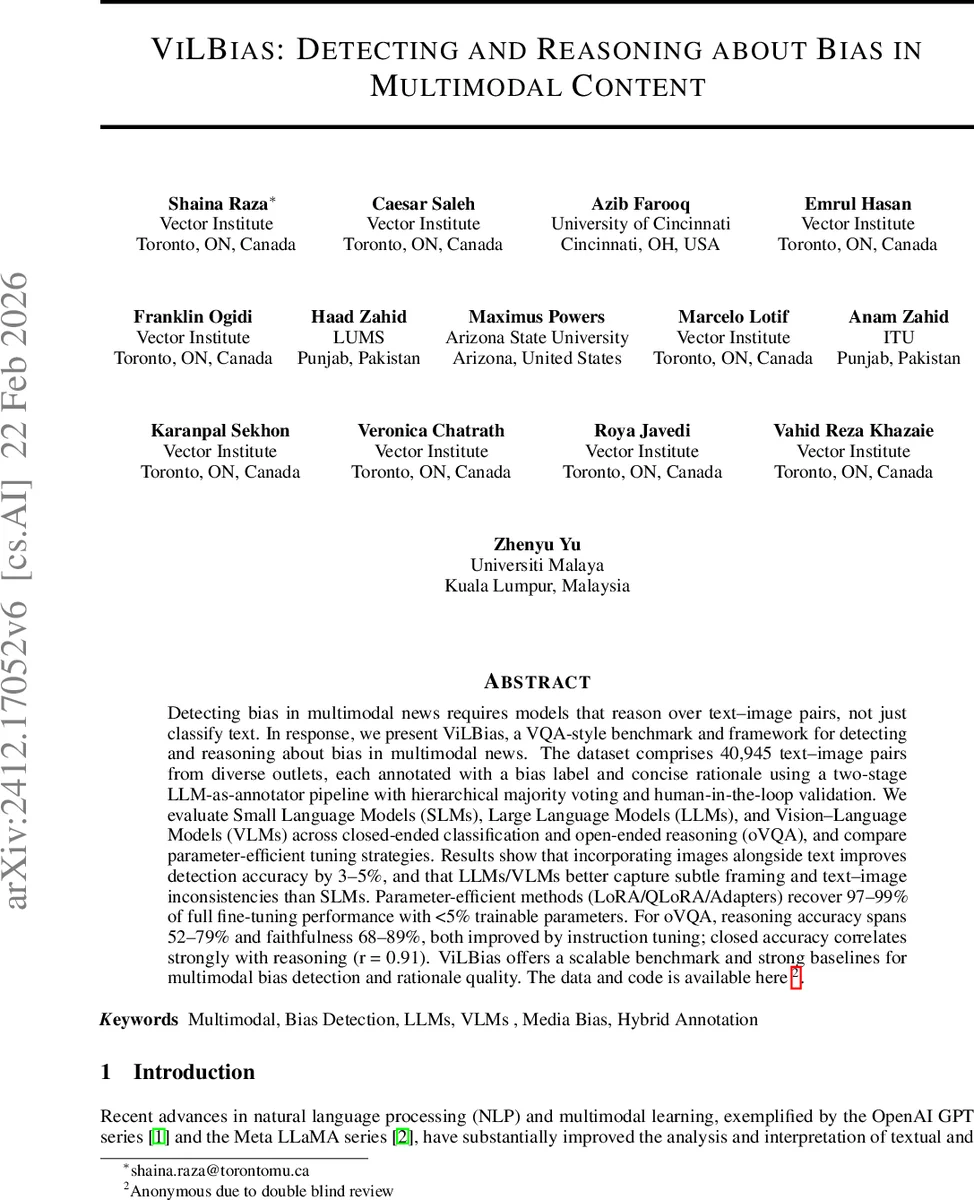
Detecting bias in multimodal news requires models that reason over text–image pairs, not just classify text. In response, we present ViLBias, a VQA-style benchmark and framework for detecting and reasoning about bias in multimodal news. The dataset comprises 40,945 text–image pairs from diverse outlets, each annotated with a bias label and concise rationale using a two-stage LLM-as-annotator pipeline with hierarchical majority voting and human-in-the-loop validation. We evaluate Small Language Models (SLMs), Large Language Models (LLMs), and Vision–Language Models (VLMs) across closed-ended classification and open-ended reasoning (oVQA), and compare parameter-efficient tuning strategies. Results show that incorporating images alongside text improves detection accuracy by 3–5%, and that LLMs/VLMs better capture subtle framing and text–image inconsistencies than SLMs. Parameter-efficient methods (LoRA/QLoRA/Adapters) recover 97–99% of full fine-tuning performance with $<5%$ trainable parameters. For oVQA, reasoning accuracy spans 52–79% and faithfulness 68–89%, both improved by instruction tuning; closed accuracy correlates strongly with reasoning ($r = 0.91$). ViLBias offers a scalable benchmark and strong baselines for multimodal bias detection and rationale quality.
💡 Research Summary
ViLBias introduces a comprehensive benchmark and evaluation framework for detecting and reasoning about bias in multimodal news content. The authors argue that existing bias‑detection resources focus almost exclusively on textual signals, overlooking the substantial role of visual elements such as image selection, cropping, and staging. To address this gap, they construct BiasCorpus, a collection of 40,945 news articles paired with the first image that appears in each article. The corpus spans a wide range of outlets (e.g., Financial Times, USA TODAY, CNN) and political orientations, ensuring diverse editorial slants.
Annotation is performed through a two‑stage “LLM‑as‑annotator” pipeline followed by human‑in‑the‑loop (HITL) validation. Three large language models are each queried three times per item; a majority vote within each model stabilizes its stochastic output, and a second majority vote across the three models yields a provisional label and a concise rationale. Twelve domain experts (computer science, media studies, political science, linguistics) then review every annotation, marking it as acceptable, needing improvement, or incorrect, and providing corrective feedback. This hybrid approach achieves a Cohen’s Kappa of 0.72 between automated and expert judgments, indicating substantial agreement while dramatically reducing manual labeling costs.
Each data point includes a binary bias label (Biased vs. Not Biased) and a short natural‑language explanation that points to textual framing (e.g., loaded wording, selective omission) and/or visual cues (e.g., emotive imagery, cropping). The benchmark is framed as a VQA‑style task: given a text‑image pair and a question such as “Does this content exhibit bias? Please explain your reasoning,” models must output both a class prediction and a rationale. This design enables simultaneous evaluation of predictive accuracy and reasoning quality, a capability missing from prior text‑only bias corpora like MBIB or BABE.
The authors evaluate three families of models: (1) Small Language Models (SLMs) – BERT‑base, RoBERTa‑base, DistilBERT, GPT‑2‑small, BART‑base – operating on text only; (2) Large Language Models (LLMs) – LLaMA‑3.2‑Instruct, Mistral‑7B‑Instruct, as well as closed‑source APIs GPT‑4o and Gemini 1.5 Pro – used in zero‑shot, five‑shot, and instruction‑fine‑tuned regimes; (3) Vision‑Language Models (VLMs) – Phi‑3‑Vision‑128k‑Instruct, LLaVA‑1.6, LLaMA‑3.2‑11B‑Vision‑Instruct, plus GPT‑4o‑mini and Gemini 1.5 Pro – capable of processing both modalities jointly. For each model family, the authors test (a) zero‑shot prompting, (b) five‑shot exemplars, (c) full fine‑tuning on the training split, and (d) parameter‑efficient fine‑tuning methods (LoRA, QLoRA, Adapters) that train fewer than 5 % of the total parameters.
Key findings include: (i) Adding image information yields a consistent 3‑5 % boost in classification accuracy over text‑only baselines, confirming that visual cues provide complementary signals for bias detection. (ii) LLMs and VLMs outperform SLMs, especially on subtle framing cases where lexical cues are insufficient; F1 scores improve by 8‑12 % on average. (iii) Parameter‑efficient tuning recovers 97‑99 % of the performance of full fine‑tuning while dramatically reducing computational cost, making large multimodal models more accessible for downstream deployment. (iv) In the open‑ended VQA setting, reasoning accuracy ranges from 52 % to 79 % and faithfulness (measured by an LLM‑as‑judge) from 68 % to 89 %; instruction tuning improves both metrics by roughly 6‑9 %. (v) Closed‑ended classification accuracy correlates strongly with VQA reasoning accuracy (Pearson r = 0.91), suggesting that a model’s ability to correctly label bias is a good proxy for its explanatory competence.
The paper also discusses limitations. The definition of bias (directional framing in text, image, or their interaction) remains inherently subjective, and the reliance on LLMs for initial annotation may propagate the annotators’ own biases. Only the first image of each article is used, potentially missing bias expressed through alternative images or video content. Evaluation of rationales depends on another LLM (the “judge”), which could introduce systematic evaluation bias. Finally, the dataset is dominated by English‑language outlets from 2023‑2024, limiting generalizability to non‑Western media ecosystems.
Future research directions proposed include expanding to multiple images or video frames, enriching bias categories (ideological, gender, racial, etc.), developing human‑centric metrics for rationale quality, performing meta‑evaluation of LLM‑judge reliability, and curating multilingual, cross‑cultural multimodal bias corpora. By providing a large‑scale, well‑annotated, and rigorously evaluated benchmark, ViLBias sets a new standard for multimodal bias detection and opens avenues for more nuanced, explainable AI systems in the media domain.
Comments & Academic Discussion
Loading comments...
Leave a Comment