Countable models of weakly quasi-o-minimal theories I
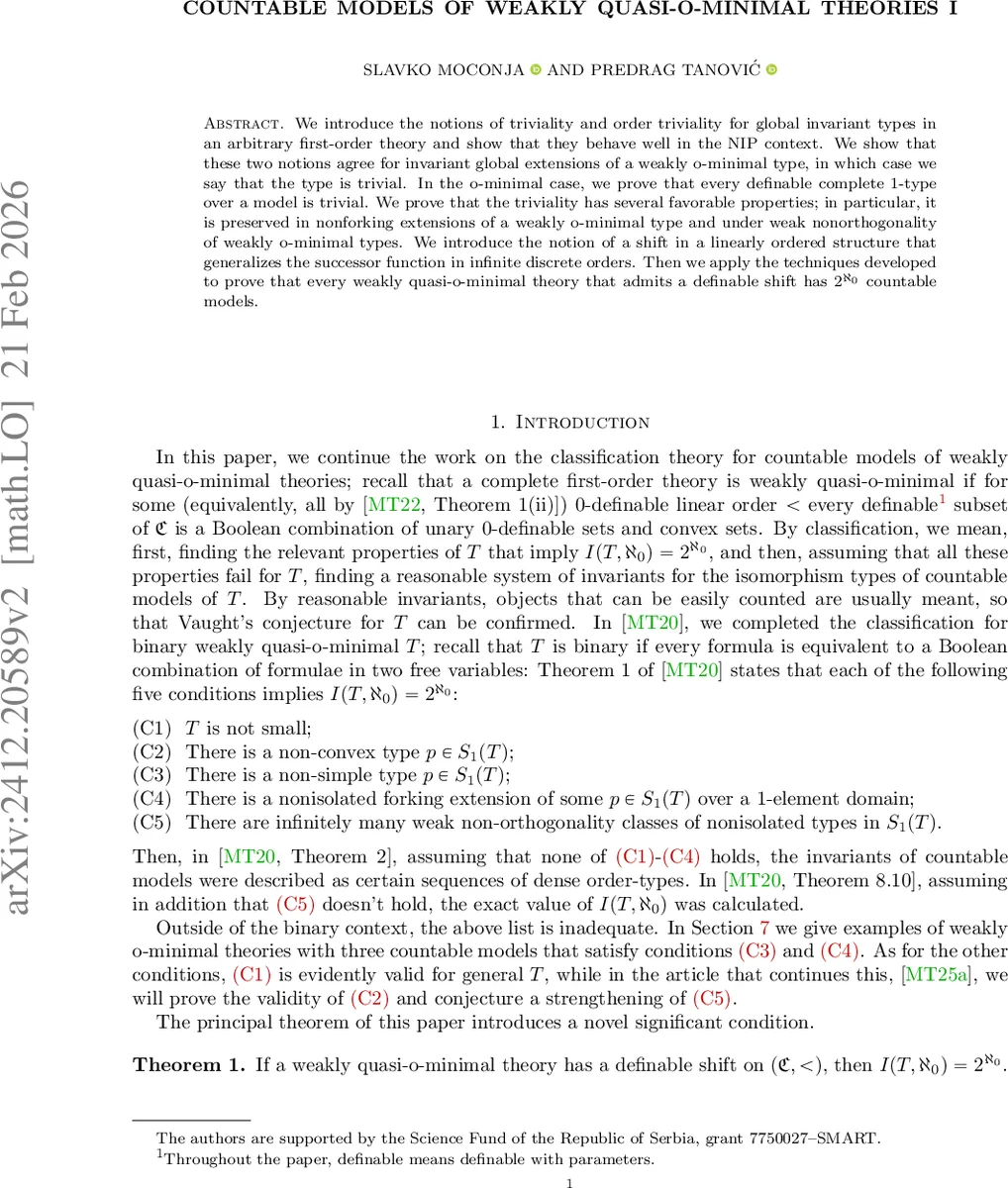
We introduce the notions of triviality and order-triviality for global invariant types in an arbitrary first-order theory and show that they are well behaved in the NIP context. We show that these two notions agree for invariant global extensions of a weakly o-minimal type, in which case we say that the type is trivial. In the o-minimal case, we prove that every definable complete 1-type over a model is trivial. We prove that the triviality has several favorable properties; in particular, it is preserved in nonforking extensions of a weakly o-minimal type and under weak nonorthogonality of weakly o-minimal types. We introduce the notion of a shift in a linearly ordered structure that generalizes the successor function. Then we apply the techniques developed to prove that every weakly quasi-o-minimal theory that admits a definable shift has $2^{\aleph_0}$ countable models.
💡 Research Summary
The paper introduces two new notions for global invariant types in an arbitrary first‑order theory: triviality and order‑triviality. A global type $p$ is called trivial over a set $A$ if any pairwise $A$‑independent Morley sequence in $p$ is itself a Morley sequence; order‑triviality requires this only for sequences indexed by a linear order. In the NIP (non‑independence property) context the authors prove that triviality transfers to any larger set of parameters and that triviality and order‑triviality coincide for invariant extensions of a weakly o‑minimal type. When they coincide, the type is termed trivial.
A type $p$ is weakly o‑minimal if there exists a relatively $A$‑definable linear order $\prec$ on its locus such that every relatively $A$‑definable subset of the locus is a finite union of convex components. The paper shows that for any weakly o‑minimal type the two notions of triviality agree, and that any invariant global extension of a weakly o‑minimal type is either the left‑generic or the right‑generic extension (the only non‑forking extensions). Moreover, in an o‑minimal structure every complete $1$‑type over a model is trivial. Trivial weakly o‑minimal types enjoy several stability‑like properties: they are preserved under non‑forking extensions, under weak orthogonality ($\mathbin{\bot}^w$), and their weak orthogonal classes transfer to extensions. In theories with few countable models, trivial types over finite domains are both convex and simple.
The central technical tool is the introduction of a shift in a linearly ordered structure. A shift is a definable increasing function $f\colon C\to C$ such that $x\prec f(x)$ for all $x$; it generalizes the successor function in infinite discrete orders. The authors prove that if a weakly quasi‑o‑minimal theory admits a definable shift, then the theory has $2^{\aleph_0}$ non‑isomorphic countable models. The proof proceeds by constructing, from the shift, a family of countable models with distinct “gap patterns” (different configurations of convex components and gaps) that cannot be mapped onto each other by any isomorphism. The existence of a shift forces the theory to have enough combinatorial richness to encode continuum many distinct countable structures.
This result extends earlier classification theorems for binary weakly quasi‑o‑minimal theories, where five conditions (C1)–(C5) were shown to guarantee $2^{\aleph_0}$ countable models. The shift condition is independent of (C1)–(C5) and can hold even when all those conditions fail, providing a new sufficient condition for maximal model diversity. Conversely, the paper discusses that the absence of a shift together with the failure of (C1)–(C2) may be enough to confirm Vaught’s and Martin’s conjectures for a broad subclass of weakly quasi‑o‑minimal theories, though for the full class further work is needed.
Section 7 supplies concrete examples illustrating theories with and without definable shifts, including weakly o‑minimal expansions of dense orders, discrete orders with a successor‑like function, and mixed structures. These examples demonstrate how the shift notion captures the essential combinatorial property needed for the continuum many models result.
In summary, the paper makes three major contributions: (1) a robust notion of triviality for invariant types in NIP theories, (2) a detailed analysis of trivial weakly o‑minimal types and their preservation properties, and (3) the introduction of definable shifts as a powerful tool to prove that any weakly quasi‑o‑minimal theory with a shift has $2^{\aleph_0}$ countable models. This advances the classification program for weakly quasi‑o‑minimal theories and opens new avenues for addressing Vaught’s conjecture in broader contexts.
Comments & Academic Discussion
Loading comments...
Leave a Comment