Distributed Security: From Isolated Properties to Synergistic Trust
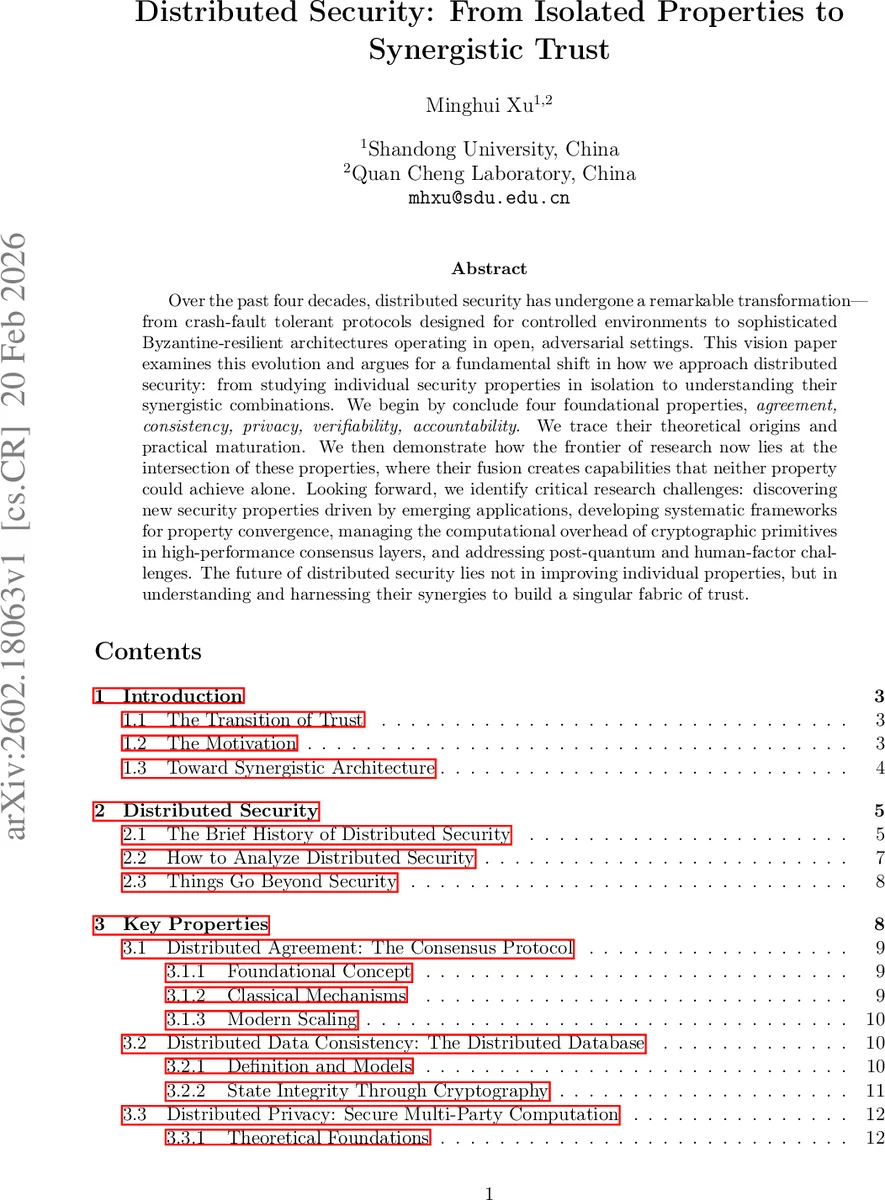
Over the past four decades, distributed security has undergone a remarkable transformation – from crash-fault tolerant protocols designed for controlled environments to sophisticated Byzantine-resilient architectures operating in open, adversarial settings. This vision paper examines this evolution and argues for a fundamental shift in how we approach distributed security: from studying individual security properties in isolation to understanding their synergistic combinations. We begin by conclude four foundational properties, \textit{agreement, consistency, privacy, verifiability, accountability}. We trace their theoretical origins and practical maturation. We then demonstrate how the frontier of research now lies at the intersection of these properties, where their fusion creates capabilities that neither property could achieve alone. Looking forward, we identify critical research challenges: discovering new security properties driven by emerging applications, developing systematic frameworks for property convergence, managing the computational overhead of cryptographic primitives in high-performance consensus layers, and addressing post-quantum and human-factor challenges. The future of distributed security lies not in improving individual properties, but in understanding and harnessing their synergies to build a singular fabric of trust.
💡 Research Summary
The paper presents a sweeping historical and conceptual survey of distributed security, arguing that the field must move from studying isolated security properties to deliberately engineering their synergistic combinations. It begins by tracing the evolution of distributed systems over the past four decades: from early crash‑fault tolerant protocols (two‑phase commit, Paxos, view‑stamp replication) operating in closed, trusted environments, through the practical era of Byzantine Fault Tolerance (PBFT, Raft, Spanner) that introduced real‑world fault models, to the decentralization era inaugurated by Bitcoin and Ethereum, where permissionless, economically incentivized consensus became the norm. This trajectory reflects a fundamental reconceptualization of trust—from assuming honest majority to defending against strategic, financially motivated adversaries.
The authors identify five foundational security properties that together constitute the “fabric of trust” in modern distributed systems:
- Agreement – achieving a single, globally accepted state despite malicious participants.
- Consistency – guaranteeing that once agreement is reached, all replicas maintain identical state, preventing double‑spending or divergent histories.
- Privacy – enabling computation over distributed inputs without revealing the underlying data, realized through MPC, differential privacy, homomorphic encryption, etc.
- Verifiability – providing cryptographic proof (zero‑knowledge proofs, accumulators) that a computation was performed correctly, allowing trust without exposing inputs.
- Accountability – ensuring misbehaviour can be detected, attributed, and penalized through audit trails, slashing mechanisms, and cryptographic evidence.
For each property the paper reviews its theoretical origins (Lamport’s safety/liveness, the Byzantine Generals problem, FLP impossibility) and the most influential practical realizations (PBFT, Tendermint, HotStuff for agreement; Google Spanner’s TrueTime for consistency; MPC frameworks and differential privacy for privacy; zk‑SNARKs and cryptographic accumulators for verifiability; blockchain‑based slashing and secure logging for accountability). The authors emphasize that each community—consensus researchers, database theorists, cryptographers—has traditionally pursued its own property in isolation, often assuming that the other properties would be handled elsewhere in the stack.
The core contribution is the “synergy” thesis: when two or more of these properties are deliberately fused, new capabilities emerge that are impossible to achieve with any single property alone. The paper illustrates several concrete fusions:
- Agreement + Consistency → Blockchains – the combination yields immutable, globally consistent ledgers.
- Consistency + Verifiability → Succinct Distributed Proofs / ZK‑Rollups – enable scalable, privacy‑preserving state transitions with on‑chain verification.
- Privacy + Verifiability → Collaborative Zero‑Knowledge Protocols – allow parties to jointly compute and prove statements without revealing inputs.
- Verifiability + Accountability → Economic Security – slashing mechanisms that automatically penalize provably malicious behavior.
- Triple and higher‑order combinations – emerging research explores three‑way or even four‑way fusions, such as privacy‑preserving accountable consensus for regulated DeFi.
The authors argue that these fusions are not merely additive; they often reduce overhead (e.g., a single ZK proof can replace separate audit logs) or create novel security guarantees (e.g., privacy‑preserving accountability). However, they also introduce new challenges: trade‑offs become multidimensional, performance overhead can explode when multiple heavyweight cryptographic primitives are stacked, and the design space is poorly understood.
In the forward‑looking section, the paper outlines four research agendas:
- Discovery of New Properties – as applications like federated learning, metaverse data sharing, and AI model marketplaces emerge, novel security requirements (e.g., model provenance, data freshness) will need formal definition.
- Systematic Frameworks for Property Convergence – develop mathematical models (multi‑objective optimization, game‑theoretic equilibria) and design patterns that quantify and manage trade‑offs among properties.
- Managing Cryptographic Overhead – explore hardware acceleration, protocol‑level batching, and lightweight post‑quantum primitives to keep high‑throughput consensus viable.
- Post‑Quantum and Human‑Factor Challenges – integrate lattice‑based or code‑based cryptography into existing fusion protocols and consider usability, social engineering, and regulatory compliance as first‑class aspects of distributed security.
The conclusion reiterates that the next frontier is not to harden each property in isolation but to understand, model, and harness their interactions. By doing so, designers can construct “synergistic architectures” where security, privacy, correctness, and accountability reinforce each other, delivering a truly trustworthy distributed fabric for the increasingly open and adversarial digital ecosystem.
Comments & Academic Discussion
Loading comments...
Leave a Comment