Bestvina metric and tree reduction for $K(π,1)$-conjecture
We reduce the $K(π,1)$-conjecture for all Artin groups to properties of Artin groups whose Coxeter diagrams are trees, from which we deduce new classes of Artin groups satisfying the $K(π,1)$-conjecture. This relies on constructing actions of Artin g…
Authors: Jingyin Huang
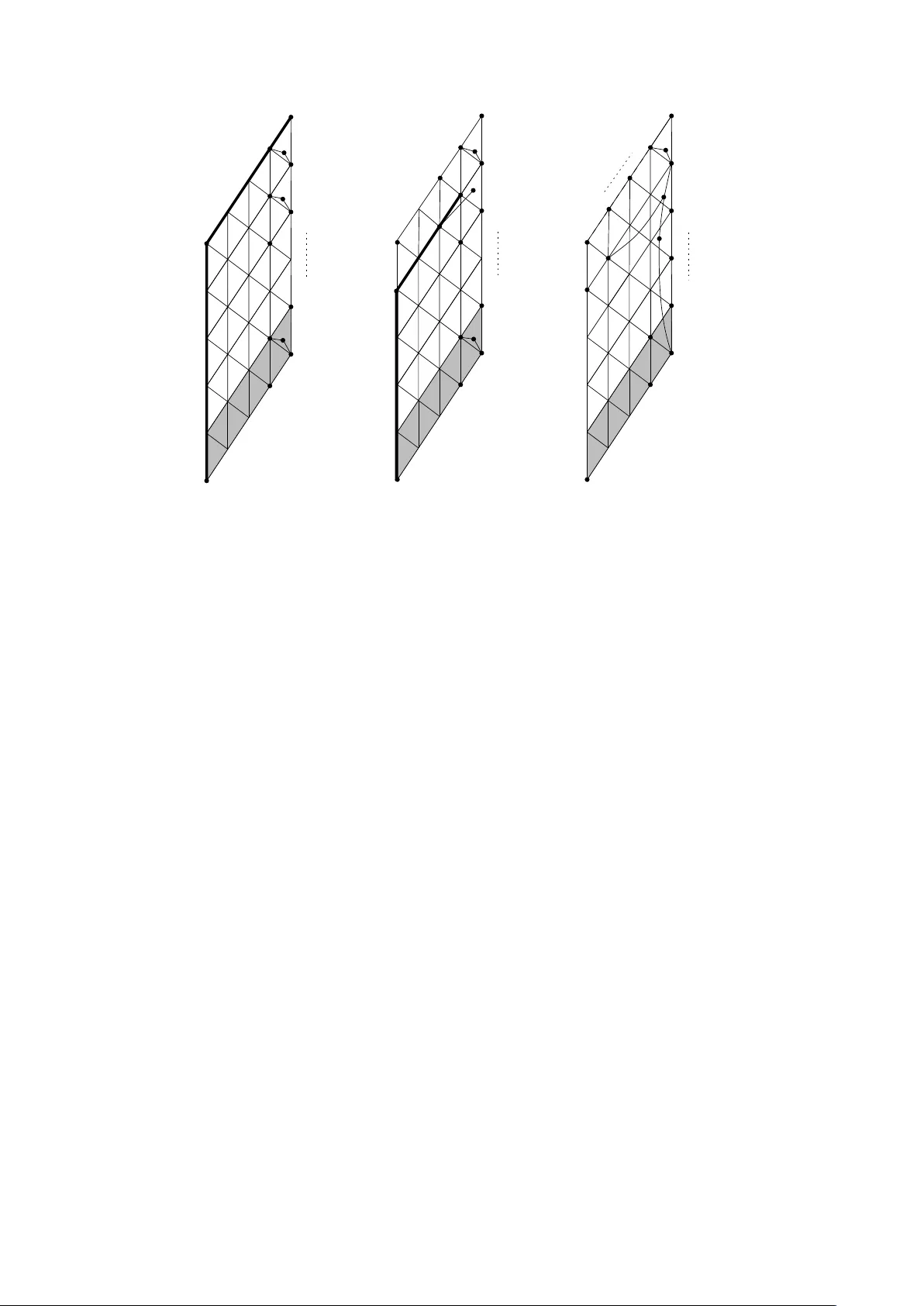
BESTVINA METRIC AND TREE REDUCTION F OR K ( π , 1) -CONJECTURE JINGYIN HUANG Abstra ct. W e reduce the K ( π, 1) -conjecture for all Artin groups to properties of Artin groups whose Coxeter diagrams are trees, from which w e deduce new classes of Artin groups satisfying the K ( π, 1) -conjecture. This relies on constructing actions of Artin groups on Bestvina complexes of suitable Garside group oids. 1. Intr oduction 1.1. Main results. The K ( π , 1) -conjecture, due to Arnol’d, Briesk orn, Pham, and Thom, predicts that for eac h Artin group A S , the space of regular orbits of a canon- ical action of the asso ciated Co xeter group is a K ( A S , 1) -space. W e refer to [Par14] for more background on this conjecture. It has b een established for sev eral imp ortan t classes of Artin groups, notably spherical, t ype F C, affine etc [Del72, CD95a, Cha04, CMS10, PS21, Juh23, Gol24, HH25, Hua24b, Hua24a, GH25, HP25]. Nevertheless, our understanding of the conjecture remains limited in dimensions ≥ 4 . The goal of this article is to pro v e a reduction theorem sho wing that, pro vided cer- tain properties hold for Artin groups whose Co xeter diagrams are trees, the K ( π , 1) - conjecture follows for all Artin groups. Let A S b e an Artin group with standard generating set S . Recall that the A rtin c omplex ∆ S of A S , has its vertex set in 1-1 corresp ondence with left cosets of the form { g A S \{ s } } g ∈ A S ,s ∈ S , where A S \{ s } is the subgroup of A S generated b y S \ { s } . A collection of vertices span a simplex if the corresp onding collection of cosets ha ve non-empt y common in tersection. This a natural generalization of the classical no- tion of Co xeter complexes for Co xeter groups to the world of Artin groups. Artin complexes pla y imp ortan t roles in the study Artin groups, for example, proving K ( π , 1) -conjecture for all Artin groups is equiv alent to pro ving the contractibilit y of all Artin complexes ∆ S whenev er A S is not spherical [GP12]. A v ertex of the Artin complex ∆ S is of type ˆ s = S \ { s } if it corresp onds to a coset of the form g A S \{ s } . A sp e cial 4 -cycle in ∆ S is an em b edded 4 -cycle in the 1 -sk eleton ∆ 1 S whose v ertex types alternate as ˆ s ˆ t ˆ s ˆ t for some s, t ∈ S . A special 4 -cycle has an c enter , if its v ertices are adjacen t to a common vertex in ∆ S . Theorem 1.1. (Cor ol lary 9.2) Supp ose that for e ach A rtin gr oup A S with Coxeter diagr am b eing a tr e e, A S satisfies the K ( π , 1) -c onje ctur e and any sp e cial 4-cycle in ∆ S has a c enter. Then any Artin gr oup satisfies the K ( π , 1) -c onje ctur e. Theorem 1.2. (Cor ol lary 9.3) L et A S b e an A rtin gr oup with its Coxeter diagr am Λ . Supp ose that for any induc e d sub diagr am Λ ′ ⊂ Λ which is a tr e e, the Artin gr oup A S ′ define d by Λ ′ satisfies the K ( π , 1) -c onje ctur e and any sp e cial 4-cycle in ∆ S ′ has a c enter. Then A S satisfies the K ( π , 1) -c onje ctur e. Com bining the ab ov e results with [Hua24b], w e further reduce to a smaller class. Theorem 1.3. (Cor ol lary 9.9) Supp ose that for every Artin gr oup A S whose Coxeter diagr am is a tr e e with al l e dge lab els at most 5 , the K ( π , 1) -c onje ctur e holds and every sp e cial 4 -cycle in ∆ S admits a c enter. Then the K ( π , 1) -c onje ctur e holds for al l Artin gr oups. 1 2 JINGYIN HUANG Theorem 1.4. (Cor ol lary 9.10) L et A S b e an Artin gr oup with its Coxeter diagr am Λ . Supp ose that for any induc e d sub diagr am Λ ′ ⊂ Λ which is a tr e e with e dge lab els ≤ 5 , the A rtin gr oup A S ′ define d by Λ ′ satisfies the K ( π , 1) -c onje ctur e and any sp e cial 4-cycle in ∆ S ′ has a c enter. Then A S satisfies the K ( π , 1) -c onje ctur e. W e conjecture that the assumption on 4-cycles alw a ys hold. Conjecture 1.5. ( [Hua24b, Conj 9.18] ) Supp ose A S is an A rtin gr oup with its Coxeter diagr am b eing a tr e e. Then any sp e cial 4-cycle in ∆ S has a c enter. This conjecture holds whenever all edges of the Co xeter diagram hav e lab el ≥ 4 . More generally , it is kno wn to hold when A S is lo c al ly r e ducible [Hua24b, Cor. 9.14]. The most difficult case is when all edge lab els are 3 . The conjecture is also known when A S is spherical, or more generally when its Co xeter diagram is a tree satis- fying the conditions of [Hua24b, Thm. 1.1], or when it is of type e C n , e B 4 , or e D 4 [Hua24a], or of dimension ≤ 3 [HP25]. In general, proving Conjecture 1.5 reduces to understanding certain pairs of comm uting elemen ts in A S [Hua24b, Prop. 8.3]. Com bining Theorem 1.4 with the kno wn cases of Conjecture 1.5, w e obtain many new examples of Artin groups satisfying the K ( π , 1) -conjecture. As an illustration, w e deduce the following generalization of [Hua24b, Thm. 1.1]. Corollary 1.6. L et Λ b e a Coxeter diagr am. Supp ose that, after r emoving al l e dges of Λ with lab els at le ast 6 , e ach c onne cte d c omp onent of the r emaining diagr am is either spheric al, lo c al ly r e ducible, or 3 -dimensional. Then the Artin gr oup A Λ satisfies the K ( π , 1) -c onje ctur e. More applications are given in [HH26]. Theorems 1.1 and 1.2 are based on constructing actions of Artin groups whose Co xeter diagrams con tain cycles on suitable Garside group oids. Garside groups and group oids ha v e play ed a central role in earlier approac hes to the K ( π , 1) -conjecture. F or instance, the fun damen tal group of the complement of a complexified real sim- plicial cen tral hyperplane arrangemen t can be iden tified with the isotropy group of a finite-t yp e Garside group oid [Del72]. In particular, suc h a group admits a free action on the morphisms of the asso ciated Garside group oid with finitely many orbits. Although most affine Artin groups are not known to admit actions of this type, it w as shown in [MS17] that every affine Artin group embeds into a larger (infinite- t yp e) Garside group. This can b e in terpreted as an action of the affine Artin group on the morphisms of a Garside group oid that is free but has infinitely man y orbits. In this paper, w e inv estigate a complementary situation: actions on Garside group oids with finitely many orbits but in finite stabilizers. More precisely , we con- struct actions of Artin groups on Garside group oids such that the stabilizer of each morphism is itself a smaller Artin group. These smaller Artin groups, in turn, admit analogous actions with stabilizers given b y y et smaller Artin groups. This produces a tow er of Garside group oids, yielding an inductive framew ork for proving K ( π , 1) - results (and p oten tially other structural prop erties of Artin groups). Suc h groupoids can b e constructed whenev er the Coxeter diagram con tains a cycle; consequen tly , the base case of the induction consists of Artin groups whose Co xeter diagrams are trees. More precisely , we establish the following statemen t, combining Theorem 9.1, Prop osition 7.2, and Corollary 6.7. Theorem 1.7. L et A S b e an Artin gr oup such that its Coxeter diagr am Λ c ontains a cycle. Supp ose that for e ach induc e d sub diagr am Λ ′ ⊂ Λ that is a tr e e, the asso ciate d A rtin c omplex ∆ S ′ satisfies that e ach sp e cial 4-cycle in ∆ S ′ has a c enter. Then A S acts c o c omp actly on the Bestvina c omplex of a Garside gr oup oid, such that stabilizer of e ach simplex is isomorphic to a pr op er p ar ab olic sub gr oup of A S . BESTVINA METRIC AND TREE REDUCTION FOR K ( π , 1) -CONJECTURE 3 Roughly sp eaking, the Bestvina complex is the “cen tral quotient” of the Garside group oid. The Bestvina complex was originally defined for spherical Artin groups [Bes99], then it is generalized to Garside groups [CMW04] and Garside groupoids [Bes06, Sec 8]. The theorem relies crucially on Bestvina’s asymmetric metric on Bestvina complex, introduced in [Bes99]. These complexes also b elong to a class of complexes studied in [Hae25] (type A , without locally finite assumption). Consequen tly , they ha v e an additional metric structure, i.e. admit metric with conv ex geo desic bicombing (which is a relaxation of CA T (0) [DL15]), and suc h metric is inv arian t under the Artin group action. This can b e pro ved in the same wa y as [Hae24, Thm 4.6]. W e exp ect this additional metric structure could lead to other in teresting prop erties of Artin groups, ho w ev er, this asp ect is not explored here. 1.2. Discussion of pro ofs. W e only discuss the pro of of Theorem 1.7, whic h is the most imp ortan t ingredient to w ards other main theorems. Using a combination of to ols from Garside theory and non-p ositiv e curv ature, we will gradually reduces Theorem 1.7 to a problem ab out triangulation of a 2-dimensional disk. In the follo wing discussion, w e do not assume the reader is familiar with Garside theory , and we start with a discussion of Z n , whic h is one of the most simple Garside groups. Bac kground on Bestvina complexes Let G = Z n with its standard basis as generators. Let G + b e the p ositiv e monoid of G (i.e. G + is made of elements all of whose coordinates are non-negative). W e define a partial order on G : g ≤ h if h = g k with k ∈ G + . This is indeed a partial order, and ( G, ≤ ) is a lattice (i.e. ev ery pair of elemen t has a least common upp er b ound, and greatest common lo w er b ound). Let ∆ b e the elemen t (1 , 1 , . . . , 1) in G . Non-trivial elements of G that are lo w er bounded b y identit y and upper b ounded b y ∆ are called atoms of G . The Bestvina c omplex X for G , has a v ertex for each cosets of the subgroup ⟨ ∆ ⟩ . T w o differen t vertices are joined b y an edge if the t w o cosets are differed b y an atom. The flag completion of this 1-sk eleton is the Bestvina complex for G . The complex X has extra structure, inherit from ( G, ≤ ) , which can be formulated in m ultiple w a ys. Here w e adopt a treatmen t in [Hae24]. Note that a maximal c hain from 0 to ∆ in ( G, ≤ ) descen ts to a cycle in X whic h span a maximal simplex of X . Th us the liner order in this maximal c hain giv es to a cyclic order on the v ertex set of this maximal simplex of K . Use group action, we obtain cyclic order on the vertex set of eac h maximal simplex of X , and these cyclic orders are compatible in the in tersection of tw o maximal simplices. As each cyclically order set with one elemen t remo v ed has a canonical induced linear order, w e hav e a well-defined partial order < x on the v ertex set of lk( x, X ) for eac h v ertex x ∈ X . Note that (lk( x, X ) , < x ) is isomorphic (as a p oset) to ( ˆ x, ∆ ˆ x ) , where ˆ x is any lift of x in Z n , and ( ˆ x, ∆ ˆ x ) denotes the collection of elemen ts of ( G, ≤ ) that is > ˆ x and < ∆ ˆ x . F or an y Garside group, and more generally Garside groupoid, one can create a Bestvina complex in a similar fashion with cyclic orders on its maximal simplices. The vertex set of this complex is made of elements in the central quotien t. Con- v ersely , give a simplicial complex X with cyclic orders on its maximal simplices, as long as X is simply-connected and the relation < x in lk 0 ( x, X ) satisfies that it is transitiv e (hence < x is a partial order), an y upp er b ounded pair (lk 0 ( x, X ) , < x ) has the join, and an y lo w er b ounded pair (lk 0 ( x, X ) , < x ) has the meet, then X is the Bestvina complex of some Garside group oid - this is a consequence of the classical lo cal-to-global characterization of Garside structure, see [HH24, Thm 1.3] for an explanation. It also follows from Garside theory that X is contractible. This is an imp ortan t lo cal-to-global contractibilit y criterion used in this article. 4 JINGYIN HUANG a b Figure 1. The diagram Λ . Giv en a Cox eter group W S with generating set S , w e can define its Coxeter com- plex C S and t yp es of vertices in C S in the same fashion as Artin complexes. Now assume W S is of t yp e e A n − 1 . Then its Co xeter diagram Λ is a cyclic, whic h giv es a natural cyclic order on S . By considering types of vertices in C S , w e obtain a cyclic order on each maximal simplex of C S . Then C S is isomorphic to the Bestv- ina complex X of Z n , such that the isomorphism resp ects cyclic orders on maximal simplices, see e.g. [Hir20, Sec 3.2]. Similarly , w e can consider the Artin complex ∆ S asso ciated with the Artin group A S of type e A n − 1 . Again the Coxeter diagram b eing a cycle induces cyclic orders on maximal simplices of ∆ S . By work of Crisp- McCammond and Haettel [Hae24], the complex ∆ S with the cyclic orders on its maximal simplices satisfies all the conditions required for it to b e a Bestvina com- plex of a Garside group oid. F ailure of p oset property No w w e consider the more general situation that Λ is an y Co xeter diagram con taining an induced cycle Λ ′ ⊂ Λ . Let S, S ′ b e the v ertex set of Λ , Λ ′ resp ectiv ely . Let ∆ S b e the Artin complex of A S , and let ∆ S,S ′ b e the induced sub complex of ∆ S spanned by vertices of t yp e ˆ s with s ∈ S ′ . As S ′ is the v ertex set of a cycle, w e can endo w S ′ with a natural cyclic order. This gives a cyclic order on the vertex set of eac h maximal simplex of ∆ S,S ′ . In [Hua24b] we studied the question of whether ∆ S,S ′ is the Bestvina complex of a Garside group oid. It is sho wn that for some hyperb olic type Artin groups whose Coxeter diagrams con tain a cycle, ∆ S,S ′ is indeed the Bestvina complex of some Garside group oid, whic h leads to K ( π , 1) -conjecture for these Artin groups. Ho w ev er, in general, ∆ S,S ′ can not b e a Bestvina complex, since the relation < x defined as b efore is not transitive except for very sp ecific Coxeter diagrams, so (lk 0 ( x, ∆ S,S ′ ) , < x ) is not a p oset! A different complex In order to construct Bestvina complexes for Artin groups with cycles in their Coxeter diagrams in full generality , the first main ingredient is a different complex, whic h we called minimal cut c omplex , whic h can b e used to fix this fundamental issue of failure of p oset prop ert y . W e demonstrate the complex in a simple example. Let Λ b e the diagram in Figure 1, with P being the thic k ened orien ted path from b to a in Λ . Let A Λ b e the asso ciated Artin group. Let Λ P b e the sub diagram of Λ obtained b y remo ving interior p oints of the path P from Λ . Let a, b b e the t wo v ertices in Λ P as in Figure 1. Giv en tw o sets of vertices A, B of Λ P , a cut of Λ P b et w een A and B is a set T of vertices of Λ P suc h that an y path from a p oin t in A \ T to a p oin t in B \ T has n on-empt y in tersection with T (w e assume this property holds true automatically if A \ T = ∅ or B \ T = ∅ ). A minimal cut of Λ P b et w een A and B is a cut suc h that any prop er subset of this cut is not a cut. Let Mincut Λ P ( { a } , { b } ) b e the collection of minimal cuts separating { a } and { b } . W e sa y t w o suc h minimal cuts are c omp ar able if one of them is a cut of Λ P b et w een { a } and the remaining one. Let C P b e the collection of sets of vertices of Λ suc h that an elemen t of C P is either an elemen t of Mincut Λ P ( { a } , { b } ) (whic h is a typ e II element ), or is made of a single vertex that is an in terior vertex of P (whic h is a typ e I elemen t). T wo BESTVINA METRIC AND TREE REDUCTION FOR K ( π , 1) -CONJECTURE 5 differen t elements are c omp ar able , if either one of them is a type I element, or b oth of them are type I I and they are comparable. Note that orien tation of edges in Λ as in Figure 1 induces a cyclic order on any maximal collection of elements in C P that are pairwise comparable. No w we define a complex ∆ P Λ up on whic h the Artin group A Λ acts. V ertices of ∆ P Λ are in 1-1 corresp ondence with left cosets of form g A ˆ T with g ∈ A Λ and T ∈ C P , where A ˆ T denotes the subgroup of A Λ generated by all generators except those in T . A v ertex corresp onding to g A ˆ T has typ e ˆ T . T wo vertices of t yp e ˆ T 1 and ˆ T 2 are adjacen t, if T 1 and T 2 are comparable, and the corresponding cosets ha v e non-empt y in tersection. Then ∆ P Λ is the flag completion of its 1-skeleton. Giv en a maximal simplex in ∆ P Λ , by considering type of vertices in this simplex and the previous paragraph, w e obtain a cyclic order on its v ertex set. The adv an tage of this new complex is that the relation < x is now transitive, and it can b e defined more generally whenever Λ contains a cycle, for an appropriate c hoice of path P inside Λ . There is a natural action A Λ ↷ ∆ P Λ , whose vertex stabilizers are prop er parab olic subgroups of A Λ . Lab eled 4-cycle property and the lattice condition In order to show ∆ P is a Bestvina complex, it remains to v erify that for vertex x ∈ Λ P , the poset (lk 0 ( x, ∆ P Λ ) , < x ) satisfies that eac h upper b ounded pair has the join and eac h low er b ounded pair has the meet. W e will refer these tw o prop erties as the lattic e c on- dition , as they will imply if w e add a greatest elemen t and a smaller elemen t to (lk 0 ( x, ∆ P Λ ) , < x ) , then we obtain a lattice. Our second ingredien t relates the lattice condition to lab ele d 4-cycle pr op erty . Definition 1.8. Let Λ b e a Co xeter diagram, and let ∆ Λ b e the asso ciated Artin complex. W e sa y ∆ Λ satisfies lab ele d 4-cycle c ondition , if for any em b edded 4-cycle x 1 x 2 x 3 x 4 in ∆ Λ with x 1 , x 3 ha ving the same t ype ˆ s and x 2 , x 4 ha ving the same t ype ˆ t , and any connected induced subgraph Λ ′ ⊂ Λ containing b oth s and t , there is a v ertex z suc h that (1) z is adjacent to each x i for 1 ≤ i ≤ 4 . (2) z has type ˆ r with r ∈ Λ ′ . This condition w as defined in the sp ecial case when Λ is a tree in [Hua24b] b efore w e ha ve the correct formulation in full generality here. This prop ert y is related to the lattice condition in the follo wing w a y . Prop osition 1.9. L et Λ b e a Coxeter diagr am. Supp ose al l pr op er induc e d sub dia- gr ams Λ ′ of Λ , ∆ Λ ′ satisfies the lab ele d 4-cycle c ondition. Then al l vertex links of c omplex ∆ P Λ satisfy the lattic e c ondition. Henc e ∆ P Λ is a Bestvina c omplex. There is a serious gap betw een the assumption of Theorem 1.7 and the assumption of Prop osition 1.9, as assumption of the former only implies lab eled 4-cycle condition for ∆ Λ ′ with Λ ′ b eing an induced tree sub diagram of Λ . This gap can b e filled by rep eatedly applying the following propagation theorem of lab eled 4-cycle prop erty , whic h is the core of this article. Due to the relation b et w een lab eled 4-cycle prop ert y and lattice condition discussed b efore, the follo wing can also view ed as a propagation theorem for the lattice condition. Prop osition 1.10. Supp ose Λ is a c onne cte d Coxeter diagr am which is not a tr e e. Supp ose al l pr op er induc e d sub diagr ams Λ ′ of Λ , ∆ Λ ′ satisfies the lab ele d 4-cycle c ondition. Then ∆ Λ satisfies the lab ele d 4-cycle c ondition. Propagation via Bestvina non-p ositiv e curv ature No w w e discuss the pro of of Prop osition 1.10. Given a 4-cycle η = x 1 x 2 x 3 x 4 in ∆ Λ of type ˆ s ˆ t ˆ s ˆ t . Our goal is to 6 JINGYIN HUANG find an appropriate center of this 4-cycle, i.e. a vertex adjacen t to eac h x i satisfying Definition 1.8. The assumption of Proposition 1.10 and Prop osition 1.9 implies that for an ap- propriate choice of the path P in Λ , the complex X = ∆ P Λ is a Bestvina complex. Bet w een each pair of tw o v ertices, there is a preferred shortest edge path in X 1 b e- t w een them introduced by Bestvina in [Bes99], which we called the B-ge o desic . An induced sub complex Y of X is B-c onvex , if for an y t wo vertices of Y , the B -geo desic b et w een them is con tained in Y . While the prop erty of b eing B -conv ex seems to b e a global prop ert y that is hard to c hec k, w e show ed in [HP25] that it suffices to chec k that lk( y , Y ) is locally con v ex in lk( y , X ) for eac h vertex y ∈ Y in an appropriate sense, which makes B -conv ex subsets easier to identify . W e reduce the study the 4-cycle η in ∆ Λ to the study of a configuration of four B -conv ex sub complexes of X as follo ws. Giv en a vertex x ∈ X corresponding to g A ˆ T for g ∈ A Λ and T being a set of vertices of Λ , we can realize x as the barycenter of the simplex in ∆ Λ spanned b y vertices corresp onding to { g A ˆ s } s ∈ T . Th us eac h v ertex of X can b e viewed as the barycenter of a simplex in ∆ Λ . Giv en x i ∈ ∆ Λ , let Y i b e the full sub complex of X spanned by the collection of vertices of X that are con tained in the same simplex of ∆ Λ as x i . It turns out that each Y i is B -conv ex in X , and X i ∩ Y i +1 = ∅ for i ∈ Z / 4 Z . Moreo v er, the task of finding a center of η can b e reduced to showing that such configuration of Y 1 , Y 2 , Y 3 , Y 4 is degenerate in the sense that either Y 1 ∩ Y 3 = ∅ or Y 2 ∩ Y 4 = ∅ . Let Ξ b e the collection of quadruple ( y 1 , y 2 , y 3 , y 4 ) of v ertices in ∆ P Λ with y i ∈ Y i ∩ Y i +1 for all i ∈ Z / 4 Z . Eac h suc h quadruple determines a 4-gon in X by considering the B -geo desic from y i to y i +1 . The conv exit y of Y i implies that eac h side of this 4-gon is con tained in one of Y i . Suc h 4-gon is called an admissible 4-gon . As X is simply-connected, eac h suc h 4-gon bound a triangulated disk in X . The task of showing the configuration Y 1 , Y 2 , Y 3 , Y 4 is degenerate can b e further reduced to finding an admissible 4-gon that b ounds a degenerate triangulated disk. In order to find such 4-gon, w e lo ok at the collection Ξ ′ of quadruples in Ξ that minimize the distance sum P i ∈ Z / 4 Z d ( y i , y i +1 ) , here d denotes the path metric on X 1 with edge length one. There is another metric d on X 0 , in tro duced by Bestvina [Bes99], whic h is an asymmetric metric, i.e. d ( x, y ) = d ( y , x ) in general. The metric d has the adv an tage of preserving more information from the Garside structure, and it has a form of non-p ositiv e curv ature [Bes99, Prop 3.12], whic h will play a k ey role in our argument. Among quadruples in Ξ ′ , we select a mem b er whic h also minimizes a carefully designed distance sum of some of the y i ’s with resp ect to Bestvina’s asymmetric metric d , and consider the associated 4-gon. Most of the w ork here is to show that, one can pro duce a filling of this 4-gon using B -geodesics, suc h that the resulting triangulated disk from such filling has a very sp ecific combinatorial structure, due to Bestvina’s non-p ositiv e curv ature on this asymmetric metric. Moreo v er, this tri- angulated has extra decorations coming from Garside theory , and information from the am bien t Artin groups, which further limits the p ossibilit y of such triangulation, ev en tually leads to degeneracy of the disk. W e caution the reader that it is not true that whenever we ha ve four B -conv ex sub complexes { X i } 4 i =1 in a Bestvina complex X with X i ∩ X i +1 = ∅ , then either X 1 ∩ X 3 = ∅ or X 2 ∩ X 4 = ∅ . Here we only work with sp ecific conv ex sub complexes coming from the 4-cycle η as explained b efore. The Bestvina complex X = ∆ P Λ dep ends on the c hoice of the path P in Λ . F or differen t c hoices of P , w e obtain differen t Bestvina complexes with four con v ex sub complexes coming from η . It is also not true that these four conv ex sub complexes alwa ys b eha v e in the wa y w e BESTVINA METRIC AND TREE REDUCTION FOR K ( π , 1) -CONJECTURE 7 exp ect for an y c hoice of P - in the end, the c hoice of P dep ends on the type of v ertices of η . 1.3. Structure of the article. In Section 2 and Section 3, w e collect some pre- liminary material. Section 4 is a pure graph theoretical discussion on prop erties of minimal cuts in graphs which are needed in later sections. Section 5 is ab out the lab eled 4-cycle prop ert y for Artin complexes ∆ Λ , and a companion of this prop- ert y , called the strong lab eled 4-cycle prop ert y . W e will discuss the relation of these t w o prop erties. Section 6 collects some bac kground on Garside theory , and has a discussion on Bestvina’s asymmetric metric and the non-p ositiv e curv ature asp ect of this metric. In Section 7, we define the minimal cut complex in full generality , and pro v e Prop osition 1.9. Section 8 is dev oted to the pro of of the key propagation result Prop osition 1.10. In Section 9 w e deduce all the results on K ( π , 1) -conjecture in the introduction. 1.4. A c kno wledgmen t. W e thank Piotr Przyt yc ki for v aluable discussion related to this article. The author is partially supp orted by a Sloan fello wship and NSF gran t DMS-2305411. The author thanks Chinese A cadem y of Sciences for hospitalit y , where part of the w ork w as undertak en. The author thanks the Isaac Newton Institute for Mathematical Sciences, Cambridge, for supp ort and hospitalit y during the programme Op erators, Graphs, Groups, where part of the w ork w as undertaken. This work was partially supp orted b y EPSR C grant EP/Z000580/1. 2. Complexes for Ar tin and Co xeter gr oups 2.1. Artin complexes and relativ e Artin complexes. A Coxeter diagr am Λ is a finite simple graph with v ertex set S = { s i } i and lab els m ij = 3 , 4 , . . . , ∞ for each edge s i s j . If s i s j is not an edge, w e define m ij = 2 . The Artin group A Λ is the group with generator set S and relations s i s j s i · · · = s j s i s j · · · with both sides alternating w ords of length m ij , whenever m ij < ∞ . The Co xeter group W Λ is obtained from A Λ b y adding relations s 2 i = 1 . The pur e A rtin gr oup P A Λ is the kernel of the ob vious homomorphism A Λ → W Λ . W e say that A Λ is spheric al , if W Λ is finite. Recall that any S ′ ⊂ S generates a subgroup of A Λ isomorphic to A Λ ′ , where Λ ′ is the sub diagram of Λ induced on S ′ . Suc h subgroup is called a standar d p ar ab olic sub gr oup . The follo wing is a consequence of [GP12, Lem 4.7 and Prop 4.5]. Prop osition 2.1. L et { g i A S i } n i =1 b e a finite c ol le ction of left c osets of standar d p ar- ab olic sub gr oups of A Λ . Supp ose these c osets p airwise have non-empty interse ction. Then the c ommon interse ction of them is non-empty. The Artin c omplex ∆ Λ , introduced in [CD95b] and further studied in [GP12, CMV23], is a simplicial complex defined as follows. F or each s ∈ S , let A ˆ s b e the standard parab olic subgroup generated by ˆ s = S \ { s } . The v ertices of ∆ Λ corresp ond to the left cosets of { A ˆ s } s ∈ S . Moreo v er, v ertices span a simplex if the corresp onding cosets ha v e non-empty common intersection. It follo ws from [GP12, Prop 4.5] that ∆ Λ is a flag complex. The Coxeter c omplex C Λ is defined analogously , where w e replace A ˆ s b y W ˆ s < W Λ generated b y ˆ s . A vertex of C Λ or ∆ Λ corresp onding a left coset of W ˆ s or A ˆ s has typ e ˆ s . W e ha v e that C Λ is the quotien t of ∆ Λ under the action of P A Λ . Let ∆ ′ Λ b e the barycentric sub division of the Artin complex ∆ Λ . Giv en a vertex x ∈ ∆ ′ Λ whic h is the barycenter of a simplex σ ∈ ∆ Λ with vertices of σ hav e t yp e ˆ s 1 , . . . , ˆ s k , the typ e of this vertex is defined to b e ˆ T = S \ S ′ suc h that ˆ T = ∩ k i =1 ˆ s i . Note that v ertices of t yp e ˆ T in ∆ ′ Λ are in 1-1 corresp ondence with left cosets in A Λ of 8 JINGYIN HUANG form g A S \ T , where A S \ T is the standard parab olic subgroup generated by elements in S \ T . T w o vertices of ∆ ′ Λ are adjacen t if and only if the left coset asso ciated with one vertex is contained the left coset asso ciated with another vertex. Similarly , we can define types of v ertices in the barycentric sub division C ′ Λ of C Λ . Theorem 2.2. [GP12, Thm 3.1] Supp ose A S is not spheric al. If ∆ S is c ontr actible and e ach { A ˆ s } s ∈ S satisfies the K ( π , 1) -c onje ctur e, then A S satisfies the K ( π , 1) - c onje ctur e. Let A Λ b e an Artin group with generating set S , and S ′ ⊂ S . The ( S, S ′ ) -r elative A rtin c omplex ∆ S,S ′ (in tro duced in [Hua24b]) i s defined to b e the induced sub com- plex of the Artin complex ∆ S of A S spanned b y vertices of type ˆ s with s ∈ S ′ . W e also write ∆ S,S ′ as ∆ Λ , Λ ′ where Λ , Λ ′ are Coxeter diagrams for A S , A S ′ resp ectiv ely . Links of vertices in relativ e Artin complexes can b e computed as follows. Lemma 2.3. ( [Hua24b, Lem 6.4] ) L et ∆ = ∆ Λ , Λ ′ , and let v ∈ ∆ b e a vertex of typ e ˆ s with s ∈ Λ ′ . L et Λ s and Λ ′ s b e the induc e d sub gr aph of Λ and Λ ′ r esp e ctively sp anne d al l the vertic es which ar e not s . Then ther e is a typ e-pr eserving isomorphism b etwe en lk( v , ∆) and ∆ Λ s , Λ ′ s . Mor e over, L et I s b e the union of c onne cte d c omp onents of Λ s that c ontain at le ast one c omp onent of Λ ′ s . Then Λ ′ s ⊂ I s and ther e is a typ e- pr eserving isomorphism b etwe en lk( v , ∆) and ∆ I s , Λ ′ s . The following is a direct consequence of definition. Lemma 2.4. Supp ose | S ′ | ≥ 2 . Then ∆ S,S ′ is c onne cte d. Lemma 2.5. ( [Hua24b, Lem 6.2] ) Supp ose | S ′ | ≥ 3 . Then ∆ S,S ′ is simply-c onne cte d. The following is a sp ecial case of [HP25, Lem 11.7 (2)]. Lemma 2.6. L et T b e a subset of vertic es of a Coxeter diagr am Λ . Supp ose ∆ Λ \ R is c ontr actible for e ach nonempty subset R of T . Then ∆ Λ deformation r etr acts onto ∆ Λ , Λ \ T . 2.2. Da vis complexes. Definition 2.7 (Davis complex) . Giv en a Co xeter group W Λ , let P b e the p oset of left cosets of spherical standard parab olic subgroups in W Λ (with resp ect to inclu- sion) and let b Σ Λ b e the geometric realization of this p oset (i.e. b Σ Λ is a simplicial complex whose simplices corresp ond to c hains in P ). No w w e mo dify the cell struc- ture on b Σ Λ to define a new complex Σ Λ , called the Davis c omplex . The cells in Σ Λ are induced sub complexes of b Σ Λ spanned b y a given vertex v and all other v ertices whic h are ≤ v (note that vertices of b Σ Λ corresp ond to elements in P , hence inherit the partial order). If Λ ′ ⊂ Λ is an induced subgraph, then W Λ ′ → W Λ induces an embedding Σ Λ ′ → Σ Λ . The image of this em bedding and its left translations are standar d sub c omplexes of t yp e Λ ′ . There is a corresp ondence b et w een standard sub complexes of type Λ ′ in Σ Λ and left cosets of W Λ ′ in W Λ . Definition 2.8. F or each vertex x ∈ C ′ Λ of t yp e ˆ T , let g W S \ T b e the asso ciated left coset in W Λ . Recall that vertices of the Da vis complex Σ Λ can b e iden tified with W Λ . The standar d sub c omplex of Σ Λ asso ciate d with the vertex x ∈ C Λ is defined to b e the standard sub complex of Σ Λ spanned by vertices in g W S \ T . Lemma 2.9 b elow is standard, see e.g. [Bou02] or [Da v12]. Let d b e the path metric on th e 1-skeleton of Σ Λ , with eac h edge ha ving length 1. Lemma 2.9 describ es nearest p oint pro jection into the v ertex set of a standard sub complex. BESTVINA METRIC AND TREE REDUCTION FOR K ( π , 1) -CONJECTURE 9 Lemma 2.9. L et F b e a standar d sub c omplex of Σ Λ and let x ∈ Σ Λ b e a vertex. Then the fol lowing hold. (1) F or two vertic es x 1 , x 2 ∈ R , the vertex set of any ge o desic in Σ 1 Λ joining v 1 and v 2 is inside F . Mor e over, ther e exists a unique vertex x F ∈ F such that d ( x, x F ) ≤ d ( x, y ) for any vertex y ∈ F , wher e d denotes the p ath metric on the 1-skeleton of Σ Λ . The vertex x F is c al le d the pro jection of x to F , and is denote d Pro j F ( x ) . (2) F or any vertex y ∈ F , ther e exists a shortest e dge p ath ω in Σ 1 Λ fr om x to y so that ω p asses thr ough x F and so that the se gment of ω b etwe en x F and y is c ontaine d in F . Definition 2.10. Let F be a standard sub complex of Σ Λ . Lemma 2.9 giv es a map Π F : V ert Σ Λ → V ert F whic h extends to a retraction Π F : Σ Λ → F as follo ws. Note that for eac h face E of Σ Λ , π (V ert E ) is the vertex set of a face E ′ ⊂ F . Then we extends π to a map π ′ from the v ertex set of b Σ Λ to the v ertex set of bF , by sending the barycen ter of E to the barycenter of E ′ . As π ′ map v ertices in a simplex to v ertices in a simplex, it extends linearly to a map Π F : b Σ Λ ∼ = Σ Λ → bF ∼ = F . 2.3. Orien ted Da vis complexes and Salv etti complexes. Let P b e the p oset of faces of Σ Λ (under containmen t), and let V b e the vertex set of Σ Λ . W e now define the oriente d Davis c omplex b Σ Λ as follo ws. Consider the set of pairs ( F , v ) ∈ P × V . Define an equiv alence relation ∼ on this set by ( F , v ) ∼ ( F , v ′ ) ⇐ ⇒ F = F ′ and Pro j F ( v ′ ) = Pro j F ( v ) . Denote the equiv alence class of ( F , v ′ ) by [ F , v ′ ] and let E ( A ) be the set of equiv alence classes. Note that each equiv alence class [ F , v ′ ] contains a unique represen tative of the form ( F , v ) , with v ∈ V ert F . The oriente d Davis c omplex b Σ Λ is defined as the regular CW complex given b y taking Σ Λ × V (i.e., a disjoin t union of copies of Σ Λ ) and then identifying faces F × v and F × v ′ whenev er [ F , v ] = [ F , v ′ ] , i.e., (2.11) b Σ Λ = (Σ Λ × V ) / ∼ . F or example, for each edge F of Σ Λ with endp oin ts v 0 and v 1 , w e get t w o 1 -cells [ F , v 0 ] and [ F , v 1 ] of b Σ Λ glued together along their endp oin ts [ v 0 , v 0 ] and [ v 1 , v 1 ] . So, the 0 -sk eleton of b Σ Λ is equal to the 0 -skeleton of b Σ Λ while its 1 -skeleton is formed from the 1 -skeleton of b Σ Λ b y doubling each edge. There is a natural map π : b Σ Λ → Σ Λ defined by ignoring the second co ordinate. The definition of oriented Davis complex traced back to work of Salv etti [Sal87], so it is also called Salvetti complex by other authors. The naming “oriented Davis complex” comes from an article of J. McCammond [McC17], clarifying the relation b et w een Salvetti’s w ork and Davis complex. Definition 2.12. As the 1-sk eleton of Σ Λ can b e iden tified with the unoriented Ca yley graph of W Λ , each edge of Σ Λ is lab eled b y an element in the generating set S . W e pull back the edge lab eling from Σ Λ to b Σ Λ via the map π : b Σ Λ → Σ Λ . F or a subset E in Σ , we define Supp( E ) to b e the collection of lab els of edges in E . F or each sub complex Y of Σ Λ , w e write b Y = p − 1 ( Y ) and call b Y the sub complex of b Σ Λ asso ciated with Y . A standar d sub c omplex of b Σ Λ is a subcomplex of b Σ Λ asso ciated with a standard sub complex of Σ Λ . In other words, if F ⊂ Σ Λ is a standard sub complex, then b F is the union of faces of form E × v in b Σ Λ with E ⊂ F and v ranging ov er v ertices in Σ Λ . Lemma 2.13. ( [Hua24b, Lem 3.12] ) L et E b e a fac e of Σ Λ and let F b e a standar d sub c omplex of Σ Λ . If [ E , v 1 ] = [ E , v 2 ] , then [Pro j F ( E ) , v 1 ] = [Pro j F ( E ) , v 2 ] . 10 JINGYIN HUANG W e will use the following imp ortan t construction in [GP12]. Definition 2.14. Let F b e a face in Σ Λ . Then there is a retraction map Π b F : b Σ Λ → b F defined as follo ws. Recall that b Σ Λ = (Σ Λ × V ) / ∼ . F or each v ∈ V , let (Σ Λ ) v b e the union of all faces in b Σ Λ of form E × v with E ranging ov er faces of Σ Λ . By Definition 2.10, there is a retraction (Π F ) v : (Σ Λ ) v → F × v for eac h v ∈ V . It follo ws from Lemma 2.13 that these maps { (Π F ) v } v ∈ V are compatible in the intersection of their domains. Th us they fit together to define a retraction Π b F : b Σ Λ → b F . The following lemma is a direct consequence of the definition. Lemma 2.15. T ake standar d sub c omplexes E , F ⊂ Σ Λ . Then Π b F ( b E ) = \ Π F ( E ) . 2.4. Generalized cycles. Let Λ b e a connected Dynkin diagram with its vertex set S . Giv en tw o vertices x, y in the barycentric sub division ∆ ′ Λ of the Artin complex ∆ Λ , we write x ∼ y if they are con tained a common simplex of ∆ Λ . Then x ∼ y if and only if the associated tw o left cosets hav e nonempty intersection. Let σ x b e the simplex of ∆ Λ suc h that x is the barycen ter of σ x . A collection of v ertices x 1 x 2 · · · x n in ∆ ′ Λ form a gener alize d cycle if x i ∼ x i +1 for 1 ≤ i ≤ n − 1 and x n ∼ x 1 . Lemma 2.16. ( [HP25, Lem 2.2] ) Given vertic es x 1 , x 2 , x 3 of typ es ˆ S 1 , ˆ S 2 , ˆ S 3 in ∆ ′ Λ . Supp ose that for any x ∈ S 1 \ S 2 and y ∈ S 3 \ S 2 , x and y ar e in differ ent c omp onents of Λ \ S 2 . Supp ose x 1 ∼ x 2 and x 2 ∼ x 3 . Then x 1 ∼ x 3 . Lemma 2.17. Given vertic es { x i } i ∈ Z / 4 Z in ∆ ′ Λ such that x i ∼ x i +1 for e ach i . Then ther e is a vertex x ′ 2 of ∆ ′ Λ of the same typ e as x 4 such that x ′ 2 ∼ x i for 1 ≤ i ≤ 3 . L et { x i } i ∈ Z / 5 Z b e vertic es of ∆ ′ Λ such that x i ∼ x i +1 for e ach i . Then ther e exist vertic es x ′ 2 , x ′ 3 of ∆ ′ Λ of the same typ es as x 2 , x 3 , r esp e ctively, such that x ′ 3 ∼ { x ′ 2 , x 4 , x 5 } and x ′ 2 ∼ { x ′ 3 , x 1 , x 5 } . Pr o of. Let C be the Coxeter complex for W Λ , with its barycentric sub division de- noted by C ′ . Let ¯ π : ∆ ′ Λ → C ′ b e the simplicial map induced by action of the pure Artin group on ∆ Λ . Let ¯ z i = ¯ π ( x i ) and let C i b e the standard sub complex of Σ Λ as- so ciated with ¯ z i (in the sense of Definition 2.8). Let b C i b e the standard sub complex of b Σ Λ asso ciated with C i . Let L i b e the left coset of A Λ asso ciated with x i . Then L i ∩ L i +1 = ∅ . T ake ℓ i ∈ L i − 1 ∩ L i , and let w i ∈ A Λ b e such that ℓ i +1 = ℓ i w i . Then w 1 w 2 w 3 w 4 is trivial in A Λ . This giv es a n ull-homotopic edge lo op in Sal Λ , which lifts a null-homotopic edge lo op P in b Σ Λ . W e can assume P is a concatenation of four paths P 1 P 2 P 3 P 4 suc h that each P i ⊂ b C i corresp onds to w i . Let E i,j = Π C i ( C j ) (see Definition 2.10). Let I = Supp( E 2 , 4 ) (Definition 2.12). Let I ′ b e the union of irreducible comp onen ts of I that are not contained in Supp( C 1 ) , and I ′′ = I \ I ′ . As C 1 has nonempty intersection with b oth C 2 and C 4 , [Hua24b, Lem 5.10] implies that I ′ ⊂ Supp( C 2 ) ∩ Supp( C 4 ) . The definition of I ′′ implies that I ′′ ⊂ Supp( C 2 ) ∩ Supp( C 1 ) . Let E 2 , 4 = E ′ × E ′′ with Supp( E ′ ) = I ′ and Supp( E ′′ ) = I ′′ . Let b E 2 , 4 , b E ′ , b E ′′ b e the asso ciated complexes in b Σ Λ . As P is n ull-homotopic in b Σ Λ , Π b C 2 ( P ) = Q 1 Q 2 Q 3 Q 4 is n ull-homotopic in b C 2 , where Q i = Π b C 2 ( P i ) . As P 2 = Q 2 , so P 2 is homotopic rel endp oin ts in b C 2 to ¯ Q 1 ¯ Q 4 ¯ Q 3 where ¯ Q i is the inv erse path of Q i . By Lemma 2.15, Q 1 ⊂ b E 2 , 1 = b C 2 ∩ b C 1 , and Q 3 ⊂ b C 2 ∩ b C 3 . By previous paragraph, ¯ Q 4 is homotopic rel endp oin ts in b E 2 , 4 ⊂ b C 2 to ¯ Q ′′ 4 ¯ Q ′ 4 with Supp( Q ′′ 4 ) ⊂ I ′′ and Supp( Q ′ 4 ) ⊂ I ′ . As ¯ Q 4 (hence ¯ Q ′′ 4 ) starts with a v ertex in b C 2 ∩ b C 1 , and I ′′ ⊂ Supp( C 2 ) ∩ Supp( C 1 ) , w e know ¯ Q ′′ 4 ⊂ b C 2 ∩ b C 1 . Thus w e can assume P 2 is a concatenation of path in b C 2 ∩ b C 1 (i.e. ¯ Q 1 ¯ Q ′′ 4 ), ¯ Q ′ 4 , and a path BESTVINA METRIC AND TREE REDUCTION FOR K ( π , 1) -CONJECTURE 11 in b C 2 ∩ b C 3 . Up to adjusting the choice of ℓ i ∈ L i − 1 ∩ L i , we can assume P 2 = ¯ Q ′ 4 . Then Supp( P 2 ) ⊂ Supp( b C 2 ) ∩ Supp( b C 4 ) b y the previous paragraph. Hence there is a left coset L = g A S \ T 4 (assuming x 4 has type b T 4 ) containing b oth ℓ 2 and ℓ 3 . In particular, L ∩ L i = ∅ for i = 1 , 2 , 3 , and it suffices to choose x ′ 2 to b e the vertex corresp onding to L . No w we prov e the second part of the lemma. W e can pro duce ¯ z i , L i , ℓ i , C i , b C i , w i , P i from { x i } i ∈ Z / 5 Z as before. Let I 53 = Supp( E 5 , 3 ) and I 52 = Supp( E 5 , 2 ) . Let I ′ 53 b e the union of irreducible comp onen ts of I 53 that are not contained in Supp( C 4 ) , and I ′′ 53 = I 53 \ I ′ 53 . As C 4 has nonempty in tersection with C 3 and C 5 , [Hua24b, Lem 5.10] implies that I ′ 53 ⊂ Supp( C 5 ) ∩ Supp( C 3 ) . The definition of I ′′ 53 implies that I ′′ 53 ⊂ Supp( C 5 ) ∩ Supp( C 4 ) . Let E 5 , 3 = E ′ 5 , 3 × E ′′ 5 , 3 with Supp( E ′ 5 , 3 ) = I ′ 53 and Supp( E ′′ 5 , 3 ) = I ′′ 53 . Let b E 5 , 3 , b E ′ 5 , 3 , b E ′′ 5 , 3 b e the asso ciated complexes in b Σ Λ . Simi- larly , using C 1 has nonempt y intersection with C 5 and C 2 , w e obtain pro duct de- comp osition b E 5 , 2 = b E ′ 5 , 2 × b E ′′ 5 , 2 suc h that Supp( b E ′ 5 , 2 ) ⊂ Supp( C 5 ) ∩ Supp( C 2 ) and Supp( b E ′′ 5 , 2 ) ⊂ Supp( C 5 ) ∩ Supp( C 1 ) . Note that Π b C 5 ( P ) = Q 1 Q 2 Q 3 Q 4 Q 5 is n ull-homotopic in b C 5 , where Q i = Π b C 5 ( P i ) . As P 5 = Q 5 , P 5 is homotopic rel endp oints in b C 5 to ¯ Q 4 ¯ Q 3 ¯ Q 2 ¯ Q 1 , with ¯ Q 4 ⊂ b C 5 ∩ b C 4 and ¯ Q 1 ⊂ b C 5 ∩ b C 1 . By previous paragraph, ¯ Q 3 is homotopic rel endp oin ts in b E 5 , 3 to ¯ Q ′′ 3 ¯ Q ′ 3 with Supp( ¯ Q ′′ 3 ) ⊂ Supp( C 5 ) ∩ Supp( C 4 ) and Supp( ¯ Q ′ 3 ) ⊂ Supp( C 5 ) ∩ Supp( C 3 ) ; and ¯ Q 2 is homotopic rel endp oin ts in b E 5 , 2 to ¯ Q ′ 2 ¯ Q ′′ 2 with Supp( ¯ Q ′ 2 ) ⊂ Supp( C 5 ) ∩ Supp( C 2 ) and Supp( ¯ Q ′′ 2 ) ⊂ Supp( C 5 ) ∩ Supp( C 1 ) . Thus w e can assume P 5 is a concatenation of ¯ Q 4 ¯ Q ′′ 3 ⊂ b C 5 ∩ b C 4 , ¯ Q ′ 3 ¯ Q ′ 2 , and ¯ Q ′′ 2 ¯ Q 1 ⊂ b C 5 ∩ b C 1 . Up to adjusting the c hoice of ℓ i ∈ L i − 1 ∩ L i , w e assume P 5 = ¯ Q ′ 3 ¯ Q ′ 2 . This gives an elemen t ℓ ′ ∈ L 5 suc h that ℓ 5 and ℓ ′ differ b y an element in A S \ T 3 , and ℓ ′ and ℓ 1 differ b y an element in A S \ T 2 (assume x i has type b T i ). This gives the desired x ′ 3 and x ′ 2 . □ 3. Rela tion on sets 3.1. P osets. A p oset P is called we akly gr ade d if there is a p oset map r : P → Z , i.e. such that for every x < y in P , we ha v e r ( x ) < r ( y ) : the map r is called a r ank map . A p oset P is we akly b ounde d ly gr ade d if there is a rank map r : P → Z with finite image. Note that a finite w eakly graded p oset is alw a ys w eakly b oundedly graded. An upp er b ound for a pair of elements a, b ∈ P is an elemen t c ∈ P suc h that a ≤ c, b ≤ c . A minimal upp er b ound for a, b is an upp er b ound c such th at there does not exist upp er bound c ′ of a, b suc h that c ′ < c . The join of t w o elements a, b in P is an upp er b ound c of them such that for an y other upp er bound c ′ of a, b , w e hav e c ≤ c ′ . W e define lower b ound , maximal lower b ound , and me et similarly . In general, the meet or join of t w o elements in P migh t not exist. A poset P is a lattic e if any pair of elements hav e a meet and a join. W e will mainly interested in p osets arising from relativ e Artin complexes and their v ariations. Let Λ b e a Co xeter diagram, and let Λ ′ ⊂ Λ b e a linear induced sub diagram. W e choose a linear order of the vertices { s i } n i =1 of Λ ′ , and define a relation on the vertex set of ∆ Λ , Λ ′ as follows: for v ertices w , v ∈ ∆ Λ , Λ ′ , v < w if v and w are adjacent in ∆ Λ , Λ ′ and the type ˆ s i of v and the t yp e ˆ s j of w satisfy i < j . This relation dep ends on the choice of the linear order on Λ ′ . W e sa y an induced subdiagram Λ ′ of a Co xeter diagram Λ is admissible , if for an y v ertex s ∈ Λ ′ , if s 1 , s 2 ∈ Λ ′ are v ertices in different connected comp onen ts of Λ ′ \ { s } , then they are in differen t comp onents of Λ \ { s } . It is shown that [Hua24b, Lem 6.7] that if Λ ′ an admissible linear sub diagram of Λ , then for an y choice of the linear order on Λ ′ , the asso ciated relation on ∆ 0 Λ , Λ ′ is a p oset. 12 JINGYIN HUANG A b owtie x 1 y 1 x 2 y 2 consists of distinct elements of P satisfying x i < y j for all i, j = 1 , 2 . Definition 3.1. A p oset P is b owtie fr e e if for an y b o wtie x 1 y 1 x 2 y 2 there exists z ∈ P suc h that x i ≤ z ≤ y j for all i, j = 1 , 2 . Definition 3.2. ([Hua24b, Def 6.8]) Supp ose Λ ′ is an admissible linear subdiagram of an Co xeter diagram Λ with consecutiv e vertices of Λ ′ b eing { s i } n i =1 . W e define ∆ Λ , Λ ′ is b owtie fr e e if the p oset defined on its vertex set as ab o v e is b o wtie free. The prop ert y of b eing b o wtie free do es not dep end on the c hoice of one of the t w o linear orders on Λ ′ . 3.2. P artial cyclic order. Definition 3.3. A p artial cyclic or der on a set X is a relation C ⊂ X 3 , written as [ a, b, c ] , that satisfies the following axioms: (1) Cyclicit y: if [ a, b, c ] then [ b, c, a ] ; (2) Asymmetry: if [ a, b, c ] then not [ c, b, a ] ; (3) T ransitivity: if [ a, b, c ] and [ a, c, d ] then [ a, b, d ] . This partial cyclic order is a cyclic or der if it satisfies an extra condition: if a, b and c are mutually distinct, then either [ a, b, c ] or [ c, b, a ] . It follows from Definition 3.3 that if [ a, b, c ] , then { a, b, c } are mutually distinct. Giv en a set X with a linear order < , the cyclic order on X induced b y < is defined as follows: [ a, b, c ] if and only if a < b < c or b < c < a or c < a < b . F or example, the natural linear order on Z induces a cyclic order on Z , which w e refer to the c anonic al cyclic or der on Z . Giv en a partial cyclic order on X and an element x ∈ X , w e can define a binary relation < on ( X \ { x } ) 2 suc h that x 1 < x 2 if [ x 1 , x 2 , x ] . One readily v erifies that ( X \ { x } , < ) is a p oset. Sometimes w e can “glue” p osets to form partial cyclic ordered sets. W e will b e sp ecifically in terested in the following situation. Let X b e a set suc h that X = X 1 ∪ X 2 and X 1 ∩ X 2 = { a, b } . Supp ose X 1 and X 2 are also p osets such that b is the maximal element in X 2 and a is the minimal element in X 2 ; and b is the minimal elemen t in X 1 and a is the maximal elemen t in X 1 . No w w e define a relation C ⊂ X 3 , written as [ x, y , z ] made of pairwise distinct triple satisfying one of the following conditions and all cyclic p ermutation of suc h triples: (1) x, y , z are in X 2 and x < y < z ; (2) x, y , z are in X 1 and x < y < z ; (3) x, y are in X 2 and z is in X 1 , and x < y ; (4) x is in X 1 and y , z are in X 2 , and y < z . The following lemma is a definition chase. Lemma 3.4. This ternary r elation on X is a p artial cyclic or der. 4. Minimal cuts in graphs All the graphs in this section are finite and simplicial. Let Λ b e a graph. Let A, B , C b e sets of vertices of Λ . W e say B sep ar ates A fr om C , if for an y x ∈ A \ C and y ∈ B \ C , x and y are in differen t connected comp onents of Λ \ C . Definition 4.1. Let Λ b e a graph, with tw o sets of vertices A and B . A minimal cut b etwe en A and B is a set C of vertices in Λ such that BESTVINA METRIC AND TREE REDUCTION FOR K ( π , 1) -CONJECTURE 13 (1) C separates A from B ; (2) an y prop er subset C ′ of C do es not separate A from B . If A \ C = ∅ or B \ C = ∅ , then it is considered that prop erty (1) is satisfied. W e will use Mincut Λ ( A, B ) to denote the collection of all minimal cuts betw een A and B , and w e write Mincut( A, B ) if Λ is clear. The set Mincut Λ ( A, B ) is alwa ys non-empt y , although it could p ossibly contain the empty subset of Λ . Also if C ∈ Mincut Λ ( A, B ) , then A ∩ B ⊂ C . Giv en a path ω in Λ , view ed as a map f : [ a, b ] → Λ . Let T ⊂ Λ b e a subset. W e sa y ω is T -tight , if f − 1 ( T ) is a single p oint. F or multiple subsets T 1 , T 2 , . . . of Λ , we sa y ω is ( T 1 , T 2 , . . . ) -tight if ω is T i -tigh t for each i . Remark 4.2. If C ∈ Mincut Λ ( A, B ) and x ∈ C , then there exist a path ω from a ∈ A to b ∈ B suc h that ω ∩ ( C \ { x } ) = ∅ . Note that ω m ust visit x , p ossibly m ultiple times. Up to remo ving certain subpaths of ω , w e can assume ω visit x once. This gives a path from a ∈ A to b ∈ B visiting x once, but do es not visit an y other vertices of C . Moreov er, w e can assume this path meets A only in its starting p oin t a , and meets B only in its ending p oin t b . In other w ords, this path is ( A, B , C ) -tigh t. The following is a sligh tly reformulation of Definition 4.1. Lemma 4.3. L et Λ , A, B b e as b efor e. Then C ∈ Mincut Λ ( A, B ) if and only if (1) any p ath fr om a ∈ A to b ∈ B must have non-empty interse ction with C ; (2) for any x ∈ C , ther e exist a ∈ A , b ∈ B and a p ath fr om a to b outside C \ { x } . Lemma 4.4. L et Φ 1 , Φ 2 ∈ Mincut Λ ( A, B ) . L et Φ A i b e the union of c omp onents of Λ \ Φ i c ontaining at le ast one element in A \ Φ i . Similarly we define Φ B i . Then the fol lowing ar e e quivalent: (1) Φ A 1 ⊂ Φ A 2 ; (2) Φ B 1 ⊃ Φ B 2 ; (3) Φ 1 sep ar ates Φ 2 fr om A ; (4) Φ 2 sep ar ates Φ 1 fr om B . Pr o of. W e first prov e (1) ⇒ (2) . W e argue by contradiction and take x ∈ Φ B 2 \ Φ B 1 . Let ω b e a shortest edge path from x to a v ertex b ′ in B \ Φ 2 outside Φ 2 . By the c hoice of x , ω ∩ Φ 1 = ∅ . Let y ∈ Φ 1 b e the p oin t in ω closest to b ′ , and let ω 0 b e the subpath of ω from y to b ′ . By Remark 4.2, there is a path ω ′ from a ′ ∈ A to b ′ ∈ B which is ( A, B , Φ 1 ) -tigh t and meets Φ 1 at y . Let ω ′′ b e the subpath of ω ′ from a ′ un til it hits y the first time. Then either ω ′′ is the trivial path (if a ′ ∈ Φ 1 ) or ω ′′ is con tained in Φ A 1 except its endp oin t y (if a ′ / ∈ Φ 1 ). In either case ω ′′ \ { y } ⊂ Φ A 1 ⊂ Φ A 2 . Then ω ′′ ∪ ω 0 is a path from a ′ to b ′ a v oiding Φ 2 . This is a con tradiction. (2) ⇒ (1) is similar. Now w e pro v e (1) ⇒ (3) . Supp ose b y contradiction that x ∈ Φ 2 and y ∈ A are connected by a path ω a v oiding Φ 1 . W e assume x / ∈ B , otherwise w e hav e a contradiction immediately . Similar to the previous paragraph (using Remark 4.2), there is a path ω ′ from b ∈ B to x such that ω ′ \ { x } ⊂ Φ B 2 . As Φ B 2 ⊂ Φ B 1 b y (1) ⇒ (2) , w e obtain that ω ∪ ω ′ is a path from a point in A to a p oint in B av oiding Φ 1 , contradiction. Similarly , we can prov e (2) ⇒ (4) . F or (3) ⇒ (1) , note that (3) implies that Φ 2 \ Φ 1 is disjoint from Φ A 1 . As Φ 1 ∩ Φ A 1 = ∅ , we obtain Φ A 1 ∩ Φ 2 = ∅ . It follows that Φ A 1 ⊂ Φ A 2 . (4) ⇒ (2) is similar. □ In the case of Lemma 4.4, we will say Φ 1 and Φ 2 are c omp ar able in Mincut Λ ( A, B ) . 14 JINGYIN HUANG Lemma 4.5. In the c ase of L emma 4.4 (1), the fol lowing hold: (1) Φ 1 ⊂ Φ A 2 ∪ Φ 2 ; (2) if Φ ′ 1 = Φ 1 ∩ Φ A 2 , then Φ 1 = ¯ Φ 1 wher e ¯ Φ 1 is Φ ′ 1 to gether with al l vertic es in Φ 2 that c an b e c onne cte d to a vertex in A by a Φ 2 -tight p ath in (Φ A 2 ∪ Φ 2 ) \ Φ ′ 1 ; (3) Φ A 1 c an b e alternatively char acterize d as p oints in Φ A 2 that c an b e c onne cte d to a p oint in A by a p ath in Φ A 2 \ Φ ′ 1 . Pr o of. F or the first assertion, for an y x ∈ Φ 1 , b y Remark 4.2, there is an ( A, Φ 1 ) - tigh t path ω from a ∈ A to x ∈ Φ 1 . Then ω \ { x } ⊂ Φ A 1 ⊂ Φ A 2 . If x / ∈ Φ 2 , then x ∈ Φ A 2 . F or Assertion 2, ¯ Φ 1 ⊂ Φ 1 is a consequence of Φ A 1 ⊂ Φ A 2 , and Φ 1 ⊂ ¯ Φ 1 is a consequence of Remark 4.2 and Assertion 1. Assertion 3 is clear. □ Lemma 4.6. W e endow elements in Mincut Λ ( A, B ) with a r elation < such that Φ 1 < Φ 2 if Φ A 1 ⊂ Φ A 2 and Φ 1 = Φ 2 . Then (Mincut Λ ( A, B ) , < ) is a lattic e. Mor e over, given Φ 1 , Φ 2 ∈ (Mincut Λ ( A, B ) , < ) , b oth the join and me et of Φ 1 and Φ 2 ar e c ontaine d in Φ 1 ∪ Φ 2 . Pr o of. The relation is transitiv e b y definition. W e will only prov e Φ 1 and Φ 2 ha v e the meet. Existence of join will b e similar, due to the symmetry b et w een A and B and Lemma 4.4. Let E b e the collection of p oin ts in Λ that can b e connected to a p oin t in A b y a (p ossibly trivial) path outside Φ 1 ∪ Φ 2 . Let ∂ E = ¯ E \ E where ¯ E is the closure of E in Λ (it is p ossible that E = ∅ , in which case ∂ E = ∅ ). Set Φ = ∂ E ∪ (Φ 1 ∩ A ) ∪ (Φ 2 ∩ A ) . Note that ∂ E ∩ B ⊂ Φ i ∩ B for i = 1 , 2 . As A ∩ B ⊂ Φ i for i = 1 , 2 , w e obtain Φ ∩ B ⊂ Φ i ∩ B for i = 1 , 2 . Moreo v er, Φ ⊂ Φ 1 ∪ Φ 2 . W e claim Φ ∈ Mincut Λ ( A, B ) . W e firs t sho w any path ω ⊂ Λ from a ∈ A \ Φ to b ∈ B \ Φ has non-trivial intersection with Φ . Note that a / ∈ Φ i for i = 1 , 2 . If ω ∩ Φ = ∅ , then ω ⊂ E and ω ∩ (Φ 1 ∪ Φ 2 ) = ∅ , contradicting that Φ 1 ∈ Mincut Λ ( A, B ) . Next w e show for an y x ∈ Φ , there exist a 0 ∈ A , b 0 ∈ B and a path ω from a 0 to b 0 suc h that ω has empty intersection with Φ \ { x } . Indeed, b y definition of Φ , w e can find a path ω 1 from a 0 ∈ A to x intersecting Φ only at its endp oint x (it is p ossible that a 0 = x and ω 1 is the trivial path). Note that x ∈ Φ 1 ∪ Φ 2 . Without loss of generalit y , we assume x ∈ Φ 1 . By Remark 4.2, w e can find a path ω 2 from x to b 0 ∈ B \ Φ 1 suc h that ω 2 only visits Φ 1 at its starting p oint x . Let ω = ω 1 ∪ ω 2 . Then ω ∩ Φ 1 = { x } . Let y ∈ ω ∩ Φ 2 . By the choice of ω 1 , y ∈ ω 2 . If y ∈ Φ and y = x , then we can find a path ω ′ from a ′ 0 ∈ A to y such that ω ′ meets Φ only in its endp oin t y . As y i s in the in terior of ω 2 , the subpath ω ′′ of ω 2 from y to b 0 satisfies ω ′′ ∩ Φ 1 = ∅ . Then ω ′ ∪ ω ′′ is a path from a ′ 0 ∈ A to b 0 ∈ B outside Φ 1 , con tradiction. It follo ws that if y ∈ ω ∩ Φ 2 satisfies y = x , then y / ∈ Φ . As Φ ⊂ Φ 1 ∪ Φ 2 , it follo ws that ω meets Φ only at { x } , hence ω has empt y in tersection with Φ \ { x } , as desired. Lastly , we show if Φ 0 ∈ Mincut Λ ( A, B ) satisfies Φ 0 ≤ Φ i for i = 1 , 2 , then Φ 0 ≤ Φ . Indeed, as Φ A 0 ⊂ Φ A i for i = 1 , 2 , we kno w p oin ts in Φ A 0 can b e connected to a p oin t in A via a path outside Φ 1 ∪ Φ 2 . In particular, Φ A 0 ⊂ E . On the other hand, E ⊂ Φ A . Th us Φ A 0 ⊂ Φ A . □ Lemma 4.7. Given Φ 1 , Φ 2 ∈ Mincut Λ ( A, B ) with Φ 1 < Φ 2 . If Φ ∈ Mincut Λ (Φ 1 , Φ 2 ) , then Φ ∈ Mincut Λ ( A, B ) and Φ 1 ≤ Φ ≤ Φ 2 . Pr o of. Note that any path ω from a ∈ A \ Φ to b ∈ B \ Φ must ha v e non-empt y in tersection with Φ . Indeed, suppose ω meets Φ 1 in vertex u 1 , and meets Φ 2 in v ertex u 2 . Then the subpath of ω b et w een u 1 and u 2 m ust meet Φ . W e claim an y a ∈ A \ Φ 1 and an y c ∈ Φ \ Φ 1 are in different connected comp onen ts of Λ \ Φ 1 . As Φ ∈ Mincut Λ (Φ 1 , Φ 2 ) , there exist u 1 ∈ Φ 1 , u 2 ∈ Φ 2 and a path ω 0 BESTVINA METRIC AND TREE REDUCTION FOR K ( π , 1) -CONJECTURE 15 from u 1 to u 2 outside Φ \ { c } . Note that c ∈ ω 0 . Up to passing a sub-path, we can assume ω 0 meets Φ 1 only at its starting p oin t u 1 . As c / ∈ Φ 1 and Φ 1 ∩ Φ 2 ⊂ Φ , we obtain Φ 1 ∩ Φ 2 ⊂ Φ \ { c } . In particular, u 2 / ∈ Φ 1 , and ω 0 is not the trivial path. As c ∈ ω 0 , c and u 2 are in the connected comp onen t of Λ \ Φ 1 . As a and u 2 are in different comp onen ts of Λ \ Φ 1 b y Lemma 4.4, the claim follo ws. Similarly , an y c ∈ Φ \ Φ 2 and b ∈ B \ Φ 2 are in different connected comp onen ts of Λ \ Φ 2 . Giv en c ∈ Φ , we sho w there exists a 0 ∈ A , b 0 ∈ B and a path ω from a 0 to b 0 a v oiding Φ \ { c } . By R emark 4.2, there exist u 1 ∈ Φ 1 , u 2 ∈ Φ 2 , and a (Φ 1 , Φ , Φ 2 ) - tigh t path ω 0 from u 1 to u 2 visiting at Φ once at c . By Remark 4.2, there is an ( A, Φ 1 ) -tigh t path ω 1 from a 0 ∈ A to u 1 , and a (Φ 2 , B ) -tight path ω 2 from u 2 to b 0 ∈ B . By previous paragraph, ω 1 \ { u 1 } and any p oin t in Φ \ Φ 1 are in different connected comp onen ts of Λ \ Φ 1 . In particular ( ω 1 \ { u 1 } ) ∩ Φ = ∅ . Similarly , ( ω 2 \ { u 2 } ) ∩ Φ = ∅ . Thus the concatenation ω 1 ω 0 ω 2 is the path as desired. It follo ws that Φ ∈ Mincut Λ (Φ 1 , Φ 2 ) . The previous paragraph implies that Φ 1 ≤ Φ ≤ Φ 2 . □ Lemma 4.8. Given Φ 1 , Φ 2 , Φ 3 ∈ Mincut Λ ( A, B ) with Φ 1 < Φ 2 < Φ 3 . Then Φ 2 sep ar ates Φ 1 fr om Φ 3 . Pr o of. T ake v ∈ Φ 1 \ Φ 2 and u ∈ Φ 3 \ Φ 2 . By Remark 4.2, there is a path ω from a ∈ A to v suc h that ω \ { v } ⊂ Φ A 1 (w e do allow ω = { v } ), and there is a path ω ′ from u to b ∈ B with ω ′ \ { u } ⊂ Φ B 3 . Lemma 4.4 implies that ω ⊂ Φ A 2 and ω ′ ⊂ Φ B 2 . If v and u are connected by a path ω 0 outside Φ 2 , then the concatenation ω ω 0 ω ′ connects a ∈ A to b ∈ B outside Φ 2 , contradiction. This finishes the pro of. □ 5. The labeled 4-cycle condition Definition 5.1. W e say ∆ Λ satisfies lab ele d 4-cycle c ondition , if for any em b edded 4-cycle x 1 x 2 x 3 x 4 in ∆ Λ of v ertex type ˆ s ˆ t ˆ s ˆ t , and an y connected induced subgraph Λ ′ ⊂ Λ containing b oth s and t , there is a vertex z suc h that (1) z is adjacent to each x i for 1 ≤ i ≤ 4 . (2) z has type ˆ r with r ∈ Λ ′ . Recall generalized cycles are defined in Section 2.4. Definition 5.2. W e say ∆ Λ satisfies str ong lab ele d 4-cycle c ondition , if the follo wing holds. Let A, B be t w o sets of v ertices of Λ . Then for an y generalized 4-cycle x 1 x 2 x 3 x 4 in ∆ ′ Λ of type ˆ A, ˆ B , ˆ A, ˆ B resp ectiv ely , there exists C ∈ Mincut Λ ( A, B ) and a vertex y ∈ ∆ ′ Λ of type ˆ C such that y ∼ x i for each i . Definition 5.3. Let Q b e a subset of 2 V Λ , i.e. the p o w er set of the v ertex set of Λ , endo w ed with a relation < . W e sa y ( Q , < ) is admissible if the following are true: (1) the relation < is a p oset; (2) if A, B ∈ Q are comparable with resp ect to the relation < , then any elemen t of Mincut Λ ( A, B ) is contained in Q ; moreo v er, if C ∈ Mincut Λ ( A, B ) , then either A < C < B or B < C < A ; (3) if A < B < C in Q , then B separates A from C ; (4) t w o elements A, B of Q with a common upp er b ound hav e the join C with C ⊂ A ∪ B , and t w o elemen ts A, B of Q with a common low er b ound ha ve the meet C with C ⊂ A ∪ B . Lemma 5.4. L et Q = Mincut Λ ( A, B ) endowe d with the r elation < in L emma 4.6. Then ( Q , < ) is admissible. Pr o of. Definition 5.3 (1) (4) follow from Lemma 4.6. Definition 5.3 (2) follo ws from Lemma 4.7. Definition 5.3 (3) follows from Lemma 4.8. □ 16 JINGYIN HUANG Lemma 5.5. L et ( Q , < ) b e admissible as in Definition 5.3. L et P b e the c ol le ction of vertic es in ∆ ′ Λ with typ e ˆ C such that C ∈ Q . F or x = y ∈ P of typ e ˆ T x , ˆ T y , we define x < y if x ∼ y and T x < T y . Supp ose ∆ Λ satisfies the str ong lab ele d 4-cycle c ondition. Then the r elation < on P is a we akly b ounde d ly gr ade d p oset such that any upp er b ounde d p air has the me et and any lower b ounde d p air has the join. Pr o of. It follo ws from Lemma 2.16 and Definition 5.3 (3) that P is a p oset. As Q is a p oset with finitely man y elements, Q is weakly graded. There is a natural map f : P → Q by considering t yp es of elemen ts in P . Note that x < y implies f ( x ) < f ( y ) . Thus P is w eakly graded. Let r : P → Z b e a rank function that factors through a rank function Q → Z that is also denoted b y r . W e first sho w that given x, y ∈ P with an upp er b ound suc h that T x = T y , x and y hav e the join. Let z ∈ P suc h that r ( z ) is smallest among all the common upp er b ounds of x and y . W e claim z is the join of x and y . Let w b e an upp er b ound of x and y . By Lemma 2.17, there is v ertex z ′ of ∆ ′ Λ of the same type as z suc h that w ∼ z ′ , x ∼ z ′ and y ∼ z ′ . W e first consider the case z = z ′ . Then z ∼ w . Let T u b e the meet of T z and T w in Q - it exists by Definition 5.3 (4) and T u ⊂ T z ∪ T w . Let u b e the v ertex of ∆ ′ Λ suc h that u ∼ z , u ∼ w . As z , w , x are con tained in a single simplex of ∆ Λ , we obtain u ∼ x . Similarly , u ∼ y . As T u is an upp ed b ound of { T x , T y } , w e kno w u is an upp ed b ound of { x, y } . By the choice of u , r ( u ) = r ( T u ) ≤ r ( T z ) = r ( z ) . On the other hand, r ( z ) ≤ r ( u ) . So r ( T u ) = r ( T z ) , implying T u = T z . As u ∼ z , w e obtain u = z . As T u ≤ T w , we obtain z ≤ w , as desired. No w we consider the case z = z ′ . W e will show this case is impossible by pro- ducing an upp er b ound z 0 ∈ P of { x, y } suc h that r ( z 0 ) < r ( z ) . By the strong lab eled 4-cycle condition, there is a v ertex z 0 ∈ ∆ ′ Λ with z 0 ∼ { x, y , z , z ′ } and T z 0 ∈ Mincut Λ ( T x , T z ) . By Definition 5.3 (2), T z 0 ∈ Q and T x ≤ T z 0 ≤ T z . Thus z 0 ∈ P and { x, y } ≤ z 0 ≤ z . As z = z ′ , z 0 < z , hence r ( z 0 ) < r ( z ) , as desired. Similarly we kno w for any x, y ∈ P with a low er b ound such that T x = T y , x and y ha ve the meet. Now w e consider the case T x = T y and x, y hav e a common upp er b ound. W e define z as b efore, and claim z is the join of x and y . Let w and z ′ b e as b efore. The case z = z ′ follo ws from the same argument as b efore. Supp ose z = z ′ . As T z = T z ′ , we know z and z ′ ha v e the meet, denoted z 0 . Then z 0 is a common upp er b ound of { x, y } , and r ( z 0 ) < r ( z ) , whic h is a contradiction. □ The following is a consequence of Lemma 5.4 and Lemma 5.5. Corollary 5.6. L et ∆ Λ , A, B b e as in Definition 5.2. L et P b e the c ol le ction of vertic es in ∆ ′ Λ which have typ e ˆ C for some C ∈ Mincut Λ ( A, B ) . F or x = y ∈ P of typ es ˆ T x , ˆ T y , we define x < y if x ∼ y and T A x ⊂ T A y , wher e T A x is define d in L emma 4.4. Supp ose ∆ Λ satisfies the str ong lab ele d 4-cycle c ondition. Then the r elation < on P is a we akly b ounde d ly gr ade d p oset such that any upp er b ounde d p air has the me et and any lower b ounde d p air has the join. Lemma 5.7. L et Λ b e a c onne cte d gr aph, and X b e a finite set of vertic es in Λ . Then ther e exists x ∈ X such that X \ { x } ar e c ontaine d in the same c onne cte d c omp onent of Λ \ { x } . Mor e over, if | X | > 1 and we ar e given x 0 ∈ X , then we c an cho ose such x with x = x 0 . Pr o of. T ake arbitrary x ∈ X . It suffices to sho w that if one of the comp onen ts C of Λ \ { x } con tains exactly k elemen ts from X \ { x } with k < | X | − 1 , then we can find x ′ ∈ X \ { x } , such that Λ \ { x ′ } has a comp onen t con taining all elemen ts in BESTVINA METRIC AND TREE REDUCTION FOR K ( π , 1) -CONJECTURE 17 ( C ∩ X ) ∪ { x } . Indeed, as k < | X | − 1 , w e know Λ \ { x } has a comp onen t C ′ = C suc h that C ′ has at least one element from X . Let x ′ ∈ X ∩ C ′ . W e no w sho w ( C ∩ X ) ∪ { x } is contained in a single comp onen t of Λ \ { x ′ } . As Λ is connected, eac h element in C can b e connected to x via a path in Λ . Up to passing subpaths, we can assume suc h path do es not visit x except at its endp oint. Th us each element in C can be connected to x via a path that is outside C ′ , hence outside { x ′ } . Moreo v er, x is connected to x ′ via a path visiting x ′ only at its endp oin t. Thus ( C ∩ X ) ∪ { x } is contained in a single comp onent of Λ \ { x ′ } , as desired. □ Prop osition 5.8. L et Λ b e a c onne cte d Coxeter diagr am such that for any induc e d sub diagr ams Λ ′ of Λ , ∆ Λ ′ satisfies the lab ele d 4-cycle pr op erty. Then ∆ Λ satisfies the str ong lab ele d 4-cycle pr op erty. Pr o of. W e induct on the num ber of vertices in Λ . The base case when Λ has one v ertex is clear. No w supp ose the prop osition holds for all connected Dynkin diagram with num ber of vertices ≤ | Λ | − 1 . Let A, B be tw o sets of v ertices of Λ . Consider a collection of vertices x 1 x 2 x 3 x 4 in ∆ ′ Λ of t yp e ˆ A, ˆ B , ˆ A, ˆ B resp ectiv ely suc h that x i ∼ x i +1 for i ∈ Z / 4 Z . W e aim to find C ∈ Mincut Λ ( A, B ) and a vertex y ∈ ∆ ′ Λ of t yp e ˆ C such that y ∼ x i for each i . W e emplo y an inner la y er of induction on the n um b er of v ertices in A and B . If | A | = 1 and | B | = 1 , let ω 1 b e a minimal length path connecting A and B . By Definition 5.1, there is a vertex z 1 ∈ ∆ Λ adjacen t to each of { x i } 4 i =1 suc h that z 1 is of type ˆ s 1 with s 1 ∈ ω 1 . No w consider lk( z 1 , Λ) , which is a cop y of ∆ Λ \{ s 1 } . If A and B are in different connected comp onen ts of Λ \ { s 1 } , then we are done. Otherwise w e tak e a minimal length path ω 2 connecting A and B . As ∆ Λ \{ s 1 } satisfies the lab eled 4-cycle condition, there is a vertex z 2 ∈ ∆ Λ \{ s } ∼ = lk( z 1 , Λ) adjacent to each of { x i } 4 i =1 suc h that z 2 has t yp e s 2 with s 2 ∈ ω 2 . By rep eating this finitely man y times, w e obtain C = { s 1 , . . . , s k } ∈ Mincut Λ ( A, B ) and v ertices { z 1 , . . . z k } ∈ ∆ Λ spanning a simplex such that z i has t yp e ˆ s i and z i is adjacen t to each of { x i } 4 i =1 , as desired. Supp ose at least one of | A | and | B | is > 1 . By Lemma 5.7, there is an element of A ∪ B , say a ∈ A such that Λ \ { a } con tains ( A ∪ B ) \ { a } in a single connected comp onen t. The moreo v er part of Lemma 5.7 implies that we can assume A \ { a } = ∅ . Let Λ a b e the full subgraph of Λ spanned by v ertices in the comp onen t of Λ \ { a } con taining ( A ∪ B ) \ { a } . W e first consider the case a ∈ A ∩ B . Then there is a v ertex y ∈ ∆ Λ of t ype ˆ a suc h that y ∼ x i for each i . Let ¯ x 1 , ¯ x 2 , ¯ x 3 , ¯ x 4 b e vertices of type ˆ A 1 , ˆ B 1 , ˆ A 1 , ˆ B 1 with A 1 = A \ { a } and B 1 = B \ { a } suc h that ¯ x i ∼ x i for each i . Note that { ¯ x i } 4 i =1 can b e view ed as v ertices in ∆ ′ Λ a . By our assumption, ∆ Λ a also satisfies the labeled 4-cycle condition. As Λ a is connected, by induction w e know there is ¯ y ∈ ∆ ′ Λ a of type ˆ C 1 suc h that ¯ y ∼ ¯ x i for each i and C 1 ∈ Mincut Λ a ( A 1 , B 1 ) . As y ∼ { ¯ y , ¯ x 1 , ¯ x 2 , ¯ x 3 , ¯ x 4 } , y and ¯ y determine a vertex y 0 ∈ ∆ ′ Λ of type ˆ C suc h that y 0 ∼ x i for 1 ≤ i ≤ 4 and C = C 1 ∪ { a } . Note that C ∈ Mincut Λ ( A, B ) . No w we assume a / ∈ B . W e refer to Figure 2 for the following discussion. F or i = 1 , 3 , let x ′ i ∈ ∆ ′ Λ b e the vertex of type ˆ a with x ′ i ∼ x i , let x ′′ i ∈ ∆ ′ Λ b e the vertex of t yp e ˆ A 1 with x ′′ i ∼ x i . By induction assumption, there is a v ertex z ∈ ∆ ′ Λ of type ˆ T z suc h that z ∼ x i for i = 2 , 4 , z ∼ x ′ i for i = 1 , 3 and T z ∈ Mincut Λ ( { a } , B ) . If a ∈ T z , then T z = { a } and x ′ 1 = x ′ 3 = z . As x ′ 1 ∼ { x ′′ 1 , x 2 , x ′′ 3 , x 4 } and a / ∈ B , A 1 , w e can view x ′′ 1 , x 2 , x ′′ 3 , x 4 as v ertices in ∆ ′ Λ a . Note that ∆ Λ a also satisfies the lab eled 4-cycle condition. Similar as the previous paragraph, there exist C 1 ∈ Mincut Λ a ( A 1 , B ) and a v ertex ¯ y ∈ ∆ ′ Λ a of t yp e ˆ C 1 suc h that ¯ y ∼ { x ′′ 1 , x 2 , x ′′ 3 , x 4 } . Thus ¯ y ∼ x i for all i . If C 1 ∈ Mincut Λ ( A, B ) , then we are done. If not, then C ∈ Mincut Λ ( A, B ) for 18 JINGYIN HUANG x ′′ 1 x ′ 1 x 2 x 4 z x ′ 3 x ′′ 3 ˆ A 1 ˆ a ˆ B ˆ B ˆ T z ˆ a lab el of v ertices t yp e of v ertices in lk( x ′ 1 , ∆ Λ ) ∼ = ∆ Λ a x ′′ 1 x 2 z x 4 z ′ 1 z ′ 2 ˆ A 1 ˆ T z ˆ B ˆ B ˆ T 1 ˆ T 2 = d T z \ T A 1 1 ˆ A 1 Figure 2. T wo v ertices are joined b y an edge if they satisfy the relation ∼ . C = C 1 ∪ { a } . Note that ¯ y and z determine a vertex y ∈ ∆ ′ Λ of type ˆ C such that y ∼ x i for all i , as desired. W e now assume a / ∈ T z . It suffices to find C ∈ Mincut Λ ( A, B ) and a vertex y ∈ ∆ ′ Λ of t yp e ˆ C suc h that y ∼ { x ′ 1 , x ′′ 1 , x 2 , x ′ 3 , x ′′ 3 , x 4 } . W e will do it in tw o steps - first we pro duce such y such that y ∼ { x ′ 1 , x ′′ 1 , x 2 , x ′ 3 , x 4 } . Note that x ′ 1 ∼ x ′′ 1 , x 2 , z , x 4 . As a / ∈ A 1 , B , T z , we can view x ′′ 1 , x 2 , z , x 4 as v ertices in ∆ ′ Λ a . By our assumption ∆ Λ a also satisfies the lab eled 4-cycle condition. By induction, ∆ Λ a satisfies the strong lab eled 4-cycle condition. Let P 1 b e the collection v ertices in ∆ ′ Λ a whose t yp es belong to Mincut Λ a ( A 1 , B ) . W e endow P 1 with a p oset structure as in Corollary 5.6 suc h that x 2 < x ′′ 1 . Let z ′ 1 b e the join of x 2 and x 4 in P 1 , which exists b y Corollary 5.6. W e denote the t yp e of z ′ 1 b y ˆ T 1 . In particular, T 1 ∈ Mincut Λ a ( A 1 , B ) . No w w e sho w z ′ 1 ∼ z . Indeed, b y Lemma 2.17 applied to the generalized 4-cycle z ′ 1 x 2 z x 4 in ∆ ′ Λ a , there is a vertex z ′′ 1 ∈ ∆ ′ Λ 1 of t yp e ˆ T 1 suc h that z ′′ 1 ∼ { x 2 , z , x 4 } . By the choice of z ′ 1 , we know z ′ 1 = z ′′ 1 . Thus z ′ 1 ∼ z . Claim. In Λ we ha v e T z separates T 1 from { a } . Pr o of of the claim. By con tradiction w e assume a is connected to c ∈ T 1 \ T z b y a path ω outside T z . Let T B 1 b e the union of comp onen ts of Λ a \ T 1 that contains a v ertex in B \ T 1 , and let c + b e the collection of p oin ts in the ϵ -sphere of c that are con tained in T B 1 . Next we show there is a path ω ′ in T B 1 from a p oin t in t + to b ∈ B a v oiding T z . If this is not true, w e can find S z ⊂ T z suc h that S z ∈ Mincut T B 1 ( c + , B ) . Let T = S z ∪ { t ∈ T 1 | a p oint in t + is connected to a v ertex in B in T B 1 \ S z } Then T ∈ Mincut Λ a ( B , A 1 ) and T ≤ T 1 in Mincut Λ a ( B , A 1 ) - this is a consequence of the following three observ ations and Lemma 4.4. (1) An y path in Λ a from a point in A 1 to a point in B must meet T . Indeed, this path m ust meet T 1 , and its subpath from the last time it meets T 1 to its endp oin t in B is con tained in T B 1 . So if this subpath is outside T \ S z , then one of its endp oin t is in T . (2) F or an y t ∈ T , there is a t ∈ A 1 and b t ∈ B suc h that a t is connected to b t via a path in Λ a outside T \ { t } . Indeed, if t ∈ S z , By Remark 4.2, there BESTVINA METRIC AND TREE REDUCTION FOR K ( π , 1) -CONJECTURE 19 is path ω 1 ⊂ T B 1 from a p oin t in c + to b t ∈ B outside S z \ { t } . As c ∈ T 1 and T 1 ∈ Mincut Λ a ( A 1 , B ) , by Remark 4.2, there is an ( A 1 , T 1 ) -tigh t path ω 2 ⊂ Λ a from a t ∈ A 1 to c ∈ T 1 . By filling the small gap b et w een ω 2 and ω 1 , w e obtain a path outside T \ { t } . If t ∈ T \ S z , then there is a path ω ′ 1 ⊂ T B 1 from a p oin t in t + to b t ∈ B outside S z . W e define ω 2 as b efore and obtain a path outside T \ { t } by filling the gap b et ween ω 2 and ω ′ 1 . (3) An y element in T 1 \ T and any elemen t in B \ T are con tained in differen t connected comp onen ts of Λ a \ T . Indeed, for any path in Λ a from a p oin t in T 1 \ T to a p oin t in B \ T , consider the subpath from the last time this path meets T 1 to its endp oin t in B . Then either this subpath meets S z , or it starts at a p oin t in T . Note that eac h of { z ′ 1 , z } and each of { x 2 , x 4 } are con tained in a common simplex of ∆ Λ a , and z ′ 1 ∼ z . As T ⊂ T z ∪ T 1 , we kno w z ′ 1 and z determine a v ertex of type ˆ T in ∆ ′ Λ a whic h is ∼ to eac h of x 2 and x 4 . This con tradicts the choice of z ′ 1 (and T 1 ) and justifies the existence of ω ′ . By filling the small gap b etw een ω and ω ′ , we obtain a path from a to b ∈ B av oiding T z , con tradicting the choice of T z . Hence the claim is prov ed. □ Let T A 1 1 b e the union of comp onen ts of Λ a \ T 1 that contains a vertex in A 1 \ T 1 , and let T 2 = T z \ T A 1 1 . If T 2 = ∅ , then let z ′ 2 b e the vertex in ∆ ′ Λ (also viewed as a v ertex in ∆ ′ Λ a ) of type ˆ T 2 suc h that z ∼ z ′ 2 . Next we sho w (1) an y path in Λ from a p oint in A to a p oin t in B in tersects T 1 ∪ T 2 ; (2) z ′ 1 ∼ { x ′′ 1 , z , z ′ 2 , x ′ 3 } , and z ′ 2 ∼ { x ′′ 1 , x ′ 3 } (if z ′ 2 exists). F or (1), giv en x ∈ A and y ∈ B , and a path ω in Λ from x to y . If a / ∈ ω , then ω ⊂ Λ a and ω ∩ T 1 = ∅ b y the definition of T 1 . Now supp ose a ∈ ω . Up to passing to a subpath, w e assume ω starts with a , and never returns to a . Then ω ∩ T z = ∅ b y the definition of T z . T ake w ∈ T z ∩ ω , if w ∈ T 2 , then w e are done. Now supp ose w / ∈ T 2 . Then w ∈ T A 1 1 . Note that the subpath of ω from w to y ∈ B is contained in Λ a b y our choice of ω . Thus this subpath must meet T 1 , which prov es (1). F or (2), the proof of z ′ 1 ∼ { x ′′ 1 , z ′ 2 } is similar to z ′ 1 ∼ z b efore. As z ′ 1 ∼ z and z ∼ x ′ 3 , the ab o v e claim and Lemma 2.16 imply z ′ 1 ∼ x ′ 3 . Now w e consider z ′ 2 . Note that z ′ 2 ∼ x ′ 3 is a consequence of z ∼ x ′ 3 . As z ′ 2 ∼ z ′ 1 , z ′ 1 ∼ x ′′ 1 and an y p oin t in T 2 \ T 1 and any p oin t in A 1 \ T 1 are in differen t comp onen ts of Λ a \ T 1 , b y Lemma 2.16, z ′ 2 ∼ x ′′ 1 . Thus (2) is prov ed. (1) and (2) imply that each of { z ′ 1 , z ′ 2 } is ∼ to eac h of { x 2 , x 4 , x ′′ 1 , x ′ 1 , x ′ 3 } , and T 1 ∪ T 2 con tain a subset T y ⊂ Mincut Λ ( A, B ) . Th us z ′ 1 , z ′ 2 determine vertex y ∈ ∆ ′ Λ suc h that y has t yp e ˆ T y . This finishes step 1. By switching the role of x 1 and x 3 , w e can assume y ∼ { x 2 , x 4 , x 3 , x ′ 1 } . No w w e rep eat the previous argumen t, with the role of z , T z replaced b y y , T y , to pro duce the desired vertex of ∆ ′ Λ (no w the correct v ersion of the ab o v e Claim in this new setting should b e that T y separates T 1 from A in Λ , how ev er, this can b e prov ed in the same wa y as the ab o v e Claim using the stronger assumption that T y ⊂ Mincut Λ ( A, B ) ). □ 6. Garside ca tegories, e A n -like complexes and Bestvina non-positive cur v a ture 6.1. Bac kground in Garside category. Let C b e a small category . One may think of C as of an oriented graph, whose v ertices are ob jects in C and oriented edges are morphisms of C . Arro ws in C comp ose lik e paths: x f → y g → z is comp osed in to x f g → z . F or ob jects x, y ∈ C , let C x → denote the collection of morphisms whose source ob ject is x . Similarly we define C → y and C x → y . 20 JINGYIN HUANG F or tw o morphisms f and g , w e define f ≼ g if there exists a morphism h such that g = f h . Define g ≽ f if there exists a morphism h such that g = hf . Then ( C x → , ≼ ) and ( C → y , ≽ ) are p osets. A non trivial morphism f which cannot b e factorized into t w o non trivial factors is an atom . The category C is c anc el lative if, whenev er a relation af b = ag b holds betw een comp osed morphisms, it implies f = g . C is homo gene ous if there exists a length function l from the set of C -morphisms to Z ≥ 0 suc h that l ( f g ) = l ( f ) + l ( g ) and ( l ( f ) = 0) ⇔ ( f is a unit). W e consider the triple ( C , C ϕ → C , 1 C ∆ ⇒ ϕ ) where ϕ is an automorphism of C and ∆ is a natural transformation from the identit y function to ϕ . F or an ob ject x ∈ C , ∆ giv es morphisms x ∆( x ) − → ϕ ( x ) and ϕ − 1 ( x ) ∆( ϕ − 1 ( x )) − → x . W e denote the first morphism b y ∆ x and the second morphism b y ∆ x . A morphism x f → y is simple if there exists a morphism y f ∗ → ϕ ( x ) such that f f ∗ = ∆ x . When C is cancellativ e, such f ∗ is unique. Definition 6.1 ([Bes06]) . A homo gene ous c ate goric al Garside structur e is a triple ( C , C ϕ → C , 1 C ∆ ⇒ ϕ ) such that: (1) ϕ is an automorphism of C and ∆ is a natural transformation from the iden tit y function to ϕ ; (2) C is homogeneous and cancellativ e; (3) all atoms of C are simple; (4) for any ob ject x , C x → and C → x are lattices. Definition 6.2. A Garside c ate gory is a category C that can b e equipp ed with ϕ and ∆ to obtain a homogeneous categorical Garside structure. A Garside gr oup oid is the env eloping group oid of a Garside category . Informally sp eaking, it is a groupoid obtained by adding formal in v erses to all morphisms in a Garside category . A fundamental prop erty of C is that the natural map C → G is an em bedding, where G denotes the en veloping group oid, as follo ws from the discussion in [Bes06, Section 2]. Theorem 6.3. ( [Bes06, Section 2] ) Consider homo gene ous c ate goric al Garside struc- tur e ( C , C ϕ → C , 1 C ∆ ⇒ ϕ ) , and let G b e the asso ciate d Garside gr oup oid. F or e ach morphism f ∈ G , ther e is a unique way of writing f as f = s 1 s 2 · · · s l ∆ k wher e s 1 , s 2 , . . . , s l ar e simple elements in C with sour c es x 1 , x 2 , . . . , x l and k ∈ Z such that • s i ≺ ∆ x i for 1 ≤ i ≤ l ; • s i = s i s i +1 ∧ ∆ x i in ( C x i → , ≼ ) (r e c al l that ∧ me ans me et); • ∆ k me ans a c onc atenation of | k | c opies of ∆ or ∆ − 1 with appr opriate sour c es. F ollowing [CMW04], the decomp osition in the ab o v e theorem is called the left gr e e dy Deligne normal form of f . 6.2. e A n -lik e complex. Definition 6.4. Let X be a simplicial complex. W e sa y X is e A n -lik e if (1) X is flag and simply-connected; (2) the v ertex set of each simplex of X has a cyclic order, and these cyclic orders are consistent with resp ect to inclusion of simplices; (3) for eac h v ertex x ∈ X and an y simplex σ con taining x , the cyclic order on σ 0 induces a linear order in σ 0 \ { x } (Section 3.2), and the previous item implies these linear orders fit together to form a relation < x on lk 0 ( x, X ) ; w e require BESTVINA METRIC AND TREE REDUCTION FOR K ( π , 1) -CONJECTURE 21 this relation to b e a partial order, and any pair of upp er b ounded elements ha v e the join, any pair of low er b ounded elements hav e the meet; (4) there is a function f : X 0 → Z with finite image suc h that for eac h simplex σ of X , f | σ 0 is an injectiv e morphism b etw een cyclically ordered sets (w e endo w Z with the canonical cyclic order). This notion app eared in [Hae25, §4.2]. These complexes are Bestvina complexes of certain Garside group oids [Bes06], as w e will see b elo w. Item (4) is not required in [Hae25], ho w ev er, it would simplify the discussion b elo w so w e include it (although it might not b e essential for the discussion b elo w). Here we do not require X to b e lo cally finite as in [Hae25, §4.2]. Examples of e A n -lik e simplicial complexes include the Co xeter complex of t yp e e A n , Euclidean buildings of t yp e e A n [Hir20, §3.2], and the Artin complex of t yp e e A n [Hae24, Thm 4.3]. Up to translation, we assume f ( X 0 ) ⊂ [0 , n − 1] . F ollowing [Hir20, §3.2] and [Hae24, §4], we define a simplicial complex structure on b X = X × R as follo ws. The vertex set b X 0 of b X is { ( x, i ) ∈ X 0 × Z | f ( x ) ≡ i mo d n } , The vertices ( x, i ) and ( x ′ , j ) are neighbours if x and x ′ are equal or neighbours in X , and | i − j | ≤ n . Let b X b e the flag simplicial complex with that 1 -skeleton. Note that any maximal simplex of b X has v ertices ( x i , k n + f ( x i )) , ( x i +1 , k n + f ( x i +1 )) , . . . , ( x n , k n + f ( x n )) , ( x 1 , k n + n + f ( x 1 )) , . . . , ( x i , k n + n + f ( x i )) , where k ∈ Z , 1 ≤ i ≤ n, and x 1 , x 2 , . . . , x n are v ertices of a maximal simplex of X with f ( x 1 ) < f ( x 2 ) < · · · < f ( x n ) . W e define a relation ≤ on b X 0 , b y requiring ( x, i ) < ( y , j ) if there is an edge from ( x, i ) to ( y , j ) and i < j . Then there is an automorphism φ of ( b X 0 , < ) with φ (( x, i )) = ( x, i + n ) . Note that the transitiv e closure ≤ t of ≤ is a partial order on b X 0 . Then ( b X 0 , ≤ t ) is a weakly graded p oset with rank function r (( x, i )) = i . 6.3. F rom e A n -lik e complexes to Garside categories. Definition 6.5 ([HH24, Def 4.6]) . Let b X b e a simply connected flag simplicial com- plex. Supp ose that w e ha v e a binary relation < on b X 0 (not n ecessarily a partial order) such that v ertices x, y are neigh bours exactly when x < y or y < x . F ur- thermore, supp ose that the transitive closure of < is a partial order that is w eakly graded with rank function r . W e write x ≤ y when x < y or x = y . Assume that we ha v e an automorphism φ of ( b X 0 , < ) such that • r ◦ φ = t ◦ r , for a translation t : Z → Z , and • x ≤ y if and only if y ≤ φ ( x ) , for all x, y ∈ b X 0 , and • the in terv al [ x, φ ( x )] = { z ∈ b X 0 | x ≤ z and z ≤ φ ( x ) } is a lattice for all x ∈ b X 0 (in particular, the relation < restricted to [ x, φ ( x )] is transitive). W e then call b X a Garside flag c omplex. Lemma 6.6. Supp ose X is an e A n -like c omplex. Then (1) the c omplex b X with the automorphism φ and r ank function r on ( b X 0 , < ) is a Garside flag c omplex; (2) for any x ∈ b X 0 , the p osets { w ∈ b X 0 | w ≥ t x } and { w ∈ b X 0 | w ≤ t x } ar e lattic es; (3) b X is c ontr actible, henc e X is c ontr actible. Pr o of. If ( x, f ( x ) + k n ) < ( y , i ) < ( x, f ( x ) + k n + n ) , then y ∈ lk( x, X ) , and 22 JINGYIN HUANG (1) i = f ( y ) + k n if f ( x ) < f ( y ) (such y is of typ e I ); (2) i = f ( y ) + k n + n if f ( x ) > f ( y ) (such y is of typ e II ). Giv en tw o suc h ( y 1 , i 1 ) and ( y 2 , i 2 ) that are comparable in [( x, f ( x ) + k n ) , ( x, f ( x ) + k n + n )] . If they hav e different t ypes, then the t yp e I I one is bigger. If they ha v e the same type, then the one has y i with bigger f ( y i ) v alue is bigger. Definition 6.4 (4) implies that this giv es an isomorphism b et w een ([( x, f ( x ) + k n ) , ( x, f ( x ) + k n + n )] , < ) and (lk 0 ( x, X ) , < x ) . No w Definition 6.4 (3) imp lies that [( x, f ( x ) + k n ) , ( x, f ( x ) + k n + n )] is a lattice. Other requiremen ts of Definition 6.5 are clear. The last t w o statemen ts follow from [HH24, Thm 1.3]. □ Corollary 6.7. Supp ose X is an e A n -like c omplex. Then b X gives a homo gene ous c ate goric al Garside structur e C . Obje cts of this c ate gory c orr esp onds to elements in b X 0 , x ≤ t y c orr esp onds to a morphism fr om x to y , and φ : b X 0 → b X 0 plays the r ole of ϕ in Definition 6.1. Mor e over, X is the Bestvina c omplex of C in the sense of [Bes06, §8] . 6.4. Normal forms on b X . Theorem 6.3 translates to a left greedy Deligne normal form on b X . Theorem 6.8. F or e ach x , y ∈ b X 0 , ther e is a unique e dge-p ath x 1 · · · x l · · · x n fr om x 1 = x to x n = y such that • x i < x i +1 = φ ( x i ) for 1 ≤ i < l , and • x i = x i +1 ∧ φ ( x i − 1 ) for 1 < i < l in [ x i , φ ( x i )] , and • x i = φ ± ( i − l ) ( x l ) for l ≤ i ≤ n , with al l signs p ositive or al l signs ne gative. If x < t y , then al l signs in the last item ar e p ositive. Giv en x ≤ t y ∈ b X 0 , let α ( xy ) be the maximal element (with resp ect to ≤ t ) in [ x, φ ( x )] whic h is ≤ t y . Note that α ( xy ) is w ell-defined b y Lemma 6.6. W e can pro duce an edge path from x to y as follows: w e go from x = x 1 to x 2 = α ( xy ) , then from x 2 to x 3 = α ( x 2 y ) , and rep eat this pro cedure un til we reac h x n = y . This gives a path x 1 · · · x n with 1 ≤ l ≤ n suc h that x i +1 = φ ( x i ) for 1 ≤ i < l , x i +1 < φ ( x i ) for l ≤ i ≤ n − 1 and x i = x i +1 ∧ φ ( x i − 1 ) for 1 < i < n . W e will call suc h path a left gr e e dy quasi-normal p ath from x to y . If l = 1 , then suc h path is already a left greedy normal form path. In general, we consider an alternativ e path from x = x 1 to y = x n whic h is a concatenation of φ − ( l − 1) ( x l x l +1 · · · x n ) and φ − ( l − 1) ( x n ) φ − ( l − 2) ( x n ) · · · x n , which gives the left greedy normal form path from x to y as in Theorem 6.8. The following is prov ed as [Hol10, Prop 2.4] for Garside group. Ho w ev er, the same pro of works in our setting. Prop osition 6.9. T ake x, y ∈ b X 0 with x < t y . Then the e dge p ath in The or em 6.8 is a shortest e dge p ath in b X 1 fr om x to y . W e will also b e using the right greedy normal form as follows. Let x ≤ t y ∈ b X 0 . Let β ( xy ) b e the smallest element (with resp ect to ≤ t ) in [ φ − 1 ( y ) , y ] which is ≥ t x . W e go from y = y 1 to y 2 = β ( xy ) , then from y 2 to y 3 = β ( xy 2 ) . W e repeat this pro cedure until we reach y n = x , which giv es the right greedy normal form path from x to y . If x ≤ t y is not true, then let m b e the smallest p ositive in teger suc h that x ≤ t φ m ( y ) . Then the righ t greedy normal form is a concatenation of the righ t greedy normal form from x to φ m ( y ) , and the path φ m ( y ) , φ m − 1 ( y ) , . . . , y . Right greedy normal form admits a similar characterization as Theorem 6.8. Theorem 6.10. F or e ach x, y ∈ b X 0 , ther e is a unique e dge-p ath x 1 · · · x l · · · x n fr om x 1 = x to x n = y such that BESTVINA METRIC AND TREE REDUCTION FOR K ( π , 1) -CONJECTURE 23 x 1 x 2 x n y x n − 1 x ′ n x n − 2 x ′ n − 1 x ′ n − 2 x ′ 2 Figure 3. A strip. • x i < x i +1 = φ ( x i ) for 1 ≤ i < l , and • x i = x i − 1 ∨ φ − 1 ( x i +1 ) for 1 < i < l in [ φ − 1 ( x i ) , x i ] , and • x i = φ ± ( i − l ) ( x l ) for l ≤ i ≤ n , with al l signs p ositive or al l signs ne gative. If x < t y , then al l signs in the last item ar e p ositive, The following was pro ved for certain Garside groups in [Del72] and [Cha92, Lem 2.4], how ev er, the same pro of works for Garside categories. Theorem 6.11. T ake x ≤ t y ≤ t z ∈ b X 0 . L et z ′ b e the endp oint of α ( y z ) . Then α ( xz ) = α ( xz ′ ) . The follo wing was prov ed for certain Garside groups in [Cha92, Prop 3.3] (see also [GGM10, Prop 2.6]), how ev er, the same pro of w orks for Garside categories. Theorem 6.12. L et x 1 · · · x n b e the left quasi-normal p ath fr om x 1 to x n in b X . T ake y ∈ b X 0 with x n < y . Then we c an pr o duc e the left quasi-normal p ath fr om x 1 to y by mo difying x 1 · · · x n y in the fol lowing way. First we r eplac e x n − 1 x n y by the left quasi- normal p ath x n − 1 x ′ n y fr om x n − 1 to y (it is p ossible that x ′ n = y ). Se c ond we r eplac e x n − 2 x n − 1 x ′ n by the left quasi-normal p ath x n − 2 x ′ n − 1 x ′ n fr om x n − 2 to x ′ n . R ep e ating this pr o c e dur e until the last step, when we r eplac e x 1 x 2 x ′ 3 by the left quasi-normal p ath x 1 x ′ 2 x ′ 3 . The r esulting p ath is the left quasi-normal p ath fr om x 1 to y . See Figure 3 for an illustration of Theorem 6.12. The configuration in Figure 3 is a strip , whose vertices are mapp ed to b X 0 . It is p ossible that x i = x ′ i for some i . W e record the follo wing consequence of Prop osition 6.9 and Theorem 6.12. Lemma 6.13. T ake x, y , z ∈ b X 0 with x < t y < t z . Then the length of the left quasi- normal p ath fr om x to y is upp e d b ounde d by the length of the left quasi-normal p ath fr om x to z . In p articular, d ( x, y ) ≤ d ( x, z ) , wher e d denotes the p ath metric on b X 1 with e dge length 1. 6.5. Bestvina con v exit y. Definition 6.14. Suppose X is e A n -lik e complex. Giv en an edge-path P = x 1 · · · x n in X , an admissible lift of P is an edge-path b P = ˆ x 1 · · · ˆ x n in b X such that π ( ˆ x i ) = x i , for 1 ≤ i ≤ n , and ˆ x i < ˆ x i +1 , for 1 ≤ i ≤ n − 1 . Note that for each edge-path P in X , once a lift ˆ x 1 of x 1 has b een chosen, there is a unique admissible lift of P starting at ˆ x 1 . Different admissible lifts of P differ by the translation by φ k for some k ∈ Z . Let a, b ∈ X 0 . F ollowing [Bes99, CMW04], w e sa y that an edge-path P from a to b is a left ge o desic , (or left B-ge o desic ) if some (hence all) admissible lift of P to b X has left Deligne normal form with n = l . Similarly we define right geo desic from a to b . By [Bes99, Lemma 2.1 and Prop osition 2.2], these are indeed geo desics in the sense that their length equal to d ( a, b ) , where d denotes the path metric on X 1 with edge length 1. The follo wing lemma was pro ved for left B -geo desics in [HP25, Lem 11.5 and 11.6]. The statements for right B -geodesics can b e prov ed similarly . Lemma 6.15. Supp ose X is an e A n -like c omplex. 24 JINGYIN HUANG (1) F or a, b ∈ X 0 , ther e is a unique left B -ge o desic fr om a to b , and a unique right B -ge o desic fr om a to b . (2) A n e dge p ath z 1 · · · z n in X is left B -ge o desic if and only if for e ach 2 ≤ i ≤ n − 2 , z i − 1 and z i +1 do not have a c ommon lower b ound in (lk 0 ( z i , X ) , < z i ) . A n e dge p ath z 1 · · · z n in X is right B -ge o desic if and only if for e ach 2 ≤ i ≤ n − 2 , z i − 1 and z i +1 do not have a c ommon upp er b ound in (lk 0 ( z i , X ) , < z i ) . By Lemma 6.15, the left B -geo desic from a to b coincidence with the left B - geo desic from b to a . A similar statement holds for righ t B -geo desics. Definition 6.16. Let X be an e A n -lik e complex as b efore. Let Y ⊂ X b e a full sub complex. W e sa y that Y is left lo c al ly B-c onvex if for eac h v ertex y ∈ Y 0 and an y vertices y 1 , y 2 of lk( y , Y ) , if the meet y 1 ∧ y 2 in the p oset (lk( y , X ) , ≤ y ) exists, then y 1 ∧ y 2 ∈ lk( y , Y ) . W e say that Y is right lo c al ly B-c onvex if for each vertex y ∈ Y 0 and any vertices y 1 , y 2 of lk( y , Y ) , if the join y 1 ∨ y 2 in the p oset (lk( y , X ) , ≤ y ) exists, then y 1 ∨ y 2 ∈ lk( y , Y ) . The follo wing is prov ed for left lo cally B -con vex sub complexes in [HP25, Prop 11.8] (the notions of e A n -lik e complexes and lo cally B -con v ex sub complexes in [HP25] are more restricted, ho w ev er, the same pro of works in our setting here). The state- men t for right lo cally B -con v ex sub complexes can b e pro ved in a similar wa y . Prop osition 6.17. L et X b e an e A n -like c omplex, and let Y ⊂ X b e a c onne cte d left lo c al ly B-c onvex sub c omplex. Then Y is simply-c onne cte d, and Y is itself an e A n -like c omplex, with the function f induc e d fr om X . Mor e over, for any p air of vertic es y 1 , y 2 ∈ Y 0 , the left B-ge o desic in X fr om y 1 to y 2 is c ontaine d in Y . If Y is right lo c al ly B-c onvex inste ad, then al l pr evious c onclusions stil l hold, exc ept that for any p air of vertic es y 1 , y 2 ∈ Y 0 , the right B-ge o desic in X fr om y 1 to y 2 is c ontaine d in Y . 6.6. Bestvina non-p ositiv e curv ature. Giv en a, b ∈ X 0 , the Bestvina asymmet- ric distanc e fr om a to b , denoted d ( a, b ) , is defined as follows. Let x 1 · · · x n b e the left B -geo desic in X from a to b , with ˆ x 1 · · · ˆ x n b e an admissible lift. Let r : b X 0 → Z b e the rank function in Lemma 6.6. Then d ( a, b ) := r ( ˆ x n ) − r ( ˆ x 1 ) . Note that d ( a, b ) do es not dep end on the choice of the lift. But in general d ( a, b ) might not equal to d ( b, a ) . This asymmetric distance satisfies a non-p ositiv e curv ature like feature (Prop osition 6.19 b elo w), which will pla y a key role in this article. Giv en a, x, y ∈ X 0 suc h that x and y are adjacent. Let P x (resp. P y ) b e the left B -geo desic from a to x (resp. y ). Let Q y b e the concatenation of P x and the edge xy , and let Q x b e the concatenation of P y and y x . Let ˆ P x , ˆ P y , ˆ Q x , ˆ Q y b e admissible lifts of these four paths, starting at the same v ertex ˆ a , with endp oin ts ˆ x, ˆ y , ˆ x ′ , ˆ y ′ . Then ˆ x ′ = φ m ( ˆ x ) and ˆ y ′ = φ n ( ˆ y ) for integers m, n . Lemma 6.18. ( [Bes99, Lem 3.4] ) One of m, n is 0 , the other is 1 . In p articular, either d ( a, x ) < d ( a, y ) , or d ( a, y ) < d ( a, x ) . Pr o of. Note that φ − n ( ˆ x ) < φ − n ( ˆ y ′ ) = ˆ y and ˆ y < ˆ x ′ . The concatenation of these tw o edges go from φ − n ( ˆ x ) to ˆ x ′ = φ n + m ( φ − n ( ˆ x )) . Thus n + m = 1 . It remains to sho w n ≥ 0 and m ≥ 0 . Assume n < 0 . Then ˆ a < t ˆ x < t ˆ y ′ < t ˆ y . Ho w ev er, the admissible lift of the left B -geo desic from ˆ a to ˆ y satisfies n = l in Theorem 6.8, contradiction. Similarly , m ≥ 0 . □ Prop osition 6.19. ( [Bes99, Prop 3.12] ) Given a, b, c ∈ X 0 and let x 1 · · · x n b e the left B -ge o desic in X fr om b to c . Then d ( a, x i ) first strictly de cr e ases and then strictly incr e ases as i go es fr om 1 to n (the de cr e asing p art or the incr e asing p art is al lowe d to b e trivial). BESTVINA METRIC AND TREE REDUCTION FOR K ( π , 1) -CONJECTURE 25 Pr o of. Supp ose on the con trary d ( a, x i − 1 ) < d ( a, x i ) > d ( a, x i +1 ) for some i . Let ˆ P i − 1 , ˆ P i , ˆ P i +1 b e admissible lifts of left B -geo desics from a to x i − 1 , x i , x i +1 , starting from the same p oin t ˆ a and ending at ˆ x i − 1 , ˆ x i , ˆ x i +1 . By Lemma 6.18, ˆ x i − 1 < ˆ x i , ˆ x i < ˆ x ′ i +1 and ˆ x ′ i +1 = φ ( ˆ x i +1 ) , where ˆ x i ˆ x ′ i +1 is the admissible lift of x i x i +1 . As x 1 · · · x n is a left B -geo desic, α ( ˆ x i − 1 ˆ x ′ i +1 ) = ˆ x i − 1 ˆ x i with α defined in Section 6.4, so Theorem 6.11 implies that α (ˆ a ˆ x ′ i +1 ) = α ( ˆ a ˆ x i ) . Ho w ever, as ˆ a < t ˆ x i +1 < t ˆ x ′ i +1 , we kno w α (ˆ a ˆ x ′ i +1 ) = ˆ aφ ( ˆ a ) . On the other hand, ˆ P i satisfies n = l in Theorem 6.8. This is a contradiction. □ 7. The minimal cut complex Let Λ be a Co xeter diagram. Let P ⊂ Λ b e a nontrivial path from v ertex a ∈ Λ to v ertex b ∈ Λ suc h that P is embedded except p ossibly a = b , and all in terior v ertices of P has v alence 2 in Λ . W e also assume that a, b are not v alence one vertices of Λ . W e remov e all the interior p oin ts of P from Λ to obtain a subgraph Λ P of Λ . Let C P b e the collection of sets of vertices of Λ such that elements in C P are either single v ertices in the interior of P , called typ e I elemen ts, or belong to Mincut Λ P ( { a } , { b } ) , called typ e II elements. T w o elements S, S ′ ∈ C P are c om- p ar able , if either at least one of them is of t yp e I, or they are both of t yp e I I and they are comparable in Mincut Λ P ( { a } , { b } ) . Definition 7.1. W e define the minimal cut c omplex ∆ P Λ asso ciated to P ⊂ Λ to b e a simplicial complex as follows. V ertices of ∆ P Λ are in 1-1 corresp ondence with v ertices of ∆ ′ Λ that are of type ˆ S with S ∈ C P . T w o vertices of ∆ P Λ , one of type ˆ S 1 and another of type ˆ S 2 , are adjacen t if they are con tained in a common simplex of ∆ Λ and S 1 and S 2 are comparable. Then ∆ P Λ is the flag complex on its 1-sk eleton. A vertex of ∆ P Λ is of typ e I or II if it is of t yp e ˆ S with S b eing of t yp e I or I I. In other w ords, vertices of ∆ P Λ are in 1-1 corresp ondence with left cosets of form g A ˆ S , with S ∈ C P . A collection of v ertices span a simplex if and only if the com- mon in tersection of the asso ciated cosets is non-empty , and their t yp es are pairwise comparable. By Prop osition 2.1, this description coincides with the description in the previous paragraph. The goal of this section is the following. Prop osition 7.2. L et Λ b e a Coxeter diagr am. Supp ose that for al l pr op er induc e d sub diagr ams Λ ′ of Λ , ∆ Λ ′ satisfies the lab ele d 4-cycle c ondition. L et P b e an emb e dde d p ath in Λ as ab ove such that Λ P is c onne cte d. Then the c omplex ∆ P Λ is an e A n -like c omplex in the sense of Definition 6.4. 7.1. Simply-connectedness of ∆ P Λ . Let Σ P b e the collection of sets of v ertices of Λ such that elemen ts in Σ P are either a single vertex of P , or a subset of Λ P \ { a, b } that contains at least one type I I elemen t of C P . Then C P ⊂ Σ P . Definition 7.3. W e define a simplicial complex ∆ 1 as follows. V ertices of ∆ 1 are in 1-1 corresp ondence of left cosets of form g A ˆ T with T ∈ Σ P . Such a v ertex is sp e cial if T is a vertex of P , otherwise the vertex is non-sp e cial . A sp ecial v ertex is adjacen t to another vertex is the t w o asso ciated left cosets hav e non-empt y in tersection. T wo non-sp ecial v ertices are adjacent the left coset asso ciated with one vertex is contained in the left coset asso ciated with another v ertex. Then ∆ 1 is the flag complex on its 1-sk eleton. Lemma 7.4. The c omplex ∆ 1 is simply-c onne cte d. 26 JINGYIN HUANG Pr o of. W e define an auxiliary complex ∆ 2 whose v ertex set is the same as ∆ 1 . A collection of v ertices of ∆ 2 span a simplex if the asso ciated cosets hav e non-empty common intersection. By P roposition 2.1 ∆ 2 is a flag complex. Note that ∆ 1 and ∆ 2 are homotopic equiv alent. Indeed, let V b e the collection of v ertices such that the asso ciated coset con tain the iden tit y elemen t. F or i = 1 , 2 , let K i b e the full sub complex of ∆ i spanned b y V . By Prop osition 2.1, U 1 = { g K 1 } g ∈ A Γ form a co v ering of ∆ 1 . Note that if finitely many elements in U 1 ha v e non-empt y in tersection, then the in tersection is contractible. T o see this, it suffices to sho w the full sub complex L of K 1 spanned by vertices whose asso ciated cosets con taining a finite list of given elemen ts { g i } k i =1 of A Γ is con tractible. This is clear if L con tains a sp ecial vertex, as an y other v ertex in L is adjacen t to this sp ecial vertex. If L do es not contain an y special v ertex, then let x b e the vertex of L corresp onding to the in tersection of all cosets associated with v ertices of L . Then x is adjacen t to any other v ertex of L . Let N 1 b e the nerve of this co v ering. Then N 1 is homotopic to ∆ 1 b y [Bjö03, Thm 6]. Let N 2 b e the nerve of { g K 2 } g ∈ A Γ . Then N 1 ∼ = N 2 . Similarly , N 2 is homotopic equiv alen t to ∆ 2 , so ∆ 1 and ∆ 2 are homotopic equiv alen t. Let Z b e the Cayley complex of the Artin group A Λ (i.e. the universal cov er of its presentation complex). Then Z is simply-connected. Then the 0-skeleton of Z can b e identified with elements in A Λ . F or each left coset g A ˆ T , let Z ( g A ˆ T ) b e the full subcomplex of Z spanned b y vertices in g A ˆ T . By [vdL83], Z ( g A ˆ T ) is a cop y of the Cayley complex of A ˆ T , hence is simply-connected. W e claim the collection { Z ( g A ˆ T ) } g ∈ A Λ ,T ∈ Σ P forms a cov ering of Z . As the nerve of this cov ering is ∆ 2 , by [Bjö03, Thm 6], π 1 (∆ 2 ) ∼ = π 1 ( Z ) , and the lemma follows. T o pro v e the claim, it suffices to sho w that for eac h edge e of Λ , there is T ∈ Σ P suc h that e ∩ T = ∅ , as this w ould imply each 2-cell of Z is con tained in one of the sub complexes in { Z ( g A ˆ T ) } g ∈ A Λ ,T ∈ Σ P . Supp ose P has length ≥ 2 . Let c b e an in terior v ertex of P . Then an y edge of Λ P m ust be disjoin t from c , and { c } ∈ Σ P ; and an y edge contained in P is disjoin t from either a , or b . Supp ose P has length 1 . Then a and b ha v e distance ≥ 2 in Λ P . Hence any edge of Λ P is either disjoint from a , or from b . No w w e consider the unique edge e of P . Let T b e the collection of vertices in Λ P that has distance 1 from a . Then T is disjoin t from a and b . As T separates { a } from { b } in Λ P , T con tains a subset whic h belongs to Mincut Λ P ( { a } , { b } ) . Th us T ∈ Σ P . By the construction of T , w e know e ∩ T = ∅ . □ Definition 7.5. W e define a sub division b ∆ P Λ of ∆ P Λ as follows. A v ertex of ∆ P Λ is sp e cial , if it is of t yp e ˆ s for vertex s ∈ P , otherwise the vertex is non-sp e cial . A sp ecial simplex of ∆ P Λ is a simplex made of sp ecial v ertices. Similarly , w e define non-sp ecial simplices of ∆ P Λ . Then b ∆ P Λ is obtained from ∆ P Λ b y only p erforming barycen tric sub division on non-sp ecial simplices of ∆ P Λ , i.e. each simplex of b ∆ P Λ is the join of a sp ecial simplex of ∆ P Λ and a simplex of the barycentric sub division of some non-sp ecial simplex of ∆ P Λ . W e define a sp e cial v ertex of b ∆ P Λ to b e a v ertex corresp onding to a sp ecial vertex of ∆ P Λ . Other vertices of b ∆ P Λ are non-sp ecial. Note that a v ertex x of b ∆ P Λ corresp onds to a left coset of form g A ˆ T , where T is either a vertex of P (when x is a sp ecial v ertex), or a union of a collection of pairwise comparable elements in Mincut Λ P ( { a } , { b } ) \ {{ a } , { b }} (when x is non- sp ecial). Although t w o differen t non-sp ecial v ertices of b ∆ P Λ could p ossibly give the same left coset, as the union of tw o differen t collections of pairwise comparable elemen ts in Mincut Λ P ( { a } , { b } ) \ {{ a } , { b }} could b e the same set. Definition 7.6. W e define a map ρ : b ∆ P Λ → ∆ 1 as follows. As each v ertex of b ∆ P Λ corresp onds a left coset of form g A ˆ T with T ∈ Σ P , we obtain ρ : ( b ∆ P Λ ) 0 → ∆ 0 1 . Note that ρ sends adjacent vertices of b ∆ P Λ to adjacent or iden tical vertices of ∆ 1 , so ρ extends to a simplicial map. BESTVINA METRIC AND TREE REDUCTION FOR K ( π , 1) -CONJECTURE 27 Lemma 7.7. The map ρ : b ∆ P Λ → ∆ 1 induc es a homotopy e quivalenc e b etwe en these two c omplexes. Pr o of. W e will construct a contin uous map λ : ∆ 1 → b ∆ P Λ suc h that λ ◦ ρ and ρ ◦ λ are homotopic to identit y map. Eac h sp ecial vertex of ∆ 1 corresp onds to a sp ecial v ertex of b ∆ P Λ , whic h giv es the definition of λ on sp ecial vertices. T ake a non-sp ecial v ertex v of ∆ 1 corresp onding to g A ˆ T with T ∈ Σ P . Consider the partial order on Mincut Λ ( { a } , { b } ) in Lemma 4.6, suc h that { a } < { b } . Let T − ∈ Mincut Λ ( { a } , { b } ) b e the smallest p ossible element suc h that T − ⊂ T , whic h is well-defined b y Lemma 4.6. Consider the unique left A ˆ T − -coset containing g A ˆ T , which gives a vertex v − in ∆ P Λ . Then λ ( v ) = v − . W e claim λ sends vertices of ∆ 1 in a simplex to p oin ts that are con tained in a common simplex of ∆ P Λ . It suffices to pro v e this claim for a collection of non-sp ecial v ertices { v i } k i =1 of ∆ 1 . Supp ose v i is of t yp e ˆ T i , and assume T 1 ⊂ T 2 ⊂ · · · ⊂ T k . W e define T − i , v − i as in the previous paragraph. Then T − k ≤ T − k − 1 ≤ · · · ≤ T − 1 . As the coset asso ciated with v − i con tains the coset asso ciated with v i , w e obtain that the cosets asso ciated with { v − 1 , . . . , v − k } ha v e non-empt y common intersection. Th us { v − 1 , . . . , v − k } spans a simplex in ∆ P Λ , and the claim follows. This claim implies that we can extend λ using the affine structure on each simplex of ∆ P Λ to obtain a con tin uous map λ : ∆ 1 → ∆ P Λ , which can also b e viewed as a map to b ∆ P Λ . Next we show ρ ◦ λ is homotopic to the identit y map. Giv en a simplex σ of ∆ 1 , w e write σ as a join σ 1 ∗ σ 2 where σ 1 is made of sp ecial vertices and σ 2 is made of non-sp ecial v ertices. Note that ρ ◦ λ ( σ 1 ) = σ 1 . Supp ose σ 2 has v ertices { v i } k i =1 suc h that v i has t yp e ˆ T i with T 1 ⊂ · · · ⊂ T k . W e define T − i and v − i as b efore. Let σ − 2 b e the simplex of ∆ P Λ spanned by { v − 1 , . . . , v − k } . Define K ( σ 2 ) to the full sub complex of ∆ 1 spanned b y σ 2 and ρ ( σ − 2 ) . As T − i ⊂ T i , we kno w an y union of { T − 1 , . . . , T − k } is con tained in T k . Thus eac h v ertex of K ( σ 2 ) is adjacent or equal to v k , hence K ( σ 2 ) is contractible. As each v ertex of K ( σ 2 ) is adjacen t ev ery vertex of σ 1 , w e define K ( σ ) = K ( σ 2 ) ∗ σ 1 , which is also con tractible. It follo ws from construction that for tw o simplices σ ⊂ τ of ∆ 1 , w e hav e K ( σ ) ⊂ K ( τ ) . As for each simplex σ of ∆ 1 , σ and ρ ◦ λ ( σ ) are contained in K ( σ ) , we can construct sk eleton by sk eleton a con tin uous map F : ∆ 1 × [0 , 1] → ∆ 1 suc h that F | ∆ 1 ×{ 0 } is the iden tit y map and F | ∆ 1 ×{ 1 } = ρ ◦ λ . Hence ρ ◦ λ is homotopic to identit y . Giv en a simplex σ ⊂ b ∆ P Λ with vertices { v i } k i =1 , we claim { v 1 , . . . , v k , λ ◦ ρ ( v 1 ) , . . . , λ ◦ ρ ( v k ) } are contained in he smallest simplex ¯ σ of ∆ P Λ that contains σ . Again, it suffices to consider the case that all v i are non-sp ecial. Supp ose v i has t yp e ˆ T i and supp ose T 1 ⊂ · · · ⊂ T k . Supp ose v ertices of ¯ σ are { u i } n i =1 suc h that u i is of t ype ˆ U i and U 1 ≤ U 2 ≤ · · · ≤ U n in Mincut Λ P ( { a } , { b } ) . Then T k = ∪ n i =1 U n , and eac h T i is a union of some mem b ers of { U 1 , . . . , U n } . W e define T − i and v − i as before. Then T − i ∈ { U 1 , . . . , U n } b y Lemma 4.4, hence v − i is a vertex of ¯ σ . Note that λ ◦ ρ ( v i ) = v − i . Hence the claim is pro v ed. Note that λ ◦ ρ | σ is the unique affine map extending λ ◦ ρ | σ 0 . So we can use the affine structure on ¯ σ to build the homotopy from λ ◦ ρ to the identit y map. □ The following is a consequence of Lemma 7.4 and Lemma 7.7. Corollary 7.8. The c omplex ∆ P Λ is simply-c onne cte d. 7.2. A graph theoretical observ ations. W e put a partial order on the collection of type I I elements in C P as in Lemma 4.6, such that { a } < { b } . W e put a linear order on the collection of type I elements in C P along P suc h that { b } < { a } . As C P 28 JINGYIN HUANG is obtained by gluing this t w o p osets together, we can inv ok e Section 3.2 and put a partial cyclic order on C P . Let T ∈ C P . Let C P,T b e the collection of elements in C P that are comparable but not equal to T . By Section 3.2, C P,T inherit a partial order from the partial cyclic order on C P . Giv en T ∈ C P . Let Λ T b e the full subgraph of Λ spanned b y all the vertices of Λ \ T that are in the same connected comp onen t of Λ \ T as P \ T . W e consider the in tersection of each elemen t of C P,T with Λ T , which giv es a collection C ′ P,T of sets of v ertices of Λ T , and a map ϕ : C P,T → C ′ P,T . If T is of type I, then C ′ P,T = C P,T . Let ˆ Λ T b e the connected comp onen t of Λ \ T that con tains P \ T . When T is of t yp e I I, w e let T { a } b e the connected component of Λ P \ T that contains a (if a ∈ T , then T { a } = ∅ ). Similarly we define T { b } . Then (7.9) ˆ Λ T = T { a } ∪ T { b } ∪ ( P \ T ) . By Lemma 4.4 and Lemma 4.5, giv en R ∈ C P,T , either R ⊂ T { a } ∪ T , or R ⊂ T { b } ∪ T , or R is an interior vertex of P ; and these three cases are m utually exclusive. Thus for R ′ ∈ C ′ P,T , either R ′ ⊂ T { a } , or R ′ ⊂ T { b } , or R is an interior v ertex of P . Remark 7.10 . W e will often use the follo wing observ ation, which follows from the definition. Suppose Λ P is connected. Then { a } ∈ Mincut Λ P ( { a } , { b } ) and { b } ∈ Mincut Λ P ( { a } , { b } ) . Hence, if C ∈ Mincut Λ P ( { a } , { b } ) satisfies that C = { a } and C = { b } , then a / ∈ C and b / ∈ C . Lemma 7.11. Supp ose Λ P is c onne cte d. Then ϕ : C P,T → C ′ P,T is a bije ction, henc e C ′ P,T inherits a p artial or der fr om C P,T . This p artial or der on C ′ P,T satisfies al l the pr op erties in Definition 5.3 with Λ in the definition r eplac e d by Λ T . Pr o of. First assume T is of type I. Then T = { s } with s b eing an in terior v er- tex of P , and Λ \ { s } is connected. Then C ′ P,T can b e naturally identified with Mincut Λ T ( { s 1 } , { s 2 } ) (as p osets), where s 1 , s 2 are v ertices of P that are adjacen t to s in P . Hence we are done by Lemma 5.4. Assume T is of t yp e I I. Define φ : C ′ P,T → C P,T as follows. T ak e R ′ ∈ C ′ P,T . If R ′ ⊂ T { a } (resp. T { b } ), then φ ( R ′ ) is R ′ together with all vertices in T that can b e connected to a (resp. b ) via a T -tight path in ( T { a } ∪ T ) \ R ′ (resp. ( T { b } ∪ T ) \ R ′ ). If R ′ is an interior vertex of P , then φ ( R ′ ) = R ′ . By Lemma 4.5, φ ( R ′ ) ∈ C P,T and φ and ϕ are in verse of each other. No w w e v erify the conditions in Definition 5.3. Condition 1 is clear. F or condition 4, given R 1 , R 2 ∈ C P,T with an upp er b ound R . Supp ose R 1 ⊂ T { a } ∪ T . It suffices to consider the case R 2 ⊂ T { a } ∪ T as otherwise the join of R 1 and R 2 is R 1 . B y Lemma 4.6, R 1 and R 2 ha v e the join which is con tained in R 1 ∪ R 2 . Thus the same holds for ϕ ( R 1 ) and ϕ ( R 2 ) . Other p ossibilities of R 1 as well as the lo w er b ound part of condition 4 can b e handled similarly . F or condition 3, take R 1 < R 2 < R 3 in C P,T . If all of them are in T { a } ∪ T , then R 2 separates R 1 from R 3 in Λ P b y Lemma 4.8. By (7.9), R ′ 2 separates R ′ 1 from R ′ 3 in Λ T where R ′ i = ϕ ( R i ) . If only tw o of them are in T { a } ∪ T , then they are R 2 and R 3 . Th us either R ′ 2 = { a } , or R ′ 2 separates { a } from R ′ 3 in Λ T . In the latter case, b y (7.9) a is connected to each vertex of R ′ 1 via a path outside R ′ 2 . Thus in b oth cases, R ′ 2 separates R ′ 1 from R ′ 3 . Other cases of R 1 , R 2 , R 3 can b e handled similarly . F or condition 2, giv en T ′ 1 < T ′ 2 in C ′ P,T , we first consider the case that T ′ i ⊂ T { a } for i = 1 , 2 . T ak e M ′ ∈ Mincut Λ T ( T ′ 1 , T ′ 2 ) . By (7.9) we know M ′ ⊂ T { a } . Let ( M ′ ) { a } b e the collection of p oin ts in T { a } that can b e connected to a by a path in T { a } \ M ′ . Similarly we define ( T ′ i ) { a } . W e claim (7.12) ( T ′ 1 ) { a } ⊂ ( M ′ ) { a } ⊂ ( T ′ 2 ) { a } . BESTVINA METRIC AND TREE REDUCTION FOR K ( π , 1) -CONJECTURE 29 No w pro v e this claim. Let T i = φ ( T ′ i ) . By Lemma 4.5, ( T ′ i ) { a } = T { a } i . Hence ( T ′ 1 ) { a } ⊂ ( T ′ 2 ) { a } . By Remark 4.2, for each m ∈ M ′ , there is a ( T ′ 1 , M ′ , T ′ 2 ) -path ω m in Λ T from a p oin t in T ′ 1 to a p oin t in T ′ 2 passing through m . By (7.9), we can assume ω m ⊂ T { a } . Then ω m ∩ ( T ′ 1 ) { a } = ∅ (if such a path en ters ( T ′ 1 ) { a } , then it must exits and hit T ′ 1 the second time). Hence m / ∈ ( T ′ 1 ) { a } , and M ′ ∩ ( T ′ 1 ) { a } = ∅ , which implies ( T ′ 1 ) { a } ⊂ ( M ′ ) { a } . If ( M ′ ) { a } ⊂ ( T ′ 2 ) { a } is not true, then there is a path ω ⊂ T { a } \ M ′ from a to x / ∈ ( T ′ 2 ) { a } . As for i = 1 , 2 , x / ∈ T { a } i and T i ∈ Mincut Λ P ( { a } , { b } ) , ω m ust meet b oth T 1 and T 2 . As ω ⊂ T { a } , ω contains a subpath outside M ′ from a p oin t in T ′ 1 to a p oin t in T ′ 2 , which contradicts M ′ ∈ Mincut Λ T ( T ′ 1 , T ′ 2 ) . Let M = φ ( M ′ ) . W e claim M ∈ Mincut Λ P ( T 1 , T 2 ) . T o verify Lemma 4.3 (1), let ω ⊂ Λ P b e a path from t 1 ∈ T 1 to t 2 ∈ T 2 . Up to passing to a subpath of ω , we can assume ω is ( T 1 , T 2 ) -tigh t. As T 1 ≤ T 2 ≤ T ∈ Mincut Λ P ( { a } , { b } ) , by Lemma 4.4 (3), we can assume either ω ∩ T = ∅ or ω is T -tigh t with t 2 ∈ T ∩ T 2 . In the former case, ω ⊂ T { a } , then ω can be view ed as a path in Λ T , hence it must visit M ′ . In the latter case, let ω 1 b e a T 1 -tigh t path in T { a } ∪ T from a to t 1 , which exists by Remark 4.2. Then ( ω 1 \ { t 1 } ) ∩ M ′ = ∅ by (7.12). If ω is outside M ′ , then by considering the concatenation of ω 1 and ω , w e kno w t 2 ∈ M b y the definition of φ ( M ) . Th us Lemma 4.3 (1) follows. No w we verify Lemma 4.3 (2). T ake x ∈ M . If x ∈ M ′ , as M ′ ∈ Mincut Λ T ( T ′ 1 , T ′ 2 ) , there is a path in Λ T from a p oint in T ′ 1 to a p oin t in T ′ 2 a v oiding M ′ \ { x } . W e can assume this path is in T { a } , hence it av oids M \ { x } . If x ∈ M ∩ T , then there is a T -tight path ω ⊂ T { a } ∪ T from x to a a v oiding M ′ . By (7.12), ( M ′ ) { a } ⊂ T { a } 2 ⊂ T { a } , then x ∈ T 2 . If ω ∩ T ′ 1 = ∅ , then x ∈ T 1 b y Lemma 4.5 (2) and it suffices to consider the constan t path at x . If ω ∩ T ′ 1 = ∅ , then w e consider the subpath of ω from x to when it hits T ′ 1 the first time. By Lemma 4.7 M ∈ Mincut Λ P ( { a } , { b } ) , and Lemma 4.5 and (7.12) imply that ( T 1 ) { a } ⊂ M { a } ⊂ ( T 2 ) { a } ⊂ T { a } . Thus M ′ ∈ C ′ P,T and T ′ 1 ≤ M ′ ≤ T ′ 2 . No w w e consider the case T ′ 2 ⊂ T { a } and T ′ 1 ⊈ T { a } . T ake M ′ as b efore. W e will only consider the non trivial situation M ′ is not a v ertex of P . Then either M ′ ⊂ T { a } or M ′ ⊂ T { b } . Up to symmetry we consider M ′ ⊂ T { a } . Then M ′ ∈ Mincut Λ T ( { a } , T ′ 2 ) . By the ab o v e discussion, M ′ ∈ C ′ P,T and T ′ 1 ≤ { a } < M ≤ T ′ 2 , as desired. Thus Condition 2 holds when at least one of { T ′ 1 , T ′ 2 } is contained in T { a } . By symmetry , the condition also holds when at least one of { T ′ 1 , T ′ 2 } is contained in T { b } . The remaining case of b oth T ′ 1 and T ′ 2 are vertices of P is trivial. □ 7.3. V ertex links of ∆ P Λ . Giv en a v ertex x ∈ ∆ P Λ of t yp e ˆ T with T ∈ C P . Then v ertices in lk( x, ∆ P Λ ) ha v e types in C P,T . W e define a relation < on lk( x, ∆ P Λ ) 0 as follo ws. Given vertices x 1 , x 2 ∈ lk( x, ∆ P Λ ) of t yp e ˆ S 1 , ˆ S 2 , w e define x 1 < x 2 if x 1 and x 2 are adjacent and S 1 < S 2 in ( C P,T , < ) . Lemma 7.13. Supp ose that for any pr op er induc e d sub diagr am Λ ′ ⊊ Λ , ∆ Λ ′ satisfies the lab ele d 4-cycle pr op erty. Supp ose Λ \ { p } is c onne cte d for any interior p oint p ∈ P . Then (lk( x, ∆ P Λ ) , < ) is a we akly gr ade d p oset such that e ach p air with a c ommon upp er b ound have the join and e ach p air with a c ommon lower b ound have the me et. Pr o of. Let A Λ \ T b e the subgroup of A Λ generated b y v ertices in Λ \ T . Up to a left translation, w e assume x corresp onds to the iden tit y coset A Λ \ T , which con tains A Λ T as a direct summand. Supp ose A Λ \ T ∼ = A Λ T ⊕ H where H is another standard parab olic subgroups. V ertices of lk( x, ∆ P Λ ) corresp ond to left cosets of form g A Λ \ R with g ∈ A Λ \ T and R ∈ C P,T . Let R ′ = ϕ ( R ) = R ∩ Λ T . By the discussion in the 30 JINGYIN HUANG b eginning of Section 7.2, A Λ \ T ∩ g A Λ \ R = g ( A Λ T \ R ′ ⊕ H ) . This implies the following alternativ e description of lk( x, ∆ P Λ ) : vertices are in 1-1 corresp onds with left cosets of form g A Λ T \ R ′ with g ∈ A Λ T and R ′ ∈ C ′ P,T . T w o v ertices are adjacent if their t yp es are comparable with resp ect to the partial order on C ′ P,T defined in Lemma 7.11 and they are contained in the same simplex of ∆ Λ T . As Λ T satisfies the lab eled 4-cycle prop ert y and it is connected, Proposition 5.8 implies that ∆ Λ T satisfies the strong lab eled 4-cycle prop ert y . No w we are done b y Lemma 5.5 and Lemma 7.11. □ Pr o of of Pr op osition 7.2. By Lemma 4.6, there is a rank function f : Mincut Λ P ( { a } , { b } ) → Z . W e can extend f to b e f : C P → Z such that f ( { s } ) = f ( { b } ) + k for an y inter ior v ertex s of P , where k is the distance of s and b in P . Then f is a morphism of partial cyclically ordered sets (with resp ect to the canonical cyclic order on Z ), i.e. [ x, y , z ] implies [ f ( x ) , f ( y ) , f ( z )] . Then f induces (∆ P Λ ) 0 → Z by considering t yp es of vertices in ∆ P Λ , whic h w e also denote b y f . Given a simplex in ∆ P Λ , then the collection of t yp es of its vertices are pairwise comparable in C P , hence forms a cyclically ordered subset of C P . Hence Definition 6.4 (2) and (4) follow. Definition 6.4 (3) follows from Lemma 7.13. It remains to prov e the simply-connectedness assertion of Definition 6.4 (1), whic h follo ws from Corollary 7.8. □ 8. Pr op aga tion of labeled f our cycle condition The goal of this section is the following. Prop osition 8.1. Supp ose Λ is a c onne cte d Coxeter diagr am which is not a tr e e. Supp ose al l pr op er induc e d sub diagr ams Λ ′ of Λ , ∆ Λ ′ satisfies the lab ele d 4-cycle c ondition. Then ∆ Λ satisfies the lab ele d 4-cycle c ondition. In the rest of this section, x 1 x 2 x 3 x 4 is a 4-cycle of type ˆ s ˆ t ˆ s ˆ t in ∆ Λ . It suffices to find x ∈ ∆ 0 Λ whic h is adjacent to all x i . Indeed, let Λ ′ b e a connected induced sub diagram of Λ con taining s and t . If x is of type ˆ r with r ∈ Λ ′ , then we are done. If r / ∈ Λ ′ , then x 1 x 2 x 3 x 4 can b e viewed as a 4-cycle in lk( x, ∆ Λ ) ∼ = ∆ Λ \{ r } . As ∆ Λ \{ r } satisfies the labeled 4-cycle condition b y our assumption, there is a vertex x ′ neigh b oring to all x i with type ˆ s ′ suc h that s ′ ∈ Λ ′ . W e assume Λ is not a cycle, otherwise Proposition 7.2 implies that ∆ Λ is an e A n -lik e complex and the prop osition follows from [Hua24b, Lem 4.9]. 8.1. Choice of P . W e endo w Λ with the path metric d such that each edge has length 1 . Let s b e as ab ov e. Let C ⊂ Λ b e an induced cycle such that the v alue d ( s, C ) is smallest possible. Let s ∈ C b e a vertex with d ( s, s ) = d ( s, C ) . Note that s is unique in C , otherwise we can find an induced cycle whic h is closer to s . Let P b e a maximal subpath of C from s to v ertex b suc h that all interior vertices of P hav e v alence 2 in Λ (it is p ossible that P go es around C once and s = b ). Let X = ∆ P Λ for this sp ecific choice of P . Let C P and Λ P b e as in Section 7. If s = b , then we put a partial order on the collection of t yp e I I elemen ts in C P as in Lemma 4.6, such that { s } < { b } . W e put a linear order on the collection of type I elemen ts in C P along P suc h that { b } < { s } . If s = b , then P = C and elements in C P are v ertices of P . So C P has a cyclic order induced from a c hosen cyclic order on C . Given T ∈ C P , let C P,T b e as in Section 7, endow ed with its partial order. By Prop osition 7.2, X is an e A n -lik e complex. Let b X be the complex constructed from X as in Section 6.2. BESTVINA METRIC AND TREE REDUCTION FOR K ( π , 1) -CONJECTURE 31 Lemma 8.2. L et Q b e a shortest e dge p ath in Λ fr om s to s . L et T ∈ C P with T = { s } . Then T ∩ Q = ∅ . Pr o of. Supp ose T is of t yp e I I. W e argue b y con tradiction and tak e v ∈ T ∩ Q . Then v = s . By Remark 4.2, there is an edge path ω ⊂ Λ P from s to b with v ∈ ω , and w e can assume ω is em b edded and induced. Then ω ∪ P is an induced cycle in Λ whic h is closer to s than C , con tradiction. The case of T b eing t yp e I is similar. □ Lemma 8.3. Supp ose s = s . T ake T ∈ C P with T = { s } . Then s sep ar ates s fr om T in Λ . Pr o of. First w e consider the case T is of type I I. W e argue by con tradiction and let η b e an edge path from s to x ∈ T a v oiding s . W e can assume η is embedded and induced in Λ . Let Λ P b e as in the b eginning of Section 7. Then Remark 4.2 implies that there is an edge path η ′ ⊂ Λ P from s to b passing through x suc h that η ′ is T -tight. W e can assume η ′ is embedded and induced in Λ P . Then η ′ ∪ P gives an em b edded and induced cycle in Λ . Then ( η ′ ∪ P ) ∩ Q = { s } , otherwise we found a cycle closer to s than C . Let η ′′ b e the subpath of η ′ from s to x . Now w e consider the closed path Q ∪ η ∪ η ′′ , where Q is in Lemma 8.2. F rom ( η ′ ∪ P ) ∩ Q = { s } , we kno w the path Q ∪ η ′′ is lo cally embedded at s . On the other hand, s / ∈ η . So w e can pro duce an induced and em b edded cycle from Q ∪ η ∪ η ′′ whic h is closer to s than C , contradiction. The case of T being of t yp e I is similar. □ 8.2. Some generalized 4-cycles in X . Lemma 8.4. T ake a vertex u ∈ X of typ e ˆ T u . T ake z 1 , z 2 , w ∈ (lk 0 ( u, X ) , < u ) such that w is either the join or me et of z 1 and z 2 . L et x b e a vertex of ∆ Λ of typ e ˆ s with s / ∈ T u and x ∼ u . Supp ose xz 1 w z 2 forms a gener alize d 4-cycle in ∆ ′ Λ . Then x ∼ w . Pr o of. W e consider the case when w is the join of z 1 and z 2 . Let Λ ′ b e the full subgraph spanned b y vertices in Λ \ T u . Then x corresp onds to a vertex in ∆ Λ ′ , and w , z 1 , z 2 corresp ond to v ertices w ′ , z ′ 1 , z ′ 2 of ∆ ′ Λ ′ as in the pro of of Lemma 7.13. By Lemma 2.17, there is a v ertex w ′′ ∈ ∆ ′ Λ ′ (also viewed as an elemen t in (lk 0 ( u, X ) , < u ) ) with the same t yp e as w ′ suc h that w ′′ ∼ { x, z ′ 1 , z ′ 2 } . Then w ′′ is an upp er b ound of z ′ 1 and z ′ 2 in (lk 0 ( u, X ) , < u ) . As w ′ is the join of z ′ 1 and z ′ 2 , w ′ ≤ u w ′′ . As w ′ and w ′′ ha v e the same t ype, w ′ = w ′′ . So x ∼ w ′ , hence x ∼ w . Then case of w b eing the meet of z 1 and z 2 is similar. □ Lemma 8.5. T ake a vertex u ∈ X of typ e ˆ T u . L et z , w b e adjac ent vertic es in (lk 0 ( u, X ) , < u ) with z < u w . L et x, y b e adjac ent vertic es in ∆ Λ of typ e ˆ s, ˆ t with s, t / ∈ T u , and assume { x, y } ∼ u . Supp ose xy z w forms a gener alize d 4-cycle in ∆ ′ Λ . Then ther e is a vertex θ ∈ (lk 0 ( u, X ) , < u ) with z ≤ θ ≤ w such that θ ∼ { x, y , z , w } . Pr o of. Let Λ ′ b e the full subgraph spanned by vertices in Λ \ T u . Then x, y correspond to vertices in ∆ Λ ′ , and w, z corresp ond to vertices w ′ , z ′ of ∆ ′ Λ ′ as in the proof of Lemma 7.13. Supp ose w is of t yp e ˆ T w . Then T w ′ = T w ∩ Λ ′ and T z ′ = T z ∩ Λ ′ . Lemma 2.17 implies there is a v ertex z ′′ with the same t yp e as z ′ suc h that z ′′ ∼ { w ′ , x, y } . If z ′′ = z ′ , then lemma is pro v ed. Supp ose z ′′ = z ′ . Then w ′ is an upp er bound for { z ′ , z ′′ } , when we view these elements as in (lk 0 ( u, X ) , < u ) . By Lemma 7.13, z ′′ and z ′ ha v e the join in this p oset, represen ted by z ′ 11 ∈ ∆ ′ Λ ′ . Note that z ′ < z ′ 11 ≤ w ′ . By Lemma 8.4, z ′ 11 ∼ y . Now we rep eat this argument with z ′ 11 replacing the role z ′ , either to find x ∼ z ′ 11 and the claim is pro v ed, or w e pro duce z ′ 12 with z ′ 12 ∼ { y , w ′ , z ′ 11 } and z ′ 11 < z ′ 12 ≤ w ′ (this implies z ′ ∼ z ′ 12 ). As the length of strictly increasing chain in (lk 0 ( u, X ) , < u ) is b ounded, this stops after finitely man y steps and we find the desired element. □ 32 JINGYIN HUANG Lemma 8.6. L et x ∈ ∆ Λ b e a vertex. L et Y x b e the ful l sub c omplex of X sp anne d by vertic es that ar e c ontaine d in the same simplex of ∆ Λ as x . Then Y x is c onne cte d. Mor e over, Y x is a b oth left lo c al ly B -c onvex and right lo c al ly B -c onvex sub c omplex of X in the sense of Definition 6.16. Pr o of. Supp ose x is of type ˆ s . W e assume s / ∈ P , otherwise x ∈ ∆ P Λ and Y x is the close star of x in ∆ P Λ whic h is connected. Without loss of generalit y , we assume x corresp onding to the identit y coset A ˆ s . Then vertices in Y x corresp onds to left cosets of form g A ˆ T suc h that T ∈ C P and g A ˆ T ∩ A ˆ s = ∅ . T ak e tw o distinct vertices s 1 and s 2 in P . By definition of ∆ P Λ , an y vertex in Y x is adjacen t to a v ertex of type ˆ s 1 in Y x . Ho wev er, the full sub complex of Y x spanned b y all type ˆ s 1 or ˆ s 2 v ertices is a copy of ∆ Λ \{ s } ,s 1 s 2 , which is connected b y Lemma 2.4. Th us Y x is connected. W e only treat the left lo cally B -con v ex case, as the other case is similar. Giv en v ertex y ∈ Y 0 x and a pair of v ertices y 1 , y 2 of lk( y , Y x ) . W e assume they hav e a meet z = y 1 ∧ y 2 in the p oset (lk( y , X ) , ≤ y ) . Supp ose x has type ˆ s , and y has t yp e ˆ T . If s ∈ T , then x ∼ z since y ∼ z . If s / ∈ T , then x ∼ z b y Lemma 8.4. □ 8.3. Reduction. Let x 1 , x 2 , x 3 , x 4 , s, t b e as in the b eginning of Section 8. Lemma 8.7. Supp ose ther e is an emb e dde d e dge p ath w 1 · · · w n in ∆ Λ fr om x 1 to x 3 such that e ach w i is adjac ent to b oth x 2 and x 4 . Then ther e is an x ∈ ∆ 0 Λ adjac ent to al l x i , henc e Pr op osition 8.1 holds. Pr o of. W e induct on n . The base case n = 3 is clear. Supp ose w i has t yp e ˆ s i for v ertex s i ∈ Λ , and let Λ i b e the connected comp onen t of Λ \ { s i } containing t . Giv en tw o consecutive v ertices w i , w i +1 . W e assume s i +1 ∈ Λ i (if this is not true, then as Λ is connected, t and s i are contained in the same comp onent of Λ \ { s i +1 } and w e switch the role of w i and w i +1 for the following discussion). Let P b e the collection of v ertices in ∆ ′ Λ i with t yp e ˆ C for some C ∈ Mincut Λ i ( { t } , { s i +1 } ) . W e endo w P with the partial order as in Corollary 5.6 suc h that elements of type ˆ t are minimal. In particular, x 2 , x 4 , w i +1 are elements of P and w i +1 is a common upp er b ound of x 2 , x 4 . By Prop osition 5.8 and Corollary 5.6, x 2 and x 4 ha v e the join in P , denoted by θ . Then θ ∼ w i +1 . By an argument similar to Lemma 8.4, θ ∼ w i − 1 . Assume θ has type ˆ B with B ∈ Mincut Λ i ( { t } , { s i } ) . If B = { s i +1 } , then θ = w i +1 and w i − 1 ∼ w i +1 , whic h decreases the length of the path from x 1 to x 3 and we are done by induction assumption. Now supp ose B = { s i +1 } . Then B ⊂ Λ i +1 . W e first consider the case s i ∈ Λ i +1 . Let P ′ b e the collection of vertices in ∆ ′ Λ i +1 with t yp e ˆ C for some C ∈ Mincut Λ i +1 ( { t } , B ∪ { s i } ) , endow ed with the partial order as in Corollary 5.6 suc h that elemen ts of type ˆ t are minimal. Then w i and θ together determine a maximal elemen t in P ′ whic h is an upp er bound for x 2 , x 4 . Then we argue as before to obtain θ ′ of t yp e ˆ B ′ with B ′ ∈ Mincut Λ i +1 ( { t } , B ∪ { s i } ) suc h that θ ′ is the join of { x 2 , x 4 } in P ′ , and θ ′ ∼ { w i , θ , w i +2 } . W e claim B ′ \ { s i } separates t from B in Λ \ { s i } . Indeed, tak e a path ω in Λ \ { s i } from t to a p oin t in B . As B ′ ∈ Mincut Λ i +1 ( { t } , B ∪ { s i } ) , w e are done if s i +1 / ∈ ω . No w assume s i +1 ∈ ω . W e tak e the subpath ω ′ of ω from t un til it first meets s i +1 . As B ∈ Mincut Λ i ( { t } , s i +1 ) , ω ′ m ust meets B and we consider the subpath ω ′′ of ω ′ from t to the first time when it meets B . Then ω ′′ ∈ Λ i +1 b y the c hoice of ω ′ , hence ω ′′ meets B ′ , as desired. Th us w e find B ′′ ⊂ B ′ suc h that B ′′ ∈ Mincut Λ i ( { t } , B ) . Let θ ′′ b e the ver- tex of type ˆ B ′′ suc h that θ ′′ ∼ θ ′ . As θ ′ ∼ { x 2 , x 4 , w i , θ , w i +2 } , w e obtain θ ′′ ∼ { x 2 , x 4 , w i , θ , w i +2 } . Lemma 4.7 implies that B ′′ ∈ Mincut Λ i ( { t } , { s i +1 } ) . Thus θ ′′ is an element of P . By Lemma 4.7 again, θ ′′ ≤ θ in P . As θ ′′ is an upp er b ound for BESTVINA METRIC AND TREE REDUCTION FOR K ( π , 1) -CONJECTURE 33 { x 2 , x 4 } , w e kno w θ ′′ = θ . Th us θ ∼ w i − 1 and θ ∼ w i +2 , whic h decreases the length of the path from x 1 to x 3 . The case s i / ∈ Λ i +1 is similar. W e instead let P ′ to b e the collection of vertices in ∆ ′ Λ i +1 with t yp e ˆ C for some C ∈ Mincut Λ i +1 ( { t } , B ) and let θ ′ to b e the join of x 2 and x 4 in P ′ . Then θ ′ ∼ { θ , w i +2 } . W e still hav e θ ′ ∼ w i as ∆ Λ i +1 is a join factor of ∆ Λ \{ s i +1 } . The rest of the argument is similar. □ Lemma 8.8. Supp ose one of { s } and { t } is an element in C P . Then the assumption of L emma 8.7 holds, henc e Pr op osition 8.1 holds. Pr o of. Supp ose { s } is an element of C P . Then x 1 , x 3 are vertices of X . Let Y x 2 , Y x 4 b e as in Lemma 8.6. Then x 1 , x 3 ∈ Y x 2 , Y x 4 . Lemma 8.6 and Prop osition 6.17 imply that Y x 2 ∩ Y x 4 is connected, hence contained an edge path z 1 · · · z n from x 1 to x 3 . Supp ose z i has t yp e ˆ T i . F or eac h i , let y i b e vertex of ∆ Λ of t yp e ˆ s i with s i ∈ T i and y i ∼ z i . As z i ∼ { x 2 , x 4 } , w e obtain y i ∼ { x 2 , x 4 } and y i ∼ y i +1 . Thus the assumption of Lemma 8.7 is satisfied. □ F rom no w on, w e assume { s } and { t } are not elemen ts in C P . In later subsections, w e show the assumption of Lemma 8.7 still holds, hence finish the pro of. 8.4. Distance minimizing quadruples. F or 1 ≤ i ≤ 4 , let Y i = Y x i b e as de- fined in Lemma 8.6, which is B -conv ex. Let Ξ be the collection of all quadruple ( y 1 , y 2 , y 3 , y 4 ) of vertices in ∆ P Λ with y i ∈ Y i ∩ Y i +1 for all i ∈ Z / 4 Z . Let d denotes the path metric on X 1 with edge length 1. Let φ : b X 0 → b X 0 b e as in Section 6.3. Recall that there are tw o relations on b X 0 (Section 6.3), < and its transitiv e closure denoted by < t . Lemma 8.9. L et ( v 1 , v 2 , v 3 , v 4 ) ∈ Ξ b e an element with minimal p ossible value of (8.10) d ( v 1 , v 2 ) + d ( v 2 , v 3 ) + d ( v 3 , v 4 ) + d ( v 4 , v 1 ) . Then either v i = v i +1 for some i , or d ( v 1 , v 2 ) = d ( v 3 , v 4 ) and d ( v 2 , v 3 ) = d ( v 4 , v 1 ) . Pr o of. Supp ose v i = v i +1 for all i . It suffices to pro v e d ( v 1 , v 2 ) + d ( v 2 , v 3 ) = d ( v 3 , v 4 ) + d ( v 4 , v 1 ) , and d ( v 2 , v 3 ) + d ( v 3 , v 4 ) = d ( v 4 , v 1 ) + d ( v 1 , v 2 ) . W e only prov e the second equalit y as the first will b e similar. Assume by contradiction that d ( v 2 , v 3 ) + d ( v 3 , v 4 ) < d ( v 1 , v 2 ) + d ( v 2 , v 3 ) . Let Ξ ′ ⊂ Ξ made of ( y 1 , y 2 , y 3 , y 4 ) with d ( y 2 , y 3 ) ≤ d ( v 2 , v 3 ) and d ( y 3 , y 4 ) ≤ d ( v 3 , v 4 ) . Let d b e the asymmetric distance discussed in Section 6.6. In Ξ ′ w e select ( u 1 , u 2 , u 3 , u 4 ) which minimizes the v alue of (8.11) d ( u 2 , u 3 ) + d ( u 1 , u 3 ) + d ( u 4 , u 3 ) . Let ω = z 1 · · · z n b e the left B -geodesic from u 2 to u 3 , and let ω ′ = z ′ 1 · · · z ′ m b e the left B -geo desic from u 4 to u 3 . W e will show (1) d ( u 1 , z 1 ) < d ( u 1 , z 2 ) and d ( u 1 , z ′ 1 ) < d ( u 1 , z ′ 2 ) ; (2) the concatenation of the left B -geo desic from u 2 to u 1 and the left B -geo desic from u 1 to u 4 is the left B -geodesic from u 2 to u 4 . Note that Assertion (2) leads to a contradiction as it implies d ( u 2 , u 1 ) + d ( u 1 , u 4 ) = d ( u 2 , u 4 ) ≤ d ( u 2 , u 3 ) + d ( u 3 , u 4 ) ≤ d ( v 2 , v 3 ) + d ( v 3 , v 4 ) . So ( u 1 , u 2 , u 3 , u 4 ) giv es an element with smaller v alue of (8.10), con tradiction. It remains to prov e Assertions (1) and (2). F or Assertion (1), let ω 12 b e the right B -geo desic from u 1 to u 2 and let w 2 b e the v ertex in ω 12 adjacen t to u 2 . By Lemma 8.6 and Prop osition 6.17, ω 12 ⊂ Y 2 . W e consider admissible lifts of ω 12 and the left B -geo desic from u 1 to z 2 , starting at the same vertex ˆ u 1 ∈ b X and ending at ˆ u 2 , ˆ z 2 resp ectiv ely . As d ( u 1 , z 2 ) < d ( u 1 , u 2 ) , 34 JINGYIN HUANG b y Lemma 6.18, ˆ z 2 < ˆ u 2 . Let ˆ w 2 b e the induced lift of w 2 . Then the right greedy prop ert y of ω 12 implies that ˆ w 2 ≤ ˆ z 2 . Th us z 2 and w 2 are adjacen t in ∆ P Λ and w 2 ≤ u 2 z 2 in (lk 0 ( u 2 , ∆ P Λ ) , < u 2 ) . If z 2 = w 2 , then w 2 ∈ Y 2 ∩ Y 3 and replacing u 2 b y w 2 decreases the v alue of (8.11). Indeed, w e consider admissible lifts of u 2 z 2 · · · z n and w 2 z 2 · · · z n with the same endp oin t ˆ z n . The t w o lifts coincide on the part z 2 · · · z n , ho w ev er, as u 2 < z 2 w 2 in (lk 0 ( z 2 , ∆ P Λ ) , < z 2 ) , we hav e ˆ u 2 < ˆ w 2 . Thus d ( w 2 , u 3 ) ≤ r ( ˆ z n ) − r ( ˆ w 2 ) < r ( ˆ z n ) − r ( ˆ u 2 ) = d ( u 2 , u 3 ) . After replacing u 2 b y w 2 , we still obtain an element in Ξ ′ , contradiction. No w supp ose z 2 = w 2 . W e assume t / ∈ T u 2 where u 2 is of t yp e ˆ T u 2 , otherwise u 2 ∼ z 2 implies x 2 ∼ z 2 , hence z 2 ∈ Y 2 ∩ Y 3 and w e can replace u 2 b y z 2 to reduce the v alue of (8.11) but still remain in Ξ ′ . Similarly , we assume s / ∈ T u 2 (otherwise we replace u 2 b y w 2 ). As x 2 x 3 z 2 w 2 giv es a generalized 4-cycle in ∆ ′ Λ , by Lemma 2.17, there is a v ertex θ ∈ (lk 0 ( u 2 , ∆ P Λ ) , < u 2 ) with z 2 ≤ θ ≤ w 2 suc h that θ ∼ { x 2 , x 3 , z 2 , w 2 } . Note that θ ∈ Y 2 ∩ Y 3 . W e can assume θ = z 2 , then u 2 < z 2 θ in lk 0 ( z 2 , ∆ P Λ ) . By the argument in the previous paragraph, replacing u 2 b y θ decreases the v alue of (8.11) and k eeps the tuple in Ξ ′ , con tradiction. Thus Assertion (1) is pro v ed (the other part is similar). No w w e pro v e Assertion (2). Let ω ′ 12 and ω ′ 14 b e the left B-geo desic from u 1 to u 2 , u 4 resp ectiv ely . Similarly we define ω ′ 23 and ω ′ 43 . F or i = 2 , 4 , let θ i b e the v ertex on ω ′ 1 i that is adjacent to u 1 . By Prop osition 6.19, Prop osition 7.2 and Assertion (1), w e know d ( u 1 , z i ) < d ( u 1 , z i +1 ) and d ( u 1 , z ′ i ) < d ( u 1 , z ′ i +1 ) for any i . W e consider admissible lifts of the paths ω ′ 12 z 1 · · · z n and ω ′ 14 z ′ 1 · · · z ′ m in b X starting from the same vertex ˆ u 1 . Then Lemma 6.18 implies that these tw o lifts end in the same v ertex ˆ u 3 = ˆ z n = ˆ z ′ m , and d ( u 1 , u 3 ) = r ( ˆ u 3 ) − r ( ˆ u 1 ) . Th us ˆ u 1 < t ˆ θ i < t ˆ u 3 for i = 2 , 4 . In particular, ˆ θ 2 , ˆ θ 4 ha v e the join (with resp ect to < t ) whic h is < φ ( ˆ u 1 ) . Consequen tly , θ 2 and θ 4 ha v e the join ¯ θ in (lk 0 ( u 1 , X ) , < u 1 ) . Supp ose Assertion (2) fails. Then b y Lemma 6.15 (2), θ 2 and θ 4 also hav e the meet θ in (lk 0 ( u 1 , X ) , < u 1 ) . Assume s / ∈ T u 1 and t / ∈ T u 1 (where u 1 has type ˆ T u 1 ), otherwise we can replace u 3 b y θ 2 or θ 4 to decrease (8.11). Let Λ 1 b e the full su bgraph spanned by v ertices in Λ \ T u 1 . Let ¯ θ ′ , θ ′ , θ ′ 2 , θ ′ 4 b e v ertices in ∆ ′ Λ 1 corresp onding to ¯ θ , θ , θ 2 , θ 4 resp ectiv ely (as in the pro of of Lemma 7.13). As θ ′ ≤ u 1 θ ′ 2 ≤ u 1 ¯ θ ′ , Lemma 7.11 and Definition 5.3 (3) implies T θ ′ 2 separates T θ ′ from T ¯ θ ′ in Λ 1 . Th us in Λ 1 , T θ ′ 2 separates t from one of { T θ ′ , T ¯ θ ′ } , say T θ ′ . Then Lemma 2.16 implies that x 2 ∼ θ ′ . By considering the generalized 4-cycle x 2 θ θ 4 x 1 and applying Lemma 8.5, w e find θ ∈ lk( u 1 , X ) such that θ ∼ { x 2 , θ , θ 4 , x 1 , u 1 } and θ ≤ θ ≤ θ 4 in (lk 0 ( u 1 , X ) , < u 1 ) . In particular, θ ∈ Y 1 ∩ Y 2 . Replacing u 1 b y θ decreases the v alue of (8.11). Indeed, the path u 1 θ θθ 4 has an admissible lift to a path from ˆ u 1 to ˆ θ 4 . Let ˆ θ b e the lift of θ . Then ˆ u 2 < t ˆ θ < t ˆ u 3 . Note that the path in X from θ to θ 4 , then follow ω 14 and z ′ 1 · · · z ′ m to u 3 ha v e an admissible lift starting at ˆ θ and ending at ˆ u 3 . Thus d ( θ , u 3 ) ≤ r ( ˆ u 3 ) − r ( ˆ θ ) < r ( ˆ u 3 ) − r ( ˆ u 1 ) = d ( u 1 , u 3 ) . The case x 2 ∼ ¯ θ ′ can b e handled in a similar wa y . This finishes the pro of. □ T ake ( u 1 , u 2 , u 3 , u 4 ) as in Lemma 8.9 which minimizes (8.10) among Ξ . Let ρ ij b e the left B -geodesic from u i to u j . W e can assume in addition ρ 21 ∪ ρ 14 = ρ 24 – indeed, w e consider an element minimizing (8.11) among Ξ ′ , which satisfies ρ 21 ∪ ρ 14 = ρ 24 b y the pro of of Assertion (2). By the definition of Ξ ′ , suc h an elemen t still minimizes (8.10) among Ξ . Our next goal, occupying Section 8.5 to Section 8.7, is the following. BESTVINA METRIC AND TREE REDUCTION FOR K ( π , 1) -CONJECTURE 35 Lemma 8.12. Ther e exists i ∈ Z / 4 Z such that u i = u i +1 . Lemma 8.13. Assuming L emma 8.12. Then Pr op osition 8.1 holds. Pr o of. W e assume without loss of generalit y that u 2 = u 3 . Then Y 2 ∩ Y 3 ∩ Y 4 is non-empt y . No w we consider all triples ( v 1 , v 2 , v 3 ) with v 1 ∈ Y 1 ∩ Y 2 , v 2 ∈ Y 2 ∩ Y 4 and v 3 ∈ Y 4 ∩ Y 1 , and tak e one suc h triple whic h minimizes d ( v 1 , v 2 ) + d ( v 1 , v 3 ) . W e claim { v 1 , v 2 , v 3 } are iden tical. Supp ose by contradiction that { v 1 , v 2 , v 3 } are m utually distinct. Let ω = z 1 · · · z n b e the left B -geodesic from v 2 = z 1 to v 3 = z n . Similar to the pro of of Assertion (1) in Lemma 8.9, we ha v e d ( v 1 , z 1 ) < d ( v 1 , z 2 ) and d ( v 1 , z n ) < d ( v 1 , z n − 1 ) . How ev er, this contradicts Prop osition 6.19. Th us the claim follows. By the claim, Y 1 ∩ Y 2 ∩ Y 4 = ∅ . By Lemma 8.6 and Prop osition 6.17, Y 2 ∩ Y 4 is connected. By considering an edge path in Y 2 ∩ Y 4 from a vertex in Y 2 ∩ Y 3 ∩ Y 4 to a v ertex in Y 2 ∩ Y 3 ∩ Y 4 , w e can pro duce (as in Lemma 8.8) the path satisfying the assumption of Lemma 8.7, whic h finishes the pro of. □ It remains to prov e Lemma 8.12. W e argue b y contradiction and assume u i = u i +1 for all i ∈ Z / 4 Z in Section 8.5 to Section 8.7. Then Lemma 8.9 implies d ( u 1 , u 2 ) = d ( u 3 , u 4 ) and d ( u 2 , u 3 ) = d ( u 1 , u 4 ) . In the end we will pro v e there is a different quadruple with a smaller v alue of (8.10), leading to a contradiction. Up a symmetry of the cycle x 1 x 2 x 3 x 4 , we can assume: (8.14) d ( u 4 , u 1 ) ≤ d ( u 4 , u 3 ) . This symmetry brings us t w o cases to consider, Case 1 b eing x 4 has t yp e ˆ t and x 1 has type ˆ s ; and Case 2 b eing x 4 has type ˆ s and x 1 has type ˆ t . 8.5. A disk diagram. Supp ose ρ 34 = a n 1 a n 2 · · · a nm where a n 1 = u 3 and a nm = u 4 . W e consider admissible lifts of ρ 21 ∪ ρ 14 and ρ 23 ∪ ρ 34 to b X , starting at the same v ertex ˆ u 2 . As ρ 21 ∪ ρ 14 is distance minimizing, so is ρ 23 ∪ ρ 34 b y Lemma 8.9, hence d ( a ni , u 2 ) < d ( a n,i +1 , u 2 ) for 1 ≤ i < m . By Lemma 6.18, ˆ a ni < ˆ a n,i +1 and these t w o lifts ha v e the same ending vertex ˆ u 4 = ˆ a nm . By considering the pro cedure of obtaining the left normal from ˆ u 2 to ˆ a n,i +1 using the left normal from ˆ u 2 to ˆ a ni as in Theorem 6.12, w e produce a triangulated disk D as in Figure 4 (I) which is a union of strips as in Figure 3 (w e highlight the first strip b y gra y) and a map f from vertices of D to b X 0 . The thick ened line in D (Figure 4 (I)) is mapp ed to the admissible lift of ρ 21 ∪ ρ 14 starting at ˆ u 2 . By (8.14) and rep eatedly applying Theorem 6.11, we can prov e b y induction on i that the left v ertical edge of the i -th strip in Figure 4 (I) coincides with the lift of the i -th edge of ρ 21 ∪ ρ 14 . W e will sligh tly abuse notation and use the same sym b ol to denote a v ertex in D and its f -image (note that tw o differen t v ertices of D might b e mapp ed to the same v ertex of b X ). W e lab el the v ertices in D as follo ws: v ertices on the left most vertical line are lab eled by ˆ a 11 , ˆ a 12 , · · · , ˆ a 1 m from b ottom to top; vertices on the left most but one v ertical line are lab eled b y ˆ a 21 , ˆ a 22 , · · · , ˆ a 2 m , etc. Assume there are n vertical lines in D . Let a ij b e the image of ˆ a ij in X . As u i = u i +1 for any i , w e hav e a n − 1 ,m = a nm and a n,m − 1 = a nm . Assume a n − 1 ,m = a n,m − 1 , otherwise a n − 1 ,m ∈ Y 1 ∩ Y 4 and w e can replace u 4 b y a n − 1 ,m to decrease (8.10). By considering the generalized 4-cycle x 1 a n − 1 ,m a n,m − 1 x 4 and applying Lemma 8.5, w e know there is a v ertex b m ∈ lk( u 4 , X ) suc h that a m − 1 ,n ≤ u 4 b m ≤ u 4 a n − 1 ,m and b m ∼ { x 1 , x 4 } . So b m ∈ Y 1 ∩ Y 4 . W e assume b m = a n − 1 ,m and b m = a m − 1 ,n , otherwise w e can replace u 4 b y b m to decrease (8.10). Let ˆ a m − 1 ,n ˆ b m ˆ a n − 1 ,m b e an admissible lift of a m − 1 ,n b m a n − 1 ,m . Then ˆ a m − 1 ,n ≤ ˆ b m ≤ ˆ a n − 1 ,m . 36 JINGYIN HUANG ˆ u 4 = ˆ a nm ˆ u 3 = ˆ a n 1 ˆ a n,m − 1 ˆ a n 2 ˆ a n,m − 2 ˆ u 2 ˆ u 1 ˆ a n − 1 , 1 ˆ a n − 1 ,m ˆ a n − 1 ,m − 2 ˆ b m ˆ b m − 1 ˆ b 2 ˆ u 4 = ˆ a nm ˆ u 3 = ˆ a n 1 ˆ a n,m − 1 ˆ a n 2 ˆ a n,m − 2 ˆ u 2 ˆ u 1 ˆ a n − 1 , 1 ˆ a n − 1 ,m − 2 ˆ b m ˆ b 2 ˆ θ m − 1 ˆ θ ˆ a n − 2 ,m ( I ) ( I I ) ˆ u 2 ( I I I ) ˆ a 2 m ˆ a n − 1 ,m ˆ b m ˆ a n − 1 ,m ˆ u 4 = ˆ a nm ˆ u 3 = ˆ a n 1 ˆ a n,m − 1 ˆ a n 2 ˆ a n,m − 2 ˆ a 1 m ˆ a 2 ,m − 1 ˆ b ˆ r Figure 4. The disk D . W e claim the admissible lift of the left B -geo desic from a n 1 to b m starting at ˆ a n 1 m ust end at ˆ b m . Indeed, as φ (ˆ a n 1 ) is not b ounded ab o v e b y ˆ a nm (with resp ect to < t ), the same holds with ˆ a nm replaced by ˆ b m . By considering admissible lift of a n 1 · · · a n,m − 1 b m and apply Lemma 6.18, the claim follows. When m ≥ 3 , we assume b m is not adjacent to a n,m − 2 , otherwise d ( u 3 , b m ) < d ( u 1 , u 4 ) and replacing u 4 b y b m decreases (8.10). Let ˆ b m − 1 = β (ˆ a n,m − 2 ˆ b m ) where β is defined in Section 6.4. Then b m − 1 is on the righ t B -geo desic from b m to a n,m − 2 . As b m , a n,m − 2 ∈ Y 4 , by Lemma 8.6, b m − 1 ∈ Y 4 . As ˆ a n,m − 2 ≤ ˆ a n − 1 ,m − 1 < ˆ b m and d ( b m , a n,m − 2 ) = 2 , w e know ˆ a n,m − 2 < ˆ b m − 1 ≤ ˆ a n − 1 ,m − 1 . Define { ˆ b i } m − 1 i =2 inductiv ely b y ˆ b i = β (ˆ a n,i − 1 ˆ b i +1 ) . Then b i ∼ x 4 and ˆ a n,i − 1 ≤ ˆ b i ≤ ˆ a n − 1 ,i for 2 ≤ i ≤ m . W e assume d ( u 3 , b m ) = d ( u 1 , u 4 ) , otherwise w e can replace u 4 b y b m . Th us ˆ a n,i − 1 < ˆ b i ≤ ˆ a n − 1 ,i for 2 ≤ i ≤ m . Supp ose a ij has type ˆ A ij , and b i has type ˆ B i . Lemma 8.15. W e have x 4 ≁ a n − 1 ,i for 2 ≤ i ≤ m (in p articular ˆ a n − 1 ,i and ˆ a n,i − 1 give differ ent vertic es in b X ). Pr o of. W e refer to Figure 4 (II) for the follo wing proof. W e only pro ve treat the case of x 4 ≁ a n − 1 , 2 as the other cases are similar. If m = 2 , then we can replace u 4 b y a n − 1 , 2 to decrease (8.10). W e assume m ≥ 3 . Then ˆ a n − 1 , 2 ≤ t ˆ b m . Let ˆ a n − 1 , 2 ˆ θ 3 ˆ θ 4 · · · ˆ θ m − 1 ˆ b m b e the left normal form from ˆ a n − 1 , 2 to ˆ b m (Figure 4 (I I)). As x 4 ∼ { b m , a n − 1 , 2 } , b y Lemma 8.6, x 4 ∼ θ i for 3 ≤ i ≤ m − 1 . As ˆ a n − 1 ,m − 1 ≤ ˆ b m , w e deduce that ˆ a n − 1 ,i ≤ t ˆ θ i for 3 ≤ i ≤ m − 1 by rep eatedly applying Theorem 6.12. Let η b e the thic k ened path in Figure 4 (I I) from ˆ u 2 to ˆ a n − 1 ,m − 1 . Let η ′ b e the edge path ˆ a 11 ˆ a 21 · · · ˆ a n − 1 , 1 ˆ a n − 1 , 2 ˆ θ 3 ˆ θ 4 · · · ˆ θ m − 1 . Then η and η ′ ha v e the same length. Let ˆ θ = ˆ a n − 2 ,m − 1 . As η is a left normal form in b X b y the construction of D , by Theorem 6.12, ˆ θ is adjacen t to ˆ θ m − 1 . Th us d ( ˆ θ m − 1 , ˆ u 1 ) ≤ d (ˆ a n − 1 ,m , ˆ u 1 ) , hence d ( θ m − 1 , u 1 ) ≤ d ( a n − 1 ,m , u 1 ) . In particular, ˆ θ m − 1 = ˆ b m in b X , otherwise d ( u 1 , b m ) < d ( u 1 , u 4 ) and replacing u 4 b y b m decreases (8.10). BESTVINA METRIC AND TREE REDUCTION FOR K ( π , 1) -CONJECTURE 37 Next w e show ˆ θ m − 1 ≤ ˆ a n − 2 ,m . It suffices to show ˆ a n − 2 ,m ≤ φ ( ˆ θ m − 1 ) . Note that φ ( ˆ u 1 ) ≤ t φ ( ˆ θ m − 1 ) is not true, otherwise ˆ u 1 ≤ t ˆ θ m − 1 ≤ ˆ b m ≤ ˆ a n − 1 ,m , and by Lemma 6.13, d ( ˆ u 1 , ˆ b m ) ≤ d ( ˆ u 1 , ˆ a n − 1 ,m ) < d ( ˆ u 1 , ˆ u 4 ) and replacing u 4 b y b m decreases (8.10). Consider the path ˆ a 1 m ˆ a 2 m · · · ˆ a n − 1 ,m φ ( θ m − 1 ) (note that ˆ a n − 1 ,m ≤ φ ( ˆ θ m − 1 ) as ˆ a n − 1 ,m − 1 ≤ ˆ θ m − 1 ≤ ˆ a n − 1 ,m ). The previous discussion implies that α ( ˆ u 1 φ ( ˆ θ m − 1 )) < φ ( ˆ u 1 ) ( α is defined in Section 6.4). Then Lemma 6.18 implies that the admissible lift of the left B -geo desic from u 1 to θ m − 1 starting at ˆ u 1 m ust end at φ ( ˆ θ m − 1 ) . As d ( u 1 , θ m − 1 ) ≤ d ( u 1 , a n − 1 ,m ) , Theorem 6.12 implies that ˆ a n − 2 ,m ≤ φ ( ˆ θ m − 1 ) , as desired. A ctually ˆ θ m − 1 < ˆ a n − 2 ,m , otherwise we can replace u 4 b y b m to decrease (8.10). Recall that θ m − 1 ∼ x 4 . Consider the generalized 4-cycle θ m − 1 a n − 1 ,m x 1 x 4 around b m . Lemma 8.5 implies that there is u ∈ lk 0 ( b m , X ) suc h that a n − 1 ,m ≤ b m u ≤ b m θ m − 1 in (lk 0 ( b m , X ) , ≤ b m ) and u ∼ { x 1 , x 4 } . Thus u ∈ Y 1 ∩ Y 4 and a n − 1 ,m ≤ θ m − 1 u in (lk 0 ( θ m − 1 , X ) , ≤ θ m − 1 ) . By previous paragraph, a n − 2 ,m , a n − 1 ,m ∈ lk( θ m − 1 , X ) and a n − 2 ,m ≤ θ m − 1 a n − 1 ,m . It follows that a n − 2 ,m ≤ θ m − 1 u , and a n − 2 ,m and u are adjacent in X . Then d ( u 1 , u ) < d ( u 1 , u 4 ) , and d ( u 3 , u ) ≤ d ( u 3 , a n − 1 , 2 ) + d ( a n − 1 , 2 , θ m − 1 ) + d ( θ m − 1 , u ) = d ( a n − 1 , 2 , θ m − 1 ) + 2 ≤ d ( u 3 , u 4 ) . Th us replacing u 4 b y u decreases (8.10). The lemma follows. □ Lemma 8.16. W e have x 1 ≁ a i,m − 1 for 2 ≤ i ≤ n . Pr o of. W e refer to Figure 4 (I II) for the follo wing proof. W e assume d ( b m , u 3 ) = d ( u 4 , u 3 ) , otherwise replacing u 4 b y b m decreases (8.10). W e assume n ≥ 3 , otherwise the lemma is already clear. Then (8.14) implies m ≥ 3 . W e only sho w x 1 ≁ a 2 ,m − 1 , as other cases are similar. Assume b y contradiction that x 1 ∼ a 2 ,m − 1 . Let ˆ b = β (ˆ a 2 ,m − 1 ˆ b m ) . By Lemma 8.6, b ∼ x 1 . As ˆ a 2 ,m − 1 ≤ t ˆ a n − 1 ,m − 1 ≤ ˆ b m , we kno w ˆ b ≤ ˆ a n − 1 ,m − 1 . By (8.14), ˆ a n 1 ≤ t ˆ a 2 ,m − 1 . So ˆ a n 1 ≤ t ˆ b . Let η b e the left normal form path from ˆ a n 1 to ˆ b . As ˆ a 2 ,m − 1 ≤ t ˆ a n,m − 1 ≤ ˆ b m , w e kno w ˆ a n 1 ≤ t ˆ b ≤ ˆ a n,m − 1 . Thus length ( η ) ≤ d (ˆ a n,m − 1 , ˆ a n 1 ) = d ( u 4 , u 3 ) − 1 . As d ( b m , u 3 ) = d ( u 4 , u 3 ) , w e kno w η has length d ( u 4 , u 3 ) − 1 . Let ˆ r be the vertex in η that is adjacent to ˆ b . Then Lemma 6.18 and Theorem 6.12 imply that ˆ r ≤ ˆ a n,m − 1 (in particular these tw o v ertices are adjacent). Consider the generalized 4-cycle x 1 ba n,m − 1 x 4 around b m . Lemma 8.5 implies that there is p ∈ (lk 0 ( b m , X ) , < b m ) with b ≤ b m p ≤ b m a n,m − 1 and p ∼ { x 1 , x 4 } . Let ˆ b ˆ p ˆ a n,m − 1 b e the admissible lift of bpa n,m − 1 starting at ˆ b . Then ˆ b ≤ ˆ p ≤ ˆ a n,m − 1 . By Lemma 6.13, d ( u 3 , p ) ≤ d ( ˆ u 3 , ˆ p ) ≤ d ( ˆ u 3 , ˆ a n,m − 1 ) < d ( u 3 , u 4 ) − 1 . Th us replacing u 4 b y p decreases (8.10) – it suffices to show d ( u 1 , p ) ≤ d ( u 1 , u 4 ) . Note that d ( u 1 , p ) ≤ d ( u 1 , a 2 ,m − 1 ) + d ( a 2 ,m − 1 , b ) + d ( b, p ) = 2 + d ( a 2 ,m − 1 , b ) ≤ 2 + d ( ˆ a 2 ,m − 1 , ˆ b ) . How ev er, d (ˆ a 2 ,m − 1 , ˆ b ) = d ( ˆ a 2 ,m − 1 , ˆ b m ) − 1 ≤ d ( ˆ a 2 ,m − 1 , ˆ a n − 1 ,m ) − 1 ≤ d ( u 1 , u 4 ) − 2 . Th us d ( u 1 , p ) ≤ d ( u 1 , u 4 ) . □ 8.6. Case 1. The goal of this section is to prov e that under the follo wing assump- tions we can replace ( u 1 , u 2 , u 3 , u 4 ) by another elemen t in Ξ that decreases (8.10): (1) x 1 , x 3 are of type ˆ s , and x 2 , x 4 are of type ˆ t ; (2) u i = u i +1 for any i ∈ Z / 4 Z . This will prov e Lemma 8.12 in Case 1. Let A c ij b e the induced subgraph of Λ spanned b y v ertices in Λ \ A ij . F or T , T 0 ∈ C P that are comparable, let C ′ P,T b e as in the b eginning of Section 7.2, and let T ′ 0 b e 38 JINGYIN HUANG the element in C ′ P,T corresp onding to T 0 . F or subsets A, B , C of a graph, w e write A | B C if A do es not separate B from C , and B | A | C if A separates B from C . Definition 8.17. Given T ∈ C P with T = { s } , let ˆ Λ T b e as in the b eginning of Section 7.2. Let e b e the edge in P con taining s and the v ertex of P that is < s with resp ect to the order on P discussed in the b eginning of Section 8.1. W e define s − T to b e the connected comp onen ts of ˆ Λ T \ { s } that con tains e \ { s } , and s + T to b e the union of other connected comp onen ts of ˆ Λ T \ { s } . Lemma 8.18. T ake vertex r ∈ Λ with r ∈ s − T . L et T 0 ∈ C P,T with T 0 < { s } such that r and s ar e c onne cte d by a p ath η ⊂ ˆ Λ T \ T 0 . Then r ∈ s − T 0 . Pr o of. As r ∈ s − T , w e can assume η starts with the edge e and nev er uses e again. As η ∩ T 0 = ∅ , w e kno w η ∈ ˆ Λ T 0 . As η only uses e once, r ∈ s − T 0 . □ Lemma 8.19. L et T ∈ C P with T = { s } . Supp ose ther e is an e dge p ath η ⊂ T c fr om a vertex r ∈ Λ to s without using the e dge e . Then r ∈ s + T . Pr o of. If r ∈ s − T , then for any in terior p oin t x ∈ e , r and s are in different connected comp onen ts of ˆ Λ T \ { x } . Thus any edge path from r to s m ust use the edge e . Now the lemma follows. □ Lemma 8.20. W e have t / ∈ A ni for 1 ≤ i ≤ m , { s } = A nm and t ∈ s + A nm in A c nm . Pr o of. The first statement follows from Lemma 8.15. As ˆ b m ∼ { x 1 , x 4 } , Lemma 8.15 and 8.16 implies that ˆ b m = ˆ a n − 1 ,m and ˆ b m = ˆ a n,m − 1 . Hence B m , A n,m − 1 , A n − 1 ,m , A nm are m utually distinct. Note that ( B m ∪ A nm ) | sA n,m − 1 in Λ , otherwise as x 1 ∼ { a nm , b m } and a n,m − 1 ∼ { a nm , b m } , we deduce x 1 ∼ a n,m − 1 b y Lemma 2.16, con- tradicting Lemma 8.16. Similarly , we deduce from Lemma 2.16 and Lemma 8.15 that ( B m ∪ A nm ) | tA n − 1 ,m in Λ . Note that { s } = A nm and { s } = B m , otherwise Lemma 8.3 and Lemma 2.16 imply that x 1 ∼ a n,m − 1 , con tradiction. Lemma 8.2 im- plies that ( B m ∪ A nm ) | sA n,m − 1 in Λ . Hence B m | sA n,m − 1 in A c nm . As A ′ n,m − 1 < B ′ m in C P,A nm , Lemma 7.11 and Definition 5.3 imply that { s } < B ′ m in C P,A nm . Then { s } < B ′ m < A ′ n − 1 ,m in C P,A nm . Hence s | B ′ m | A ′ n − 1 ,m in A c nm b y Lemma 7.11. As B ′ m | tA ′ n − 1 ,m in A c nm , we ha v e { s } | tA ′ n − 1 ,m in A c nm . Thus there is an edge path from t to c ∈ A ′ n − 1 ,m a v oiding { s } ∪ A nm . As A ′ n − 1 ,m ∈ s + A nm , the lemma follows. □ Lemma 8.21. F or 2 ≤ i ≤ m − 1 , supp ose A ni = { s } and t ∈ s − A ni in A c ni . Then (1) A ′ n,i − 1 < { s } in C ′ P,A ni (in p articular A n,i − 1 = { s } ). (2) Ther e is an e dge p ath fr om t to s in A c ni avoiding A ′ n,i − 1 . (3) W e have t ∈ s − A n,i − 1 . Pr o of. F or (1), we argue by contradiction and assume A ′ n,i − 1 ≥ { s } in C ′ P,A ni . Then { s } ≤ A ′ n,i − 1 ≤ A ′ n − 1 ,i . Hence t ∈ s − A ni implies that s separates t from A ′ n − 1 ,i in A c ni . By Lemma 7.11, s | A ′ n,i − 1 | A ′ n − 1 ,i in A c ni if A ′ n,i − 1 = { s } . Th us t | A ′ n,i − 1 | A ′ n − 1 ,i in A c ni . On the other hand, Lemma 8.15 and Lemma 2.16 imply that A ′ n,i − 1 | tA ′ n − 1 ,i in A c ni , contradiction. Thus (1) follo ws. F or (2), by A ′ n,i − 1 | tA ′ n − 1 ,i in A c ni there is an edge path η ′ from t to a p oin t c ∈ A ′ n − 1 ,i a v oiding A ni ∪ A n,i − 1 . When A ni is of t yp e I I, by s ∈ P , A ′ n,i − 1 ≤ A ′ n − 1 ,i in C ′ P,A ni , Lemma 4.5 and (7.9), w e deduce that there is an edge path η ′′ from c to s av oiding A ′ n,i − 1 in A c ni . Thus (2) follo ws. (3) follo ws from (1), (2) and Lemma 8.18. □ Lemma 8.22. Supp ose 2 ≤ i ≤ m . Supp ose A ni = { s } and t ∈ s + A ni in A c ni . (1) If A ′ n,i − 1 < { s } in C P,A ni , then t ∈ s + A n,i − 1 . BESTVINA METRIC AND TREE REDUCTION FOR K ( π , 1) -CONJECTURE 39 (2) If A ′ n,i − 1 > { s } in C P,A ni , then t ∈ s − A n,i − 1 . Pr o of. F or (1), let e b e as in Definition 8.17. Then e ⊂ ˆ Λ A ni . As t ∈ s + A ni , w e hav e an edge path η in ˆ Λ A ni connecting t and s without using the edge e . As A ′ n,i − 1 < { s } , w e deduce A ′ n,i − 1 ⊂ s − A ni . Th us we can assume η is disjoin t from A ′ n,i − 1 , hence can view ed as a path in ˆ Λ A n,i − 1 . As this path do es not use e , t ∈ s + A n,i − 1 . F or (2), b y the partial cyclic order structure on C P , A ′ n,i − 1 > { s } in C P,A ni implies that A ′ ni < { s } in C P,A n,i − 1 . As ˆ a n,i − 1 < ˆ a n − 1 ,i < ˆ a n,i , w e obtain A ′ n − 1 ,i < A ′ ni in C P,A n,i − 1 . Lemma 8.15 implies that A ′ ni | tA ′ n − 1 ,i in A c n,i − 1 . By Lemma 7.11, A ′ n − 1 ,i | A ′ n,i | { s } in A c n,i − 1 . Thus there is an edge path η from t to a p oin t c ∈ A ′ n − 1 ,i a v oiding s . As A ′ n − 1 ,i < { s } in C P,A n,i − 1 , c ∈ s − A n,i − 1 . Thus t ∈ s − A n,i − 1 . □ Note that the pro of of Lemma 8.22 (2) do es not use the assumption t ∈ s + A ni . The pro of of the follo wing is similar to that of Lemma 8.22 (2). Lemma 8.23. L et 2 ≤ i ≤ m − 1 . Supp ose A in = { s } . Then t ∈ s − A n,i − 1 . Lemma 8.24. The fol lowing holds: (1) If A n 1 = { s } and t ∈ s + A n 1 , then A ni = { s } and t ∈ s + A ni for e ach 1 ≤ i ≤ m . Mor e over, A ′ n,i − 1 < { s } in C P,A ni for 2 ≤ i ≤ m . (2) If A n 1 = { s } or t ∈ s − A n 1 , then we c an r eplac e ( u 1 , u 2 , u 3 , u 4 ) by another element in Ξ with smal ler value of (8.10) . Pr o of. (1) follows from Lemma 8.20, Lemma 8.21, Lemma 8.23 and Lemma 8.22. F or (2), first w e consider the case A n 1 = { s } . If s = s , then in Λ w e kno w s separates s from any elemen ts of C P that is distinct from { s } by Lemma 8.3. Then x 3 ∼ b 2 b y Lemma 2.16. W e still hav e x 3 ∼ b 2 if s = s . So b 2 ∈ Y 3 ∩ Y 4 , and replacing u 4 b y b m and replacing u 3 b y b 2 decreases (8.10) (as d ( u 2 , b 2 ) = d ( u 2 , u 3 ) , d ( b 2 , b m ) < d ( u 3 , u 4 ) and d ( u 1 , b m ) ≤ d ( u 1 , u 4 ) ). No w assume A n 1 = { s } and t ∈ s − A n 1 . As x 4 ∼ { a n 1 , b 2 } , w e ha v e ( B 2 ∪ A n 1 ) | tA n − 1 , 2 in Λ (otherwise a n − 1 , 2 ∼ x 4 ). Hence B ′ 2 | tA n − 1 , 2 in A c n 1 . Similarly to Lemma 8.21 (1), we deduce from t ∈ s − A n 1 that B ′ 2 < { s } in C ′ P,A n 1 . Consider A ′ n − 1 , 1 in C ′ P,A n 1 . As ˆ a n − 1 , 1 < ˆ a n 1 < ˆ b 2 < ˆ a n − 1 , 2 and ˆ a n − 1 , 1 < ˆ a n − 1 , 2 , w e kno w a n − 1 , 1 ∼ b 2 , and b 2 < u 3 a n − 1 , 1 ∈ (lk 0 ( u 3 , X ) , < u 3 ) . Th us B ′ 2 < A ′ n − 1 , 1 in C ′ P,A n 1 . Assume A ′ n − 1 , 1 = { s } , otherwise we deduce from a n − 1 , 1 ∼ b 2 that x 3 ∼ b 2 , and w e replace u 3 b y b 2 to decrease (8.10). If B ′ 2 < A ′ n − 1 , 1 < { s } in C ′ P,A n 1 , then Lemma 7.11 implies s | ( A n 1 ∪ A n − 1 , 1 ) | B 2 in Λ . By Lemma 8.2, s | ( A n 1 ∪ A n − 1 , 1 ) | B 2 in Λ . As x 3 ∼ { a n 1 , a n − 1 , 1 } and b 2 ∼ { a n 1 , a n − 1 , 1 } , by Lemma 2.16, b 2 ∼ x 3 , and we conclude as b efore. Supp ose A ′ n − 1 , 1 > { s } . W e consider the generalized 4-cycle b 2 x 4 x 3 a n − 1 , 1 around a n 1 . Lemma 8.5 implies that there is a vertex a ∈ (lk 0 ( a n 1 , X ) , < a n 1 ) suc h that with b 2 ≤ a n 1 a ≤ a n 1 a n − 1 , 1 and a ∼ { x 3 , x 4 } . Supp ose a has type ˆ A . Then B ′ 2 ≤ A ′ ≤ A ′ n − 1 , 1 in C P,A n 1 . If A ′ < { s } , then Lemma 7.11 implies that B ′ 2 | A ′ | { s } in A c n 1 . By Lemma 8.2, B ′ 2 | A ′ | s in A c n 1 . As x 3 ∼ { a n 1 , a } and b 2 ∼ { a n 1 , a } , b y Lemma 2.16, b 2 ∼ x 3 and we conclude as b efore. Now supp ose { s } ≤ A ′ < A ′ n − 1 , 1 . As t ∈ s − A n 1 , A ′ n − 1 , 1 | s | t in A c n 1 . By Lemma 7.11, s | A ′ | A ′ n − 1 , 1 in A c n 1 if A ′ = { s } . Th us A ′ n − 1 , 1 | A ′ | t in A c n 1 , hence A n − 1 , 1 | ( A ∪ A n 1 ) | t in Λ . As x 4 ∼ { a, a n 1 } and a n − 1 , 1 ∼ { a, a n 1 } , by Lemma 2.16, x 4 ∼ a n − 1 , 1 . Thus a n − 1 , 1 ∈ Y 4 ∩ Y 3 , and replacing u 3 b y a n − 1 , 1 and u 4 b y b m decreases (8.10), as d ( u 2 , a n − 1 , 1 ) < d ( u 2 , u 3 ) and d ( a n − 1 , 1 , b m ) = 1 + d ( b 2 , b m ) ≤ d ( u 3 , u 4 ) . It remains to consider A ′ = A ′ n − 1 , 1 , in whic h case a = a n − 1 , 1 and x 4 ∼ a n − 1 , 1 . Then a n − 1 , 1 ∈ Y 4 ∩ Y 3 . As b efore, replacing u 4 b y b m and u 3 b y a n − 1 , 1 decreases (8.10). □ 40 JINGYIN HUANG In the rest of this section, we assume Lemma 8.24 (1) holds. In particular, A ′ n,m − 1 < { s } < A ′ n − 1 ,m in C P,A nm . Lemma 8.25. W e have A im = { s } for 1 ≤ i ≤ n − 1 , and A i,m − 1 = { s } for 2 ≤ i ≤ n . Mor e over, in C P, { s } , A 1 m < A 2 m < · · · < A n − 1 ,m < A 2 ,m − 1 < A 3 ,m − 1 < · · · < A n,m − 1 . Pr o of. Lemma 8.16 and Lemma 8.2 imply that A im = { s } for 1 ≤ i ≤ n − 1 . The discussion in Lemma 8.20 implies that in C P, { s } , A ′ n − 1 ,m < A ′ n,m − 1 . As ˆ a n − 1 ,m − 1 < ˆ a n,m − 1 < ˆ a n − 1 ,m , w e ha ve A ′ n − 1 ,m − 1 < A ′ n,m − 1 in C P,A n − 1 ,m . Lemma 8.16 implies A ′ n − 2 ,m | sA ′ n − 1 ,m − 1 in A c n − 1 ,m . Lemma 8.2 implies that A ′ n − 2 ,m | sA ′ n − 1 ,m − 1 in A c n − 1 ,m . As A ′ n − 1 ,m − 1 < A ′ n,m − 1 < { s } in C P,A n − 1 ,m and A ′ n − 1 ,m − 1 < A ′ n − 2 ,m (this follows from ˆ a n − 1 ,m − 1 < ˆ a n − 2 ,m < ˆ a n − 1 ,m ), w e deduce from Lemma 7.11 that A ′ n − 2 ,m > { s } in C P,A n − 1 ,m . So A ′ n − 1 ,m − 1 < A ′ n,m − 1 < { s } < A ′ n − 2 ,m in C P,A n − 1 ,m . It follo ws that A ′ n − 2 ,m < A ′ n − 1 ,m < A ′ n − 1 ,m − 1 < A ′ n,m − 1 in C P, { s } . Rep eating this argumen t, w e obtain A ′ i − 1 ,m < A ′ i,m < A ′ i,m − 1 < A ′ i +1 ,m − 1 in C P, { s } for 2 ≤ i ≤ n − 1 . Thus the lemma follows. □ Lemma 8.26. Supp ose t ∈ s − A 1 m . Then we c an r eplac e ( u 1 , u 2 , u 3 , u 4 ) by another element in Ξ with smal ler value of (8.10) . Pr o of. Let ˆ c n − 1 = ˆ b m . W e define ˆ c i to b e the meet of ˆ c i +1 and ˆ a im in ( b X 0 , ≤ t ) for 1 ≤ i < n − 1 . Note that ˆ a i +1 ,m − 1 ≤ ˆ c i ≤ ˆ a i,m for 1 ≤ i ≤ n − 1 . Note that ˆ c i = ˆ a i,m for 1 ≤ i ≤ n − 1 , otherwise d ( u 1 , c n − 1 ) < d ( u 1 , u 4 ) and replacing u 4 b y b m = c n − 1 decreases (8.10). By Lemma 6.15 (2), ˆ a im ˆ c i ˆ c i +1 giv es a left B -geo desic from a im to c i +1 for 1 ≤ i < n − 1 . As c n − 1 ∈ Y 1 , using Lemma 8.6 w e deduce inductively that c i ∈ Y 1 for 1 ≤ i ≤ n − 1 . Then by Lemma 8.16, ˆ a i +1 ,m − 1 = ˆ c i for 1 ≤ i ≤ n − 1 . Th us ˆ a i +1 ,m − 1 < ˆ c i < ˆ a i,m . Supp ose c i has type ˆ C i . Note that C ′ 1 | sA ′ 2 ,m − 1 in A c 1 m , otherwise by x 1 ∼ { a 1 m , c 1 } , a 2 ,m − 1 ∼ { a 1 m , c 1 } and Lemma 2.16, we know x 1 ∼ a 2 ,m − 1 , con tradicting Lemma 8.16. By Lemma 8.2, C ′ 1 | sA ′ 2 ,m − 1 in A c 1 m . By Lemma 8.25, A ′ 2 ,m − 1 < { s } in C P,A 1 m . Moreo v er, ˆ a 2 ,m − 1 < ˆ c 1 < ˆ a 1 m implies that A ′ 2 ,m − 1 < C ′ 1 in C P,A 1 m . Thus C ′ 1 > { s } in A c 1 m . As a 1 ,m − 1 < ˆ a 2 ,m − 1 < ˆ a 1 m , thus A ′ 1 ,m − 1 ≤ A ′ 2 ,m − 1 in A c 1 m . Th us A ′ 1 ,m − 1 ≤ A ′ 2 ,m − 1 < { s } < C ′ 1 in A c 1 m . No w we consider the generalized 4-cycle a 1 ,m − 1 c 1 x 1 x 2 around a 1 m . Lemma 8.5 implies there exists a ∈ (lk 0 ( a 1 m , X ) , < a 1 m ) with a 1 ,m − 1 ≤ a 1 m a ≤ a 1 m c 1 suc h that a ∼ { x 1 , x 2 } . Supp ose a is of type ˆ A . Then A ′ 1 ,m − 1 ≤ A ′ ≤ C ′ 1 in C P,A 1 m . W e assume A ′ is not one of { A ′ 1 ,m − 1 , C ′ 1 , { s }} , otherwise either x 1 ∼ a 1 ,m − 1 or x 2 ∼ c 1 (w e use Lemma 8.3 when A ′ = { s } ). W e can decrease (8.10) b y replacing u 1 b y c 1 and u 4 b y b m when x 2 ∼ c 1 ; or b y replacing u 1 b y a 1 ,m − 1 and u 4 b y b m when x 1 ∼ a 1 ,m − 1 . If A ′ 1 ,m − 1 < A ′ < { s } in C P,A 1 m , then s | A ′ | A ′ 1 ,m − 1 in A c 1 m b y Lemma 7.11. Hence s | A ′ | A ′ 1 ,m − 1 in A c 1 m b y Lemma 8.2. By x 1 ∼ { a 1 m , a } , a 1 ,m − 1 ∼ { a 1 m , a } and Lemma 2.16, we obtain x 1 ∼ a 1 ,m − 1 and finish as b efore. It remains to consider { s } < A ′ < C ′ 1 . Using t ∈ s − A 1 m , w e deduce x 1 ∼ c 1 from c 1 ∼ { a, a 1 m } and x 1 ∼ { a, a 1 m } in the same wa y as the last paragraph of the pro of of Lemma 8.24, and conclude as b efore. □ Note that t / ∈ A 1 m , otherwise x 2 ∼ c 1 and w e decrease (8.10) as before. So it remains to consider t ∈ s + A 1 m . Lemma 8.27. Supp ose t ∈ s + A 1 m . Then we c an r eplac e ( u 1 , u 2 , u 3 , u 4 ) by another element in Ξ with smal ler value of (8.10) . Pr o of. By Lemma 8.24 (1), A ′ n,i − 1 < { s } in C P,A ni . Thus A ′ n,i < A ′ n,i − 1 in C P, { s } for 1 ≤ i ≤ m . Hence A ′ n,m − 1 < A ′ n,m − 2 < · · · < A ′ n 1 in C P, { s } . This together with BESTVINA METRIC AND TREE REDUCTION FOR K ( π , 1) -CONJECTURE 41 Lemma 8.25 implies that in C P, { s } w e hav e: A ′ 1 m < A ′ 2 m < · · · < A ′ n − 1 ,m < A ′ 2 ,m − 1 < A ′ 3 ,m − 1 < · · · (8.28) < A ′ n,m − 1 < A ′ n,m − 2 < · · · < A ′ n 1 . Let D b e the disk in Figure 4. By construction, edges of D that are in the same direction as ˆ a n − 1 ,m ˆ a nm or ˆ a n,m − 1 ˆ a nm are mapp ed to non-degenerated edges in b X . W e claim A ′ 1 m < A ′ 12 < A ′ 11 < A ′ 21 < A ′ n 1 in C P, { s } . T o pro v e this, we start with an observ ation: if there is a triangle ˆ a ij ≤ ˆ a i +1 ,j ≤ ˆ a i,j +1 in D such that (1) the three vertices in b X are m utually distinct, (2) A ′ i,j +1 < A ′ i +1 ,j in C P, { s } ; Then A ′ i,j +1 < A ′ ij < A ′ i +1 ,j in C P, { s } . Indeed, this follows from A ′ ij < A ′ i +1 ,j < { s } in C P,A i,j +1 . No w lo ok at the top strip of D . Then ˆ a 1 ,m − 1 = { ˆ a 1 m , ˆ a 2 ,m − 1 } in b X . Moreo v er, ˆ a 1 m = ˆ a 2 ,m − 1 as A ′ 1 m < A ′ 2 ,m − 1 in C P, { s } . Thus So the ab o v e observ ation implies that A ′ 1 m < A ′ 1 ,m − 1 < A ′ 2 ,m − 1 in C P, { s } . Thus A ′ 1 m < A ′ 1 ,m − 1 < A ′ 2 ,m − 1 < · · · < A ′ n,m − 1 . Next w e lo ok at the second top strip of D , from righ t to left, first at the triangle with v ertices ˆ a n − 1 ,m − 2 , ˆ a n,m − 2 , ˆ a n − 1 ,m − 1 . Then ˆ a n − 1 ,m − 1 = ˆ a n,m − 2 in b X by (8.28), and ˆ a n − 1 ,m − 2 = ˆ a n,m − 2 and ˆ a n − 1 ,m − 2 = ˆ a n − 1 ,m − 1 in b X by the construction of D . Th us the ab ov e observ ation implies that A ′ n − 1 ,m − 1 < A ′ n − 1 ,m − 2 < A ′ n,m − 2 in C P, { s } . This together with (8.28) implies A ′ n − 2 ,m − 1 < A ′ n − 1 ,m − 1 < A ′ n − 1 ,m − 2 in C P, { s } . In particular, ˆ a n − 2 ,m − 1 = ˆ a n − 1 ,m − 2 in b X . W e argue as b efore for the triangle with v ertices ˆ a n − 2 ,m − 2 , ˆ a n − 1 ,m − 2 , ˆ a n − 2 ,m − 1 , and deduce A ′ n − 2 ,m − 1 < A ′ n − 2 ,m − 2 < A ′ n − 1 ,m − 2 in C P, { s } . W e pro cess triangles in this strip from right to left, and obtain A ′ 1 ,m − 1 < A ′ 1 ,m − 2 < A ′ 2 ,m − 2 < · · · < A ′ n − 1 ,m − 2 < A ′ n,m − 2 . W e successiv ely lo ok at lo w er strips of D , and rep eat such argumen t to deduce A ′ 12 < A ′ 11 < A ′ 21 < · · · < A ′ n − 1 , 1 < A ′ n 1 in C P, { s } . Thus the claim follows. As t ∈ s + A 1 m , by the previous claim, t ∈ s + A 11 . Considering the generalized 4-cycle x 2 a 12 a 21 x 3 around a 11 . By Lemma 8.5, there is a ∈ (lk 0 ( a 11 , X ) , < a 11 ) suc h that a 21 < a 11 a < a 11 a 12 and a ∼ { x 2 , x 3 } . Suppose a has type ˆ A . Then A ′ 21 ≤ A ′ ≤ A ′ 12 in C P,A 11 . By the claim, A ′ 21 < { s } < A ′ 12 in C P,A 11 . W e will sho w either x 2 ∼ a 21 or x 3 ∼ a 12 , in whic h case replacing u 2 b y a 21 or a 12 decreases (8.10). This is clear when A ′ ∈ { A ′ 21 , A ′ 12 , { s }} . If A ′ 21 < A ′ < { s } , then A ′ 21 | A ′ | t in A c 11 as t ∈ s + A 11 , hence w e deduce x 2 ∼ a 21 from x 2 ∼ { a 11 , a } and a 21 ∼ { a 11 , a } . If { s } < A ′ < A ′ 12 , then s | A ′ | A ′ 12 , hence s | A ′ | A ′ 12 in A c 11 b y Lemma 8.2. It follows that x 3 ∼ a 12 . □ 8.7. Case 2. The goal of this section is to prov e that under the follo wing assump- tions we can replace ( u 1 , u 2 , u 3 , u 4 ) by another elemen t in Ξ that decreases (8.10): (1) x 1 , x 3 are of type ˆ t , and x 2 , x 4 are of type ˆ s ; (2) u i = u i +1 for any i ∈ Z / 4 Z . This will prov e Lemma 8.12 in Case 2. Lemma 8.29. In C P, { s } , we have A ′ nm < A ′ n,m − 1 < · · · < A ′ n 1 < B ′ 2 . The pro of of this lemma is similar to that of Lemma 8.25, using Lemma 8.15. Lemma 8.30. Supp ose t ∈ s + A n 1 . Then we c an r eplac e ( u 1 , u 2 , u 3 , u 4 ) by another element in Ξ with smal ler value of (8.10) . 42 JINGYIN HUANG The pro of of this lemma is similar to that of Lemma 8.24 (2), using A ′ n 1 < B ′ 2 in C P, { s } (Lemma 8.29). Note that t / ∈ A n 1 , otherwise x 3 ∼ b 2 and w e can replace as in Lemma 8.24 (2) to decrease (8.10). In the rest of this section, w e assume t ∈ s − A n 1 . Lemma 8.31. Supp ose t ∈ s + A im for some i with 2 ≤ i ≤ n . Then { s } < A ′ i − 1 ,m in C P,A im and t ∈ s + A i − 1 ,m . Pr o of. First w e sho w { s } < A ′ i − 1 ,m in C P,A im . Supp ose A ′ i − 1 ,m ≤ { s } . Then A ′ i,m − 1 < A ′ i − 1 ,m ≤ { s } in C P,A im . As t ∈ s + A im , t | A ′ i − 1 ,m | A ′ i,m − 1 in A c im . Then t | ( A i − 1 ,m ∪ A im ) | A i,m − 1 , and b y Lemma 2.16 we obtain t ∼ a i,m − 1 , con tradiction Lemma 8.16. Lemma 8.16 implies that A ′ i − 1 ,m | tA ′ i,m − 1 in A c im . Then there is an edge path η ⊂ A c im from t to x ∈ A ′ i,m − 1 a v oiding A ′ i − 1 ,m . Let e b e the edge in Definition 8.17. If A ′ i,m − 1 ≤ { s } in C P,A im , as t ∈ s + A im , then η has a subpath from t to s without using e . If A ′ i,m − 1 > { s } in C P,A im , then we can assume η do es not use e , and there is an edge path η ′ ⊂ A c im from x to s without using e and av oiding A ′ i − 1 ,m (the existence of η ′ follo ws from A ′ i − 1 ,m > A ′ i,m − 1 > { s } ). In either cases, we hav e an path outside A im ∪ A i − 1 ,m from t to s without using e . Thus t ∈ s + A i − 1 ,m b y Lemma 8.19. □ Lemma 8.32. L et 2 ≤ i ≤ n . Supp ose A ′ im < A ′ i − 1 ,m in C P, { s } . Then t ∈ s + A i − 1 ,m . Pr o of. Our assumption implies that A ′ i − 1 ,m < { s } in C P,A im . Th us A ′ i,m − 1 < A ′ i − 1 ,m < { s } . Lemma 8.16 implies that A ′ i − 1 ,m | tA ′ i,m − 1 in A c im . So there is an edge path η ⊂ A c im from t to x ∈ A ′ i,m − 1 a v oiding A ′ i − 1 ,m . As A ′ i,m − 1 | A ′ i − 1 ,m | s in A c im b y Lemma 7.11, s / ∈ η . Let e by the edge in Definition 8.17. Then η does not use e . W e view η as an edge path in A c i − 1 ,m . As { s } < A ′ i,m − 1 in C P,A i − 1 ,m , there is an edge path η ′ ⊂ A c i − 1 ,m from x to s without using e . The concatenation of η and η ′ giv es a path in A c i − 1 ,m from t to s without using e . Hence t ∈ s + A i − 1 ,m b y Lemma 8.19. □ Lemma 8.33. Supp ose t ∈ s + A 1 m . Then we c an r eplac e ( u 1 , u 2 , u 3 , u 4 ) by another element in Ξ with smal ler value of (8.10) . Pr o of. Similar to Lemma 8.31, w e ha v e { s } < C ′ 1 in C P,A 1 m . W e claim x 1 ∼ a 1 ,m − 1 or x 2 ∼ c 1 . The lemma follows from this claim as in the former case w e replace u 1 b y a 1 ,m − 1 and u 4 b y b m to decrease (8.10), in the latter case w e replace u 1 b y c 1 and u 4 b y b m to decrease (8.10). It suffices to prov e the claim. Note that A ′ 1 ,m − 1 < C ′ 1 in C P,A 1 m . If { s } ≤ A ′ 1 ,m − 1 < C ′ 1 , then Lemma 7.11 and Lemma 8.2 imply that C ′ 1 | A ′ 1 ,m − 1 | s in A c 1 m . As x 2 ∼ { a 1 m , a 1 ,m − 1 } and c 1 ∼ { a 1 m , a 1 ,m − 1 } , Lemma 2.16 implies that x 2 ∼ c 1 . Now we assume A ′ 1 ,m − 1 < { s } in C P,A 1 m . Consider the generalized 4- cycle x 1 c 1 a 1 ,m − 1 x 2 around a 1 m . By Lemma 8.5, there is a ∈ (lk 0 ( a 1 m , X ) , < a 1 m ) with a 1 ,m − 1 ≤ a 1 m a ≤ a 1 m c 1 and a ∼ { x 1 , x 2 } . Supp ose a has type ˆ A . If A ∈ { A ′ 1 ,m − 1 , { s } , C ′ 1 } , then the claim follo ws. If { s } < A ′ < C ′ 1 in C P,A 1 m , then C 1 | ( A 1 m ∪ A ) | s b y Lemma 7.11 and C 1 | ( A 1 m ∪ A ) | s b y Lemma 8.2. As x 2 ∼ { a 1 m , a } and c 1 ∼ { a 1 m , a } , b y Lemma 2.16, x 1 ∼ c 1 . It remains to consider A ′ 1 ,m − 1 < A ′ < { s } . As t ∈ s + A 1 m , A ′ 1 ,m − 1 | A ′ | t in A c 1 m . Th us t | ( A 1 m ∪ A ) | A 1 ,m − 1 . As x 1 ∼ { a 1 m , a } and a 1 ,m − 1 ∼ { a 1 m , a } , w e hav e x 1 ∼ a 1 ,m − 1 and the claim follo ws. □ Note that t / ∈ A 1 m , otherwise x 1 ∼ a 1 ,m − 1 . So it remains to consider t ∈ s − A 1 m . Lemma 8.34. Supp ose t ∈ s − A 1 m . Then we c an r eplac e ( u 1 , u 2 , u 3 , u 4 ) by another element in Ξ with smal ler value of (8.10) . Pr o of. By Lemma 8.31 and Lemma 8.32, A ′ im > A ′ i − 1 ,m in C P, { s } for 2 ≤ i ≤ n − 1 . This and Lemma 8.29 imply that A ′ 1 m < A ′ 2 m < · · · A ′ n − 1 ,m < A ′ n,m − 1 < A ′ n,m − 2 < · · · < A ′ n 1 . BESTVINA METRIC AND TREE REDUCTION FOR K ( π , 1) -CONJECTURE 43 Similar to the pro of of Lemma 8.27, we deduce that A ′ 1 m < A ′ 12 < A ′ 11 < A ′ 21 < A ′ n 1 in C P, { s } . As t ∈ s − A n 1 (w e assumed so b efore Lemma 8.31) and { s } < A ′ 11 in C P,A n 1 , w e hav e t ∈ s − A 11 . W e no w sho w either x 2 ∼ a 21 or x 3 ∼ a 12 . Considering the generalized 4-cycle x 2 a 12 a 21 x 3 around a 11 . Let a and A be the same as in the last paragraph of the pro of of Lemma 8.27. If { s } < A ′ < A ′ 12 in C P,A 11 , then A ′ 12 | A ′ | t in A c 11 as t ∈ s − A 11 , hence a 12 ∼ x 3 . If A ′ 21 < A ′ < { s } , then s | A ′ | A ′ 21 in A c 11 , hence s | A ′ | A ′ 21 b y Lemma 8.2 and x 2 ∼ a 21 . The rest of the pro of is iden tical to Lemma 8.27. □ 9. Contra ctibility of Ar tin complexes 9.1. Cycle reduction. Theorem 9.1. L et C b e a class of Coxeter diagr ams which is close d under taking induc e d sub diagr ams. Supp ose that we have C 1 ⊂ C such that e ach element in C \ C 1 is not a for est. (1) Supp ose for e ach element Λ in C 1 , ∆ Λ satisfies the lab ele d 4-cycle c ondition. Then ∆ Λ satisfies the lab ele d 4-cycle c ondition for any Λ ∈ C . (2) Supp ose in addition that for e ach element Λ in C 1 which is not spheric al, ∆ Λ is c ontr actible. Then ∆ Λ is c ontr actible for e ach non-spheric al Λ ∈ C . In p articular, A Λ satisfies the K ( π , 1) -c onje ctur e for e ach Λ ∈ C . Pr o of. F or (1), w e induct on n um b er of v ertices in Λ ∈ C . It suffices to consider the case Λ is connected, as otherwise by induction each connected comp onen t of Λ satisfies the lab eled 4-cycle condition. Also w e can assume Λ / ∈ C 1 , then Λ is not a tree. Then Prop osition 8.1 implies that ∆ Λ satisfies the lab eled 4-cycle condition. F or (2), we induct on num ber of vertices in Λ ∈ C . It suffices to consider the case Λ is connected, as otherwise there is a non-spherical connected component Λ ′ ⊂ Λ with ∆ Λ ′ con tractible. As ∆ Λ ′ is a join factor of ∆ Λ , ∆ Λ is con tractible. W e can also assume Λ / ∈ C 1 , so Λ is not a tree. W e c ho ose a path P ⊂ Λ and define Λ P as in the b eginning of Section 7. Claim 1. The complex ∆ Λ deformation retracts onto ∆ Λ , Λ ′ for an y connected in- duced non-spherical sub diagrams Λ ′ of Λ . Pr o of. This follows from Lemma 2.6 and our induction assumption. □ Let C P , Σ P , ∆ 1 b e as in Section 7.1. W e define a sub division ∆ 0 of ∆ Λ as follo ws. A vertex v of ∆ 0 corresp ondences a left coset of form g A ˆ T with T b eing either a single vertex of P (in whic h case v is called a sp e cial vertex ), or T b eing a subset of Λ P \ { a, b } (in whic h case v is a non-sp e cial vertex ). A sp ecial vertex is adjacent to another vertex if the asso ciated t w o cosets hav e non-empt y in tersection. T wo non-sp ecial vertices are adjacen t, if the coset associated to one v ertex is con tained in the coset asso ciated to the other vertex. Then ∆ 0 is the flag sub complex on its 1-sk eleton. Note that ∆ 1 em b eds as a sub complex of ∆ 0 . F or a set of v ertex V ⊂ Λ P , let ∆ V 0 to b e the full sub complex of ∆ 0 spanned b y all v ertices of type ˆ T with T ∩ ( V ∪ P ) = ∅ . Note that given t w o sets of vertices V 1 , V 2 of Λ 0 ∩ Λ , ∆ U 0 = ∆ V 1 0 ∪ ∆ V 2 0 where U = V 1 ∪ V 2 . Clearly , ∆ V 1 0 ∪ ∆ V 2 0 ⊂ ∆ U 0 . Given a simplex σ of ∆ U 0 , we write a join decomp osition σ = σ 1 ∗ σ 2 where σ 1 is spanned by sp ecial vertices and σ 2 is spanned by non-sp ecial v ertices. Supp ose σ 2 has v ertices { v i } k i =1 suc h that v i has type ˆ T i . Supp ose T 1 ⊂ · · · ⊂ T k . As T 1 ∩ U = ∅ , we kno w either T 1 ∩ V 1 = ∅ or T 2 ∩ V 2 = ∅ . In the former case, T i ∩ V 1 = ∅ for 1 ≤ i ≤ k , hence σ ⊂ ∆ V 1 0 . In the latter case σ ⊂ ∆ V 2 0 . Consider the set of all embedded induced edge paths in Λ P joining a to b . Let Θ denote the collection of v ertex sets consisting of the interior vertices of such paths, 44 JINGYIN HUANG and let Θ ′ b e the family of (non-empt y) unions of elements of Θ . If V ∈ Θ ′ , then the induced sub diagram of Λ spanned by V ∪ P is connected, hence ∆ Λ deformation retracts onto ∆ Λ ,V ∪ P b y Claim 1. Th us H i (∆ 0 , ∆ Λ ,V ∪ P ) = 0 for all i . Note that ∆ V 0 is the union of the collection of simplices of ∆ 0 that ha v e non-empty intersection with ∆ Λ ,V ∪ P . Hence there is a deformation retraction r : ∆ V 0 → ∆ Λ ,V ∪ P sending vertices of type ˆ T to vertices of type ˆ T ′ with T ′ = T ∩ ( V ∪ P ) . Hence H i (∆ V 0 , ∆ Λ ,V ∪ P ) = 0 for i ≥ 0 . Then H i (∆ 0 , ∆ V 0 ) = 0 for i ≥ 0 . Next w e prov e ∆ 1 = ∩ V ∈ Θ ′ ∆ V 0 . It suffices to show ∆ 1 = ∩ V ∈ Θ ∆ V 0 . W e only need to sho w these t w o sub complexes hav e the same set of non-sp ecial v ertices. Giv en a non-sp ecial vertex v ∈ ∩ V ∈ Θ ∆ V 0 of t yp e ˆ T , then T ∩ V = ∅ for any V ∈ Θ . Hence T has non-empty intersection with any embedded and induced edge path in Λ P from a to b . Hence T separates a from b in Λ P . It follo ws that T con tains an elemen t in Mincut Λ P ( { a } , { b } ) and v ∈ ∆ 1 . Con v ersely , if v ∈ ∆ 1 is a non-sp ecial vertex of t yp e ˆ T , then T con tains an elemen t from Mincut Λ P ( { a } , { b } ) . Hence T ∩ V = ∅ for an y V ∈ Θ . Claim 2. F or any V 1 , V 2 , . . . V k ∈ Θ ′ , H i (∆ 0 , ∩ k i =1 ∆ V i 0 ) = 0 for i ≥ 0 . Pr o of. W e induct on k and the case k = 1 is already pro v ed. Supp ose the claim holds true for k − 1 sets. W e consider the Ma y er–Vietoris sequence: · · · → H n (∆ 0 , ( ∩ k − 1 i =1 ∆ V i 0 ) ∩ ∆ V k 0 ) → H n (∆ 0 , ∩ k − 1 i =1 ∆ V i 0 ) ⊕ H n (∆ 0 , ∆ V k 0 ) → H n (∆ 0 , ( ∩ k − 1 i =1 ∆ V i 0 ) ∪ ∆ V k 0 ) → H n − 1 (∆ 0 , ( ∩ k − 1 i =1 ∆ V i 0 ) ∩ ∆ V k 0 ) → · · · By previous discussion, ( ∩ k − 1 i =1 ∆ V i 0 ) ∪ ∆ V k 0 = ∩ k − 1 i =1 (∆ V i 0 ∪ ∆ V k 0 ) = ∩ k − 1 i =1 ∆ V i ∪ V k 0 . As V i ∪ V k ∈ Θ ′ , by induction, w e kno w H n (∆ 0 , ( ∩ k − 1 i =1 ∆ V i 0 ) ∪ ∆ V k 0 ) = 0 and H n (∆ 0 , ∩ k − 1 i =1 ∆ V i 0 ) = 0 . Th us the claim follows. □ In particular, H i (∆ 0 , ∆ 1 ) = 0 for all i . As ∆ 0 is simply-connected ([CMV23, Lem 4]) and ∆ 1 is connected, π 1 (∆ 0 , ∆ 1 ) = 0 . As ∆ 1 is simply-connected by Lemma 7.4, b y the relative v ersion of Hurewicz Theorem [Hat02, Thm 4.32], π i (∆ 0 , ∆ 1 ) = 0 for i ≥ 1 . By the long exact sequence of relative homotop y groups, we obtain that the inclusion ∆ 1 → ∆ 0 induces isomorphism on homotop y groups in all dimensions. Hence the Whitehead Theorem implies that ∆ 1 and ∆ 0 are homotopic equiv alent. Ho w ev er, ∆ 1 and ∆ P Λ are homotopic equiv alen t by Lemma 7.7, and ∆ P Λ is contractible b y Assertion (1), Prop osition 7.2 and Lemma 6.6. Th us ∆ Λ is contractible. T o see A Λ satisfies the K ( π , 1) -conjecture, w e induct on the n um b er of v ertices in Λ , and use Theorem 2.2 and the fact that the K ( π , 1) -conjecture is kno wn for spherical Artin groups [Del72] to conclude the pro of. □ Corollary 9.2. Supp ose that for e ach non-spheric al tr e e Coxeter diagr am Λ , ∆ Λ satisfies the lab ele d 4-cycle c ondition and A Λ satisfies the K ( π , 1) -c onje ctur e. Then any Artin gr oup satisfies the K ( π , 1) -c onje ctur e. Pr o of. W e apply Theorem 9.1 with C b eing the class of all Coxeter diagrams, and C 1 b eing the class of all Coxeter diagrams that are forests. F or Λ ∈ C 1 , ∆ Λ ′ satisfies the labeled 4-cycle condition for eac h connected comp onen t Λ ′ of Λ . Hence ∆ Λ is con tractible. Now take Λ ∈ C 1 non-spherical, then it has at least one non-spherical connected comp onent Λ ′ . By [GP12, Cor 2.4], A Λ ′ and A Λ ′ \{ s } satisfy the K ( π , 1) - conjecture for each vertex s ∈ Λ ′ . [GP12, Thm 3.1] implies that ∆ Λ ′ is con tractible. Hence ∆ Λ is contractible. Then the corollary follows from Theorem 9.1. □ BESTVINA METRIC AND TREE REDUCTION FOR K ( π , 1) -CONJECTURE 45 Corollary 9.3. L et Λ b e a Coxeter diagr am such that for any non-spheric al induc e d sub diagr am Λ ′ which is a tr e e, ∆ Λ ′ satisfies the lab ele d 4-cycle c ondition and A Λ ′ satisfies the K ( π , 1) -c onje ctur e. Then A Λ satisfies the K ( π , 1) -c onje ctur e. Pr o of. W e apply Theorem 9.1 suc h that C is the collection of all induced sub diagrams of Λ , and C 1 is the collection of all induced sub diagrams of Λ that is a forest. The rest of the pro of is similar to Corollary 9.2. □ 9.2. e G 2 -reduction. Definition 9.4. An edge e is n -solid in Λ if the graph ∆ Λ ,e has girth ≥ 2 n . Prop osition 9.5. ( [Hua24b, Prop 9.11] ) Supp ose Λ is tr e e Coxeter diagr am. Sup- p ose ther e exists a c ol le ction E of op en e dges with lab el ≥ 6 such that for e ach c omp onent Λ ′ of Λ \ E the Artin c omplex ∆ Λ ′ satisfies the lab ele d 4-cycle c ondition. Then ∆ Λ , Λ ′ satisfies the lab ele d 4-cycle c ondition for e ach c omp onent Λ ′ of Λ \ E ; and e ach e dge e ∈ E is 6 -solid in Λ . The following is a consequence of [Hua24b, Prop 6.20, Lem 6.9]. Recall that the notion of b o wtie free is defined in Definition 3.2. Lemma 9.6. Given tr e e Coxeter diagr ams Λ ′ , Λ , Λ ′ 1 , Λ 1 such that Λ ′ , Λ 1 , Λ ′ 1 ar e c on- ne cte d induc e d sub diagr ams of Λ , Λ ′ 1 ⊂ Λ 1 and Λ ′ 1 ⊂ Λ ′ . Supp ose ∆ Λ , Λ ′ is b owtie fr e e. Then ∆ Λ 1 , Λ ′ 1 is b owtie fr e e. Lemma 9.7. L et Λ b e a tr e e Coxeter diagr am satisfying the assumption of Pr op osi- tion 9.5. L et Λ ′ b e a line ar sub diagr am of Λ with its c onse cutive no des b eing { s i } n i =1 , and let { b 1 , b 2 , b 3 } b e thr e e c onse cutive vertic es of Λ ′ such that b 1 is the closest to s 1 among them. W e assume that (1) the e dge b 2 b 3 has lab el ≥ 6 ; (2) if Λ ′ 1 is the c onne cte d c omp onent of Λ ′ \ { b 1 } c ontaining s n and C 1 is the c omp onent of Λ \ { b 1 } c ontaining Λ ′ 1 , then the ( C 1 , Λ ′ 1 ) -r elative A rtin c omplex is b owtie fr e e; (3) if Λ ′ 3 is the c onne cte d c omp onent of Λ ′ \ { b 3 } c ontaining s 1 and C 3 is the c omp onent of Λ \ { b 3 } that c ontaining Λ ′ 3 , then the ( C 3 , Λ ′ 3 ) -r elative A rtin c omplex is b owtie fr e e. Then the (Λ , Λ ′ ) -r elative Artin c omplex satisfies the b owtie fr e e c ondition. Pr o of. Let Λ ′′ b e the induced subdiagram spanned b y { b 1 , b 2 , b 3 } . Let X = ∆ Λ , Λ ′′ . W e metric triangles in X such that they are flat triangles in the Euclidean plane with angle π / 2 at v ertex of t yp e ˆ b 2 , angle π / 6 at v ertex of type ˆ b 1 and angle π / 3 at v ertex of t yp e ˆ b 3 . As the link of eac h v ertex of t ype ˆ b 2 in X is a bipartite graph, the link of eac h v ertex of type ˆ b 1 has girth ≥ 12 b y Lemma 2.3, Prop osition 9.5 and assumption (1), and the link of each vertex of type ˆ b 3 has girth ≥ 6 b y Lemma 2.3 and assumption (3). Hence X is lo cally CA T (0) with such metric [BH99, Thm II.5.5 and Lem I I.5.6]. As X is simply-connected ([Hua24b, Lem 6.1]), it is CA T (0) [BH99, Thm I I.4.1]. W e will prov e the lemma by induction on the n um b er of v ertices in Λ ′ . The base case is Λ ′ has three v ertices, i.e. Λ ′ = Λ ′′ , in which case ∆ Λ , Λ ′ is b o wtie free b y Prop osition 9.5 and [Hua24b, Lem 9.3]. A ctually , w e deduce that ∆ Λ , Λ ′ is b o wtie free whenever b 3 = s n . Assume the lemma holds for all pairs Λ ′ ⊂ Λ satisfies the assumptions of the lemma suc h that Λ ′ has ≤ n − 1 v ertices. Now tak e Λ ′ ⊂ Λ suc h that Λ ′ has n v ertices. It suffices to verify the t w o assumptions of [Hua24b, Lem 6.10]. T ak e v ∈ ∆ Λ , Λ ′ of type ˆ s 1 . If s 1 = b 1 , then b y Lemma 2.3, lk( v , ∆ Λ , Λ ′ ) ∼ = ∆ Θ 1 , Θ ′ 1 , where 46 JINGYIN HUANG Θ ′ 1 = Λ ′ \ { s 1 } and Θ 1 is the comp onen t of Λ \ { s 1 } that con tains Θ ′ 1 . Then Θ ′ 1 ⊂ Θ 1 satisfies the induction assumption as (1) b y Lemma 9.6 an y connected sub diagram of Λ (in particular Θ ) satisfies the assumption of Prop osition 9.5; (2) b y Lemma 2.3 and Lemma 9.6, the pair Θ ′ 1 ⊂ Θ 1 satisfies three assumptions of the lemma. Hence lk( v , ∆ Λ , Λ ′ ) is b o wtie free. If s 1 = b 1 , then C 1 = Θ 1 and Λ ′ 1 = Θ ′ 1 and ∆ Θ 1 , Θ ′ 1 is b o wtie free b y assumption (2). The case v is of type ˆ s n can b e handled simil arly . It remains to verify assumption (2) of [Hua24b, Lem 6.10]. T ak e embedded 4-cycle x 1 y 1 x 2 y 2 in ∆ Λ , Λ ′ of type ˆ s 1 ˆ s n ˆ s 1 ˆ s n . Claim. If there is an edge path w 1 w 2 · · · w k in ∆ Λ , Λ ′ from x 1 to x 2 suc h that for 1 ≤ i ≤ k , w i is adjacent to each of y 1 and y 2 , then there is a vertex z ∈ ∆ Λ , Λ ′ suc h that z is adjacen t to each of { x 1 , x 2 , y 1 , y 2 } . If there is an edge path u 1 u 2 · · · u k in ∆ Λ , Λ ′ from y 1 to y 2 suc h that for 1 ≤ i ≤ k , u i is adjacen t to each of x 1 and x 2 , then there is a vertex z ∈ ∆ Λ , Λ ′ suc h that z is adjacen t to each of { x 1 , x 2 , y 1 , y 2 } . Pr o of. W e only prov e the first statement, as the second can b e prov ed in a similar w a y . W e induct on k . The base case of k = 3 is clear. Now we consider k > 3 . Supp ose w 2 , w 3 , w 4 ha v e t ype ˆ s i 2 , ˆ s i 3 , ˆ s i 4 resp ectiv ely . Then i 2 > 1 . If i 3 > i 2 , then w 1 and w 3 are adjacen t b y Lemma 2.16 and we finish by induction assumption. Assume i 2 > i 3 . Similarly , we can assume i 4 > i 3 . Let Θ (resp. Θ ′ ) be the connected comp onen t of Λ \ { s i 3 } (resp. Λ ′ \ { s i 3 } ) that con tains s n . Then y 1 w 2 y 2 w 4 is a 4-cycle in lk( w 3 , ∆ Λ , Λ ′ ) ∼ = ∆ Θ , Θ ′ . Ho w ev er, ∆ Θ , Θ ′ is b owtie free. This is similar to the pro of of ∆ Θ 1 , Θ ′ 1 b eing b o wtie free as abov e, if s i 3 is b et w een s 1 and b 1 in Λ ′ (including these t w o endp oin t). If s i 3 is b et w een b 2 and s n , then Θ ⊂ C 1 and Θ ′ ⊂ Λ ′ 1 , hence ∆ Θ , Θ ′ is b o wtie free by assumption (2) and Lemma 9.6. It follows that there is w ′ 3 ∈ ∆ Θ , Θ ′ that is adjacent to each of { y 1 , w 2 , y 2 , w 4 } . Th us w ′ 3 is of type ˆ s i ′ 3 with i ′ 3 > i 2 . Hence w ′ 3 is adjacent to w 1 b y Lemma 2.16. As w ′ 3 is adjacent w 4 , this decreases the length of the edge path. □ W e view ∆ Λ , Λ ′ and X as sub complexes of ∆ Λ . Let X i b e the full sub complex of X spanned b y v ertices of X that are adjacen t to x i . Similarly we define Y i . No w we pro v e for i = 1 , 2 , X i and Y i are conv ex sub complexes of X . This claim is only in teresting when x i , y i / ∈ X . So w e can assume s 1 = b 1 and s n = b 3 . By Lemma 2.3, X i ∼ = ∆ Θ 1 , Λ ′′ , so [Hua24b, Lem 6.2] implies X i is connected. Similarly , Y i is connected. Con v exit y of X i follo ws from [Hua24b, Lem 9.4]. T o see Y 1 is con v ex, it suffices to sho w Y 1 is locally conv ex in X aroun d each v ertex of Y 1 , whic h reduces further to sho w for eac h v ertex y ∈ Y 1 , lk( y , X 1 ) is π -conv ex in lk( y , X ) , i.e. for an y t w o p oin ts in lk( y , X 1 ) of distance < π , the shortest path in lk( y , X ) b et w een these t w o p oin ts is contained in lk( y , X 1 ) . If y is of type ˆ b 3 , as b 3 separates { b 1 , b 2 } from s n in Λ , Lemma 2.16 implies that lk( y , Y 1 ) = lk( y , X ) , so π -conv exit y is clear. If y is of t ype ˆ b 2 , then b oth lk( y , Y 1 ) and lk( y , X ) are complete bipartite graphs with edge length π / 2 , hence lk( y , Y 1 ) is π -conv ex in lk( y , X ) . Supp ose y is of type ˆ b 1 . By Lemma 2.3, lk( y , X ) ∼ = ∆ C 1 ,b 2 b 3 . Let b 4 b e the v ertex in Λ ′ that is adjacen t to b 3 suc h that b 4 = b 2 . Let X 234 = ∆ C 1 ,b 2 b 3 b 4 , such that triangles in X 234 are flat triangles in Euclidean plane with angle π / 2 at vertices of t yp e ˆ b 3 , angle π / 3 at v ertices of type ˆ b 2 , and angle π / 6 at vertices of t yp e ˆ b 4 . By Prop osition 9.5, the link of each v ertex of type ˆ b 4 in X 234 ha v e girth ≥ 12 . Let Θ 2 (resp. Θ ′ 2 ) b e the connected comp onen t of C 1 \ { b 2 } (resp. Λ ′ \ { b 2 } ) that contains BESTVINA METRIC AND TREE REDUCTION FOR K ( π , 1) -CONJECTURE 47 s n . Then Lemma 9.6 and assumption (2) imply that ∆ Θ 2 , Θ ′ 2 is b owtie free. As the link of a v ertex of t ype ˆ b 2 in X 234 is a cop y of ∆ Θ 2 ,b 3 b 4 b y Lemma 2.3, the b o wtie free condition implies suc h link has girth ≥ 6 . Th us X 234 is CA T (0) . Let Y 234 b e the full sub complex of X 234 spanned b y v ertices that are adjacent to y 1 (w e view b oth X 234 and y 1 as sitting inside ∆ C 1 , Λ ′ 1 ∼ = lk( y , ∆ Λ , Λ ′ ) ). Then Y 234 is a con v ex sub complex of X 234 b y [Hua24b, Lem 9.4]. Note that for an y v ertex v of type ˆ b 4 in Y 234 , we ha v e lk( v , X 234 ) = lk( v , Y 234 ) b y Lemma 2.16. As lk( y , X ) is the i nduced sub complex of X 234 spanned b y vertices of t yp e ˆ b 2 and ˆ b 3 , and lk( y , Y 1 ) is the induced sub complex of Y 234 spanned b y v ertices of t yp e ˆ b 2 and ˆ b 3 , b y [Hua24b, Lem 9.8 (2)], for an y t w o v ertices of lk( y , Y 1 ) that are joined by an edge path in lk( y , X ) with < 6 edges, an y shortest edge path of lk( y , X ) connecting these t wo vertices are contained in lk( y , Y 1 ) . Th us lk( y , Y 1 ) is π -con v ex in lk( y , X ) . This shows Y 1 is con v ex sub complex of X . Similarly , Y 2 is a conv ex sub complex of X . Claim. Either Y 1 ∩ Y 2 ∩ X i = ∅ for i = 1 , 2 , or X 1 ∩ X 2 ∩ Y j = ∅ for j = 1 , 2 . Pr o of. A 4 -gon in X is admissible if it is made of fours geo desic segmen ts { S i } 4 i =1 suc h that S 1 go es from p 1 ∈ X 1 ∩ Y 1 to p 2 ∈ Y 1 ∩ X 2 , S 2 go es from p 2 ∈ Y 1 ∩ X 2 to p 3 ∈ Y 2 ∩ X 2 , S 3 go es from p 3 ∈ Y 2 ∩ X 2 to p 4 ∈ Y 2 ∩ X 1 and S 4 go es from Y 2 ∩ X 1 to Y 1 ∩ X 1 . Let ℓ ( S i ) denotes the length of S i . The p erimeter of this 4-gon is defined to b e P 4 i =1 ℓ ( S i ) . Let P b e a 4-gon with p erimeter minimized among all admissible 4-gons. W e sa y P is non-degenerate at p 1 , if p 4 = p 1 and p 2 = p 1 . The first three paragraphs of the pro of of [Hua24b, Lem 9.6] imply that such P exists, and if P is non-degenerate at the corner p 1 with ∠ p 1 ( p 2 , p 4 ) < π , then p 1 is a v ertex of X , and the shortest arc in lk( p 1 , X ) from log p 1 ( p 4 ) to log p 1 ( p 2 ) do es not contain any p oin t in lk( p 1 , X 1 ∩ Y 1 ) , where log p 1 ( p 4 ) is the p oin t in lk( p 1 , X ) giv en b y the geo desic segmen t from p 1 to p 4 . Similar statements hold at other corners of P . By Lemma 2.16, if p 1 is of type ˆ b 1 , then lk( p 1 , X 1 ) = lk( p 1 , X ) ; if p 1 is of type ˆ b 3 , then lk( p 1 , Y 1 ) = lk( p 1 , X ) . Thus the previous paragraph implies that if P is non-degenerate at p 1 with ∠ p 1 ( p 2 , p 4 ) < π , then p 1 is not t yp e ˆ b 1 or ˆ b 3 . Th us p 1 is of t yp e ˆ b 2 , and lk( p 1 , X ) is a complete bipartite graph which is a join B 1 ◦ B 3 where B 1 (resp. B 3 ) is made of all type ˆ b 1 (resp. ˆ b 3 ) v ertices in lk( p 1 , X ) . Lemma 2.16 implies that B 1 ⊂ lk( p 1 , Y 1 ) and B 3 ⊂ lk( p 1 , X 1 ) . The complete bipartite structure implies that at y 1 w e can hav e four triangles { δ i } 4 i =1 forming a piece of a flat plane as in Figure 5 left suc h that the segmen ts p 1 p 2 and p 1 p 4 ha v e their initial subsegmen ts con tained in one of { δ i } 4 i =1 . Let { z i } 4 i =1 b e vertices in Figure 5 left such that z 1 , z 3 ha ving type ˆ b 3 and z 2 , z 4 ha ving type ˆ b 1 . Note that the edges y 1 z 4 , y 1 z 2 are contained in Y 1 , and the edges y 1 z 1 , y 1 z 3 are con tained in X 1 . Conv exit y of X 1 implies that if ∠ y 1 ( z 4 , p 4 ) < π / 2 , then σ 4 , σ 3 ⊂ X 1 ; if ∠ y 1 ( z 2 , p 4 ) < π / 2 , then σ 1 , σ 2 ⊂ X 1 . An analogous statemen t can b e deduced from conv exit y of Y 1 . Th us the previous paragraph implies that ∠ p 1 ( p 2 , p 4 ) ≥ π / 2 . Supp ose P is non-degenerate at eac h of its 4 corners. Then b y previous discussion the angle at eac h corner is ≥ π / 2 . By [BH99, Chapter I I.2.12], the angle at eac h corner is π / 2 and P b ounds a flat con v ex rectangle R in X . As the angle at p 1 is π / 2 , the only wa y the condition at the end of the first paragraph is satisfied is that the segment p 4 p 1 con tains one of the edges p 1 z 1 , p 1 z 3 and p 1 p 2 con tains one of the edges p 1 z 2 , p 1 z 4 . W e ha v e similar conclu sions at other corners of P . Th us P is con tained in the 1-skeleton of X and the flat rectangle b ounded b y P is tessellated b y flat triangles with angles ( π / 6 , π / 3 , π / 2) . Figure 5 righ t sho ws part of suc h tessellation around the corner p 1 . Let z 5 , z 6 , z 7 , z 8 b e the v ertices in Figure 5 right with z 5 , z 6 ∈ X 1 . As z 6 has t yp e ˆ b 1 and z 7 has t yp e ˆ b 2 , Lemma 2.16 implies that 48 JINGYIN HUANG p 1 z 1 ( ˆ b 3 ) z 2 ( ˆ b 1 ) z 3 ( ˆ b 3 ) z 4 ( ˆ b 1 ) δ 1 δ 2 δ 3 δ 4 p 1 ( ˆ b 2 ) z 8 ( ˆ b 1 ) z 5 ( ˆ b 3 ) z 7 ( ˆ b 2 ) z 6 ( ˆ b 1 ) Figure 5. x 1 ∼ z 7 , hence z 7 ∈ X 1 . As X 1 is a conv ex subcomplex of X , w e kno w z 8 ∈ X 1 . Ho w ev er, z 8 ∈ Y 1 , whic h con tradicts the end of the first paragraph of the pro of. Th us the p ossibility of P b eing non-degenerate at eac h of its 4 corners is ruled out. It remains to consider P is degenerate at one of its corners, say p 1 . Then we ha v e either p 1 = p 4 or p 1 = p 2 . If b oth equalit y holds, then we are done. Suppose p 1 = p 4 and p 1 = p 2 . By the same reasoning w e can assume in addition that p 3 = p 4 . Note that p is degenerate at one of p 2 , p 3 , as otherwise the angles at b oth corner are ≥ π / 2 , forcing the triangle p 1 p 2 p 3 to b e degenerate. If P is degenerate at p 2 , as p 1 = p 2 , we must hav e p 2 = p 3 , and the claim follows. If P is degenerate at p 3 , as p 3 = p 4 , w e still hav e p 2 = p 3 . It remains to consider p 1 = p 4 and p 1 = p 2 , whic h can b e handled in a similar wa y . □ As Y 1 ∩ Y 2 ∩ X i is conv ex, hence connected, if non-empt y , taking an edge path in Y 1 ∩ Y 2 from a vertex in Y 1 ∩ Y 2 ∩ X 1 to a vertex in Y 1 ∩ Y 2 ∩ X 2 giv es an edge path w 1 w 2 · · · w k in ∆ Λ , Λ ′ from x 1 to x 2 suc h that eac h w i is adjacen t to b oth { y 1 , y 2 } , as desired. The case of X 1 ∩ X 2 ∩ Y i = ∅ is similar. □ Prop osition 9.8. Supp ose Λ is a tr e e Coxeter diagr am. L et Λ ′ b e the diagr am obtaine d fr om Λ by r emoving al l op en e dges of lab el ≥ 6 . Supp ose the lab ele d 4-cycle c ondition holds for ∆ Γ wher e Γ is any c onne cte d c omp onent of Λ . Then ∆ Λ satisfies the lab ele d 4-cycle c ondition. Pr o of. By [Hua24b, Prop 6.17], it suffices to show ∆ Λ , Θ is b owtie free for any max- imal linear sub diagram Θ of Λ . This follows immediately from Prop osition 9.5 and Lemma 9.6 if Θ do es not con tain any edge of lab el ≥ 6 . Now supp ose Θ con tains at least one edge of lab el ≥ 6 . Let { e i } k − 1 i =1 b e all suc h edges and let { Θ i } k i =1 b e all connected comp onen ts of Θ ∩ Λ ′ suc h that e i is b et ween Θ i and Θ i +1 . Let Λ i b e the connected comp onen t of Λ ′ that contains Θ i . By Proposition 9.5, ∆ Λ , Λ i satisfies the lab eled 4-cycle condition. Hence ∆ Λ , Θ i satisfies the lab eled 4-cycle condition, in particular, it is b o wtie free by [Hua24b, Lem 6.14]. No w we use Lemma 9.7 to show ∆ Λ , Θ 1 ∪ e 1 ∪ Θ 2 is b owtie free. W e c hoose consecutiv e v ertices { b 1 , b 2 , b 3 } suc h that b 1 ∈ Θ 1 and b 2 , b 3 ∈ e 1 . Then assumption (1) of Lemma 9.7 follo ws from Prop osition 9.5. By Prop osition 9.5, [Hua24b, Lem 9.3 and Prop 6.20], ∆ Λ ,e 2 ∪ Θ 2 is b owtie free, hence assumption (2) of Lemma 9.7 follows. Assumption (3) of Lemma 9.7 follows from the previous paragraph and Lemma 9.6. By rep eatedly applying Lemma 9.7 in such a wa y , ∆ Λ , Θ is b owtie free. □ Corollary 9.9. Supp ose that for e ach non-spheric al tr e e Coxeter diagr am Λ such that al l e dge lab els ar e ≤ 5 , ∆ Λ satisfies the lab ele d 4-cycle c ondition and A Λ satisfies the K ( π , 1) -c onje ctur e. Then any Artin gr oup satisfies the K ( π , 1) -c onje ctur e. BESTVINA METRIC AND TREE REDUCTION FOR K ( π , 1) -CONJECTURE 49 Pr o of. By Prop osition 9.8 and [Hua24b, Prop 9.12], for an y tree Co xeter diagram Λ , ∆ Λ satisfies the lab eled 4-cycle and A Λ satisfies the K ( π , 1) -conjecture. No w w e are done by Corollary 9.2. □ Corollary 9.10. L et Λ b e a Coxeter diagr am such that for any non-spheric al induc e d sub diagr am Λ ′ which is a tr e e with al l e dge lab els ≤ 5 , ∆ Λ ′ satisfies the lab ele d 4-cycle c ondition and A Λ ′ satisfies the K ( π , 1) -c onje ctur e. Then A Λ satisfies the K ( π , 1) - c onje ctur e. Pr o of. By Prop osition 9.8 and [Hua24b, Prop 9.12], for any induced tree subdiagram Λ ′ of Λ , ∆ Λ ′ satisfies the lab eled 4-cycle and A Λ ′ satisfies the K ( π , 1) -conjecture. No w we are done b y Corollary 9.10. □ Corollary 9.11. L et Λ b e a Coxeter diagr am such that if we r emove al l the op en e dges of Λ of lab el ≥ 6 fr om Λ , the r emaining diagr am has e ach of its c onne cte d c omp onent b eing spheric al. Then A Λ satisfies the K ( π , 1) -c onje ctur e. Pr o of. F or eac h Co xeter diagram Λ which is connected and spherical, ∆ Λ satisfies the labeled 4-cycle condition b y [Hua24b, Cor 8.2], and ∆ Λ satisfies the K ( π , 1) - conjecture by [Del72]. Th us the corollary follo ws from Corollary 9.10. □ References [Bes99] Mladen Bestvina. Non-p ositively curved asp ects of Artin groups of finite type. Ge om. T op ol. , 3:269–302 (electronic), 1999. [Bes06] Da vid Bessis. Garside categories, perio dic lo ops and cyclic sets. arXiv pr eprint math/0610778 , 2006. [BH99] Martin R. Bridson and André Haefliger. Metric sp ac es of non-p ositive curvatur e , volume 319 of Grund lehr en der Mathematischen Wissenschaften [F undamental Principles of Mathematic al Scienc es] . Springer-V erlag, Berlin, 1999. [Bjö03] Anders Björner. Nerves, fib ers and homotop y groups. Journal of Combinatorial The ory, Series A , 102(1):88–93, 2003. [Bou02] Nicolas Bourbaki. Lie groups and lie algebras. chapters 4–6. translated from the 1968 frenc h original by andrew pressley . elements of mathematics, 2002. [CD95a] Ruth Charney and Michael W. Davis. The K ( π , 1) -problem for h yp erplane complements asso ciated to infinite reflection groups. J. Amer. Math. So c. , 8(3):597–627, 1995. [CD95b] Ruth Charney and Michael W. Davis. The K ( π, 1) -problem for h yp erplane complements asso ciated to infinite reflection groups. J. Amer. Math. So c. , 8(3):597–627, 1995. [Cha92] Ruth Charney . Artin groups of finite t ype are biautomatic. Mathematische Annalen , 292(1):671–683, 1992. [Cha04] Ruth Charney . The Deligne complex for the four-strand braid group. T r ansactions of the Americ an Mathematic al So ciety , 356(10):3881–3897, 2004. [CMS10] Filipp o Callegaro, Da vide Moroni, and Mario Salv etti. The K ( π , 1) problem for the affine Artin group of type e B n and its cohomology . Journal of the Eur op e an Mathematic al So ciety (EMS Publishing) , 12(1), 2010. [CMV23] María Cumplido, Alexandre Martin, and Nicolas V askou. P arab olic subgroups of large- t yp e Artin groups. Mathematic al Pr o c e e dings of the Cambridge Philosophic al So ciety , 174(2):393–414, 2023. [CMW04] Ruth Charney , John Meier, and Kim Whittlesey . Bestvina’s normal form complex and the homology of garside groups. Ge ometriae De dic ata , 105(1):171–188, 2004. [Da v12] Michael Davis. The geometry and top ology of coxeter groups.(lms-32). In The Ge ometry and T op olo gy of Coxeter Gr oups.(LMS-32) . Princeton Universit y Press, 2012. [Del72] Pierre Deligne. Les immeubles des group es de tresses généralisés. Inventiones mathe- matic ae , 17(4):273–302, 1972. [DL15] Dominic Descombes and Urs Lang. Con v ex geodesic bicom bings and h yp erbolicity . Ge- ometriae de dic ata , 177(1):367–384, 2015. [GGM10] V olker Gebhardt and Juan González-Meneses. The cyclic sliding op eration in garside groups. Mathematische Zeitschrift , 265(1):85–114, 2010. [GH25] Katherine Goldman and Amy Herron. The Deligne complex for the B 3 Artin group. arXiv:2503.15820 , 2025. 50 JINGYIN HUANG [Gol24] Katherine Goldman. The K ( π, 1) conjecture and acylindrical h yp erbolicity for relatively extra-large Artin groups. Algebr aic & Ge ometric T op olo gy , 24(3):1487–1504, 2024. [GP12] Eddy Go delle and Luis Paris. K ( π , 1) and word problems for infinite t yp e Artin– Tits groups, and applications to virtual braid groups. Mathematische Zeitschrift , 272(3):1339–1364, 2012. [Hae24] Thomas Haettel. Lattices, injective metrics and the K ( π , 1) conjecture. Algebr aic & Ge ometric T op olo gy , 24(7):4007–4060, 2024. [Hae25] Thomas Haettel. A link condition for simplicial complexes, and CUB spaces. Mathema- tische Annalen , 393(2):1939–1987, 2025. [Hat02] Allen Hatc her. Algebr aic top olo gy . Cambridge Univ ersit y Press, Cambridge, 2002. [HH24] Thomas Haettel and Jingyin Huang. Lattices, garside structures and weakly mo dular graphs. Journal of Algebr a , 656:226–258, 2024. [HH25] Thomas Haettel and Jingyin Huang. New Garside structures and applications to Artin groups. Duke Mathematic al Journal , 174(9):1665–1722, 2025. [HH26] Nima Ho da and Jingyin Huang. F rom T rees to T rip o ds: Pro of of K ( π , 1) for Artin groups with AB I -t yp e spherical parabolics. arXiv pr eprint , 2026. [Hir20] Hiroshi Hirai. Uniform mo dular lattices and affine buildings. A dvanc es in Ge ometry , 20(3):375–390, 2020. [Hol10] Derek F Holt. Garside groups hav e the falsification by fello w-trav eller prop ert y . Gr oups, Ge ometry, and Dynamics , 4(4):777–784, 2010. [HP25] Jingyin Huang and Piotr Przytyc ki. 353-combinatorial curv ature and the 3 -dimensional K ( π, 1) conjecture. arXiv pr eprint arXiv:2509.06914 , 2025. [Hua24a] Jingyin Huang. Cycles in spherical Deligne complexes and application to K ( π , 1) - conjecture for Artin groups. arXiv pr eprint arXiv:2405.12068 , 2024. [Hua24b] Jingyin Huang. Lab eled four cycles and the K ( π , 1) -conjecture for Artin groups. Inven- tiones mathematic ae , 238(3):905–994, 2024. [Juh23] Arye Juhász. A class of Artin groups in whic h the K ( π, 1) conjecture holds. Journal of Pur e and Applie d Algebr a , page 107401, 2023. [McC17] Jon McCammond. The m ysterious geometry of Artin groups. Winter Br aids L e ctur e Notes , 4:1–30, 2017. [MS17] Jon McCammond and Rob ert Sulw ay . Artin groups of Euclidean t yp e. Inventiones math- ematic ae , 210(1):231–282, 2017. [P ar14] Luis P aris. K ( π, 1) conjecture for Artin groups. A nn. F ac. Sci. T oulouse Math. (6) , 23(2):361–415, 2014. [PS21] Gio v anni Paolini and Mario Salvetti. Pro of of the K ( π, 1) conjecture for affine Artin groups. Invent. Math. , 224(2):487–572, 2021. [Sal87] Mario Salv etti. T op ology of the complement of real hyperplanes in C n . Invent. math , 88(3):603–618, 1987. [vdL83] Harm v an der Lek. The homotopy typ e of c omplex hyp erplane c omplements . 1983. Dep ar tment of Ma thema tics, The Ohio St a te University, 100 Ma th Tower, 231 W 18th A ve, Columbus, OH 43210, U.S. Email addr ess : huang.929@osu.edu
Original Paper
Loading high-quality paper...
Comments & Academic Discussion
Loading comments...
Leave a Comment