Learning While Transmitting: Pilotless Polar Coded Modulation for Short Packet Transmission
Short packets make channel learning expensive. In pilot-aided transmission (PAT), a non-negligible fraction of the packet is consumed by pilots, creating a direct pre-log loss and tightening the reliability margin needed for ultra-reliable low-latenc…
Authors: Geon Choi, Namyoon Lee
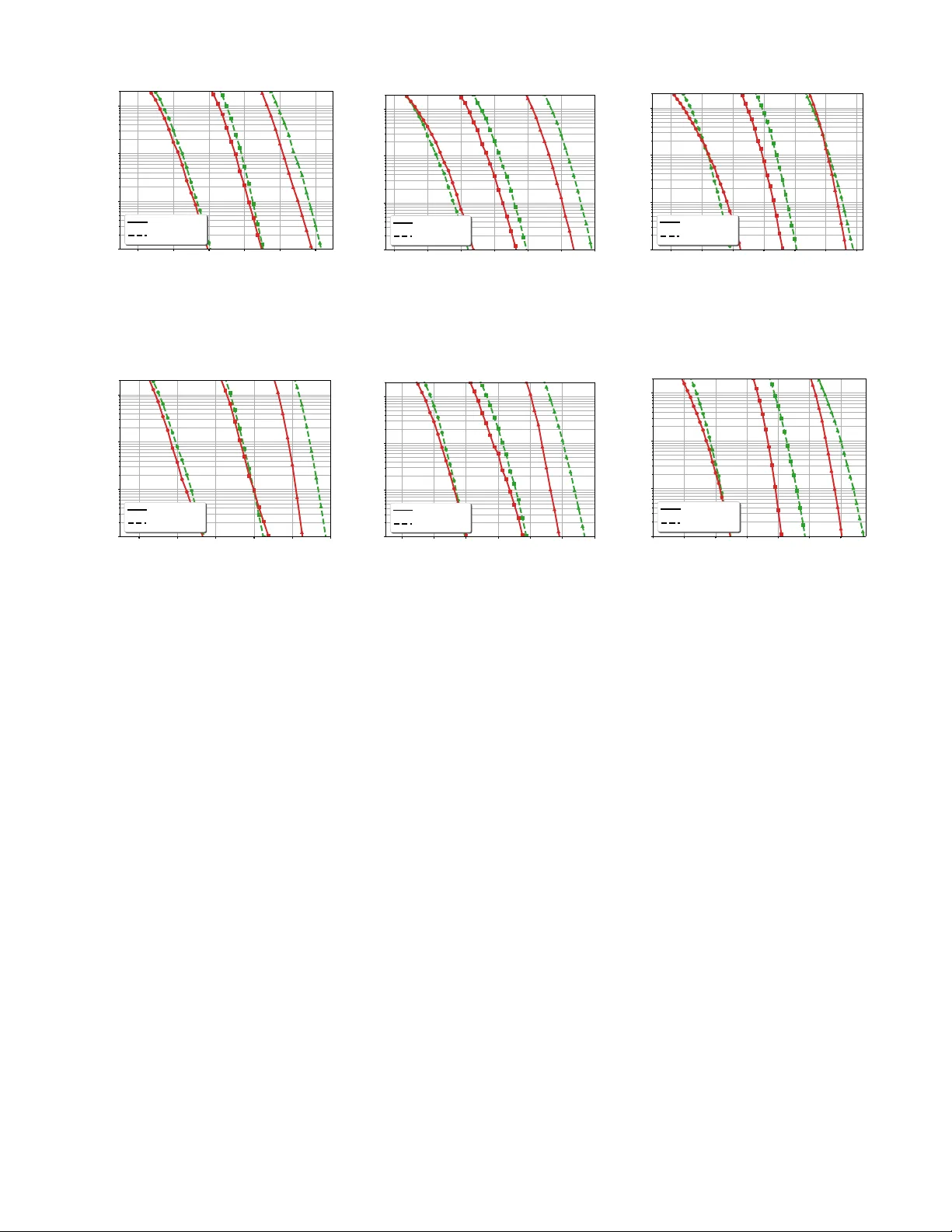
1 Learning While T ransmitting: Pilotless P olar Co ded Mo dulation for Short P ac k et T ransmission Geon Choi, Memb er, IEEE and Namy o on Lee, Senior Memb er, IEEE A bstr act —Short pac k ets mak e c hannel learning ex- p ensiv e. In pilot-aided transmission ( P A T ), a non- negligible fraction of the pac k et is consumed b y pi- lots, creating a direct pre-log loss and tightening the reliabilit y margin needed for ultra-reliable low-latency comm unication. W e prop ose a pilot-free p olar-co ded framew ork that replaces explicit pilots with c o de d pi- lots . The message is carried by tw o p olar-co ded seg- men ts: a quadrature phase shift keying ( QPSK ) segmen t that is deco dable without c hannel state information ( CSI ), and a higher-order quadrature amplitude mo d- ulation ( QAM ) segmen t that pro vides high sp ectral eciency . The receiv er emplo ys hybrid de c o ding : it rst join tly infers CSI during successiv e-cancellation-based deco ding of the QPSK segment by exploiting QPSK phase-rotation inv ariance together with polar frozen- bit constrain ts; the deco ded QPSK symbols then act as implicit pilots for coherent detection and deco ding of the QAM segment. The split also mak es rate adap- tation practical b y conning the symmetry/ frozen- bit requiremen ts for phase resolution to the QPSK segmen t, enabling puncturing and shortening without breaking the pilot-free mec hanism. F or multi-block fad- ing, we optimize the split and co de parameters via den- sit y ev olution with Gaussian approximation ( DEGA ); for higher-order mo dulation, we use bit-interlea ved co ded modulation capacity approximation to obtain equiv alen t channel parameters. Incorp orating channel- estimation error v ariance into the DEGA-based analy- sis, sim ulations o v er practical multi-block block-fading c hannels sho w gains up to 1 . 5 dB o v er P A T in the short- blo c klength regime. I. Introduction Ultra-reliable lo w-latency comm unication ( URLLC ) c hanges the op erating p oint of wireless design. When the pac k et is short and the error probability target is stringent, there is no longer room to aver age out ineciencies: every c hannel use sp ent on ov erhead directly reduces the infor- mation that can b e delivered within the latency budget. This regime is increasingly central in emerging closed-loop applications —rob ot control for ph ysical articial in telli- gence, autonomous driving, and industrial automation — where the con trol cycle itself allocates only a small num ber of channel uses p er up date. P olar co des, in tro duced b y Arıkan [ 1 ], ha ve b ecome a leading co ding solution for this short-blo ck, high-reliability regime. They are the rst family of c hannel co des pro v en to The authors are with the Department of Electrical Engineer- ing, Pohang Univ ersit y of Science and T echnology ( POSTECH ), Pohang 37673, South Korea ( e-mail: geon.choi@postech.ac.kr; nylee@postech.ac.kr ). ac hiev e the capacity of symmetric binary-input memory- less channels under low-complexit y successive cancellation ( SC ) deco ding, and their structure supports ecien t list deco ding and practical implementations. These adv an- tages led to their adoption in the 5G New Radio ( NR ) standard [ 2 ]. Beyond standardization, a large bo dy of w ork has improv ed nite-length p erformance through pre- transform and concatenation ideas, including cyclic redun- dancy chec k ( CRC ) -aided deco ding, dynamic frozen bits, p olarization-adjusted conv olutional ( P AC ) co de-type con- structions, and learning-assisted metho ds [ 3 ] – [ 9 ]. In short, from a c o ding p ersp ectiv e, the ingredients for URLLC are strong [ 10 ] – [ 14 ]. The more subtle b ottleneck is often not coding, but c oher enc e . Consider the basic blo ck-fading picture: within a coherence interv al of T c hannel uses, the c hannel is ( ap- pro ximately ) constan t but unknown. Pilot-assisted trans- mission ( P A T ) spends τ of these T uses on pilots, leaving only T − τ uses for data [ 15 ] – [ 18 ]. The o v erhead creates a fundamen tal pre-log penalty: even b efore accoun ting for estimation error, the eective pa yload is reduced by a factor (1 − τ / T ) . When T is small —as in fast fading, high mobility , or short pack ets—this p enalty is no longer negligible. Moreov er, in the very regime where reliability m ust b e highest, imp erfect channel estimates can turn the remaining data sym bols into a mismatch problem, comp ounding the loss. This motiv ates pilot-free ( or pilot- minimized ) designs that embed channel inference into the co ded transmission itself, aiming to approach coherent p erformance without explicit pilot o v erhead [ 19 ] – [ 24 ]. A. R elate d W orks Pilot-free p olar-co ded comm unication has developed along several directions, each trading o generality , com- plexit y , and robustness. A rst direction uses c o de c onstr aints as implicit r ef- er enc es . Y uan et al. [ 25 ] prop osed a t wo-stage sc heme that eliminates explicit pilots by exploiting frozen-bit constrain ts for join t c hannel estimation and deco ding: candidate phase rotations are ev aluated through successiv e cancellation list ( SCL ) deco ding and lik eliho o d compar- ison. The approach ac hieves near-coheren t p erformance for quadrature phase shift k eying ( QPSK ), but scales p o orly to multi-block fading b ecause the n um b er of phase com binations grows rapidly , and extending to higher- order mo dulation is challenging due to amplitude-related am biguities. 2 A second direction resolv es phase ambiguit y b y en- for cing e quivarianc e . Phase-equiv ariant p olar co des freeze rotation-discriminating bits to lev erage co de automor- phisms and disambiguate unknown phase without pi- lots [ 26 ]. While eective for QPSK and 16-quadrature am- plitude mo dulation ( QAM ), these constructions are fragile under the rate-matching op erations required in practice: puncturing/shortening can disrupt frozen-bit patterns and symmetry , undermining phase resolution. A third direction introduces emb e dde d pilot p ositions . Systematic p olar codes with selected p ositions used for c hannel estimation were dev elop ed in [ 27 ], enabling opera- tion in m ulti-carrier and Doppler c hannels. Ho w ever, these reserv ed p ositions ultimately do not carry data, so ov er- head is not fully conv erted into co ding gain. Hybrid p olar enco ding [ 28 ] creates dynamic pilots by mixing systematic and non-systematic segmen ts, enabling blind estimation follo w ed b y coheren t decoding; current formulations are mainly tailored to real-v alued fading with binary phase shift k eying ( BPSK ) and do not directly address unknown phase osets in complex baseband channels. These w orks rev eal a recurring design tension: a practi- cal pilot-free scheme must ( i ) supp ort higher-order mo du- lation while resolving phase ambiguities, ( ii ) remain com- patible with exible rate-matching and arbitrary co de lengths, and ( iii ) keep complexity manageable in m ulti- blo c k fading. Existing metho ds typically satisfy only a subset of these requirements. B. Overview of A ppr o ach W e prop ose a pilot-free p olar-co ded transmission frame- w ork that resolv es the ab ov e tension b y separating t wo roles that are usually coupled: channel anchoring and sp e ctr al eciency . The core idea is a c o de-splitting arc hi- tecture: a QPSK-mo dulated segment provides a constant- amplitude anchor that enables blind c hannel inference using the algebraic structure of p olar co des, while a higher-order QAM segment carries the bulk of the in- formation at high sp ectral eciency . The receiv er rst deco des the QPSK segmen t to reco ver the relev ant c hannel state information ( CSI ), then reuses the decoded bits as implicit pilots to enable coherent detection and deco ding of the QAM segmen t. Importantly , b y conning the phase- resolution constrain ts to the QPSK portion, the ov erall design remains compatible with practical rate-matching. C. Contributions Our main contributions are summarized as follows: • Code-splitting architecture: W e develop a pilot- free polar-co ded framework that partitions each code- w ord into a QPSK segmen t for blind c hannel estima- tion and a higher-order QAM segmen t for sp ectral eciency , supporting arbitrary blo ck lengths. • Hybrid deco ding with implicit pilots: W e design an ecient tw o-phase receiv er that rst resolves CSI through deco ding of the QPSK segmen t, then uses the reco vered bits as implicit pilots for coherent QAM detection and deco ding. • Rate-matc hing integration: The split lo calizes the delicate frozen-bit/ symmetry constrain ts to the QPSK component, enabling puncturing/ shortening ( e.g., quasi-uniform rate-matching ) without breaking phase-am biguit y resolution. • Multi-block fading optimization: W e pro vide a systematic optimization framew ork for multi- ple fading blo cks by extending densit y ev olution with Gaussian appro ximation ( DEGA ) to the code- splitting setting. F or higher-order modulation, we construct a binary input–additive white Gaussian noise ( BI-A W GN ) approximation c hannel and apply a bit-interlea ved coded mo dulation ( BICM ) capacity- matc hing metho d to determine equiv alen t channel parameters. • Analysis and v alidation: W e incorp orate channel- estimation error v ariance into the DEGA-based anal- ysis and v alidate the mo del through extensive simu- lations across diverse fading proles and mo dulation orders, demonstrating gains up to 1 . 5 dB o ver P A T in practical multi-block blo ck-fading channels. The remainder of this pap er is organized as follows. Section I I presents the channel mo del and p olar prelim- inaries. Section I I I describ es the prop osed co de-splitting arc hitecture and enco ding pro cedure. Section IV develops the hybrid deco ding algorithm with implicit pilot gener- ation. Section V presen ts the DEGA- and BICM-based optimization framew ork. Section VI reports sim ulation results. Section VI I concludes the pap er. I I. System Model and Back ground A. System Mo del W e consider a pack et of length N t transmitted ov er a blo c k-fading channel with coherence time N c . The pack et exp eriences B independent fading blo c ks, where B = N t / N c . The channel co ecient for the b th fading blo ck is denoted as h b = | h b | e j ϕ b . Let the transmitted pac ket b e represented as x = [ x 1 , x 2 , . . . , x B ] , where x b ∈ C N c for b ∈ { 1 , 2 , . . . , B } . The corresp onding received signal vector y = [ y 1 , y 2 , . . . , y B ] is giv en by y b = h b x b + v b , ( 1 ) where v b ∈ C N c denotes the additive white Gaussian noise ( A W GN ) vector with indep endent and iden tically distributed elements following v b ∼ C N ( 0 , σ 2 I ) . Throughout this pap er, w e denote the i th elemen t of v ector x as x i and the i th element of vector x k as x k,i . B. Pilot-Aide d Communic ations W e b egin b y briey reviewing the pilot-aided communi- cation framework. In such systems, the transmitted sym- b ol v ector x ∈ C N t is partitioned into B + 1 comp onents: pilot symbols x ( b ) p ∈ C N ( b ) p for the b th blo ck fading, and 3 data symbols x d ∈ C N d , where P B b =1 N ( b ) p + N d = N t . The pilot symbols, typically pseudo-random QPSK sequences of length N ( b ) p , are kno wn a priori to the receiver and facilitate c hannel estimation. The data symbols, of length N d , conv ey K information bits. The pilot symbols are inserted b et ween the data sym b ols, so that symbol vector x ( b ) p exp eriences the b th blo ck fading channel. Assuming N s -ary QAM with constellation X N s , eac h sym b ol x i ∈ X N s represen ts n s = log 2 ( N s ) consecutiv e co dew ord bits. 1 The constellation is normalized such that 1 N s P x ∈X N s | x | 2 = 1 , and Gray lab eling is employ ed throughout [ 30 ]. Giv en a total pack et size N c , pilot length N p , and modu- lation size N s , the eectiv e codeword length is M = n s N d . A ccordingly , the transmitter enco des K information bits m ∈ F K 2 in to a codeword c ∈ F M 2 with nominal code rate R = K / M . How ever, due to the pilot ov erhead, the eectiv e co de rate b ecomes R p eff = K N c = K N p + N d = (1 − α ) n s R, ( 2 ) where α = N p / N c denotes the pilot ov erhead fraction. C. Polar Co des and R ate-Matching P olar co des are dened by a transform matrix F N = F ⊗ n 2 where N = 2 n and F 2 = 1 0 1 1 . The co de is charac- terized by an information index set I ⊆ { 0 , 1 , . . . , N − 1 } , while the frozen index set F is the complement of I . The generator matrix consists of the ro ws of F N indexed by I . Polar co des achiev e arbitrary co de rates R = K / N by setting |I | = K . The inheren t constrain t of Arıkan ’ s construction limits p olar co de lengths to p ow ers of t w o, i.e., M = 2 n . T o supp ort arbitrary codeword lengths M 6 = 2 n , rate- matc hing techniques are employ ed: • Shortening and Puncturing: Used to reduce co de length from a larger mother co de of size N > M . • Extension and Rep etition: Used to increase co de length from a smaller mother co de of size N < M . In 5G NR systems, quasi-uniform puncturing and short- ening with sub-blo ck interlea ving are employ ed for rate- matc hing, ensuring compatibility while maintaining go o d p erformance [ 2 ]. Shortening remov es the last N − M in terlea v ed co deword bits, while puncturing remov es the rst N − M bits. Rep etition extends the rst M − N in terlea v ed c odeword bits. I I I. Pilot-Free Polar-Coded Modula tion In this section, we presen t a rate-matching, pilot-free p olar-co ded transmission framework designed for ecient short-pac k et comm unication o ver fading channels. The core of our approach is a co de-splitting architecture that 1 W e assume the codeword bits are interlea ved appropriately for the bit-in terlea ved co ded modulation ( BICM ) scheme [ 29 ]. 𝐅 𝑵 ! 𝐅 𝑵 " Rate - matching Rate - matching QPSK 𝑁 " - QAM Po la r - transform Modulation AAAFVnicbdTJbhMxGAdwtyS0FErTcoOLRUHqYRTNhLaUW5t0X9MlS9uEyOM4qZXZsD1Aao3EnffghASPA+JdEJ4kkp0WSyNZP//n8zIju5FHubDt3xOTDzLZh1PTj2YeP5l9OpebX6jyMGaYVHDohazuIk48GpCKoMIj9YgR5Lseqbm9Ujpe+0gYp2FwIfoRafqoG9AOxUgoauWey4bbgX4CGzSADR+JG9eV20mr8P6glVu08/agwfsdZ9RZXF9Y+vP1+4fZcms+86rRDnHsk0BgD3F+7diRaErEBMUeSWYaMScRwj3UJdeqGyCf8KYcbCKBr5W0YSdk6gkEHKj5hkQ+533fVcl0mfzuWIr/G7uORWetKWkQxYIEeDhRJ/agCGF6IrBNGcHC66sOwoyqtUJ8gxjCQp3b2CxpbRGGHh/bihS0dzuUtOdRlyHWl1HIaXrGNOhaECMPWxAxFn7ieZ8IlMyMleiFgnxOrU066ksONi9DhoIu5TeJPNspJrKwsmI57wqWnYzHuoyQQMec5VWrYK9Za3dzUcwi9RVGKXvVgstvLKjio3kbeEPKwS+gVis3kkT9FAMuGlzUXDK4pHnT4E3Fo9pbBm/p9LbB25p3DN7RvGvwrq69Z/CeTu8bvK/5wOADzYcGH+raRwYf6fSxwceaTww+0Vw2uKxrnxp8qtNnBp9pPjf4XPOFwRe6dsXgik5XDa5qrhlc01w3uK5rXxp8qdNXBl9pvjX4VrG6V5y7t8j9TrWQd1bzK6fqgimAYZsGL8BLsAQc8Basg11QBhWAwRfwDfwAPzO/Mn+z2ezUMDo5MXrnGRhr2dw/ipPizw== m → F K 2 AAAFXHicbdTLb9MwHAdwb7QwNgYbQ1yQkMVA4hBVSdnG4LT3+9GN9bGtpXJct7OaxJHtAJ2VK1f+Ea7wF3DmzoW/BaetZHcjUqWfPv7m50cq+3FAhXTdP2Pjd3L5u/cm7k9OPZh++Ghm9nFFsIRjUsYsYLzmI0ECGpGypDIgtZgTFPoBqfrd9Wy8+olwQVl0JnsxaYSoE9E2xUhqas5AVffbMEybLqzTCNZDJK98X22lzeJHtd900+bMvFtw+w+8XXjDYn5l7tv7J79/PS81Z3Mv6y2Gk5BEEgdIiEvPjWVDIS4pDkg6WU8EiRHuog651GWEQiIaqr+VFL7S0oJtxvUvkrCv9hsKhUL0Ql8ns6WKm2MZ/m/sMpHt5YaiUZxIEuHBRO0kgJLB7Fxgi3KCZdDTBcKc6rVCfIU4wlKf3sgsWW/JWCBGtqIk7V4PJKsC6nPEeypmgmYnTaOOAzEKsAMR5+yzKIREonRypEWXSfIlsxZp6+/Z37xiHEUdKq5Sdbq9lqri4qLjvSs6bjoa63BCIhPzFpacorvsLN/MxQmP9VcYptwlBy68caCOD+et41Wl+n8DvVq1mqYpHPCaxWuG1y1eN7xh8YbmYe9NizdNesviLcPbFm8b3rF4x/TetXjXpPcs3jO8b/G+4QOLD0zvQ4sPTfrI4iPDxxYfGy5ZXDK9Tyw+MelTi08Nf7D4g+Ezi89M77LFZZOuWFwxXLW4arhmcc30Prf43KQvLL4wfG3xtWZ9r3g3b5HbRaVY8JYKiyf6gimCwTMBnoEX4DXwwFuwAnZACZQBBl/Bd/AD/Mz9zefyU/npQXR8bPjOHBh58k//AefP4/g= m 0 → F K 0 2 AAAFXHicbdTLb9MwHAdwb7QwNgYbQ1yQkMVA4hBVSdnG4LT3+9GN9bGtpXJct7OaxJHtAJ2VK1f+Ea7wF3DmzoW/BaetZHcjUqWfPv7m50cq+3FAhXTdP2Pjd3L5u/cm7k9OPZh++Ghm9nFFsIRjUsYsYLzmI0ECGpGypDIgtZgTFPoBqfrd9Wy8+olwQVl0JnsxaYSoE9E2xUhqas5AVffbMEybHqzTCNZDJK98X22lzeJHtd/00ubMvFtw+w+8XXjDYn5l7tv7J79/PS81Z3Mv6y2Gk5BEEgdIiEvPjWVDIS4pDkg6WU8EiRHuog651GWEQiIaqr+VFL7S0oJtxvUvkrCv9hsKhUL0Ql8ns6WKm2MZ/m/sMpHt5YaiUZxIEuHBRO0kgJLB7Fxgi3KCZdDTBcKc6rVCfIU4wlKf3sgsWW/JWCBGtqIk7V4PJKsC6nPEeypmgmYnTaOOAzEKsAMR5+yzKIREonRypEWXSfIlsxZp6+/Z37xiHEUdKq5Sdbq9lqri4qLjvSs6bjoa63BCIhPzFpacorvsLN/MxQmP9VcYptwlBy68caCOD+et41Wl+n8DvVq1mqYpHPCaxWuG1y1eN7xh8YbmYe9NizdNesviLcPbFm8b3rF4x/TetXjXpPcs3jO8b/G+4QOLD0zvQ4sPTfrI4iPDxxYfGy5ZXDK9Tyw+MelTi08Nf7D4g+Ezi89M77LFZZOuWFwxXLW4arhmcc30Prf43KQvLL4wfG3xtWZ9r3g3b5HbRaVY8JYKiyf6gimCwTMBnoEX4DXwwFuwAnZACZQBBl/Bd/AD/Mz9zefyU/npQXR8bPjOHBh58k//AfGV4/o= m 1 → F K 1 2 AAAFXHicbdTLb9MwHAdwb7QwNgYbQ1yQkMVA4hBVSdnG4LT3+9GN9bGtpXJct7OaxJHtAJ2VK1f+Ea7wF3DmzoW/BaetZHcjUqWfPv7m50cq+3FAhXTdP2Pjd3L5u/cm7k9OPZh++Ghm9nFFsIRjUsYsYLzmI0ECGpGypDIgtZgTFPoBqfrd9Wy8+olwQVl0JnsxaYSoE9E2xUhqas5AVffbEKdNF9ZpBOshkle+r7bSZvGjOmy6aXNm3i24/QfeLrxhMb8y9+39k9+/npeas7mX9RbDSUgiiQMkxKXnxrKhEJcUBySdrCeCxAh3UYdc6jJCIREN1d9KCl9pacE24/oXSdhX+w2FQiF6oa+T2VLFzbEM/zd2mcj2ckPRKE4kifBgonYSQMlgdi6wRTnBMujpAmFO9VohvkIcYalPb2SWrLdkLBAjW1GSdq8HklUB9TniPRUzQbOTplHHgRgF2IGIc/ZZFEIiUTo50qLLJPmSWYu09ffsb14xjqIOFVepOt1eS1VxcdHx3hUdNx2NdTghkYl5C0tO0V12lm/m4oTH+isMU+6SAxfeOFDHh/PW8apS/b+BXq1aTdMUDnjN4jXD6xavG96weEPzsPemxZsmvWXxluFti7cN71i8Y3rvWrxr0nsW7xnet3jf8IHFB6b3ocWHJn1k8ZHhY4uPDZcsLpneJxafmPSpxaeGP1j8wfCZxWemd9nisklXLK4YrlpcNVyzuGZ6n1t8btIXFl8Yvrb4WrO+V7ybt8jtolIseEuFxRN9wRTB4JkAz8AL8Bp44C1YATugBMoAg6/gO/gBfub+5nP5qfz0IDo+NnxnDow8+af/AMAZ4/A= c 0 → F M 0 2 AAAFXHicbdTLb9MwHAdwb7QwNgYbQ1yQkMVA4hBVSdnG4LT3+9GN9bGtpXJct7OaxJHtAJ2VK1f+Ea7wF3DmzoW/BaetZHcjUqWfPv7m50cq+3FAhXTdP2Pjd3L5u/cm7k9OPZh++Ghm9nFFsIRjUsYsYLzmI0ECGpGypDIgtZgTFPoBqfrd9Wy8+olwQVl0JnsxaYSoE9E2xUhqas5AVffbEKdND9ZpBOshkle+r7bSZvGjOmx6aXNm3i24/QfeLrxhMb8y9+39k9+/npeas7mX9RbDSUgiiQMkxKXnxrKhEJcUBySdrCeCxAh3UYdc6jJCIREN1d9KCl9pacE24/oXSdhX+w2FQiF6oa+T2VLFzbEM/zd2mcj2ckPRKE4kifBgonYSQMlgdi6wRTnBMujpAmFO9VohvkIcYalPb2SWrLdkLBAjW1GSdq8HklUB9TniPRUzQbOTplHHgRgF2IGIc/ZZFEIiUTo50qLLJPmSWYu09ffsb14xjqIOFVepOt1eS1VxcdHx3hUdNx2NdTghkYl5C0tO0V12lm/m4oTH+isMU+6SAxfeOFDHh/PW8apS/b+BXq1aTdMUDnjN4jXD6xavG96weEPzsPemxZsmvWXxluFti7cN71i8Y3rvWrxr0nsW7xnet3jf8IHFB6b3ocWHJn1k8ZHhY4uPDZcsLpneJxafmPSpxaeGP1j8wfCZxWemd9nisklXLK4YrlpcNVyzuGZ6n1t8btIXFl8Yvrb4WrO+V7ybt8jtolIseEuFxRN9wRTB4JkAz8AL8Bp44C1YATugBMoAg6/gO/gBfub+5nP5qfz0IDo+NnxnDow8+af/AMnf4/I= c 1 → F M 1 2 AAAFW3icbdTJbhMxGAdwdwmUUKAF9QQSFgWJwyiaCU0pt+77kpZmaTtp5HGc1Mpssj3Q1BoJIXHiUbiCxKtw4F3wJJHstFhK9Onn/3weeyR7sU+5sO0/Y+MTk7l796ce5B9OP3r8ZGb2aZVHCcOkgiM/YnUPceLTkFQEFT6px4ygwPNJzeuuZfO1T4RxGoWnoheTRoA6IW1TjISi5sxL6XpteJ02bejSELq43pSHTZ5eqn98aafNmXm7YPcHvFs4w2J++cXv0tz3r1/KzdnJ124rwklAQoF9xPmFY8eiIRETFPskzbsJJzHCXdQhF6oMUUB4Q/Z3ksI3SlqwHTH1CwXsq/mERAHnvcBTyQCJK357LsP/zV0kor3UkDSME0FCPFionfhQRDA7FtiijGDh91SBMKPqXSG+QgxhoQ5vZJWst4gin49sRQravRlIVvnUY4j1ZBxxmh00DTsWxMjHFkSMRZ95ISACpfmRFt1IkOvMWqStPmd/8zJiKOxQfpXKk63VVBZLJcv5ULTsdDTWYYSEOuYsLFpFe8laup2LExarrzBM2YsWXHhnQRUfruviFSndbI/qbeVKmqZwwKsGr2peM3hN87rB64qHvTcM3tDpTYM3NW8ZvKV52+Bt3XvH4B2d3jV4V/OewXua9w3e170PDD7Q6UODDzUfGXykuWxwWfc+NvhYp08MPtH80eCPmk8NPtW9KwZXdLpqcFVzzeCa5rrBdd37zOAznT43+FzzjcE3itW94ty+Re4W1WLBWSyUjtUFUwSDMQWeg1fgLXDAe7AMtkEZVAAG38AP8BP8mvybm8jlc9OD6PjY8JlnYGTk5v4BxYvjvQ== x 0 → X N 0 c N s AAAFV3icbdTJbhMxGAdwtySllKUt5VYJWRQkDqNoJrSlcOq+L+mSpe2kkcdxUiuzyfZAU2sOPAGPwRXegTP3Pg14kkh2WiyN9Onn/3weeyR7sU+5sO27kdFHufzY4/EnE0+fPX8xOTX9ssKjhGFSxpEfsZqHOPFpSMqCCp/UYkZQ4Pmk6nXWsvnqF8I4jcIz0Y1JPUDtkLYoRkJRY2pWul4L3qQNB7o0hC6uNeav5GEDXzlpY2rOLti9AR8WzqCYW575/vnVn9+vS43p3Fu3GeEkIKHAPuL80rFjUZeICYp9kk64CScxwh3UJpeqDFFAeF32dpHCd0qasBUx9YQC9tR8Q6KA827gqWSAxDW/P5fh/+YuE9FaqksaxokgIe4v1Ep8KCKYHQlsUkaw8LuqQJhR9a0QXyOGsFAHN7RK1ltEkc+HtiIF7dz2Jat86jHEujKOOM0OmYZtC2LkYwsixqKvvBAQgdKJoRadSJCbzJqkpX5lb/MyYihsU36dypOt1VQWFxYs51PRstPhWJsREuqYM79oFe0la+l+Lk5YrP7CIGUvWnD+gwVVfLCui1ekdLM9qq+VK2mawj6vGryqec3gNc3rBq8rHvTeMHhDpzcN3tS8ZfCW5m2Dt3XvHYN3dHrX4F3Newbvad43eF/3PjD4QKcPDT7UfGTwkeaSwSXd+9jgY50+MfhE86nBp5rPDD7TvcsGl3W6YnBFc9XgquaawTXd+9zgc52+MPhC863Bt4rVveLcv0UeFpViwVksLByrC6YI+mMczII34D1wwEewDLZBCZQBBt/AD/AT/Mrd5f7mx/Lj/ejoyOCdGTA08tP/AMun4qc= x 1 → X N 1 c 4 Π Fig. 1. Enco ding structure of the proposed code-splitting metho d. Information bits are partitioned into t wo sub-messages that are independently encoded and modulated using dierent schemes. Π is an in terlea v er for BICM [ 29 ]. separates the transmission into m ultiple SC-deco dable 2 segmen ts. Consider the transmission of K information bits o ver N t c hannel uses, comprised of B indep endent fading blocks with coherence time N c sym b ols. The prop osed scheme is parameterized by { N b c , K b } B b =0 , satisfying the constraints P B b =0 N b c = N t and P B b =0 K b = K . The o v erall enco ding structure, illustrated in Fig. 1, follows a multi-path design in which the information message m ∈ F K 2 is partitioned in to B + 1 sub-messages, m b ∈ F K b 2 , whic h are pro cessed indep enden tly as follow: 3 • Component 0: The sub-message m 0 is enco ded with a polar code C 0 , resulting in a co deword c 0 with length M 0 = N 0 c log 2 N s . W e use conv en tional rate-matc hing tec hniques. F ollowing interlea ving, the co deword bits are mo dulated with N s -QAM symbol vector x 0 of length N 0 c . The symbol vector x 0 is further divided in to x 0 = [ x 0 , 1 , x 0 , 2 , . . . , x 0 ,B ] . • Components i ( i = 1 , 2 , . . . , B ) – co ded-pilot: Eac h sub-message m i is enco ded using p olar co de C i with the constrain t { N i − 2 , N i − 1 } ⊆ F i , pro- ducing co deword c i of length M i = 2 N i c . W e use con v en tional rate-matc hing tec hniques, but exclude shortening. The co dew ord is then QPSK-mo dulated to generate symbol vector x i of length N i c , whic h serv es as the channel estimation component for the i th fading blo ck with c hannel coecient h i . The complete transmitted signal consists of co ded-pilot comp onen ts x i for c hannel estimation and higher-order mo dulated sub-v ectors x 0 ,i for data transmission, arranged as x = [ x 1 , x 0 , 1 , x 2 , x 0 , 2 , . . . , x B , x 0 ,B ] . Consequently , each sub-v ector pair [ x b , x 0 ,b ] exp eriences the b th fading blo ck with channel co ecient h b . The eectiv e co de rate of the prop osed pilot-free p olar- co ded transmission scheme is giv en by R e = K M = n s α 0 R 0 + B X b =1 2 α b R b , ( 3 ) where M = P B b =0 M b , α b = N b c / N t and R b = K b / M b . This eective co de rate formulation naturally includes 2 W e use the term SC-decodable to indicate co des able to be decoded with SC t ypes of decoder with low complexity 3 The framew ork naturally accommodates outer codes suc h as CRC by treating the concatenated message [ m , p crc ] as the information sequence. 4 Mag. Estim . AAAFXHicbdTLb9MwHAdwD1oYG4ONSVy4WAwkDlGVlG2M27bu/ewefWxrVzmu21lN4sh2gM7KDfHXcAXxr3Dhv+CO01ayuxGp0k8ff/PzI5X9OKBCuu7viQcPc/lHjyefTE0/nXn2fHbuRVWwhGNSwSxgvO4jQQIakYqkMiD1mBMU+gGp+b1SNl77RLigLDqX/Zg0Q9SNaIdiJDW1ZqFq+B3YT1sebNAINkIkb3xfldJrddTC117aml1wC+7ggfcLb1QsrM79/TU/0f5abs3l3jTaDCchiSQOkBBXnhvLpkJcUhyQdKqRCBIj3ENdcqXLCIVENNVgKyl8q6UNO4zrXyThQO03FAqF6Ie+TmZLFXfHMvzf2FUiOytNRaM4kSTCw4k6SQAlg9m5wDblBMugrwuEOdVrhfgGcYSlPr2xWbLekrFAjG1FSdq7HUpWBdTniPdVzATNTppGXQdiFGAHIs7ZZ1EIiUTp1FiLHpPkS2Zt0tHfc7B5xTiKulTcpOp0ez1VxaUlx/tYdNx0PNblhEQm5i0uO0V3xVm5m4sTHuuvMEq5yw5cfO9AHR/N28BrSg3+Bnq1ai1NUzjkdYvXDZcsLhnesHhD86j3psWbJr1l8ZbhbYu3De9YvGN671q8a9J7Fu8Z3rd43/CBxQem96HFhyZ9ZPGR4WOLjw2XLS6b3icWn5j0qcWnhs8sPjN8bvG56V2xuGLSVYurhmsW1wzXLa6b3hcWX5j0pcWXhm8tvtWs7xXv7i1yv6gWC95yYelEXzBFMHwmwSvwGrwDHvgAVsEOKIMKwOAb+A5+gJ+5P/lcfjo/M4w+mBi9Mw/GnvzLf5Fm5FA= y 1 → C N 1 c AAAFXHicbdTLb9MwHAdwD1oYG4ONSVy4WAwkDlGVlG2M27bu/ewefWxrVzmu21lN4sh2gM7KDfHXcAXxr3Dhv+CO01ayuxGp0k8ff/PzI5X9OKBCuu7viQcPc/lHjyefTE0/nXn2fHbuRVWwhGNSwSxgvO4jQQIakYqkMiD1mBMU+gGp+b1SNl77RLigLDqX/Zg0Q9SNaIdiJDW1ZqFq+B3YT1subNAINkIkb3xfldJrddTC127aml1wC+7ggfcLb1QsrM79/TU/0f5abs3l3jTaDCchiSQOkBBXnhvLpkJcUhyQdKqRCBIj3ENdcqXLCIVENNVgKyl8q6UNO4zrXyThQO03FAqF6Ie+TmZLFXfHMvzf2FUiOytNRaM4kSTCw4k6SQAlg9m5wDblBMugrwuEOdVrhfgGcYSlPr2xWbLekrFAjG1FSdq7HUpWBdTniPdVzATNTppGXQdiFGAHIs7ZZ1EIiUTp1FiLHpPkS2Zt0tHfc7B5xTiKulTcpOp0ez1VxaUlx/tYdNx0PNblhEQm5i0uO0V3xVm5m4sTHuuvMEq5yw5cfO9AHR/N28BrSg3+Bnq1ai1NUzjkdYvXDZcsLhnesHhD86j3psWbJr1l8ZbhbYu3De9YvGN671q8a9J7Fu8Z3rd43/CBxQem96HFhyZ9ZPGR4WOLjw2XLS6b3icWn5j0qcWnhs8sPjN8bvG56V2xuGLSVYurhmsW1wzXLa6b3hcWX5j0pcWXhm8tvtWs7xXv7i1yv6gWC95yYelEXzBFMHwmwSvwGrwDHvgAVsEOKIMKwOAb+A5+gJ+5P/lcfjo/M4w+mBi9Mw/GnvzLf4eg5E4= y 0 → C N 0 c Π !" Demapper Decoding Re - encoding Channel Estim . Demapper Decoding Phase Estim . AAAFYHicbdTJbhMxGAdwtzS0lKUt5QQSsmiROIyimdCWwqn7vqRttrYTIo/jJFZmk+0BUmtegAuvwhXOnLlz5UnwJJHstIwU6dPP//m8TGQv9ikXtv1nbPzeRO7+5NSD6YePHj+ZmZ17WuFRwjAp48iPWM1DnPg0JGVBhU9qMSMo8HxS9bqb2Xj1E2GcRmFJ9GJSD1A7pC2KkVDUmF10O0hI12vBIG040KUhdAMkOp4nd9JG4aM8bDhpY3bBztv9B94tnGGxsDb/7cOz379eFhtzE4tuM8JJQEKBfcT5tWPHoi4RExT7JJ12E05ihLuoTa5VGaKA8LrsbyeFr5U0YSti6hcK2FfzDYkCznuBp5LZUvntsQz/N3adiNZqXdIwTgQJ8WCiVuJDEcHsbGCTMoKF31MFwoyqtULcQQxhoU5wZJast4gin49sRQravRlIVvnUY4j1ZBxxmp02DdsWxMjHFkSMRZ95PiACpdMjLbqRIF8ya5KW+qb9zcuIobBNeSeV57sbqSwsL1vO+4Jlp6OxNiMk1DFnacUq2KvW6u1cnLBYfYVhyl6x4NJbC6r4cF4Xr0vZ/xuo1cr1NE3hgDcM3tC8afCm5i2DtxQPe28bvK3TOwbvaN41eFfznsF7uve+wfs6fWDwgeZDgw81Hxl8pHsfG3ys0ycGn2g+NfhUc9Hgou59ZvCZTp8bfK75wuALzSWDS7p32eCyTlcMrmiuGlzVXDO4pntfGnyp01cGX2m+MfhGsbpXnNu3yN2iUsg7K/nlM3XBFMDgmQIvwCvwBjjgHVgDe6AIygCDr+A7+AF+TvzNTeVmcnOD6PjY8J15MPLknv8DhVzluw== ˆ m 1 → F K 1 2 AAAFR3icbdTJbhMxGAdwt6SllK2FIxeLgsRhFM2EtpRb931J2mZpm6jyOE5iZTZsDzQdzUNwgSuceBZ4A8RDcEMc8SSR/KXF0kiffv7P52WkcSOPS2XbP8fG7+QmJu9O3Zu+/+Dho8czs08qMowFZWUaeqGouUQyjwesrLjyWC0SjPiux6pudy2br75nQvIwOFW9iDV80g54i1OiNDXqHaKSutvCV+mlczkzZ+ft/sC3C2dYzC1Pln79+PTxW/FyNvei3gxp7LNAUY9IeeHYkWokRChOPZZO12PJIkK7pM0udBkQn8lG0t91il9qaeJWKPQTKNxX+EZCfCl7vquTPlEdeXMuw//NXcSqtdRIeBDFigV0sFAr9rAKcXYFuMkFo8rr6YJQwfVeMe0QQajSFzWyStZbhaEnR46SKN69HkhWedwVRPSSKJQ8u1QetC1MiUctTIQIP8i8zxRJp0dadEPFrjJrspb+dP3DJ6EgQZvLTpocb62mSWFhwXLeFiw7HY21BWOBiTnzi1bBXrKWbuaiWET6KwxT9qKF519bWMeH69bpSpLUszPq3SYraZriAa8CXjW8BnjN8Drgdc3D3huAN0x6E/Cm4S3AW4a3AW+b3juAd0x6F/Cu4T3Ae4b3Ae+b3geAD0z6EPCh4SPAR4aLgIumdwlwyaSPAR8bPgF8YvgU8KnpXQZcNukK4IrhKuCq4Rrgmul9BvjMpM8Bnxu+BnytWf9XnJt/kdtFpZB3FvMLJf2DKaDBmELP0HP0CjnoDVpG26iIyoiid+gz+oK+5r7nfuf+5P4OouNjw3eeopExMfYPZiXgmQ== ˆ x 1 AAAFYHicbdTJbhMxGAdwtzS0lKUt5QQSsmiROIyimdCWwqn7vqRttrYTIo/jJFZmk+0BUmtegAuvwhXOnLlz5UnwJJHstIwU6dPP//m8TGQv9ikXtv1nbPzeRO7+5NSD6YePHj+ZmZ17WuFRwjAp48iPWM1DnPg0JGVBhU9qMSMo8HxS9bqb2Xj1E2GcRmFJ9GJSD1A7pC2KkVDUmF10O0hI12vBIG3Y0KUhdAMkOp4nd9JG4aM8bNhpY3bBztv9B94tnGGxsDb/7cOz379eFhtzE4tuM8JJQEKBfcT5tWPHoi4RExT7JJ12E05ihLuoTa5VGaKA8LrsbyeFr5U0YSti6hcK2FfzDYkCznuBp5LZUvntsQz/N3adiNZqXdIwTgQJ8WCiVuJDEcHsbGCTMoKF31MFwoyqtULcQQxhoU5wZJast4gin49sRQravRlIVvnUY4j1ZBxxmp02DdsWxMjHFkSMRZ95PiACpdMjLbqRIF8ya5KW+qb9zcuIobBNeSeV57sbqSwsL1vO+4Jlp6OxNiMk1DFnacUq2KvW6u1cnLBYfYVhyl6x4NJbC6r4cF4Xr0vZ/xuo1cr1NE3hgDcM3tC8afCm5i2DtxQPe28bvK3TOwbvaN41eFfznsF7uve+wfs6fWDwgeZDgw81Hxl8pHsfG3ys0ycGn2g+NfhUc9Hgou59ZvCZTp8bfK75wuALzSWDS7p32eCyTlcMrmiuGlzVXDO4pntfGnyp01cGX2m+MfhGsbpXnNu3yN2iUsg7K/nlM3XBFMDgmQIvwCvwBjjgHVgDe6AIygCDr+A7+AF+TvzNTeVmcnOD6PjY8J15MPLknv8De5bluQ== ˆ m 0 → F K 0 2 AAAFQ3icbdTbbtMwGAdwDwKMcdrGJTcRA2kXUZWUbYy7nc+H7tDDtlST67qt1SSObAfosjwDF9zCyyDxEDwDdwgukXDaSv66YSnSp5//+WwnkhtxwKRy3R9jd+5a9+4/GH848ejxk6fPJqemK5IngtAy4QEXtQaWNGARLSumAlqLBcVhI6DVRnc1n6++p0IyHp2qXkzrIW5HrMUIVprOrv0OVmknu76cnHELbn/YtwtvWMwsTfuzf7598kuXU9Yrv8lJEtJIkQBLeeG5saqnWChGAppN+ImkMSZd3KYXuoxwSGU97e84s19radotLvQTKbuv8I0Uh1L2woZOhlh15M25HP83d5Go1mI9ZVGcKBqRwUKtJLAVt/Pj200mKFFBTxeYCKb3apMOFpgo/ZFGVsl7K84DOXKUVLHu1UDyKmANgUUvjblk+QdlUduxCQ6IY2Mh+AdZCKnC2cRIiy5X9GNuTdrSv61/+JQLHLWZ7GTp8eZKlhbn5x3vXdFxs9FYW1AamZg3t+AU3UVn8WYuTkSs/8Iw5S449twbx9bx4bo+WU5TPz+j3m26nGWZPeAVwCuGVwGvGl4DvKZ52Hsd8LpJbwDeMLwJeNPwFuAt03sb8LZJ7wDeMbwLeNfwHuA903sf8L5JHwA+MHwI+NBwCXDJ9D4CfGTSx4CPDZ8APjF8CvjU9C4DLpt0BXDFcBVw1XANcM30PgN8ZtLngM8NXwG+0qzvFe/mLXK7qBQL3kJh/khfMEU0GOPoBXqJZpGH3qIltIVKqIwICtFn9AV9tb5bP61f1u9B9M7Y8J3naGRYf/8BlsPf8g== | ˆ h | AAAFU3icbdTJbhMxGAdwtyRQSgstHDggIYuCxGEUzYS2lFv3fUnaZmkzUeQ4nsTKbLI9QGrNkSfhCve+CAeegUfggieJZKfF0kiffv7P57FHcjv2KRe2/Xtq+kEu//DRzOPZJ3PzT58tLD6v8ihhmFRw5Ees3kac+DQkFUGFT+oxIyho+6TW7m9l87XPhHEahZdiEJNmgLoh9ShGQlFr4aXbQ0K6cY+mLemyAEaex4lIWwtLdsEeDni/cMbF0vrcbfnPt9e3pdZi7q3biXASkFBgH3HecOxYNCVigmKfpLNuwkmMcB91SUOVIQoIb8rhDlL4TkkHehFTTyjgUM03JAo4HwRtlQyQ6PG7cxn+b66RCG+tKWkYJ4KEeLSQl/hQRDA7DtihjGDhD1SBMKPqWyHuIYawUIc2sUrWW0SRzye2IgXt34wkq3zaZogNZBxxmh0wDbsWxMjHFkSMRV94ISACpbMTLfqRIF8z6xBP/cbh5mXEUNilvJfK873NVBZXViznU9Gy08lYlxES6pizvGoV7TVr7W4uTlis/sI4Za9acPmDBVV8vK6LN6R0sz2qr5UbaZrCEW8avKl5y+AtzdsGbyse994xeEendw3e1bxn8J7mfYP3de8Dgw90+tDgQ81HBh9pPjb4WPc+MfhEp08NPtV8ZvCZ5pLBJd27bHBZp88NPtd8YfCF5kuDL3XvisEVna4aXNVcM7imuW5wXfe+MvhKp68NvtZ8Y/CNYnWvOHdvkftFtVhwVgsrZXXBFMFozIBX4A14DxzwEayDfVACFYBBCr6DH+Bn7lfub346nxtFp6fG77wAEyM//w/SJONL ˆ ω o ! set AAAFY3icbdTbbtMwGAdwb6wwNmAHuENIFgOxi6hKyjbG3c7nQ3foYVtK5bpOa5rEke0AnZdHQDwMt3DDW/AAPAL3JG0luxuWKn39+Z/PsSO5EflUSNv+PTJ6byx3/8H4w4nJR4+fTE3PzJYFizkmJcx8xqsNJIhPQ1KSVPqkGnGCgoZPKo3OejZf+US4oCw8l92I1ALUCqlHMZIp1aff3LhtJFU7uYHkg/oIe//cqE2TunJ5AJnnCSKTpD49Z+ft3oB3C2dQzK3MuvN/f31zi/WZsVduk+E4IKHEPhLiyrEjWVOIS4p9kky4sSARwh3UIldpGaKAiJrq7SiBr1NpQo/x9BdK2FPzCYUCIbpBI00GSLbF7bkM/zd3FUtvuaZoGMWShLi/kBf7UDKYHQ9sUk6w9LtpgTCn6btC3EYcYZke4tAqWW/JmC+GtqIk7Vz3Jat82uCId1XEBM0OnIYtC2LkYwsiztlnkQ+IRMnEUIsOk+RLZk3ipZ+1t3nFOApbVLQTdbq9lqjC4qLlvC9YdjIca3FCQh1zFpasgr1sLd/ORTGP0q8wSNlLFlx4a8E0PljXxatKudke07dVq0mSwD6vGbymed3gdc0bBm+kPOi9afCmTm8ZvKV52+BtzTsG7+jeuwbv6vSewXua9w3e13xg8IHufWjwoU4fGXyk+djgY81Fg4u694nBJzp9avCp5jODzzSfG3yue5cMLul02eCy5orBFc1Vg6u694XBFzp9afCl5muDr5PeveLcvkXuFuVC3lnKL56kF0wB9Mc4eA5egnnggHdgBeyAIigBDL6C7+AH+Dn2JzeZm80960dHRwbPPAVDI/fiH/+i6R8= | ˆ h | e j ˆ ω offset AAAFeHicbdTJbhMxGAdwFxooZWvhyMWiIBYN0UzoEiSQuu9LumRpmzRyHCexMptsDzS1/DIceQxOXOHGmyBOeJJIdlosRfry838+j8eSG7FPuXDd32O3bo9n7tyduDd5/8HDR4+npp+UeJQwTIo48iNWaSBOfBqSoqDCJ5WYERQ0fFJudFfS+fJnwjiNwhPRi0ktQO2QtihGQlN96mO1xRCWnpL7dXzhqSpPgrqkn1x1MZB3noK9uvQcqqodJOSlGvy5eOvA+tSMm3X7A94svGExs7gAvzW//8kX6tPjL6rNCCcBCQX2EefnnhuLmkRMUOwTNVlNOIkR7qI2OddliALCa7K/TQVfamnCVsT0LxSwr/YTEgWc94KGTgZIdPj1uRT/N3eeiFa+JmkYJ4KEeLBQK/GhiGD6zWCTMoKF39MFwozqd4W4g/R3E/rLjqyS9hZR5PORrUhBu1cDSSufNhhiPRlHnKanQMO2AzHysQMRY9EXng2IQGpypEU3EuQytSZp6bPub15GDIVtyjtKHm0sK5mbm3O8DznHVaOxNiMkNDFvdt7JuXknfz0XJyzWpzBMufMOnH3vQB0frlvFS1JW0z3qt5VLSik44GWLlw2vWLxieNXiVc3D3msWr5n0usXrhjcs3jC8afGm6b1l8ZZJb1u8bXjH4h3Duxbvmt57Fu+Z9L7F+4YPLD4wXLC4YHofWnxo0kcWHxk+tvjY8InFJ6Z30eKiSZcsLhkuW1w2XLG4YnqfWnxq0mcWnxm+svhKs75XvOu3yM2ilMt689m5Q33B5MBgTIBn4Dl4DTywABbBJiiAIsDgK/gBfoJf438zMPMq82YQvTU2fOYpGBmZ3D+wne/s 1 N 1 c N 1 c → 1 ! i =0 y 1 ,i ˆ x ↑ 1 ,i , Fig. 2. Deco ding o w chart sho wing sequential processing of QPSK and QAM p ortions with blind channel estimation. the pilot-aided case as a special instance. By selecting K b = 0 and N b c = N ( b ) p for b ≥ 1 , w e recov er the eective co de rate for conv entional pilot-aided transmission, i.e., R eff = R p eff . Thus, the proposed framew ork generalizes the standard pilot-aided comm unication system. F urthermore, b y appropriately c hoosing the parameters ( K b , N b c ) for b ≥ 0 , the eectiv e co de rate can b e exibly optimized to achiev e a desired reliability target or spectral eciency constrain t. In addition, the prop osed method can ac hieve higher sp ectral eciency compared to pilot-aided communica- tion. When the deco ding of y b ≥ 1 is successful, the receiver can leverage the deco ded information ˆ x b ≥ 1 for enhanced c hannel estimation. Since these successfully deco ded sym- b ols serv e as kno wn reference signals, they eectiv ely func- tion as pilot sym bols while maintaining channel estima- tion qualit y equiv alent to that of conv entional pilot-based metho ds. Ho wev er, unlike traditional pilot sc hemes where dedicated symbols carry no information, our approac h enables x b ≥ 1 to simultaneously transmit data bits and pro vide channel estimation capability . IV. Hybrid Decoding In this section, we present a hybrid deco ding metho d. F or simplicit y , w e restrict our atten tion to the single blo ck- fading channel case with B = 1 . The deco ding pro cedure op erates in t wo stages. First, the co ded-pilot comp onent y 1 is deco ded in a blind fashion, yielding the decoded message ˆ m 1 . This message is then re-enco ded to generate a pilot sequence for estimating the channel coecient h 1 . Second, using the estimated channel, the higher-order mo dulated comp onen t y 0 is deco ded in a coheren t manner. A. Blind De c o ding for x 1 W e now describ e the deco ding pro cess for m 1 , whic h lev erages both the constant-amplitude prop ert y of QPSK mo dulation and the algebraic structure of p olar codes. As illustrated in Fig. 2, the prop osed blind deco ding pro ce- dure consists of three main stages: ( i ) channel magnitude estimation, and ( ii ) c hannel phase estimation. 1 ) Channel Magnitude Estimation: F or constan t- amplitude mo dulation such as QPSK where | x 1 ,i | 2 = 1 , c hannel magnitude estimation leverages the relationship | y 1 ,i | 2 = | h | 2 | x 1 ,i | 2 + | v 1 ,i | 2 + 2 Re ( h ∗ x ∗ 1 ,i v 1 ,i ) . ( 4 ) Since the noise components v 1 ,i are i.i.d. with zero mean, a v eraging ov er all received symbols yields 1 N 1 c N 1 c − 1 X i =0 | y 1 ,i | 2 ≈ | h | 2 + σ 2 , ( 5 ) pro viding the magnitude estimate | ˆ h | = v u u u t max 0 , 1 N 1 c N 1 c − 1 X i =0 | y 1 ,i | 2 − σ 2 , ( 6 ) where the max ( · , 0) op eration ensures non-negative esti- mates in the presence of estimation errors. 2 ) Channel Phase Estimation: Channel phase estima- tion is more challenging due to the rotational symmetry inheren t in QPSK mo dulation. The c hannel phase e j ϕ ro- tates all receiv ed sym bols by ϕ radians. How ever, the four- fold rotational symmetry of QPSK creates an inherent am biguit y in phase estimation, as rotations by multiples of π /2 cannot b e distinguished without additional infor- mation. Due to this phase ambiguit y , the estimated phase ˆ ϕ can b e decomp osed as ˆ ϕ = m π 2 + ˆ ϕ oset , ( 7 ) where m ∈ { 0 , 1 , 2 , 3 } represents integer am biguit y and ˆ ϕ oset ∈ [0 , π /2) is the fractional oset. W e adopt the estimation strategy from [ 26 ], inv olving t wo steps: esti- mating the fractional oset without c hannel deco ding, then resolving the integer ambiguit y using the p olar code structure. F ractional Phase Oset Estimation: F or fractional oset estimation, the metho d employs the Viterbi and Viterbi phase estimation ( VVPE ) algorithm [ 31 ]. The VVPE algorithm is designed for M-PSK mo dulation and op erates b y rotating all received symbols to a com- mon reference p oint, thereb y eliminating the mo dulation- dep enden t phase v ariations. F or QPSK ( M = 4) , the k ey insight is that raising eac h sym b ol to the fourth p ow er eliminates the data-dep endent phase v ariations: 4 ϕ = 4 m π 2 + 4 ϕ oset = 4 ϕ oset , ( 8 ) since 4 mπ /2 = 2 mπ is a m ultiple of 2 π . The fractional phase oset is estimated as [ 32 ] ˆ ϕ oset = 1 4 tan − 1 P N 1 c − 1 i =0 Im y 4 1 ,i | y 1 ,i | 3 P N 1 c − 1 i =0 Re y 4 1 ,i | y 1 ,i | 3 − π 4 . ( 9 ) In teger Phase Ambiguit y Resolution: T o resolve the in teger ambiguit y m , the approach exploits the al- gebraic properties of p olar co des under phase rotation. Consider a p olar codeword c = [ c 0 , c 1 , c 2 , c 3 , . . . , c N − 1 ] . 5 Phase rotations by multiples of π /2 transform the co de- w ord according to sp ecic patterns: c 0 = [ c 0 , c 1 , c 2 , c 3 , . . . , c N − 2 , c N − 1 ] , ( 10 ) c π /2 = [¯ c 1 , c 0 , ¯ c 3 , c 2 , . . . , ¯ c N − 1 , c N − 2 ] , ( 11 ) c π = [¯ c 0 , ¯ c 1 , ¯ c 2 , ¯ c 3 , . . . , ¯ c N − 2 , ¯ c N − 1 ] , ( 12 ) c 3 π /2 = [ c 1 , ¯ c 0 , c 3 , ¯ c 2 , . . . , c N − 1 , ¯ c N − 2 ] , ( 13 ) where ¯ c = c ⊕ 1 ( binary addition ) and c ϕ denotes the co dew ord obtained after phase rotation by ϕ . These transformations can b e decomp osed in to a p er- m utation follow ed by a translation. The p ermutation σ is dened as σ : [ c 0 , c 1 , c 2 , c 3 , . . . ] 7→ [ c 1 , c 0 , c 3 , c 2 , . . . ] , ( 14 ) whic h sw aps adjacent pairs of bits. The rotated codewords can then b e expressed as c π /2 = σ ( c 0 ) ⊕ [1 , 0 , 1 , 0 , . . . , 1 , 0] , ( 15 ) c π = σ ( c 0 ) ⊕ [1 , 1 , 1 , 1 , . . . , 1 , 1] , ( 16 ) c 3 π /2 = σ ( c 0 ) ⊕ [0 , 1 , 0 , 1 , . . . , 0 , 1] , ( 17 ) where ⊕ denotes bit-wise X OR op eration. A ccording to [ 33 , Denition 6 ], the p erm utation σ cor- resp onds to an ane transformation of the monomial represen tation that preserv es the p olar co de structure, making it an automorphism for p olar co des following the standard partial order. 4 By our assumption that { N − 2 , N − 1 } ⊆ F , these p ositions are normally set to zero in the original co deword c 0 . How ever, under phase rotation, these p ositions take on sp ecic v alues that uniquely iden tify the rotation angle: c π /2 : [ u N − 2 , u N − 1 ] = [1 , 0] , ( 18 ) c π : [ u N − 2 , u N − 1 ] = [0 , 1] , ( 19 ) c 3 π /2 : [ u N − 2 , u N − 1 ] = [1 , 1] . ( 20 ) These relationships enable in teger phase am biguit y reso- lution b y treating the last tw o frozen p ositions as informa- tion bits during deco ding, then using the deco ded v alues to determine the rotation angle. B. Coher ent De c o ding for x 0 The blind deco ding architecture enables the receiver to estimate the c hannel without explicit pilots b y treating the deco ded codeword ˆ c 1 as an eectiv e sequence of pilot sym- b ols. Let ˆ x 1 denote the corresp onding QPSK-mo dulated sym b ol vector. The receiver computes the maximum lik e- liho o d channel estimate as ˆ h = 1 N 1 c N 1 c − 1 X i =0 y 1 ,i ˆ x ∗ 1 ,i , ( 21 ) with estimation v ariance σ 2 ˆ h = σ 2 / N 0 c . 4 The p ermutation σ corresp onds to ane transform p 7→ Ap + b of vector of monomials p = [ p 0 , p 1 , . . . , p log 2 N − 1 ] with A = I and b = [0 , 0 , . . . , 0 , 1] ⊤ . The translation corresp onds to ipping some message bits as p er ( 18 ) - ( 20 ) . This c hannel estimate is then used for soft demo dulation of the remaining data symbols. Specically , for each bit k of sym bol i , the receiv er computes the log-likelihoo d ratio ( LLR ) as LLR i,k = log P x ∈K k, 1 exp − | y 0 ,i − ˆ hx | 2 σ 2 e P x ∈K k, 0 exp − | y 0 ,i − ˆ hx | 2 σ 2 e , ( 22 ) where K k, 0 and K k, 1 denote the sets of constellation p oints with the k -th bit equal to 0 and 1, resp ectiv ely , and σ 2 e = σ 2 ˆ h + σ 2 captures the aggregate uncertaint y from b oth channel estimation and thermal noise. Armed with these bit-wise LLRs, the receiv er proceeds with p olar deco ding to recov er the information bits in m 0 . C. Complexity A nalysis W e analyze the computational complexity of the pro- p osed pilot-free scheme and compare it with con v en tional pilot-aided transmission. The complexity is ev aluated in terms of the n um b er of arithmetic op erations required for enco ding and deco ding. 1 ) Enc o ding Complexity: The enco ding complexit y of the prop osed scheme is iden tical to that of con v en- tional p olar codes. Each component co de C i requires O ( N i log 2 N i ) op erations for p olar enco ding, where N i is the mother co de length. Since encoding op erations are p erformed indep endently for eac h component, the total enco ding complexity is O ( N 0 log 2 N 0 + N 1 log 2 N 1 ) . ( 23 ) This complexity is comparable to con v en tional pilot-aided sc hemes using p olar codes with similar total co dew ord lengths. 2 ) De c o ding Complexity: The deco ding complexity con- sists of three main comp onents: blind channel estimation for the QPSK segment, blind decoding of C 1 , and coherent deco ding of C 0 . Channel Magnitude Estimation: Computing the c hannel magnitude estimate in ( 6 ) requires N 1 c additions for the summation, one square ro ot operation, and several scalar m ultiplications. The complexit y is therefore O ( N 1 c ) . F ractional Phase Oset Estimation: The VVPE algorithm in ( 9 ) inv olv es computing the fourth p ow er of eac h receiv ed sym bol, follow ed b y summation and arctan- gen t op erations. This requires O ( N 1 c ) multiplications and additions, plus one arctangent computation. The ov erall complexit y remains O ( N 1 c ) . Blind Deco ding of C 1 : Resolving the integer phase am biguit y requires one full polar deco ding pass of comp o- nen t co de C 1 . This introduces an additional O ( N 1 log 2 N 1 ) op erations. F ollowing successful decoding, w e m ust reco v er the original message by removing the translation v ector and inv erting the p ermutation σ . The translation remo v al requires N 1 binary XOR operations at the frozen p osi- tions { N 1 − 2 , N 1 − 1 } , while the p ermutation inv ersion is accomplished through the polar transform, requiring O ( N 1 log 2 N 1 ) op erations. Since the deco ding complexity 6 dominates these p ost-pro cessing steps, the total complex- it y for blind deco ding of C 1 is O ( N 1 log 2 N 1 ) . Channel Re-enco ding and Estimation: After de- co ding C 1 , the deco ded message ˆ m 1 is re-enco ded to gen- erate the pilot sequence ˆ x 1 . This re-enco ding step requires O ( N 1 log 2 N 1 ) operations. The maxim um likelihoo d chan- nel estimate in is then computed via correlation, requiring N 1 c complex multiplications and additions. The ov erall complexit y for this stage is O ( N 1 log 2 N 1 + N 1 c ) . Coheren t Deco ding of C 0 : Once the channel estimate ˆ h is obtained, comp onent co de C 0 is deco ded using stan- dard SC or SCL deco ding. The LLR computation in ( 22 ) for higher-order QAM requires ev aluating exponentials o v er all constellation p oints for each received sym b ol. F or N s -QAM, each symbol requires O ( N s ) op erations, resulting in O ( N 0 c N s ) complexity for demapping. The sub- sequen t p olar decoding requires O ( N 0 log 2 N 0 ) operations. F or practical mo dulation orders ( N s ≤ 64 ), the deco ding complexit y dominates, yielding an ov erall complexity of O ( N 0 log 2 N 0 ) for this stage. 3 ) Over al l Complexity: Com bining all stages, the total deco ding complexity of the prop osed scheme is O ( N 0 log 2 N 0 + N 1 log 2 N 1 ) . ( 24 ) Compared to pilot-aided transmission using a single p olar co de of length N P A T with complexity O ( N P A T log 2 N P A T ) , the prop osed sc heme in troduces an additional decoding pass for the QPSK segment. How ever, since N 1 N 0 in typical congurations optimized for sp ectral eciency , the additional complexity o verhead is mo dest. F urther- more, the elimination of explicit pilots allo ws for smaller total co deword lengths while achieving equiv alen t or su- p erior p erformance, p otentially osetting the complexity increase. F or SCL deco ding with list size L , the complexity scales linearly with L , yielding O ( L ( N 0 log 2 N 0 + N 1 log 2 N 1 )) . ( 25 ) In practical URLLC scenarios where small list sizes ( L ≤ 8 ) suce for the target reliability , this complexit y re- mains manageable and compatible with lo w-latency re- quiremen ts. V. Code Optimiza tion A. BICM channel mo del Consider the complex-A W GN channel W : X → C with conditional probability density function W ( y | x ) = 1 π σ 2 e − | y − x | 2 σ 2 ( 26 ) where X is the constellation symbol set with p o wer nor- malization P x ∈X | x | 2 = |X | , and the signal-to-noise ratio is given by SNR = 1/ σ 2 . Consider a constellation of size |X | = 2 n s . F or each sym b ol x i ∈ X , the corresp onding binary sequence b i = ( b i, 0 , b i, 1 , . . . , b i,n s − 1 ) ∈ F n s 2 is determined b y the bit- lab eling function ψ : F n s 2 → X such that ψ : b i 7→ x bi2de ( b i ) , ( 27 ) 𝐅 𝑵 ! 𝐅 𝑵 " Rate - matching Rate - matching QPSK 𝑁 " - QAM AAAFXHicbdTLb9MwHAdwb7QwNgYbQ1yQkMVA4hBVSdnG4LT3+9GN9bGtpXJct7OaxJHtAJ2VK1f+Ea7wF3DmzoW/BaetZHcjUqWfPv7m50cq+3FAhXTdP2Pjd3L5u/cm7k9OPZh++Ghm9nFFsIRjUsYsYLzmI0ECGpGypDIgtZgTFPoBqfrd9Wy8+olwQVl0JnsxaYSoE9E2xUhqas5AVffbMEybLqzTCNZDJK98X22lzeJHtd900+bMvFtw+w+8XXjDYn5l7tv7J79/PS81Z3Mv6y2Gk5BEEgdIiEvPjWVDIS4pDkg6WU8EiRHuog651GWEQiIaqr+VFL7S0oJtxvUvkrCv9hsKhUL0Ql8ns6WKm2MZ/m/sMpHt5YaiUZxIEuHBRO0kgJLB7Fxgi3KCZdDTBcKc6rVCfIU4wlKf3sgsWW/JWCBGtqIk7V4PJKsC6nPEeypmgmYnTaOOAzEKsAMR5+yzKIREonRypEWXSfIlsxZp6+/Z37xiHEUdKq5Sdbq9lqri4qLjvSs6bjoa63BCIhPzFpacorvsLN/MxQmP9VcYptwlBy68caCOD+et41Wl+n8DvVq1mqYpHPCaxWuG1y1eN7xh8YbmYe9NizdNesviLcPbFm8b3rF4x/TetXjXpPcs3jO8b/G+4QOLD0zvQ4sPTfrI4iPDxxYfGy5ZXDK9Tyw+MelTi08Nf7D4g+Ezi89M77LFZZOuWFwxXLW4arhmcc30Prf43KQvLL4wfG3xtWZ9r3g3b5HbRaVY8JYKiyf6gimCwTMBnoEX4DXwwFuwAnZACZQBBl/Bd/AD/Mz9zefyU/npQXR8bPjOHBh58k//AefP4/g= m 0 → F K 0 2 AAAFXHicbdTLb9MwHAdwb7QwNgYbQ1yQkMVA4hBVSdnG4LT3+9GN9bGtpXJct7OaxJHtAJ2VK1f+Ea7wF3DmzoW/BaetZHcjUqWfPv7m50cq+3FAhXTdP2Pjd3L5u/cm7k9OPZh++Ghm9nFFsIRjUsYsYLzmI0ECGpGypDIgtZgTFPoBqfrd9Wy8+olwQVl0JnsxaYSoE9E2xUhqas5AVffbMEybHqzTCNZDJK98X22lzeJHtd/00ubMvFtw+w+8XXjDYn5l7tv7J79/PS81Z3Mv6y2Gk5BEEgdIiEvPjWVDIS4pDkg6WU8EiRHuog651GWEQiIaqr+VFL7S0oJtxvUvkrCv9hsKhUL0Ql8ns6WKm2MZ/m/sMpHt5YaiUZxIEuHBRO0kgJLB7Fxgi3KCZdDTBcKc6rVCfIU4wlKf3sgsWW/JWCBGtqIk7V4PJKsC6nPEeypmgmYnTaOOAzEKsAMR5+yzKIREonRypEWXSfIlsxZp6+/Z37xiHEUdKq5Sdbq9lqri4qLjvSs6bjoa63BCIhPzFpacorvsLN/MxQmP9VcYptwlBy68caCOD+et41Wl+n8DvVq1mqYpHPCaxWuG1y1eN7xh8YbmYe9NizdNesviLcPbFm8b3rF4x/TetXjXpPcs3jO8b/G+4QOLD0zvQ4sPTfrI4iPDxxYfGy5ZXDK9Tyw+MelTi08Nf7D4g+Ezi89M77LFZZOuWFwxXLW4arhmcc30Prf43KQvLL4wfG3xtWZ9r3g3b5HbRaVY8JYKiyf6gimCwTMBnoEX4DXwwFuwAnZACZQBBl/Bd/AD/Mz9zefyU/npQXR8bPjOHBh58k//AfGV4/o= m 1 → F K 1 2 Π … … AAAFO3icbdRNb9MwGAdwbwQY422DIxeLgcQhqpKyjXLbuvf3dltftrWaXNdtreZNtgN0UT4BV/g4fBDO3BBX7jhtJD/dsBTp0c//PLYTyZ3I41I5zs+Z2XvW/QcP5x7NP37y9NnzhcUXdRnGgrIaDb1QNDtEMo8HrKa48lgzEoz4HY81OsONbL7xiQnJw+BcjSLW9kk/4D1OidJUbVwvLDkFZzzw3cLNiyWUj8r1ovWm1Q1p7LNAUY9IeeU6kWonRChOPZbOt2LJIkKHpM+udBkQn8l2Mt5pit9q6eJeKPQTKDxW+EZCfClHfkcnfaIG8vZchv+bu4pVr9ROeBDFigV0slAv9rAKcXZs3OWCUeWNdEGo4HqvmA6IIFTpjzO1StZbhaEnp46SKD68mUhWebwjiBglUSh59iF50LcxJR61MREi/CwLPlMknZ9qMQwV+5JZl/X07xofPgkFCfpcDtLkdKecJsWVFdv9WLSddDrWF4wFJuYur9pFp2SXbueiWET6L+QpZ9XGy+9trOP5ui26niSt7Ix6t8l6mqZ4wmXAZcMbgDcMbwLe1Jz33gK8ZdLbgLcN7wDeMbwLeNf03gO8Z9L7gPcNHwA+MHwI+ND0PgJ8ZNLHgI8NnwA+MVwBXDG9q4CrJn0K+NTwGeAzw+eAz03vGuCaSdcB1w03ADcMNwE3Te8LwBcmfQn40vAN4BvN+l5xb98id4t6seCuFlaqy0trpfyGmUOv0Gv0DrnoA1pDu6iCaogihr6ib+i79cP6Zf22/kyiszP5Oy/R1LD+/gOn7dia W AAAFO3icbdRNb9MwGAdwbwQY422DIxeLgcQhqpKyjXLbuvf3dltftrWaXNdtreZNtgN0UT4BV/g4fBDO3BBX7jhtJD/dsBTp0c//PLYTyZ3I41I5zs+Z2XvW/QcP5x7NP37y9NnzhcUXdRnGgrIaDb1QNDtEMo8HrKa48lgzEoz4HY81OsONbL7xiQnJw+BcjSLW9kk/4D1OidJUbVwvLDkFZzzw3cLNiyWUj8r1ovWm1Q1p7LNAUY9IeeU6kWonRChOPZbOt2LJIkKHpM+udBkQn8l2Mt5pit9q6eJeKPQTKDxW+EZCfClHfkcnfaIG8vZchv+bu4pVr9ROeBDFigV0slAv9rAKcXZs3OWCUeWNdEGo4HqvmA6IIFTpjzO1StZbhaEnp46SKD68mUhWebwjiBglUSh59iF50LcxJR61MREi/CwLPlMknZ9qMQwV+5JZl/X07xofPgkFCfpcDtLkdKecJsWVFdv9WLSddDrWF4wFJuYur9pFp2SXbueiWET6L+QpZ9XGy+9trOP5ui26niSt7Ix6t8l6mqZ4wmXAZcMbgDcMbwLe1Jz33gK8ZdLbgLcN7wDeMbwLeNf03gO8Z9L7gPcNHwA+MHwI+ND0PgJ8ZNLHgI8NnwA+MVwBXDG9q4CrJn0K+NTwGeAzw+eAz03vGuCaSdcB1w03ADcMNwE3Te8LwBcmfQn40vAN4BvN+l5xb98id4t6seCuFlaqy0trpfyGmUOv0Gv0DrnoA1pDu6iCaogihr6ib+i79cP6Zf22/kyiszP5Oy/R1LD+/gOn7dia W Par al le l BI - AW GN s w ith differen t SNR AAAFR3icbdTJbhMxGAdwt6RQytbCkcuIglSkUTQT0hBu3fclXbK0Tagcx0mszIbtAVJrnoMrPA6PwFNwQxzxJCP5S4ulkT79/J/Py0jTjjwmpOP8mpq+l5u5/2D24dyjx0+ePptfeF4TYcwJrZLQC3mjjQX1WECrkkmPNiJOsd/2aL09WE/n658pFywMzuUwoi0f9wLWZQRLTa1mH0tVTz6qJfdtcj2/6OSd0bDuFm5WLKJsVK4Xcq+bnZDEPg0k8bAQV64TyZbCXDLi0WSuGQsaYTLAPXqlywD7VLTUaNeJ9UZLx+qGXD+BtEYK31DYF2Lot3XSx7Ivbs+l+L+5q1h2yy3FgiiWNCDjhbqxZ8nQSq/A6jBOifSGusCEM71Xi/Qxx0Tqi5pYJe0tw9ATE0dRkg1uxpJWHmtzzIcqCgVLL5UFPdsi2CO2hTkPv4i8TyVO5iZaDEJJv6bWoV396UaHVyHHQY+JfqJOt9cSVVhett0PBdtJJmM9TmlgYm6xZBecsl2+nYtiHumvkKWckm0V39mWjmfrNsmqUs30jHq3ajVJEmvMa4DXDK8DXje8AXhDc9Z7E/CmSW8B3jK8DXjb8A7gHdN7F/CuSe8B3jO8D3jf8AHgA9P7EPChSR8BPjJ8DPjYcAVwxfQ+AXxi0qeATw2fAT4zfA743PSuAq6adA1wzXAdcN1wA3DD9L4AfGHSl4AvDd8AvtGs/yvu7b/I3aJWyLul/PJJcXGlmP1hZtFL9AotIRe9RytoB1VQFRH0CX1D39GP3M/c79yf3N9xdHoqe+cFmhgzU/8AAPzceA== ˆ W (1) AAAFR3icbdTJbhMxGAdwt6RQytbCkcuIglSkUTQT0hBu3fclXbK0Tagcx0mszIbtAVJrnoMrPA6PwFNwQxzxJCP5S4ulkT79/J/Py0jTjjwmpOP8mpq+l5u5/2D24dyjx0+ePptfeF4TYcwJrZLQC3mjjQX1WECrkkmPNiJOsd/2aL09WE/n658pFywMzuUwoi0f9wLWZQRLTa1mH0tVTz6qJedtcj2/6OSd0bDuFm5WLKJsVK4Xcq+bnZDEPg0k8bAQV64TyZbCXDLi0WSuGQsaYTLAPXqlywD7VLTUaNeJ9UZLx+qGXD+BtEYK31DYF2Lot3XSx7Ivbs+l+L+5q1h2yy3FgiiWNCDjhbqxZ8nQSq/A6jBOifSGusCEM71Xi/Qxx0Tqi5pYJe0tw9ATE0dRkg1uxpJWHmtzzIcqCgVLL5UFPdsi2CO2hTkPv4i8TyVO5iZaDEJJv6bWoV396UaHVyHHQY+JfqJOt9cSVVhett0PBdtJJmM9TmlgYm6xZBecsl2+nYtiHumvkKWckm0V39mWjmfrNsmqUs30jHq3ajVJEmvMa4DXDK8DXje8AXhDc9Z7E/CmSW8B3jK8DXjb8A7gHdN7F/CuSe8B3jO8D3jf8AHgA9P7EPChSR8BPjJ8DPjYcAVwxfQ+AXxi0qeATw2fAT4zfA743PSuAq6adA1wzXAdcN1wA3DD9L4AfGHSl4AvDd8AvtGs/yvu7b/I3aJWyLul/PJJcXGlmP1hZtFL9AotIRe9RytoB1VQFRH0CX1D39GP3M/c79yf3N9xdHoqe+cFmhgzU/8A/BTcdw== ˆ W (0) AAAFR3icbdTJbhMxGAdwt6RQytbCkcuIglSkUTQT0hBu3fclXbK0Tagcx0mszIbtAVJrnoMrPA6PwFNwQxzxJCP5S4ulkT79/J/Py0jTjjwmpOP8mpq+l5u5/2D24dyjx0+ePptfeF4TYcwJrZLQC3mjjQX1WECrkkmPNiJOsd/2aL09WE/n658pFywMzuUwoi0f9wLWZQRLTa1mH0tVTz6qpcLb5Hp+0ck7o2HdLdysWETZqFwv5F43OyGJfRpI4mEhrlwnki2FuWTEo8lcMxY0wmSAe/RKlwH2qWip0a4T642WjtUNuX4CaY0UvqGwL8TQb+ukj2Vf3J5L8X9zV7HslluKBVEsaUDGC3Vjz5KhlV6B1WGcEukNdYEJZ3qvFuljjonUFzWxStpbhqEnJo6iJBvcjCWtPNbmmA9VFAqWXioLerZFsEdsC3MefhF5n0qczE20GISSfk2tQ7v6040Or0KOgx4T/USdbq8lqrC8bLsfCraTTMZ6nNLAxNxiyS44Zbt8OxfFPNJfIUs5JdsqvrMtHc/WbZJVpZrpGfVu1WqSJNaY1wCvGV4HvG54A/CG5qz3JuBNk94CvGV4G/C24R3AO6b3LuBdk94DvGd4H/C+4QPAB6b3IeBDkz4CfGT4GPCx4Qrgiul9AvjEpE8Bnxo+A3xm+BzwueldBVw16RrgmuE64LrhBuCG6X0B+MKkLwFfGr4BfKNZ/1fc23+Ru0WtkHdL+eWT4uJKMfvDzKKX6BVaQi56j1bQDqqgKiLoE/qGvqMfuZ+537k/ub/j6PRU9s4LNDFmpv4BBdXceQ== ˆ W (2) Density Evolution AAAFR3icbdTJbhMxGAdwt6RQytbCkYtFQeIwimbStJRb931JlyxtE1WO46RWZsP2AKk1z8EVHodH4Cm4IY54kpH8pcXSSJ9+/s/nZaRpxz6XynV/TUw+KEw9fDT9eObJ02fPX8zOvazJKBGUVWnkR6LRJpL5PGRVxZXPGrFgJGj7rN7ur2fz9c9MSB6F52oQs1ZAeiHvckqUoVblWjdlFzMhIpFez867RXc48P3Cy4t5lI/K9VzhbbMT0SRgoaI+kfLKc2PV0kQoTn2WzjQTyWJC+6THrkwZkoDJlh7uOsXvjHRwNxLmCRUeKnxDk0DKQdA2yYCoG3l3LsP/zV0lqrvc0jyME8VCOlqom/hYRTi7AtzhglHlD0xBqOBmr5jeEEGoMhc1tkrWW0WRL8eOohXv344kq3zeFkQMdBxJnl0qD3sOpsSnDibmXr/IYsAUSWfGWvQjxb5m1mFd8+mGh9eRIGGPy5tUn26vpbq0uOh4H0uOm47HeoKx0Ma88pJTcped5bu5OBGx+Qp5yl1ycHnBwSaer9ukq1o3szOa3erVNE3xiNcAr1leB7xueQPwhuG89ybgTZveArxleRvwtuUdwDu29y7gXZveA7xneR/wvuUDwAe29yHgQ5s+Anxk+RjwseUK4IrtfQL4xKZPAZ9aPgN8Zvkc8LntXQVcteka4JrlOuC65Qbghu19AfjCpi8BX1q+BXxr2PxXvLt/kftFrVT0loqLJ+X5lXL+h5lGr9Eb9B556ANaQTuogqqIok/oG/qOfhR+Fn4X/hT+jqKTE/k7r9DYmJr4B+2L3N4= P error AAAFVHicbdRJbxMxFAdwt02gFCgtHLlYVEgcRtFMmoZy676lS7pkaZso8jhOamU22R4gHc2X4AqfC4nvwgFPEskvKZZGevr5P8/LSONGHpfKtv/MzS/k8s+eL75Yevnq9fKbldW3dRnGgrIaDb1QNF0imccDVlNceawZCUZ812MNd7CbzTe+MiF5GNyoYcTaPukHvMcpUZqalY5t4UrH6ays2QV7NPDTwpkUa2gyqp3VXLnVDWnss0BRj0h579iRaidEKE49li61YskiQgekz+51GRCfyXYy2nCKP2rp4l4o9BMoPFL4RkJ8KYe+q5M+UQ9ydi7D/83dx6q32U54EMWKBXS8UC/2sApxdnrc5YJR5Q11Qajgeq+YPhBBqNJ3NLVK1luFoSenjpIoPngcS1Z53BVEDJMolDy7Tx70LUyJRy1MhAi/yYLPFEmXplq4rj8jg1Cx75l1WU9/x9F1JKEgQZ/LhzS5OtxJk+LGhuV8KVp2Oh3rC8YCE3NKZatob1qbs7koFpH+LpOUXbZwad3COj5Zt0W3k6SVnVrvP9lO0xSPeQfwjuFdwLuG9wDvaZ703ge8b9IHgA8MHwI+NHwE+Mj0PgZ8bNIngE8MVwBXDJ8CPjW9zwCfmfQ54HPDF4AvDFcBV03vS8CXJn0F+MrwNeBrwzeAb0zvGuCaSdcB1w03ADcMNwE3Te9bwLcmfQf4zvAj4EfN+k/jzP5Xnhb1YsEpFzYuS2tbpck/ZxG9Rx/QJ+Sgz2gLHaEqqiGKPPQD/US/cr9zf/ML+fw4Oj83eecdmhr55X+nOd6n K 0 ,K 1 AAAF0HicbdTbbtMwGAfwdKwwBowNLkDixmJCGhBVSenKEELa+dQdunY9bEupHNftrCZxZLuwLooQXPKGvAGPgZNWstsRKdKnn//57NhR3NAjXFjWn8zMvdns/QdzD+cfPX6y8HRx6Vmd0wFDuIaoR1nThRx7JMA1QYSHmyHD0Hc93HD7W8l44xtmnNDgXAxD3PJhLyBdgqCQ1F78VWpbXx0uIDNBqW2PSvAFODTEDArKAujjdxFkPcf0SRC3I/kAeJ9kZaoUg8jhXVA9qcTAQR0qgONDce26fmTHK+V2OooZo0yOexg4OOTEo8Fn2cBKZ3wL2ovLVs5KL3C3sMfFsjG+yu2l2aLToWjg40AgD3J+ZVuhaMlFCoI8HM87A45DiPqwh69kmbwCb0XpZsXgjZQO6FIm70CAVPUnIuhzPvRdmUxehU+PJfi/sauB6K61IhKEA4EDNJqoO/CAoCDZedAhDCPhDWUBESNyrQBdQwaRkOczMUvSW1Dq8YlXiQTp344kqTziMsiGUUg5Sc6SBD0TIOghE0C54d95zscCxvMTLeTBTEmfCnyTWAd35TeUbkdEGQx6hF/HUWVvM47yq6um/SlvWvFkrMcwDlTMLhTNvLVmrk3nwgEL5bmMU1bRBIUPJpDx8bwO2oii9MOR64824lh+LClvarypeEvjLcXbGm9LHvfe0XhHpXc13lW8p/Ge4n2N91XvA40PVPpQ40PFJY1Lio80PlK9jzU+VukTjU8Un2p8qriscVn1PtP4TKUrGlcUVzWuKj7X+Fz1rmlcU+m6xnXFDY0bipsaN1XvC40vVPpS40vFtxrfSpZ/Gnv6v3K3qOdzdjG3elZYXi+M/zlzxivjtbFi2MZHY93YN8pGzUDG38xC5kXmZbaSvcn+yP4cRWcy42eeGxNX9vc/dRYIoQ== K ω 0 ,K ω 1 = arg min K 0 + K 1 = K SNR · ( P error → ω ; K 0 ,K 1 ) Fig. 3. Co de parameter optimization procedure. where bi2de ( b i ) = P n s − 1 j =0 b i,j 2 j con v erts the binary vector to its decimal equiv alent. Instead of op erating on symbols x i directly , we dene the equiv alent channel ¯ W as ¯ W ( y | b i ) = W ( y | ψ ( b i )) . This c hannel can b e decomp osed in to n s binary input channels ¯ W ( k ) : F 2 → C , with probabilit y densit y function ¯ W ( k ) ( y | b i,k ; b i,k − 1 , . . . , b i, 0 ) ( 28 ) = 1 Z X b ∈ F n s − i − 1 2 W ( y | ψ ([ b , b i,k , b i,k − 1 , . . . , b i, 0 ])) ( 29 ) where b i,k − 1 , . . . , b i, 0 represen t genie-aided bits corre- sp onding ϕ ( b i ) and Z is the normalization factor. In the BICM channel mo del, the channel ¯ W ( k ) is ap- pro ximated by ˜ W ( k ) : F 2 → C with densit y function ˜ W ( k ) ( y | b i,k ) ( 30 ) = 1 Z X b b ∈ F n s − i − 1 2 X b a ∈ F i 2 W ( y | ψ ([ b b , b i,k , b a ])) . ( 31 ) In terms of mutual information, the BICM c hannel induces some loss in ac hiev able rate: I ( W ) = I ( X ; Y ) = I ( B 0 , . . . , B n s − 1 ; Y ) ( 32 ) = n s − 1 X k =0 I ( B k ; Y | B 0 , . . . , B k − 1 ) ( 33 ) = n s − 1 X k =0 I ( ¯ W ( k ) ) ( 34 ) ≥ n s − 1 X k =0 I ( B k ; Y ) = n s − 1 X k =0 I ( ˜ W ( k ) ) ( 35 ) where X , Y , and B k are random v ariables corresp onding to x , y , and b i , I ( W ) is symmetric mutual information of c hannel W and I ( X ; Y ) is mutual information of random v ariables X and Y . According to [ 29 ], this appro ximation results in minimal loss of channel capacity when carefully designed bit-to-symbol mappings are emplo yed, suc h as Gra y mapping. Since w e use a demapp er that treats bits em b edded in the same symbol as indep endent, the BICM c hannel mo del is well-suited for our error probability analysis. 7 B. BI-A WGN A ppr oximation The parallel channel ˜ W ( k ) is non-Gaussian channel in general. In our co de design, we approximate the channel ˆ W ( k ) as binary input A W GN c hannel with conditional probabilit y density function ˆ W ( k ) ( y | b ) = 1 p 2 π σ 2 k e − ( y − (1 − 2 b )) 2 2 σ 2 k , ( 36 ) where σ 2 k is corresp onding Gaussian noise v ariance and equiv alent SNR is 1/ σ 2 k . T o compute the equiv alen t SNR, we match the m utual information of the tw o channels as I ( ˆ W ( k ) ) = I ( ˜ W ( k ) ) . ( 37 ) In tuitiv ely , this matc hing pro cess preserv es the av erage qualit y of LLR v alues for each c hannel output. In our equiv alent BI-A W GN framework, the original sym b ol- input channel is transformed into parallel bit-input chan- nels with Gaussian-approximated outputs, where the mu- tual information matching criterion ensures that the av- erage information conten t av ailable for deco ding is main- tained despite the non-Gaussian to Gaussian approxima- tion. This approach enables p olar co de construction and p erformance analysis. Fig. 3 summarizes the equiv alent c hannel mo del. C. Err or Pr ob ability A nalysis Supp ose the blo ck error probability of the i th com- p onen t code C i is P ( i ) error . An error occurs if at least one comp onen t co de fails. Thus, the ov erall error probability P error is computed as P error = 1 − (1 − P (0) error )(1 − P (1) error ) . ( 38 ) T o compute the error probability of each comp onent co de, w e adopt the density ev olution framework with Gaussian approximation, abbreviated as DEGA [ 34 ], [ 35 ]. Consider a p olar co de with mother co de length N . F or simplicit y , we ignore the in terleav er in the follo wing ex- planation. The i th co deword bit c i = c n s k + j is mo dulated into the k th transmitted sym b ol and transmitted ov er the j th equiv alen t BI-A W GN channel ˆ W ( j ) . The channel log- lik eliho o d ratio ( LLR ) for the i th co dew ord bit is dened as L ( c ) i = log P ( y k | c i = 0) P ( y k | c i = 1) . ( 39 ) The successiv e cancellation ( SC ) deco der uses the chan- nel LLRs ( L ( c ) 0 , L ( c ) 1 , . . . , L ( c ) N − 1 ) to compute the bit LLRs ( L ( u ) 0 , L ( u ) 1 , . . . , L ( u ) N − 1 ) , dened as L ( u ) i = log P ( y , u i − 1 0 | u i = 0) P ( y , u i − 1 0 | u i = 1) . ( 40 ) In our error analysis, we fo cus on the propagation from c hannel LLRs to bit LLRs, which is directly used to compute the co de block error probabilit y . W e b egin b y reviewing the LLR propagation pro cess during SC deco ding. 1 ) LLR Pr op agation Pr o c ess in SC De c o ding: SC decod- ing can b e understoo d as a message passing algorithm that follo ws a sp ecic sc heduling p olicy for processing elemen ts. Pro cessing Elemen ts: T o explain the deco ding pro- cess, w e in tro duce the processing element, which is a fundamen tal comp onent of the p olar transform. Each pro- cessing elemen t takes a pair of scalar inputs ( U 1 , U 2 ) and pro duces a pair of scalar outputs ( U 1 ⊕ U 2 , U 2 ) , where ⊕ denotes the X OR op eration. The p olar transform consists of log 2 ( N ) levels, and each lev el con tains N /2 pro cessing elemen ts arranged in parallel. Lab eling and Message Flow: W e assign the lab el ( d, j ) to the j th pro cessing element at the d th level, where d ∈ { 0 , 1 , . . . , log 2 ( N ) − 1 } and j ∈ { 0 , 1 , . . . , N /2 − 1 } . Eac h pro cessing elemen t handles t w o t ypes of messages with k ∈ { 1 , 2 } indicating the upp er or low er p osition: • Hard-decision bits: U d, → j,k ( inputs from left ) and U d j,k ( outputs to right ) • LLR messages: L d, ← j,k ( inputs from righ t ) and L d j,k ( outputs to left ) Hard-decision bits and LLR messages ow in opp osite directions through the p olar deco ding tree. Hard-decision bits propagate from the decoded information bits ( leftmost lev el ) bac k tow ard the channel ( rightmost level ), hence the → notation for inputs. Conv ersely , LLR v alues propagate from the c hannel outputs ( righ tmost level ) tow ard the information bits ( leftmost level ), hence the ← notation for LLR inputs. T o establish the corresp ondence b etw een pro cessing ele- men ts and codeword bits, we introduce a mapping function α d : ( j, k ) 7→ i that maps pro cessing elemen t position ( j, k ) at level d to co dew ord bit index i : α d ( j, k ) = j 2 n − d − 1 2 n − d + j − j 2 n − d − 1 2 n − d − 1 + ( k − 1)2 n − d − 1 ( 41 ) The systematic interconnection b etw een pro cessing el- emen ts at dierent levels is dened by the permutation relationships: U d, → α − 1 d ( α d − 1 ( j,k )) = U d − 1 j,k ( 42 ) L d +1 , ← α − 1 d +1 ( α d ( j,k )) = L d j,k , ( 43 ) where α − 1 d denotes the in v erse mapping that conv erts co dew ord bit index back to pro cessing elemen t position at level d . Message Updates: Each pro cessing unit uses LLR messages from the righ t ( higher-indexed levels ) to compute LLR outputs tow ard the left ( lo w er-indexed levels ): L d +1 , ← α − 1 d +1 ( α d ( j, 1)) = L d j, 1 = f ( L d, ← j, 1 , L d, ← j, 2 ) , ( 44 ) L d +1 , ← α − 1 d +1 ( α d ( j, 2)) = L d j, 2 = g ( L d, ← j, 1 , L d, ← j, 2 , U d, → j, 1 ) , ( 45 ) where the functions f and g are dened as f ( L a , L b ) = log 1 + e L a + L b e L a + e L b , ( 46 ) g ( L a , L b , u ) = L b + (1 − 2 u ) L a . ( 47 ) 8 Similarly , each pro cessing unit propagates hard-decision bits from the left ( lo w er-indexed levels ) tow ard the right ( higher-indexed levels ): U d − 1 , → α − 1 d − 1 ( α d ( j, 1)) = U d j, 1 = U d, → j, 1 ⊕ U d, → j, 2 , ( 48 ) U d − 1 , → α − 1 d − 1 ( α d ( j, 2)) = U d j, 2 = U d, → j, 2 . ( 49 ) The message up dates are p erformed only when all re- quired messages are av ailable. The hard-decision bits U n, → j,k are initialized as U n, → j,k = 0 , α n ( j, k ) ∈ F 0 , α n ( j, k ) ∈ I and L n j,k > 0 1 , α n ( j, k ) ∈ I and L n j,k < 0 . ( 50 ) The LLR v alues are initialized as L 0 , ← j,k = L ( c ) α 0 ( j,k ) . 2 ) Statistic al Char acterization: Instead of computing exact LLR v alues, DEGA mo dels the LLR messages as Gaussian random v ariables and trac ks their means µ d j,k and v ariances ( σ d j,k ) 2 : L d, ← j,k ∼ N ( µ d j,k , ( σ d j,k ) 2 ) . ( 51 ) In the BICM channel model with BI-A W GN appro xima- tion, we assume that each co deword bit c i is transmitted through an A WGN c hannel with dieren t c hannel quali- ties. Due to channel symmetry , the v ariance of the LLR is determined by its mean through the relation ( σ d j,k ) 2 = µ d j,k . This appro ximation greatly simplies the analysis while pro viding accurate estimates of the deco ding error probabilit y under SC deco ding. DEGA is equiv alent to p erforming SC deco ding under the assumption that all bits are frozen ( i.e., U d, → j,k = 0 ), but with mo died message passing rules and initializ ation pro cedures. W e rst introduce the equiv alen t c hannel mo del and present the initialization pro cess based on this mo del, follo w ed b y the mo died message passing rules for statistical tracking. Co dew ord Bits to Symbols: Consider the co deword c = ( c 0 , c 1 , . . . , c M − 1 ) with length M and a constellation of size 2 n s . Before sym b ol mapping, the co deword bits are t ypically interlea v ed as ( c 0 , c 1 , . . . , c M − 1 ) 7→ ( c π (0) , c π (1) , . . . , c π ( M − 1) ) , ( 52 ) where π ( · ) is the in terleaving permutation. The in terlea v ed bits are then group ed in to n s distinctiv e sets according to their bit p ositions within eac h symbol: B i = { c π ( i ) , c π ( n s + i ) , c π (2 n s + i ) , . . . , c π (( B − 1) n s + i ) } , ( 53 ) where B = M / n s is the n umber of transmitted symbols and i ∈ { 0 , 1 , . . . , n s − 1 } . The symbol mapp er ϕ : B 0 × B 1 × · · · × B n s − 1 → X tak es n s bits from the co deword to form the j th transmitted sym bol: ϕ : c j 7→ x bi2de ( c j ) , ( 54 ) where c j = ( c π ( j n s ) , c π ( j n s +1) , . . . , c π (( j +1) n s − 1) ) and the sym b ol is transmitted through the A W GN channel. BI-A W GN Channel Mo del: According to the BI- A WGN approximation mo del introduced in Section V-B, the bits in set B i are treated as b eing transmitted through an indep enden t equiv alent A W GN c hannel ˆ W ( i ) with noise v ariance σ 2 i . The input-output relationship of the i th equiv alent c hannel is ˆ W ( i ) : B i → R , x 7→ y , ( 55 ) with probability density function ˆ W ( i ) ( y | x ) = 1 p 2 π σ 2 i e − ( y − x ) 2 2 σ 2 i . ( 56 ) LLR Initialization: Using the equiv alent channels ˆ W ( i ) , we can compute the av erage LLR v alues from the c hannel observ ations. F or the zero-co dew ord transmission assumption, the a v erage LLR for bits transmitted through c hannel ˆ W ( i ) is 2 σ 2 i . T o establish the corresp ondence b e- t w een polar deco ding lab els and channel outputs, we initialize the LLR means at the rightmost level ( lev el n = log 2 ( N ) ). If the co dew ord bit corresponding to p osition ( j, k ) at lev el n is transmitted through channel ˆ W ( p ) , we set: µ n j,k = 2 σ 2 p , π ( α n ( j, k )) ∈ Z + p. ( 57 ) Statistical Message Up dates: The up date rules di- rectly follow from the SC deco ding message up date rules. A t eac h processing elemen t, equation ( 44 ) can be rewritten as tanh 1 2 L d +1 , ← α − 1 d +1 ( α d ( j, 1)) = tanh 1 2 L d, ← j, 1 tanh 1 2 L d, ← j, 2 . ( 58 ) Under the Gaussian approximation where L d, ← j,k ∼ N ( µ, 2 µ ) , w e deriv e the mean up date equations by taking exp ectations. The exp ectation can be expressed using the function ψ ( · ) , dened as ψ ( µ ) = E tanh X 2 , ( 59 ) where X ∼ N ( µ, 2 µ ) . This function can b e appro ximated as [ 36 ] ψ ( x ) ≈ ( 1 − exp ( − 0 . 4527 x 0 . 86 + 0 . 0218) , 0 < x ≤ 10 , 1 − p π x 1 − 10 7 x e − x 4 , x > 10 . ( 60 ) F or the second output corresp onding to equation ( 45 ) , under the assumption that all bits are frozen ( i.e., U d, → j, 1 = 0 ), the update simplies to a direct addition of the input means. Therefore, at eac h processing element, the Gaussian distribution parameters are up dated according to: µ d +1 α − 1 d +1 ( α d ( j, 1)) = ψ − 1 ( ψ ( µ d j, 1 ) · ψ ( µ d j, 2 )) , ( 61 ) µ d +1 α − 1 d +1 ( α d ( j, 2)) = µ d j, 1 + µ d j, 2 , ( 62 ) σ d j,k = q 2 µ d j,k . ( 63 ) These up date rules enable ecien t trac king of LLR statistics throughout the p olar decoding tree without requiring actual message computations, signicantly re- ducing the computational complexity of error probability analysis. 9 3 ) Blo ck Err or Pr ob ability of SC De c o ding: The SC deco ding error probability for C i can b e approximated follo wing [ 34 ], [ 35 ] with the mo died channel initialization as: P ( i ) error = 1 − Y j,k : α n ( j,k ) ∈I i 1 − Q r µ n j,k 2 !! , ( 64 ) where I i denotes the set of information bit indices for C i , and µ n j,k represen ts the nal LLR mean at the leftmost lev el ( lev el n = log 2 ( N ) ) corresponding to the information bit decisions. The pro duct is tak en ov er all pro cessing elemen t positions ( j, k ) at level n whose corresp onding co dew ord bit indices α n ( j, k ) b elong to the information set I i . F or the proposed co de-splitting sc heme, w e compute the error probabilities with appropriate c hannel modications: • F or C 1 : Standard DEGA initialization at level 0 using equiv alent c hannel v ariances σ 2 p • F or C 0 : Mo died initialization at level 0 using σ 2 p + σ 2 ˆ h to account for channel estimation error v ariance σ 2 ˆ h The ov erall error probability is then computed as: P error = 1 − (1 − P (0) error )(1 − P (1) error ) . ( 65 ) This approac h captures the trade-o b etw een the im- pro v ed channel estimation quality ( due to the additional reference symbols from successfully deco ded C 1 ) and the reduced co de rate for C 0 , enabling accurate prediction of the ov erall system p erformance under the prop osed co de- splitting scheme for higher-order QAM. D. Par ameter Optimization for Co de-Splitting Design Giv en the total num b er of c hannel uses N c and the allo cation ( N 0 c , N 1 c ) where N 0 c + N 1 c = N c , w e assume that N 1 c sym b ols use QPSK mo dulation while N 0 c sym b ols emplo y higher-order QAM mo dulation. W e further assume that the rate-matching metho d and mother co de lengths N i for eac h comp onent co de are predetermined. Under these constrain ts, we present a systematic approach to determine the optimal information bit allo cation ( K 0 , K 1 ) for the comp onen t co des C 0 and C 1 , summarized in Fig. 3. The optimization pro cedure searc hes o ver all feasible com binations of ( K 0 , K 1 ) that satisfy the constraints K i ≤ N i and K 0 + K 1 = K , where K is the total num b er of information bits. F or each combination, we compute the BLER using the error probabilit y analysis framework presen ted in the previous section. The searc h algorithm proceeds as follo ws: First, w e dene a design SNR range [ SNR min , SNR max ] and start the search from SNR min with sequential SNR incremen ts. F or each SNR v alue, w e ev aluate the ov erall BLER for all feasible ( K 0 , K 1 ) combinations using the error probabilit y form ula P error = 1 − (1 − P (0) error )(1 − P (1) error ) . Among all com binations, we select the ( K ∗ 0 , K ∗ 1 ) that ac hiev es the minim um BLER. If this minimum BLER falls b elow the target threshold, we terminate the search and adopt the corresp onding parameters for co de de sign. Otherwise, we pro ceed to the next SNR v alue. The algorithm nds the optimal parameter pair ( K ∗ 0 , K ∗ 1 ) that achiev es the target BLER at the minimum required SNR under SC decoding. When cyclic redundancy chec k ( CR C ) co des with K crc bits are emplo yed for error detection, the total information bits are adjusted to K + K crc , and the same optimization pro cedure applies with the mo died constraint K 0 + K 1 = K + K crc . Although the error probabilit y analysis is deriv ed for SC deco ding, the optimized parameters can be directly applied to SCL deco ding, which typically achiev es b etter p erformance due to its enhanced error correction capabil- it y . VI. Simula tion Resul ts W e ev aluate the prop osed co ded-pilot scheme through Mon te Carlo sim ulations under block-fading c hannels. The c hannel coecient h = e j ϕ has unit magnitude with uniformly distributed phase ϕ ∼ U (0 , 2 π ) . T o enable fair comparison across modulation orders, w e x the total n um b er of channel uses: for a given sym bol coun t, 4-QAM transmits ov er x c hannel uses, while 16-QAM uses x /2 and 64-QAM uses x /4 , matc hing t ypical sp ectral eciency congurations in 5G NR c hannels [ 30 ]. All schemes transmit K information bits per pack et with an 11-bit CRC for error detection following the 5G NR standard [ 2 ]. F or the pilot-aided baseline, w e optimize pilot allocation by ev aluating candidate lengths of 4, 8, 16, and 32 symbols p er pack et. The pilot length minimizing the required SNR to achiev e BLER of 10 − 3 is selected for eac h conguration. The prop osed co ded-pilot scheme uses the same candidate set { 4 , 8 , 16 , 32 } for N 1 selection, with co de parameters optimized according to the metho d in Section V. Rate-matc hing via puncturing ( for R < 0 . 55 ) or shortening ( for R ≥ 0 . 55 ). Sub-block interlea ving follow 5G NR recommendations. A. V alidation of The or etic al A nalysis W e rst v alidate the theoretical BLER approximation deriv ed in Section V-C by comparing it against Monte Carlo simulations. SCL deco ding with list size L = 1 is employ ed. Fig. 4 and Fig. 5 show results for single blo c k fading ( B = 1 ) and three blo ck fading ( B = 3 ), resp ectiv ely , with M = 600 coded bits and pilot co de length M 1 = 32 ( equiv alen tly N 1 c = 32 for 4-QAM, N 1 c = 16 for 16-QAM, N 1 c = 8 for 64-QAM ). F or eac h mo dulation order, w e examine three code rates: R ∈ { 0 . 25 , 0 . 5 , 0 . 75 } bits p er channel use, corresp onding to K ∈ { 150 , 300 , 450 } information bits. The theoret- ical curves ( dashed lines ) closely match the n umerical Mon te Carlo results ( solid lines ) across all congurations at medium to high co de rates ( R ≥ 0 . 5 ). The approximation main tains accuracy o v er the BLER range from 10 − 4 to 10 − 1 , v alidating the analytical framework for b oth single and m ultiple blo c k-fading scenarios. A t the lo w est code rate ( R = 0 . 25 ), a noticeable gap emerges b etw een theo- retical and n umerical curv es, particularly at lo w SNR. This 10 0 2 4 6 8 SNR (dB) 10 −4 10 −3 10 −2 10 −1 BLER Numerical Theoretical 6 8 10 12 14 SNR (dB) 10 −4 10 −3 10 −2 10 −1 BLER Numerical Theoretical 7.5 10.0 12.5 15.0 17.5 20.0 SNR (dB) 10 −4 10 −3 10 −2 10 −1 BLER Numerical Theoretical ( a ) 4-QAM ( b ) 16-QAM ( c ) 64-QAM Fig. 4. Comparison b etw een theoretical BLER appro ximation ( dashed lines ) and Monte Carlo sim ulation ( solid lines ) for single blo ck fading ( B = 1 ) with M = 600 total co ded bits and M 1 = 32 co ded-pilot bits. Three co de rates are shown: R ∈ { 0 . 25 , 0 . 5 , 0 . 75 } bits/ channel use. The theoretical analysis accurately predicts performance across all mo dulation orders and co de rates. 0 2 4 6 8 SNR (dB) 10 −4 10 −3 10 −2 10 −1 BLER Numerical Theoretical 6 8 10 12 14 SNR (dB) 10 −4 10 −3 10 −2 10 −1 BLER Numerical Theoretical 7.5 10.0 12.5 15.0 17.5 20.0 22.5 SNR (dB) 10 −4 10 −3 10 −2 10 −1 BLER Numerical Theoretical ( a ) 4-QAM ( b ) 16-QAM ( c ) 64-QAM Fig. 5. Comparison b etw een theoretical BLER approximation and Monte Carlo simulation for three block fading ( B = 3 ) with M = 600 coded bits and M b = 16 co ded bits p er block. The theoretical mo del maintains accuracy in multi-block fading scenarios across dierent modulation orders and code rates. discrepancy suggests that the approximation may ov eres- timate p erformance at low SNR, p otentially resulting in sub optimal co de parameter selection by the optimization algorithm. Nev ertheless, the theoretical mo del correctly captures the qualitative b ehavior and pro vides accuracy acceptable for design purp oses, enabling reliable parame- ter optimization at practical op erating points for moderate to high co de rates. B. Performanc e Comp arison with Pilot-Aide d Scheme W e compare the proposed co ded-pilot scheme against the pilot-aided baseline using SCL deco ding with list size L = 8 . T wo congurations are ev aluated in Fig. 6 and Fig. 7: M = 240 coded bits with B = 1 , and M = 720 co ded bits with B = 3 , resp ectively . F or eac h total blo c klength M , three message lengths are tested: K ∈ { 60 , 120 , 180 } for M = 240 , and K ∈ { 180 , 360 , 540 } for M = 720 , yielding eective co de rates of appro ximately 0.25, 0.5, and 0.75. The p erformance comparison reveals distinct trends dep ending on the num b er of fading blo cks. F or the three blo c k-fading case ( B = 3 , Fig. 7 ), the prop osed scheme consisten tly outperforms the pilot-aided baseline across all mo dulation orders and co de rates. The gain is particularly pronounced at higher co de rates. F or instance, in the 16- QAM conguration at K = 540 , the proposed sc heme ac hiev es approximately 1.5 dB gain at BLER of 10 − 3 . Similar substantial gains are observ ed in the 64-QAM conguration at K = 360 . In contrast, for the single block-fading case ( B = 1 , Fig. 6 ), the proposed scheme demonstrates p erformance adv antages primarily at medium to high co de rates ( R ≥ 0 . 5 ). A t the lo w est rate ( R = 0 . 25 , K = 60 ), the pilot- aided baseline achiev es comparable or slightly b etter p er- formance. This suggests that with a single fading blo ck, the o verhead of splitting the code into tw o comp onen ts b ecomes less justied when ample coding resources are a v ailable at low rates. Ho wev er, at higher rates suc h as K = 120 for 16-QAM, the prop osed sc heme achiev es appro ximately 1 dB gain at BLER of 10 − 3 , demonstrating clear b enets when co ding resources b ecome constrained. The performance improv ement in fav orable regimes stems from tw o factors: ( i ) the co ded-pilot sc heme elimi- nates dedicated pilot o v erhead by embedding channel esti- mation information within the co deword, and ( ii ) the joint optimization of co de parameters ( M 0 , K 0 ) and ( M 1 , K 1 ) balances detection reliabilit y and coding eciency . The b enets are more pronounced in multi-block fading ( B = 3 ) where channel estimation information can b e exploited across m ultiple coherence interv als, and at higher co de rates where sp ectral eciency becomes critical. 11 −2 0 2 4 6 8 SNR (dB) 10 −4 10 −3 10 −2 10 −1 BLER Proposed Pilot -aided 4 6 8 10 12 14 16 SNR (dB) 10 −4 10 −3 10 −2 10 −1 BLER Proposed Pilot -aided 7.5 10.0 12.5 15.0 17.5 20.0 22.5 SNR (dB) 10 −4 10 −3 10 −2 10 −1 BLER Proposed Pilot -aided ( a ) 4-QAM ( b ) 16-QAM ( c ) 64-QAM Fig. 6. BLER p erformance comparison between proposed co ded-pilot sc heme ( solid lines ) and pilot-aided baseline ( dashed lines ) for single block fading ( B = 1 ) with M = 240 coded bits. Three message lengths K ∈ { 60 , 120 , 180 } corresp onding to co de rates { 0 . 25 , 0 . 5 , 0 . 75 } are ev aluated. The proposed scheme achiev es consistent SNR gains across all modulation orders, with larger gains at higher co de rates. −2 0 2 4 6 8 SNR (dB) 10 −4 10 −3 10 −2 10 −1 BLER Proposed Pilot -aided 4 6 8 10 12 14 16 SNR (dB) 10 −4 10 −3 10 −2 10 −1 BLER Proposed Pilot -aided 5.0 7.5 10.0 12.5 15.0 17.5 20.0 SNR (dB) 10 −4 10 −3 10 −2 10 −1 BLER Proposed Pilot -aided ( a ) 4-QAM ( b ) 16-QAM ( c ) 64-QAM Fig. 7. BLER performance comparison for three blo ck fading ( B = 3 ) with M = 720 co ded bits and message lengths K ∈ { 180 , 360 , 540 } . The proposed co ded-pilot scheme maintains p erformance adv an tages o ver the pilot-aided baseline at longer blo cklengths, demonstrating scalability across dieren t pac k et sizes and mo dulation orders. C. R ate Al lo c ation Str ate gy A nalysis Fig. 8 illustrates ho w the rate allocation betw een the tw o comp onen t co des v aries with system parameters. The rate ratio R 1 / R 0 ( where R 1 is the coded-pilot rate and R 0 is the main code rate ) reveals distinct trends dep ending on total blo c klength M , co ded-pilot length M 1 , and mo dulation order. Fig. 8 ( a ) sho ws the rate ratio as a function of total blo c klength M . Increasing M from 100 to 1000 causes R 1 to decrease while R 0 remains relativ ely stable. This indicates that channel estimation b ecomes the b ottleneck for short pack ets, requiring higher pilot co de rates. As M gro ws, the system can aord lo w er R 1 while main taining adequate detection p erformance. The rate ratio decreases from appro ximately 0.6 to 0.2, demonstrating that the eect of pilot sym b ols b ecomes m uch smaller at longer blo c klength. Fig. 8 ( b ) plots the rate ratio v ersus co ded-pilot length M 1 . As M 1 increases from 8 to 160, the pilot co de rate R 1 increases for b oth puncturing and shortening. This reects the need to impro ve pilot detection reliability when more resources are allo cated to c hannel estima- tion. Simultaneously , R 0 decreases to comp ensate for the reduced main co deword length, prev en ting performance degradation in data detection. The rate ratio R 1 / R 0 gro ws from approximately 0.2 to 0.8, sho wing that longer pilot co des require higher relativ e rates to main tain balanced error protection. Fig. 8 ( c ) sho ws ho w the rate ratio v aries with mo du- lation order. Higher-order mo dulation increases the rate ratio R 1 / R 0 . F or 4-QAM, the ratio is approximately 0.1, while for 64-QAM it rises to 3. This trend arises b ecause eac h pilot symbol o ccupies a channel use that could oth- erwise carry more data co ded bits at higher mo dulation orders. F or instance, in 64-QAM, each pilot symbol dis- places 6 co ded bits from the main co de, compared to only 2 bits in 4-QAM. T o oset this increased opp ortunit y cost, R 1 m ust b e raised accordingly . VI I. Conclusion This work shows that pilot ov erhead is not a law of nature—it is a design c hoice. By folding channel learning in to the co deword itself, we av oid spending dedicated sym b ols on pilots while still acquiring the c hannel reli- ably . The key is the dual-pac ket structure architecture: a QPSK p ortion that simultaneously carries information and enables blind channel estimation, follo wed by a higher- order QAM p ortion that conv erts the recov ered channel kno wledge into sp ectral eciency . This separation of roles —learn while you talk, then talk faster once y ou kno w —is what mak es pilot-free op eration practical without constraining mo dulation order or codeword length. 12 200 400 600 800 1000 M 0.2 0.4 0.6 0.8 1.0 R 1 / R 0 Shortening Puncturing 20 40 60 80 100 120 140 N 1 0.2 0.4 0.6 0.8 R 1 / R 0 Shortening Puncturing 2 (4-QAM) 4 (16-QAM) 6 (64-QAM) Modulation Order (bits/symbol) 0.0 0.5 1.0 1.5 2.0 2.5 3.0 R 1 / R 0 Shortening Puncturing ( a ) V arying M ( b ) V arying N 1 ( c ) V arying QAM order Fig. 8. Rate allo cation ratio R 1 / R 0 between co ded-pilot and main data co de as a function of system parameters. ( a ) Ratio decreases with total blo cklength M ( xed M 1 = 32 , K = 0 . 5 M , 4-QAM ). ( b ) Ratio increases with pilot co de length M 1 ( xed M = 600 , K = 300 , 4-QAM ). ( c ) Ratio increases with modulation order ( xed M = 600 , K = 150 , M 1 = 32 ). Green circles represen t shortening and red squares represent puncturing for rate-matching of C 0 . The net eect is simple: more of the pack et is used for pa yload, not b o okkeeping. In short pack ets, that accoun t- ing matters. Simulations conrm that reclaiming pilot sym b ols translates into a tangible p erformance gain —up to ab out a 1.5 dB co ding adv an tage ov er conv entional pilot-aided baselines—while preserving robust channel ac- quisition. The broader message is that, for ultra-reliable lo w-latency links, the right question is not ho w to optimize pilots, but how to design co des and modulation so that pilots b ecome unnecessary . References [ 1 ] E. Arıkan, “ Channel p olarization: A metho d for constructing capacity-ac hieving codes for symmetric binary-input memory- less c hannels, ” IEEE T rans. Inf. The ory , vol. 55, no. 7, pp. 3051– 3073, 2009. [ 2 ] 3GPP , “ NR ; multiplexing and channel co ding, ” TS 38.212, Rel. 16 , 2020. [ 3 ] K. Niu and K. Chen, “ CRC-aided deco ding of p olar co des, ” IEEE Commun. Lett. , vol. 16, no. 10, pp. 1668–1671, 2012. [ 4 ] P . T rifonov and V. Milosla vskay a, “ Polar codes with dynamic frozen symbols and their decoding by directed searc h, ” in Pr o c. IEEE Inf. Theory W orkshop ( ITW ) , 2013. [ 5 ] T. W ang, D. Qu, and T. Jiang, “ Parit y-chec k-concatenated polar co des, ” IEEE Commun. Lett. , v ol. 20, no. 12, pp. 2342– 2345, Dec. 2016. [ 6 ] E. Arıkan, “ F rom sequen tial decoding to channel p olarization and back again, ” , 2019, [ Online ]. A v ailable: [ 7 ] G. Choi and N. Lee, “ Deep p olar codes, ” IEEE T r ans. Commun. , vol. 72, no. 7, pp. 3842–3855, 2024. [ 8 ] ——, “ Sparsely pre-transformed p olar co des for lo w-latency SCL decoding, ” IEEE T r ans. Commun. , 2025, early access. [ 9 ] ——, “ Rate-matching deep polar co des via polar coded ex- tension, ” , 2025, [ Online ]. A v ailable: https:// [ 10 ] M. Shirv animoghaddam, M. S. Mohammadi, R. Abbas, A. Minja, C. Y ue, B. Matuz, G. Han, Z. Lin, W. Liu, Y. Li, S. Johnson, and B. V ucetic, “ Short blo ck-length codes for ultra- reliable low latency communications, ” IEEE Commun. Mag. , vol. 57, no. 2, pp. 130–137, F eb. 2019. [ 11 ] C. Y ue, V. Miloslavska y a, M. Shirv animoghaddam, B. V ucetic, and Y. Li, “ Ecient decoders for short blo ck length codes in 6G URLLC, ” IEEE Commun. Mag. , v ol. 61, no. 4, pp. 84–90, Apr. 2023. [ 12 ] M. Geiselhart, F. Krieg, J. Clausius, D. T andler, and S. ten Brink, “ 6G : A welcome c hance to unify channel co ding? ” IEEE BITS Inf. Theory Mag. , vol. 3, no. 1, pp. 67–80, Mar. 2023. [ 13 ] D. Han, J. Park, Y. Lee, H. V. Poor, and N. Lee, “ Blo ck orthog- onal sparse sup erp osition co des for ultra-reliable low-latency communications, ” IEEE T r ans. Commun. , vol. 71, no. 12, pp. 6884–6897, 2023. [ 14 ] D. Han, B. Lee, M. Jang, D. Lee, S. Myung, and N. Lee, “ Blo ck orthogonal sparse sup erp osition co des for L 3 communications: Low error rate, low latency , and low transmission p ow er, ” IEEE J. Sel. Ar eas Commun. , vol. 43, no. 4, pp. 1183–1199, 2025. [ 15 ] P . Popovski, K. F. T rillingsgaard, O. Simeone, and G. Durisi, “ 5G wireless netw ork slicing for eMBB, URLLC, and mMTC: A communication-theoretic view, ” IEEE A c c ess , v ol. 6, pp. 55 765– 55 779, 2018. [ 16 ] L. T ong, B. Sadler, and M. Dong, “ Pilot-assisted wireless trans- missions: general mo del, design criteria, and signal pro cessing, ” IEEE Signal Pro cess. Mag. , vol. 21, no. 6, pp. 12–25, 2004. [ 17 ] C.-X. W ang, X. Y ou, X. Gao, X. Zh u, Z. Li, C. Zhang, H. W ang, Y. Huang, Y. Chen, H. Haas, J. S. Thompson, E. G. Larsson, M. D. Renzo, W. T ong, P . Zhu, X. Shen, H. V. Poor, and L. Hanzo, “ On the road to 6G: Visions, requirements, key tech- nologies, and testb eds, ” IEEE Commun. Surveys T uts. , vol. 25, no. 2, pp. 905–974, 2nd Quart. 2023. [ 18 ] K. David and H. Berndt, “ 6G vision and requirements: Is there any need for b eyond 5G? ” IEEE V eh. T e chnol. Mag. , vol. 13, no. 3, pp. 72–80, Sep. 2018. [ 19 ] G. Durisi, T. Koch, and P . Popovski, “ T ow ard massiv e, ul- trareliable, and lo w-latency wireless communication with short pack ets, ” Pr o c e e dings of the IEEE , v ol. 104, no. 9, pp. 1711– 1726, 2016. [ 20 ] J. Östman, G. Durisi, E. G. Ström, M. C. Coşkun, and G. Liva, “ Short pack ets ov er blo ck-memoryless fading channels: Pilot- assisted or noncoherent transmission? ” IEEE T r ans. Commun. , vol. 67, no. 2, pp. 1521–1536, 2019. [ 21 ] L. Zheng and D. N. C. T se, “ Communication on the Grassmann manifold: A geometric approach to the noncoherent multiple- antenna channel, ” IEEE T r ans. Inf. The ory , vol. 48, no. 2, pp. 359–383, 2002. [ 22 ] J. Choi and N. Lee, “ Generalized dieren tial index mo dulation for pilot-free communications, ” IEEE Internet Things J. , vol. 8, no. 10, pp. 7973–7984, 2021. [ 23 ] N. Lee, “ Massiv e MIMO is very useful for pilot-free uplink communications, ” in Pro c. Inf. The ory Appl. W orkshop ( IT A ) , 2020. [ 24 ] D. Han, B. Lee, M. Jang, D. Lee, S. Myung, and N. Lee, “ Blo ck orthogonal sparse sup erp osition co des for L 3 communications: Low error rate, low latency , and low transmission p ow er, ” IEEE J. Sel. Ar eas Commun. , vol. 43, no. 4, pp. 1183–1199, 2025. [ 25 ] P . Y uan, M. C. Coşkun, and G. Kramer, “ Polar-coded non- coherent communication, ” IEEE Commun. L ett. , v ol. 25, no. 6, pp. 1786–1790, 2021. [ 26 ] M. Geiselhart, M. Gauger, F. Krieg, J. Clausius, and S. T. Brink, “ Phase-equiv ariant p olar co ded mo dulation, ” in Pro c. Int. Symp. on T opics in Coding ( ISTC ) , 2023. [ 27 ] L. Li, Z. Xu, and Y. Hu, “ Channel estimation with systematic 13 polar co des, ” IEEE T r ans. V eh. T e chnol. , vol. 67, no. 6, pp. 4880–4889, 2018. [ 28 ] M. Zheng, C. Ling, and X. W u, “ A hybrid polar co ding design ov er non-coheren t channels, ” in WSA 2021; 25th International ITG W orkshop on Smart Antennas , 2021, pp. 1–5. [ 29 ] G. Caire, G. T aricco, and E. Biglieri, “ Bit-interlea ved co ded modulation, ” IEEE T r ans. Inf. The ory , v ol. 44, no. 3, pp. 927– 946, 1998. [ 30 ] 3GPP , “ NR ; physical c hannels and mo dulation, ” TS 38.211, Rel. 16 , 2020. [ 31 ] A. J. Viterbi and A. M. Viterbi, “ Nonlinear estimation of PSK-modulated carrier phase with application to burst digital transmission, ” IEEE T rans. Inf. The ory , vol. 29, no. 4, pp. 543– 551, 1983. [ 32 ] F. Rice, M. Rice, and B. Cowley , “ A new algorithm for 16QAM carrier phase estimation using QPSK partitioning, ” Digital Signal Pr o c essing , vol. 12, no. 1, pp. 77–86, 2002. [ Online ]. A v ailable: https://www.sciencedirect.com/science/article/pii/ S1051200401904002 [ 33 ] M. Bardet, V. Dragoi, A. Otmani, and J.-P . Tillic h, “ Algebraic properties of p olar codes from a new p olynomial formalism, ” in Pr o c. IEEE Int. Symp. Inf. The ory ( ISIT ) , 2016, pp. 230–234. [ 34 ] P . T rifonov, “ Ecient design and deco ding of p olar co des, ” IEEE T r ans. Commun. , v ol. 60, no. 11, pp. 3221–3227, Nov. 2012. [ 35 ] D. W u, Y. Li, and Y. Sun, “ Construction and blo ck error rate analysis of p olar co des ov er A WGN channel based on gaussian approximation, ” IEEE Commun. L ett. , vol. 18, no. 7, pp. 1099– 1102, 2014. [ 36 ] S.-Y. Chung, T. Richardson, and R. Urbanke, “ Analysis of sum-product decoding of low-densit y parity-c heck codes using a gaussian approximation, ” IEEE T r ans. Inf. Theory , vol. 47, no. 2, pp. 657–670, 2001.
Original Paper
Loading high-quality paper...
Comments & Academic Discussion
Loading comments...
Leave a Comment