Distance spectral radius conditions for perfect $k$-matching, generalized factor-criticality (bicriticality) and $k$-$d$-criticality of graphs
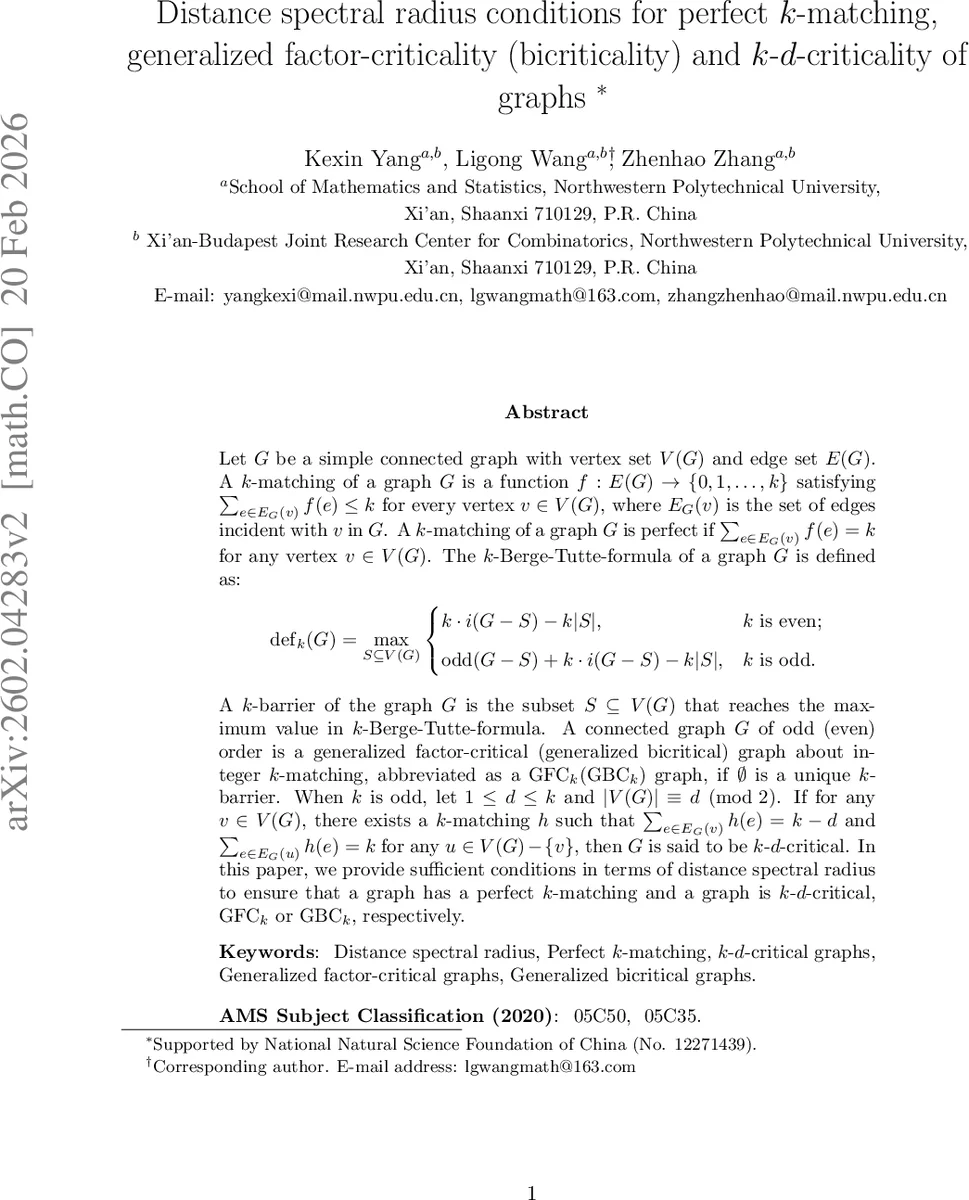
Let $G$ be a simple connected graph with vertex set $V(G)$ and edge set $E(G)$. A $k$-matching of a graph $G$ is a function $f:E(G)\rightarrow {0,1,\ldots, k}$ satisfying $\sum_{e \in E_G(v)} f(e) \leq k$ for every vertex $v \in V(G)$, where $E_G(v)$ is the set of edges incident with $v$ in $G$. A $k$-matching of a graph $G$ is perfect if $ \sum_{e \in E_G(v) } f(e) = k $ for any vertex $v \in V(G)$. The $k$-Berge-Tutte-formula of a graph $G$ is defined as: [ \defk(G) = \max_{S \subseteq V(G)} \begin{cases} k \cdot i(G - S) - k|S|, & k \text{ is even;} \[6pt] \odd(G - S) + k \cdot i(G - S) - k|S|, & k \text{ is odd.} \end{cases} ] A $k$-barrier of the graph $G$ is the subset $S \subseteq V(G)$ that reaches the maximum value in $k$-Berge-Tutte-formula. A connected graph ( G ) of odd (even) order is a {generalized factor-critical (generalized bicritical) graph about integer ( k )-matching}, abbreviated as a ( \mathrm{GFC}k (\mathrm{GBC}k)) graph, if $\emptyset$ is a unique $k$-barrier. When $k$ is odd, let ( 1 \leq d \leq k ) and ( |V(G)| \equiv d \pmod{2} ). If for any ( v \in V(G) ), there exists a ( k )-matching ( h ) such that $\sum{e \in E_G(v)} h(e) = k - d$ {and} $\sum{e \in E_G(u)} h(e) = k$ for any ( u \in V(G) - {v} ), then ( G ) is said to be ( k )-( d )-critical. In this paper, we provide sufficient conditions in terms of distance spectral radius to ensure that a graph has a perfect $k$-matching and a graph is ( k )-( d )-critical, $\mathrm{GFC}_k$ or $\mathrm{GBC}_k$, respectively.
💡 Research Summary
This paper investigates the existence of perfect k‑matchings and several generalized criticality properties of graphs by means of the distance spectral radius, i.e., the largest eigenvalue of the distance matrix. After recalling basic notions—distance matrix, distance spectral radius, k‑matching, and the k‑Berge–Tutte formula—the authors establish a series of sufficient conditions that compare a given graph’s distance spectral radius with that of certain extremal graphs.
The central tool is the equitable partition technique: by partitioning the vertex set into a few classes, the distance matrix can be reduced to a small quotient matrix whose eigenvalues are also eigenvalues of the original matrix (Lemma 2.1). This reduction makes it possible to compute or bound the distance spectral radius of the candidate extremal graphs explicitly. Lemma 2.2 (edge deletion increases the distance spectral radius) and Lemma 2.3 (the k‑Berge–Tutte condition characterizing perfect k‑matchings) are then combined to translate spectral inequalities into combinatorial guarantees.
The main results are as follows.
-
Theorem 1.1 (perfect k‑matching). For odd k and a connected graph G of even order n ≥ 6, if
λ₁(D(G)) ≤ λ₁(D(Sₙ,ₙ/2−1)) for 6 ≤ n ≤ 8, or
λ₁(D(G)) ≤ λ₁(D(G*)) for n ≥ 10,
where Sₙ,ₙ/2−1 = K_{n/2−1} ∨ (n−n/2+1)K₁ and G* = K₁ ∨ (K_{n−3} ∪ 2K₁), then G possesses a perfect k‑matching, unless G is isomorphic to the corresponding extremal graph. -
Theorem 1.2 (k‑d‑critical graphs, k odd). For odd k, 1 ≤ d < k, and n ≡ d (mod 2), the condition
λ₁(D(G)) ≤ λ₁(D(K₁ ∨ (K_{n−2} ∪ K₁)))
ensures that G is k‑d‑critical for all odd n ≥ 3 and for even n ≥ 10 (except the extremal join graph). For small even n (4 ≤ n ≤ 8) the bound with Sₙ,ₙ/2 replaces the join graph. -
Theorem 1.3 and Theorem 1.4 specialize Theorem 1.2 to d = 1 (generalized factor‑critical, GFCₖ) and d = 2 (generalized bicritical, GBCₖ), respectively, yielding identical spectral thresholds.
-
Theorem 1.5 (even k). When k is even, the same distance spectral bound guarantees both GFCₖ (for odd n) and GBCₖ (for even n ≥ 10).
The proofs proceed in two stages. First, the authors construct equitable partitions for the extremal graphs and for the general family K_s ∨ (K_{n−2s} ∪ sK₁). By analyzing the characteristic polynomials of the resulting 3 × 3 quotient matrices, they show that the join graph K₁ ∨ (K_{n−2} ∪ K₁) has the smallest distance spectral radius among all such families (Lemma 2.8). Second, they substitute the obtained spectral inequality into the k‑Berge–Tutte condition (Lemma 2.3) and the characterizations of GFCₖ, GBCₖ, and k‑d‑critical graphs (Lemmas 2.4 and 2.5). Lemma 2.2 guarantees that any proper spanning subgraph would have a larger spectral radius, confirming the extremality of the chosen comparison graphs.
The paper situates its contributions within a line of work that previously used adjacency or A_α spectra to obtain matching conditions (Brouwer–Haemers 2005; O 2015; Zhang–Lin 2020). By focusing on the distance matrix, the authors extend these ideas to the broader setting of k‑matchings and generalized criticality.
While the results are strong enough to be tight for the identified extremal graphs, they are only sufficient; necessary spectral conditions remain open. Moreover, the analysis is confined to the specific extremal families Sₙ,ₙ/2−1, K₁ ∨ (K_{n−3} ∪ 2K₁), and K₁ ∨ (K_{n−2} ∪ K₁). Extending the methodology to other graph classes (trees, planar graphs) or to other distance‑based matrices (distance Laplacian, signless distance Laplacian) constitutes a promising direction for future research.
In summary, the paper provides a clear and technically sound set of distance‑spectral‑radius criteria guaranteeing perfect k‑matchings, k‑d‑criticality, and generalized factor‑/bicriticality, thereby enriching the interplay between spectral graph theory and matching theory.
Comments & Academic Discussion
Loading comments...
Leave a Comment