Burau representation, Squier's form, and non-Abelian anyons
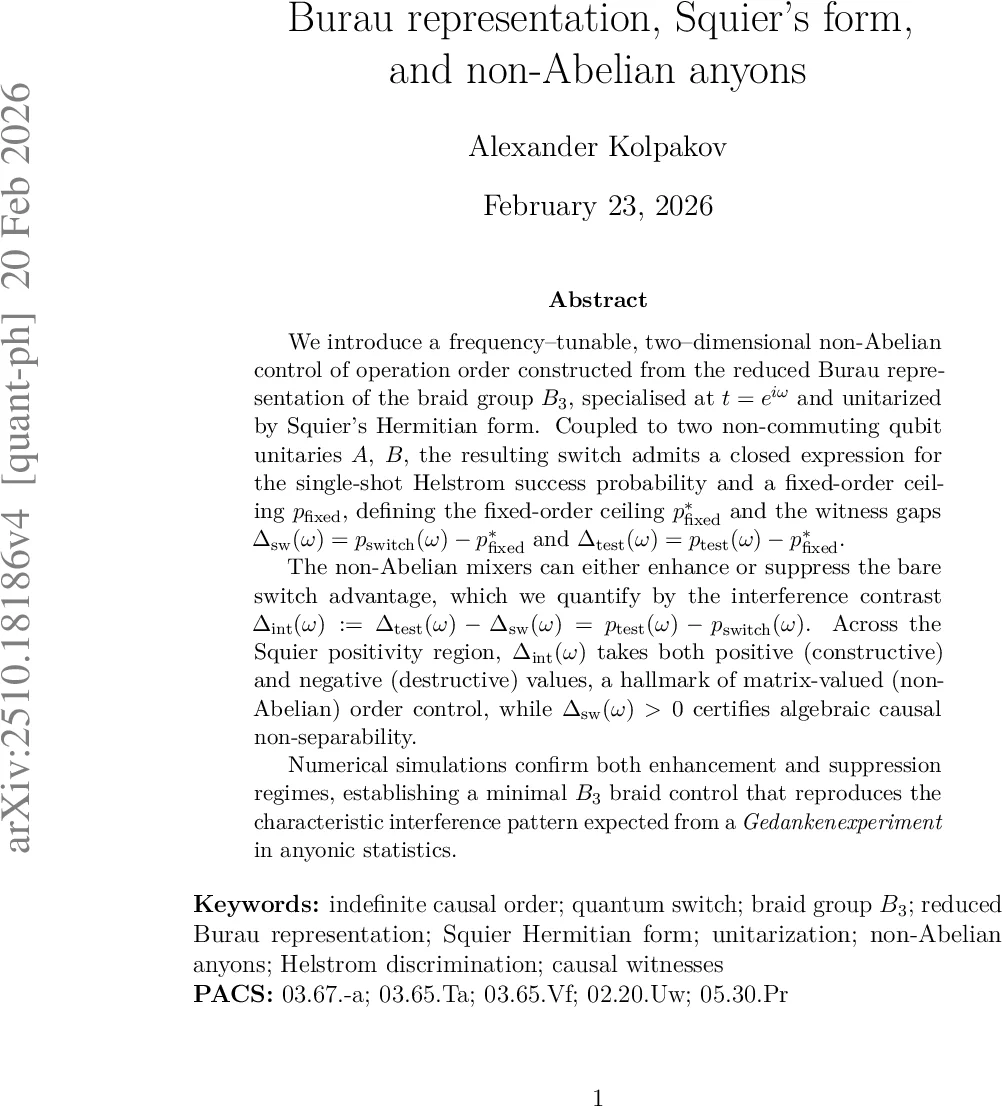
We introduce a frequency-tunable, two-dimensional non-Abelian control of operation order constructed from the reduced Burau representation of the braid group $B_3$, specialised at $t=e^{iω}$ and unitarized by Squier’s Hermitian form. Coupled to two non-commuting qubit unitaries $A$, $B$, the resulting switch admits a closed expression for the single-shot Helstrom success probability and a fixed-order ceiling $p_{\mathrm{fixed}}$, defining the fixed-order ceiling $p_{\mathrm{fixed}}^$ and the witness gaps $Δ_{\rm sw}(ω)=p_{\mathrm{switch}}(ω)-p_{\mathrm{fixed}}^$ and $Δ_{\rm test}(ω)=p_{\mathrm{test}}(ω)-p_{\mathrm{fixed}}^*$. The non-Abelian mixers can either enhance or suppress the bare switch advantage, which we quantify by the interference contrast $Δ_{\rm int}(ω):=Δ_{\rm test}(ω)-Δ_{\rm sw}(ω)=p_{\rm test}(ω)-p_{\rm switch}(ω)$. Across the Squier positivity region, $Δ_{\rm int}(ω)$ takes both positive (constructive) and negative (destructive) values, a hallmark of matrix-valued (non-Abelian) order control, while $Δ_{\rm sw}(ω)>0$ certifies algebraic causal non-separability. Numerical simulations confirm both enhancement and suppression regimes, establishing a minimal $B_3$ braid control that reproduces the characteristic interference pattern expected from a \emph{Gedankenexperiment} in anyonic statistics.
💡 Research Summary
The paper introduces a novel way to achieve indefinite causal order (ICO) using the smallest non‑abelian braid group, B₃. Starting from the reduced Burau representation ψ of B₃, the authors specialize the parameter t to e^{iω} and apply Squier’s Hermitian form J(ω) to turn the representation into a J‑unitary one. When J(ω) is positive definite—i.e., for ω in the open intervals (0, 2π/3) and (4π/3, 2π)—they perform a Cholesky decomposition J(ω)=R(ω)†R(ω) and conjugate the Squier matrices to obtain ordinary unitary 2×2 control operators U(ω). These unitaries act on a two‑dimensional control qubit, while two non‑commuting target unitaries A and B (chosen as simple SU(2) rotations) act on a separate data qubit.
The basic quantum switch is defined as S(θ)=|0⟩⟨0|⊗BA+e^{iθ}|1⟩⟨1|⊗AB, with the phase θ set equal to ω. Pre‑ and post‑mixers M_pre(ω) and M_post(ω) are constructed from possibly different braid words, yielding the full test device T(ω)=M_post⊗I·S(θ(ω))·M_pre⊗I. The performance of S(θ) and T(ω) is evaluated using single‑shot binary discrimination with equal priors. By applying Helstrom’s bound for two unitaries, the optimal success probability is p* =½
Comments & Academic Discussion
Loading comments...
Leave a Comment