Bumblebee Gravity -- Lessons from Perturbation Theory
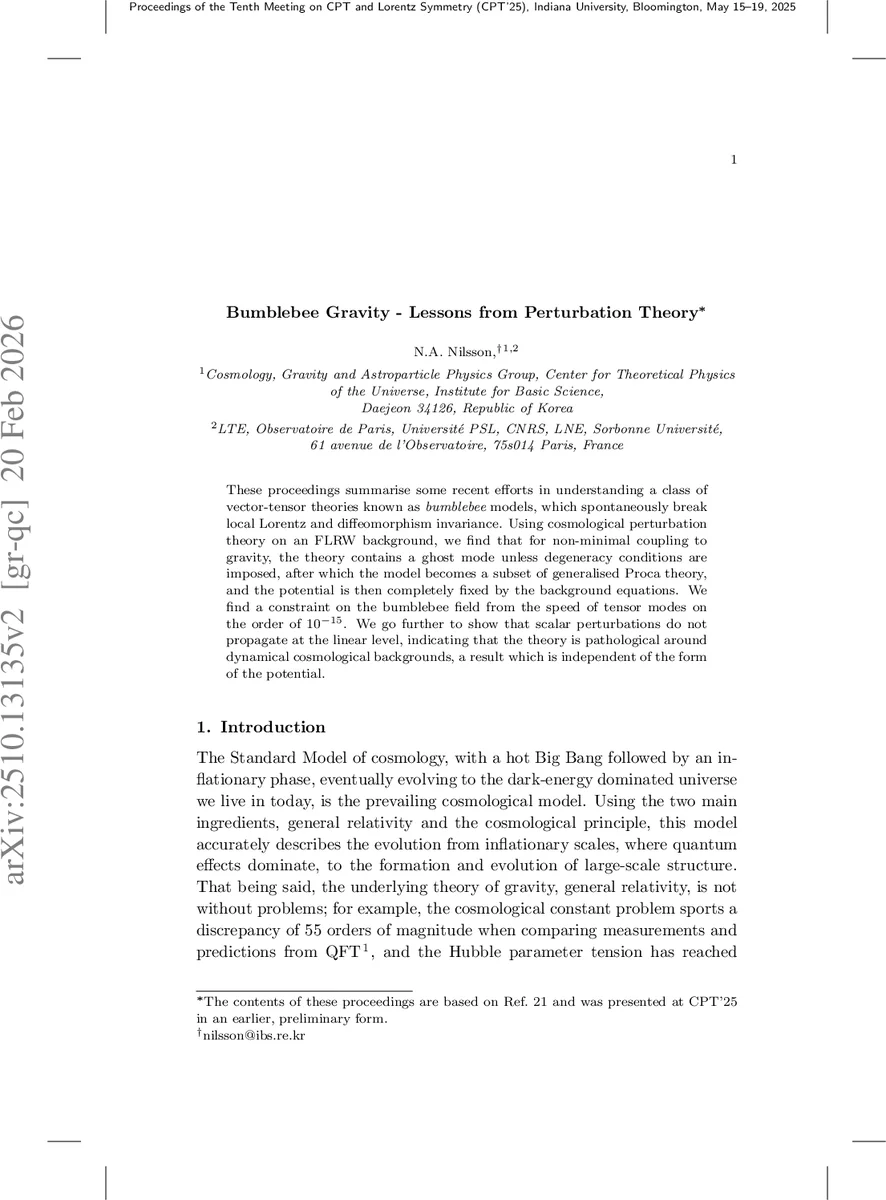
These proceedings summarise some recent efforts in understanding a class of vector-tensor theories known as {\it bumblebee} models, which spontaneously break local Lorentz and diffeomorphism invariance. Using cosmological perturbation theory on an FLRW background, we find that for non-minimal coupling to gravity, the theory contains a ghost mode unless degeneracy conditions are imposed, after which the model becomes a subset of generalised Proca theory, and the potential is then completely fixed by the background equations. We find a constraint on the bumblebee field from the speed of tensor modes on the order of $10^{-15}$. We go further to show that scalar perturbations do not propagate at the linear level, indicating that the theory is pathological around dynamical cosmological backgrounds, a result which is independent of the form of the potential.
💡 Research Summary
This paper investigates the cosmological dynamics and perturbative stability of the most general “bumblebee” vector‑tensor theory, a class of models in which a vector field acquires a vacuum expectation value and spontaneously breaks local Lorentz and diffeomorphism invariance. The authors start from the action (1) that contains the Einstein–Hilbert term, a Maxwell‑type kinetic term for the bumblebee field, a generic potential V(B²) that triggers symmetry breaking, and a set of non‑minimal couplings to curvature: η B²∇·B, ξ B^μB^νR_{μν}, σ B²R, ς(∇·B)² and υ ∇·B R. All coupling constants are taken to be dimensionless.
Working on a spatially flat Friedmann‑Lemaître‑Robertson‑Walker (FLRW) background with a timelike background vector ⟨B^μ⟩={\bar B_0(t),0,0,0}, the authors derive modified Friedmann equations (4) and a constraint equation for the background vector (5). The presence of the non‑minimal couplings ξ, σ and υ modifies the usual Hubble evolution and ties the dynamics of the scale factor to the evolution of \bar B_0.
The core of the work is a systematic linear perturbation analysis. The metric is decomposed in ADM form and the bumblebee perturbations are split into scalar (α, β, δB_0, δB_s), vector (divergenceless) and tensor (h_{ij}) sectors.
For tensor modes the quadratic action (9) yields a kinetic coefficient K_T and a propagation speed c_T² given in (10). In the small‑coupling limit c_T²≈1+2ξ\tilde B_0², where \tilde B_0≡\bar B_0/M_Pl. Using the multimessenger bound from GW170817/GRB170817A (|c_T−1|≲10⁻¹⁵) the authors infer ξ\tilde B_0²≈10⁻¹⁵, confirming that the non‑minimal coupling must be extremely weak.
Scalar perturbations are more subtle. Because the coupling υ multiplies a term (∇·B)R, the quadratic action contains second‑time‑derivative pieces (¨α, ¨δB_0). This leads to a 4×4 kinetic (Hessian) matrix K_4 whose rank can be as high as three, signalling an extra Ostrogradsky‑type ghost unless υ is set to zero. Imposing υ=0 reduces the rank to two, but still leaves two propagating scalar degrees of freedom. The authors then explore further degeneracy conditions. By requiring ξ+2σ=0 and ς=0 the kinetic matrix collapses to rank one, leaving a single scalar mode. These conditions are precisely the known degeneracy relations that define the healthy sector of generalized Proca theories.
When the degeneracy conditions (19) are enforced, the bumblebee model becomes a subset of generalized Proca with the identifications G_2=−¼B_{μν}B^{μν}−V(−2X), G_3=−2ηX, G_4=M_Pl²+ξX, where X=−½B_μB^μ. The background equations then integrate analytically, yielding a de Sitter‑like solution with Hubble constant H_dS and a potential that is no longer arbitrary but fixed by the background values (21).
Crucially, after imposing the degeneracy conditions the scalar quadratic action simplifies to (22). The kinetic coefficient K vanishes identically, meaning that the remaining scalar perturbation does not propagate at linear order, regardless of the shape of V. This result is independent of the potential and signals a pathology: the theory cannot support dynamical scalar fluctuations on a time‑dependent cosmological background.
The paper concludes with three main points: (1) the generic bumblebee model contains a higher‑derivative ghost unless the degeneracy conditions ξ+2σ=0 and ς=0 are imposed; (2) under these conditions the model is ghost‑free, maps onto a restricted sector of generalized Proca, and the potential is uniquely determined by the cosmological background; (3) however, the scalar mode is non‑propagating at linear order, rendering the theory pathological for realistic, dynamical cosmologies. The authors suggest that additional mechanisms (non‑linear effects, extra fields, or alternative symmetry‑breaking patterns) would be required to rescue the model’s viability.
Overall, the work provides a clear and rigorous assessment of bumblebee gravity in a cosmological setting, identifies the precise parameter subspace that avoids ghosts, and highlights a fundamental limitation concerning scalar dynamics that must be addressed in future extensions.
Comments & Academic Discussion
Loading comments...
Leave a Comment