Outliers for deformed inhomogeneous random matrices
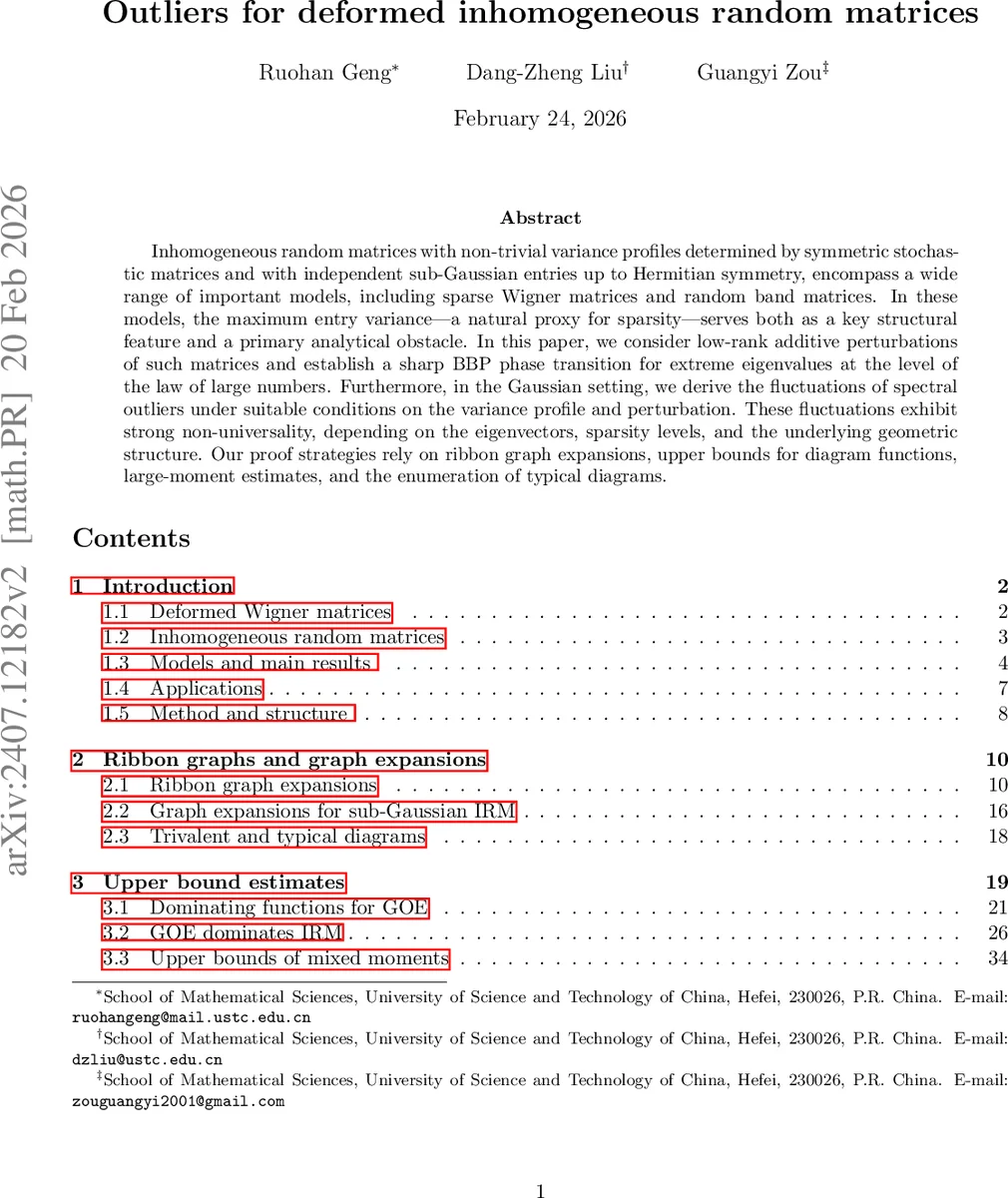
Inhomogeneous random matrices with non-trivial variance profiles determined by symmetric stochastic matrices and with independent sub-Gaussian entries up to Hermitian symmetry, encompass a wide range of important models, including sparse Wigner matrices and random band matrices. In these models, the maximum entry variance-a natural proxy for sparsity-serves both as a key structural feature and a primary analytical obstacle. In this paper, we consider low-rank additive perturbations of such matrices and establish a sharp BBP phase transition for extreme eigenvalues at the level of the law of large numbers. Furthermore, in the Gaussian setting, we derive the fluctuations of spectral outliers under suitable conditions on the variance profile and perturbation. These fluctuations exhibit strong non-universality, depending on the eigenvectors, sparsity levels, and the underlying geometric structure. Our proof strategies rely on ribbon graph expansions, upper bounds for diagram functions, large-moment estimates, and the enumeration of typical diagrams.
💡 Research Summary
The paper studies additive low‑rank deformations of inhomogeneous random matrices (IRMs), i.e., symmetric or Hermitian matrices whose entries are independent sub‑Gaussian random variables multiplied entrywise by a deterministic variance profile Σ_N. The profile is assumed to be non‑negative and such that the matrix of squared entries P_N = (σ_{ij}^2) is stochastic (each row sums to one). The maximal entry variance σ*N = max{i,j} σ_{ij} serves as a sparsity parameter: when σ*_N → 0 the matrix becomes increasingly sparse.
The authors address two fundamental questions: (1) under what sparsity condition does a Baik‑Ben‑Arous‑Péché (BBP) phase transition occur for the extreme eigenvalues of the deformed matrix X_N = H_N + A_N, where A_N is a deterministic rank‑r perturbation; (2) what are the limiting fluctuation laws of the outlier eigenvalues under the same sparsity regime?
Main results
Theorem 1.2 (BBP transition at the law‑of‑large‑numbers level).
Assume the non‑zero eigenvalues of A_N are a_1 ≥ a_2 ≥ … ≥ a_r, independent of N, and that (r + 1) σ*N √log N → 0 as N → ∞. Then for any fixed positive integer j, the j‑th largest eigenvalue λ_j(X_N) converges almost surely to
2 if a_j ≤ 1 (sub‑critical regime),
ρ{a_j}=a_j+1/a_j if a_j > 1 (super‑critical regime).
A symmetric statement holds for the lower edge. This shows that the classical BBP critical value a_c = 1 persists for IRMs, but the sparsity condition σ*_N √log N → 0 is required to prevent outliers from appearing in the unperturbed ensemble H_N.
Theorem 1.3 (Fluctuations of outliers in the Gaussian case).
When the underlying Wigner matrix is Gaussian (GOE/GUE) and the top q eigenvalues of A_N are equal to a > 1 (a_1=…=a_q=a > a_{q+1}≥…≥a_r), and σ*N log N → 0, the rescaled outliers
a²(a²−1) σ*N (λ_i(X_N)−ρ_a), i=1,…,q,
converge in distribution to the ordered eigenvalues of a q × q random matrix
Z_β = Q_β (H_ID + H_Gaussian + H_Diag) Q_β^.
Here Q_β is the q × r matrix formed by the first q rows of the eigenvector matrix U of A_N (A_N = U diag(a_1,…,a_r) U^). The three independent r × r components are:
– H_ID, a deterministic Gaussian matrix with entries σ{m_i,m_j} W{m_i,m_j};
– H_Gaussian, a centered Gaussian matrix with covariance √g_{ij}, where g_{ij} encodes the limiting interaction of the variance profile and the perturbation indices;
– H_Diag, a diagonal Gaussian matrix whose i‑th variance is τ_i − χ_i, with χ_i and τ_i defined as limits involving fourth moments of the underlying Wigner entries and the profile σ.
Thus the fluctuation law is highly non‑universal: it depends on the detailed geometry of the variance profile, on the eigenvectors of the perturbation, and on the sparsity scale σ*_N.
Proof strategy
The analysis relies on a sophisticated ribbon‑graph expansion of high moments Tr X_N^k. Each term corresponds to a diagram (a multigraph with ribbons) whose contribution is captured by a diagram function. The authors classify diagrams into “typical” (dominant) and “atypical” (negligible) families. By establishing sharp upper bounds for diagram functions of typical diagrams, they control the leading contributions to the moments. A key technical tool is a dominance result showing that the Gaussian orthogonal/unitary ensemble (GOE/GUE) bounds the moments of the general IRM, allowing transfer of estimates from the well‑understood Gaussian case. Large‑moment estimates together with concentration inequalities yield the almost‑sure convergence of the extreme eigenvalues under the sparsity condition σ*_N √log N → 0. For the fluctuation theorem, a second‑order expansion of the resolvent combined with a central limit theorem for the diagrammatic contributions leads to the explicit random matrix Z_β.
Context and novelty
Previous BBP results were confined to mean‑field models where all variances are of the same order. Recent work (e.g., Bandeira‑Cipolloni‑Schröder‑van Handel 2024) obtained a BBP transition for IRMs under a stronger sparsity condition σ*_N (log N)^2 → 0, but did not address fluctuations. This paper improves the sparsity threshold to σ*_N √log N → 0, proves the LLN‑level BBP transition, and, crucially, derives the full fluctuation law for outliers in the Gaussian setting, revealing a rich non‑universal structure.
Applications
The framework covers random band matrices in any dimension, sparse Wigner matrices arising from d‑regular graphs, and other structured ensembles used in signal processing, statistical inference, and network science. The results give precise detection thresholds for low‑rank signals (spikes) embedded in highly heterogeneous noise, and quantify how sparsity and geometry affect both the location and the variability of the detected eigenvalues.
Future directions
The authors note that extending the fluctuation result to general sub‑Gaussian entries (beyond Gaussian) and relaxing the σ*_N log N → 0 condition are natural next steps. Moreover, handling larger rank perturbations (r growing with N) and incorporating additional structural parameters such as bandwidth or spatial dimension for random band matrices remain open challenges.
In summary, the paper delivers a comprehensive treatment of BBP phase transitions and outlier fluctuations for deformed inhomogeneous random matrices, introducing ribbon‑graph techniques and diagrammatic bounds that bridge sparsity, variance profiles, and low‑rank perturbations, thereby advancing both the theory of random matrices and its applications to high‑dimensional data analysis.
Comments & Academic Discussion
Loading comments...
Leave a Comment