Pseudo-deterministic Quantum Algorithms
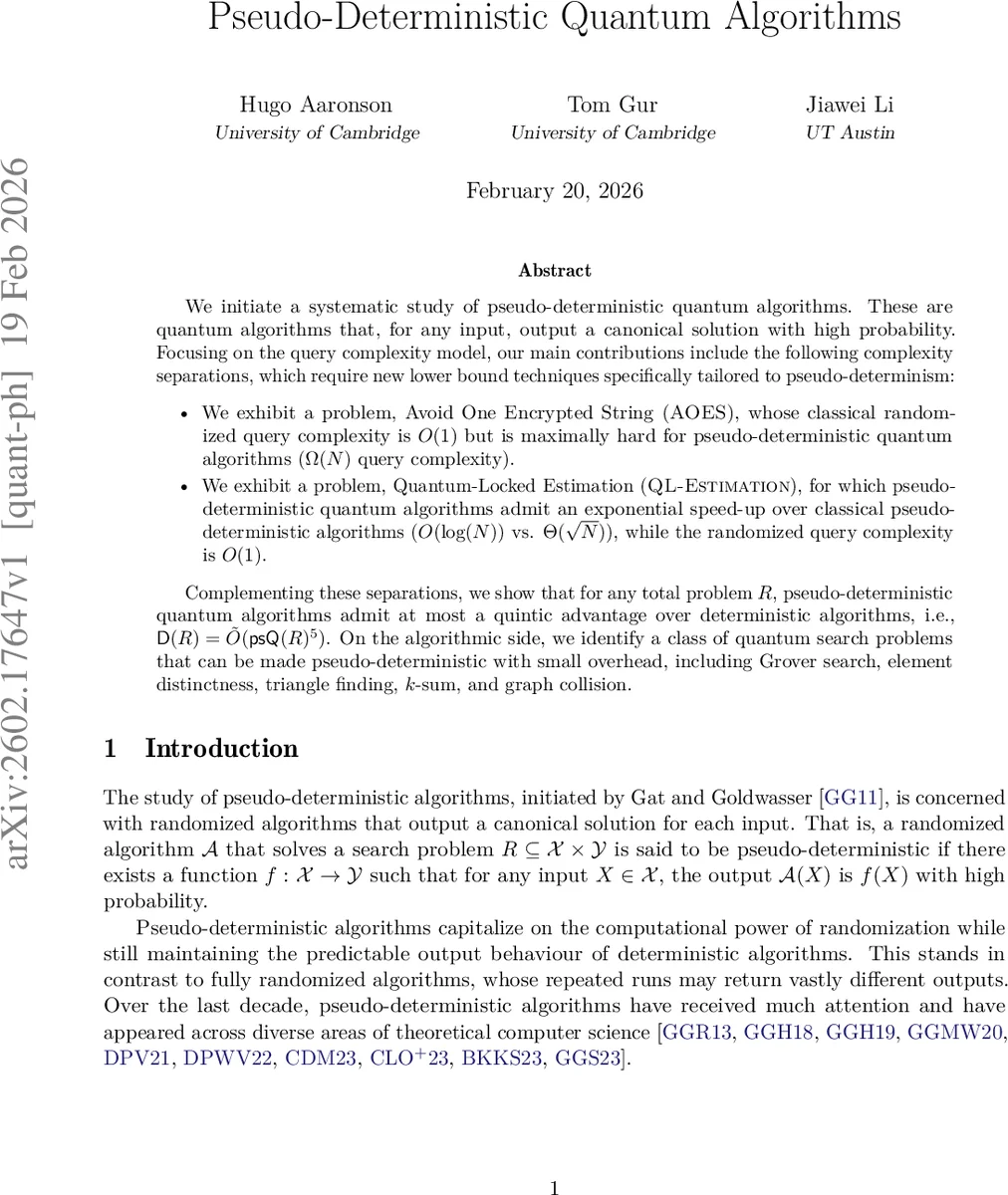
We initiate a systematic study of pseudo-deterministic quantum algorithms. These are quantum algorithms that, for any input, output a canonical solution with high probability. Focusing on the query complexity model, our main contributions include the following complexity separations, which require new lower bound techniques specifically tailored to pseudo-determinism: - We exhibit a problem, Avoid One Encrypted String (AOES), whose classical randomized query complexity is $O(1)$ but is maximally hard for pseudo-deterministic quantum algorithms ($Ω(N)$ query complexity). - We exhibit a problem, Quantum-Locked Estimation (QL-Estimation), for which pseudo-deterministic quantum algorithms admit an exponential speed-up over classical pseudo-deterministic algorithms ($O(\log(N))$ vs. $Θ(\sqrt{N})$), while the randomized query complexity is $O(1)$. Complementing these separations, we show that for any total problem $R$, pseudo-deterministic quantum algorithms admit at most a quintic advantage over deterministic algorithms, i.e., $D(R) = \tilde O(psQ(R)^5)$. On the algorithmic side, we identify a class of quantum search problems that can be made pseudo-deterministic with small overhead, including Grover search, element distinctness, triangle finding, $k$-sum, and graph collision.
💡 Research Summary
This paper initiates a systematic study of pseudo‑deterministic quantum algorithms, focusing on the query‑complexity model. A pseudo‑deterministic algorithm is a randomized algorithm that, for each input, outputs a canonical solution with high probability. While this notion has been explored extensively in classical settings, its quantum counterpart raises new questions because measurement inherently introduces randomness. The authors investigate the power and limitations of pseudo‑deterministic quantum algorithms, establishing several separations and upper bounds that illuminate when quantum advantage can be preserved under the pseudo‑deterministic requirement.
Main Results
-
Maximal Separation (AOES).
The authors define the “Avoid One Encrypted String” (AOES) problem. The input consists of m parallel X‑OR instances that collectively encrypt an m‑bit secret string b. The task is to output any m‑bit string different from b. A classical randomized algorithm can succeed with constant probability by simply sampling a random string, requiring O(1) queries. However, any pseudo‑deterministic quantum algorithm must consistently avoid b across runs, forcing it to learn at least one bit of b. Since X‑OR is known to be hard for quantum query algorithms (no algorithm can beat random guessing with fewer than n/2 queries), the authors prove a randomized reduction from X‑OR to AOES. Consequently, any zero‑error quantum algorithm for AOES would yield a quantum algorithm for X‑OR with advantage >½, contradicting the known lower bound. By amplifying the success probability of a pseudo‑deterministic algorithm via O(m) repetitions, they obtain a final lower bound of Ω(N) quantum queries for AOES. This yields the strongest possible gap between classical randomized query complexity (O(1)) and pseudo‑deterministic quantum query complexity (Ω(N)). -
Exponential Advantage (QL‑Estimation).
The second construction, “Quantum‑Locked Estimation” (QL‑Estimation), combines Simon’s problem with a Hamming‑weight estimation task. Input is a pair (f, X) where f hides a secret string s (Simon) and X is an N‑bit string whose Hamming weight must be estimated within additive N/10. A classical pseudo‑deterministic algorithm needs Θ(√N) queries because it must solve the Simon component, which requires Ω(√N) quantum queries even in the standard (non‑pseudo‑deterministic) setting. The authors design a quantum pseudo‑deterministic algorithm that first uses quantum Fourier sampling to recover s in O(log N) queries, then estimates the Hamming weight using a few classical samples. Crucially, they introduce the notion of “canonization”: the quantum algorithm stabilizes a solution that a randomized algorithm would output with high probability, turning it into a fixed canonical output. Thus the quantum algorithm achieves O(log N) queries, while any classical pseudo‑deterministic algorithm still needs Ω(√N), establishing an exponential separation. -
Upper Bound for Total Problems.
For any total search problem R (i.e., the relation is defined for every input), the paper proves D(R) = O(psQ(R)^5 log N). This shows that pseudo‑deterministic quantum algorithms cannot provide more than a quintic speed‑up over deterministic algorithms on total problems. The proof adapts the classical argument of GGR13 but requires a new lemma that bounds the number of possible outputs of a pseudo‑deterministic quantum algorithm—a non‑trivial step because quantum algorithms can produce superpositions of many outputs. -
General Upper Bound via Find1 Completeness.
Building on the earlier work of GIPS21, which showed that the Find1 problem is complete for pseudo‑deterministic classical query complexity, the authors extend this completeness to the quantum setting. Since psQ(Find1) = Θ(√N), they derive a generic upper bound: for any search problem R with randomized query complexity R(R) and verification complexity V(R),
psQ(R) = O((R(R) + V(R))·√N).
This indicates that achieving pseudo‑deterministic quantum query complexity beyond √N requires either a high randomized query complexity or a verification task that is intrinsically hard. -
Making Quantum Search Problems Pseudo‑Deterministic.
The paper identifies a broad class of k‑subset finding problems (including element distinctness, triangle finding, k‑sum, and graph collision) that satisfy a “prunable” condition: restricting the search domain does not increase the quantum query cost. For any prunable problem, they show psQ(R) = ˜O(k·Q(R)), meaning that a pseudo‑deterministic version can be obtained with only a near‑linear overhead in k. The technique generalizes the binary‑search‑plus‑Grover trick used for Find1, applying it to any algorithm that can be expressed as a sequence of quantum subroutines whose domains can be narrowed iteratively. -
Beyond the Query Model.
The authors also explore two extensions. First, they consider search problems where the input is a quantum state; they prove that if the input space is a connected continuous manifold, no pseudo‑deterministic algorithm exists. They then study “Uniform‑Support‑Finding,” the task of finding a computational‑basis element in the support of a uniform superposition over a d‑dimensional subspace, showing Θ(d) query complexity. Second, in the white‑box (Turing‑machine) setting, they prove a characterization: a search problem admits a pseudo‑deterministic quantum polynomial‑time algorithm iff it is P‑reducible to some BQP decision problem. This mirrors the classical result of GGR13 and indicates that any pseudo‑deterministic quantum advantage ultimately stems from an underlying decision‑problem advantage in BQP.
Techniques
- Randomized Reductions: To lower‑bound pseudo‑deterministic quantum algorithms, the authors construct reductions that embed a hard quantum problem (e.g., X‑OR, Simon) into a larger instance of the target problem, while preserving the requirement that the solver must avoid a specific output.
- Canonization: A formal definition that captures the process of turning a high‑probability randomized solution into a fixed canonical output. This concept is crucial for demonstrating that quantum speed‑ups can be retained under the pseudo‑deterministic constraint.
- Output‑Count Lemma (Lemma 3.1): Provides a bound on the number of distinct outputs a pseudo‑deterministic quantum algorithm can produce, enabling the quintic upper‑bound proof for total problems.
- Prunable Framework: Introduces a structural condition on search problems that allows binary‑search‑style narrowing of the domain without increasing quantum query cost, leading to efficient pseudo‑deterministic versions of many known quantum algorithms.
Implications
The work clarifies that quantum speed‑ups are not automatically compatible with the desire for deterministic‑like outputs. In some cases (AOES) the pseudo‑deterministic requirement destroys the quantum advantage entirely, while in others (QL‑Estimation) the advantage persists and even becomes exponential. The quintic upper bound suggests that for total problems, quantum pseudo‑determinism cannot yield super‑polynomial speed‑ups, aligning with intuition that total functions are less amenable to quantum miracles. The identification of a broad class of searchable problems that can be made pseudo‑deterministic with modest overhead expands the practical relevance of the model, as many algorithmic tasks (search, collision detection, subgraph finding) fall into this category.
Finally, the white‑box characterization ties pseudo‑deterministic quantum algorithms to the well‑studied class BQP, indicating that any meaningful advantage must be rooted in a decision‑problem speed‑up. This bridges the gap between search‑to‑decision reductions in classical complexity and their quantum analogues, providing a unified perspective on when and how quantum computers can deliver reliable, canonical solutions.
Overall, the paper establishes foundational results, introduces novel proof techniques, and opens several avenues for future work, including tighter lower bounds for specific problems, extensions to interactive or streaming models, and the development of error‑robust pseudo‑deterministic quantum protocols for cryptographic applications.
Comments & Academic Discussion
Loading comments...
Leave a Comment