On Sets of Monochromatic Objects in Bicolored Point Sets
Let $P$ be a set of $n$ points in the plane, not all on a line, each colored \emph{red} or \emph{blue}. The classical Motzkin--Rabin theorem guarantees the existence of a \emph{monochromatic} line. Motivated by the seminal work of Green and Tao (2013…
Authors: Sujoy Bhore, Konrad Swanepoel
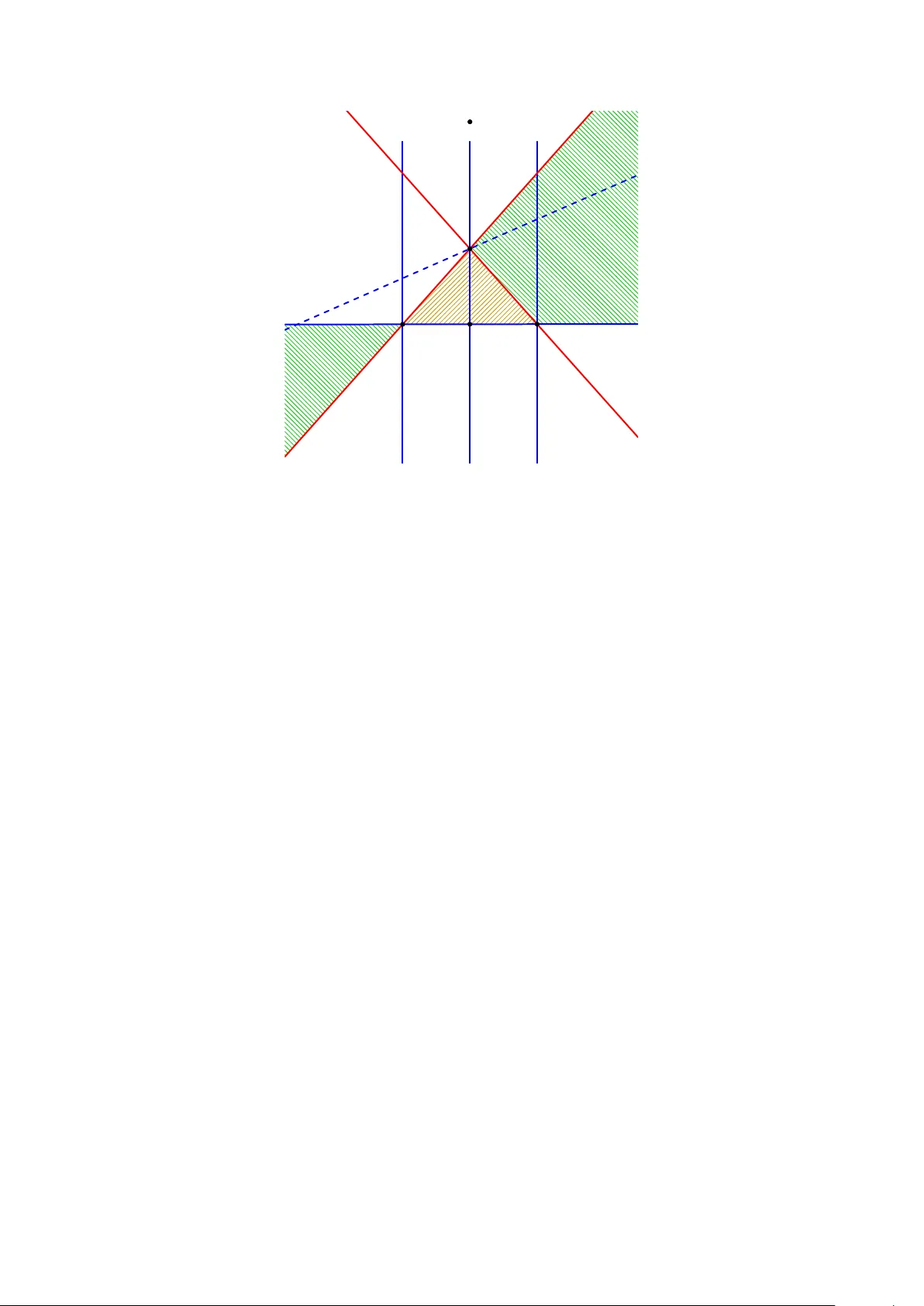
On Sets of Monochromatic Objects in Bicolored Point Sets Sujoy Bhore ∗ Konrad Swanepoel † Abstract Let 𝑃 be a set of 𝑛 points in the plane, not all on a line, each colored r ed or blue . The classical Motzkin–Rabin theorem guarantees the existence of a monochromatic line. Motivated by the seminal work of Green and T ao (2013) on the Sylvester-Gallai theorem, w e investigate the quantitative and structural properties of monochromatic geometric objects, such as lines, circles, and conics. W e rst show that if no line contains more than three points, then for all suciently large 𝑛 there are at least 𝑛 2 / 24 − 𝑂 ( 1 ) monochromatic lines. W e then show a converse of a the orem of Jamison (1986): Given 𝑛 ≥ 6 blue points and 𝑛 red points, if the blue p oints lie on a conic and every line through two blue points contains a red point, then all red points are collinear . W e also settle the smallest nontrivial case of a conje cture of Milićević (2018) by showing that if we have 5 blue p oints with no three collinear and 5 red points, if the blue points lie on a conic and every line through two blue points contains a red p oint, then all 10 p oints lie on a cubic cur ve. Further , w e analyze the random setting and show that, for any non-collinear set of 𝑛 ≥ 10 points independently colored red or blue, the expected number of monochromatic lines is minimized by the near-pencil conguration. Finally , we examine mono chromatic cir cles and conics, and e xhibit sev eral natural families in which no such monochromatic objects exist. 1 Introduction Incidence problems lie at the heart of combinatorial ge ometry , which fundamentally studies how points and lines in the plane relate to one another . Among its earliest and most inuential results is the Sylvester–Gallai theorem , proved by Gallai [ Gal44 ], by r esolving a question posed nearly forty years earlier by Sylvester [ Syl93 ] in 1893. Theorem 1.1 (Sylvester–Gallai theorem) . Suppose that 𝑃 is a nite set of points in the plane, not all on one line. Then there exists an ordinar y line spanned by 𝑃 , i.e., a line containing exactly two p oints of 𝑃 . Several elegant proofs of the Sylv ester–Gallai theorem ar e known. For instance, Melchior’s classical proof [ Mel41 ], based on projective duality and Euler’s formula, shows that every non-collinear set of 𝑛 points spans at least three ordinar y lines. Subse quent work focused on obtaining stronger quantitative bounds: Motzkin [ Mot51 ] established a lower bound of order √ 𝑛 ; K elly and Moser [ KM58 ] impro ved this to 3 𝑛 / 7 ; and Csima and Sawyer [ CS93 ] further strengthened it to 6 𝑛 / 13 for 𝑛 > 7 , building on ideas of Hansen [ Han81 ]. Comprehensive discussions of these results appear in the sur veys of Borwein and Moser [ BM90 ], and Pach and Sharir [ PS09 ]. A major breakthrough came with the work of Gr een and T ao [ GT13 ], who prov ed that any suciently large non-collinear set of 𝑛 points in the plane determines at least 𝑛 / 2 ordinar y lines, which conrmed the long-standing Dirac–Motzkin conjecture for all large 𝑛 , and characterized all extremal congurations. ∗ Department of Computer Science, Indian Institute of T echnology Bombay , Mumbai, India. Email: sujoy@cse.iitb.ac.in † Department of Mathematics, London School of Economics, London, UK. Email: konrad.swanepoel@gmail.com 1 Colorful Sylvester–Gallai (Motzkin-Rabin Theorem). Given a nite conguration of p oints in the plane , it is natural to ask whether certain geometric or combinatorial properties ar e preserved under colorings of the points. In particular , one may consider a tw o-coloring of a nite, non-collinear set of points, say , coloring each p oint either red or blue , and ask whether the existence of an ordinar y line, as guaranteed by the Sylvester–Gallai the orem , can still be ensured in a colorful instance of the point set. That is, can we always nd an ordinar y line determine d by two p oints of one color? The answer to that question is negative, as can be seen from a simple example. Consider two intersecting lines ℓ 1 and ℓ 2 : place all red points on ℓ 1 , all blue points on ℓ 2 , and say the color of the intersection point of ℓ 1 and ℓ 2 is red. In this conguration, every line containing at least two p oints of one color also contains a further point; hence, no ordinary monochromatic line exists. This observation naturally leads to the following question: even if no ordinary mono chromatic line exists, must there always exist at least one line containing points of only one color? The following classical result, known as the Motzkin–Rabin theorem (see [ BM90 , EP96 ]), provides an armative answ er to this question and may be viewed as a natural colored analogue of the Sylvester–Gallai theorem. Theorem 1.2 (Motzkin–Rabin theorem) . Let 𝑆 be a nite, non-collinear set of p oints in the plane, each colored red or blue. Then there exists a line ℓ passing through at least two points of 𝑆 , all of which have the same color . There are tw o essentially dierent proofs of the Motzkin–Rabin theor em known in the literature , both established via the projective dual form of the statement. In the projective plane, the dual version asserts that for any nite nonconcurrent set of lines, each colored red or blue, there exists a p oint where all intersecting lines share the same color . The rst proof, due to Motzkin (see [ Grü99 ]) and publishe d in [ BM90 , EP96 ], is based on a minimal-area argument. The se cond proof, due to Chakerian [ Cha70 ] (see also [ EML80 ]), derives the result from a version of Cauchy’s lemma on planar graphs with colored edges, which itself follows essentially fr om Euler’s formula. Later , Pretorius and Swanepo el [ PS04 ] gav e an algorithmic proof for Motzkin–Rabin theorem (see also [ Cox48 ]). Motivated by the seminal work of Green and T ao [ GT13 ] and several other foundational stud- ies [ BGS74 , Mel41 , KM58 , vW07 , ENR00 , CS93 , CM68 ] (see also Section 6 ), we turn to structural questions related to the Motzkin–Rabin theorem. Although the colorful version of the Sylvester–Gallai pr oblem may appear quite dierent, espe cially in view of the discussion ab ove on ordinary lines, it is natural to ask whether similar combinatorial phenomena still occur . In particular , we ar e interested in understand- ing to what extend the geometric and algebraic structure that appears in the uncolored case continues to manifest in its colored counterpart. Given a nite set of red and blue points in the plane, do es there necessarily exist a large number of monochromatic lines? More generally , what happens if we replace lines with other geometric objects, such as circles or conics, and do similar phenomena p ersist? 1.1 Our Contributions In this work, w e provide a structural and quantitative understanding of the above question. As discussed earlier , without imposing any restriction on collinearities, one cannot hop e to obtain non-trivial lower bounds on the numb er of monochromatic lines. W e show that under the assumption that no line contains more than three p oints, e very two-colored set of 𝑛 points in the plane (not all on a line) determines at least 𝑛 2 / 24 − 𝑂 ( 1 ) monochromatic lines for all suciently large 𝑛 . Moreover , w e establish a matching structural characterization: if the numb er of monochromatic lines is at most 𝑛 2 / 24 + 𝐾 𝑛 , then, after adding or deleting only 𝑂 ( 𝐾 ) points, the set is contained in a coset of a nite subgroup of a cubic curve that is either smooth or acnodal. This yields a near-complete description of all near-e xtremal congurations (Theorem 2.2 ). 2 W e next establish a converse to an earlier theorem of Jamison [ Jam86 ], by showing that if 𝑛 ≥ 6 blue points lie on a conic and every line determined by two blue p oints contains a red p oint, then all red p oints must b e collinear (The orem 2.10 ). For the extremal case 𝑛 = 5 , we further prove that the same condition forces all 2 𝑛 points to lie on a cubic curve (Theorem 2.9 ), thereby resolving the smallest nontrivial case of a conjecture of Milićević [ Mil20 ]. T o the b est of our knowledge, this converse direction has not been previously examined. Next, in Theorem 3.1 , we show that if each point of a non-collinear set of 𝑛 ≥ 10 p oints is indepen- dently colored red or blue uniformly at random, then the conguration that minimizes the expected number of monochromatic lines is the near-pencil (that is, 𝑛 − 1 p oints on a line and one point o the line; see Figure 4 ). Already , in 1951, Motzkin [ Mot51 ] proved that for any nite set of p oints in the plane, not all lying on a line or a cir cle, determines an or dinary circle , namely , a circle incident to exactly three points of the set. Later , Elliott [ Ell67 ] proved in 1967 quadratic lower bound on the number of ordinary circles. One might expect an analogous phenomenon to hold in the monochromatic setting. Surprisingly , w e show that this intuition fails: there exists an innite family of congurations with neither color class contained in a circle or a line and with no mono chromatic circle. W e further demonstrate that a similar failure of ordinary monochromatic objects persists for conics as well. Sp ecically , we show that there exists an innite family of congurations with neither color class containe d in a conic and with no monochromatic conic. 2 Monochromatic Lines W e rst investigate how the assumption that at most 𝑘 points lie on any line ae cts the number of monochromatic lines in a set of 𝑛 points, each colored r ed or blue. If 𝑘 = 2 , then the number of monochromatic lines equals 𝑏 2 + 𝑟 2 , where 𝑏 is the number of blue points and 𝑟 the number of red points, and this is minimize d when 𝑏 and 𝑟 are equal. Thus, the rst non-trivial case is 𝑘 = 3 , for which we rst describe an example. Example 2.1. Consider any smo oth irreducible cubic cur ve 𝛾 in the projective plane. Note that no 4 points on 𝛾 are collinear . It is well known that there is a group ( 𝛾 , ⊕ ) such that three p oints of 𝛾 are collinear if and only if they sum to the identity in the group. This group contains nite subgroups isomorphic to Z 𝑛 for all 𝑛 . If 𝑛 is even, let the blue points be the p oints corresponding to { 0 , 2 , 4 , . . . , 𝑛 − 2 } , and the red points { 1 , 3 , 5 , . . . , 𝑛 − 1 } . Then the mono chromatic lines in this set of 𝑛 points will always be blue, and will correspond to the total number of lines spanned by the 𝑛 / 2 blue points, which can b e calculated as 𝑛 2 / 24 + 𝑛 / 4 − 𝑂 ( 1 ) . If we remove or add 𝑂 ( 𝐾 ) points to this example, then the number of monochromatic lines will be 𝑛 2 / 24 + 𝑂 ( 𝐾 𝑛 ) . In the following theorem, we obtain a lower bound that is tight up to an additiv e 𝑛 / 4 term compared to the example above. Theorem 2.2. In a set of 𝑛 points in the plane with at most 3 points on a line, and with each p oint colored red or blue, there are at least 𝑛 2 / 24 − 𝑂 ( 1 ) monochromatic lines if 𝑛 is suciently large. Furthermore, for each 𝐾 ≥ 1 there exists 𝑛 0 such that for all 𝑛 ≥ 𝑛 0 , if there are at most 𝑛 2 / 24 + 𝐾 𝑛 monochromatic lines then, up to adding or removing 𝑂 ( 𝐾 ) points, the set forms a coset of a nite subgroup of a cubic cur ve that is either smooth or acnodal. T o prove this theorem, rst we show the following general result on the number of monochromatic lines in abstract geometries with at most three points on a line . Then, we combine it with Green and T ao’s structure theorem for sets with few ordinary lines [ GT13 ] (Lemma 2.2 below), to obtain the result. An abstract ge ometry consists of a set of points together with a collection of subsets of the points, called lines, with the property that each line contains at least two points, and for any two points there is a unique line containing them. 3 Lemma 2.1. In an abstract geometr y with 𝑛 points and at most 3 points on each line, if the p oints are each colored red or blue, then the number of monochromatic lines is at least 𝑛 2 24 − 𝑛 6 + 𝑡 2 6 , where 𝑡 2 is the number of lines containing exactly 2 points. Proof. Let 𝑏 denote the number of blue p oints, 𝑟 the number of red p oints, and 𝑡 𝑖 , 𝑗 the number of lines containing 𝑖 blue points and 𝑗 red points, for each 𝑖 , 𝑗 ≥ 0 . Then 𝑏 + 𝑟 = 𝑛 , and by counting the numb er of pairs of blue points, the number of pairs of red p oints, and the number of blue-red pairs, we obtain 𝑏 2 = 3 𝑡 3 , 0 + 𝑡 2 , 1 + 𝑡 2 , 0 , (1) 𝑟 2 = 3 𝑡 0 , 3 + 𝑡 1 , 2 + 𝑡 0 , 2 , (2) 𝑏𝑟 = 2 𝑡 2 , 1 + 2 𝑡 1 , 2 + 𝑡 1 , 1 . (3) By eliminating 𝑡 2 , 1 and 𝑡 1 , 2 from ( 1 ), ( 2 ) and ( 3 ), we obtain that the number of monochromatic lines is 𝑡 3 , 0 + 𝑡 0 , 3 + 𝑡 2 , 0 + 𝑡 0 , 2 = 1 6 𝑏 2 − 𝑏𝑟 + 𝑟 2 − 𝑏 − 𝑟 + 4 𝑡 2 , 0 + 4 𝑡 0 , 2 + 𝑡 1 , 1 = 1 6 1 4 ( 𝑏 + 𝑟 ) 2 − ( 𝑏 + 𝑟 ) + 3 4 ( 𝑏 − 𝑟 ) 2 + 4 𝑡 2 , 0 + 4 𝑡 0 , 2 + 𝑡 1 , 1 ≥ 1 6 1 4 𝑛 2 − 𝑛 + 𝑡 2 . □ Lemma 2.2 (Green– T ao [ GT13 , Theorem 1.5]) . For any 𝐾 ≥ 1 there exists 𝑛 0 such that for any set of 𝑛 ≥ 𝑛 0 points in the plane with at most 𝐾 𝑛 ordinary lines, the set diers by at most 𝑂 ( 𝐾 ) points from one of the following: 1. 𝑛 + 𝑂 ( 𝐾 ) points on a line, 2. 𝑛 / 2 + 𝑂 ( 𝐾 ) points on a conic and 𝑛 / 2 + 𝑂 ( 𝐾 ) points on a straight line not intersecting the conic, 3. A coset of a subgroup of cardinality 𝑛 + 𝑂 ( 𝐾 ) of the group on the non-singular points of an irreducible cubic cur ve that is smooth or acno dal. Lemma 2.3. For any 𝐾 ≥ 1 there exists 𝑛 0 such that any set of 𝑛 ≥ 𝑛 0 points that diers by at most 𝑂 ( 𝐾 ) points from a coset of a nite subgroup on an irreducible cubic curve determines at least 𝑛 − 𝑂 ( 𝐾 ) ordinary lines. Proof. It is well known (and explained in [ GT13 ]) that a coset 𝐻 ⊕ 𝑥 of a nite subgroup of order 𝑚 of the group on the cubic cur ve 𝛾 is a set of 𝑚 points with at least 𝑚 − 𝑂 ( 1 ) ordinary lines, and they are all tangent to 𝛾 . It is also a well-known classical fact (the Plücker formulas) that through any xe d point 𝑝 in the plane, there are at most 6 lines through 𝑝 tangent to 𝛾 if 𝑝 ∉ 𝛾 , and at most 4 tangent lines through 𝑝 if 𝑝 ∈ 𝛾 . Thus, if we remove a p oint in 𝐻 ⊕ 𝑥 , we destroy at most 4 of the 𝑚 − 𝑂 ( 1 ) many tangent lines, and for each p oint that we add, we destroy at most 6 of the original ordinar y lines. Thus, after removing and adding 𝑂 ( 𝐾 ) points, at least 𝑛 − 𝑂 ( 𝐾 ) of the original ordinary lines of the coset are left untouched. □ W e now pr oceed to the proof of the the orem. 4 Proof of Theorem 2.2 . W e rst show the second part of the theorem. Let 𝑆 be a set of 𝑛 points in the plane, each colored red or blue, with at most 3 points on a line and with at most 𝑛 2 / 24 + 𝐾 𝑛 monochromatic lines. By Lemma 2.1 , the number of mono chromatic lines is at least 𝑛 2 / 24 − 𝑛 / 6 + 𝑡 2 / 6 , so 𝑛 2 / 24 + 𝐾 𝑛 ≥ 𝑛 2 / 24 − 𝑛 / 6 + 𝑡 2 / 6 , and 𝑡 2 ≤ ( 6 𝐾 + 1 ) 𝑛 . By Lemma 2.2 , 𝑆 diers by 𝑂 ( 𝐾 ) points from a coset of a nite subgroup of a cubic curve that is smooth or acnodal. It remains to show the rst part of the theorem. Suppose that 𝑆 has at most 𝑛 2 / 24 + 𝑛 monochromatic lines. If we let 𝐾 = 1 in the above, then we de duce that 𝑆 diers by 𝑂 ( 1 ) points from a coset, and by Lemma 2.3 , 𝑡 2 ≥ 𝑛 − 𝑂 ( 1 ) , from which it follows (again using Lemma 2.1 ) that the numb er of monochromatic lines is at least 𝑛 2 / 24 − 𝑂 ( 1 ) . □ For any 2 -coloring of the construction on an irreducible cubic cur ve in the third case of Lemma 2.2 , it can be checke d that there are at least 𝑛 2 / 24 monochromatic lines, with equality when the numb er of red and blue points is exactly the same . Thus, in this case, there is a sub quadratic randomised algorithm for nding such a monochromatic line, merely by guessing and checking. This holds for any conguration with superlinearly many monochromatic lines. Instead of assuming that there are at most 3 points on a line, we can assume there are at most 𝑘 points on a line for some small value of 𝑘 , and try to do the same counting as ab ove. W e again obtain a quadratic number of mono chromatic lines, as long as the numb er of blue and red p oints are suciently unbalanced. The exact statement is in Corollary 2.4 , and nee ds the following technical result. Proposition 2.3. In a set of 𝑛 points in the plane with at most 𝑘 points on a line, the number of monochro- matic lines is at least 𝑏 2 − ( 𝑘 − 2 ) 𝑏 𝑟 + 𝑟 2 − 𝑛 𝑘 ( 𝑘 − 1 ) , where 𝑏 denotes the numb er of blue points and 𝑟 the number of red points. Proof. Similar to ( 1 ), ( 2 ), ( 3 ), we have 𝑏 2 = 2 ≤ 𝑖 + 𝑗 ≤ 𝑘 𝑖 2 𝑡 𝑖 , 𝑗 (4) 𝑟 2 = 2 ≤ 𝑖 + 𝑗 ≤ 𝑘 𝑗 2 𝑡 𝑖 , 𝑗 (5) 𝑏𝑟 = 2 ≤ 𝑖 + 𝑗 ≤ 𝑘 𝑖 𝑗 𝑡 𝑖 , 𝑗 (6) Then (with 𝜆 > 0 to b e xed later) 𝑏 2 + 𝑟 2 − 𝜆𝑏𝑟 = 2 ≤ 𝑖 + 𝑗 ≤ 𝑘 𝑖 2 + 𝑗 2 − 𝜆𝑖 𝑗 𝑡 𝑖 , 𝑗 = 2 ≤ 𝑖 ≤ 𝑘 𝑖 2 𝑡 𝑖 , 0 + 2 ≤ 𝑗 ≤ 𝑘 𝑗 2 𝑡 0 , 𝑗 + 𝑖 + 𝑗 ≤ 𝑘 ; 𝑖, 𝑗 ≥ 1 1 2 𝑖 2 − 𝑖 + 𝑗 2 − 𝑗 − 2 𝜆𝑖 𝑗 𝑡 𝑖 , 𝑗 . 5 Note that 𝑖 2 − 𝑖 + 𝑗 2 − 𝑗 − 2 𝜆𝑖 𝑗 is maximized under the constraints 𝑖 , 𝑗 ≥ 1 and 𝑖 + 𝑗 ≤ 𝑘 when { 𝑖 , 𝑗 } = { 𝑘 − 1 , 1 } . Thus 𝑏 2 + 𝑟 2 − 𝜆𝑏𝑟 ≤ 𝑘 2 © « 2 ≤ 𝑖 ≤ 𝑘 𝑡 𝑖 , 0 + 2 ≤ 𝑗 ≤ 𝑘 𝑡 0 , 𝑗 ª ® ¬ + 1 2 ( 𝑘 − 1 ) ( 𝑘 − 2 − 2 𝜆 ) 𝑖 + 𝑗 ≤ 𝑘 ; 𝑖, 𝑗 ≥ 1 𝑡 𝑖 , 𝑗 ≤ 𝑘 2 © « 2 ≤ 𝑖 ≤ 𝑘 𝑡 𝑖 , 0 + 2 ≤ 𝑗 ≤ 𝑘 𝑡 0 , 𝑗 ª ® ¬ if 𝑘 − 2 − 2 𝜆 ≤ 0 . Thus, we choose 𝜆 = ( 𝑘 − 2 ) / 2 , and we obtain that the numb er of mono chromatic lines is 2 ≤ 𝑖 ≤ 𝑘 𝑡 𝑖 , 0 + 2 ≤ 𝑗 ≤ 𝑘 𝑡 0 , 𝑗 ≥ 𝑘 2 − 1 𝑏 2 + 𝑟 2 − 𝑘 − 2 2 𝑏𝑟 = 𝑏 2 − ( 𝑘 − 2 ) 𝑏 𝑟 + 𝑟 2 − 𝑛 𝑘 ( 𝑘 − 1 ) . □ Corollary 2.4. In a set of 𝑛 points in the plane with at most 𝑘 points on a line, if one of the two color classes have at most 𝑐 𝑛 points, where 0 < 𝑐 < 2 / ( 𝑘 + √ 𝑘 2 − 4 𝑘 ) , then there are Ω 𝑘 ( 𝑛 2 ) monochromatic lines. Proof. Denote the number of blue p oints by 𝑏 , and the number of red p oints by 𝑟 , and assume without loss of generality that 𝑏 ≤ 𝑐 𝑛 . Using 𝑏 + 𝑟 = 𝑛 , we can write 𝑏 2 − ( 𝑘 − 2 ) 𝑏𝑟 + 𝑟 2 = ( 𝑘 𝑐 2 − 𝑘 𝑐 + 1 ) 𝑛 2 . The quadratic polynomial 𝑘 𝑐 2 − 𝑘𝑐 + 1 is decreasing on the interval 0 < 𝑐 < 2 / ( 𝑘 + √ 𝑘 2 − 4 𝑘 ) with a root at 2 / ( 𝑘 + √ 𝑘 2 − 4 𝑘 ) . Therefore, 𝐶 : = 𝑘 𝑐 2 − 𝑘 𝑐 + 1 > 0 By Proposition 2.3 , the numb er of monochromatic lines is at least 𝐶 𝑛 2 − 𝑛 𝑘 ( 𝑘 − 1 ) = Ω ( 𝑛 2 ) . □ Proposition 2.3 established a quantitative lower bound and naturally leads the following structural question: Question 2.5. What is the structure of a 2 -color ed point set in which there are very fe w monochromatic lines? It is easy to construct an example of a set with only one monochromatic line. Example 2.6. Fix a line ℓ and choose any number 𝑏 of blue p oints not on ℓ . For each line through two blue p oints, color its intersection point with ℓ red. Add an arbitrary numb er of red points on ℓ . Then there is no blue monochromatic line, and ℓ is a monochromatic line containing all the red points. If we choose the blue points in the ab ove example generically , we end up with a minimum of 𝑏 2 red points, and then the colors ar e very unbalanced. At the other extreme, it is possible in the above example to cho ose the blue points such that we end up with the same number of red points as blue points. For later reference, we describe this special case next. Example 2.7 (Böröczky [ CM68 ]) . Consider the vertices of a regular 𝑘 -gon on a circle. The lines through pairs of vertices (edges and diagonals of the 𝑘 -gon), as well as the lines tangent to the circle at a vertex, fall in 𝑘 parallel classes, corresponding to 𝑘 points at innity . This example has 𝑛 = 2 𝑘 points and there are exactly 𝑘 = 𝑛 / 2 ordinary lines, namely the tangent lines at the 𝑛 vertices. If we color the 𝑘 points on the circle blue and the 𝑘 points on the line red, then we obtain the same numb er of blue and red p oints, and the line at innity is the only monochromatic line. Se e the case 𝑘 = 5 in Figure 1 , which has be en drawn in perspective such that the line at innity is visible. 6 Figure 1: Böröczky example: Five blue p oints on a circle and ve red points on a line. There is just one monochromatic line. W e conjecture that the Böröczky example is extreme , in the sense that if we assume that fe wer than half of the points are on a line, then there will be many monochromatic lines. Conjecture 1. For any 𝛿 > 0 there exists 𝜖 > 0 such that in a non-collinear set of 𝑛 two-colored points, if the number of points on a line is at most ( 1 / 2 − 𝛿 ) 𝑛 , then the number of monochromatic lines is at least 𝜖 𝑛 2 . Our next result shows that Example 2.6 describes all possible two-colored sets with only one monochromatic line. It implies a slight strengthening of the Motzkin–Rabin theorem, namely that if both color classes are non-collinear , then more than one monochromatic line must exist. Theorem 2.8. Let 𝑆 be a nite set of points, each colored blue or red. Suppose that there is just one monochromatic line ℓ . Then the two color classes are 𝑆 ∩ ℓ and 𝑆 \ ℓ . Proof. W e prove the projective dual statement, namely that in a nite set of lines in the plane, each colored blue or red, if there is just one mono chromatic intersection point, of blue lines, say , then all blue lines intersect in that point. Let 𝑃 be the blue intersection point, and supp ose that not all the blue lines pass through 𝑃 . After a projective transformation, 𝑃 is on the line at innity and the line at innity is not one of the given lines. Then all lines through 𝑃 are parallel, and again without loss of generality , we can assume that all blue lines through 𝑃 are vertical lines. Then our assumption be comes that not all blue lines are vertical. Let 𝑏 1 be a non-vertical blue line (Figure 2 ). Then 𝑏 1 intersects the vertical blue lines (of which there are at least two) in points that are not at innity . Through each of these intersection points there has to pass a red line. Let 𝑟 1 and 𝑟 2 be two such red lines, intersecting 𝑏 1 in 𝐴 and 𝐵 , respectively . They are not vertical and not parallel to 𝑏 1 , so they , together with 𝑏 1 form four triangles in the projective plane ( each with vertices 𝐴, 𝐵 , 𝐶 ), with only one of the triangles containing 𝑃 . (In Figure 2 , two of the triangles not containing 𝑃 , Δ 1 and Δ 2 , are indicated.) There has to be a blue line 𝑏 2 through the intersection 𝐶 of 𝑟 1 and 𝑟 2 , and 𝑏 2 will cut at least one of the triangles b ounded by 𝑟 1 , 𝑟 2 , 𝑏 1 that does not contain 𝑃 into two smaller triangles. In Figure 2 , 𝑏 2 cuts triangle Δ 1 into triangles 𝐴𝐷𝐶 and 𝐵 𝐷 𝐶 . (The dashe d blue line in the gure shows the case where 𝑏 2 cuts Δ 2 .) Then there has to be a red line 𝑟 3 that passes through the intersection point 𝐷 of 𝑏 1 and 𝑏 2 that will cut either triangle 𝐴𝐷𝐶 or 𝐵 𝐷 𝐶 . Since this process can be repeated indenitely , we obtain a contradiction. Thus, our original assumption that not all the blue lines pass through 𝑃 must be false. □ The Böröczky example (Example 2.7 ) lies on the union of a conic and a line , which is a (reducible) cubic curve. Since there are no blue monochromatic lines, the line through any two blue points passes through a red point. Example 2.1 gives another such an example, with the points all lying on an irreducible cubic curve. Milićević [ Mil20 ] conjectured that all such constructions must lie on a cubic curve. Conjecture 2 (Milićević [ Mil20 ]) . Let 𝑛 blue points, no three on a line, and 𝑛 red p oints, disjoint from the blue points, be given. If the line through any two blue p oints contains a red point, then all 2 𝑛 points lie on a cubic cur ve. 7 𝑏 1 𝑏 2 𝐴 𝐶 𝑟 1 𝐵 𝑟 2 Δ 1 Δ 2 Δ 2 𝐷 𝑃 Figure 2: Illustration of Theorem 2.8 W e show that this conjecture holds for 𝑛 = 5 . Theorem 2.9. Given a set of 5 blue points, no three on a line, and a set of 5 red points, disjoint from the blue p oints, such that the line through any two blue points contains a red point, then it follows that all 10 points lie on a cubic cur ve. Proof. Denote the set of blue points by 𝐵 and the set of red points by 𝑅 . Exactly as in the proof of Lemma 2.4 , if we dene a bipartite graph 𝐺 with parts 𝐵 and 𝑅 by connecting 𝑏 ∈ 𝐵 and 𝑟 ∈ 𝑅 if the line through 𝑏 and 𝑟 does not contain any other blue points, then 𝐺 is a perfect matching. Thus, for each red point 𝑟 there are exactly three lines through 𝑟 and a blue point, with two of them containing 2 blue points, and one containing only one blue point, which is the neighb our of 𝑟 in 𝐺 . Thus, each red point 𝑟 determines a matching 𝑀 𝑟 of two edges on the set of blue points. Since there is a red point on the line through any two blue points, it follows that none of the matchings 𝑀 𝑟 have an edge in common. In addition, no two matchings have the same set of 4 vertices as endpoints. Then it can be checke d that there is just one possibility for the matchings, namely we can label the blue points as 𝑏 𝑖 and the red points as 𝑟 𝑖 , 𝑖 = 1 , . . . , 5 , such that 𝑀 𝑟 𝑖 = { 𝑏 𝑖 𝑏 𝑖 + 1 , 𝑏 𝑖 + 2 𝑏 𝑖 + 4 } , where indices are modulo 5 . Next, let 𝛾 be a cubic that passes through the 9 points 𝑏 1 , . . . , 𝑏 5 , 𝑟 1 , . . . , 𝑟 4 . W e will show that 𝑟 5 ∈ 𝛾 . First, suppose that 𝛾 is irreducible. W e will use the group ( 𝛾 ∗ , ⊕ ) on the set of its smo oth points. Since each of the p oints 𝑏 1 , . . . , 𝑏 5 , 𝑟 1 , . . . , 𝑟 4 ∈ 𝛾 lies on a line through two others in this set, none of these points can be the singular point (if any) of 𝛾 . From the collinearities, we obtain the following relations in the group: 𝑏 2 ⊕ 𝑏 5 ⊕ 𝑟 1 = 𝑜 = 𝑏 3 ⊕ 𝑏 4 ⊕ 𝑟 1 , hence 𝑏 2 ⊕ 𝑏 5 = 𝑏 3 ⊕ 𝑏 4 , and similarly , 𝑏 3 ⊕ 𝑏 1 = 𝑏 4 ⊕ 𝑏 5 , 𝑏 4 ⊕ 𝑏 2 = 𝑏 5 ⊕ 𝑏 1 , 𝑏 5 ⊕ 𝑏 3 = 𝑏 1 ⊕ 𝑏 2 . Let 𝑟 ′ 5 = ⊖ 𝑏 1 ⊖ 𝑏 4 and 𝑟 ′′ 5 = ⊖ 𝑏 2 ⊖ 𝑏 3 . Thus, 𝑟 ′ 5 is the third p oint of intersection of the line 𝑏 1 𝑏 4 with 𝛾 , and 𝑟 ′′ 5 is the third point of intersection of the line 𝑏 2 𝑏 3 with 𝛾 . From the above, w e have 𝑏 1 ⊖ 𝑏 2 = 𝑏 4 ⊖ 𝑏 5 = 𝑏 2 ⊖ 𝑏 3 = 𝑏 5 ⊖ 𝑏 1 = 𝑏 3 ⊖ 𝑏 4 , hence 𝑟 ′ 5 = 𝑟 ′′ 5 . Therefore, the line 𝑏 2 𝑏 3 and 𝑏 1 𝑏 4 intersect in a point on 𝛾 , hence 𝑟 5 ∈ 𝛾 . Next, consider the case where 𝛾 is the union of a conic 𝐶 and a line ℓ . Suppose that there is a blue point on ℓ . Since no line contains a blue p oint and more than one red point, there is at most one red point on ℓ , hence at least 3 red points on 𝐶 . There are also at most 2 blue points on ℓ , hence at least 3 blue points on 𝐶 . The three lines through these blue p oints have to contain distinct red p oints, but they all have to lie on ℓ , a contradiction. 8 𝑏 3 𝑏 4 𝑏 5 𝑏 1 𝑏 2 𝑟 2 𝑟 3 𝑟 1 𝑟 4 𝑟 5 Figure 3: Five blue points on a circle and ve non-collinear red points such that the line thr ough any two blue points contains a red point Thus, all 5 blue points are on 𝐶 . It follo ws that no r ed point is on 𝐶 , hence 𝑟 1 , . . . , 𝑟 4 ∈ ℓ . W e now use the natural group associated to this cubic. Then there are bijections 𝑓 : 𝐶 ∩ 𝛾 ∗ → 𝐺 and 𝑔 : ℓ ∩ 𝛾 ∗ → 𝐺 from the conic and the line to some ab elian group ( 𝐺 , ⊕ ) such that non-singular points 𝑎, 𝑏 ∈ 𝐶 and 𝑐 ∈ ℓ are collinear i 𝑓 ( 𝑎 ) ⊕ 𝑓 ( 𝑏 ) ⊕ 𝑔 ( 𝑐 ) = 0 . (W e hav e 𝐺 is isomorphic to the circle group if ℓ is disjoint from 𝐶 , isomorphic to ( R , +) is ℓ is tangent to 𝐶 , and isomorphic to ( R ∗ , · ) if ℓ intersects 𝐶 in two points.) As before, none of the 9 points 𝑏 1 , . . . , 𝑏 5 , 𝑟 1 , . . . , 𝑟 4 are singular , and we obtain 𝑓 ( 𝑏 2 ) ⊕ 𝑓 ( 𝑏 5 ) = 𝑓 ( 𝑏 3 ) ⊕ 𝑓 ( 𝑏 4 ) , 𝑓 ( 𝑏 3 ) ⊕ 𝑓 ( 𝑏 1 ) = 𝑓 ( 𝑏 4 ) ⊕ 𝑓 ( 𝑏 5 ) , 𝑓 ( 𝑏 4 ) ⊕ 𝑓 ( 𝑏 2 ) = 𝑓 ( 𝑏 5 ) ⊕ 𝑓 ( 𝑏 1 ) , 𝑓 ( 𝑏 5 ) ⊕ 𝑓 ( 𝑏 3 ) = 𝑓 ( 𝑏 1 ) ⊕ 𝑓 ( 𝑏 2 ) , and as before, we can then sho w that 𝑟 5 = 𝑔 − 1 ( ⊖ 𝑓 ( 𝑏 1 ) ⊖ 𝑓 ( 𝑏 4 ) ) = 𝑔 − 1 ( ⊖ 𝑓 ( 𝑏 2 ) ⊖ 𝑓 ( 𝑏 3 ) ) . Finally , consider the case where 𝛾 is a union of at most three lines. Since there are at most two blue points on a line , we must have that 𝛾 is a union of three distinct lines ℓ 1 , ℓ 2 , ℓ 3 . Then two of the lines, say ℓ 1 and ℓ 2 , each contains at two blue points, and ℓ 3 contains one blue point. Both ℓ 1 and ℓ 2 contain at most one red point, so ℓ 3 has to contain at least two red points, a contradiction. □ Y ears before Milićević formulated his conjecture, Jamison [ Jam86 ] already proved that if the red points lie on a line, then the blue points have to lie on a conic, which arms a special case of the conjecture. T o the best of our knowledge, the converse has not been considered b efore. This is our next theorem. Theorem 2.10. Let 𝑛 ≥ 6 blue points on a conic, and 𝑛 red p oints, disjoint from the blue points, b e given. If the line through any two blue points contains a red point, then the red points lie on a line. This theorem cannot be extended to the case 𝑛 = 5 : For a counterexample, see Figure 3 . This example is related to the Böröczky example of 10 points shown in Figure 1 . It consists of the vertices 𝑏 1 , 𝑏 2 , 𝑏 3 , 𝑏 4 , 𝑏 5 of a regular pentagon inscribed in a cir cle, together with the point 𝑟 1 where the diagonals 𝑏 2 𝑏 4 and 𝑏 3 𝑏 5 intersect, the point 𝑟 3 where the diagonals 𝑏 2 𝑏 5 and 𝑏 1 𝑏 4 intersect, the point 𝑟 4 where the edges 𝑏 1 𝑏 5 and 𝑏 2 𝑏 3 intersect, the point 𝑟 5 where the edges 𝑏 1 𝑏 2 and 𝑏 3 𝑏 4 intersect, and the point 𝑟 2 at innity where the parallel lines 𝑏 4 𝑏 5 , 𝑟 1 𝑟 3 , 𝑏 1 𝑏 3 , 𝑟 4 𝑟 5 intersect. The depiction in Figure 3 is drawn in perspective such that 𝑟 2 does not lie at innity . Nevertheless, as we show in The orem 2.9 , these 10 points lie on a cubic curve. W e show Theorem 2.10 by using a special case of Milićević’s conjecture proved by Keller and Pinchasi. 9 Theorem 2.11 (Keller and Pinchasi [ KP20 ]) . Let 𝑛 blue p oints, no three on a line, and 𝑛 red points, disjoint from the blue points, be given. If the line through any two blue p oints contains a red point not between the two blue points, then all 2 𝑛 p oints lie on a cubic cur ve. Theorem 2.10 will then follow from the following lemma, which shows that the hypotheses of Theorem 2.11 will be satised if we assume that the blue points lie on a circle. Lemma 2.4. Let 𝑛 ≥ 6 blue points on a circle, and 𝑛 red points, disjoint from the blue points, be given. If the line through any two blue points contains a red point, then the red points all lie outside the circle. Proof. Denote the set of blue points by 𝐵 and the set of red points by 𝑅 . W e dene a bipartite graph 𝐺 with parts 𝐵 and 𝑅 by connecting 𝑏 ∈ 𝐵 and 𝑟 ∈ 𝑅 if the line through 𝑏 and 𝑟 does not contain any other blue points. W e rst show that each 𝑏 ∈ 𝐵 has degree at most 1 in 𝐺 . Consider the 𝑛 − 1 lines 𝑏𝑏 ′ where 𝑏 ′ ∈ 𝐵 \ { 𝑏 } . On each of these lines there is a distinct red point. Thus, there is at most one red point 𝑟 such that 𝑏𝑟 contains no other blue point. In other words, 𝑏 is connected to at most one red p oint in 𝐺 . W e now distinguish between two cases depending on the parity of 𝑛 . The case of odd 𝑛 is simpler . W e claim that in this case, each 𝑟 ∈ 𝑅 has degree at least 1 in 𝐺 . Note that each line through 𝑟 and a blue point contains either 1 or 2 blue points. Since 𝑛 is odd, the number of these lines with one blue point is odd, so there is at least one. It now follows that 𝐺 is a perfect matching (still when 𝑛 is odd). Label the blue points 𝑏 1 , 𝑏 2 , . . . , 𝑏 𝑛 in the or der that they app ear on the circle. W e consider indices to b e modulo 𝑛 . For each 𝑖 = 1 , . . . , 𝑛 , let 𝑟 𝑖 be the red point matched to 𝑏 𝑖 in 𝐺 . Fix an index 𝑖 . Let 𝑟 𝑗 be a red point on 𝑏 𝑖 − 1 𝑏 𝑖 + 1 , and suppose that 𝑟 𝑗 is between 𝑏 𝑖 − 1 and 𝑏 𝑖 + 1 . Since all lines through 𝑟 𝑗 and a blue point contain two blue points e xcept for 𝑏 𝑗 𝑟 𝑗 , there can only be two mor e blue points apart from 𝑏 𝑖 − 1 , 𝑏 𝑖 , 𝑏 𝑖 + 1 . This contradicts the assumption 𝑛 ≥ 6 . It follows that 𝑟 𝑗 must be outside the circle, and 𝑏 𝑗 = 𝑏 𝑖 . This shows that each red point 𝑟 𝑖 lies on the line 𝑏 𝑖 − 1 𝑏 𝑖 + 1 outside the circle . Thus all red points are outside the circle . This nishes the case where 𝑛 is odd. W e now assume that 𝑛 is even. Again, since each line through an 𝑟 ∈ 𝑅 and a blue point contains either 1 or 2 blue points, it no w follows that the number of lines with one blue point is e ven. Thus, each 𝑟 ∈ 𝑅 has even degree in 𝐺 . Since we have alr eady shown that 𝐺 has at most 𝑛 edges, it follows that the number of red points with non-zero degree in 𝐺 is at most 𝑛 / 2 . Thus the total number of red points with zero degree is at least 𝑛 / 2 . As in the odd case, it follows from the assumption 𝑛 ≥ 6 that any red point 𝑟 on a line 𝑏 𝑖 − 1 𝑏 𝑖 + 1 is outside the circle. Since there is only one blue p oint on 𝑟 𝑏 𝑖 , the degree of 𝑟 in 𝐺 is non-zero. Furthermore, a r ed point can b elong to at most two lines of the form 𝑏 𝑖 − 1 𝑏 𝑖 + 1 , so as we go through all 𝑛 values of 𝑖 , we obtain at least 𝑛 / 2 points of non-zero degree in this way . Therefore , there are exactly 𝑛 / 2 p oints of non-zero degree, with each of degree exactly 2 , and each lying on two lines of the form 𝑏 𝑖 − 1 𝑏 𝑖 + 1 outside the circle. It also follows then that there ar e exactly 𝑛 / 2 points of degree 0 in 𝐺 . Fix an 𝑖 and consider a red point 𝑟 on 𝑏 𝑖 𝑏 𝑖 + 1 . If 𝑟 is inside the circle, then as b efore we obtain a contradiction. Thus all of these points are outside the circle . If one of them has non-zero degree, it has to lie on two lines of the form 𝑏 𝑖 − 1 𝑏 𝑖 + 1 as well as one of the form 𝑏 𝑖 𝑏 𝑖 + 1 , which is not possible. Thus they all have degr ee zero in 𝐺 . Since a red p oint can belong to at most two lines of the form 𝑏 𝑖 𝑏 𝑖 + 1 , it follows that there are at least 𝑛 / 2 red p oints on the lines 𝑏 𝑖 𝑏 𝑖 + 1 , all of degree 0 . Thus all degree zero points are also outside the circle. This concludes the proof for 𝑛 even. □ Using K eller and Pinchasi’s proof, it is easy to see that in the above situation furthermore the 𝑛 blue points are projectively equivalent to the vertices of a regular 𝑛 -gon on a circle. 10 Figure 4: Near-pencil: 𝑛 non-collinear points with exactly 𝑛 − 1 on a line Corollary 2.12. Given a set of 𝑛 ≥ 6 blue points on a conic, and a set of 𝑛 red points, disjoint from the blue p oints, such that the line through any two blue points contains a red p oint, then it follows that the red points lie on a line, and after some projective transformation, the line is the line at innity , the conic is a circle, and the blue points form the vertex set of a regular 𝑛 -gon. 3 Expecte d numb er of monochromatic lines In this section, we consider random two-colorings of a set of points. If we have 𝑛 points with no three on a line, then there are 𝑛 2 lines. If each p oint is independently and uniformly colored red or blue, then the pr obability that a line is mono chromatic is 1 / 2 , which gives that the expe cted number of mono chromatic lines is 1 2 𝑛 2 . This is clearly the maximum for a given 𝑛 . On the other hand, the minimum expected numb er is trivially 2 − 𝑛 + 1 if all points are collinear . W e are thus inter ested in the minimum expe cted number of mono chromatic lines in a randomly two-colored set of 𝑛 points that are not all on a line. Note that the near-pencil on 𝑛 points , which is any set of 𝑛 points with exactly 𝑛 − 1 p oints on a line (Figure 4 ) has an expected number of mono chromatic lines of ( 𝑛 − 1 ) / 2 + 2 − 𝑛 + 2 . For 𝑛 = 7 there is an example with a smaller expe ctation: Consider the vertices, midpoints of edges, and centroid of a triangle. For this set of 7 points, the expe ctation is exactly 3 . W e show that if 𝑛 is suciently large, the near-pencil has the minimum expectation among all non-collinear sets of 𝑛 points. W e show a mor e general version where blue and red ar e not necessarily equiprobable. Theorem 3.1. Let 0 ≤ 𝑝 ≤ 1 and 𝑛 ≥ 10 . If each of the points of a non-collinear set of 𝑛 points is colored uniformly and independently at random blue with probability 𝑝 and red with probability 1 − 𝑝 , then the expected number of monochromatic lines is uniquely minimize d by the near-pencil on 𝑛 points. T o show this theorem, we ne ed two inequalities. The rst is an elementar y conse quence of the Euler formula, and in dual form was rst shown by Melchior [ Mel41 ]. Lemma 3.1 (Melchior inequality) . In a set 𝑆 of 𝑛 points in the real plane, if we let 𝑡 𝑖 denote the number of lines containing exactly 𝑖 points of 𝑆 , then we have 𝑖 ≥ 2 ( 3 − 𝑖 ) 𝑡 𝑖 ≥ 3 . The following inequality , due to Langer [ Lan03 , Proposition 11.3.1], does not hav e an elementary proof. See [ dZ18 ] for an overview of consequences of this inequality . Lemma 3.2 (Langer ine quality) . In a set 𝑆 of 𝑛 points in the plane (real or complex) with at most 2 𝑛 / 3 on a line, if we let 𝑡 𝑖 denote the number of lines containing exactly 𝑖 points of 𝑆 , then we have 𝑖 ≥ 2 𝑖 𝑡 𝑖 ≥ 𝑛 ( 𝑛 + 3 ) / 3 . 11 Proof of Theorem 3.1 . If 𝑝 = 0 or 1 , then the the orem states that the total number of lines in a non- collinear set of 𝑛 points is uniquely minimized by the near-p encil, which is a well-known result by De Bruijn and Erdős [ dBE48 ]. Fix 𝑝 ∈ ( 0 , 1 ) , and let 𝑓 ( 𝑥 ) = 𝑝 𝑥 + ( 1 − 𝑝 ) 𝑥 , 𝑥 ∈ R . If we color each p oint blue with probability 𝑝 and red with pr obability 1 − 𝑝 , then the expected number of monochromatic lines is Í 𝑖 ≥ 2 𝑓 ( 𝑖 ) 𝑡 𝑖 . For the near-pencil, this expe ctation is ( 𝑛 − 1 ) 𝑓 ( 2 ) + 𝑓 ( 𝑛 − 1 ) , so we would like to prov e that for all 𝑛 ≥ 10 , (7) 𝑖 ≥ 2 𝑓 ( 𝑖 ) 𝑡 𝑖 ≥ ( 𝑛 − 1 ) 𝑓 ( 2 ) + 𝑓 ( 𝑛 − 1 ) . W e rst assume that there ar e at most 2 𝑛 / 3 p oints on a line. W e add ( 𝑓 ( 2 ) − 2 3 𝑓 ( 3 ) ) times Melchior’s inequality to 1 3 𝑓 ( 3 ) times Langer’s inequality to obtain 𝑖 ≥ 2 ( ( 3 − 𝑖 ) 𝑓 ( 2 ) + ( 𝑖 − 2 ) 𝑓 ( 3 ) ) 𝑡 𝑖 ≥ 3 𝑓 ( 2 ) − 2 𝑓 ( 3 ) + 𝑛 ( 𝑛 + 3 ) 9 𝑓 ( 3 ) . T o show ( 7 ), it is now sucient to show the following tw o inequalities for each 𝑖 ≥ 2 : (8) 𝑓 ( 𝑖 ) ≥ ( 3 − 𝑖 ) 𝑓 ( 2 ) + ( 𝑖 − 2 ) 𝑓 ( 3 ) and (9) 3 𝑓 ( 2 ) − 2 𝑓 ( 3 ) + 𝑛 ( 𝑛 + 3 ) 9 𝑓 ( 3 ) ≥ ( 𝑛 − 1 ) 𝑓 ( 2 ) + 𝑓 ( 𝑛 − 1 ) . Note that 𝑓 ( 𝑥 ) , being the sum of two exponential functions, is convex, hence 𝑓 ( 3 ) ≤ 𝑖 − 3 𝑖 − 2 𝑓 ( 2 ) + 1 𝑖 − 2 𝑓 ( 𝑖 ) , which immediately implies ( 8 ) . Since ( 9 ) clearly holds when 𝑛 = 3 , we may assume that 𝑛 ≥ 4 , and then, since 𝑓 is de creasing, ( 9 ) will follow from 𝑛 ( 𝑛 + 3 ) 9 − 3 𝑓 ( 3 ) ≥ ( 𝑛 − 4 ) 𝑓 ( 2 ) , and since 𝑓 ( 2 ) / 𝑓 ( 3 ) ≥ 2 , this will in turn follow from 𝑛 ( 𝑛 + 3 ) 9 − 3 ≥ 2 ( 𝑛 − 4 ) , which can be checked to hold for all 𝑛 ≥ 11 . That ( 9 ) holds for 𝑛 = 10 can b e checked separately . This nishes the case where there ar e at most 2 𝑛 / 3 points on a line. Next suppose that there is a line that contains more than 2 𝑛 / 3 points. If we do not have a near-pencil, then the number of ordinary lines is bounded b elow by 2 𝑛 − 6 [ EP78 , Lemma 1], which gives a lower bound for the expectation of ( 2 𝑛 − 6 ) 𝑓 ( 2 ) , and we need to show that ( 2 𝑛 − 6 ) 𝑓 ( 2 ) ≥ ( 𝑛 − 1 ) 𝑓 ( 2 ) + 𝑓 ( 𝑛 − 1 ) , or equivalently , ( 𝑛 − 5 ) 𝑓 ( 2 ) ≥ 𝑓 ( 𝑛 − 1 ) , which holds for all 𝑛 ≥ 6 b ecause 𝑓 is decreasing. Thus, the near pencil is the unique minimizer for all 𝑛 ≥ 10 . □ 12 𝑅 𝑟 1 𝑝 𝐵 Figure 5: Five red points not lying on a line or a circle and 5 2 blue points with no monochromatic circle 4 Monochromatic Circles The Motzkin–Rabin Theorem guarantees a monochromatic line for any non-collinear bicolored set of points in the plane. Just as there is an analogue of the Sylvester–Gallai The orem for circles [ Ell67 ], we can ask for an analogue of the Motzkin–Rabin Theorem for circles. Theorem 4.1 (Elliott, 1967) . For any nite set of p oints in the plane not all on a circle or a line, there exists an ordinary circle, that is, a circle through exactly three points of the set. Question 4.2. Given a set of red and blue points in R 2 such that neither color class is on a line or a circle, does there e xist a monochromatic circle (including a line as a special circle) passing through at least 3 p oints? The following negative e xamples show that we w ould need to make quite strong assumptions on the sets. Example 4.3. Consider two circles 𝑅 and 𝐵 that intersect in two points 𝑟 and 𝑏 . For the blue points, cho ose the point 𝑏 and some more points on 𝐵 , and for the red p oints, cho ose the point 𝑟 and some more points on 𝑅 . Then any three blue points determine the circle 𝐵 , and any three red points determine the circle 𝑅 . Neither of these circles is monochromatic. Note that each color class lies on a circle. In the next example , one of the color classes does not lie on a circle. Example 4.4. Fix a circle 𝑅 and cho ose some red points on 𝑅 . Then independently perturb innitesimally each of these red points such that any three red points determine a circle that is very close to 𝑅 . Let one of the red points 𝑟 1 still b e on the original circle 𝑅 . Next, choose a circle 𝐵 that intersects the circle 𝑅 in two distinct p oints, one of them being the red point 𝑟 1 , and the other intersection point 𝑝 (Figure 5 ). Then 𝐵 also intersects each of the circles through triples of red p oints in two points, one close to 𝑟 1 , and one close to 𝑝 . These p oints are all distinct. Choose as blue points the intersection points that are close to 𝑝 . Then the blue points lie on a unique circle that also contains a red point, so there is no blue mono chromatic circle. Also, each circle through three red p oints contains a blue point. Thus we have found a set in which one color class is not on a circle, and with no monochromatic circle. 13 Figure 6: T en red points not on a circle and ten blue p oints not on a circle with no mono chromatic cir cle Example 4.5. Consider two concentric circles 𝐵 and 𝑅 centered at the origin of the plane. On each circle, we can determine a point uniquely by specifying its angle from the positive 𝑥 -axis. Then two points on 𝐵 with angles 𝛼 1 and 𝛼 2 , and two p oints on 𝑅 with angles 𝛽 1 and 𝛽 2 , lie on a circle i 𝛼 1 + 𝛼 2 = 𝛽 1 + 𝛽 2 . Let 𝑚 be even. On circle 𝐵 , cho ose 𝑚 blue p oints with angles 2 𝜋 𝑘 𝑚 , 𝑘 = 0 , 1 , . . . , 𝑚 − 1 and 𝑚 red p oints with angles 2 𝜋 𝑘 𝑚 − 𝜋 , 𝑘 = 0 , 1 , . . . , 𝑚 − 1 . On circle 𝑅 , cho ose 𝑚 red p oints with angles 2 𝜋 𝑘 𝑚 − 𝜋 2 and 𝑚 blue points with angles 2 𝜋 𝑘 𝑚 + 𝜋 2 , 𝑘 = 0 , 1 , . . . , 𝑚 − 1 . Using the ab ove criterion on when two p oints from 𝐵 and two points from 𝑅 are on a circle, it can then be checked that there is no mono chromatic circle. In the above example, the union of two circles is an algebraic cur ve of degree 4 , though not irreducible. As we now show , there also exist irr educible algebraic curves of degree 4 (and 2 and 3 ) of red and blue points with no monochromatic circle. Example 4.6. Let 𝑚 be odd. On the ellipse with equation 𝑥 2 + 4 𝑦 2 = 1 , take the 𝑚 blue points cos ( 2 𝜋 𝑘 𝑚 − 𝜋 4 ) , 2 sin ( 2 𝜋 𝑘 𝑚 − 𝜋 4 ) , 𝑘 = 0 , . . . , 𝑚 − 1 , and the 𝑚 red p oints cos ( 2 𝜋 𝑘 𝑚 + 3 𝜋 4 ) , 2 sin ( 2 𝜋 𝑘 𝑚 + 3 𝜋 4 ) , 𝑘 = 0 , . . . , 𝑚 − 1 . (The blue and red points are disjoint because 𝑚 is odd.) Then it can easily be checked that there is no mono chromatic circle (Figure 7 ). Figure 7: Nine red points and nine blue points on an ellipse with no monochromatic circle Example 4.7. Consider a circular cubic curve 𝛾 in the real projective plane. This is dened to be a cubic curve dened by a homogeneous p olynomial of degree 3 of the form ( 𝑢𝑥 + 𝑣𝑦 ) ( 𝑥 2 + 𝑦 2 ) + 𝑞 ( 𝑥 , 𝑦 , 𝑧 ) 𝑧 , where 𝑢 , 𝑣 ∈ R , and 𝑞 ( 𝑥 , 𝑦, 𝑧 ) a quadratic homogeneous polynomial. Equivalently , a circular cubic is a cubic cur ve that intersects the line at innity at the circular points at innity that lie on all circles. As described in 14 [ LMM + 18 ], there is an ab elian group ( 𝛾 ∗ , ⊕ ) on the set 𝛾 ∗ of non-singular points of this cur ve with zero element 𝑜 chosen to b e the real p oint of intersection of 𝛾 ∗ with the line at innity , and such that 4 points lie on a circle i their sum in the group is equal to the real point 𝜔 where the tangent to 𝛾 at 𝑜 intersects 𝛾 again. If 𝛾 is either smooth or acnodal, then the group on 𝛾 ∗ has nite cyclic subgroups of any order 𝑛 (see [ LMM + 18 ] for a description of these curves). Let 𝑚 be odd, let 𝑔, ℎ ∈ 𝛾 ∗ be elements of order 𝑚 and 8 , respe ctively , in 𝛾 ∗ . Also , let 𝜔 / 4 b e an element of 𝛾 ∗ such that 4 · ( 𝜔 / 4 ) = 𝜔 . Let 𝐵 = { 𝑘 · 𝑔 − ℎ + 𝜔 / 4 : 𝑘 ∈ Z } be the set of blue p oints and 𝑅 = { 𝑘 · 𝑔 + 3 · ℎ + 𝜔 / 4 : 𝑘 ∈ Z } the set of red points. Note that | 𝐵 | = | 𝑅 | = 𝑚 , and that 𝐵 and 𝑅 are disjoint because 𝑚 is o dd. Then for any three blue p oints there exists a red point such that the sum of the three blue points and the red point is e qual to 𝜔 , giving that the four p oints lie on a circle. The same statement holds if the colors are interchanged, so in this set of blue and red points, there is no monochromatic circle. Examples that lie on bicircular quartics can now b e found by applying an inversion of the circular cubic in a point not lying on the cur ve. Also, if an acnodal cubic is used in the above example, and the cubic is inverted in its singularity , then the cur ve transforms into an ellipse, and we regain Example 4.6 . After considering these examples, we may ask what conditions should b e impose d on the set of points so that there will b e a monochromatic cir cle if we two-color the points. More specically , we can ask the following question. Question 4.8. Suppose that in a set of 𝑛 points in the plane not on a line or a circle there is no monochromatic circle. Does it follow that either one of the colors lie on a circle, or all the p oints lie, up to inversion, on one of the curves in the above e xamples, namely an ellipse, the union of tw o disjoint circles, a circular elliptic cubic, a circular acnodal cubic, a bicircular elliptic quartic, or a bicircular elliptic acnodal quartic? W e could also replace circle with some other strictly convex closed curve, and then ask if we obtain a monochromatic homothet (translate of a scaled copy) of the curve. Question 4.9. For which closed strictly convex curves 𝐶 is the following true: Given a nite set 𝐵 ∪ 𝑅 of red and blue points, not all lying on a homothet of 𝐶 , is there a homothet of 𝐶 that intersects 𝐵 ∪ 𝑅 in at least 3 p oints, all of the same color? Is this true for “almost all” convex curves? 5 Monochromatic Conics Just as for circles, there are examples of sets of blue and red points on cubic curves, with neither color class on a conic, and such that there is no monochromatic conic. W e consider a monochromatic conic to be a conic passing through at least 5 p oints of the set, and such that all p oints of the set on the conic are of the same color . Example 5.1. Consider a planar cubic curve 𝛾 , and let ( 𝛾 ∗ , ⊕ ) be the group on its non-singular points such that three points 𝑎, 𝑏 , 𝑐 ∈ 𝛾 ∗ are collinear i 𝑎 ⊕ 𝑏 ⊕ 𝑐 = 0 in the group. It is known that 6 points of 𝛾 ∗ lie on a (not necessarily irreducible) conic i their sum in the group is 0 . If 𝛾 is chosen to be smooth or acnodal, the group 𝛾 ∗ contains a cyclic subgroup 𝐺 𝑛 of order 𝑛 for any value of 𝑛 . Choose 𝑛 = 24 𝑘 for some 𝑘 ≥ 1 , and let 𝐻 be a subgroup of 𝐺 𝑛 of index 24 . W e identify 𝐺 with ( Z 𝑛 , +) , and then 𝐻 is the subgroup generated by 24 ∈ Z 𝑛 . W e choose the following cosets for the blue and red points: 𝐵 = 5 + 𝐻 , 𝑅 = − 1 + 𝐻 . Consider a conic that passes through 5 blue p oints 𝑏 1 , 𝑏 2 , 𝑏 3 , 𝑏 4 , 𝑏 5 . By the theorem of Bézout, the conic intersects 𝛾 ∗ in 6 points, which have to b e 𝑏 1 , . . . , 𝑏 5 and − ( 𝑏 1 + · · · + 𝑏 5 ) ∈ − 25 + 𝐻 = − 1 + 𝐻 = 𝑅 . Thus the conic also passes through a red point. Similarly , if a conic passes through 5 red points, then the 6 th point has to be in 5 + 𝐻 = 𝐵 , so has to blue. Thus, there are no monochromatic conics in 𝐵 ∪ 𝑅 , which contains 𝑘 blue p oints and 𝑘 red p oints, with neither 𝐵 nor 𝑅 contained in a conic, since a conic intersects 𝛾 in at most 6 distinct points. 15 Are there any positive r esults by making stronger assumptions on the given point set? Question 5.2. Consider a nite set 𝑆 of points in the plane, each colored blue or r ed. Suppose that 𝑆 does not lie on a cubic cur ve. Does there exist a conic that intersects 𝑆 in at least 5 points, all of the same color? 6 Other Relate d W ork W e conclude by giving an overview of the other related work, which may lead to interesting directions in connection with the attempt of giving quantitative bounds on the Motzkin-Rabin theorem. Bichromatic Ordinary Lines: A natural variant concerns bichromatic ordinary lines , namely lines containing exactly one red and one blue point. Pach and Pinchasi [ PP00 ] showed that such lines nee d not exist. On the other hand, the y prov ed that there always e xists a line containing at most two red and at most two blue points. This extends earlier conjectures of Fukuda [ DSF98 , PP00 ], who asked whether a bichromatic ordinary line must exist when the two colors are separated by a line and their cardinalities dier by at most one; Pach and Pinchasi conrmed the statement without the cardinality restriction. Sylvester-Gallai and related problems for Other Shapes: A natural direction is to se ek Sylv ester– Gallai–type statements in which lines are replaced by algebraic cur ves of higher degree. Elliott [ Ell67 ] initiated the study of such questions for other families of cur ves by proving an analogue of the Sylvester– Gallai theorem for circles: if a nite set of points in R 2 is not contained in a single line or a single circle, then ther e exists a cir cle passing through exactly thr ee of the points. The number three here is signicant—it is precisely the numb er of points that typically determine a circle. In general, one e xpects a Sylvester–Gallai–type statement for a given family of cur ves to yield a cur ve passing through exactly as many points as are normally required to determine one, such a cur ve being calle d ordinary . Thus, an ordinary line is determine d by two points, an ordinary circle by three, and similarly , an ordinary conic (as shown by Wiseman and Wilson [ W W88 ]) by ve p oints, since ve generically determine a conic (not necessarily irreducible). Re cently , Cohen and Ze euw [ CdZ22 ] proved a variant of the Sylvester–Gallai theorem for cubics (algebraic curves of degree three): If a nite set of suciently many points in R 2 is not contained in a cubic, then there is a cubic that contains exactly nine of the points. Fractional Sylvester-Gallai and Motzkin-Rabin: The Sylvester–Gallai (SG) the orem and its color- ful counterpart, the Motzkin–Rabin theorem, hav e deep modern connections to the theory of locally correctable and lo cally decodable codes (LCCs and LDCs). In both settings, the essential phenomenon is that of local linear dependencies : in the geometric case, every pair of p oints determines a third collinear one, while in the coding-theoretic formulation, each symbol of a codewor d can be recover ed from a few others. This correspondence, rst developed by Barak, Dvir , Y ehuday o, and Wigderson [ BD YW11 ] (see also the survey by Dvir [ Dvi12 ]), gave rise to quantitative SG-type results over general elds thr ough rank bounds on design matrices , which implies strong dimensionality limitations for low-query linear LCCs over the reals and complexes. Dvir and T essier-Lavigne [ DTL15 ] later proved a quantitative variant of multi-colored Motzkin-Rabin the orem in the spirit of the work of Barak et al. [ BDYW11 ]. Subsequent works rened these methods via rigidity and analytic frame works, tensor and algebraic techniques, and subspace-evasive constructions (see, e .g., [ DH16 , BDSS11 , DL12 , ADSW14 ]). Moreover , these geometric–algebraic ideas have inuenced advances in polynomial identity testing and algebraic circuit complexity [ Shp19 , SS13 , DSW14 , OS24 ]. These works established the conne ction of classical incidence geometry with mo dern complexity theory . 16 7 Ackno wledgement The rst author acknowledges Ajit A. Diwan and Gábor T ar dos for helpful p ointers and comments during the early stage of this work. References [ ADSW14] A. Ai, Z. D vir , S. Saraf, and A. Wigderson. Sylvester–Gallai type theorems for approximate collinearity . In Forum of Mathematics, Sigma , volume 2, page e3. Cambridge University Press, 2014. [p. 16 ] [BDSS11] A. Bhattachary ya, Z. Dvir , A. Shpilka, and S. Saraf. Tight lower bounds for 2 -quer y LCCs over nite elds. In 2011 IEEE 52nd A nnual Symp osium on Foundations of Computer Science , pages 638–647. IEEE, 2011. [p. 16 ] [BD YW11] B. Barak, Z. D vir , A. Y ehudayo, and A. Wigderson. Rank bounds for design matrices with applications to combinatorial ge ometry and lo cally correctable codes. In Proce edings of the 43rd A CM Symposium on Theor y of Computing, STOC 2011 , pages 519–528. ACM, 2011. [p. 16 ] [BGS74] S. A. Burr , B. Grünbaum, and N. J. Sloane. The orchard problem. Geometriae dedicata , 2(4):397–424, 1974. [p. 2 ] [BM90] P . Bor wein and W . O. Moser . A sur vey of Sylvester’s problem and its generalizations. Aequationes Mathematicae , 40(1):111–135, 1990. [pp. 1 and 2 ] [CdZ22] A. Cohen and F. de Zeeuw . A Sylvester–Gallai theorem for cubic cur ves. European Journal of Combinatorics , 103:103509, 2022. [p. 16 ] [Cha70] G. D. Chakerian. Sylvester’s problem on collinear points and a relative. The A merican Mathematical Monthly , 77(2):164–167, 1970. [p. 2 ] [CM68] D . Crow e and T . McKee. Sylvester’s problem on collinear points. Mathematics Magazine , 41(1):30–34, 1968. [pp. 2 and 6 ] [Cox48] H. Coxeter . A pr oblem of collinear points. The A merican Mathematical Monthly , 55(1):26–28, 1948. [p. 2 ] [CS93] J. Csima and E. T . Saw yer . There exist 6 𝑛 / 13 ordinary points. Discrete Comput. Geom. , 9(2):187–202, 1993. [pp. 1 and 2 ] [dBE48] N. G. de Bruijn and P . Erdös. On a combinatorial problem. Nederl. Akad. W etensch., Proc. , 51:1277–1279 = Indagationes Math. 10, 421–423, 1948. [p. 12 ] [DH16] Z. Dvir and G. Hu. Sylvester–Gallai for arrangements of subspaces. Discret. Comput. Geom. , 56(4):940–965, 2016. [p. 16 ] [DL12] Z. Dvir and S. Lovett. Subspace evasive sets. In Proce e dings of the forty-fourth annual A CM symposium on The or y of computing , pages 351–358, 2012. [p. 16 ] [DSF98] I. P. Da Silva and K. Fukuda. Isolating points by lines in the plane. Journal of Ge ometry , 62(1-2):48–65, 1998. [p. 16 ] 17 [DSW14] Z. Dvir , S. Saraf, and A. Wigderson. Improved rank bounds for design matrices and a new proof of Kelly’s theorem. In Forum of Mathematics, Sigma , volume 2, page e4. Cambridge University Press, 2014. [p. 16 ] [DTL15] Z. Dvir and C. T essier-Lavigne. A quantitative variant of the multi-colored Motzkin–Rabin theorem. Discrete & Computational Geometr y , 53(1):38–47, 2015. [p. 16 ] [Dvi12] Z. Dvir . Incidence theorems and their applications. Found. Trends Theor . Comput. Sci. , 6(4):257–393, 2012. [p. 16 ] [dZ18] F . de Zeeuw . Spanne d lines and Langer’s inequality . arXiv preprint , 2018. [p. 11 ] [Ell67] P . Elliott. On the numb er of circles determined by 𝑛 points. Acta Mathematica Hungarica , 18(1-2):181–188, 1967. [pp. 3 , 13 , and 16 ] [EML80] J. Edmonds, A. Mandel, and L. Lovász. Solution to problem in number 4, p. 250. Math. Intelligencer , 2:106–107, 1980. [p. 2 ] [ENR00] G. Elekes, M. B. Nathanson, and I. Z. Ruzsa. Convexity and sumsets. Journal of Numb er Theory , 83(2):194–201, 2000. [p. 2 ] [EP78] P . Erdős and G. Purdy . Some combinatorial problems in the plane. J. Combin. Theor y Ser . A , 25(2):205–210, 1978. [p. 12 ] [EP96] P . Erdős and G. Purdy . Extremal problems in combinatorial geometr y . In Handbook of combinatorics (vol. 1) , pages 809–874. Elsevier , 1996. [p. 2 ] [Gal44] T . Gallai. Solution of problem 4065. A merican Mathematical Monthly , 51(1):169–171, 1944. [p. 1 ] [Grü99] B. Grünbaum. Mono chromatic intersection points in families of colored lines. Ge ombina- torics , 9(1):3–9, 1999. [p. 2 ] [GT13] B. Green and T . T ao. On sets dening few ordinary lines. Discrete Comput. Ge om. , 50(2):409– 468, 2013. [pp. 1 , 2 , 3 , and 4 ] [Han81] S. Hansen. Contributions to the Sylvester–Gallai-theory . Københavns Universitet, 1981. [p. 1 ] [ Jam86] R. E. Jamison. Few slopes without collinearity . Discrete Mathematics , 60:199–206, 1986. [pp. 3 and 9 ] [KM58] L. M. Kelly and W . O. Moser . On the numb er of ordinary lines determine d by 𝑛 points. Canadian Journal of Mathematics , 10:210–219, 1958. [pp. 1 and 2 ] [KP20] C. Keller and R. Pinchasi. On sets of 𝑛 points in general position that determine lines that can be pierced by 𝑛 p oints. Discret. Comput. Geom. , 64(3):905–915, 2020. [p. 10 ] [Lan03] A. Langer . Logarithmic orbifold Euler numb ers of surfaces with applications. Proc. London Math. So c. (3) , 86(2):358–396, 2003. [p. 11 ] [LMM + 18] A. Lin, M. Makhul, H. N. Mojarrad, J. Schicho, K. Swanepoel, and F. de Zeeuw . On sets dening few ordinary circles. Discrete Comput. Ge om. , 59(1):59–87, 2018. [p. 15 ] [Mel41] E. Melchior . Über Vielseite der projektiven Ebene. Deutsche Math , 5(1):461–475, 1941. [pp. 1 , 2 , and 11 ] 18 [Mil20] L. Milićević. Classication theorem for strong triangle blocking arrangements. Publ. Inst. Math. (Be ograd) (N.S.) , 107(121):1–36, 2020. [pp. 3 and 7 ] [Mot51] T . Motzkin. The lines and planes connecting the points of a nite set. Transactions of the A merican Mathematical Society , pages 451–464, 1951. [pp. 1 and 3 ] [OS24] R. Oliveira and A. K. Sengupta. Strong algebras and radical Sylvester–Gallai congurations. In Proceedings of the 56th A nnual A CM Symp osium on Theor y of Computing , pages 95–105, 2024. [p. 16 ] [PP00] J. Pach and R. Pinchasi. Bichromatic lines with few points. J. Comb. Theory , Ser . A , 90(2):326– 335, 2000. [p. 16 ] [PS04] L. M. Pretorius and K. J. Swanepoel. An algorithmic proof of the Motzkin–Rabin the orem on monochrome lines. The A merican Mathematical Monthly , 111(3):245–251, 2004. [p. 2 ] [PS09] J. Pach and M. Sharir . Combinatorial geometry and its algorithmic applications: The Alcalá lectures . Number 152 in Mathematical Sur veys and Monographs. American Mathematical Soc., 2009. [p. 1 ] [Shp19] A. Shpilka. Sylvester–Gallai type theorems for quadratic polynomials. In Procee dings of the 51st A nnual A CM SIGA CT Symp osium on Theor y of Computing , pages 1203–1214, 2019. [p. 16 ] [SS13] N. Saxena and C. Seshadhri. From Sylvester–Gallai congurations to rank bounds: Improved blackbox identity test for depth-3 circuits. Journal of the A CM ( JA CM) , 60(5):1–33, 2013. [p. 16 ] [Syl93] J. J. Sylvester . Mathematical question 11851. Educational Times , 59(98):256, 1893. [p. 1 ] [v W07] P . van W amelen. Enumerating Motzkin–Rabin geometries. Journal of Combinatorial Designs , 15(3):179–194, 2007. [p. 2 ] [W W88] J. A. Wiseman and P . R. Wilson. A Sylvester theorem for conic sections. Discret. Comput. Geom. , 3(4):295–305, 1988. [p. 16 ] 19
Original Paper
Loading high-quality paper...
Comments & Academic Discussion
Loading comments...
Leave a Comment