Scalable, self-verifying variational quantum eigensolver using adiabatic warm starts
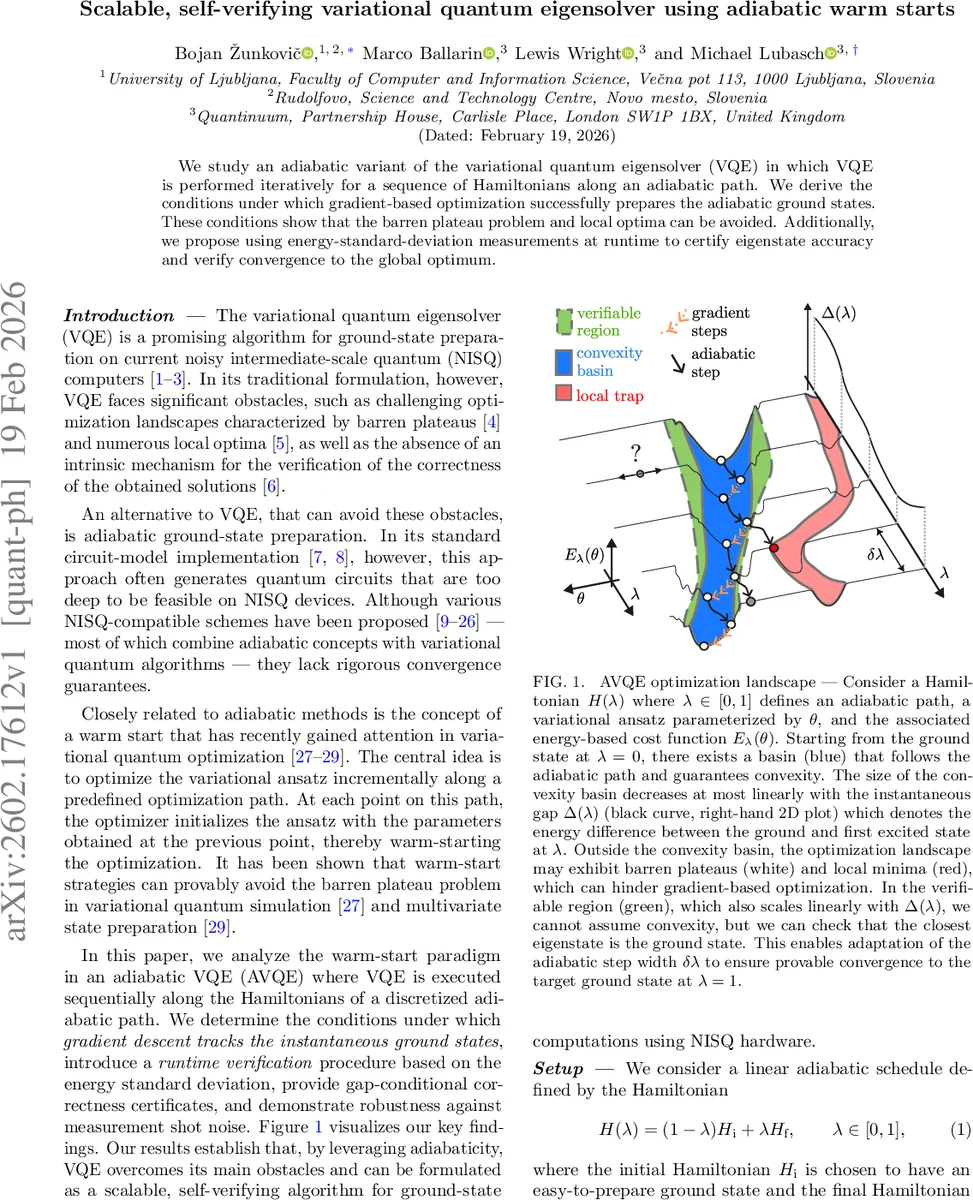
We study an adiabatic variant of the variational quantum eigensolver (VQE) in which VQE is performed iteratively for a sequence of Hamiltonians along an adiabatic path. We derive the conditions under which gradient-based optimization successfully prepares the adiabatic ground states. These conditions show that the barren plateau problem and local optima can be avoided. Additionally, we propose using energy-standard-deviation measurements at runtime to certify eigenstate accuracy and verify convergence to the global optimum.
💡 Research Summary
The paper introduces an “adiabatic variational quantum eigensolver” (AVQE), a hybrid quantum‑classical algorithm that combines the strengths of adiabatic state preparation with the flexibility of variational quantum circuits. The authors consider a linear interpolation H(λ) = (1‑λ)H_i + λH_f between an easy‑to‑prepare initial Hamiltonian H_i and a target Hamiltonian H_f whose ground state is desired. The interpolation parameter λ is discretized into T slices, and at each slice the variational parameters θ are optimized using K steps of gradient‑based descent, starting from the parameters obtained at the previous slice (a warm‑start).
Three core assumptions underlie the analysis: (1) a non‑zero minimum spectral gap Δ_min exists along the whole path, (2) the variational ansatz is expressive enough to represent the exact instantaneous ground state for every λ, and (3) the quantum geometric tensor at the exact ground‑state parameters is bounded below by a positive constant γ (non‑degenerate geometry). Under these conditions the authors prove two central theorems.
Theorem 1 (Adiabatic tracking) shows that if the adiabatic step size δλ is chosen sufficiently small—specifically δλ ≤ c₀·γ²·Δ_min²·M⁻²·‖H‖_op⁻¹·‖∂_λH‖_op⁻¹—and if the number of gradient steps per slice satisfies K ≥ c₁·M·‖H‖_op·γ·Δ_min⁻¹, then the gradient descent trajectory stays within a provably bounded distance from the exact ground‑state parameters θ⋆(λ_t) at every slice. The bound scales as O(γ⁻¹Δ_min⁻¹M^{3/2}‖H‖_op). Two independent proofs are provided: one based on the Polyak‑Łojasiewicz inequality (capturing the curvature induced by the gap) and another interpreting the discrete updates as an imaginary‑time variational evolution. The total number of updates required scales as O(‖H‖_op²·M³·‖∂_λH‖_op·γ⁻³·Δ_min⁻³). Although this Δ_min⁻³ scaling is worse than the O(Δ_min⁻²) of pure adiabatic evolution, it reflects the extra relaxation steps needed for the variational circuit to “cool” into the instantaneous ground state. Importantly, because the optimization stays in a well‑conditioned region, gradient magnitudes remain appreciable, thereby avoiding barren plateaus without any additional assumptions.
Theorem 2 (Runtime verification) addresses the lack of an a‑posteriori check in standard VQE. It states that if an experimentally accessible lower bound Δ_c ≤ Δ_min is known and the measured energy standard deviation σ_ψ(H(λ_t)) satisfies σ_ψ(H(λ_t)) < Δ_c/2 for every slice, then the current variational state is uniquely associated with a single eigenvalue branch. Moreover, the fidelity with the true ground state is guaranteed to be at least 8/9. The theorem thus provides a simple, measurement‑based certificate that the algorithm is indeed tracking the ground‑state branch. The authors also analyze shot‑noise effects, showing that O(Δ_min⁻⁴) measurement shots per slice are sufficient to keep statistical fluctuations below the gap threshold, preserving the certification with high probability.
Algorithm 1 combines these results into a concrete protocol. After preparing the exact ground state of H_i, the algorithm iteratively (i) performs K gradient steps at the current λ, (ii) measures the energy standard deviation, (iii) if the deviation exceeds Δ_c/2 repeats the gradient steps, (iv) computes a dynamic step size δλ_V based on the measured deviations, and (v) advances λ by the minimum of the theoretical safe step δλ_A and the dynamic step δλ_V. The process repeats until λ=1, at which point the variational circuit approximates the ground state of H_f with a rigorously certified fidelity.
The paper further discusses robustness to finite‑shot noise, noting that unbiased stochastic gradients remain within the tracking region with high probability, and that the verification step is unaffected by noise as long as the shot budget meets the Δ_min⁻⁴ scaling.
In the discussion, the authors emphasize that AVQE is among the few NISQ‑compatible algorithms with provable correctness guarantees. By warm‑starting along an adiabatic path, the method confines optimization to a convex‑like basin, eliminating barren plateaus. The energy‑standard‑deviation check suppresses convergence to spurious local minima and provides a self‑verifying mechanism absent in conventional VQE. The framework opens avenues for tracking excited‑state branches, solving linear systems, and developing noise‑mitigation techniques tailored to adiabatic‑variational hybrids.
Overall, the work delivers a theoretically solid, experimentally feasible protocol that transforms VQE from a heuristic optimizer into a scalable, self‑verifying algorithm suitable for near‑term quantum hardware and the early fault‑tolerant era.
Comments & Academic Discussion
Loading comments...
Leave a Comment